
He M., Petoukhov S. Mathematics of Bioinformatics: Theory, Methods and Applications
Подождите немного. Документ загружается.


APPENDIX A: BIOINFORMATICS NOTATION AND DATABASES 263
A.2 MATHEMATICAL NOTATION
N = {1, 2, 3, … }
set of natural numbers
N
0
= {0, 1, 2, 3, … }
set of nonnegative integers
Z = { … , − 3, − 2, − 1, 0,1, 2, 3, … }
set of integers
Q = { p / q | p , q ≠ 0 are integers}
set of rational numbers
R = { x | x repeating and nonrepeating
decimals}
set of real numbers
R
n
= { ( x
1
, x
2
, … , x
n
) | x
i
is a real number} n - dimensional vector space
uuu u
n
=++
1
2
2
22
norm of a vector u
u · υ = u
1
υ
1
+ u
2
υ
2
+
…
+ u
n
υ
n
standard inner product of u
and υ
u×=
−
−
−
⎛
⎝
⎜
⎜
⎜
⎞
⎠
⎟
⎟
⎟
u
uu
uu
uu
23 32
31 13
12 21
υυ
υυ
υυ
cross product of u and υ
A
n
×
n
square matrix of dimension n
I
n
unit matrix of dimension n
Tr( A )
trace of a matrix A
A
T
transpose of matrix A
A.3 PHYSICAL UNITS
Angstrom
1 Å = 1 0
− 10
m
Atomic mass
1 Da = 1.661 × 1 0
− 27
kg
Avogadro ’ s number
N
A
= 6.022 × 1 0
23
L/mol
Boltzmann constant
k
B
= 1.38 × 1 0
− 23
J/K
Electron charge
e = 1.602 × 1 0
− 19
C
Electron mass
m
e
= 9.109 × 1 0
− 31
kg
Energy (joule, J)
kg m
2
s
− 2
= N m
Force (newton, N)
kg m s
− 2
= J m
− 1
Planck constant
h = 6.626 × 1 0
− 34
J s
Reduced Planck constant
= h /(2 π ) J s
A.4 CHEMICAL NOTATION
H hydrogen atom
O oxygen atom
C carbon atom
N nitrogen atom
R side chain of amino acid
S sulfur atom
CA alpha - carbon amino acid
CB beta - carbon amino acid

264 APPENDIX A: BIOINFORMATICS NOTATION AND DATABASES
Φ
dihedral backbone angle
Ψ
dihedral backbone angle
Ω
dihedral backbone angle
χ
dihedral side - chain angle
A ademine
C cytosine
G guanine
T thymine
U uracil
5 ′ -
…
- 3 ′
single DNA strand
3 ′ -
…
- 5 ′
single DNA strand
A.5 PUBLIC MOLECULAR BIOLOGICAL DATABASES
The following table lists all major public bioinformatics databases. Detailed
information is given in a book by M. Kanehisa, Post - Genome Bioinformatics ,
Oxford University Press, New York, 2000.
Database
Primary
Function URL Organization
GenBank Nucleotide
sequences
http://www.ncbi.nlm.
nih.gov
National Center for
Biotechnology
Information (NCBI)
EMBL Nucleotide
sequences
http://www.ebi.ac.uk European Bioinformatics
Institute (EBI)
DDBJ Nucleotide
sequences
http://www.ddbj.nig.ac.jp National Institute of
Genetics, Japan (NIG)
SWISS - PROT Amino acid
sequences
http://www.expasy.ch Swiss Institute of
Bioinformatics (SIB)
PIR Amino acid
sequences
http://www.nbrf.
georgetown.edu
National Biomedical
Research Foundation
(NBRF)
PRF Amino acid
sequences
http://www.prf.or.jp Protein Research
Foundation, Japan
(PRF)
PDB Protein
structures
http://www.rcsb.org Research Collaboratory
for Structural
Bioinformatics
(RCSB)
CSD Protein
structures
http://www.ccdc.cam.
ac.uk
Cambridge
Crystallographic Data
Center (CCDC)
MEDLINE Bibliographic http://www.nlm.nih.gov National Library of
Medicine (NLM)

APPENDIX A: BIOINFORMATICS NOTATION AND DATABASES 265
A.6 20 AMINO ACIDS: ABBREVIATIONS, LINEAR, CHEMICAL,
AND THREE - DIMENSIONAL STRUCTURES
Amino Acid Abbreviations and Linear Structure
Name Abbreviation Linear Structure Formula
Alanine ala, a CH
3
– CH(NH
2
) – COOH
Arginine arg, r
HN = C(NH
2
) – NH – (CH
2
)
3
– CH(NH
2
) – COOH
Asparagine asn, n H
2
N – CO – CH
2
– CH(NH
2
) – COOH
Aspartic acid asp, d HOOC – CH
2
– CH(NH
2
) – COOH
Cysteine cys, c HS – CH
2
– CH(NH
2
) – COOH
Glutamine gln, q H
2
N – CO – (CH
2
)
2
– CH(NH
2
) – COOH
Glutamic acid glu, e HOOC – (CH
2
)
2
– CH(NH
2
) – COOH
Glycine gly, g NH
2
– CH
2
– COOH
Histidine his, h
NH – CH = N – CH = C – CH
2
– CH(NH
2
) – COOH
Isoleucine ile, i CH
3
– CH
2
– CH(CH
3
) – CH(NH
2
) – COOH
Leucine leu, l (CH
3
)
2
– CH – CH
2
– CH(NH
2
) – COOH
Lysine lys, k H
2
N – (CH
2
)
4
– CH(NH
2
) – COOH
Methionine met, m CH
3
– S – (CH
2
)
2
– CH(NH
2
) – COOH
Phenylalanine phe, f Ph – CH
2
– CH(NH
2
) – COOH
Proline pro, p NH – (CH
2
)
3
– CH – COOH
Serine ser, s HO – CH
2
– CH(NH
2
) – COOH
Threonine thr, t CH
3
– CH(OH) – CH(NH
2
) – COOH
Tryptophan trp, w
Ph – NH – CH = C – CH
2
– CH(NH
2
) – COOH
Tyrosine tyr, y
HO – p – Ph – CH
2
– CH(NH
2
) – COOH
Valine val, v (CH
3
)
2
– CH – CH(NH
2
) – COOH
Source: National Center for Biotechnology Information (NCBI), http://www.ncbi.nlm.nih.gov/
Class/Structure/aa/aa_explore.cgi .
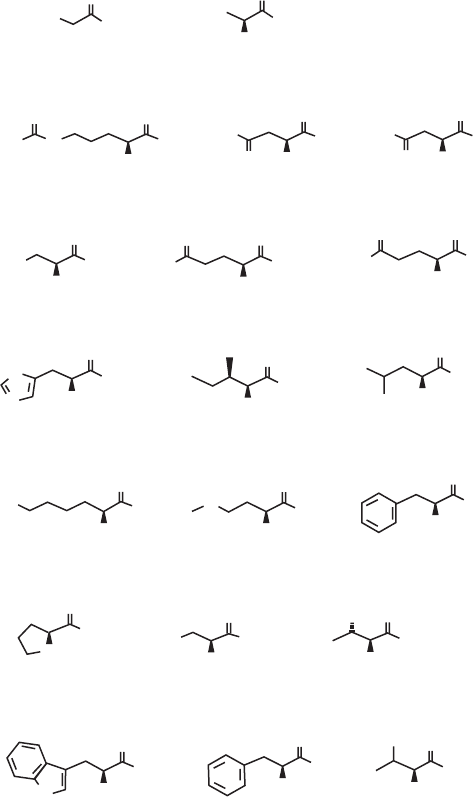
266 APPENDIX A: BIOINFORMATICS NOTATION AND DATABASES
Chemical Structure of the 20 Natural Amino Acids
HO
HO
O
O
O
O
O
O
OO
O
O
O
O
O
O
O
O
O
O
O
S
O
O
OO
O
OH
OH
OH
OH
OH
OH
OH
OH
OH
OH
OH
OH
OH
OH
OH
OH
HS
OH
OH
OH
OH
gly g Glycin
arg r Arginin
cys c Cystein
his h Histidin
lys k Lysin
pro p Prolin
trp w Tryptophan tyr y Tyrosin val v Valin
ser s Serin
thrt Threonin
met m Methionin phe f Phenylalanin
ile l Isoleucin leu l Leucin
gln q Glutarnin glu e Glutaminsaeure
asn n Asparagin asp d Asparaginsaeure
ala a Alanin
NH
2
NH
2
NH
2
NH
2
NH
2
NH
2
NH
NH
2
NH
2
NH
2
NH
2
NH
2
NH
2
OH
NH
2
H
2
N
HO
HO
NH
2
NH
2
N
NH
2
NH
NH
2
N
H
N
H
H
N
NH
2
H
2
N
H
2
N
H
2
N
H
2
N
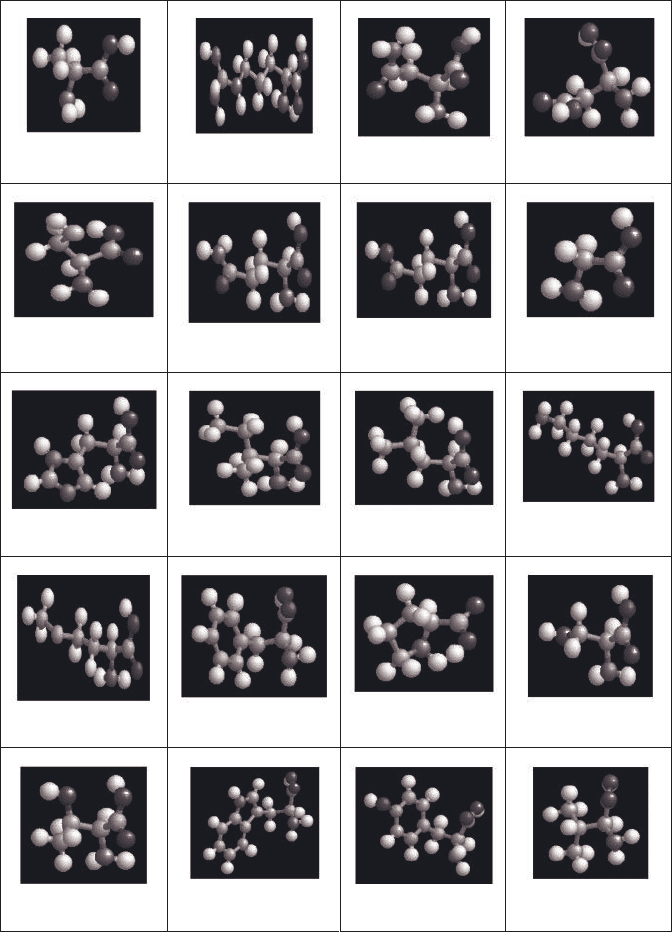
APPENDIX A: BIOINFORMATICS NOTATION AND DATABASES 267
Three - Dimensional Shapes of the 20 Amino Acids (Molmasse and
pH Value)
ala (a)
Molmasse: 89.09
pH: 6
arg (r)
Molmasse: 174.20
pH: 11.15
asn (n)
Molmasse: 132.12
pH: 5.41
asp (d)
Molmasse: 133.10
pH: 2.77
cys (c)
Molmasse: 121.15
pH: 5.02
gln (q)
Molmasse: 146.15
pH: 5.65
glu (e)
Molmasse: 147.13
pH: 3.22
gly (g)
Molmasse: 75.07
pH: 5.97
his (h)
Molmasse: 155.16
pH: 7.47
ile (i)
Molmasse: 131.17
pH: 5.94
leu (l)
Molmasse: 131.17
pH: 5.98
lys (k)
Molmasse: 146.19
pH: 9.59
met (m)
Molmasse: 149.21
pH: 5.74
pHe (f)
Molmasse: 165.19
pH: 5.48
pro (p)
Molmasse: 115.13
pH: 6.30
ser (s)
Molmasse: 105.09
pH: 5.68
thr (t)
Molmasse: 119.12
pH: 5.64
trp (w)
Molmasse: 204.23
pH: 5.89
tyr (y)
Molmasse: 181.19
pH: 5.66
val (v)
Molmasse: 117.15
pH: 5.96

APPENDIX B
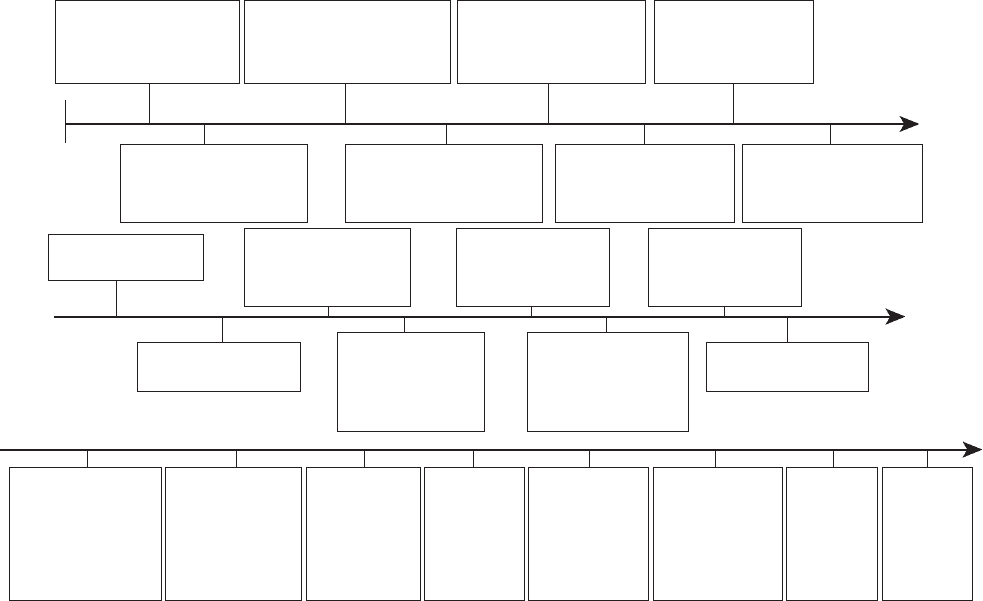
Bioinformatics and Genetics
Time Line
Mathematics of Bioinformatics: Theory, Practice, and Applications, By Matthew He and
Sergey Petoukhov
Copyright © 2011 John Wiley & Sons, Inc.
268
1869 - The chemical
material DNA is
discovered in cells.
1909 - The term “gene” is
first used and the chemical
composition of DNA is
found.
1969 - The first single
gene is isolated.
1970 - The first
artificial gene is made.
1984 - Realization
that some,
nonfunctioning
DNA is different in
each individual—
genetic fingerprinting
is born.
1988 - The Human
Genome
Organization
aims to map the
complete sequence
of DNA.
1990 - The first
human gene
experiment
takes place to
try to treat a
4-year-old
girl.
1993 - Mice
are cured of
cystic fibrosis
as a result of
gene therapy.
1996 - After six
years of work,
the brewer’s
yeast genome
is decoded, the
most complex
organism so far.
1998 - The first
multicelled
animal has its
genome
decoded—
the worm
C. elegans
2000 - The
first draft of
the human
genome is
announced.
2001 - The
first draft of
the human
genome is
published.
1976 - An artificial
gene is inserted into
a bacterium and, for
the first time, works
normally.
1978 - Bacteria are
engineered to produce
insulin.
1983 - The first
artificial chromosome.
1973 - Genetic
engineering begins with
the ability to insert
genetic material.
1977 - DNA from a
virus is fully decoded
for the first time.
1981 - A gene is
transferred from one
animal species to
another.
1944 - DNA is first
connected to the inheritance
of traits.
1953 - Crick and Watson
describe the structure of
DNA
1966 - DNA is found to be
present not only in
chromosomes but also in
the mitochondria.
1920 - Chromosomes are
proposed as the mechanism
by which inherited
characteristics are passed on.
1951 - The first sharp x-ray
diiffraction photographs of
DNA are obtained.
1956 - DNA is made
artificially.
269

APPENDIX C
Bioinformatics Glossary
In this appendix we provide a list of commonly used bioinformatics terminol-
ogy for quick reference. Most of these terms have appeared in the book.
Accession number (in GenBank)
1,2
: a unique identifi er assigned to the entire
sequence record when the record is submitted to GenBank. The GenBank
accession number is a combination of letters and numbers that are usually
in the format of one letter followed by fi ve digits (e.g., M12345) or two
letters followed by six digits (e.g., AC123456). The accession number for a
particular record will not change even if the author submits a request to
change some of the information in the record. Take note that an accession
number is a unique identifi er for a complete sequence record, while a
sequence identifi er, such as a Version, GI, or ProteinID, is an identifi cation
number assigned only to the sequence data. The NCBI Entrez System is
searchable by accession number using the Accession [ACCN] search fi eld.
Accession number
1,2
: a unique identifi cation number for a complete RefSeq
sequence record. RefSeq accession numbers are written in the following
format: two letters followed by an underscore and six digits (e.g., NT_123456).
The fi rst two letters of the RefSeq accession number indicate the type of
sequence included in the record:
•
NT_123456: constructed genomic contigs
•
NM_123456: mRNAs (actually, the cDNA sequences constructed from
mRNA) NP_123456: proteins
•
NC_123456: chromosomes
Active site: a region made of certain amino acid residues found within the
three - dimensional surface of a protein where catalysis occurs. These resi-
dues provide the binding and activation energy needed to place the sub-
strate into its transition state and bridge the energy barrier of the reaction
undergoing catalysis.
Mathematics of Bioinformatics: Theory, Practice, and Applications, By Matthew He and
Sergey Petoukhov
Copyright © 2011 John Wiley & Sons, Inc.
270
APPENDIX C: BIOINFORMATICS GLOSSARY 271
Adenine: one of the nitrogenous bases that has a double - ring structure, clas-
sifi ed as a purine, found in DNA and RNA.
A DNA: a more dehydrated form of DNA than the typical, B form. It is more
compact, with 11 nitrogen bases per turn of the helix. RNA – DNA and
RNA – RNA helices typically exist in this form.
Agents: software modules that can search the Internet for data. These modules
are independent and autonomous.
Algorithm
1,2
: a series of steps defi ning a procedure or formula for solving a
problem that can be coded into a programming language and executed.
Bioinformatics algorithms typically are used to process, store, analyze, visu-
alize, and make predictions from biological data.
Alignment: the result of a comparison of two or more gene or protein
sequences in order to determine their degree of nitrogen base or amino
acid similarity or dissimilarity. Sequence alignments are used to determine
the similarity, homology, function, or other degree of relatedness between
two or more genes or gene products.
Allele: a given form of a gene that occupies a specifi c position or locus on a
chromosome.
Alpha carbon: the central carbon atom in an amino acid to which side chains
(R groups) are bound.
Alpha helix
1,2
: one of two types of protein secondary structure. An α - helix is
a tight helix that results from the hydrogen bonding of the carboxyl (CO)
group of one amino acid to the amino (NH) group of another amino acid,
four residues away (toward the carboxyl terminus).
Alternative splicing: the production of two or more mRNA molecules from
a single hnRNA by using different splice junctions.
Amino acid: one of the 20 chemical building blocks that are joined by amide
(peptide) linkages to form a polypeptide chain of a protein.
Amphipathic: a molecule that has hydrophilic and hydrophobic characteris-
tics simultaneously. This term is often used to describe large proteins with
several domains of composed of different types of amino acid residues.
Annotation: a collection of comments, notations, references, and citations,
either in free format or utilizing a controlled vocabulary, that together
describe all the experimental and inferred information about a gene or
protein. Annotations can also be applied to the description of other biologi-
cal systems. Batch, automated annotation of bulk biological sequence is one
of the key uses of bioinformatics tools.
Anticodon: the triplet of contiguous bases on tRNA that binds to the codon
sequence of nucleotides on mRNA (e.g., the codon for glycine is GGG, on
mRNA; the anticodon for glycine is CCC, on tRNA).
Antigen: any foreign molecule that stimulates an immune response in a ver-
tebrate organism. Many antigens are proteins, such as the surface proteins
of foreign organisms. Antigens bind to antibodies.
272 APPENDIX C: BIOINFORMATICS GLOSSARY
Antisense: DNA or RNA composed of the sequence complementary to the
target DNA or RNA.
Array: a group of variables that can store multiple values. Each value is
retrieved using an integer index.
Assembly: a compilation of overlapping sequences from one or more related
genes that have been clustered together based on their degree of sequence
identity or similarity. Sequence assembly may be used to piece together
“ shotgun ” sequencing fragments based upon overlapping restriction enzyme
digests, or may be used to identify and index novel genes from single - pass
cDNA sequencing efforts.
Backbone (of an amino acid): consists of an amide, an alpha carbon, and a
carboxylic acid or carboxylate group.
Base pair: a pair of nitrogenous bases (a purine and a pyrimidine), held
together by hydrogen bonds, that form the core of DNA and RNA (i.e., the
A – T, G – C, and A – U interactions).
B DNA: the typical form of DNA, which has 10 nitrogen bases per turn of
the helix. Stacked bases are regularly spaced 0.34 nm apart and the helix
makes a complete turn every 3.4 nm.
Beta sheet: a three - dimensional arrangement taken up by polypeptide chains
that consists of alternating strands linked by hydrogen bonds between a
carboxyl group ’ s oxygen on one strand and the amide group ’ s hydrogen
from another strand. The alternating strands together form a sheet that is
frequently twisted. Beta sheets may be parallel (both strands oriented the
same direction, amino to carboxyl terimus) or antiparallel (both strands
running in opposite directions; for example, if one is oriented amino to
carboxyl, the other would be running carboxyl to amino).
Bifurcation: a point in a phylogenetic tree in which an ancestral taxon splits
into two independent lineages.
BLAST
1,2
(Basic Local Alignment Search Tool): a fast technique for detecting
ungapped subsequences that match a given query sequence.
Bootstrap test: a test that allows for a rough quantifi cation of confi dence
levels.
Carboxyl group: the – COOH functional group, acidic in nature, found in all
amino acids.
cDNA (complementary DNA): a DNA strand copied from mRNA using
reverse transcriptase.
cDNA library: a set of DNA fragments prepared from the total mRNA
obtained from a selected cell, tissue, or organism. It represents all the DNA
expressed in a cell.
CDS
1,2
: the coding sequence or the portion of a nucleotide sequence that
makes up the triplet codons that actually code for amino acids.
Chromosome: the structure in the cell nucleus that contains all of the cellular
DNA together with a number of proteins that compact and package the
DNA.