
He M., Petoukhov S. Mathematics of Bioinformatics: Theory, Methods and Applications
Подождите немного. Документ загружается.

REFERENCES 23
Waterman , M. S. (Ed.) ( 1999 ). Mathematical Methods for DNA Sequences . Boca Raton,
FL : CRC Press .
Wilson , E. ( 1998 ). Consilience: The Unity of Knowledge . New York : Random House .
Yarlagadda , R. , and Hershey , J. ( 1997 ). Hadamard Matrix Analysis and Synthesis with
Applications to Communications and Signal/Image Processing . New York : Kluwer
Academic .
Zalmanzon , L. A. ( 1989 ). Fourier, Walsh and Haar Transformations and Their Application
in Control, Communication and Other Systems . Moscow : Nauka (in Russian).

2 Genetic Codes, Matrices, and
Symmetrical Techniques
The genetic code is a key to bioinformatics and to a science of biological self -
organizing on the whole. Modern science faces the necessity of understanding
and systematically explaining mysterious features of ensembles of molecular
structures of the genetic code. Why does the genetic alphabet consist of four
letters? Why does the genetic code encode 20 amino acids? How is the system
structure of the molecular genetic code connected with known principles of
quantum mechanics, which were developed to explain phenomena on the
atomic and molecular levels? Why has nature chosen the special code confor-
mity between 64 genetic triplets and 20 amino acids? Can knowledge about
the structural essence of the genetic code be useful for mathematical natural
sciences as a whole? What type of mathematical approach should be chosen
among many possible approaches to represent and model structuralized
ensembles of molecules of the genetic code?
What direction is chosen to investigate such questions and what types of
answers it hopes to obtain are important for a science. Achieving deep under-
standing of the genetic code should promote the inclusion of an associated
science into the fi eld of the existing, developed mathematical natural sciences.
To provide it, the direction of search should be based on fundamental math-
ematical methods and concepts. Methods and principles of symmetry, and
matrix analysis, are some of the bases of modern mathematical natural sci-
ences. Apart from structures inherited genetically, morphological structures of
biological bodies are characterized by many types of symmetry. It is known
from the history of molecular genetics that investigations of symmetry in
genetic molecules have produced essential results. Revelations of new sym-
metric structures in molecular - genetic systems produce a set of useful heuristic
associations due to analogies with known symmetric structures in other scien-
tifi c fi elds, such as quantum mechanics, the theory of digital communication
and noise - immunity coding, and geometry.
Genetic coding possesses noise immunity, which allows descendants to be
similar to their parents despite strong disturbances and noise in the environ-
ment of biological molecules. It reminds one of the effective noise immunity
Mathematics of Bioinformatics: Theory, Practice, and Applications, By Matthew He and
Sergey Petoukhov
Copyright © 2011 John Wiley & Sons, Inc.
24
INTRODUCTION 25
of modern systems of digital communication and signal processing, which is
achieved by means of special mathematics. The mathematics is based on matrix
and symmetric methods of representation and analysis of information signals.
Is it possible that these mathematical methods, which were developed for
digital techniques, could be applied adequately to studies of the genetic code?
This chapter is devoted to symmetrical analysis for genetic systems.
Mathematical theories of noise - immunity coding and discrete signal process-
ing are based on matrix methods of representation and analysis of information.
These matrix methods, which are connected closely with relations of symmetry,
are borrowed for a matrix analysis of ensembles of molecular elements of the
genetic code. In this chapter we describe a uniform representation of ensem-
bles of genetic multiplets in the form of matrixes of a cumulative Kronecker
family. The analysis of molecular peculiarities of the system of nitrogenous
bases reveals the fi rst signifi cant relations of symmetry in these genetic matri-
ces. It permits one to introduce a natural numbering of the multiplets in each
of the genetic matrices and to provide a basis for further analysis of genetic
structures. Connections of the numerated genetic matrices with famous matri-
ces of dyadic shifts and with the golden section are demonstrated.
2.1 INTRODUCTION
Due to the wonderful work of many researchers, modern science knows basic
phenomenological facts about molecular structures of the genetic code, includ-
ing the four - letter genetic alphabet, 64 triplets, and 20 amino acids. The history
of molecular genetics chronicles attempts to understand and explain these
phenomenological data from various viewpoints. For example, one can mention
the famous hypothesis by George Gamow (Ycas, 1969 ) about the reason for
the existence of 20 amino acids. By this hypothesis, the reason lies in the special
confi guration of the DNA molecule. Other hypotheses, which have only his-
torical meanings, are also considered in a wealth of literature in the fi eld of
molecular genetics (e.g., Cantor and Schimmel, 1980 ; Chapevillle and Haenni,
1974 ; Karasev, 2003 ; Ratner, 2002 ; Roller, 1974 ; Shults and Schirmer, 1979 ;
Stent, 1971 ; Watson, 1968 ; Ycas, 1969 ).
All living organisms are unifi ed by nature. All of them have identical molec-
ular bases of the system of genetic coding. These bases are amazingly simple.
For realization of the genetic messages which encode sequences of amino acids
in proteins, all types of organisms utilize in their molecules of heredity, DNA
and RNA (ribonucleic acid), an “ alphabet ” consisting of four “ letters ” or
nitrogenous bases: adenine (A), cytosine (C), guanine (G), and thymine (T)
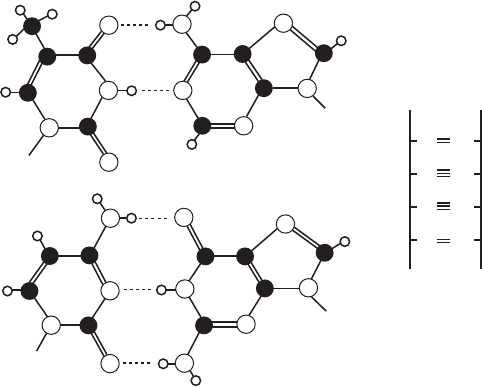
[or uracil (U) in RNA] (Figure 2.1 ). Linear sequences of these four letters on
strings of DNA and RNA contain the genetic information for protein synthesis
in all living bodies: from bacteria up to a whale or from a worm up to a bird
and even humans. One often hears the fi gurative expression that the encyclo-
pedia of life is written in four letters.
26 GENETIC CODES, MATRICES, AND SYMMETRICAL TECHNIQUES
This set of four letters is usually considered the elementary alphabet of a
genetic code. The letters form complementary pairs, C – G and A – U (or A – T),
because they stand opposite each other in molecules of heredity. The comple-
mentary letters C and G are connected by three hydrogen bonds; the comple-
mentary letters A and U (or A and T) are connected by two hydrogen bonds.
Genetic information, which is transferred by DNA and RNA, defi nes the
primary structure of proteins of biological organisms. Each coded protein
exists in the form of a chain of 20 amino acids. A sequence of amino acids in
a protein chain is defi ned by an appropriate sequence of genetic triplets. A
triplet (or a codon ) is a block of three neighboring nitrogenous bases which
are disposed along a fi lament of DNA or RNA. A sequence of amino acids in
any protein is coded by an appropriate sequence of triplets (such a sequence
of n triplets is termed a 3 n - multiplet ).
The number of types of triplets that can be constructed from the four - letter
alphabet is equal to 4
3
= 64. Each triplet has its code meaning: It encodes one
of 20 amino acids or plays the role of a stop or start signal for a process of
protein synthesis. Each codon has an anticodon , which consists of the appropri-
ate complementary letters; for example, the triplet CUG has the anticodon
GAC.
The genetic code is termed the degeneracy code because its 64 letters
encode 20 amino acids, and different amino acids are encoded by different
FIGURE 2.1 Complementary pairs of the four nitrogenous bases in DNA: A – T
(adenine and thymine) and C – G (cytosine and guanine). Hydrogen bonds in these pairs
are shown by dotted lines. Filled circles are atoms of carbon; small open circles are
atoms of hydrogen; circles with the letter N are atoms of nitrogen; circles with the letter
O are atoms of oxygen.
N
N
N
AT
CG
N
N
N
N
O
N
N
N
N
N
N
TA
CG
GC
AT
N
N
O
O
O
INTRODUCTION 27
quantities of triplets. Hypotheses about a connection between this degeneracy
and the noise immunity of genetic information have existed since the time of
the discovery of the genetic code. Symmetries in the structures of degeneracy
of the genetic code are one of the main objects of investigation in this chapter.
Many dialects of the genetic code exist in biological organisms and their sub-
systems, which differ from each other by some differences in correspondences
between triplets and objects encoded by them (see details at the NCBI ’ s Web
site: http://www.ncbi.nlm.nih.gov/Taxonomy/Utils/wprintgc.cgi ).
Proteins are the main dense component of biological organisms. Many
thousands of types of proteins exist, each possessing its own individual func-
tion. In particular, all biological ferments, which provide phenomenal speeds
of many biochemical reactions in organisms, are proteins. The entire harmonic
system of metabolism depends on proteins. All amino acids in proteins are
connected by the same type of chemical bond, the peptide bond .
The correspondence between triplets and objects encoded by them is
usually illustrated by a table of size 4 × 16, which was proposed by Francis
Crick half a century ago and which is reproduced in many textbooks and
historical reviews in the fi eld of molecular genetics (e.g., Cantor and Schimmel,
1980 ; Frank - Kamenetskiy, 1988 ; Roller, 1974 ; Stent, 1971 ; Watson, 1968 ). Each
of its 64 tabular cells contains one triplet and an appropriate object (an amino
acid or stop codon) encoded by this triplet. However, nobody has insisted that
all the possibilities of the analytical and heuristic representation of systems of
elements of the genetic code in tabular forms are exhausted by this table. The
20 amino acids which are encoded genetically and their traditional abbre-
viations are: Ala, alanine; Arg, arginine; Asn, asparagine; Asp, aspartic acid;
Cys, cysteine; Gln, glutamine; Glu, glutamic acid; Gly, glycine; His, histidine;
Ile, isoleucine; Leu, leucine; Lys, lysine; Met, methionine; Phe, phenylalanine;
Pro, proline; Ser, serine; Thr, threonine; Trp, tryptophan; Tyr, tyrosine; and Val,
valine.
Modern science does not know why the alphabet of the genetic language
has four letters (it could have any other number of letters, in principle), nor
why just these four nitrogenous bases were chosen by nature as the elements
of the genetic alphabet from billions of possible chemical compounds. Equally
unknown is why the quantity of amino acids encoded by the triplets is equal
to 20. In our opinion, this choice has a deep meaning. Investigations of sym-
metries in structures of the genetic code can help us answer these and other
important and to understand this meaning.
The problem of heritable noise immunity is a general one for all multi-
channel systems of informatics of each organism. Many applied tasks of
nanotechnology and biotechnology are connected with ensembles of genetic
molecules: for example, the task of creating DNA computers and DNA
robotics (Paun et al., 2006 ; Seeman, 2004 ; Shapiro and Benenson, 2007 ). It is
necessary to study those peculiarities of ensembles of genetic molecules that
possess formal analogies with formalisms of digital informatics and its matrix
mathematics.
28 GENETIC CODES, MATRICES, AND SYMMETRICAL TECHNIQUES
Do these mathematical methods give us the ability to enumerate each
genetic multiplet in a binary manner, taking into account the natural charac-
teristics of the genetic letters A, C, G, U/T? The main thrust of the present
chapter is primary consideration and substantiation of this effective transfer
of these methods into the fi eld of molecular genetics. Some initial construc-
tions of matrix genetics with elements of symmetry are introduced below.
2.2 MATRIX THEORY AND SYMMETRY PRELIMINARIES
A matrix (plural: matrices ) is a rectangular table of elements (or entries ), which
may be numbers or, more generally, any abstract quantities that can be added
and multiplied. Matrices are used to describe linear equations, to keep track
of the coeffi cients of linear transformations, and to record data that depend
on multiple parameters. Matrices are described by the fi eld of matrix theory.
They can be added, multiplied, and decomposed in various ways, which also
makes them a key concept in the fi eld of linear algebra. Initially, a subbranch
of linear algebra, matrix algebra has grown to cover subjects related to graph
theory, algebra, combinatorics, and statistics.
The entry that lies in the i th row and the j th column of a matrix is typically
referred to as the i , j , ( i , j ), or ( i , j )th entry of the matrix. Matrices are usually
denoted using uppercase letters, while the corresponding lowercase letters,
with two subscript indices, represent the entries. For example, the ( i , j )th entry
of a matrix A is most commonly written a
i
,
j
. Alternative notations for that entry
are A [ i , j ] or A
i,j
.
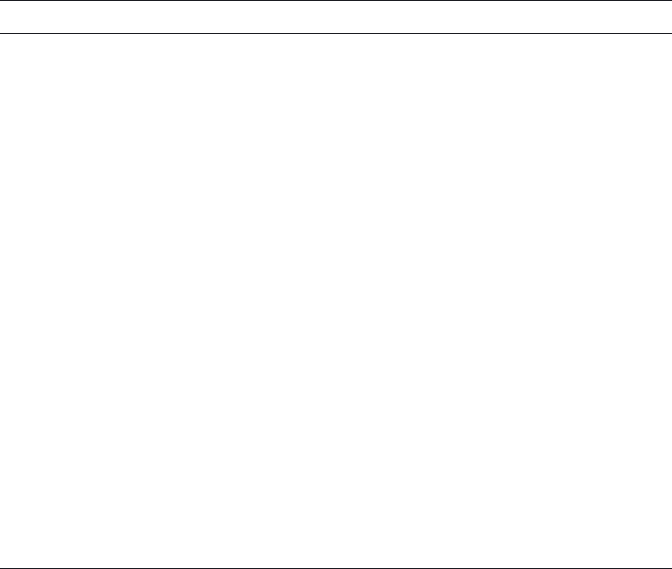
A number of operations can be used to modify matrices: matrix addition ,
scalar multiplication , and transposition (Table 2.1 ). These are the basic tech-
niques employed to deal with matrices.
Familiar properties of numbers extend to these operations of matrices: for
example, addition is commutative ; that is, the matrix sum does not depend on
the order of the summands: A + B = B + A . The transpose, which does not
exist for numbers, is also very compatible with addition and scalar multiplica-
tion, as expressed by ( c A )
T
= c ( A
T
), as well as ( A + B )
T
= A
T
+ B
T
. Finally,
( A
T
)
T
= A .
Symmetry plays an important role in nature. Many structural features of
molecules are governed by consideration of symmetry. In formal terms, we say
that an object is symmetric with respect to a given mathematical operation if,
when applied to the object, this operation does not change the object or its
appearance. Two objects are symmetric to each other with respect to a given
group of operations if one is obtained from the other by some of the opera-
tions (and vice versa).
Symmetries may also be found in living organisms, including humans and
other animals (see Section 2.5 ). In two - dimensional geometry the main types
of symmetry of interest are with respect to the basic Euclidean plane isome-
tries: translations, rotations, refl ections, and glide refl ections.
GENETIC CODES AND MATRICES 29
TABLE 2.1 Matrix Operations
Operation Defi nition
Addition
Given m × n matrices A and B , their sum A + B is
calculated entrywise; i.e.,
AB A B+
()
=+ ≤≤ ≤≤
ij
ij ij
im jn
,
,,
, where and11
Scalar multiplication
Given a matrix A and a number (also called a scalar in the
parlance of abstract algebra) c , the scalar multiplication
c A is given by multiplying every entry of A by c :
cc
ij
ij
AA
()
=⋅
,
,
Transpose
The transpose of an m × n matrix A is the n × m matrix A
T
(also denoted by A
tr
or
t
A ) formed by turning rows into
columns and columns into rows:
AA
T
(
)
=
ij
ji
,
,
Kronecker (or
tensor)
multiplication
Given m × m matrix A = ( a
ij
) and n × n matrix B = ( b
ij
),
their Kronecker multiplication is mn × mn matrix A 䊟 B :
AB
BB B
BB B
⊗=……………………………
⎡
⎣
⎢
⎢
⎢
⎤
⎦
⎥
⎥
⎥
aa a
aa a
m
mm mm
11 12 1
12
2.3 GENETIC CODES AND MATRICES
The mechanisms of genetic coding provide the high noise immunity of transfer
of hereditary information from one generation to the next, despite distur-
bances and noise that exist in biological environments. From the very begin-
ning of the discovery of the genetic code, scientists thought that the structures
of the code were connected with the noise immunity (noise - proof features) of
genetic systems (see the review by Ycas, 1969 ). However, when discussing the
noise immunity of genetic coding, one is usually limited to citing the high
degree of degeneracy in the code, which is capable of reducing the quantity
of lethal mutations.
But studies have already been done which suppose that the requirement
for the infl uence of noise immunity on structures of the genetic code is much
deeper. This area of research uses the developments of the mathematical
theory of noise - immunity coding, which are applied in the techniques of digital
communication, in an attempt to understand bioinformatics phenomena.
In this area the suppositional infl uence of noise immunity can be studied by
30 GENETIC CODES, MATRICES, AND SYMMETRICAL TECHNIQUES
different methods and in different directions of thought (see, e.g., MacDonaill,
2003 ). Our own research, presented in this chapter, which is based on the idea
of a deep connection between structures of the genetic code and the require-
ment for noise immunity of genetic information, is quite original in the research
methods used and in the new facts obtained.
Let us discuss the noise - immunity property of genetic systems more deeply.
It seems fantastic, but descendants grow similar to their ancestors due to
genetic information, despite enormous disturbances and noise in trillions of
biological molecules. How is it possible to approach this problem of such fan-
tastic noise immunity in molecular genetics? Does modern science have any
precedents from similar problems of noise immunity?
Yes; science has successfully solved a similar task recently: the noise -
immunity transfer of photos from surfaces of other planets to the Earth. In
this task, electromagnetic signals, which carry data, should pass through mil-
lions of kilometers of cosmic space full of electromagnetic disturbances. These
disturbances transform signals tremendously, but modern mathematical tech-
nology permits one to restore a transferred photo qualitatively.
The solution to this problem became possible due to the theory of noise -
immunity coding created by mathematicians. This theory has appeared rather
recently; initial basic work in this fi eld was published by Hamming in 1950
(Hamming, 1980 ). The theory of such coding utilizes intensive matrix mathe-
matics, including the representation of sets of signals and codes in the form of
matrices and their Kronecker powers. Our book describes many interesting
results in the fi eld of molecular genetics and bioinformatics which were
obtained by its authors on the basis of such matrix mathematics. The investiga-
tion of the genetic code from the viewpoint of the theory of discrete signals
is natural because of the discrete character of the code.
Coding in modern digital techniques is generally utilized not to prevent
reading of text by unauthorized users but to provide technical ease of transfer
of discrete information with high noise immunity, speed, and reliability. The
most famous example of codes is the Morse code, but of course modern codes
are much more effective than the Morse code. These codes allow us to transfer
capacious amounts of information across great distances qualitatively.
Orthogonal codes, which use Hadamard matrices, is one such code (Ahmed
and Rao, 1975 ; Blahut, 1985 ; Geadah and Corinthios, 1977 ; Lee and Kaveh,
1986 ; Peterson and Weldon, 1972 ; Petoukhov, 2008a,b ; Sklar, 2001 ; Trahtman,
1972 ; Trahtman and Trahtman, 1975 ; Yarlagadda and Hershey, 1997 ). Any
signal transmitted consists of a set of elementary signals (a component of a
signal vector of an appropriate dimension). The task of the receiver in condi-
tions of noise is the approximate defi nition of a concrete vector signal which
has been sent from a known set of vector signals (Sklar, 2001 ). Application of
Hadamard matrices allows us to solve similar problems by means of the spec-
tral decomposition of vector signals and the transfer of their spectra, on the
basis of which the receiver restores an initial signal. This decomposition utilizes
orthogonal functions of rows of Hadamard matrices (Ahmed and Rao, 1975 ).
GENETIC CODES AND MATRICES 31
One should emphasize important differences in circumstances: Unlike
digital techniques, biological organisms solve the task not only to provide noise
immunity simply, but to provide it in a way that is suitable for transfer of the
noise - immunity property along a chain of biological generations.
In this chapter we pay signifi cant attention to the matrix approach to the
genetic code, which forms the special investigatory fi eld of matrix genetics.
Investigations in this fi eld reveal an important role for symmetries in the
structural organization of molecular ensembles of the genetic code. But why
have we chosen the matrix approach to studying the genetic system among
the many other possible approaches? The following six reasons explain this
matrix choice for studying the genetic code and developing matrix genetics:
1. Information is usually stored in computers in the form of matrices.
2. Noise - immunity codes are constructed on the basis of matrices.
3. Quantum mechanics utilizes matrix operators whose connections can be
detected in matrix forms of presentation of the genetic code. The signifi -
cance of the matrix approach is emphasized by the fact that quantum
mechanics arose in a form of matrix mechanics by Werner Heisenberg.
4. Complex and hypercomplex numbers, which are utilized in physics and
mathematics, possess matrix forms of presentation. The notion of number
is the main notion of mathematics and the mathematical natural sciences.
In view of this, investigation of a possible connection of the genetic code
to multidimensional numbers in their matrix presentations can lead to
very signifi cant results.
5. Matrix analysis is one of the main investigatory tools in mathematical
natural sciences. The study of possible analogies between matrices, which
are specifi c for the genetic code, and famous matrices from other branches
of sciences can be heuristic and useful.
6. Matrices, which are a union of many components in a single whole, are
subordinated to certain mathematical operations which determine sub-
stantial connections between collectives of many components. Such con-
nections can be essential for collectives of genetic elements of different
levels as well.
A pioneer work in the fi eld of matrix genetics is the article by Konopelchenko
and Rumer (1975) . Let us recall the basic facts about the elements of the
genetic code, the integral ensemble of which is fi rst investigated in matrix
genetics.
Genetic Alphabet and Multiplets in Genetic Matrices
Is it possible to propose a matrix approach to represent all sets of genetic
multiplets in a well - ordered general form and with an individual binary number
for each multiplet on the basis of the molecular features of the four letters A,
32 GENETIC CODES, MATRICES, AND SYMMETRICAL TECHNIQUES
C, G, and U/T of the genetic alphabet? Will such a general form be connected
with important principles and methods of computer informatics and of noise
immunity in digital techniques?
Positive answers to these questions will be useful in analyzing structural
properties and symmetries of the genetic system and to reveal analogies
between principles of the genetic code and computer informatics for many
theoretical and applied tasks.
To get such positive answers, we demonstrate, fi rst, that symmetries in the
molecular characteristics of the genetic alphabet provide the existence of
binary subalphabets. The four letters (or the four nitrogenous bases) of the
genetic alphabet represent specifi c polynuclear constructions with special bio-
chemical properties. The set of these four constructions is not absolutely
heterogeneous, but it bears a substantial symmetric system of distinctive -
uniting attributes (or, more precisely, attribute – antiattribute pairs).
The system of such attributes divides the genetic four - letter alphabet into
various pairs of three letters, which are equivalent from the viewpoint of one
of these attributes or its absence: (1) C = U and A = G (according to the
binary - opposite attributes “ pyrimidine ” or “ nonpyrimidine, ” that is, purine);
(2) A = C and G = U (according to the attributes amino - mutating or non -
amino - mutating, under the action of nitrous acid, HNO
2
(Wittmann, 1961 ;
Ycas, 1969 ), or as given by the attributes “ keto ” or “ amino ” (Waterman, 1999 );
(3) C = G and A = U (according to the attributes, three or two hydrogen bonds
are materialized in these complementary pairs). The possibility of such divi-
sion of the genetic alphabet into three binary subalphabets is known from the
book by Waterman (1999) . We will utilize these known subalphabets by means
of a new method in the fi eld of matrix genetics. We will attach appropriate
binary symbols “ 0 ” or “ 1 ” to each of the genetic letters from the viewpoint of
each of these subalphabets. Then we will use these binary symbols for binary
numbering of the columns and rows of the genetic matrices of the Kronecker
family.
Let us assign the numbers N = 1, 2, and 3 to the three types of binary -
opposite attributes, and let us ascribe to each of the four genetic letters the
symbol 0
N
(the symbol 1
N
) in the presence (or absence, correspondingly) of
the attribute under the number N at this letter. As a result, we obtain a rep-
resentation of the genetic four - letter alphabet in the system of its three binary
subalphabets to attributes (Table 2.2 ). The table shows that on the basis of
each type of attribute, each of the letters A, C, G, and U/T possesses three
“ faces ” or meanings in the three binary subalphabets. On the basis of each
type of attribute, the genetic four - letter alphabet is curtailed into a two - letter
alphabet. For example, on the basis of the fi rst type of binary - opposite attri-
bute, we have (instead of the four - letter alphabet) an alphabet from the two
letters 0
1
and 1
1
, which one can term the binary subalphabet to the fi rst type of
binary attributes .
Accordingly, any genetic message as a sequence of the four letters C, A, G,
and U consists of three parallel and various binary texts or three different