
He M., Petoukhov S. Mathematics of Bioinformatics: Theory, Methods and Applications
Подождите немного. Документ загружается.


GENETIC MATRICES, HYDROGEN BONDS, AND THE GOLDEN SECTION 43
not only in a general matrix, but in the entire family of genetic matrices, which
embraces sets of multiplets of different lengths (Figure 2.2 ). In this way, hidden
connections between parameters of separate parts of the united genetic system
can be revealed, together with their relations to famous physical and mathe-
matical constants and other objects.
Let us consider the numerical genomatrices of hydrogen bonds of the
nitrogenous bases. The hydrogen bonds of complementary letters of the genetic
alphabet have long been recognized for their important information. In addi-
tion, hydrogen plays the main role in the composition of the universe, where
of each 100 atoms, 93 are atoms of hydrogen and where the chemical infl uence
of omnipresent hydrogen is the defi ning factor (Ponnamperuma , 1972 ). Thus,
investigation of a possible meaning for hydrogen bonds in genetic information
is of special interest.
The complementary letters C and G have three hydrogen bonds (C = G = 3),
and the complementary letters A and U have two hydrogen bonds (A = U = 2).
Let us replace each multiplet in the Kronecker family of the genomatrices
P
(
n
)
= [C A; U G]
(3)
by the product of these numbers of its hydrogen bonds.
In this case we get the Kronecker family of the multiplicative matrices marked
as
P
n
n
MULT
()
()
=
[]
32 23;
conditionally. For example, the triplet CAU will be
replaced by the number 12 ( = 3 × 2 × 2) in the genomatrix
P
MULT
3
()
. Figure 2.5
demonstrates the three initial genomatrices from the Kronecker family of
genomatrices [3 2; 2 3]
(
n
)
constructed in this way. The numerical characteris-
tics of each genomatrix [3 2; 2 3]
(
n
)
are connected with the quint ratio 3 : 2;
for this reason we call such genomatrices quint genomatrices .
All matrices
P
n
MULT
()
are nonsingular. They are symmetrical relative to both
diagonals and can be termed bisymmetric matrices . All rows and all columns
of this matrix differ from each other by the sequences of their numbers. But
the sums of all numbers in the cells of each row and each column in any
matrix
P
n
MULT
()
are identical. For example, in the case of the matrix
P
MULT
3
()
, these
FIGURE 2.5 Beginning of the family of quint multiplicative genomatrices
P
n
n
MULT
()
()
=
[]
32 23;
, which are based on the product of the numbers of hydrogen bonds
(C = G = 3, A = U = 2 ) .
3 2
2 3
; P
MULT
(2)
=
9 6 6 4
6 9 4 6
6 4 9 6
4 6 6 9
; P
MULT
(3)
=
27 18 18 12 18 12 12 8
18 27 12 18 12 18 8 12
18 12 27 18 12 8 18 12
12 18 18 27 8 12 12 18
18 12 12 8 27 18 18 12
12 18 8 12 18 27 12 18
12 8 18 12 18 12 27 18
8 12 12 18 12 18 18 27
P
MULT
(1)
=

44 GENETIC CODES, MATRICES, AND SYMMETRICAL TECHNIQUES
sums are 125 = 5
3
, and the total sum of numbers inside the matrix is 1000. The
rank of this matrix is 8. Its determinant is 5
12
. Eigenvalues of
P
MULT
3
()
are 1, 5,
5, 5, 5
2
, 5
2
, 5
2
, and 5
3
. The matrix
P
MULT
3
()
has four types of numbers only: 8, 12,
18, and 27. Certain laws are observed in their disposition, which are connected
with a few interesting properties of this matrix, including the property of
invariance of its numerical mosaic under many mathematical operations (see
below).
Numerical Genomatrices and the Golden Section
In biology, a genetic system provides the self - reproduction of biological organ-
isms in their generations. In mathematics, the golden section (or divine propor-
tion ) and its properties were a mathematical symbol of self - reproduction from
the Renaissance and have been studied by Leonardo da Vinci, Johannes
Kepler, and many other prominent thinkers (see the details at the Web site
“ Museum of Harmony and Golden Section, ” http://www.goldenmuseum.com ).
Is there any connection between these two systems? Yes, and we demonstrate
here such an unexpected connection.
The golden section has the value ϕ = ( 1 + 5
0.5
)/2 = 1.618. … (Sometimes
the inverse of this value is called the golden section in the literature.) If the
simplest genetic matrix,
P
MULT
1
()
, is raised to the power
1
2
in the ordinary sense
(i.e., if we take the square root), the result is the bisymmetric matrix
Φ=
(
)
()
P
MULT
1
12
, the matrix elements of which are equal to the golden section
and to its inverse value. And if any other genomatrix
P
n
n
MULT
()
()
=
[]
32 23;
is raised to the power
1
2
in the ordinary sense, the result is the bisymmetric
matrix
Φ
n
n
P
()
()
=
(
)
MULT
12
, the matrix elements of which are equal to the golden
section in various integer powers with elements of symmetry among these
powers (Figure 2.6 ). For example, the matrix
Φ
MULT MULT
3
12
() ()
=
(
)
P
n
has only two
pairs of inverse numbers: ϕ
1
and ϕ
− 1
, ϕ
3
and ϕ
− 3
(Figure 2.6 ). Matrices with
matrix elements, all of which are equal to golden section ϕ in different powers
only, can be referred to as golden matrices . Figuratively speaking, the quint
genomatrices have a secret substrate from the golden matrices. The product
of all numbers in any row and any column of these golden matrices is 1. The
matrices
P
n
MULT
()
and Φ
(
n
)
are connected with matrices of diadic shifts by means
of the character of the disposition of their elements.
The matrix elements of the matrix
Φ
n
n
P
()
()
=
(
)
MULT
12
can be constructed
directly from a combination of ϕ and ϕ
− 1
using the following algorithm. We
take a corresponding multiplet of the matrix P
(
n
)
= [C A; U G]
(
n
)
and change
its letters C and G to ϕ . Then we take the letters A and U in this multiplet
and change each of them to ϕ
− 1
. As a result, we obtain a chain with n links,
where each link is ϕ or ϕ
− 1
. The product of all such links gives the value
of corresponding matrix elements in the matrix Φ
(
n
)
. For example, for the
matrix
Φ
3
3
12
()
()
=
(
)
P
MULT
, let us calculate a matrix element which is disposed at
the same place as the triplet CAU in the matrix [C A; U G]
(3)
= P
(3)
. According
to the algorithm described, one should change the letter C to ϕ and the letters
GENETIC MATRICES, HYDROGEN BONDS, AND THE GOLDEN SECTION 45
A and U to ϕ
− 1
. In the example considered, we obtain the following product:
( ϕ × ϕ
− 1
× ϕ
− 1
) = ϕ
− 1
. This is the desired value of the matrix element considered
for the matrix Φ
(3)
in Figure 2.6 .
A ratio between adjacent numbers in numerical sequences inside each such
matrix Φ
(
n
)
(e.g., … ϕ
− 3
, ϕ
− 1
, ϕ
1
, ϕ
3
, … ) is equal to ϕ
2
always. The same ratio ϕ
2
exists in regular 5 - stars as a ratio between sides of the adjacent stars entered
in each other (this pentagram is the ancient symbol of health).
The golden section is presented in fi ve - symmetrical objects of biological
bodies (e.g., fl owers), which are present widely in living nature but are forbid-
den in classical crystallography. It exists as well in many fi gures of modern
generalized crystallography: quasicrystals by Shechtman, Penrose ’ s mosaics
(Penrose, 1989 ), dodecahedrons of ensembles of water molecules, icosahedron
fi gures of viruses, and biological phyllotaxis laws, for example.
One can propose a new principal matrix - genetic defi nition of the golden
section on the basis of the matrix specifi cs of genetic code systems: The golden
section ϕ and its inverse value ϕ
− 1
are single matrix elements of a bisymmetri-
cal matrix Φ
MULT
, which is the square root of such a bisymmetrical 2 × 2 matrix
P
MU LT,
the elements of which are genetic numbers of hydrogen bonds
(C = G = 3, A = U = 2) and which has a positive determinant.
This matrix - genetic defi nition does not use traditional elements of defi ni-
tion of the golden section: line segments, their proportions, and so on. Probably,
many realizations of the golden section in nature are related to its matrix
essence and its matrix representation. It should be investigated specially and
systematically, where in natural systems and phenomena we have the bisym-
metric matrix P
MULT
with its matrix elements 3 and 2 in a direct or masked
form (e.g., in the form of such pairs of numbers as 6 and 4, or 9 and 6, or 12
and 8, with the same 3 : 2 proportion which is so frequent for ratios of elements
FIGURE 2.6 Beginning of the Kronecker family of the golden matrices
Φ
n
n
P
()
()
=
()
MULT
12
, where ϕ = ( 1 + 5
0.5
)/2 = 1. 618 … is the golden section.
(P
MULT
)
1/2
= φ =
ϕ ϕ
-1
ϕ
-1
ϕ
; (P
MULT
(2)
)
1/2
= φ
(2)
=
ϕ
2
ϕ
0
ϕ
0
ϕ
-2
ϕ
0
ϕ
2
ϕ
-2
ϕ
0
ϕ
0
ϕ
-2
ϕ
2
ϕ
0
ϕ
-2
ϕ
0
ϕ
0
ϕ
2
(P
MULT
(3)
)
1/2
=
= φ
(3)
=
ϕ
3
ϕ
1
ϕ
1
ϕ
-1
ϕ
1
ϕ
-1
ϕ
-1
ϕ
-3
ϕ
1
ϕ
3
ϕ
-1
ϕ
1
ϕ
-1
ϕ
1
ϕ
-3
ϕ
-1
ϕ
1
ϕ
-1
ϕ
3
ϕ
1
ϕ
-1
ϕ
-3
ϕ
1
ϕ
-1
ϕ
-1
ϕ
1
ϕ
1
ϕ
3
ϕ
-3
ϕ
-1
ϕ
-1
ϕ
1
ϕ
1
ϕ
-1
ϕ
-1
ϕ
-3
ϕ
3
ϕ
1
ϕ
1
ϕ
-1
ϕ
-1
ϕ
1
ϕ
-3
ϕ
-1
ϕ
1
ϕ
3
ϕ
-1
ϕ
1
ϕ
-1
ϕ
-3
ϕ
1
ϕ
-1
ϕ
1
ϕ
-1
ϕ
3
ϕ
1
ϕ
-3
ϕ
-1
ϕ
-1
ϕ
1
ϕ
-1
ϕ
1
ϕ
1
ϕ
3
46 GENETIC CODES, MATRICES, AND SYMMETRICAL TECHNIQUES
in genetic codes). One can, in this way, hope to discover many new system
phenomena and connections between them in nature.
The new theme of the golden section in genetic matrices seems to be impor-
tant because many inherited physiological systems and processes are con-
nected with it. It is known that proportions of a golden section characterize
many physiological processes: cardiovascular processes, respiratory processes,
electric activities of brain, locomotion activity, and so on. The golden section
has long been described and investigated as a phenomenon of aesthetic per-
ception as well. Taking these facts into account, the golden section should be
considered as a candidate for the role of one of the base elements in an inher-
ited interlinking of the physiological subsystems, which provides unity of an
organism. The matrix relation between the golden section ϕ and signifi cant
parameters of genetic codes testifi es in favor of a molecular genetics that
provides such physiological phenomena. One can hope that the algebra of
bisymmetric genetic matrices, which are connected with the theme of the
golden section, will be useful for explanation and in the numerical forecasting
of separate parameters in different physiological subsystems of biological
organisms with their cooperative essence and golden section phenomena.
The Kronecker families of the golden and quint genomatrices are con-
nected with the famous Pascal triangle by means of quantities of equal numbers,
which are presented in sequences of matrices of increasing size. As is evident
from Figure 2.2 , the golden 2 × 2 matrix contains one number ϕ
1
and one
number ϕ
− 1
; the 2
2
× 2
2
matrix contains one number ϕ
2
, one number ϕ
− 2
, and
two numbers ϕ
0
; the 2
3
× 2
3
matrix contains one number ϕ
3
, one number ϕ
− 3
,
three numbers ϕ , three numbers ϕ
− 1
, and so on. With the appropriate arrange-
ment, which is shown in Table 2.3 , Pascal ’ s triangle is formed.
The molecular system of the genetic alphabet is constructed by nature such
that other genetic matrices play the role of quint and golden matrices for other
parameters. An example is that of the quantities of atoms in the molecular
rings of pyrimidines and purines: The ring of purine contains six atoms, and
the ring of pyrimidine contains nine atoms (Figure 2.1 ). From the viewpoint
of these types of parameters, C = U = 6 and A = G = 9. The ratio 9 : 6 = 3 : 2 is
equal to the quint. Thus, the symbolic matrices [A C; U G]
(
n
)
, [G C; U A]
(
n
)
,
TABLE 2.3 Pascal ’ s Triangle for Quantities of Iterative Types of Numbers in the
Kronecker Family of the Golden Matrices from Figure 2.6
Matrix Size Pascal ’ s Triangle
a
2
1
× 2
1
2
2
× 2
2
2
3
× 2
3
2
4
× 2
4
… …
1 ( ϕ
1
) 1 ( ϕ
− 1
)
1 ( ϕ
2
) 2 ( ϕ
0
) 1 ( ϕ
− 2
)
1 ( ϕ
3
) 3 ( ϕ
1
) 3 ( ϕ
− 1
) 1 ( ϕ
− 3
)
1 ( ϕ
4
) 4 ( ϕ
2
) 6 ( ϕ
0
) 4 ( ϕ
− 2
) 1 ( ϕ
− 4
)
… … … … … … … … … … … … … … … … … … … …
a
The parentheses contain iterative numbers in the matrix of corresponding size.
GENETIC MATRICES, HYDROGEN BONDS, AND THE GOLDEN SECTION 47
[A U; C G]
(
n
)
, and [G U; A C]
(
n
)
become the threefold quint matrixes in the
Kronecker power n in case of the replacement of their symbolic elements by
the numbers 9 and 6. The square root of such numeric matrices is obviously
connected with the golden matrices.
A biological organism is the master in the use of a set of parallel informa-
tion channels. It is enough to point out the many sensory channels by means
of which we obtain sensory information simultaneously: visual, acoustical,
tactile, and so on. It is probable that many types of genetic matrices are used
by an organism in parallel information channels as well.
The theory of discrete signal processing utilizes the important notions of
the energy and power of signals (details of which were provided earlier in the
chapter). If one interprets any row of the quint genomatrix
P
n
n
MULT
()
()
=
[]
32 23;
as a vector signal, the energy of such a vector signal is equal to 13
n
and its
power is equal to (13/2)
n
. If one interprets any row of the golden genomatrix
Φ
(
n
)
= ([C A; U G]
(
n
)
)
0.5
as a vector signal, the energy of the vector signal
would equal 3
n
and its power would be (3/2)
n
, where the quint ratio partici-
pates. The family of the quint genomatrices is connected with the Pythagorean
musical scale (Petoukhov, 2006, 2008a ; Petoukhov and He, 2009 ).
The bisymmetric genomatrices Φ
(
n
)
and
P
n
MULT
()
have an unexpected group -
invariant property, which is connected with multiplications of matrices and can
be termed the mosaic - invariant property . We will explain this property using
the matrix
P
MULT
3
()
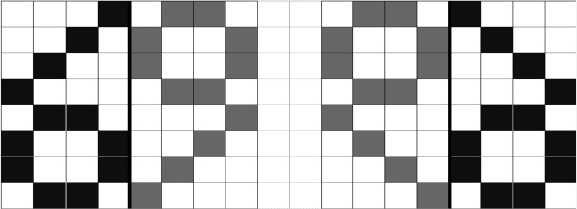
from Figure 2.5 as an example. This matrix consists of only
four numbers: 8, 12, 18, and 27, with their special disposition. The numbers 8
and 27 are disposed separately at matrix diagonals in the form of a diagonal
cross. The number 12 is disposed in matrix cells, a set of which produces a
special mosaic. Such a mosaic can be referred to conditionally as the symbol
69 (note that the numbers 6 and 9 are famous in I Ching as traditional symbols
of yin and yang, respectively, but such a coincidence can be accidental.) The
number 18 is disposed in matrix cells, a set of which produces a mirror -
symmetrical mosaic in comparison with a 69 - mosaic of the previous case.
Figure 2.7 demonstrates these two cases by means of the set of dark matrix
cells with the number 12 (left matrix) and with the number 18 (right matrix).
FIGURE 2.7 Mosaic of cells with number 12 ( left , the dark cells) and number 18
( right ) from the multiplicative matrix
P
MULT
3
()
(Figure 2.5 ).
48 GENETIC CODES, MATRICES, AND SYMMETRICAL TECHNIQUES
It is known that if an arbitrary octet matrix with four types of numbers as
its matrix elements is raised to the power n , the resulting matrix will usually
have many more types of numbers with very different dispositions (up to 64
types of numbers for 64 matrix cells). But our bisymmetrical genetic matrices
have the unexpected property of invariance of their numerical mosaic
after the operation of raising to the power n . For example, if the octet matrix
P
MULT
3
()
is raised to the power of 2, the resulting octet matrix
P
MULT
3
2
()
(
)
will
have a new set of four numbers 2197, 2028, 1872, and 1728 (instead of the
initial four numbers 27, 18, 12, and 8) with the same disposition inside the octet
matrix.
It is essential that this beautiful property of invariance of the numeric
mosaic of the genetic matrix is independent of values of numbers. This prop-
erty is realized for such matrices with the arbitrary set of four numbers a , b ,
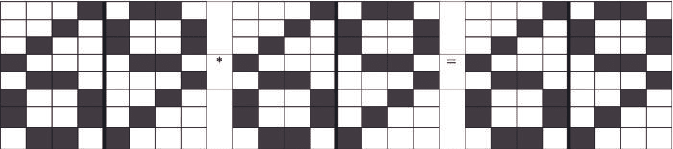
c , and d if they are located in the same manner inside a matrix. Moreover, if
we have one matrix X with a set of four numbers a , b , c , and d , and another
matrix Y with another set of four numbers k , m , p , and q , the product of these
matrices will be the matrix Z = XY with a set of four numbers r , g , υ , and z
and with the same mosaic of their disposition (Figure 2.8 ).
It is obvious that the four symbols (e.g., a , b , c , d ) in such matrices can be
not only ordinary numbers, but also such arbitrary mathematical objects as
complex numbers, matrices, or functions of time (e.g., a = R cos wt , b = T sin wt ,
… ). The mosaic - invariant property of these genetic matrices is an expression
of the cooperative behavior of its elements, not the result of the individual
behavior of each type of element. This property is reminiscent of some aspects
of the cooperative behavior of the elements of biological organisms. This
property is explained by the fact that the matrices described are matrix forms
of presentation of a special type of hypercomplex number, the hyperbolic
matrions (for details, see Petoukhov, 2008a ; Petoukhov and He, 2009 ).
A mathematical analogy exists between the bisymmetric 2 × 2 genomatri-
ces and the famous matrices of the hyperbolic turn, which are also bisymmetri-
cal: [sh( x ) ch( x ); ch( x ) sh( x )], where sh( x ) and ch( x ) are the hyperbolic sine
and cosine. This analogy gives us the opportunity to interpret normalized
FIGURE 2.8 Multiplication of mosaic - invariant matrices X and Y gives a new matrix
Z with the same mosaic of the disposition of its four types of numbers. Cells with the
numbers b , m , and s in the matrices X , Y , and Z are shaded.
X(a, b, c, d) Y(k, m, p, q) Z(r, g, v, z)
d bbba
qppm
pqm p
p m qp
m ppq
p mm k
m pkm
m kpm
k mm p
p mm k
m pkm
m kpm
k mm p
qppm
pqm p
p m qp
m ppq
z
v
v
g
v
g
g
r
v
z
g
v
g
v
r
g
v
g
z
v
g
r
v
g
g
v
v
z
r
g
g
v
v
g
g
r
z
v
v
g
g
v
r
g
v
z
g
v
g
r
v
g
v
g
z
v
r
g
g
v
g
v
v
z
cc c
cccabd bb
ccacbb d b
b d bbccc a
caccbbb d
bbd b cca c
bbbdcac c
acccdbb b
SYMMETRICAL PATTERNS, MOLECULAR GENETICS 49
bisymmetric genomatrices in connection with hyperbolic turns, which have the
following applications in physics and mathematics:
• The rotation of pseudo - Euclidean space
• The special theory of relativity
• The geometric theory of logarithms, where properties of logarithms are
introduced by hyperbolic turns (Shervatov , 1954 )
• The theory of solitons of the sine - Gordon equation
In particular, this coincidence of the genomatrices with the matrices of
hyperbolic turns refl ects the structural connections of the genetic code with
the famous psychophysical Weber – Fechner law.
2.5 SYMMETRICAL PATTERNS, MOLECULAR GENETICS,
AND BIOINFORMATICS
Symmetry in biological systems, in particular in the form of biological bodies,
caused continuing interest to be expressed by thinkers for centuries as one of
the most remarkable and mysterious phenomena of nature (e.g., Thompson
d ’ Arcy, 1942 ; Weyl, 1952 ), and the work of many modern scientists is devoted
to it as well. Problems of biological symmetries at a macromolecular level were
considered in a special Nobel symposium (Engstrom and Strandberg, 1968 ),
in which the important role of symmetry in biological research was empha-
sized. School programs in biology include consideration of numerous exam-
ples: rotary, transmitting, and mirror symmetries, symmetries of scale similarity
in biological bodies such as fl owers and sprouts of plants, and support - motion
systems of animals.
Principles of symmetry have played an important role in the x - ray analysis
of genetic molecules, as a result of which the concept of the double helix of
DNA was developed in the famous work by Crick and Watson (Roller, 1974 ;
Watson and Crick, 1953 ). Also, living substances are traditionally compared
with crystals to reveal similarities and differences between them. For example,
Schr ö dinger (1955) considered a living substance to be an aperiodic crystal.
But all crystallography is based on principles of symmetry; crystallography has
given a powerful impulse to the development and application of methods of
symmetry in the mathematical natural sciences, including mathematical
biology. New discoveries in crystallography frequently generate new hypoth-
eses and discussions regarding the role of symmetry in crystals and living
substances. The discovery of quasicrystals (Shechtman et al., 1984 ), which were
connected to mosaics by Penrose (1989, 2004) , with pentagrams (penta -
symmetry) and with the golden section, can serve as an example here. This
discovery has drawn the attention of researchers again to fi ve - symmetries,
which exist widely in biological bodies (e.g., colors, starfi sh) and which are
50 GENETIC CODES, MATRICES, AND SYMMETRICAL TECHNIQUES
forbidden in classical crystallography, with its principles of dense packing,
one type of confi guration unit.
The development of biological knowledge is accompanied by revealing new
facts of subordination of very different biological objects to principles of sym-
metry on very different levels of their organization. Many biological concepts
that have been affi rmed in science or that sometimes cause critical discussions
are connected to some extent with the question of biological symmetry:
the law of homologous series (Vavilov, 1922 ); theories of morphogenetic fi elds;
the hypothesis by Vernadsky (1965) regarding the non - Euclidean geometry
of living matter; and conceptions about the morphogenetic conditionality of
many psychological phenomena, including the phenomenon of aesthetic pref-
erence of the golden section, which is connected with Fibonacci numbers and
morphogenetic laws of phyllotaxis (see the reviews of phyllotaxis in books by
Jean, 1994 and Jean and Barabe, 2001 ).
Molecular biology has discovered the existence of fundamental problems of
symmetry and of left – right dissymmetry on the level of biological molecules.
On the other hand, development of the theory of symmetry has raised questions
about new types of symmetry: for example, of non - Euclidean symmetry in
biological bodies (see reviews by Petoukhov, 1981, 1989 ). Modeling biological
phenomena on the basis of modern theories of nonlinear dynamics enters into
the biological models at the highest levels of symmetry, which were known
earlier in the fi elds of mathematics and physics. For example, the solitonic model
of the macrobiological phenomena involves symmetries of Lorentz transforma-
tions from the special theory of relativity (Petoukhov, 1999a ). It is no doubt
that principles of symmetry were, are, and will continue to be a major compo-
nent in the development of biology. They will play an increasing role in theo-
retical biology because of their status as one of the fundamentals of modern
natural mathematical sciences as a whole (Bernal et al., 1972 ; Birss, 1964 ;
Darvas, 2007 ; Fujita, 1991 ; Gardner, 1991 ; Hahn, 1989, 1998 ; Hargittai, 1986,
1989 ; Hargittai and Hargittai, 1994 ; Kappraff, 2002 ; Leyton, 1992 ; Loeb, 1971,
1993 ; Mainzer, 1988 ; Mandelbrot, 1983 ; Marcus, 1990, 2006 ; Miller, 1972 ; Moller
and Swaddle, 1997 ; Ne ’ eman, 1999, 2002 ; Ne ’ eman and Kirsh, 1986 ; Petoukhov,
1981 ; Rosen, 1983 , 1995 ; Shubnikov and Koptsik, 1974 ; Stewart and Golubitsky,
1992 ; Weyl, 1931, 1946, 1952 ; Wigner, 1965, 1967, 1970 ). Such a fundamental
status for the principles of symmetry is connected with the famous Erlangen
program by Klein and with the process of geometrization of physics (Lochak,
1994 ; Weyl, 1952 ). This process of geometrization has led to the interpretation
of many basic theories of physics as theories of symmetry: The special theory
of relativity, quantum mechanics, the theory of conservation laws, theories of
elementary particles, and some other parts of modern physics are examples.
Investigations of symmetries are most relevant when science does not know
how to create a theory of a concrete natural system. Biological organisms
belong to a category of very complex natural systems. The variety of organisms
is very numerous. They differ from each other vastly in many aspects: by their
size, appearance, types of motions, and so on. But to humanity ’ s surprise,
SYMMETRICAL PATTERNS, MOLECULAR GENETICS 51
molecular genetics has discovered that from a molecular - genetic viewpoint, all
organisms are equivalent to each other by their basic genetic structure. Due
to this revolutionary discovery, a great unifi cation of all biological organisms
has taken place in science, and information - genetic lines of investigation
have become one of the most effective not only in biology, but in science as a
whole. It is essential that a basic system of genetic coding is strikingly simple.
Its simplicities and its orderliness throw down a challenge to specialists in
many scientifi c fi elds, including specialists in the theory of symmetry and
antisymmetry.
It should be noted that the fantastic successes of molecular genetics have
been defi ned in particular by the disclosure of phenomenological facts of sym-
metry in molecular constructions of the genetic code and by a skillful use of
these facts in theoretical modeling. An outstanding example is the discovery
of a symmetrological fact, refl ected in the famous rule by Chargaff, of an equal-
ity of quantities of nitrogenous bases in their appropriate pairs (adenine –
thymine and cytosine – guanine) in molecules of DNA in a variety of organisms.
This phenomenological rule was used skillfully in the theoretic modeling of
the double helix of DNA by Crick and Watson using additional symmetro-
logical principles (Roller, 1974 ). Many specialists from many countries around
the world now work in this very attractive fi eld of investigation of symmetries
in the genetic code and bioinformatics (Arques and Michel, 1994, 1996,
1997 ; Bakhtiarov, 2001 ; Chernavskiy, 2000 ; Dragovich and Dragovich, 2007 ;
Frank - Kamenetskiy, 1988 ; Hargittai, 2001 ; He, 2001 ; He and Petoukhov, 2007 ;
He et al., 2004, 2005 ; Jimenes - Montano, 2005 ; Karasev, 2003 ; Karasev et al.,
2005 ; Kargupta, 2001 ; Khrennikov and Kozyrev, 2007 ; Konopelchenko and
Rumer, 1975 ; MacDonaill, 2003, 2005 ; Makovskiy, 1992 ; Marcus, 2001, 2007 ;
Negadi, 2001, 2005, 2006 ; Petoukhov, 1990, 2001a,b, 2003, 2003 – 2004, 2005,
2006, 2008a,b ; Ratner, 2002 ; Shcherbak, 1988 ; Stambuk, 1999 ; Stambuk et al.,
2005 ; Szabo and He, 2006 ; Szabo et al., 2005 ; Waterman, 1999 ; Yang, 2001, 2005 ).
From an information viewpoint, biological organisms are informational
essences. They obtain genetic information from their ancestors and transmit it
to their descendants. In the biological literature we often come across the
statement that living organisms are the texts of a molecular level of their
organization. Just from an information - hereditary point of view, all living
organisms are wonderfully unifi ed: All have identical bases of genetic coding.
A conception of the informational nature of living organisms is refl ected in
the words: “ If you want to understand life, don ’ t think about vibrant, throbbing
gels and oozes, think about information technology ” (Dawkins, 1991 ). Or
another citation, which presents a similar direction of thought: “ Notions of
‘ information ’ or ‘ valuable information ’ are not utilized in the physics of non -
biological nature because they are not needed there. On the contrary, in
biology the notions of ‘ information ’ and especially ‘ valuable information ’ are
main ones; understanding and description of phenomena in biological nature
are impossible without these notions. A specifi city of ‘ living substance ’ lies in
these notions ” (Chernavskiy, 2000 ).
52 GENETIC CODES, MATRICES, AND SYMMETRICAL TECHNIQUES
In the attempt to reveal the genetic code, the theoretical problem of a
“ bioinformation evolution ” has arisen. This problem exists alongside ideas
about chemical evolution and is very signifi cant for understanding biological
life. Informatics began to be used in concepts of the origin of life and in theo-
retical biology only in the past few decades. Now modern science hopes to
obtain a deeper and more substantive understanding of life and its origin from
the viewpoint of bioinformatics. In our opinion, modern investigations in the
fi eld of bioinformatics form the foundation of future theoretical biology.
Therefore, the problem of the maximum union of molecular - genetic knowl-
edge with the mathematics of the theory of discrete signal processing is espe-
cially relevant.
Bioinformatics can lead to deeper knowledge regarding the questions of
what life is and why life exists. An investigation of symmetrical and structural
analogies between computer informatics and genetic informatics is one of the
important tasks of modern science in connection with the creation of DNA
computers and with the development of bioinformatics. The development of
bioinformatics and its applications requires an appropriate mathematical
model of structural ensembles of genetic elements. The methods of symmetry
can be one of the most useful in creating such a model. In this chapter we
demonstrate the usefulness of methods of symmetry to study the genetic code
and to develop effective matrix approaches in the fi eld of genetic coding.
We should note that many attempts have been made to construct mathe-
matical models or biochemical explanations of separate features of the genetic
code. One of the most historically famous attempts to answer questions regard-
ing the 20 amino acids was made by George Gamow more than 50 years ago
(Gamow, 1954 ; Gamow and Metropolis, 1954 ). He proposed an explanation
based on morphological character: that this quantity of amino acids is defi ned
by the molecular confi guration of the double helix of DNA, which possesses
the appropriate quantity of hollows along the double helix. A few initial
attempts at an explanation of features of the genetic code have been presented
(Stent, 1971 ; Ycas, 1969 ).
Some mathematical, and other approaches to the genetic code have been
proposed in the literature (Cristea, 2002, 2004, 2005 ; Dragovich and Dragovich,
2007 ; He, 2001 ; Jimenes - Montano, 2005 ; Karasev, 2003 ; Khrennikov and
Kozyrev, 2007 ; Konopelchenko and Rumer, 1975 ; MacDonaill, 2003, 2005 ;
Negadi, 2005, 2006 ; Petoukhov, 2001a,b, 2003, 2003 – 2004, 2005, 2006, 2008a,b ;
Ratner, 2002 ; Shcherbak, 1988 ; Stambuk, 1999 ; Waterman, 1999 ; Yang, 2001,
2005 ; etc.). Each of these attempts was important for the general advancement
of the science leading to understanding the genetic code. This work was very
useful because it has shown the specifi city of the code and its differences from
many other natural systems, the diffi culties in modeling its features to obtain
a fruitful model, the multiplicity of approaches in attempts at such modeling,
the importance of the decision to perform this task, and so on. These publica-
tions have drawn the attention of many young researchers to this fundamental
problem. Despite many interesting publications, the general situation in under-