
He M., Petoukhov S. Mathematics of Bioinformatics: Theory, Methods and Applications
Подождите немного. Документ загружается.

GENETIC CODES AND MATRICES 33
sequences of zero and unity (such binary sequences are used for storage and
transfer of the information in computers). Each of these parallel binary texts,
based on objective biochemical attributes, can provide its own genetic function
in organisms. According to our data, the genetic system uses the possibility of
reading triplets from the viewpoint of different binary subalphabets. This pos-
sibility participates in construction of genetic octet bipolar algebra (or yin –
yang algebra), which serves as the algebraic model of the genetic code in
Chapter 8 .
Natural System of Numbering the Genetic Multiplets
Genetic information is transferred by means of discrete elements: four letters
of the genetic alphabet, 64 amino acids, and so on. The general theory of pro-
cessing discrete signals encodes the signals by means of special mathematical
matrices and spectral representation of the signals, with the principal aim of
increasing the reliability and effi ciency of information transfer (e.g., Ahmed
and Rao, 1975 ; Sklar, 2001 ). A typical example of such matrices with appropri-
ate properties is the Kronecker family of Hadamard matrices:
Hn
n
n
+
()
=−
[]
()
1
11 11; , where indicates an integer Kronecker powwer
(2.1)
The simplest Hadamard matrix H
2
= [ 1 1 ; − 1 1] is termed the kernel of this
Kronecker family. Rows of Hadamard matrices (2.1) form an orthogonal
system of Walsh functions (see Chapter 1 ), which is used for a spectral pre-
sentation and transfer of discrete signals (Ahmed and Rao, 1975 ; Yarlagadda
and Hershey, 1997 ). Quantum computers use normalized Hadamard matrixes
TABLE 2.2 Three Binary Subalphabets According to Three Types of Binary -
Opposite Attributes in a Set of Nitrogenous Bases C , A , G , U
a
N Symbol of a Genetic Letter C A G U/T
1 0
1
, pyrimidines (one ring in a molecule)
1
1
, purines (two rings in a molecule)
0
1
1
1
1
1
0
1
2 0
2
, a letter with amino - mutating property (amino)
1
2
, a letter without it (keto)
0
2
0
2
1
2
1
2
3 0
3
, a letter with three hydrogen bonds
1
3
, a letter with two hydrogen bonds
0
3
1
3
0
3
1
3
a
The following scheme explains graphically the symmetric relations of equivalence between the
pairs of letters from the viewpoint of the separate attributes 1, 2, and 3:
C
11
3
3
2
2
A
UG

34 GENETIC CODES, MATRICES, AND SYMMETRICAL TECHNIQUES
FIGURE 2.2 The fi rst genetic matrices of the Kronecker family P
(
n
)
= [C A; U G]
(
n
)
with the binary numbering of their columns and rows on the base of the binary subal-
phabets 1 and 2 from Table 2.2 . The lower matrix is the genomatrix P
(3)
= [C A; U G]
(3)
.
Each matrix cell contains a symbol of a multiplet, a binary number of this multiplet,
and its expression in decimal notation. Decimal numbers of columns, rows, and multi-
plets are shown in parentheses.
in the role of logic gates in connection with the important role of these
matrixes in quantum mechanics (Nielsen and Chuang, 2001 ). In Chapter 8 we
describe deep connections between Hadamard matrices and ensembles of
elements of the genetic code.
On the basis of the idea of a possible analogy between discrete signal pro-
cessing in computers and in a genetic code system, one can present the genetic
four - letter alphabet in the following matrix form: P = [C A; U G]. It is
obvious that this form is analogous to kernel (2.1) of the Kronecker family of
Hadamard matrices. Then the Kronecker family of matrices with such an
alphabetical kernel can be considered:
Pn
n
n
()
()
=
[]
()
C A U G where indicates an integer Kronecker pow;, eer
(2.2)
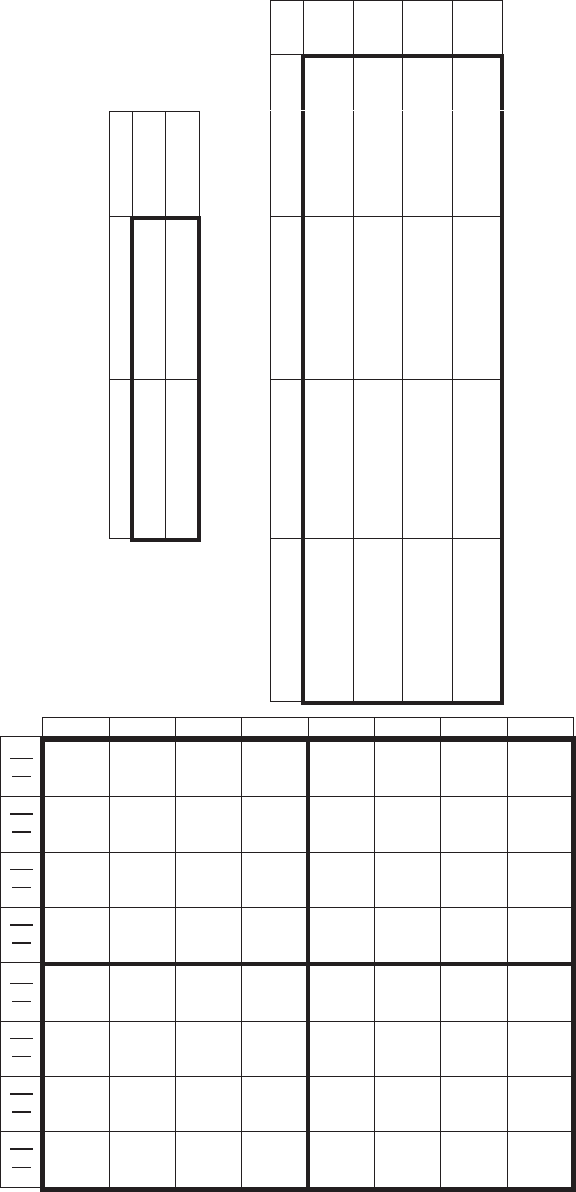
Figure 2.2 shows the fi rst matrices of such a family. One can see in this fi gure
that each matrix contains all genetic multiplets of equal length: [C A; U G]
(1)
contains all four monoplets; [C A; U G]
(2)
contains all 16 duplets; [C A; U G]
(3)
contains all 64 triplets; and so on. It should be emphasized that in this chapter
we pay the greatest attention to the genetic alphabet: we consider the alpha-
betical matrices [C A; U G]
(
n
)
from different viewpoints persistently, and
we construct algorithms of matrix transformations on the basis of features of
the letters A, C, G, and U/T. The genetic alphabet serves as the key structure
to investigate system properties of the genetic code and its dialects.
Such a presentation of ensembles of elements of the genetic code in the
form of Kronecker families of genetic matrices ( genomatrices in short) has
proved to be a useful tool in investigating structures of the genetic code from
the viewpoint of their analogy with the theory of discrete signal processing
and noise - immunity coding. The results of matrix genetics reveal hidden inter-
connections, symmetries, and evolutionary invariants in genetic code systems
(He, 2001 ; He and Petoukhov, 2007, 2009 ; He et al., 2004 ; Kappraff and
Petoukhov, 2009 ; Petoukhov, 1999b, 2001a,b, 2003, 2003 – 2004, 2005, 2006,
2008a,b ; Petoukhov and He, 2009 ). Simultaneously, they testify that genetic
molecules are the important part of the specifi c maintenance of the noise
immunity and effi ciency of a discrete information transfer.
The Kronecker family of genetic matrices [C A; G U]
(
n
)
(2.2) represents
all genetic multiplets if the value of n is large enough. This family includes the
genomatrix of the genetic alphabet; the genomatrix of triplets, which encode
00(0) 01(1) 10(2) 11(3)
;
00
(0)
CC
0000
(0)
CA
0001
(1)
AC
0010
(2)
AA
0011
(3)
0 1
P
(1)
= P
(2)
=
0
C
00
(0)
A
01
(1)
01
(1)
CU
0100
(4)
CG
0101
(5)
AU
0110
(6)
AG
0111
(7)
1
U
10
(2)
G
11
(3)
10
(2)
UC
1000
(8)
UA
1001
(9)
GC
1010
(10)
GA
1011
(11)
11
(3)
UU
1100
(12)
UG
1101
(13)
GU
1110
(14)
GG
1111
(15)
000 (0) 001 (1) 010 (2) 011 (3) 100 (4) 101 (5) 110 (6) 111 (7)
000
(0)
CCC
000000
(0)
CCA
000001
(1)
CAC
000010
(2)
CAA
000011
(3)
ACC
000100
(4)
ACA
000101
(5)
AAC
000110
(6)
AAA
000111
(7)
001
(1)
CCU
001000
(8)
CCG
001001
(9)
CAU
001010
(10)
CAG
001011
(11)
ACU
001100
(12)
ACG
001101
(13)
AAU
001110
(14)
AAG
001111
(15)
010
(2)
CUC
010000
(16)
CUA
010001
(17)
CGC
010010
(18)
CGA
010011
(19)
AUC
010100
(20)
AUA
010101
(21)
AGC
010110
(22)
AGA
010111
(23)
011
(3)
CUU
011000
(24)
CUG
011001
(25)
CGU
011010
(26)
CGG
011011
(27)
AUU
011100
(28)
AUG
011101
(29)
AGU
011110
(30)
AGG
011111
(31)
100
(4)
UCC
100000
(32)
UCA
100001
(33)
UAC
100010
(34)
UAA
100011
(35)
GCC
100100
(36)
GCA
100101
(37)
GAC
100110
(38)
GAA
100111
(39)
101
(5)
UCU
101000
(40)
UCG
101001
(41)
UAU
101010
(42)
UAG
101011
(43)
GCU
101100
(44)
GCG
101101
(45)
GAU
101110
(46)
GAG
101111
(47)
110
(6)
UUC
110000
(48)
UUA
110001
(49)
UGC
110010
(50)
UGA
110011
(51)
GUC
001100
(52)
GUA
110101
(53)
GGC
110110
(54)
GGA
110111
(55)
111
(7)
UUU
111000
(56)
UUG
111001
(57)
UGU
111010
(58)
UGG
111011
(59)
GUU
111100
(60)
GUG
111101
(61)
GGU
111110
(62)
GGG
111111
(63)
36 GENETIC CODES, MATRICES, AND SYMMETRICAL TECHNIQUES
the amino acids; and the genomatrices of long multiplets, which encode pro-
teins. All of this natural set of genetic multiplets, which have various coding
functions in the genetic system, appears coordinated with this simple Kronecker
family of matrices [C A; G U]
(
n
)
(2.2) .
All n - plets, which begin with one of the four letters C, A, U, and G, are
assigned to one of the four quadrants of an appropriate genomatrix
[C A; G U]
(
n
)
because of the specifi cs of Kronecker multiplication. If one
does not pay attention to this fi rst letter in the n - plets of each matrix quadrant,
one can see that each quadrant reproduces a previous matrix P
(
n
− 1)
of this
Kronecker family. So, speaking fi guratively, each genomatrix of such a family
possesses information (or “ memory ” ) about all previous genomatrices of this
family.
It should be noted that each column of the formally constructed genomatrix
[C A; G U]
(3)
(Figure 2.2 ) corresponds to one of the eight classical octets by
Wittmann (1961) , which are famous in the history of molecular genetics and
which refl ect real biochemical properties of elements of the genetic code
(Ycas, 1969 ). This fact is the fi rst indirect confi rmation of the adequacy of the
given matrix approach, which refl ects a natural orderliness inside the genetic
system.
Let us demonstrate now that all 64 triplets can be enumerated binarily in
a natural manner by means of the binary subalphabets (Table 2.2 ), which are
based on the real structural and biochemical features of the genetic molecules.
As a result of such natural numbering, all triplets appear arrayed in the geno-
matrix [C A; G U]
(3)
in monotonical order on increase of their binary
numbers.
Really, all columns and rows of the matrices in Figure 2.2 are enumer-
ated binarily by the following algorithm. Their numbers are formed auto-
matically if one interprets multiplets of each column from the viewpoint
of the fi rst binary subalphabet (Table 2.2 ) and if one interprets multiplets
of each row from the viewpoint of the second binary subalphabet. For
example, from the viewpoint of the fi rst subalphabet, the triplet CAU pos-
sesses the binary number 010 (all triplets of the same column possess the
same binary number, which is utilized correspondingly as the general
number of this column). But from the viewpoint of the second subalphabet,
the triplet CAU possesses the binary number 001 (all triplets of the same
row possess the same binary number, which is utilized as the general
number of this row). One can see in Figure 2.2 , that in such a way, all
columns and all rows in the genomatrix [C A; G U]
(3)
appear renumbered
and arrayed in monotonic order.
Each genetic multiplet obtains its own individual binary number in the
natural system of numbering the multiplets in matrices [C A; G U]
(
n
)
that we
have described. This multiplet also obtains its own disposition in the appropri-
ate genetic matrix of the Kronecker family. It is obvious that the length of the
individual binary number for a n - plet, which contains n letters, is equal to 2 n .
The fi rst half of this number is the interpretation of letters of the multiplet
GENETIC CODES AND MATRICES 37
from the viewpoint of the second binary subalphabet (Table 2.2 ), and the
second part is the interpretation from the viewpoint of the fi rst binary subal-
phabet. For example, the sequence GACUUCACGGUG, which contains nine
letters, obtains the individual binary number with 9 × 2 = 18 binary symbols:
100110001111/110000101101. If one wishes to construct a catalog of genetic
sequences of various lengths and composition, it can be done on the basis of
the natural system of numbering the sequences as multiplets.
In the genomatrix [C A; G U]
(3)
, each of 64 triplets has its own number,
which consists of the association of binary numbers of its row and column (e.g.,
the triplet CAU has the binary number 001010, which is equal to 10 in decimal
notation). This genomatrix refl ects real interrelations of elements in the set of
triplets: any codon and its anticodon are disposed in inversion - symmetrical
manner relative to the center of the genomatrix (Figure 2.2 ).
Each codon – anticodon pair (and only such a pair) has the sum of its decimal
numbers, which is to equal 63 (in binary notation it is equal to 111111). For
example, the triplet CAU has the decimal number 10, and the complementary
triplet GUA has the decimal number 53; the sum of these numbers is 63. Each
sequence of triplets can be presented in the genomatrix P
(3)
in the form of an
appropriate trajectory passing through matrix cells with these triplets in series.
It is obvious that the complementary sequences on the two fi laments of the
double helix of DNA correspond to two appropriate trajectories in the geno-
matrix [C A; G U]
(3)
, which are inversion symmetrical to each other relative
to the center.
The genomatrix [C A; G U]
(3)
(Figure 2.2 ) coincides with the famous table
of 64 hexagrams in Fu - Xi ’ s order from the ancient Chinese “ The Book of
Changes ” ( I Ching ), which was written a few thousand years ago. This matrix
amazed the creator of one of the fi rst computers, Gottfried Leibniz (1646 –
1716), who considered himself the creator of the system of binary notation,
but in one moment he suddenly found ancient predecessors relative to this
system. Leibniz saw in features of the ancient table of 64 hexagrams many
features similar to his ideas regarding binary systems and universal language.
“ Leibniz has seen in this similarity … evidence of the preestablished harmony
and unity of the divine plan for all times and people ” (Schutskiy, 1997 , p. 12).
Modern physics and other branches of science pay attention to I Ching and
other ancient Oriental teachings (see, e.g., Capra, 2000 ; Gell - Mann and
Ne ’ eman, 2000 ). A possible connection between the genetic code and the
symbolic system of I Ching has been noted in the literature (e.g., Jacob, 1974,
1977 ; Stent, 1969 ). Our results in the fi eld of matrix genetics confi rm this
guesswork.
So the natural system of numbering the genetic triplets and their cells in
the genomatrix [C A; G U]
(3)
has already been known for thousands of years.
From a historical viewpoint it can be called an ancient Chinese system. The
matrix approach to the genetic code, in addition to being an object of research
and matrix mathematics, leads unexpectedly to historical analogies and
connections.
38 GENETIC CODES, MATRICES, AND SYMMETRICAL TECHNIQUES
Genetic Multiplets and Matrices of Diadic Shifts
Next we describe the connection between numerated genomatrices P
(
n
)
(Figure
2.2 ) and the matrices of dyadic shifts long known in the theory of discrete
signal processing. The theory of discrete signal processing utilizes broadly the
special mathematical operation of modulo - 2 addition for binary numbers.
Modulo - 2 addition is a fundamental operation for binary variables. By defi ni-
tion, the modulo - 2 addition of two numbers written in binary notation is made
in a bitwise manner in accordance with the following rules:
000 011 101 110+= += += +=,,,
(2.3)
For example, modulo - 2 addition of two binary numbers 110 and 101, which
are equal to 6 and 5, respectively, in decimal notation, gives the result
110 䊝 101 = 011, which is equal to 3 in decimal notation ( 䊝 is the symbol for
modulo - 2 addition). The series of binary numbers
000 001 010 011 100 101 110 111,,,,,,,
(2.4)
forms a diadic group , in which modulo - 2 addition serves as the group opera-
tion (Harmut, 1989 ). The distance in this symmetry group is known as the
Hamming distance . Since the Hamming distance satisfi es the conditions of a
metric group, the diadic group is a metric group. The modulo - 2 addition of any
two binary numbers from (2.4) always results in a new number from the same
series. The number 000 serves as the unit element of this group: for example,
010 䊝 000 = 010. The reverse element for any number in this group is the
number itself: for example, 010 䊝 010 = 000.
The series (2.4) is transformed by modulo - 2 addition with the binary number
001 into a new series with a new sequence of the same numbers:
001 000 011 010 101 100 111 110,,,,,,,
(2.5)
Such changes in the initial binary sequence, produced by modulo - 2 addition
of its members with any binary numbers (2.4) , are termed diadic shifts (Ahmed
and Rao, 1975 ; Harmut, 1989 ). If any system of elements demonstrates its con-
nection with diadic shifts, it indicates that the structural organization of its
system is related to the logic of modulo - 2 addition.
Let us use modulo - 2 addition to create the binary numbers of columns and
rows for all cells in the genomatrix P
(3)
in Figure 2.2 . For example, the cell
disposed in column 110 and row 101 obtains the binary number 011 by means
of such addition. As a result, a numeric matrix
P
DIAD
3
()
arises (Figure 2.3 ).
The 8 × 8 matrix
P
DIAD
3
()
is bisymmetrical because it is symmetrical relative
to both diagonals. This matrix contains only eight binary numbers, which are
equal to 0, 1, 2, 3, 4, 5, 6, and 7 in decimal notation. Each of these numbers
occupies eight matrix cells from 64 numerated cells (see Figure 2.2 ). The sum
of the numbers of these eight matrix cells is equal to 252 in decimal notation
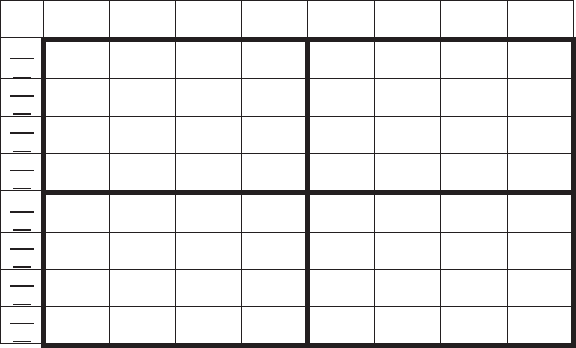
GENETIC CODES AND MATRICES 39
for each case. For example, the number 5 occupies those eight matrix cells on
Figure 2.3 , which are numerated individually on Figure 2.2 by the numbers 5,
12, 23, 30, 33, 40, 51, and 58. The sum of these eight numbers is equal to 252.
The left and right halves (and the upper and lower halves) of this matrix
P
DIAD
3
()
are inversion - symmetrical to each other in the sense of the binary inversion
relative to their three - digit numbers in matrix cells (by defi nition, the binary
inversion interchanges the binary symbols 1 and 0 with each other). For this
reason, the modulo - 2 addition of such binary numbers, which exist in any two
mirror - symmetrical cells of this matrix, gives the binary number 111. For
example, a cell with the number 001 in the left half of the matrix has a mirror -
symmetrical cell in its right half with the number 110 always. Their sum in the
sense of modulo - 2 addition is equal to 001 䊝 110 = 111.
By an analogical algorithm of modulo - 2 addition, the entire family of matri-
ces of dyadic shifts
P
n
DIAD
()
, where n = 2, 4, 5, … , can be constructed from the
genomatrices P
(
n
)
(Figure 2.2 ). All such matrices
P
n
DIAD
()
are bisymmetrical as
well. Each of matrices
P
n
DIAD
()
is the matrix form of presentation of a particular
case of special hypercomplex numbers, termed hyperbolic matrions (Petoukhov,
2008a ; Petoukhov and He, 2009 ).
Do such matrices
P
n
DIAD
()
have any connection with the theory of discrete
signal processing? Yes, they have. The matrix
P
DIAD
3
()
and other analogical matri-
ces
P
n
DIAD
()
have long been known in information theory under the name matri-
ces of dyadic shifts (see, e.g., Ahmed and Rao, 1975 ). They are fundamentals
of some special methods of analysis and synthesis of signals as vectors. In
computer informatics, matrices of dyadic shifts are constructed by means of
modulo - 2 addition without utilizing Kronecker multiplication of matrices,
which we have used to obtain the Kronecker family of the genomatrices P
(
n
)
FIGURE 2.3 Bisymmetrical matrix
P
DIAD
3
()
of dyadic shifts. Parentheses contain expres-
sions of numbers in decimal notation.
000
(0)
001
(1)
010
(2)
011
(3)
100
(4)
101
(5)
110
(6)
111
(7)
000
(0)
000
(0)
001
(1)
010
(2)
011
(3)
100
(4)
101
(5)
110
(6)
111
(7)
001
(1)
001
(1)
000
(0)
011
(3)
010
(2)
101
(5)
100
(4)
111
(7)
110
(6)
010
(2)
010
(2)
011
(3)
000
(0)
001
(1)
110
(6)
111
(7)
100
(4)
101
(5)
011
(3)
011
(3)
010
(2)
001
(1)
000
(0)
111
(7)
110
(6)
101
(5)
100
(4)
100
(4)
100
(4)
101
(5)
110
(6)
111
(7)
000
(0)
001
(1)
010
(2)
011
(3)
101
(5)
101
(5)
100
(4)
111
(7)
110
(6)
001
(1)
000
(0)
011
(3)
010
(2)
110
(6)
110
(6)
111
(7)
100
(4)
101
(5)
010
(2)
011
(3)
000
(0)
001
(1)
111
(7)
111
(7)
110
(6)
101
(5)
100
(4)
011
(3)
010
(2)
001
(1)
000
(0)
40 GENETIC CODES, MATRICES, AND SYMMETRICAL TECHNIQUES
of all multiplets from the 2 × 2 matrix of the genetic alphabet (Figure 2.2 ).
One can note that the analogical 8 × 8 matrix of diadic shifts is constructed
from the table of 64 hexagrams of I Ching (Petoukhov, 2008a ; Petoukhov and
He, 2009 ).
It should be emphasized especially that dyadic shifts are one of the ele-
ments of an interesting theory, which is described in a book about applications
of methods of information theory in physics (Harmut, 1989 ). This theory uti-
lizes the notions of dyadic spaces, dyadic metrics, and dyadic coordinates in
connection with special codes. The relation of the genetic code to this theory
is one of the prospective topics in the fi eld of matrix genetics for investigations
in the future.
Now let us pay attention to the block character of the matrices of dyadic
shifts
P
n
DIAD
()
. Each 2
n
× 2
n
matrix
P
n
DIAD
()
is a system of fractal kind. It contains
four block matrices, each of which has the size 2 × 2. Two such block matrices,
which are disposed along each diagonal, are identical to each other always. For
this reason, the lower half of each 2
n
× 2
n
matrix
P
n
DIAD
()
can be produced from
its upper half algorithmically by a cyclic shift. In this sense, each block matrix
P
n
DIAD
()
is a matrix of the cyclic shift of its 2 × 2 blocks and is crosswise in
character.
Two quadrants along the main diagonal contain identical block elements,
which are 2
n
− 1
× 2
n
− 1
matrices of a dyadic shift. Matrix cells along the second
diagonal contain identical block elements in a form of 2
n
− 1
× 2
n
− 1
matrices also,
elements of which are changed only by addition of the number 2
n
− 1
relative to
elements of the 2
n
− 1
× 2
n
− 1
matrices along the main diagonal. In turn, these
2
n
− 1
× 2
n
− 1
matrices are the block matrices of the cyclic shift, which are cross-
wise in character; and so on.
For example, the 2
3
× 2
3
matrix
P
DIAD
3
()
in Figure 2.3 is the block matrix of the
cyclic shift relative to its 2 × 2 quadrants. Identical quadrants, which are dis-
posed along the main diagonal, are 2
2
× 2
2
matrices of the dyadic shift with the
elements 0, 1, 2, and 3. Another type of identical block in the form of the 2
2
× 2
2
quadrants with elements 4, 5, 6, and 7 are disposed along the second diagonal.
They differ from the fi rst 2
2
× 2
2
quadrants by addition of the number 2
2
to
their elements only. In turn, each of these 2
2
× 2
2
quadrants of the matrix
P
DIAD
3
()
in Figure 2.3 is the block matrix of the cyclic shift of its 2 × 2 blocks.
In connection with cyclic shifts in the genetic matrices described, one can
mention cyclic codes , which are based on cyclic shifts (Peterson and Weldon,
1972 ; Sklar, 2001 ). Cyclic codes are usually considered to be one of the most
interesting codes in the fi eld of digital techniques due to their mathematical
properties. Some modern publications in the fi eld of molecular genetics analyze
the question of a possible important participation of cyclic codes in systems
of genetic coding (Arques and Michel, 1996, 1997 ; Frey and Michel, 2003, 2006 ;
Stambuk, 1999 ).
Returning to the crosswise character of genetic matrices of diadic shifts
P
n
DIAD
()
(Figure 2.3 ), which reminds one of the crosswise character of chromo-
somes to some extent, we note that genetic inherited constructions of physi-
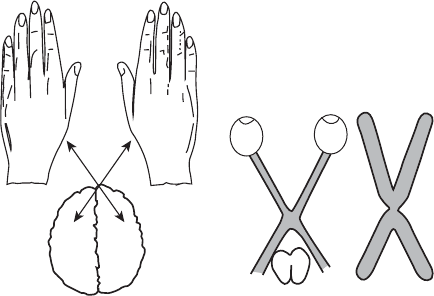
GENETIC MATRICES, HYDROGEN BONDS, AND THE GOLDEN SECTION 41
ological systems (including sensory - motion systems) demonstrate similar
crosswise structures for unknown reasons. For example, the connection
between the hemispheres of the human brain and the halves of the human
body possesses a similar crosswise character: The left hemisphere serves the
right half of the body and the right hemisphere serves the left half (Figure 2.4 )
(Annett, 1985, 1992 ; Gazzaniga, 1995 ; Hellige, 1993 ). The system of optic
cranial nerves from two eyes possesses crosswise structures as well: The optic
nerves transfer information about the right half of the fi eld of vision into the
left hemisphere of brain, and transfer information about the left half of the
fi eld of vision into the right hemisphere. The same is true for the hearing
system (Penrose, 1989 , Chap. 9 ). One can suppose that these inherited physi-
ological phenomena are connected with genetic crosswise structures, which
include, in particular, crosswise matrices of dyadic shifts and octet bipolar
matrices (see Chapter 8 ) to provide noise - immunity properties of genetic
systems.
2.4 GENETIC MATRICES, HYDROGEN BONDS, AND
THE GOLDEN SECTION
Until this moment we analyzed the symbolic genetic matrices. In this
paragraph we analyze numeric genetic matrices, which are produced from
the symbolic genomatrices. What are some reasons to consider numeric
genomatrices?
Many materials demonstrate that the Kronecker product of matrices is
useful for analysis of the genetic code and is adequate for its structure.
FIGURE 2.4 Crosswise schemes of some morpho - functional structures in the human
organism. Left: crosswise connections of brain hemispheres with the left and right
halves of a human body. Middle: crosswise structure of optic nerves from eyes to brain.
Right: a chromosome.
LR
42 GENETIC CODES, MATRICES, AND SYMMETRICAL TECHNIQUES
But the Kronecker product possesses some distinctive properties, which are
connected with eigenvalues of matrices: eigenvalues of the Kronecker product
A 䊟 B for two matrices A and B , whose eigenvalues α
i
and β
k
are equal to
the products
αβ
ik
*
of these eigenvalues. This property gives an additional
reason to introduce the notion of the Kronecker product into mathematics
(Bellman , 1960 ). But if eigenvalues are so important for the theme of Kronecker
products, one should investigate numeric genomatrices, which possess eigen-
values (symbolic matrices do not possess eigenvalues).
We would also like to investigate genetic sequences from the viewpoint of
the theory of digital signal processing. This theory presents a signal in the
form of a sequence of its numerical values in points of reference. Discrete
signals are interpreted as vectors of multidimensional spaces: a value of the
signal at each time point (a moment of reference) is interpreted as the value
of one of the coordinates of multidimensional space of signals (Trahtman,
1972 ). The theory of discrete signal processing is the geometrical science of
multidimensional spaces to some extent. The number of dimensions of such
a space is equal to the quantity of moments of references for the signal.
Appropriate metric notions and other necessary things for providing the reli-
ability, velocity, and economy of information transfer are introduced in these
multidimensional vector spaces. For example, important information notions
of the energy and power of a discrete signal are correspondingly the square
of the length of the vector signal and the same square of the length of the
vector signal, which is divided by the number of dimensions. Various signals
and their ensembles are compared as geometrical objects of such metric mul-
tidimensional spaces.
These methods underlie technologies of signal intelligence and pattern
recognition, detections and corrections of information mistakes, artifi cial intel-
ligence and robotic learning, and so on. If we wish to use the methods of the
theory of discrete signal processing to analyze genetic structures, we should
learn to turn from the symbolic genetic matrices and genetic sequences to their
numerical analogies.
The method, which is utilized in this chapter for such a turn, replaces the
letter symbols A, C, G, and U(T) of the genetic alphabet by quantitative
parameters of these nitrogenous bases, which determine their physical –
chemical role (Petoukhov, 2001a ). First, these symbols are replaced in this
chapter by numbers of the hydrogen bonds, which have long been thought to
be important participants in the transfer of genetic information. Each molecu-
lar element of the genetic code is a component of a harmonic system of genetic
coding. Its molecular parameters are coordinated with quantitative parame-
ters of other elements of this system. Quantitative characteristics of separate
elements should be investigated as part of the set of quantitative characteris-
tics of a system ensemble of elements. The matrix approach has long been
known to be very effective for system investigations: for example, in the fi elds
of quantum mechanics and the physics of elementary particles. In the fi eld of
matrix genetics, this approach unites parameters of a set of separate elements