
Health and Safety Executive. Guidelines for use of statistics for analysis of sample inspection of corrosion
Подождите немного. Документ загружается.


HSE
Health & Safety
Executive
Guidelines for use of statistics for
analysis of sample inspection
of corrosion
Prepared by TWI Limited
for the Health and Safety Executive 2002
RESEARCH REPORT 016
HSE
Health & Safety
Executive
Guidelines for use of statistics for
analysis of sample inspection
of corrosion
TWI Limited
Granta Park
Great Abington
Cambridge
CB1 6AL
United Kingdom
This document is intended to advise plant engineers and inspection personnel on
methods for analysing and extrapolating inspections for large plant items including
vessels, pipework and pipelines, taking into account the statistical nature of corrosion.
The document is intended to introduce the methods of statistical analysis of corrosion
inspection data. Before the methodology is included in standards, practical experience of
industrial applications is needed to identify the most relevant distributions and statistical
techniques.
This report and the work it describes were funded by the Health and Safety Executive
(HSE). Its contents, including any opinions and/or conclusions expressed, are those of
the author alone and do not necessarily reflect HSE policy.
HSE BOOKS
© Crown copyright 2002
Applications for reproduction should be made in writing to:
Copyright Unit, Her Majesty’s Stationery Office,
St Clements House, 2-16 Colegate, Norwich NR3 1BQ
First published 2002
ISBN 0 7176 2554 0
All rights reserved. No part of this publication may be
reproduced, stored in a retrieval system, or transmitted
in any form or by any means (electronic, mechanical,
photocopying, recording or otherwise) without the prior
written permission of the copyright owner.
ii
SUMMARY
Leakages of hydrocarbons provide both a serious risk of fire and explosion, and a loss of plant
availability. Corrosion has been shown to cause in the region of 15% of the leakage occurrences.
Inspection is carried out, particularly for internal corrosion by means of non-destructive test methods
which give values of the pipe or vessel wall thickness. Typically these methods only sample the
overall area of a plant. There are risks associated with this. The sampling may lead to inaccurate
estimates of corrosion rate, especially where pitting has occurred, or may not address the fact that a
sample needs to be extrapolated over the whole area of plant in order to give a realistic estimate of the
minimum wall thickness in that area.
Statistical methods to improve the estimation of corrosion rate or to estimate the minimum thickness
over a larger area have been suggested for over 50 years, and have been applied in a few isolated
cases. These methods, when combined with reliability methods, offer a potential for obtaining better
information from inspections by further analysis of the data collected and can produce predictions of
future probability of leakage. However widespread application is not common, largely because the use
of statistics requires specialist knowledge, and no reference standards exist. These guidelines are
intended to provide an introduction to the techniques and capabilities of the statistical methods with
view to their wider application in industry.
iii
iv
TABLE OF CONTENTS
1 SCOPE OF DOCUMENT............................................................................................................................ 1
2 ACKNOWLEDGEMENT ........................................................................................................................... 1
3 BACKGROUND ........................................................................................................................................... 2
4 INTRODUCTION – STATISTICS AND CORROSION .......................................................................... 3
4.1 FREQUENCY DISTRIBUTIONS ...................................................................................................... 3
4.2 DETERMINATION OF DISTRIBUTION (UNKNOWN CORROSION).................................... 11
5 THE USE OF INSPECTION DATA ........................................................................................................ 14
5.1 GENERAL COMMENTS ON DATA COLLECTION................................................................... 14
5.2 DETERMINATION OF CORROSION RATE - C
URRENT PRACTICE.......................................... 14
5.3 SUGGESTED ANALYSIS METHODS – NORMAL DISTRIBUTION ....................................... 16
5.4 EXTREME VALUE FITTED DATA (TYPE 1 DISTRIBUTION)................................................ 18
5.5 DETERMINATION OF CORROSION RATE ............................................................................... 20
5.6 NUMBER OF SAMPLES NEEDED (EACH CASE) ...................................................................... 21
5.7 CHOICE OF LOCATION ................................................................................................................. 21
6 CASE STUDY: FAILED OIL PIPE ......................................................................................................... 23
7 CONCLUSIONS ......................................................................................................................................... 25
8 RECOMMENDATIONS ........................................................................................................................... 26
9 REFERENCES ........................................................................................................................................... 27
10 APPENDIX A CALCULATION OF CORRELATION DISTANCE ............................................... 28
10.1 A
PPLICATION ....................................................................................................................................... 28
10.2 H
ANNING WINDOW............................................................................................................................... 28
11 APPENDIX B CALCULATION OF INHERENT AND SAMPLING ERRORS ............................. 29
11.1 APPLICATION .................................................................................................................................. 29
v
vi
1 SCOPE OF DOCUMENT
This document is intended to advise plant engineers and inspection personnel on methods for
analysing and extrapolating inspections for large plant items including vessels, pipework and
pipelines, taking into account the statistical nature of corrosion. The document is intended to
introduce the methods of statistical analysis of corrosion inspection data. Before the
methodology is included in standards, practical experience of industrial applications is needed
to identify the most relevant distributions and statistical techniques.
The analyses contained refer to areas where corrosion conditions are known to be alike. In
general, to achieve these conditions the following must be similar:
· Materials
· Corrosion product/chemistry
· Temperature
· Flow rate
· Presence of inhibitor
· Fluid composition
· Presence of contaminants
It should be noted that small changes in these parameters can cause wide changes in corrosion
rate. Where conditions do change in the area to be inspected (e.g. welds), this can be handled
by collecting data from these specific locations and treating them separately for analysis.
100% inspection of a large area of plant is not a practical proposition in most cases; the
majority of applications use sample inspection. The majority also use ultrasonic thickness
measurement for data collection, and this method is assumed for the most of this document.
It is recognised that new methods for measurement of corrosion are becoming available, and a
short review of the possible applications of these is included.
The document also does not address:
1. the choice of locations for inspection made on a risk-based or experience-based
methodology, targeted at ‘hot spots’, or
2. analysis of corrosion localised to specific locations in a plant
It should be noted that the use of extreme values is particularly suitable for the evaluation of
the potential for leakage, rather than bursting. For further guidance on the latter refer to the
RACH (Reliability Assessment for Containers of Hazardous materials) project report (1).
If the data does not fit the distributions described here then analysis by more advanced
techniques may be necessary (for example Type 3 Extreme Value Distributions). Additional
issues to be considered include the correlation between adjacent data points (Appendix A) and
the estimation of inherent and sampling errors (Appendix B).
TWI has drawn up these guidelines, at HSE’s request, specifically in order to improve the
sampling ultrasonic inspection of pipe, by making data collection, analysis and extrapolation
available to non-specialists. However it should be pointed out that the guidance given here is
introductory and more application experience is needed before standards can be developed.
2 ACKNOWLEDGEMENT
The Health and Safety Executive, together with TWI, acknowledge the input from Mitsui
Babcock Technology Centre in preparation of this document.
1
3 BACKGROUND
Corrosion has been shown to be the cause of 15-20% of leakages of hydrocarbons from
offshore plant (2). Leakages can lead to more disastrous consequences if subsequent ignition
was to result in fire or explosion. In order to reduce the number of leakages from this source,
the defects that lead to failure need to be detected and mitigating action taken before failure
occurs.
Corrosion is in essence a statistical effect (3) governed by a number of variables. For
example, microscopic variations in a surface tend to cause different forms of corrosion and
also variations in the corrosion rate over either a wide or small area (pitting). In these areas
the simple assumption that corrosion rate is uniform across an area is unlikely to be accurate,
and sample thickness measurements are unlikely to be representative of the whole component.
Studies and applications of the statistical nature of corrosion, and its relationship to
inspection, have been carried out since the 1950's, but have never been commonly applied in
routine inspections. No standards exist for the analysis of inspection data for corrosion.
Initial work using extreme values was carried out by Gumbel (4). He used the theory to
estimate the condition of pipelines with external corrosion.
Hawn (5) also used the extreme value method for external pits on pipelines, and extrapolated
to 5820 times the inspected area to estimate the probability that a maximum pit size would be
no greater than a certain value. For example, there was 97% probability that the pit size would
be no greater than 139 mils (3.5mm).
Manley (6) described the use of an ultrasonic thickness gauge, and a computer, to log and
record data from an erosion/corrosion survey. Essentially the method used was linear
interpolation of sample readings.
Joshi et al (7) use the extreme value analysis method to extrapolate from small inspection
patches in an above ground storage tank to the whole tank. They noted that the method
particularly applied to pitting corrosion. Sparago (8) shows how the underlying thickness
distribution can be used to estimate the probability of a wall thickness being below a certain
level from ultrasonic thickness gauge data.
Kowaka (9) gives a useful overall text to the statistical method of analysing corrosion data.
The use of these methods for analysing corrosion data has been referred to consistently in
Japan since the 1980’s, however little of the work refers to the strategies of data collection by
NDT methods.
More recently Mitsui Babcock (10) conducted a group sponsored project which included
some analysis of corrosion data by the extreme value method.
Thus it can be seen that although the statistical methods have been developed, the application
of these methods is not carried out routinely apart from possibly in Japan. The papers above,
although describing the methods used, do not generally validate the results obtained by
comparing a sample with the whole population.
2
4 INTRODUCTION – STATISTICS AND CORROSION
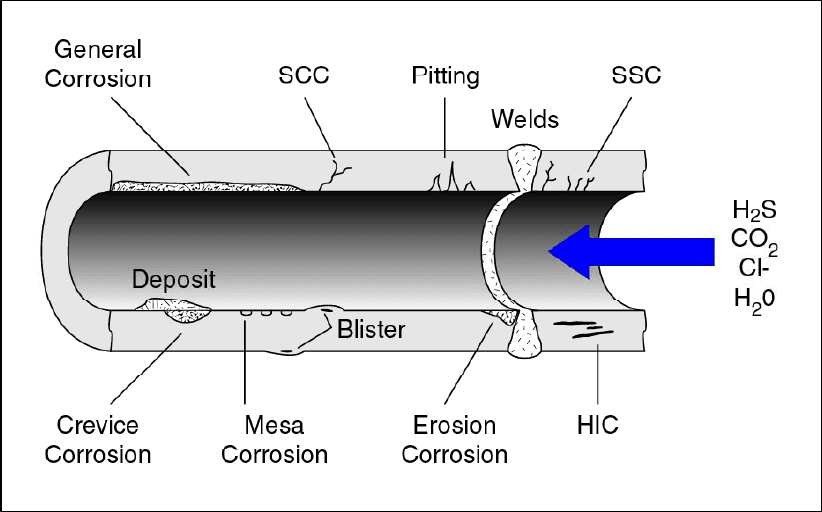
Corrosion can take many forms (Figure 1), and the statistics of each will be different. The
statistics arise from the measurements taken of the wall thickness of a component or the pit
depth (when a surface is accessible). The morphology of the corrosion (the shape of the
surface) will affect these measurements and form them into distributions of data. To
understand the process of converting the series of data points into the statistical distribution, a
useful step is to construct a frequency distribution (see Section 4.1) However the frequency
distribution needs to be converted to a mathematical form for further analysis.
Figure 1
Different Forms of Corrosion
4.1 FREQUENCY DISTRIBUTIONS
The inspection data can be shown in a graphical form, which is useful to show the overall
variations. One example of this is a frequency distribution. To construct a frequency
distribution, the data is ordered in size, and grouped into size ranges of equal intervals
(usually for UT thickness data size groups of 0.1 or 0.2 mm are reasonable). The number of
data points in each size group is plotted against the size group.
For example the following thickness data may have been taken of a pressure vessel or pipe:
3