
International Commission on Large Dams (ICOLD) - The Physical Properties of Hardened Conventional concrete in Dams
Подождите немного. Документ загружается.

ICOLD Bulletin: The Physical Properties of Hardened Conventional Concrete in Dams
Section 5 (Shrinkage)
As submitted for ICOLD review, march 2008 Section 5-1
5 SHRINKAGE
5 SHRINKAGE ....................................................................................... 1
5.1 GENERAL ............................................................................................................1
5.2 TYPES OF SHRINKAGE......................................................................................2
5.3 CAUSES AND MECHANISM OF DRYING SHRINKAGE ....................................3
5.4 FACTORS AFFECTING DRYING SHRINKAGE ..................................................5
5.4.1 Materials and mix design...............................................................................5
5.4.2 Time, humidity and temperature ....................................................................7
5.4.3 Geometry.......................................................................................................9
5.5 ESTIMATION OF DRYING SHRINKAGE...........................................................10
5.5.1 Laboratory methods.....................................................................................10
5.5.2 Site measurements......................................................................................11
5.5.3 Prediction models (ACI, CEB/FIP, etc.) .......................................................12
5.6 EFFECT OF SHRINKAGE ON CRACKING .......................................................15
5.7 EFFECT OF SHRINKAGE ON CONCRETE DAMS...........................................16
5.8 REFERENCES ...................................................................................................17
5.1 GENERAL
Volume changes in concrete can be caused by a series of mechanical, physical and
chemical processes such as stresses from applied loads, moisture variations,
temperature variations, cement hydration, carbonation and phenomena like sulphate
attack or alkali-aggregate reaction. Some of them are characterised by a volume
decrease (shrinkage) while others by a volume increase (swelling). However, when
becoming excessive, they are detrimental to the concrete, inducing deformations in the
dam, which are transmitted to its foundations to a greater or lesser extent, according to
the relative rigidity of the foundations and the type of the dam. Because in practice
these deformations are usually partially or wholly restrained, stresses are developed
and cracks may therefore appear, depending also on concrete ultimate strain capacity.
The ability of the concrete itself to withstand its design loads could then be affected and
its durability compromised.
In this section the volume decrease due to the moisture variations in hardened concrete
(drying shrinkage) will be essentially dealt with. The volume decrease due to moisture
variations in fresh concrete (plastic shrinkage), due to hydration of cement (autogenous
shrinkage) and carbonation (carbonation shrinkage) will be only rapidly touched on.
Other processes are instead specifically treated elsewhere in this ICOLD Bulletin (i.e.
elastic, creep, thermal and durability properties). However it should be remembered that
some of these processes are inter-dependent and influenced by common factors. Both
shrinkage and creep, for example, depend on moisture migration within the concrete
and can hardly be completely isolated. The magnitude of creep can be affected by
concurrent shrinkage and the two phenomena are influenced by a common process
during drying. Creep does not add to shrinkage but combines with it [5.1].
ICOLD Bulletin: The Physical Properties of Hardened Conventional Concrete in Dams
Section 5 (Shrinkage)
As submitted for ICOLD review, march 2008 Section 5-2
As further discussed in the paragraph 5.7, the volume changes in concrete dams due to
drying shrinkage are usually to be considered as belonging to the indigeneous
physiological behaviour of concrete and should not be considered as pathologic.
Moreover, as they concern only the external part of the massive concrete, they are
usually of minor importance in dams, even if cracks can develop on concrete surfaces
exposed to air, further enhancing the risk of other deterioration phenomena such as for
example leaking. Therefore, if cracking of concrete due to drying shrinkage is not dealt
with, the cracking advances and may cause serious problems.
5.2 TYPES OF SHRINKAGE
A first shrinkage phenomenon occurs when concrete is still plastic. The loss of water
through evaporation from the surface, drainage of forms and suction by drying concrete
below, cause a volumetric reduction named plastic shrinkage. Taking place on plastic
and not on hardened concrete, it is beyond the scope of the Bulletin.
On the contrary autogenous shrinkage occurs on hardened concrete and can be
defined as the decrease of volume when no moisture movement to or from hardened
concrete is possible, as typically happens inside the massive concrete of dams.
Autogenous shrinkage is caused by the initial water content of the concrete mix when
this water is used up in the cement hydration. The decrease of volume is the result of
the formation of hydrated final products that are characterised by lower volume than
that of the initial component materials (cement and water). Autogenous shrinkage is
very small, typically 40*10
-6
after 1 month curing to 100*10
-6
after 5 years and it is
generally not distinguished from more relevant drying shrinkage [5.2]. Increasing values
are to be expected with high cement content, low water/cement ratio and at high
temperatures.
Also carbonation, that is the reaction of CO
2
with Ca(OH)
2
of hydrated cement to form
CaCO
3
, produces a shrinkage, named carbonation shrinkage. It is usually measured
together with drying shrinkage but its mechanism is different. In fact the progressive
decomposition of Ca(OH)
2
increases the compressibility of the cement paste and then
foster the ability of drying concrete to shrink. Carbonation shrinkage is strongly
influenced by relative humidity of the environment: it is negligible at low (25%) and high
(100%) values of R.H., when carbonation process is hindered, while it is considerable at
intermediate humidities (50%). Since CO
2
does not penetrate deep into the mass
concrete, this type of shrinkage is usually of minor importance.
Drying shrinkage is the effect of loss of water by evaporation from hardened concrete
stored in unsaturated air and consequent moisture variations inside the concrete itself.
Compared to the other shrinkage types, this is the more relevant one for both
conventional and mass concrete. However drying shrinkage becomes negligible in
conditions approaching 100% of relative humidity or when drying is prevented. The total
drying shrinkage potential of a dam concrete specimen exposed to 50% relative
humidity is in the range of 200 - 800 * 10
-6
, depending on the several factors influencing
shrinkage and discussed in the following. As in most cases only drying shrinkage is of
engineering importance, it will be specifically considered and more accurately
examined.
ICOLD Bulletin: The Physical Properties of Hardened Conventional Concrete in Dams
Section 5 (Shrinkage)
As submitted for ICOLD review, march 2008 Section 5-3
5.3 CAUSES AND MECHANISM OF DRYING SHRINKAGE
Drying shrinkage is related to the gel and capillary porosity of cement paste that allow
evaporable water to be contained inside the concrete. At low relative humidity the loss
of free water (not physically bound), which takes place first in the large size capillaries,
causes little or no shrinkage as its effect is limited by the paste structure. Only when the
adsorbed water is removed from the hydrated gel a volume decrease occurs,
connected to a gel contraction. Shrinkage is therefore directly associated with the water
held by small gel pores in the range of 3 to 20 nm [5.3].
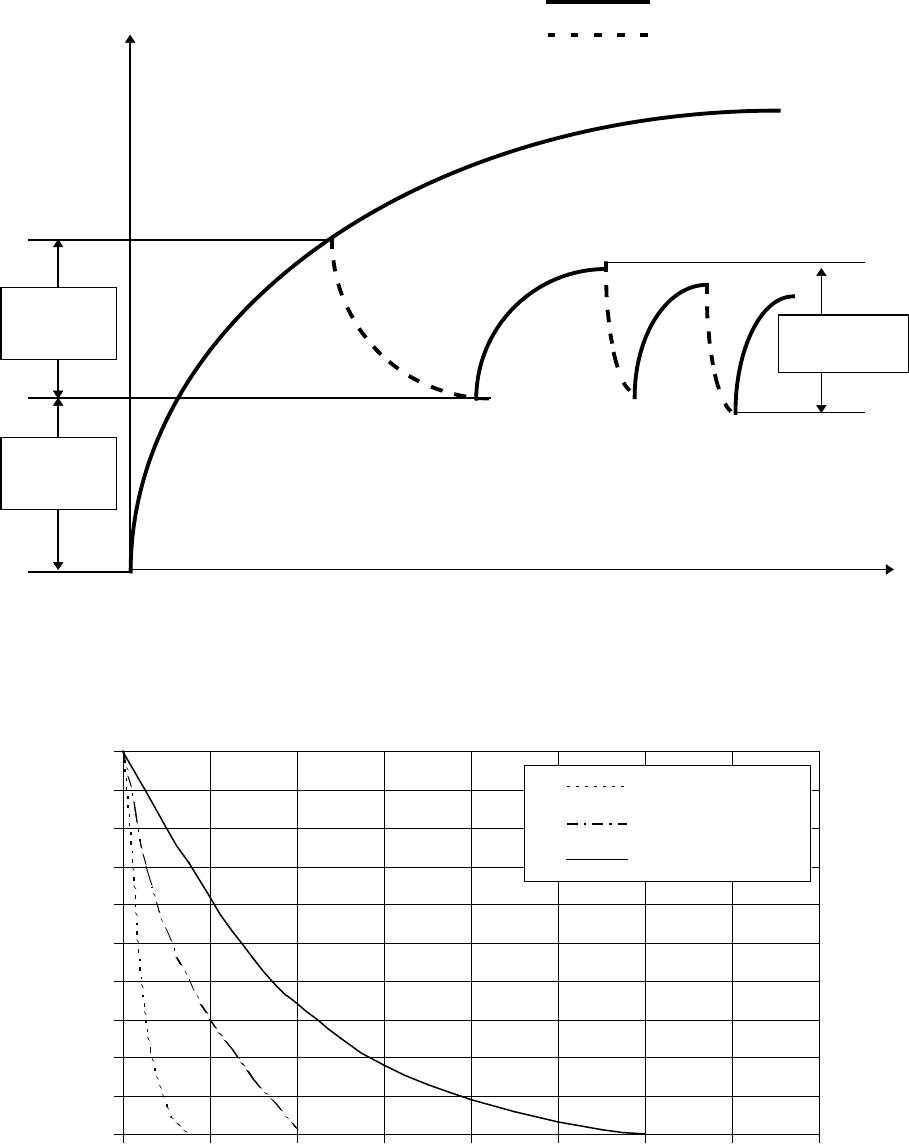
As shown in Fig. 5.1, if concrete is successively wetted, it again swells but only a part of
the initial shrinkage is reversible and subsequent cycles of wetting and drying are
characterised by lower volume changes (moisture movement).
The reversible part of shrinkage ranges between 40 and 70% of the initial shrinkage,
depending also on the age of the onset of first drying and on the extension of
concurrent carbonation. The irreversible drying shrinkage is probably due to the
development of new chemical bonds within the paste structure as a consequence of
drying.
Drying is generally very much slower than wetting. This can be justified by considering
that when the water flows outwards through gel and capillary pores, the adsorption
bonds of water particles increases as the water content decreases.
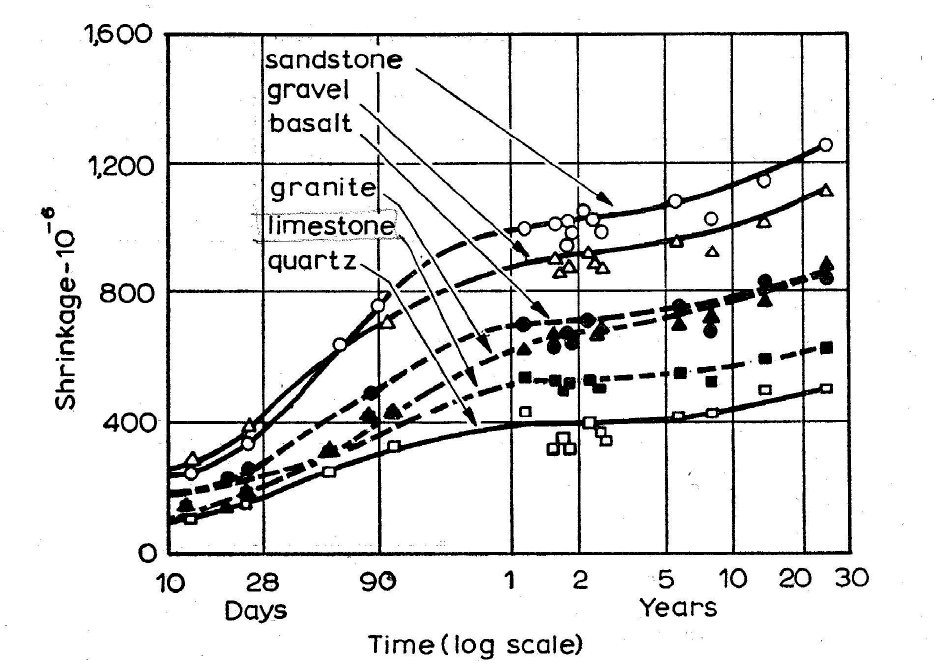
Massive concrete is characterised by an even lower rate of drying and the deeper is the
concrete layer considered the lower is the loss of water and then its shrinkage. Fig. 5.2
shows that, although the drying penetration depends obviously also on environmental
relative humidity, in practice concrete underneath 50 - 60 cm is not subjected to any
loss of water and drying shrinkage. It is therefore evident that a gradient of relative
humidity will be established between the surface and the internal part of a massive
concrete, inducing stresses and possible cracks.
ICOLD Bulletin: The Physical Properties of Hardened Conventional Concrete in Dams
Section 5 (Shrinkage)
As submitted for ICOLD review, march 2008 Section 5-4
in air
in water
Drying
Shrinkage
time
Reversible
Shrinkage Moisture
Mouvement
Irreversible
Shrinkage
Fig. 5.1 - Volume changes and humidity conditions (just qualitative behaviour)
0
10
20
30
40
50
60
70
80
90
100
0 10 20 30 40 50 60 70 80
Depth under the concrete surface (cm)
Loss of evaporable water
after 1 month
after 1 year
after 10 years
Fig. 5.2 - Loss of water at different depths from a massive concrete at 50% R.H.
ICOLD Bulletin: The Physical Properties of Hardened Conventional Concrete in Dams
Section 5 (Shrinkage)
As submitted for ICOLD review, march 2008 Section 5-5
5.4 FACTORS AFFECTING DRYING SHRINKAGE
Drying shrinkage is affected by several factors that very often act simultaneously [5.4].
To assess its influence it is necessary to consider them separately, also because their
interrelations are quite complex and not still completely understood.
5.4.1 Materials and mix design
The main source of concrete drying shrinkage is its hydrated cement paste: the higher
the water content and the higher its porosity and the larger the resulting shrinkage.
However the shrinkage of concrete is considerably less than that of cement paste owing
to the restraint against deformation of the surrounding aggregates. The ratio of the
concrete shrinkage (S
c
) and the relative cement paste shrinkage (S
p
) can be estimated
through the relation S
c
=S
p
*(1-a)
n
where “a” is the volume fraction of aggregate and n a
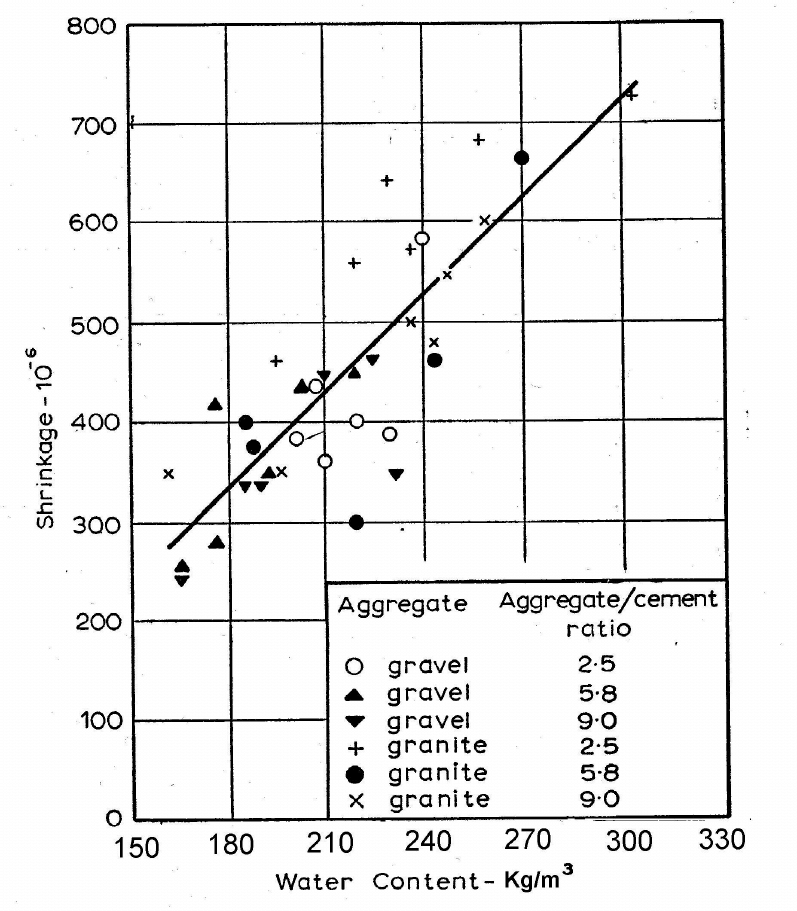
value depending on the elastic modulus of [5.5]. The higher the aggregate modulus the
lower the concrete shrinkage (Fig. 5.3). Therefore quartz or granite (high modulus of
elasticity) generally give a concrete with less shrinkage than sandstone (low modulus of
elasticity). Granite and sandstone aggregate used in some concrete investigations on
Guri dam (Venezuela) indicated shrinkage values at 90 days passing respectively from
340 to 750 * 10
-6
, other conditions being constant [5.6]. An increase of water content
also reduces the volume of restraining aggregate and thus results in higher shrinkage.
The aggregate content of the concrete, the aggregate modulus of elasticity and the
water content are therefore the most important material factors influencing concrete
drying shrinkage. The water content of a mix would just indicate the order of shrinkage
to be expected: some indications for normal concrete are reported in Fig. 5.4. For dam
concrete, water contents even lower than the value of 160 kg/m
3
reported in Fig. 5.4 are
used but shrinkage values below 200 * 10
-6
are hardly to be obtained.
Other parameters can indirectly have an influence through their effect on the aggregate
content of concrete and on the compactability of concrete mixture. For example the
maximum aggregate size and grading control the amount of cement paste in a properly
designed concrete mix. Therefore larger maximum size aggregates allow the use of
leaner mixes, at a constant water/cement ratio, and then lead to a lower drying
shrinkage. In some cases the importance of the shrinkage of the aggregate on the
shrinkage of concrete has been emphasised [5.7] [5.8]. Aggregates with low modulus of
elasticity and high absorption capacity could exhibit significant changes in volume from
the wet to the dry state an vice versa.
The properties of cement have minor influence on concrete shrinkage. For example
fineness and composition of Portland cement affect mainly the rate of hydration but not
the characteristics of the hydration products [5.2]. Mineral additions as granulated slag
and pozzolans and accelerators admixtures as calcium chloride seem to increase the
drying shrinkage as the result of pore refinement of cement paste. Mineral admixtures
may increase the shrinkage also because of their increased water demand. Water
reducing admixtures have naturally a significant effect on limiting the concrete
shrinkage while air entrainment admixtures has not been found to have a significant
influence.
ICOLD Bulletin: The Physical Properties of Hardened Conventional Concrete in Dams
Section 5 (Shrinkage)
As submitted for ICOLD review, march 2008 Section 5-6
Fig. 5.3 – Shrinkage of concretes with different aggregates and stored in air at 21°C
and 50% relative humidity [5.2]
ICOLD Bulletin: The Physical Properties of Hardened Conventional Concrete in Dams
Section 5 (Shrinkage)
As submitted for ICOLD review, march 2008 Section 5-7
Fig. 5.4 – Relation between water content of fresh concrete and drying shrinkage for
different aggregate types and aggregate/cement ratio [5.2]
5.4.2 Time, humidity and temperature
It is well known that shrinkage takes place over a considerably long period of time (20
to 30 years) but the rate of increasing of shrinkage decreases with time. Most of the
total shrinkage occurs in the first years. Fig. 5.3 shows an example of concrete drying
shrinkage over a period of 30 years for concretes of fixed mix proportions but made of
different aggregates and stored in air at 21°C and 50% relative humidity, after an initial
wet curing of 28 days [5.3].
ICOLD Bulletin: The Physical Properties of Hardened Conventional Concrete in Dams
Section 5 (Shrinkage)
As submitted for ICOLD review, march 2008 Section 5-8
A prolonged moist curing before drying delays the shrinkage development but
contradictory results on the final shrinkage magnitude of concrete have been reported.
It is generally assumed that long initial moist curing tends to reduce the shrinkage.
On the contrary, the relative humidity of the environment surrounding the concrete
greatly affects its drying shrinkage. Therefore much attention should be given to keep
the concrete surfaces from drying out during construction.
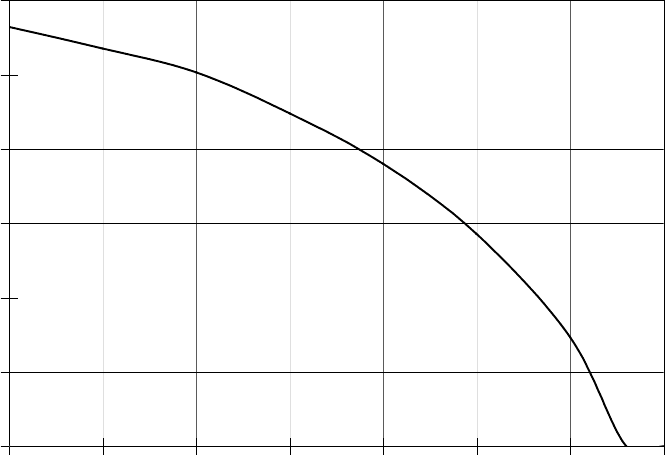
There is a theoretical hygrometry equilibrium at 94% relative humidity at which does not
occur neither weight nor volume changes. At lower humidity the water flows from the
interior to the outer surface of concrete and the shrinkage increases as the humidity
decreases. For a given exposure time, the effects of relative humidity of air on drying
shrinkage of a structural concrete are shown in Fig. 5.5. In the above quoted concrete
investigations carried out on Guri dam (Venezuela), the ratio between the shrinkage
value at 70 % and 50% was about 0.7 as reported in Tab. 5.1 [5.6], confirming the trend
of curve in Fig. 5.5.
Temperature is generally less important than relative humidity, affecting mainly the rate
of concrete ageing due to the more rapid development of cement hydration.
0
0,2
0,4
0,6
0,8
1
1,2
30 40 50 60 70 80 90 100
Relative humidity (R.H.) of air (%)
Relative drying shrinkage
d.s.( R.H.) /d.s.(50%)
Fig. 5.5 – General trend of the effect of relative humidity of the environment upon
drying shrinkage [5.9]

ICOLD Bulletin: The Physical Properties of Hardened Conventional Concrete in Dams
Section 5 (Shrinkage)
As submitted for ICOLD review, march 2008 Section 5-9
Tab. 5.1 – Range of drying shrinkage for different concrete compositions and different
environmental conditions
Water content
110/160, l/m
3
250/650
Fineness of cement:
Spec. surface, cm
2
/g
ASTM I 2200/1300 800/700
ASTM IV 2200/1300 1050/850
sandstone 750
granite 340
fog/water curing ±zero
70% RH 500
50%RH 700
28 days 300
90 days 250
Range of variable
Range of shrinkage at age of 90 days
[10
-6
]
Ambient humidity
Aggregates
Duration of moist curing
Variable
Conditions:
concrete with MSA=20mm, water/cement ratios between 0.59 and 0.62,
28 days fog curing, thereafter in 50% rel. humidity (RH) at 21
0
C.
5.4.3 Geometry
For a given period of time, at a constant relative humidity and temperature and with a
fixed concrete mix composition, the magnitude of shrinkage depends on both size and
shape of the concrete element. In fact they influence the length of the path travelled by
the water diffusing from the interior of the concrete to the atmosphere.
The shrinkage increases as the ratio between volume and surface area decreases. The
shrinkage of a concrete element with a ratio of 150 mm is about one half of that showed
by the same concrete in an element with a volume/surface ratio of 25 mm [5.10], [5.4].
Therefore for practical purposes drying shrinkage cannot be considered as purely an
inherent property of concrete without reference to the size and shape of the element.
ICOLD Bulletin: The Physical Properties of Hardened Conventional Concrete in Dams
Section 5 (Shrinkage)
As submitted for ICOLD review, march 2008 Section 5-10
5.5 ESTIMATION OF DRYING SHRINKAGE
5.5.1 Laboratory methods
The measurement of drying shrinkage is covered by several National Standards. For
example ASTM C 157 [5.11] prescribes the use of concrete prisms of 100 mm square
cross section and 285 mm long. After 28 days of moist curing, the specimens are
stored in a dry room at a temperature of 23 °C and a relative humidity of 50% up to 64
weeks. The magnitude of shrinkage can be determined by means of a measuring frame
fitted with micrometer gauges or inductive transducers. ASTM C 341 [5.12] provides for
similar procedures in the case of specimens cored from a structure.
Nevertheless these specimens are usually not suitable for a dam concrete, due to their
small sizes in comparison with the typical aggregate maximum size used in dam
construction. Larger specimens should then be considered and, if necessary, the
concrete be sieved.
Some results obtained by the Bureau of Reclamation on mass concrete for dams are
reported in Tab. 5.2. The tests were conducted on 100 x 100 x 705 (or 1000) mm
specimens from concrete wet screened from the mass mix to contain 38 mm maximum
size aggregate. Drying shrinkage specimens were fog cured for 14 days after
fabrication and then allowed to dry in a room at 50 % relative humidity and 23 °C. In
Tab. 5.2 autogenous shrinkage results are also reported. They were obtained in on
specimens sealed in soldered copper jackets and maintained at 23°C [5.13].
However the results obtained on concrete test specimens in the laboratory are of
limited value in determining the amount of shrinkage which actually takes place in the
concrete of a dam. This is due to the fact that shrinkage is very much dependent on the
size of specimens being tested and on the humidity and temperature conditions. The
rate and magnitude of shrinkage of a small laboratory specimen will be much greater
than that obtained on the concrete in the structures. Furthermore, even if carbonation
shrinkage has a minor importance in the overall shrinkage of a concrete dam, it plays
an important role in the shrinkage of small specimens, particularly when subjected to
long term exposure to drying in laboratory [5.14].
Therefore it is a common practice to estimate drying shrinkage from empirical formulas
as herein described.