
International Commission on Large Dams (ICOLD) - The Physical Properties of Hardened Conventional concrete in Dams
Подождите немного. Документ загружается.

ICOLD Bulletin: The Physical Properties of Hardened Conventional Concrete in Dams
Section 6 (Thermal properties)
As submitted for ICOLD review, march 2008 Section 6-2
The hydration reactions of the cement develop and conclude during the early years of
the life while the environmental variations of temperature continue to affect the
structure throughout its lifetime.
In both cases a careful analysis of the temperature distribution in the dam must take
into account the effective heat of hydration developed during the hardening phase of
concrete, the thermal conductivity and diffusivity, the specific heat and the coefficient of
thermal expansion of the concrete. All these parameters evolve during the setting time
and depend on temperature and moisture content of concrete.
Some data on thermal properties of concrete dams can be found in reference [6.1].
6.2 TEMPERATURE RISE OF YOUNG CONCRETE DURING HYDRATION OF
CEMENTITIOUS MATERIALS
One of the most important factor associated with thermal cracking in concrete dams is
the evolution and distribution of the rise in temperature at any time after pouring. The
rise in temperature is a direct result of the heat evolved from the hydration of the
cement.
In order to minimise the risk of thermal cracking in concrete dams a knowledge of the
expected temperature rise during the hydration of cement is desirable. The temperature
distribution in hardening concrete depends in a complex way on a large number of
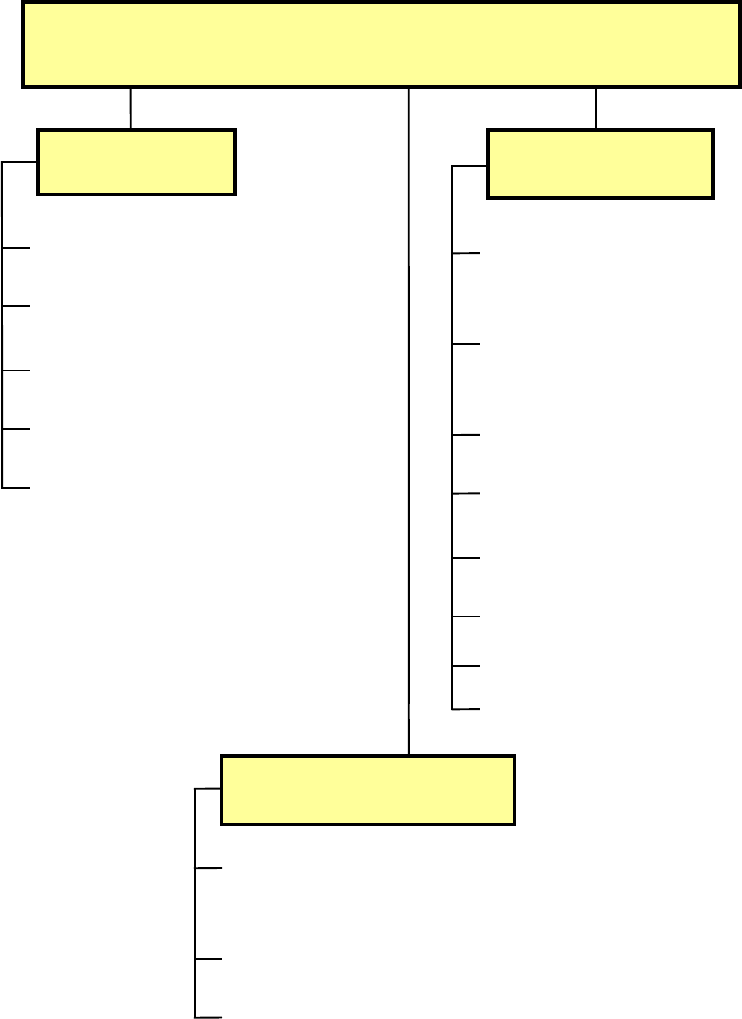
parameters: they are schematically summarised in Fig. 6.1. They can be divided among
factors related to mix design (type and content of cementitious material and
aggregates, water content, admixtures, etc.), factors related to construction techniques
(block shapes and sizes, restraint conditions, speed of placement, artificial cooling
systems, curing procedures, heat loss through galleries and shafts, creep, etc.) factors
related to the environment conditions (temperature daily fluctuations, heat gain by solar
radiation, wind effects, etc.). Also the thermal properties of concrete (conductivity,
diffusivity and specific heat) play an important role: they, in turn, mainly depend on the
type of aggregate.
Numerous laboratory techniques have been developed to measure the temperature rise
in concrete [6.2] [6.3]. They range from sophisticated calorimeters used to monitor the
temperature in very small samples of cement to temperature measurements at the
centre of a large insulated block of concrete.
The testing methods used to this aim can be divided into the following categories: heat
of solution technique, isothermal conduction calorimetry, adiabatic and semi-adiabatic
calorimetry .The first two method methods are applied to pure cement or cementitious
pastes and make them possible to measure the heat generated by samples kept at
constant temperature. Temperature rise in concrete under adiabatic conditions is then
calculated, based on the experimental test results. The adiabatic and semi-adiabatic
calorimetry can instead be applied to concrete, directly measuring the temperature rise.
ICOLD Bulletin: The Physical Properties of Hardened Conventional Concrete in Dams
Section 6 (Thermal properties)
As submitted for ICOLD review, march 2008 Section 6-3
Fig. 6.1 – Lay-out of factors influencing temperature control in concrete
!
"
#
$ !!
!
%
#
$
$ &

ICOLD Bulletin: The Physical Properties of Hardened Conventional Concrete in Dams
Section 6 (Thermal properties)
As submitted for ICOLD review, march 2008 Section 6-4
6.2.1 Heat of solution technique
This technique consists of determining the heat of solution of hydrated cement or
cementitious material by dissolving the hydrated material in a mixture of acids and
recording the temperature rise in an insulated container (calorimeter). By subtracting
the equivalent measure for the unhydrated cementitious powder, the heat of hydration
can be obtained. Measurements are typically performed after 3, 7 and 28 days of
hydration. Standard procedures for determining the heat of hydration of cement by the
heat of solution method exist (EN 196/8 and ASTM C186). Low heat cements must not
exceed a maximum heat of hydration value of 270 J/g (about 65 cal/g).
The concrete temperature rise under adiabatic conditions ∆T is then determined by the
following relationship:
γ
*
)(
c
tQ
T =∆ (6.1)
being Q(t) the total heat of hydration for unit volume of concrete developed at a
considered time, c the concrete specific heat and γ the density of concrete. This
methods do not take account of the parameters that affect the temperature rise in real
structure, so Equation (6.1) gives rise to large errors.
6.2.2 Isothermal conduction calorimetry
More and more works laboratories refrain from performing the solution method in auto-
control procedures, applying an isothermal heat flux calorimeter instead.
With this method [6.4], the heat of hydration of cement paste is directly measured by
monitoring the heat flow from the specimen when both the specimen and the
surrounding environment are maintained at approximately isothermal conditions
(isothermal heat flux calorimeter). Thermopiles are often used to convert the thermal
flux into a voltage, which can be continuously monitored. This device measures the
release of heat “online” throughout the hydration period, which permits to illustrate the
reaction sequences of different cements or cementitious mixes. One difficulty lies in
capturing the heat released during the initial mixing (wetting) of the cement and water.
Calorimeters have been designed with internal mixing units to attempt to capture the
complete heat signature curve.
The heat flux calorimeter further permits to investigate the impact of mineral and
chemical admixtures on cement hydration. The chemical admixture can either be input
with the water or the cement during the mixing process, or after a time lag. The change
in the sequence of heat of hydration release conveys information on the working
mechanism of the chemical admixtures.
Again the concrete temperature rise under adiabatic conditions is then determined by
the equation 6.1.
The ideal testing method should be able to reproduce the temperature = f(time) curve of
each type of concrete during hardening. Since the information obtained though
isothermal tests do not reflect the conditions in the real structure, prediction of the
temperature rise of concrete from these results can be difficult.
ICOLD Bulletin: The Physical Properties of Hardened Conventional Concrete in Dams
Section 6 (Thermal properties)
As submitted for ICOLD review, march 2008 Section 6-5
6.2.3 Adiabatic or Semi-Adiabatic Calorimetry
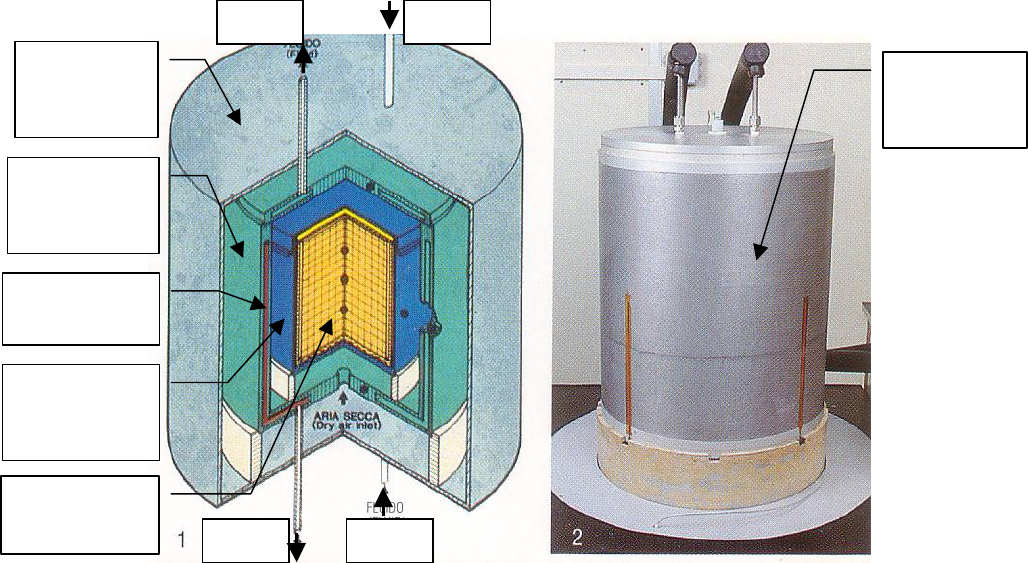
Adiabatic and semi-adiabatic methods are much more reliable. They use calorimeters
(Fig. 6.2) for measuring directly the temperature rise in a concrete sample being
hydrated: the first ones work with no heat exchanges with the external medium, in the
second one the heat exchange with the external environment is limited.
Since it is impossible to achieve an adiabatic environment, the calorimeter is
considered adiabatic as long as the temperature loss of the sample is not greater than
0.02 °C/h. Controlling the temperature of the surrounding environment prevents the
heat loss. The insulated material could be water, air and heated containers. Water
insulation is the most popular way [6.5].
Adiabatic heat measurements are most convenient for producing a continuous heat of
hydration curve under curing conditions close to mass curing. And also adiabatic
hydration curves are the most suitable starting points for temperature calculation in
hardening concrete dams. One of the major drawback of an adiabatic calorimeter is the
effect of curing temperature on the rate of hydration is measured implicity. The
activation energy is required to convert the result to the isothermal reference
temperature. The result can also be affected by the assumption of the thermal
properties of the materials. The advantage is that the heat evolution of an actual
concrete mixture can be determined.
Fig. 6.2 – Adiabatic calorimeter scheme
Concrete
Sample
Sample
container in
stainless
Fluid Fluid
Heating
resistors
A
luminium
isothermal
shield
Fluid Fluid
Outer
stainless
steel body
A
luminium
isothermal
shield
ICOLD Bulletin: The Physical Properties of Hardened Conventional Concrete in Dams
Section 6 (Thermal properties)
As submitted for ICOLD review, march 2008 Section 6-6
6.2.4 Comparison among different methods
True adiabatic conditions are impossible to achieve but they do at least more closely
resemble conditions at the centre of a large pour than do the isothermal conditions.
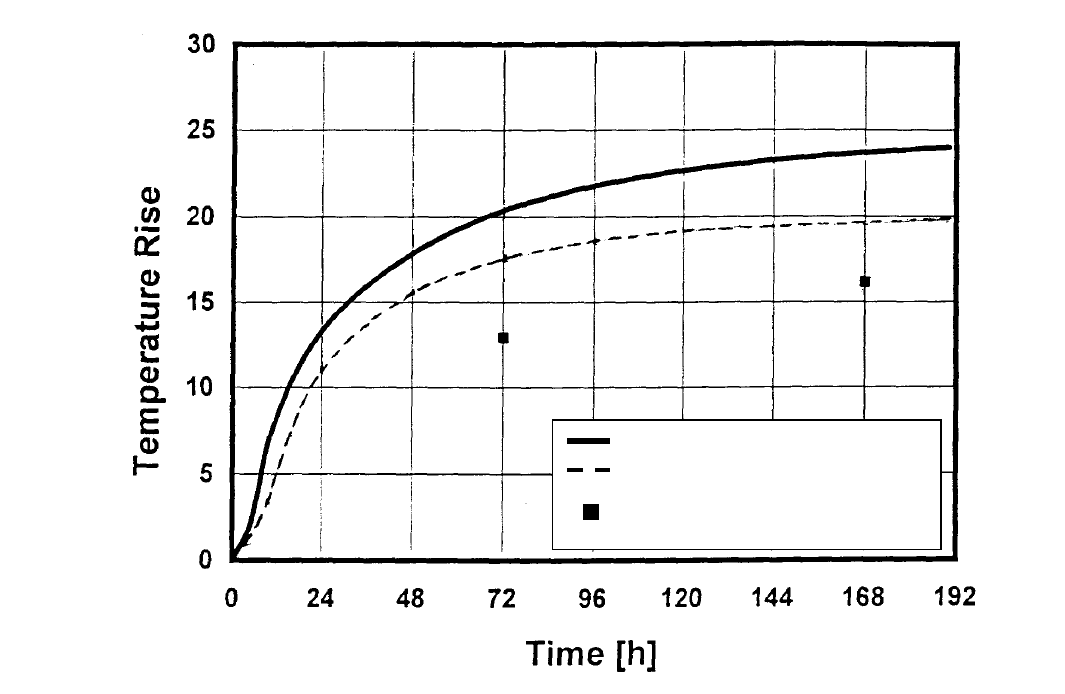
An exhaustive example of experimental data concerns the results given in Fig. 6.3 with
respect to a concrete used for an Italian large dam. To prevent a large amount of
temperature rise a pozzolanic cementitious mixture has been used.
The mix composition is: cement content 200 kg/m
3
, basalt aggregate 2082 kg/ m
3
, fly
ash 50 kg/ m
3
, w/c=0.82. The measurements of heat of hydration of the cementious
mixture performed by the heat of solution method at 3 and 7 days have given 40 cal/g
and 49 cal/g respectively.
From the measurement of the specific heat of concrete equal to 0.25 kcal/kg/ ºC and
applying equation 6.1, the corresponding adiabatic temperature rises are 13ºC and
16ºC, respectively.
The adiabatic temperature rises measured directly at the same time during the
hydration of 25 litres of a concrete sample have given 20°C and 24 °C, respectively.
Moreover, the in situ measurement of temperature rise at the centre of a dam block
during the construction is only a little lower than the adiabatic temperature rise, as a
consequence of an amount of heat losses. In conclusion, the use of the heat of solution
technique has given rise to an underestimate of about 35% on the evaluation of the
adiabatic temperature rise.
ICOLD Bulletin: The Physical Properties of Hardened Conventional Concrete in Dams
Section 6 (Thermal properties)
As submitted for ICOLD review, march 2008 Section 6-7
Fig. 6.3 - comparison between heat of solution technique, adiabatic and in situ
measurements
This example put also in evidence that a more realistic test would perhaps be to use
semi-adiabatic methods where some heat is lost form the calorimeter. It should be
realised, however, that even these tests may not truly reflect the conditions in the
structure where the rate of heat loss is continually changing. However, also in presence
of constant rate of heat losses, it would be very difficult and expensive to accurately
reproduce them in the laboratory. So, through a careful calibration, semi-adiabatic
calorimeters must be considered as an alternative and less expensive way to reproduce
the adiabatic temperature rise with a lower accuracy than adiabatic calorimeters do.
Adiabatic and semi-adiabatic calorimeters have been developed to measure the
temperature rise in cement pastes, cement mortars and concrete samples. Although
those developed for use with pastes and mortars are often much smaller than those
used for concretes, the results obtained do not give a direct measure of the
temperature rise in the concrete. The results can only be used to estimate the
behaviour of the concrete from a knowledge of the mix proportions and thermal
characteristics of the aggregates. Calculations of this kind can be extremely difficult
because the kinetics involved are significantly different due to the effects of the
aggregate.
Adiabatic measures
In situ measurements
Calculated values from
heat of solution technique
°C
ICOLD Bulletin: The Physical Properties of Hardened Conventional Concrete in Dams
Section 6 (Thermal properties)
As submitted for ICOLD review, march 2008 Section 6-8
For calculations by numerical models, it would be preferable to have an expression
describing the heat of hydration of concrete. This is very difficult to obtain since, as it
has been mentioned, the number of parameters that affect the heat of hydration of
concrete is so high that actually no general expression of the heat of hydration is
existing. So, it is common practice to perform a direct measurement of the temperature
rise of the concrete by adiabatic or semi-adiabatic methods and use the experimental
data in a tabular form as input for numerical methods.
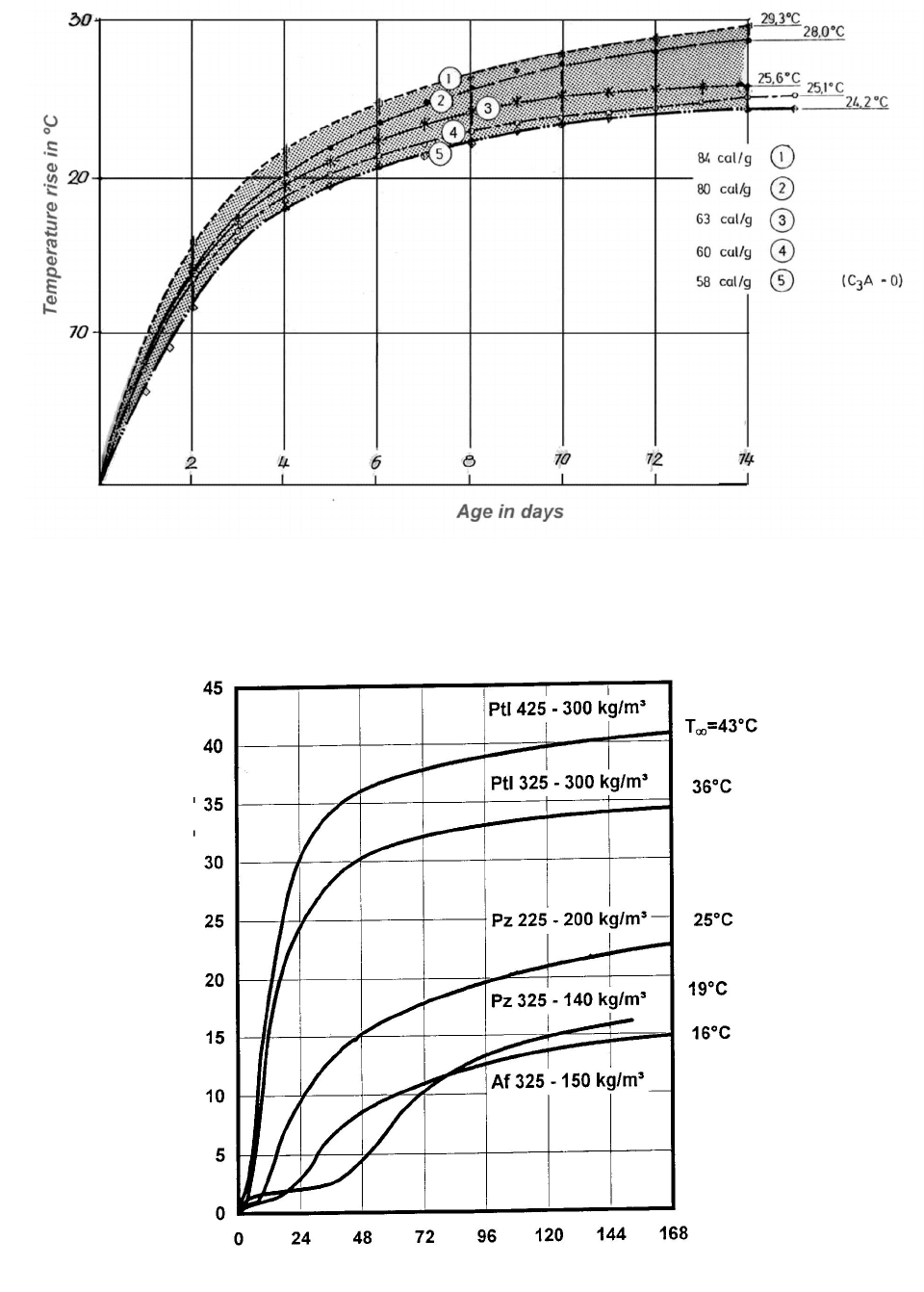
Other examples of adiabatic temperature rise curves from a dam concrete are reported
in Fig. 6.4., in Fig. 6.5 and in Fig. 6.6.
In Fig. 6.4 the temperature rise of concretes with constant content of cementitious
materials, but different heats of hydration of the cementitious mixes, are reported: they
refer to a long period of time, up to 74 days.
Fig. 6.5 shows the temperature rise of concretes with different types of cement (normal
Portland, Pozzolanic and Blast Furnace) at different cement contents (from 140 to 300
kg/m
3
). The infinite time temperature rise is obtained by extrapolating the results of the
first 7 days.
Finally, for two of the concretes of Fig. 6.5 (Portland cement Ptl 325 at a cement
content of 300 kg/m
3
and Pozzolanic cement Pz 225 at a cement content of 200 kg/m
3
),
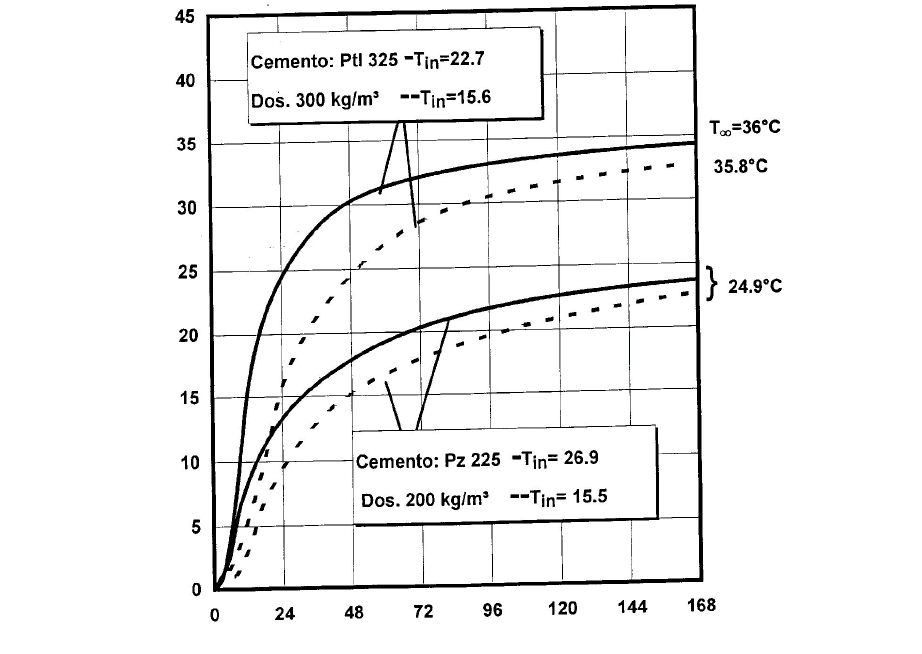
the effect of different initial temperature (over 20 °C and about 15 °C) is shown in Fig.
6.6. Even if the final rise temperature at infinite time is almost the same, the heat
evolution with time of the concrete mixtures are quite different, especially at the first
week, when the tensile properties of concrete are low. This behaviour underline the
importance of the concrete temperature at placement on the crack tendency of a dam.
Thermal cracking in dams is most critical to occur in the core of a lift and at the lift joint.
The latter is occasionally forgotten in the thermal analysis (long waiting time at lift joints
can create high temperature difference).
ICOLD Bulletin: The Physical Properties of Hardened Conventional Concrete in Dams
Section 6 (Thermal properties)
As submitted for ICOLD review, march 2008 Section 6-9
Fig. 6.4 – Example of adiabatic temperature rise with cements of different heat of
hydration (content of cementitious material: 180 kg/m
3
) [6.7]
Fig. 6.5 – Examples of adiabatic temperature rise with different cements and cement
contents (Ptl = Portland cement; Pz = Pozzolanic cement; Af = Blast Furnace cement)
Time (h)
Temperature
rise (°C)
ICOLD Bulletin: The Physical Properties of Hardened Conventional Concrete in Dams
Section 6 (Thermal properties)
As submitted for ICOLD review, march 2008 Section 6-10
Fig. 6.6 - Examples of adiabatic temperature rise for two concretes with different initial
temperature
6.3 THERMAL CONDUCTIVITY OF HARDENED CONCRETE
The thermal conductivity of a concrete is the rate at which it transmit heat and is
defined as the ratio of the flux of heat to the temperature gradient.
Thermal conductivity λ of concrete depends on the moisture content, type of aggregate,
porosity, density and temperature. For ordinary hardened concrete in a normal
temperature and moisture state, thermal conductivity may vary between 1.2 and 3.0
[W/mº/K]. Values beyond 3.0 W/mº/K, even up to 3.5 W/mº/K, are found as well (Tab.
6.1). Besides a strong dependency on the type of aggregate, the conductivity also
depends on the moisture content in the pore system.
Time (h)
Temperature
rise °C

ICOLD Bulletin: The Physical Properties of Hardened Conventional Concrete in Dams
Section 6 (Thermal properties)
As submitted for ICOLD review, march 2008 Section 6-11
Tab. 6.1 – Typical coefficient of thermal conductivity of concrete: typical values (1 W/(m
°C) = 0.8598 kcal/(m °C h)
Thermal conductivity of concreteType of aggregate
[W/(m °C)] [kcal/(m ºC h)]
Quartzite 3.5 3.0
Dolomite 3.2 2.7
Limestone 2.6 - 3.3 2.2 - 2.8
Granite 2.6 - 2.7 2.2 – 2.3
Rhyolite 2.2 1.9
Basalt 1.9 - 2.2 1.6 - 1.9
6.3.1 Effect of dry density
The influence of the dry density γ
0
is mainly correlated with the content and the type of
aggregate. With some exception in concretes with barytes aggregate, the following
relationship [6.8] [6.9] between thermal conductivity and dry density can be used:
λ
γ
o
e
o
=
0
072
0 00125
.
. .
(6.2)
where the thermal conductivity is expressed in W/(m ºC) and the dry density in kg/m
3
.
6.3.2 Effect of temperature
Data concerning the effect of temperature on thermal conductivity are rather scarce.
However, they agree in indicating a decrease in thermal conductivity with the increasing
temperature. As order of magnitude, it can be assumed a decrease of about 0.04 W/(m
ºC) for a rise in temperature of 10 ºC [6.8].
6.3.3 Effect of moisture content
The thermal conductivity of concrete increases with increasing of the moisture content.
For the determination of the effect of the water content on the thermal conductivity of
moist concrete the ACI recommends the use of the following formula [6.8] [6.9]:
λ = λ
0
(1+k
w
*
w
γ
0
) (6.3)
with: λ
0
= thermal conductivity of oven-dried concrete