
International Commission on Large Dams (ICOLD) - The Physical Properties of Hardened Conventional concrete in Dams
Подождите немного. Документ загружается.


ICOLD Bulletin
:
The Physical Properties of Hardened Conventional Concrete in Dams
Section 6 (Thermal properties)
As submitted for ICOLD review, march 2008 Section 6-12
γ
0
= density of oven-dried concrete [kg/m
3
]
k
w
= factor equal to 6 for light weight concrete and to 9 for
normal concrete
w = water content [kg/m
3
]
6.3.4 Measurement method
No standard testing method exists to measure the thermal conductivity of concrete. The
main reason is that concrete is a complex system constituted from a solid skeleton and
pore space, partially filled with water, which can be closed or interconnected. As far as
a thermal gradient is applied migration of the water through the interconnected pore
spaces takes place. This alters the hygrometric conditions of the sample to be tested,
the higher the thermal gradient and the longer the duration of the test, the higher the
degree of disturbance is. For this reason the standard testing methods for insulating
and dry materials, such as the hot guarded plate method, cannot be applied to concrete
samples unless they are in oven-dried conditions. The alternative way is to use
transient methods. The most popular is the linear heat source method [6.9], which
consists in inserting in the material a thermal probe, heated at constant power, and in
measuring the temperature rise during the transient time. Data reduction according to
the linear heat source theory allows to determine the thermal conductivity.
6.4 SPECIFIC HEAT OF HARDENED CONCRETE
The specific heat c of concrete is the heat required to rise a unit weight of concrete 1
degree. It can be determined from the values of the component parts of the mix:
C c g
i i
=
.
(6.4)
with: g
i
= fraction of content by mass of the mix components
c
i
= specific heat of the mix components:
The range of specific heats of the constituents are:
aggregate: c
a
= 0.7 - 0.9 k J/kg ºC
1
= 700 – 900 J/kg,
0
C
cement: c
e
= 0.84 kJ/kg ºC
water: c
w
= 4.186 kJ/kg ºC
Typical values of the specific heat for ordinary concrete vary between 0.850 and 1.15
kJ/kg ºC [6.10].
Because of the high specific heat of water there is a strong correlation between the
specific heat of a mix and the amount of water content. The specific heat of concrete
increases with increasing moisture content. For water saturated concrete the higher
values apply while the lower values can be referred to dry concrete.
1
1 J/kg, C
0
= 0.24x10
-3
kcal/kg, C
0
= 2.38x10
-4
Btu/lb
0
F

ICOLD Bulletin
:
The Physical Properties of Hardened Conventional Concrete in Dams
Section 6 (Thermal properties)
As submitted for ICOLD review, march 2008 Section 6-13
The specific heat also increases with the increasing temperature: an increase of about
10% for an increase in temperature from 10 ºC to 66 ºC has been reported by ACI [6.8].
6.5 THERMAL DIFFUSIVITY OF HARDENED CONCRETE
Diffusivity is described as an index of the ease or difficulty with which concrete
undergoes temperature change.
Thermal diffusivity a is defined as the quotient of the coefficient of thermal conductivity
and the specific heat per unit volume:
a =
λ
γ.c
(6.5)
The main factor of influence on the thermal diffusivity is the type of aggregate. Tab. 6.2
gives typical values of thermal diffusivity of concrete for different types of aggregate
[6.9].
Tab. 6.2 – Typical thermal diffusivity of concrete for different types of aggregate.
Coarse aggregate Diffusivity
[m
2
/h]
Quartzite 0.0054
Limestone 0.0045 – 0.0055
Dolomite 0.0046
Granite 0.0040
Rhyolite 0.0033
Gneiss 0.00354 – 0.004
Basalt 0.0030
Thermal diffusivity of cement varies between 0.002 and 0.004 m
2
/h.
As for thermal conductivity, also diffusivity depends on dry density, moisture content
and temperature. The dependency on the moisture content and temperature follows
from the dependency in the coefficient of thermal conductivity and the specific heat
from these parameters.
ICOLD Bulletin
:
The Physical Properties of Hardened Conventional Concrete in Dams
Section 6 (Thermal properties)
As submitted for ICOLD review, march 2008 Section 6-14
6.5.1 Effect of dry density
Very little data are reported about the influence of the dry density on the thermal
diffusivity. They however indicate a linear increase of diffusivity with the dry density of
the order of 0.00012 m
2
/h for an increase in dry density of 100 kg/m
3
, in the range of
1500-2500 kg/m
3
[6.9].
6.5.2 Effect of moisture content
As both conductivity and the specific heat increase with increasing moisture content,
the net effect on the coefficient of thermal diffusivity is only marginal. Data reported in
literature do not indicate a dependence of diffusivity from moisture content.
6.5.3 Effect of temperature
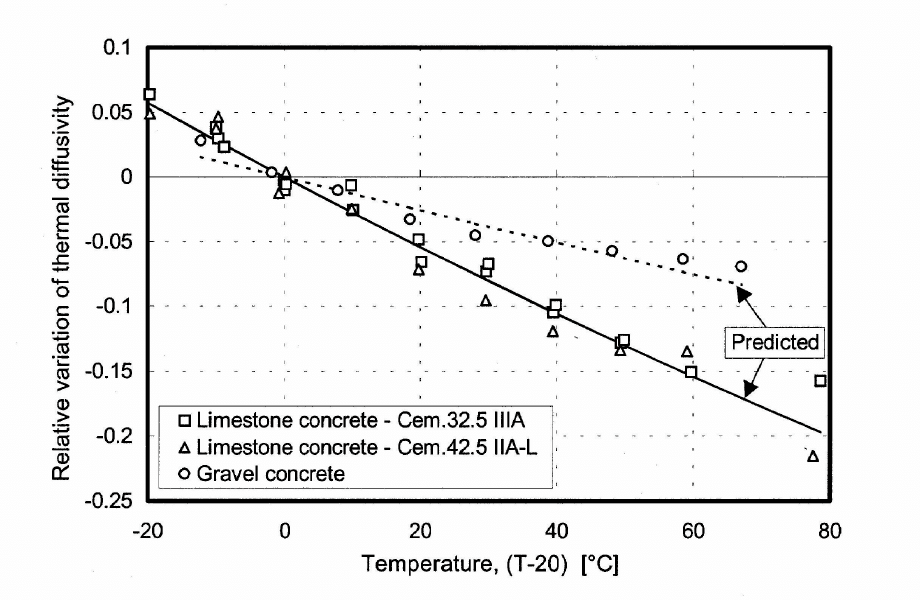
The influence of temperature on the thermal diffusivity depends upon the corresponding
influence on both the thermal conductivity and the specific heat. Since with increasing
temperature the conductivity decreases and the specific heat increases, the thermal
diffusivity decreases stronger with increasing temperature (up to about 15% in the
temperature range from 10 ºC to 66 ºC) than the thermal conductivity [6.6]. This effect
has been observed though accurate laboratory measurements (Fig. 6.7).
Fig. 6.7 – Relative variation of thermal diffusivity against temperature variation [6.7]
ICOLD Bulletin
:
The Physical Properties of Hardened Conventional Concrete in Dams
Section 6 (Thermal properties)
As submitted for ICOLD review, march 2008 Section 6-15
However a measurement campaign of the thermal diffusivity on Brazilian dams in the
thermal ranges between 20 and 60°C showed practically no temperature dependence
[6.7]. This could be probably due to the difficulties of these types of measurements
(paragraph 6.5.4).
6.5.4 Measurement method
Even more difficult than for conductivity is the problem to measure the thermal
diffusivity of concrete. The main reason relies upon the fact that, being the concrete an
heterogeneous material, large samples are necessary. Since the testing methods used
for metals, such as the laser flash method, work on very little samples, they cannot be
applied. In the laser flash method, a short pulse (less than 1 millisecond) of heat is
applied to the front face of a specimen using a laser flash, and the temperature change
of the rear face is measured with an infrared (IR) detector.
So thermal diffusivity is usually evaluated by measuring the temperature variations in
different points of a huge concrete sample, or directly in a concrete dam, under a
dynamic temperature field suitably generated inside the concrete. Through a careful
data reduction, which takes into account the phase shift of the thermal wave at the
different points, thermal diffusivity can be estimated.
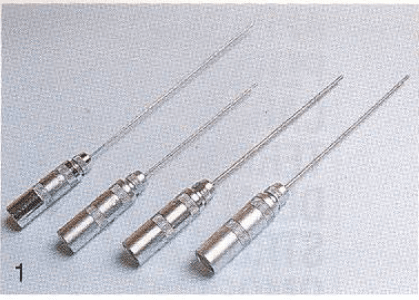
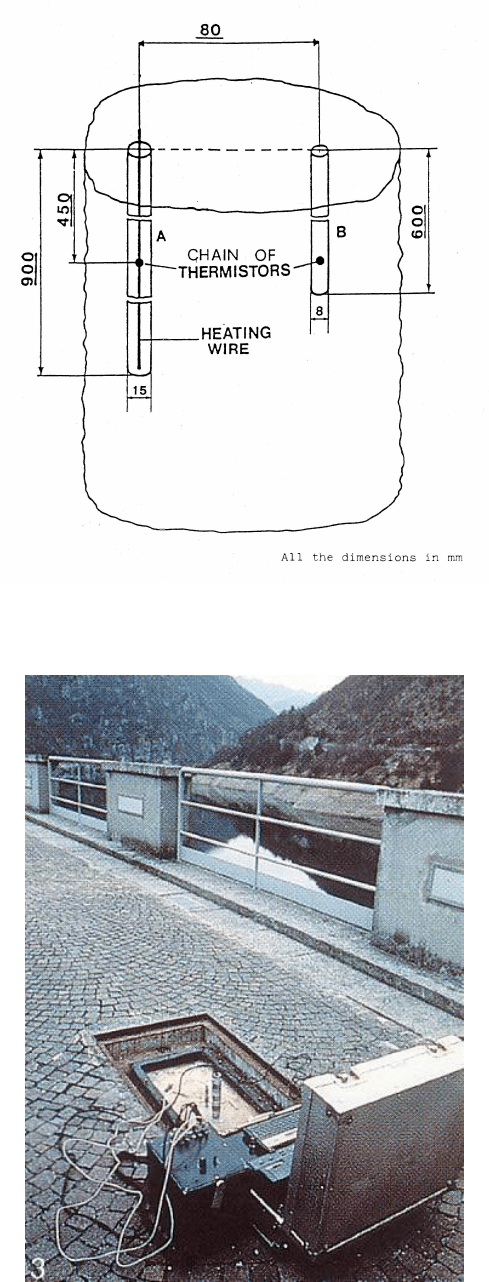
Recently a new testing method has been developed [6.9] [6.11]; it can be applied both
in laboratory samples as well on site. The method is based on the linear heat source
method in the double probe version, namely the two linear parallel probe method (TLPP
method). It consists in inserting two probes inside the sample: one is used as heating
source, the other as temperature sensor positioned at a known distance from the
heating probe.
By applying the linear source theory to the temperature measurements detected by the
second probe during the heating time the thermal diffusivity is also determined.
Such method has the advantage that during a single test both thermal conductivity and
thermal diffusivity can be measured simultaneously; through the measurement of the
density the specific heat can also be determined and, thus, a complete thermal
characterisation of the material is obtained. It can be carried out both in laboratory and
at the dam site.
Fig. 6.8 – Needle probes for thermal tests on concrete specimens in laboratory
ICOLD Bulletin
:
The Physical Properties of Hardened Conventional Concrete in Dams
Section 6 (Thermal properties)
As submitted for ICOLD review, march 2008 Section 6-16
Fig. 6.9 – Lay-out of the two linear parallel probe method for thermal measures in field
(all dimensions in mm).
Fig. 6.10 – Thermal measurements on concrete at a dam

ICOLD Bulletin
:
The Physical Properties of Hardened Conventional Concrete in Dams
Section 6 (Thermal properties)
As submitted for ICOLD review, march 2008 Section 6-17
6.6 COEFFICIENT OF THERMAL EXPANSION OF HARDENED CONCRETE
The coefficient of concrete thermal linear expansion is defined as the change in linear
dimension per unit length divided by the temperature change expressed in millionth per
°C. It is affected to a large degree by the thermal expansion coefficient of the
aggregate, since the latter generally occupies 65-80% of the volume of concrete. The
coefficient of thermal expansion of concrete ranges from 4 µm/m ºC up to 14 µm/m ºC
(Tab. 6.3), usually in the range 8 to 12 µm/m ºC. The thermal expansion coefficient of
pure cement paste is of the order of 20 µm/m ºC, but as the cement content for unit
volume of concrete is very low in respect to the content of aggregate, its influence on
the thermal expansion of concrete is only marginal. No influence of the temperature
seems to exist in the temperature range going from 10° to 80°C.
There are no data concerning the influence of the moisture content: The reason can be
due to the fact that, since it is necessary to reach two different thermal equilibrium
conditions of the sample for the measurement of the thermal expansion, it is very
difficult to maintain the same water content in the sample during the test.
Tab. 6.3 – Typical coefficient of thermal linear expansion of concrete for different types
of aggregate.
Coarse aggregate Coefficient of linear expansion
[10
-6
°C]
Sandstone 4 to 14
Dolomite 7 to 10
Limestone 4 to 12
Basalt 6 to 8
Granite 7 to 9
Other references on thermal properties of concrete are reported from [6.12] to [6.24].
Finally in Tab. 6.4 and Tab. 6.5 a list of thermal properties of dam concretes, mainly
from Bureau of Reclamation, is reported [6.22] [6.25]. Other data of thermal properties
of concrete with mica sand are reported in [6.26].

ICOLD Bulletin
:
The Physical Properties of Hardened Conventional Concrete in Dams
Section 6 (Thermal properties)
As submitted for ICOLD review, march 2008 Section 6-18
Tab. 6.4 – Thermal properties of mass concrete dams (I) [6.22] [6.25]
Dam/
aggregate
°C Coeff. linear
expansion
µm/m ºC
Thermal
conductivity
kcal/mh°C
Thermal
diffusivity
m
2
/h * 10
-3
Specific heat
k J/kg ºC
10 2.53 4.7 0.887
38 2.48 4.4 0.941
Hoover/
Limestone-
granite
66
8.6
2.46 3.9 1.050
10 1.61 2.9 0.916
38 1.61 2.7 0.967
Grand
Cooley/
Basalt
66
8.3
1.62 2.5 1.075
10 1.83 3.4 0.904
38 1.83 3.2 0.962
Friant/
Quartzite,
Granite,
Rhyolite
66
-
1.84 3.1 1.017
10 1.96 3.6 0.916
38 1.96 3.6 0.975
Shasta/
Andesite, Slate
66
8.6
1.95 3.2 1.033
10 2.22 4.2 0.925
38 2.20 3.8 0.992
Angostura/
Limestone
66
7.2
2.17 3.5 1.054
10 2.39 4.6 0.870
38 2.38 4.4 0.925
Kortes/
Granite,
gabbros, quatz
66
8.1
2.36 4.1 0.979
10 2.56 4.9 0.908
38 2.53 4.6 0.971
Hungry
Horse/
Sandstone
66
10.3
2.51 4.3 1.033
10 2.41 4.6 0.895
38 2.39 4.4 0.937
Canyon
Ferry/
Sandstone,
metasiltstone,
quartzite, rhyol.
66
9.4
2.36 4.2 0.983
10 2.34 4.3 0.941
38 2.31 4.0 0.992
Monticello/
Sandstone,
graywacke,
quartz
66
9.4
2.28 3.7 1.046
10 1.70 3.2 0.950
38 1.70 3.0 1.013
Anchor/
Andesite, latite,
limestone
66
8.1
1.71 2.8 1.079

ICOLD Bulletin
:
The Physical Properties of Hardened Conventional Concrete in Dams
Section 6 (Thermal properties)
As submitted for ICOLD review, march 2008 Section 6-19
Tab. 6.5 – Thermal properties of mass concrete dams (II) [6.22] [6.25]
Dam/
aggregate
°C Coeff. linear
expansion
µm/m ºC
Thermal
conductivity
kcal/mh°C
Thermal
diffusivity
m
2
/h * 10
-3
Specific heat
k J/kg ºC
10 3.19 6.0 0.908
38 3.06 5.5 0.971
Glen Canyon/
Limestone,
chert, sandstone
66
-
2.94 4.9 1.033
10 2.65 5.0 0.925
38 2.60 4.6 0.979
Flaming
Gorge/
Limestone,
sandstone
66
-
2.58 4.3 1.038
10 2.31 4.2 0.946
38 2.26 3.9 1.000
Yellowtail/
Limestone,
andesite
66
7.7
2.20 3.6 1.054
Libby/
Natural quartz
gravel
36 10.8 3.32 6.2 0.920
Dworshak/
Granite, Gneiss
36 9.9 2.01 3.9 0.920
Ihla Solteira/
Quartzite, basalt
36 12.5 2.58 4.6 0.920
Itaipu/
Basalt
36 7.8 1.58 2.7 0.975
ICOLD Bulletin
:
The Physical Properties of Hardened Conventional Concrete in Dams
Section 6 (Thermal properties)
As submitted for ICOLD review, march 2008 Section 6-20
6.7 IN SITU MEASUREMENTS OF CONCRETE TEMPERATURES
In situ temperature measurements in concrete dams are important both in the
construction phase and during the normal service life of the structure.
The knowledge of the spatial distribution and the temporal development of internal
temperature rise, due to the concrete hydration, is essential to control the induced
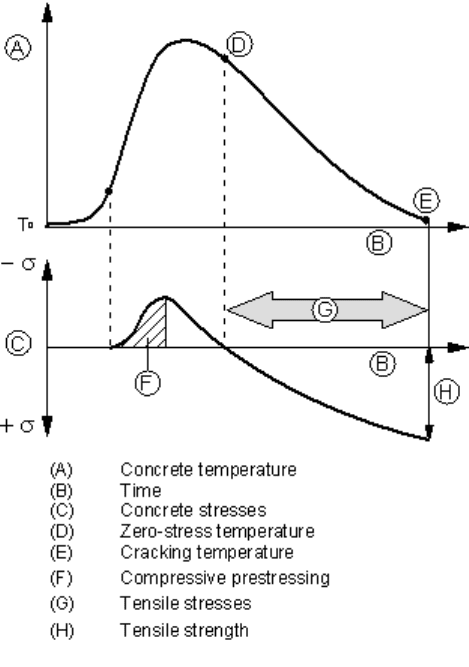
thermal stresses and to prevent the consequent cracks. The concrete temperature
value, which causes a stage of no-stress (Fig. 6.11) is called zero-stress temperature
[6.27] [6.28]. The higher the zero-stress temperature of the concrete and the
temperature decrease to an average ambient temperature is, the higher is the
resulting potential of thermal induced cracking [6.30]. In situ temperature
measurements are also used to control the cooling process during the grouting
operations.
Fig. 6.11 – Stress in young concrete under restrained deformation [6.30]
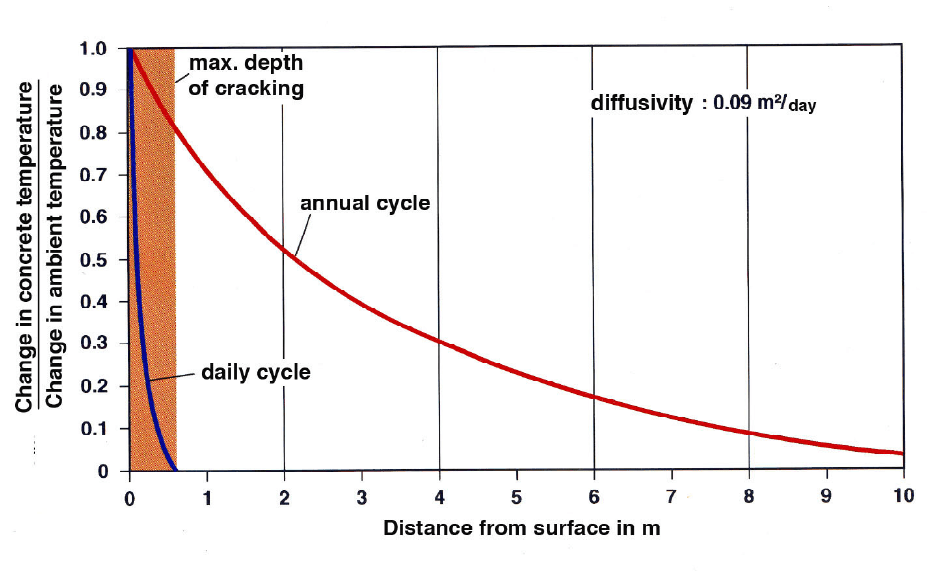
During the normal service life, the temperature inside of the dam body varies
according to the water and air temperature and significant temperature differentials
depend on the reservoir and seasonal fluctuation (Fig. 6.12), and are a significant
loading for thin dams only.
ICOLD Bulletin
:
The Physical Properties of Hardened Conventional Concrete in Dams
Section 6 (Thermal properties)
As submitted for ICOLD review, march 2008 Section 6-21
Fig. 6.12 - Influence of ambient temperature cycles on concrete depth
The temperature measurements are important for some dams to determine the
causes of dam deformation due to expansion or contraction and to compute actual
movements. They are very important particularly in thin arch dams since volume
change caused by temperature fluctuation is a significant contributor to the loading on
such dams.
The temperature in concrete dams may be measured using any of several different
kinds of embedded thermometers or by simultaneous temperature readings on
devices. The most commonly ones are resistance temperature detectors (RTD’s) and
vibrating wire sensors. Both provide long-term stability and accuracy. They are to be
placed non uniformly along the width of the dam in order to respect the higher
temperature gradient towards the faces, Fig. 6.13.