
International Commission on Large Dams (ICOLD) - The Physical Properties of Hardened Conventional concrete in Dams
Подождите немного. Документ загружается.

ICOLD Bulletin:
The Physical Properties of Hardened Conventional Concrete in Dams
Section 7 (Water permeability)
As submitted for ICOLD review, march 2008 Section 7-26
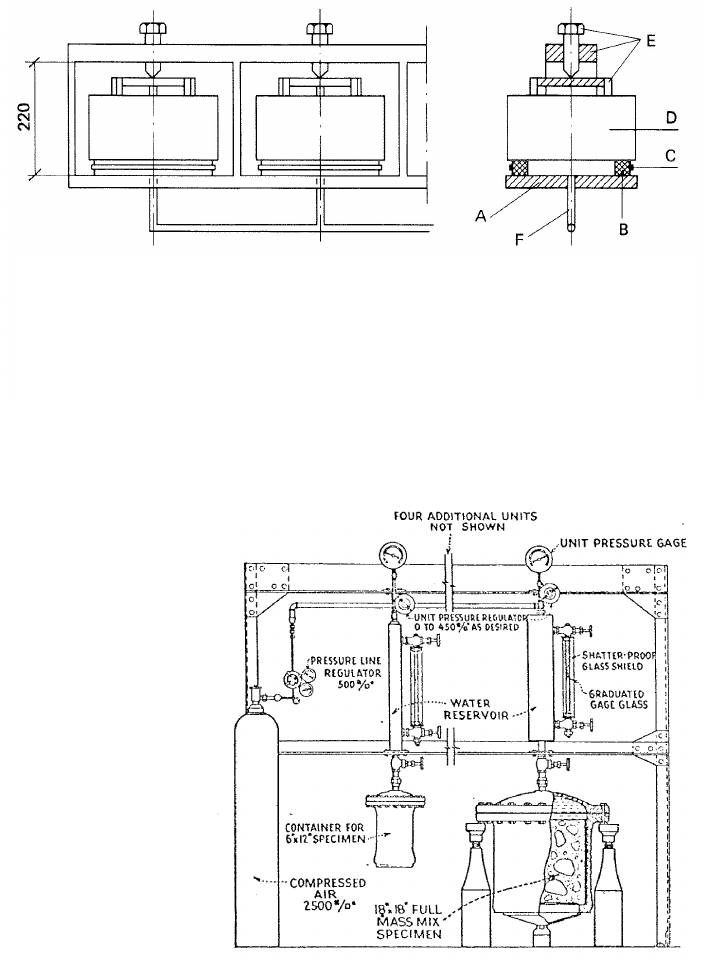
Fig. 7.20 - Examples of uniaxial cells for permeability evaluated through the
penetrated water front ([7.6] and [7.39].
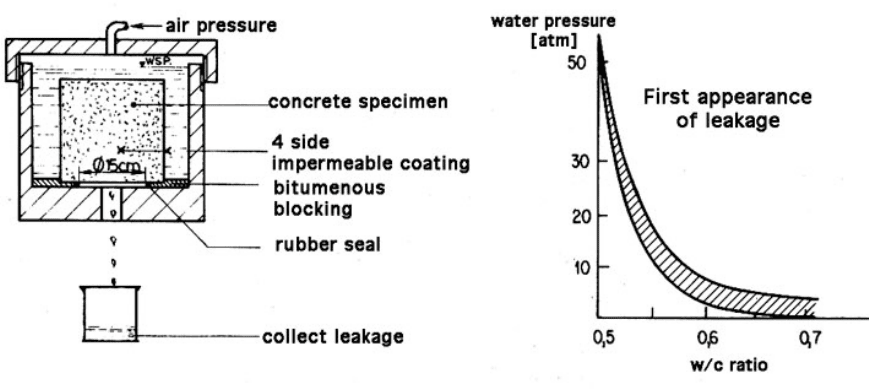
Fig. 7.21 – Permeability apparatus used for testing mass concrete [7.3].
Generally permeability testing at dam sites need to use a simple test set-up.
Fig. 7.22 shows a device used for dams to test permeability at site. The pressure
vessel is used for both cylinders and cubes. The pressure is increased stepwise from
0.5 to 30 atm. (or less for small dams). Each pressure range is kept constant for 24
hours and a protocol records any leakage. Generally, good concrete will not leak at
all after the 10 cycles reaching 30 atm. Then the specimen is crushed and the water
penetration depth is measured and a corresponding Darcy value calculated.
A Flat support, e.g. a table.
B Tightening ring of rubber with a diameter of 170 mm.
C Supporting ring of steel outside the rubber ring.
D Concrete specimen.
E Supporting and locking frame
F Pressurized water inlet.
ICOLD Bulletin:
The Physical Properties of Hardened Conventional Concrete in Dams
Section 7 (Water permeability)
As submitted for ICOLD review, march 2008 Section 7-27
Fig. 7.22 – Device for permeability testing of large concrete dams.
7.3.4 The pressure side
Gravity dams have a pressure gradient as low as 1.3 to 1.4 meter water head per
meter of width of the structure (m/m), a 100 m high dam being traditionally 75 m wide
at the base.
Arch dams can have pressure gradients of up to 12 (m/m). Buttress dams can have
gradients of about 30 to 40 (m/m) over their front slabs. The buttress itself may have
a more complex pattern of gradients, the complexity depending on the geometry, the
possible cracks that leak water and the moisture conditions close to the pillar.
Of particular interest for controlling permeability is the pressure head between
reservoir pressure and dam galleries close to the upstream face. Some designers
stipulate a gradient not exceeding 25.
The most common ways to achieve a water pressure on the specimen is:
•
Place the test cells inside a hydropower station and subjected to the headwater;
•
The water is pressurised by a container with high pressure gas;
•
A pump pressurises water inside a container (Fig. 7.17)
7.3.5 Water flow measuring
The method for measuring the flow of water coming out from the specimens must
fulfil the following requirements.
The out-flow end of the specimen must be filled with water, in order to avoid any
contact with air before water have percolated out from the specimen.
ICOLD Bulletin:
The Physical Properties of Hardened Conventional Concrete in Dams
Section 7 (Water permeability)
As submitted for ICOLD review, march 2008 Section 7-28
The measuring exactness must be suitable to the amount of water that comes out
from the specimens. Some concrete has very low and some very high permeability. It
should be possible to read the amount of water in an exact way, but on the other
hand, the water shall not spill over the measuring vessel.
The measuring vessels shall not let air in or moisture out. If air is let in, the CO
2
in it
will form CaCO
3
with the percolated solution coming from the specimen. If moisture is
let out, the correctness of measured volume of water will be wrong.
There should be careful investigations regarding possible leakage through the
sealing. If there is any flow channel in the sealing, the flow of water may be very
much higher than through the specimen only.
7.3.6 Expression of results
When steady state flow of water is reached, the permeability coefficient is calculated
as (see equation in 7.1.2):
k
w
= q
w
⋅
L/dP
w
/A
(7.4)
where:
k
w
= permeability coefficient (m/s)
q
w
= water flow (m
3
/s)
dP
w
= difference in pressure (m) between upstream and downstream end of the
specimen;
L
= length of specimen (m);
A
= cross section area (m
2
).
For penetration tests, i.e. for not completely saturated specimens, the penetration
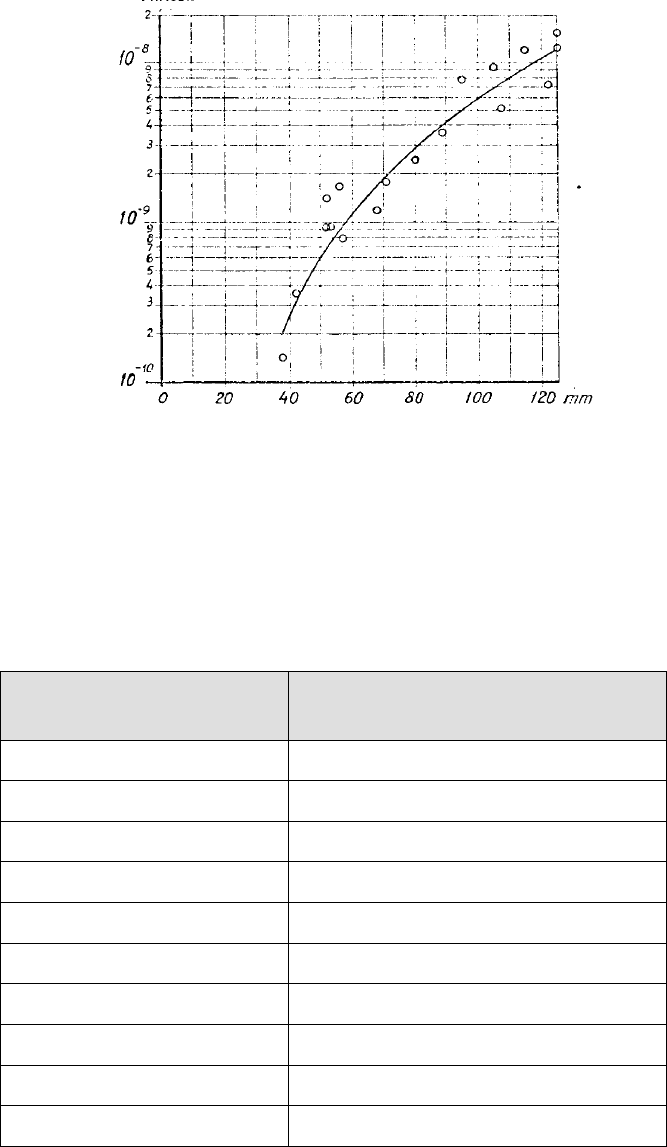
depths may be transformed to Darcian permeability. Sällström [7.7] studied relations
between a standard method [7.39] of testing the penetration and one for testing water
permeability (Fig. 7.23).
Conventional dam concrete has generally a inherently low water permeability [7.40].
Good proportioned concrete mixes placed with good vibration and subjected to a
suitable curing, usually show permeability values in the range of 10
-10
to 10
-13
m/s.
In Tab. 7.3 the permeability coefficients k
w
are reported for some Bureau of
Reclamation dams. Specimens for Dworshak and Lower Granite dams were 150 x
150 cm (6 x 6 in.) cylinders while specimens for the other dams listed in Tab. 7.3
were 460 x 460 mm (18 x 18 in.). The tests were carried out under a pressure of 2.8
MPa (400 psi).
ICOLD Bulletin:
The Physical Properties of Hardened Conventional Concrete in Dams
Section 7 (Water permeability)
As submitted for ICOLD review, march 2008 Section 7-29
Penetration depth
Permeability cm/s
Fig. 7.23 - Relations between permeability and penetration depth for concrete
composed of low-heat cement and 4 to 6 percent air [7.7]. 32 mm maximum
aggregate size and various w/c-ratios (0.55 to 0.82).
Tab. 7.3 – Mass concrete water permeability [7.41]
Dam Water permeability coefficient k
w
(m/s)
Hoover
5.99 *10
-13
Hungry Horse
1.79 * 10
-12
Canyon Ferry
1.87 * 10
-12
Monticello
7.93 * 10
-12
Glen Canyon
1.75 * 10
-12
Flaming Gorge
1.07 * 10
-11
Yellowtail
1.90 *10
-12
Dworshak
1.84 *10
-12
Lower Granite
4.54 * 10
-12
Anchor
4.37* 10
-11
ICOLD Bulletin:
The Physical Properties of Hardened Conventional Concrete in Dams
Section 7 (Water permeability)
As submitted for ICOLD review, march 2008 Section 7-30
7.4 MODELING WATER PERMEABILITY IN SATURATED CONCRETE
7.4.1 Introduction
Many models describing the mobility of water in a porous material such as concrete
have been developed through the years. It should be emphasized that the complexity
of the microstructure of cement paste, mortar and concrete is so great that it is not
possible to derive their macroscopic properties from simple flow rules on a micro-
scale without efforts being made to model the structure itself [7.42]. It is above all the
enormous scale differences in the material, ranging from a 2 nm to approximately
100 nm pore diameter size and to the atomic size of the elements that are difficult to
include in a model.
Methods for modelling fluid motion are usually classified into two groups, the one
being microscopic models and the other macroscopic models.
Microscopic models describe the motion involved in terms of each of the small
tubular conduits in the porous medium, using a statistical approach. By these models
more detailed studies can be made regarding transport of water and other
constituents as air, ions, etc in concrete at different properties and geometry. On the
other hand the verification with experiments is often very complex and difficult, not
suitable for any standard tests of mass concrete from dams. Often a microscopic
model can be used for macroscopic calculations, if estimations are made of how to
“smear out” the microscopic model on a larger volume and in more than one
directions.
Macroscopic models describe the fluid as a unit moving at a macroscopic-average
velocity, which can be given, for example, by Darcy’s law. Macroscopic models are
more useful for estimating the permeability for mass concrete in real structures and
they can be used for 2- and 3 dimensional dam structures directly in analytical or
numerical models and can be verified in tests in a relatively easily way.
Van Brakel
[7.44
] divided the modelling of porous media into two other main types:
pore space and non-pore space models. Pore space models can involve the
conception of connected tubes or discrete particles in one, two or three dimensions.
These are often suitable for examining microscopic behaviour. Non-pore space
models can be empirical correlations (such as Darcy’s equation), discrete particle
models, continuum models or statistical models, often suitable for analysing
macroscopic behaviour. Van Brakel is of the opinion that even non-pore space
models need always to some extent to be attached to a pore space model. With
respect to capillary liquid transport in particular, he regards the sensibility of using the
continuum approach as being disputable.
7.4.2 Macroscopic (non-pore space) models for mass concrete
Macroscopic, or non-pore space, models are often used to calculate homogenous
percolation of water in a continuous body of concrete, e.g. a dam. A commonly used
model is Darcy’s law for saturated concrete, but also other models are used for
ICOLD Bulletin:
The Physical Properties of Hardened Conventional Concrete in Dams
Section 7 (Water permeability)
As submitted for ICOLD review, march 2008 Section 7-31
example when the concrete is not saturated (e.g. Richard’s equation) or if the water
velocity through the concrete is rather high (e.g. Brinkman equation).
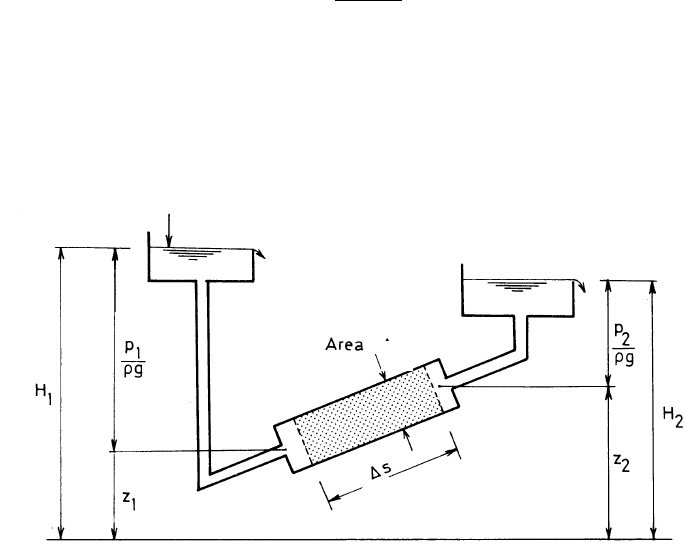
Darcy [7.1], in filtrating water through sand in a circular tube, found the following
empirical relationship (Darcy’s law) concerning homogenous flow in saturated,
porous media:
2 1
( )
w w tot
h h
q k A
L
−
= − ⋅ ⋅
(7.5)
where
q
w
= the amount of the percolating fluid (m
3
/s);
k
w
= the bulk permeability
coefficient, which depended on both the porous media and the fluid (m/s);
A
tot
= the
cross sectional area of the filter bed (m
2
);
h
1
, h
2
= liquid that rises above an arbitrary
level at the inlet or outlet end of the filter bed (m); and
L
= the length of the filter bed
(m) (Fig. 7.26).
Reference level
Fig. 7.26 - A principal figure in Darcy’s experiment [7.45].
In its original form, Darcy’s law overlooked hydrodynamic microscopic flow in a
complicated system of pores. The law is an averaging macroscopic one. The
macroscopic approach is commonly used in modelling work and is the perhaps the
only approach that can be verified experimentally. In practice, it is the value kw that is
usually measured and reported. According to Collins et al. [7.46], there is evidence,
however, that the flow of water through saturated concrete, mortar and hardened
cement paste very closely approximates Darcy’s law [7.3] [7.11]. Darcy’s law is
limited in some aspects. It is essentially valid for the following [7.47]:
•
Homogenous, steady-state flux in saturated, porous media
•
The permeability coefficient k
w
, which is fluid-dependent (it depends on the
viscosity)
•
Incompressible fluids
•
Isothermal conditions
•
Creeping, laminar flow (very low velocity)
•
Newtonian fluid
•
Flow through a relatively long, uniform and isotropic porous medium
•
A low level of hydraulic conductivity in the medium
L
A
tot

ICOLD Bulletin:
The Physical Properties of Hardened Conventional Concrete in Dams
Section 7 (Water permeability)
As submitted for ICOLD review, march 2008 Section 7-32
Darcy’s equation can be restated in terms of the pressure p and the density
ρ
of the
liquid. The pressure at the two ends (see Fig. 7.26) can be written as [7.22]:
h
1
= p
1
/(
ρ⋅
g) + z
1
; h
2
= p
2
/(
ρ⋅
g) + z
2
(7.6)
where p/(
ρ
g) = pressure head (m); and z = height above an arbitrary reference level.
Darcy’s equation is then reformulated to
2 1
2 1
( ) ( )
w w w
p p
p
z z z
g g
q k A k A
L L
ρ ρ
−
∆
+ − + ∆
⋅
= − ⋅ ⋅ = − ⋅ ⋅
(7.7)
Trying to write the equation for infinite filter lengths
∆
l and at the same time simplify
by introducing a hydraulic potential (sometimes called a piezometric head), Pw
=p/
ρ
g+z, and assuming no variation of kw or
ρ
, Darcy’s equation becomes:
w w w
v k P
= − ⋅∇
(7.8)
where vw = seepage velocity (m/s). Note that the velocity vw is to be understood as
the bulk velocity and not as the velocity u in an individual flow channel. For an
isotropic porous medium, permeability becomes a tensor:
w w w
v P
= − ⋅∇
k
(7.9)
A balance of the water volume can be written as
ˆ
( )
w
w w
P
D c v
t
∂
= −∇ ⋅
∂
(7.10)
where D = damping; and
ˆ
w
c
= source or sink (e.g. hydration) of water (m3/s). Under
steady-state conditions, the partial time derivatives and source term
ˆ
w
c
vanish.
Equation (7.10) suits well to be calculated using the Finite Element Method.
7.4.3 Microscopic (-pore space) models for more detailed studies
Microscopic, or pore space, models can be used directly for calculations of water flow
in distinct flow channels as for example in cracks or they can be transformed to a
homogenous percolation of water in a continuous body of concrete.
According to Scheidegger [7.22], flow through porous media appears to take place
along flow channels at the local (pore) velocity, u. The macro scale filter velocity v of
the fluid is smaller than the local velocity, as often described by the Dupuit-
Forchheimer equation:
v =
Φ⋅
u45 (7.13)
where v = filter (bulk) velocity of the fluid (m/s);
Φ
= porosity (m3/m3); and u = local
velocity of the fluid in the flow channels (m/s). The local velocity is assumed to

ICOLD Bulletin:
The Physical Properties of Hardened Conventional Concrete in Dams
Section 7 (Water permeability)
As submitted for ICOLD review, march 2008 Section 7-33
fluctuate both between channels and along channels. In the Fochheimer equation, v
is an average velocity.
A pore space model of the flow of a fluid through a porous medium is often based in
some way on the Navier-Stokes equations for incompressible fluids.
0
∇⋅ =
u
(7.14)
( )
T
w w w
p
t
ρ ρ µ ρ
∂
+ ⋅∇ + ∇ − ∇ ⋅ ∇ + ∇ + =
∂
u
u u u u g 0
(7.15)
where
ρ
w
= density of water (kg/m
3
);
u
= local velocity of water (m/s);
p
= hydrostatic
pressure (Pa);
µ
= dynamic viscosity (Pa
⋅
s); and
g
= acceleration due to gravity
(m/s
2
). Note that the velocity
u
is the velocity within each small flow channel and not
the bulk velocity of the material.
Assuming steady-state flow, a straight, smooth and horizontal circular tube, laminar
flow and the velocity of the fluid being zero on the walls of the tube allows Navier-
Stoke flow to be integrated with the Hagen-Poiseuille equation:
2
32
mean
p
u
L
φ
µ
∆
= ⋅
(7.16)
where
u
mean
= mean velocity in the tube (m/s);
∆
p
= pressure gradient (Pa);
L
= length
of the tube (m);
d
φ
= diameter of the tube (m). Observer that in small tubes/pores the
water at the walls is hard bounded to the wall and not involved in the transport, so the
diameter should be reduced to the diameter in which the flow take place. The total
flow of water through a tortuous, rough tube in concrete may be estimated by
2 2 4
,
32 4 128
w tube w mean tube w w
p d p d d p
q r u A r r
L L L
π π
µ µ
∆ ∆ ⋅ ⋅ ∆
= ⋅ ⋅ ⋅ = ⋅ ⋅ ⋅ = ⋅ ⋅
⋅
(7.17)
where
q
w,tube
= flow through the tube (m
3
3/s); and
r
w
= reduction factor (-) taking
account reductions for real flow tubes in cement materials due to deviation from a
large, strait and smooth cylinder (that the Hagen-Poiseuille equation assumes).
Fluxes caused by gradients in hydraulic head
P
w
(m) are written in terms of the same
equations as above but are multiplied by the fluid density
ρ
w
and the gravity
coefficient
g
.
Under these same conditions the integration of Navier-Stoke for the flow of fluids
through parallel slits, for example for a real crack in a dam, gives
3
12
w w
b w p
q r
L
µ
⋅ ∆
= ⋅ ⋅
⋅
(7.18)
where
L
= flow channel length of the slit (m);
w
= slit width (m); and
b
= slit length
perpendicular to the flow direction (m);
r
w
= “surface roughness factor”, generally
about 0.01-0.2 .
A very simple capillary model of flow in one direction in concrete is that of a bundle of
straight parallel capillaries of uniform diameter together with the Hagen-Poiseuille
equation.
ICOLD Bulletin:
The Physical Properties of Hardened Conventional Concrete in Dams
Section 7 (Water permeability)
As submitted for ICOLD review, march 2008 Section 7-34
2
32
a a a
a w a a
n k
p p
q r A A
x x
φ
µ µ
∂ ∂
= − ⋅ ⋅ ⋅ = − ⋅ ⋅
∂ ∂
(7.19)
2
32
a a
a w
n
k r
φ
= ⋅
(7.20)
2
4
a
A
π φ
⋅
=
(7.21)
where
q
a
= water flow in all capillaries with a particular size
a
(m
3
/s);
k
a
= specific
permeability of all capillaries with a particular size
a
(m
2
);
δ
p/
δ
x
= the pressure
gradient (Pa/m);
n
a
= the number of capillaries of diameter
φ
a
per square meter cross
section (nos./m
2
); and
µ
= the dynamic viscosity (Ns/m
2
);
r
w
= reduction factor, see
equation (7.17); and
A
a
= the cross-sectional area of one capillary of size
a
(m
2
).
7.4.4 Combined water flow in a “real dam”
In a real structure exposed to one side water pressure, the water flow is a
combination of true Darcian flow (in saturated media) and moisture flow in not
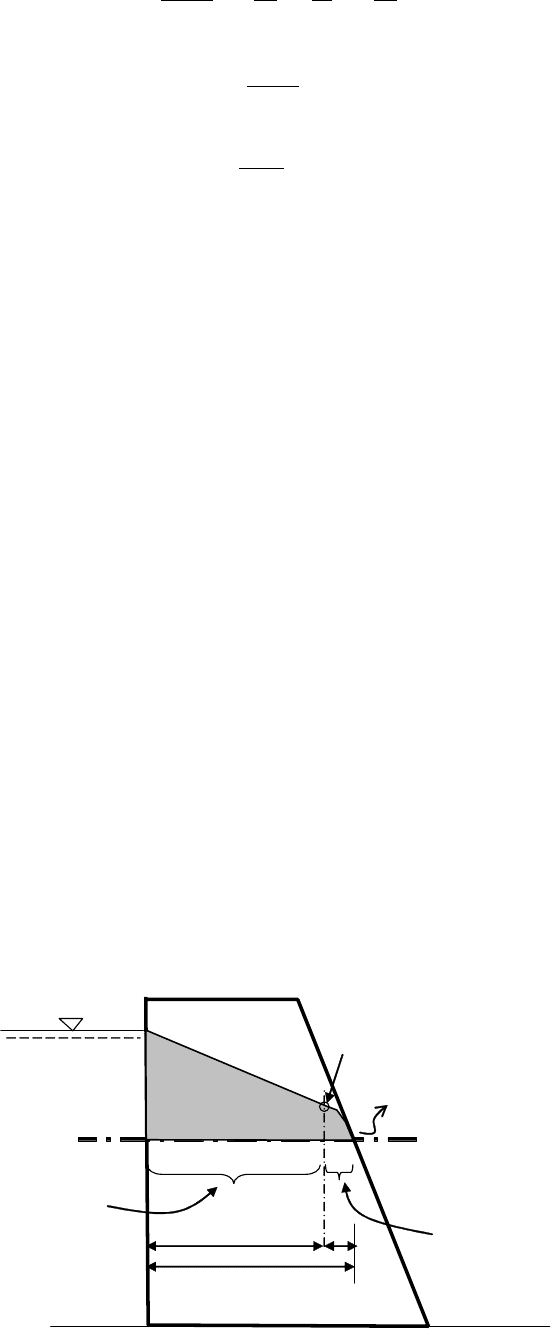
saturated media [7.48]. Fig. 7.33 shows a thick concrete dam where there is a
hydrostatic pressure against the upstream face of the dam and the downstream face
is exposed to air. The concrete is saturated and the internal water pressure is
hydrostatic down into a point near the downstream face, where the humidity reaches
100 % RH. Further downstream, the internal relative humidity decreases down to the
current climatic condition at the downstream face. A sunny summer day, the relative
humidity at the downstream face can reach as low as about 30-40 % RH. The water
transport is caused by a combination of over-pressure, suction and diffusion. Finally,
at the downstream face, evaporation to the surrounding air occurs.
Saturated zone.
Flow due to over-
pressure gradient.
Evaporation zone. Flow
due to vapour pressure
gradient.
B
B
a L-a
L
Upstream
water level
Concrete dam
P
w
RH=100%
RH

ICOLD Bulletin:
The Physical Properties of Hardened Conventional Concrete in Dams
Section 7 (Water permeability)
As submitted for ICOLD review, march 2008 Section 7-35
Fig. 7.33 - A schematic of a thick concrete dam with a combined water flow in a
section B-B. In this section the upstream face is in water and the downstream face is
in air. The section has one saturated zone and one evaporation zone
In a combined transport of water, the flow of water in the over-pressure part is the
same as the moisture flow in the not saturated part. Assuming Darcy’s law to be valid
the flow of water in the saturated part is:
w
dp
v B
a
=
(7.22)
where
v
w
= water flow (kg/(m
2
s));
B
= permeability coefficient (s); dp = pressure
difference (Pa); and a = distance to the saturation level (m) (Fig. 7.33). This distance
a
to where the concrete is not longer water saturated can be written as [7.49]:
100% 100%
w
w RH RH w
k dp L
a
v H k dp
< <
⋅ ⋅
=
⋅ + ⋅
(7.23)
where
v
w<100%RH
= measured flux of water below 100 % RH in laboratory (kg/(m
2
s));
H
<100%RH
= the thickness of the specimen tested in laboratory (m); and L = the total
thickness of the dam (m). Downstream this saturation level where RH goes below
100 % the flow of water is driven by a vapour pressure gradient. Data of some types
of concrete considering equation (7.23) can be found in Hedenblad [7.48].
Another case of combined water flow in a concrete dam with an inspection tunnel is
from the upstream surface to the tunnel. The saturation point RH=100% lays a little
bit into the upstream wall of the tunnel. Upstream this point there is saturated Darcian
water flow and downstream this point, and out in the air inside the tunnel, there is a
diffusion flow.
If there is water at the downstream face, water flow will of course be depended only
on hydrostatic pressure all the way from the upstream to the downstream face.
7.5 REFERENCES
[7.1] Darcy H. (1856), “Les fontaines publiques de la ville de Dijon”, Dalmont, Paris.
[7.2] McMillan F.R., Lyse I. (1930), “Some permeability studies of concrete”, Journal
of the American Concrete Institute Nov. 1929 – June 1930.
[7.3] Ruettgers, A., Vidal, E. N., Wing, S. P. (1935), “An investigation of the
permeability of mass concrete with particular reference to Boulder Dam”, ACI
Journal, Proceedings 1935(31):4, pp. 382-416.
[7.4] Mary, M. (1936), contribution to the discussion with Ruettgers, Proceedings of
the ACI, vol. 32, pp. 125-129.