
International Commission on Large Dams (ICOLD) - The Physical Properties of Hardened Conventional concrete in Dams
Подождите немного. Документ загружается.

ICOLD Bulletin:
The Physical Properties of Hardened Conventional Concrete in Dams
Section 7 (Water permeability)
As submitted for ICOLD review, march 2008 Section 7-6
(a) Relation of permeability k
w
to the w/c ratio (b) Relation of permeability to capillary
porosity
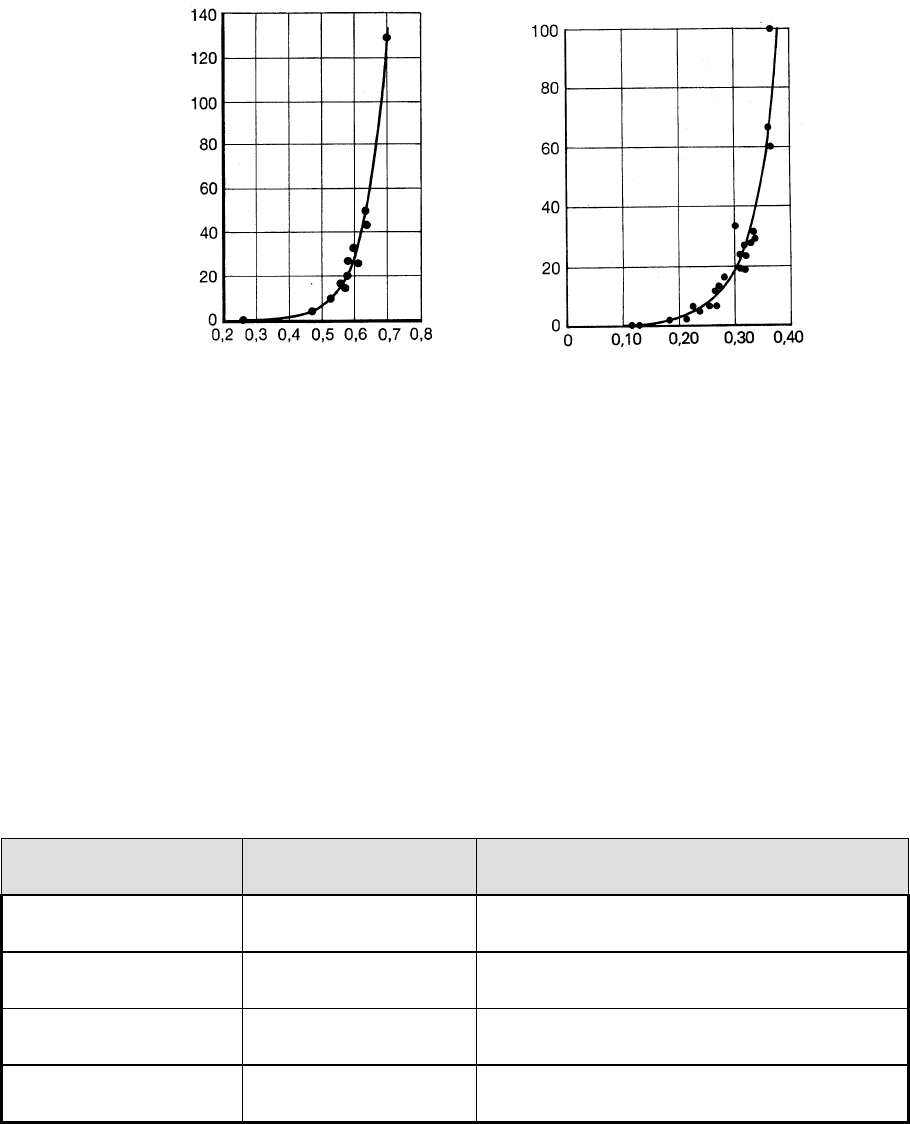
Fig. 7.2 - Water permeability of well hydrated cement paste in relation to (a) the w/c
ratio and (b) capillary porosity (Powers et al. 1954 [7.9], presented by Fagerlund in
[7.10]).
7.1.5 Permeability of aggregate
Despite its generally low porosity (below 3%), aggregate tends to have about the
same level of permeability as cement paste [7.11] [7.12] (Tab. 7.1). This can be
explained by the difference in typical size between the capillary pores in the paste
(10 to 100 nm) and in aggregate (larger than 10
µ
m in average) [7.12].
Tab. 7.1 - Comparison of the permeability of rocks and of cement paste [7.11].
Type of rock Permeability
(m/s)
W/c ratio of mature cement paste of
the same permeability
Quartz diorite
8.24
⋅
10
-14
0.42
Marble
2.39-57.7
⋅
10
-13
0.48-0.66
Granite
5.35-15.6
⋅
10
-11
0.70-0.71
Sandstone
1.23
⋅
10
-10
0.71
k
w
(10
-1
2
m/s
kw
(10
-
12
m/s
w/c
Capillary
porosity
ICOLD Bulletin:
The Physical Properties of Hardened Conventional Concrete in Dams
Section 7 (Water permeability)
As submitted for ICOLD review, march 2008 Section 7-7
7.1.6 The permeability of concrete
This discussion about concrete permeability is mainly valid for mass concrete
material and not always valid for mass concrete structures as a whole, e.g. dams.
Mass concrete materials can be thought of as “defect-free” whereas mass concrete
structures, such as dams, often have manmade discontinuities, as for example
construction joints, or cavities, for example cracks due to different causes. For
discussion and information of permeability of construction joints see Appendix B
(Physical properties of construction joints in concrete dam).
Although the reduction in flow area (when the porosity is lower for the aggregate than
for the cement paste), segmenting of the flow channels and lengthening of the
effective flow channels, suggests that the permeability of concrete should be less that
of cement paste, the permeability of concrete is in fact about 100 times as high as
that of the corresponding cement paste [7.13]. The major explanation for this is that
the addition of aggregate produces a porous interfacial zone between the aggregate
and the paste and that micro-cracks are formed there during hydration [7.12].
The permeability of the interfacial zone is governed mainly by the pore size
distribution within the zone, the crystals within the zone (mainly Ca(OH)2) and micro-
cracks within the zone. The interfacial zones are weak and relatively porous and are
vulnerable to differential strains between the cement paste and the aggregate
induced by drying shrinkage, thermal shrinkage and externally applied loads, such
strains resulting in micro-crack. No direct measurements of the permeability of the
interfacial zone can be found in the literature.
The flow of water through concrete is the sum of all leakage of water through it,
ranging from large-scale flow in large connected and water-filled cracks and cavities
(e.g. honey combing, beneath aggregate, along rebar, etc) to very low levels of
vapour diffusion through the capillary pores. In defect-free concrete, such as mass-
concrete, flow occurs in capillary pores and the porous transition layer around the
aggregate. Defects in concrete, such as cracks, can have permeability many orders
as high as that of the concrete itself, its level depending on the size of the cracks and
on how connected they are within the concrete.
The amount of pores present in the cement paste phase is typical in the order of 35-
50% of the volume. In for example ordinary aggregate of granite the pores represent
approximately 0.5-1% of the volume. Within the whole concrete, i.e. including both
cement paste and aggregate, the porosity is on the order of 10-20 %.
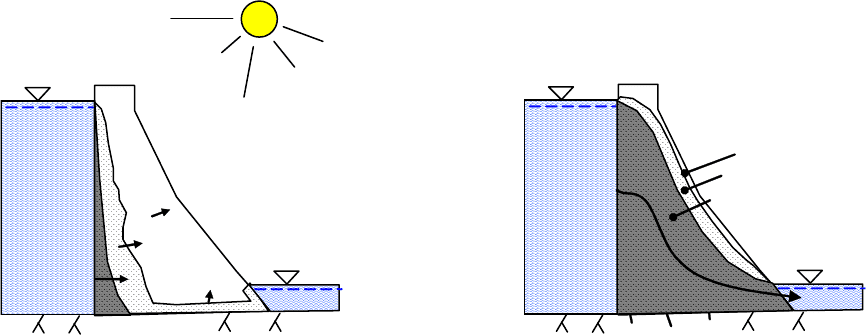
The driving potentials for water flow in a concrete dam exposed to water at the one
side and either air or water at the other side is schematically shown in Fig. 7.3. In the
figure the conditions are presented at a relative short time after impounding Fig. 7.3
a) and after long time after the reservoir has been filled (Fig. 7.3 b). Water transport
is due to a combined flow of different mechanisms such as vapour diffusion and
capillary suction in not water saturated concrete and external over-pressure in
saturated concrete.
ICOLD Bulletin:
The Physical Properties of Hardened Conventional Concrete in Dams
Section 7 (Water permeability)
As submitted for ICOLD review, march 2008 Section 7-8
Water
reservoir
Concrete
dam
Downstream
water
1)
2)
3)
1) Vapour diffusion
2) Capillary suction
3) External over-pressure
4) Darcian flow
1)
2
)
3)
4)
2)
(
a) Short time after impounding (b) Long time after impounding
Fig. 7.3 - Scheme of the driving potentials for the flow of water in a concrete dam
exposed to water at the one side and either air or water at the other, where (a) shows
the conditions found a relative short time after the reservoir has been filled and (b)
the conditions long after the reservoir has been filled.
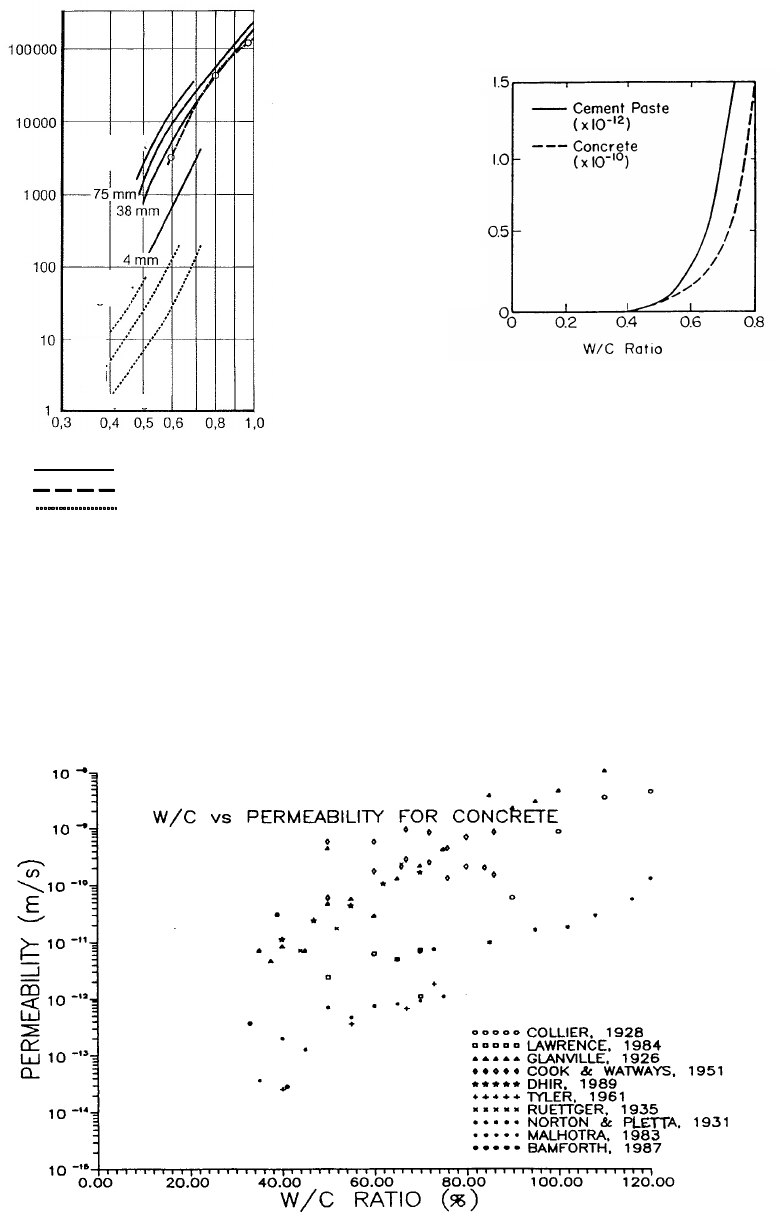
The permeability of i) plain cement paste, ii) the paste phase in concrete and iii) of
concrete is shown in Fig. 7.4, on the basis of different studies. The figure indicates
that permeability decreases as the hydration ratio increases, the permeability
increases as higher w/c-ratios are used, and the permeability increases for concrete
compared to plain cement paste. It is also shown that the permeability increases if
bigger aggregate particles are used, which also other studies show [7.10]. In reality
there is a large scatter in permeability measurements depending on type of curing,
type of aggregate, size of the concrete, etc, which can be seen in Fig. 7.5, showing
different studies of the permeability of cement paste and concrete.
According to Hearn [7.14], the results of individual studies have shown a direct
proportionality between permeability and the w/c ratio, although the data for different
studies show a high degree of scatter in relation to each other (Fig. 7.5). This is
probably due to differences in specimen treatment and in test procedures, which is
important to bear in mind when comparing different permeability studies.
4
3
ICOLD Bulletin:
The Physical Properties of Hardened Conventional Concrete in Dams
Section 7 (Water permeability)
As submitted for ICOLD review, march 2008 Section 7-9
113 mm aggr
.
size
W/c ratio
Water permeability k
w
(10
-
12
m/s)
60% hydr. ratio
70% hydr. ratio
93% hydr. ratio
Cement paste phase in concrete Ruettgers et al (1935)
Cement paste Ruettgers et al (1935)
Cement paste Powers et al (1954)
Water permeability k
w
(m/s)
Fig. 7.4 - (a) Permeability to water for various cement pastes and for the cement
paste phase in various concretes [7.10]. Observe that the permeability shown for the
“paste phase in concrete” (solid line) is for the paste phase in the concrete only,
which means that for having the permeability for concrete the values should be
multiplied with the share of cement paste. b) Water permeability for cement paste
and for concrete [7.13].
Fig. 7.5 - Correlation between the w/c-ratio and the permeability of concrete on the
basis of data from different studies [7.14]. Note the high degree of scatter, probably
due to differences in specimen treatment and in test procedures,
ICOLD Bulletin:
The Physical Properties of Hardened Conventional Concrete in Dams
Section 7 (Water permeability)
As submitted for ICOLD review, march 2008 Section 7-10
7.2 FACTORS INFLUENCING THE CONCRETE WATER PERMEABILITY
7.2.1 General
Permeability of concrete may be divided in:
* Laboratory tested permeability
* Permeability of mass concrete in a dam
* Permeability of the overall dam structure(including joints and interfaces)
It can be said generally that all factors that enlarge, connect or straighten existing
flow channels or create new flow channels increase the permeability of the concrete.
Since the flow of water in tube-like pores can be said to be proportional to the pore
diameter raised approximately to the power of 4 and in a crack the thickness raised
approximately to the power of 3, the flow obviously increases rapidly as pores and
cracks become wider and more connected.
7.2.2 Cracks or cavities
Cracks or other cavities can be formed due to various factors: man-made joints,
imperfect compaction, thermal shrinkage during the cooling period after casting,
shrinkage due to drying, flow channels along the reinforcement bars due to water
separation and to settlement of the concrete mass, due deflection, due to seasonal
changes in temperature, elastic strain and creep and due to externally applied loads.
The cracks are found mainly in the interfacial zone between paste and aggregate, but
are found in the paste as well. Micro-cracks are always larger than capillary pores.
They propagate from one discontinuity to another, creating more or less continuous
flow channels throughout the cement matrix. The curing period is particularly
important, since drying and cooling produce large variations in stress in the concrete
when it has not yet obtained any large degree of strength. The sooner the water
curing of concrete starts, the more quickly the concrete gains in strength and the
smaller the stresses due to differences in temperature and moisture are. In the
massive concrete of dams, cracks are easily formed due to large temperature
differences during hardening and along construction joints, unless suitable actions
(such as cooling) are undertaken to prevent cracks from being formed. Around water-
stopping bands in joints, around embedded steel for gate abutment or in other parts
in dams where imperfect compaction may occur, the permeability is often higher than
in the mass concrete.
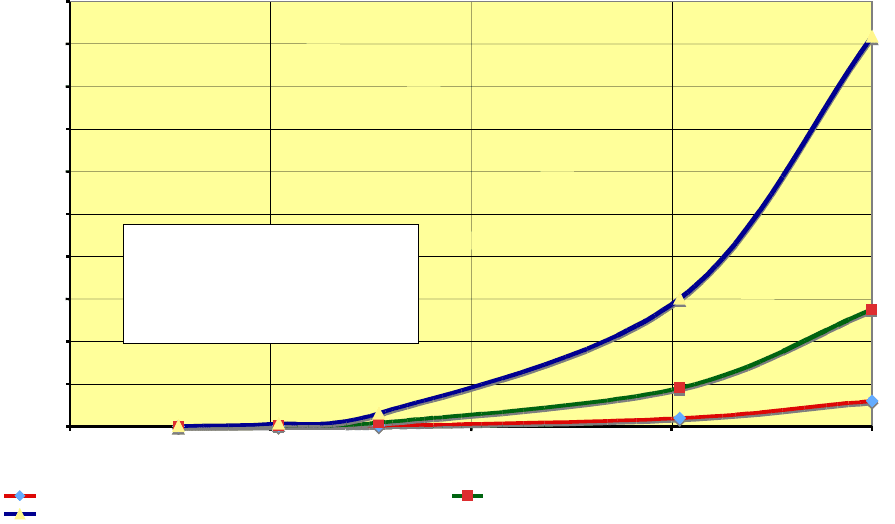
Leakage through cracked concrete can be approximated by using Poiseuille’s law
and introducing a correcting roughness coefficient for irregularities and crack
tortuosity. Fig. 7.6 shows an example for potential leakage assuming a continuous
crack (or leaking lift joint). It indicates the importance of high quality (facing) upstream
concrete in order to avoid excessive leakage into dam galleries.
ICOLD Bulletin:
The Physical Properties of Hardened Conventional Concrete in Dams
Section 7 (Water permeability)
As submitted for ICOLD review, march 2008 Section 7-11
!
"#$
$
%
Fig. 7.6 – Leakage along cracked concrete or defect lift joints.
7.2.3 Internal humidity
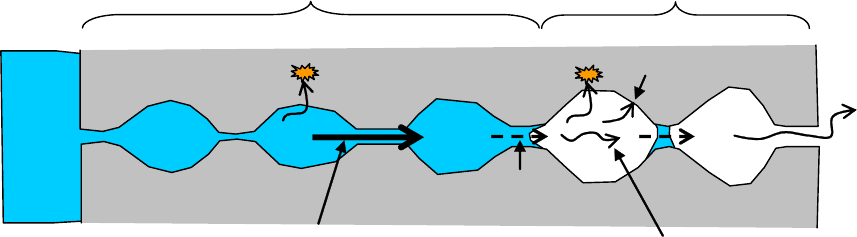
The humidity of the concrete has an important influence on the water permeability.
The solid phase changes due to shrinkage or swelling or to chemical reactions,
leading to changes in the geometry of the pore system. The moisture content itself
influences the extent to which water can flow through the pore system.
In a dam there may be many combinations of moisture conditions throughout the
structure, the flow of water being a function of many different types of transport
mechanisms. Fig. 7.3 and Fig. 7.7 show in principle how water can be transported
through concrete subjected to water on one side and air on the other, e.g. as in a real
dam. In the upstream end and as long as the flow channel is filled with water the flow
is of a Darcian type. By flow channel is meant any capillary pore, micro-crack, joint,
etc, where water is transported in. However, coming closer to the downstream end
the channel becomes dryer and not completely filled with water. At RH above about
45 % curved water menisci are formed in narrow passages, leading to capillary
condensation. In air-filled parts the water is transported as vapour diffusion along the
channel. Some of the water/vapour may also be adsorbed on the walls of the
channel, are stuck in very narrow pores or react chemically with compounds in the
pore walls. Some pores are so isolated and difficult to reach by the water that they
are filled with water first after a long period of water suction.
In thick concrete structures with a low w/c ratio there may be parts located in the
interior, which have a humidity of less than 100 %, even if the concrete is always
ICOLD Bulletin:
The Physical Properties of Hardened Conventional Concrete in Dams
Section 7 (Water permeability)
As submitted for ICOLD review, march 2008 Section 7-12
covered with water. The reason is that much water is used in these parts during the
hydration and external water has difficulties to reach these parts.
Water
reservoir
Water saturated part
Capillary
suction
Adsorption
Reaction
Vapour diffusion
Upstream
end
Downstream
end
Darcian flow
Not water saturated part
Fig. 7.7 - Movements or fixation of water molecules in saturated or dry pores of
cement
7.2.4 Curing conditions
The same type of curing in laboratory and in field are of course different. Adequate
laboratory permeability is confirming a good pore structure (mix design) but it does
not take into account the influence of work execution and early-age cracking (field
curing).
Both the curing of concrete at an early degree of hydration, and the treatment
conditions, present at later stages, influence the permeability of the concrete as a
result of the formation of micro-cracks. The access to water, and use of an
appropriate curing temperature, are of great importance for the tightness of concrete.
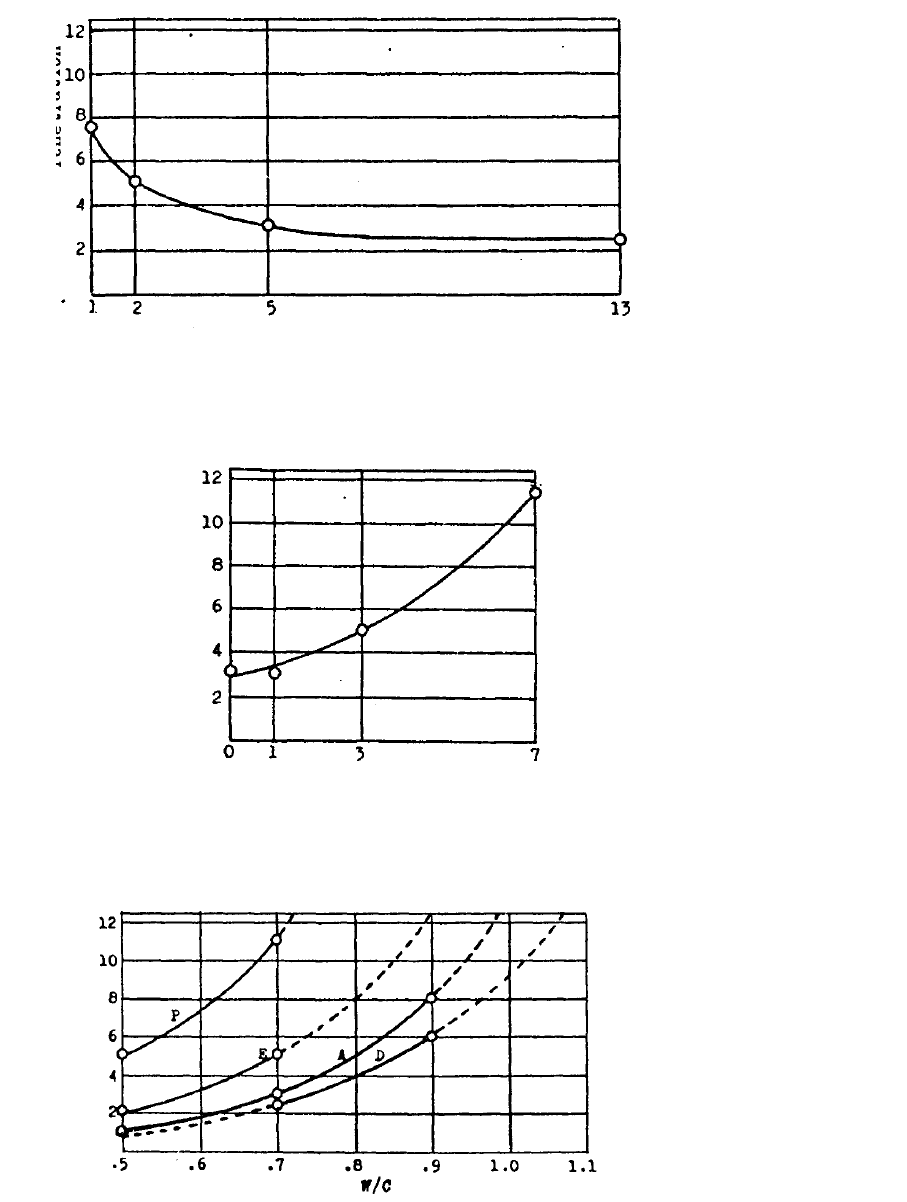
Fig. 7.8, Fig. 7.9 and Fig. 7.10 and show laboratory results of the influence of
different curing conditions on the water permeability of concrete. The maximum size
of the aggregate was 32 mm. The water pressure was applied to a surface of the
specimens with a diameter of 170 mm (see paragraph 7.3.3) . Fig. 7.8 shows the
influence of different water curing times on the 28 day permeability, if curing is started
one day after casting. If the curing last 1-5 days the permeability is highly reduced
while the permeability is almost not affected by longer curing times. Fig. 7.9 shows
the importance of that curing with water begins as soon as possible after casting. Fig.
7.10 shows the influence of different methods of curing on the permeability.
ICOLD Bulletin:
The Physical Properties of Hardened Conventional Concrete in Dams
Section 7 (Water permeability)
As submitted for ICOLD review, march 2008 Section 7-13
Fig. 7.8 - The influence of the duration of water curing on the permeability, if curing
has started day after casting. Concrete w/c ratio = 0.7. Age of specimens at time of
test = 28 days [7.6].
Penetration (cm)
Fig. 7.9 – The influence of the starting time for water curing of five day. Concrete w/c
ratio = 0.7 . Age of specimens at time of test = 28 days [7.6].
Penetration (cm)
Fig. 7.10 - The influence of different w/c ratios and curing conditions on the
penetration of water in concrete tested at 28 days. P = concrete for 14 days in
watertight moulds and afterwards in laboratory air; E, A and D = concrete for 2, 5 and
13 days respectively in water prior to its being in laboratory air [7.6].
Penetration (cm)
Days of curing
Starting time of curing, days
ICOLD Bulletin:
The Physical Properties of Hardened Conventional Concrete in Dams
Section 7 (Water permeability)
As submitted for ICOLD review, march 2008 Section 7-14
Powers and Copeland [7.9] showed by laboratory experiments that even in the case
of a very slow drying to 79 % RH and re-saturation the coefficient of permeability
increased 70-fold. Vuorinen [7.16] found the permeability to increase 100 times in
initially fog-cured laboratory specimens if they were first dried at +105
°
C and then re-
saturated. Even a short period of drying after demoulding can “destroy” the tightness
of concrete, due to the formation of micro-cracks.
The pore size distribution of the paste phase in concrete is strongly influenced by the
curing temperature. High temperatures increase the volume of large pores [7.13] and
also lead to micro-cracking, which both lead to higher permeabilities. Ekström [7.17]
found that if concrete specimens were heated at an early hydration age but not dried,
the initial permeability was about 100 times as high as for virgin specimens, although
it later decreased by a factor of about 100, probably due to continued hydration.
7.2.5 Degree of hydration
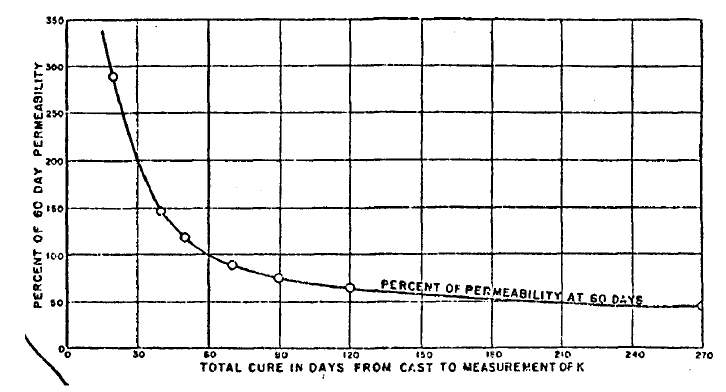
The permeability of concrete, mortar and cement paste is sensitive to the degree of
hydration or age at which a permeability test is started. The permeability is much
larger when testing is started at a young age [7.2], [7.3] and [7.9] (Fig. 7.11).
Concrete exposed to penetrating water at an early age may seal due to continuous
hydration. The degree of hydration (hydration rate) is typically around 0.9-0.95 for
well hydrated concrete in dams after long time. However, the hydration ratio depends
much on the availability of water. The lower the relative humidity (RH) the lower the
hydration rate becomes and beneath RH 80% the hydration stops [7.18]. That means
that in concrete structures where there might be somewhat dryer parts, as in parts
with low w/c ratio or inside thick dams, the hydration ratio will be lower than 0.9 even
after long time.
Fig. 7.11 - Effects of length of cure on permeability of concrete [7.3]
ICOLD Bulletin:
The Physical Properties of Hardened Conventional Concrete in Dams
Section 7 (Water permeability)
As submitted for ICOLD review, march 2008 Section 7-15
7.2.6 Water cement ratio
The higher the w/c ratio, the higher the permeability of both the cement paste and the
concrete is. Fig. 7.5 presents results of several investigations concerning the
dependency of w/c on the permeability of concrete. The data in the figure include
only specimens that were cured for at least 28 days and were tested without any pre-
conditioning.
If superplasticizers are used a lower w/c ratio can be used for the same workability as
a higher w/c ratio. A lower w/c ratio means a reduction of the permeability.
7.2.7 Large air- or water-filled pores
In hardened concrete there exist air-voids “naturally” made in the compaction
process. To improve the freeze-thawing resistance even more air-voids can be made
if air-entraining agents are mixed into the fresh concrete. Air-voids prevent water from
penetrating the concrete, leading to a lower permeability, as long as they are filled
with air.
However, as the water pressure increases, the air is compressed, possibly allowing
the water to pass. Also, the air bubble will gradually be filled by water. The higher the
pressure, the easier it is for the air in voids to be dissolved in water. However, a long
time is required before the air voids are completely filled with water, permitting the
permeability to increase. Many authors[7.3] [7.19] [7.20] emphasize the long period of
time, possibly hundreds of years that may be required before the water pressure
becomes steady across a wide concrete section, such as the gravity dam shown in
Fig. 7.12. Water is also sucked into the dam by capillary suction, increasing the
saturation rate. A long time is required, nevertheless, before saturation is completed.
In reality, water will penetrate more quickly if there are cracks or other cavities in the
dam.