
International Commission on Large Dams (ICOLD) - The Physical Properties of Hardened Conventional concrete in Dams
Подождите немного. Документ загружается.

ICOLD Bulletin:
The Physical Properties of Hardened Conventional Concrete in Dams
Section 7 (Water permeability)
As submitted for ICOLD review, march 2008 Section 7-16
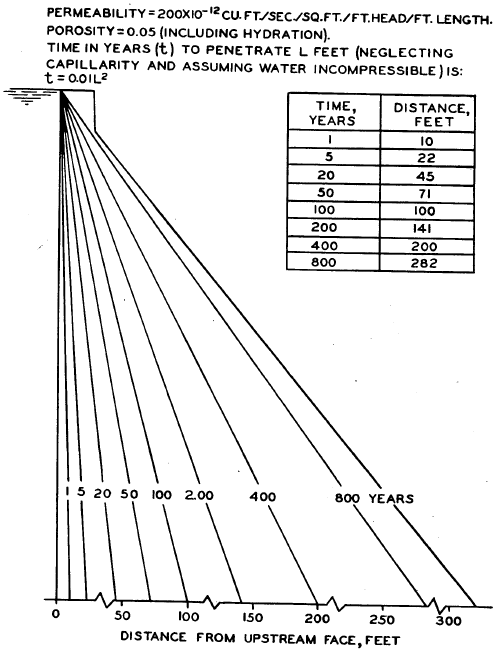
Fig. 7.12 - Calculated penetration of water into a 400-ft (122m) wide concrete dam for
various durations of hydraulic head [7.19]. Permeability in figure = 200
⋅
10
-12
(ft/s)
⋅
0.305 (m/ft) = 6.1
⋅
10
-11
m/s.
7.2.8 Porosity and pore size distribution
The hydration of cement results in cement paste in the concrete with two forms of
pores: gel pores and capillary pores. The main flow of water goes in the capillary
pores (or cracks if these are present), which are much larger than the gel pores,
ranging from 10 nm up to 1
µ
m in size. According to Hearn [7.14], Peer [7.21] has
shown that pores smaller than 10
-7
m in diameter and with a length/diameter ratio of
2 or less do not contribute significantly to the water permeability of cement paste for
water. With increasing degree of hydration, the capillary pore system becomes less
connected, becoming filled with hydration products. Below a w/c ratio of
approximately 0.7, the connections within the capillary pore system become largely
blocked, whereas above w/c 0.7 no total blocking occurs [7.10].
Due to the highly complex pattern of the pore system in a porous material, no simple
relation between porosity and permeability can be found [7.22]. Nyame and Illston
[7.23] [7.24] conducted a study of the relationship between the permeability of
hardened cement paste and its porosity and pore size distributions with the aim of
gaining a better understanding of the significance of a threshold diameter in
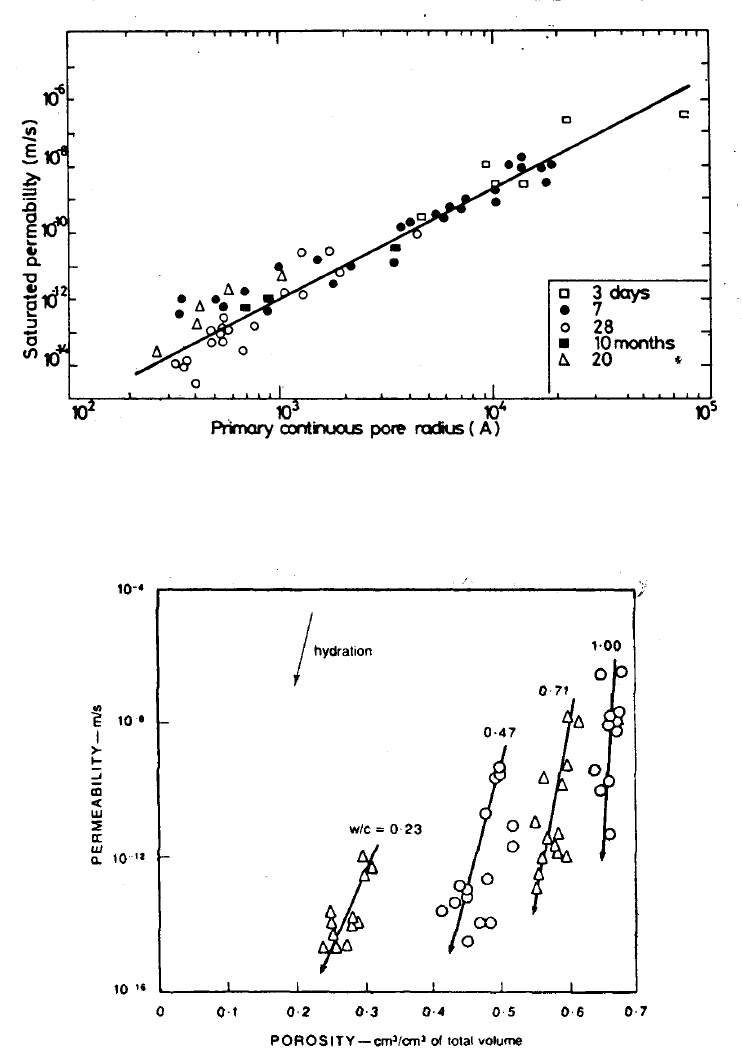
connection with permeability. The authors concluded that the hydraulic radius of the
ICOLD Bulletin:
The Physical Properties of Hardened Conventional Concrete in Dams
Section 7 (Water permeability)
As submitted for ICOLD review, march 2008 Section 7-17
pore system describes the measured permeability rather well (Fig. 7.13), except for
pore sizes of close to molecular dimensions. They found permeability not to be a
unique function of porosity, but to be dependent upon the w/c ratio as well, as can be
seen in Fig. 7.14. The authors assumed continued hydration to subdivide the pore
system into many unconnected pores. They suggested water flow to occur in distinct
flow channels.
Fig. 7.13 - The relationship between the “continuous pore radius” and the saturated
permeability of hardened cement paste [7.23].
Fig. 7.14 - Permeability of cement paste as a function of the total porosity [7.24]
ICOLD Bulletin:
The Physical Properties of Hardened Conventional Concrete in Dams
Section 7 (Water permeability)
As submitted for ICOLD review, march 2008 Section 7-18
7.2.9 Type, size and amount of aggregate
For a given water-to-cement ratio, the tightest concrete can be achieved by use of
such an aggregate, which has a shape and a size distribution that require a minimum
of mixing water. The aggregate should have a grading curve with as much of the
space between the larger particles as possible is filled with smaller particles, thus
reducing the amount of cement paste. Unstable mixes leading to bleeding might
produce channels in the concrete and cavities under big aggregate particles. This will
increase the permeability. The grading curve of aggregate shall be such that stable
mixes are produced. Use of larger and more porous aggregate makes the concrete
more permeable.
The larger the aggregate, the greater the risk of microcracks and the permeability
increasing [7.6]. The work of Ruettgers et al. [7.3] indicated that with the use of a
larger aggregate the concrete was more permeable (Fig. 7.4). Other researchers,
however, have not found there to be any strong relationship between the gradation of
the aggregate and permeability [7.4] [7.25]. Probably, the permeability is not
increased if larger aggregate is used if the concrete is well compacted and well
cured. However, if this is not fulfilled, concrete with larger aggregate is probably of
higher permeability because micro-cracks and cavities may be formed around the
aggregate.
7.2.10 Type of cement
Ingredients in the cement that consume calcium hydroxide and forms silica hydrates
gels, such as pozzolanic material (fly ash, silica fume, blast furnace slag), usually
decrease the permeability of concrete in the micro-scale level. On the other hand, if
cracks are formed, the sealing of them (paragraph 7.2.11) may be reduced.
The more finely the cement is ground, the tighter the concrete becomes [7.6]. On the
other hand, Powers et al [7.9] maintain that after some time pastes made from
coarsely ground cement are just as impermeable as pastes made of finer cement.
Any impact of cement fineness on permeability is tied up with the corresponding w/c
ratios (required for adequate workability), i.e finer cement calls for higher w/c ratios,
which, in turn may increase water permeability. However, this reasoning is not correct
if the workability of fine cement concrete is improved by chemical admixtures
(superplasticizers, air entraining agents, etc.).
7.2.11 Leaching, self sealing or deposit of material inside a dam
The permeability of concrete may change due to the removal or the formation of
compounds inside the concrete or on the surfaces. For an example, the dissolution
and precipitation of calcium hydroxide may lead to a change in the permeability.
If solid material is leached away, the permeability in the area in question increases. In
[7.26] the permeability of concrete specimens made and tested in laboratory often
ICOLD Bulletin:
The Physical Properties of Hardened Conventional Concrete in Dams
Section 7 (Water permeability)
As submitted for ICOLD review, march 2008 Section 7-19
rose sharply after their being percolated for some time. When the flow of water rose
rapidly, it appeared that the increase in flow took place in only a rather few individual
flow channels that had been broadened through material being leached away from
the channel walls. In such cases the flux could not be described in terms of a steady-
state Darcian flow but rather by a number of flow tubes described by Hagen-
Poiseuille’s law (paragraph 7.4.2).
If leached material comes in contact with carbon dioxide, or bicarbonate comes in
contact with calcium hydroxide, the resulting precipitation of CaCO
3
may decrease
the permeability in the area, the concrete is self-sealed. The cement paste in
concrete may also seal due to continued hydration, which is discussed in the
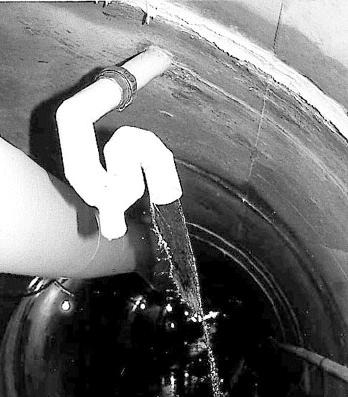
paragraph 7.2.4. The backing of leaching by carbon dioxide is the reason why
siphons are occasionally used at the exit of drains, hindering carbon dioxide to enter
the drain hole (Fig. 7.15).
Fig. 7.15 – Siphon in a dam foundation gallery in order to avoid that the leaking
water from a limestone formation is exposed to carbon dioxide of the air.
In high dams, the head of water may cause pore rupture and thus increase the length
of continuous leakage paths. However, also the opposite may occur, namely that
high pressure may block pores by its silting up with material from the reservoir.
Permeability rates after first impounding may therefore not be representative for the
dam’s later life cycle.
Pozzolonic material (fly ash, silica fume, blast furnace slag) decrease the amount of
freee calcium hydroxide in the pore solution and thus also influence the permeability
(see 7.2.10).
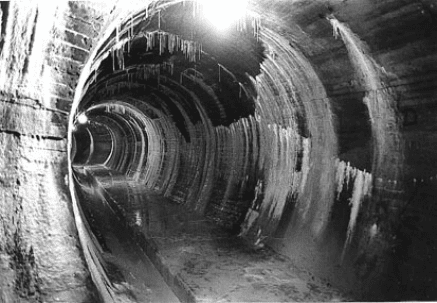
According to Meyers [7.27], material can readily deposit inside a thick concrete dam.
Both Ca(OH)
2
and CaCO
3
are more soluble at lower than at higher temperatures and
some of this material will be precipitated in the central portion of the concrete mass or
in dam galleries (Fig. 7.16). However, in the majority of cases CaCO
3
precipitations
reduce permeability due to blockage and/or long-term self-colmatation.
ICOLD Bulletin:
The Physical Properties of Hardened Conventional Concrete in Dams
Section 7 (Water permeability)
As submitted for ICOLD review, march 2008 Section 7-20
Fig. 7.16 – Excessive deposit of CaCO
3
- leaching from cement grout - in a dam
foundation gallery.
7.2.12 Workability and placing
The workability of concrete is important for tightness. The concrete needs to fill out
the mould and enclose the reinforcement. The grading of aggregate is decisive for
the workability, consistency and stability of the concrete. Experience shows that, at
equal w/c ratio, a stiff consistency results in concrete that is less tight than if the
concrete has a more plastic consistency [7.6]. In old concrete dams made of stamped
concrete, there is a considerable risk of the concrete not being tight, especially at
joints between different batches of concrete.
Potentially, entrapped air or honeycombing (large irregular voids due to poor
compaction) are damaging, even if they are isolated and do not form continuous flow
paths in the cement matrix.
A frequently observed detrimental effect on permeability is honeycombing along lift
joints. The reason is mainly incomplete compaction because vibrators are easily
damaged when touching the hardened concrete of the lift surface. In order to avoid
such damages the workers tend to pull back the vibrators before they touch the lift
surface.
Bleeding has equally serious effects; the formation of bleeding channels creates
continuous flow paths and the deposition of water pockets underneath coarse
aggregate particles” [7.14].

ICOLD Bulletin:
The Physical Properties of Hardened Conventional Concrete in Dams
Section 7 (Water permeability)
As submitted for ICOLD review, march 2008 Section 7-21
7.2.13 The viscosity of water
The flow resistance of a liquid is highly dependent on its viscosity. In large flowing
channels, the viscosity of the water depends on the temperature. In very small
channels, such as in many of the pores in concrete, large intermolecular forces
develop between different ions in the water and between ions in the water and ions
bounded in compounds in the pore walls. When strong intermolecular forces need to
be exceeded, the viscosity becomes greater. Although all the evaporable water in
cement materials is mobile when subjected to hydrostatic pressure, some of it has a
high degree of viscosity. Powers [7.28] calculated the effect of w/c-ratio on the
viscosity (Tab. 7.2).
Tab. 7.2 - Computed relative viscosity of the fluid in saturated cement pastes, as
based on eq. 62 in Powers [7.28].
W/c Porosity
ε
εε
ε
Hydraulic radius
(Å)
Factor for the increase in
viscosity
0.38 0.280 7.8 47 600
0.45 0.346 10 2 700
0.50 0.395 12 600
0.60 0.461 16 134
0.70 0.489 18 78
Powers noted that the permeability is 5-6 times as great when pure water permeates
a cement paste than when salts, particularly NaOH and KOH, are dissolved in the
water. Powers and Copeland [7.9] also observed that the permeability increased
when alkali were removed from the pore solution. Some reports mean that the
roughness of the walls of the channels may extend through the laminar layer, causing
turbulent flow. The true viscosity also includes the turbulent viscosity [7.29].
Powers noted that the permeability is 5-6 times as great when pure water permeates
a given cement paste than when salts, particularly NaOH and KOH, are dissolved in
the water. Powers and Copeland [7.9] also observed that the permeability increased
when alkali was removed from the pore solution. Some reports means that the
roughness of the walls of the channels may extend through the laminar layer, causing
turbulent flow. The true viscosity also includes the turbulent viscosity [7.29].
7.2.14 State of stress
Experiments conducted by Wisnicki et al. [7.30] indicated there to be no significant
reduction in permeability due to 2-dimensional compressive stress being applied. A
stress of maximally 75% of their compressive strength was applied in the experiment.
It appeared that the main effect of stress upon the permeability of concrete was that
of closing major cracks.
ICOLD Bulletin:
The Physical Properties of Hardened Conventional Concrete in Dams
Section 7 (Water permeability)
As submitted for ICOLD review, march 2008 Section 7-22
7.3 TEST METHODS FOR WATER PERMEABILITY
7.3.1 General
Measuring water mobility in concrete is generally a very difficult task. Unsaturated
concrete can be penetrated by water by means of a number of different mechanisms
such as adsorption, diffusion, chemical reactions, capillary suction and viscous flow
caused by over-pressure. The pore system may change its geometry due to the
formation or leaching of compounds or to swelling or shrinking. This means that
permeability tests need to be selected very carefully.
Testing samples taken out from real dams is especially difficult because such
samples are often not completely water saturated. If they are water saturated in the
test this saturation may more or less destroy the pore system, which changes the
permeability.
The variation of permeability in concrete is considerably higher than other properties,
for example strength. Alterations in preparation of the specimen, or in testing
procedures, and different ages of the specimens when tested, can lead to large
differences in the measured permeability. The degree of saturation of the concrete is
probably the major cause of discrepancies when results from different laboratories
are compared.
There are various advantages to use saturated concrete in permeability tests:
•
there is only viscous laminar flow of water under such conditions. No absorption,
moisture diffusion or capillary suction take place;
•
the flow can be calculated with the simple use of Darcy’s law, assuming viscous
flow;
•
the flow is steady over time. Both in-flow and out-flow need to be measured in
order to ensure the presence of the equilibrium conditions;
•
There is no shrinkage or swelling.
The disadvantage in only studying Darcian flow in saturated concrete is that such
concrete is not very frequent in real structures. In dams of reasonable good concrete
quality, saturated concrete is limited to a rather narrow portion near the upstream
face. The downstream face, exposed to air, has relative humidity below 100%.
Permeability measurements suffer from a lack of standardization. It is usually very
difficult to compare the results of different permeability tests due to differences in test
setups and procedures. The causes for these different results can be the following:
•
Different concrete mix designs (including the maximum size of aggregate);
•
Different curing methods (drying, heating, in air, in vapour, in water);
•
Different quality of the penetrating water;
•
Different concrete ages or different duration time of the test;
•
Different applied water pressures;
•
Different sizes of test specimens or made on different ways, e.g. cast or drilled out
from a larger block of concrete.
One standard method for measuring the permeability in saturated concrete is
described in [7.31]. In a comprehensive study made of Scherer et al [7.32] several
ICOLD Bulletin:
The Physical Properties of Hardened Conventional Concrete in Dams
Section 7 (Water permeability)
As submitted for ICOLD review, march 2008 Section 7-23
methods are reviewed such as beam-bending tests, pressure decay test,
thermopermeametry test and dynamic pressurization test.
There are also a number of standard methods in which the water is forced into a
concrete that are not completely water saturated. After a certain time the specimen is
split in two halves and the penetration of the water front is measured. One method is
SS 13 72 14 [7.33]. After 24
±
2 h the specimen is split and the penetration depths is
measured. Other methods are BS1881 [7.34], ACI-SP 108 [7.35], DIN 1048 [7.36]
and ISO 7031 [7.37]. Because the concrete is not completely saturated the test is in
reality a test of the combination of capillary suction and water tightness. However,
based on other investigations (see paragraph 7.3.6), the penetration depths are
transformed to a permeability coefficient comparable to the permeability coefficient in
Darcy’s law.
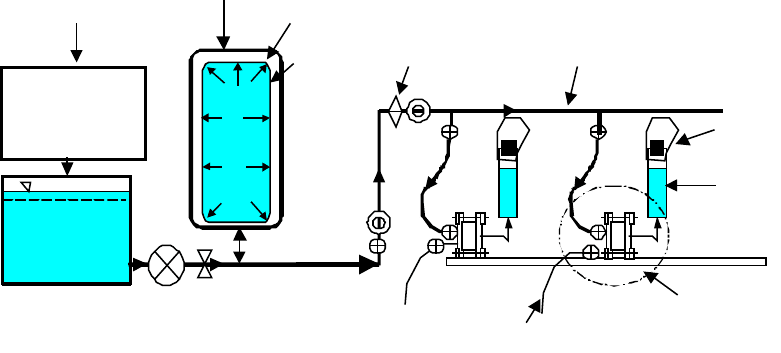
The test equipment for measuring water permeability consists usually of (e.g. Fig.
7.17):
•
A pressure side applying a pressure on the test specimen;
•
A test cell in which the specimen is placed;
•
A measuring device at the outlet that measure the flow of water penetrating the
specimen.
All parts must be made of materials resistant to both high and low pH-values
Deionising
aggregate
Ordinary municipal
tap water flowing
into
400 litre
storage tank.
Pump
Water under a
pressure of
6<P<8 bar
Steel or plastic pipes. maximum
water pressure of 6 bar.
Water
under
pressure
Pressure tank
of steel. Air under
pressure
Rubber
bladder
Rubber plug
and balloon
Measuring
glass
Test cell with
test specimen
inside.
Plastic tube for entrapped
air and for flushing
Pressure-
reduction
valves
Fig. 7.17 - Permeability equipment, consisting of a deionising aggregate, a storage
tank, a pump, a pressure tank, pressure reduction valves and a number of test cells
containing concrete specimens [7.26].
ICOLD Bulletin:
The Physical Properties of Hardened Conventional Concrete in Dams
Section 7 (Water permeability)
As submitted for ICOLD review, march 2008 Section 7-24
7.3.2 Preparation of specimens
The most important task is to decide what the relevant permeability is for the test, for
example:
•
Permeability of virgin (never dried, never heated) specimens made in laboratory.
•
Permeability of not virgin, e.g. dried and/or heated, specimens made in laboratory.
•
Permeability of specimens taken out from a real structure.
For dams the first testing is most common and it is used as an indicator of the
durability of the concrete mix. Permeability testing should therefore be a standard test
in a pre-construction test program (see Table 2.1 in Section 2).
To achieve true Darcian permeability the test specimens preferably must be water
saturated before the test starts. If the specimens already are saturated before the
test, such as virgin specimens, they can be directly put into the test equipment. If the
specimens are not fully saturated, for example laboratory made not-virgin specimens
or cores drilled out from dams, the air inside the specimen must be forced or sucked
out of the specimen before a steady-state water flow appears. This can take different
long time depended mainly on the moisture content in the pore system, the pore size
distribution of the specimen, the history of treatment of the specimen, continued
hydration reactions, swelling, etc.
To saturate concrete without destroying the pore structure and changing the
permeability is difficult. Two main principles are commonly used: Forcing water into
the specimen or sucking water into the specimen.
If the specimen is exposed to external water pressure such a long time that the flow
becomes steady state, the specimen can be assumed to be water-saturated. In such
a case a test method like that described in Fig. 7.17 can be used. The possibilities of
continuous hydration or leaching must however be regarded if it takes a long time
reaching steady-state flow.
A faster method to water-saturate a specimen is to vacuum saturate the specimen. A
suitable method is described in NT Build 492 [7.38], point 6.3.2 . In another method,
specimens are dried in oven before the vacuum treatment. This is a quicker method
for withdrawing all air inside the specimens. On the other hand, this method will much
more alter the pore size distribution and porosity and thereby also increase the short
term permeability of the specimen. In long lasting tests the permeability often
decrease again due to continued hydration.
Given these difficulties, permeability testing from cores of existing dams is only
meaningful if serious defects in material-permeability are found to be prone for
investigations.
ICOLD Bulletin:
The Physical Properties of Hardened Conventional Concrete in Dams
Section 7 (Water permeability)
As submitted for ICOLD review, march 2008 Section 7-25
7.3.3 The test cell
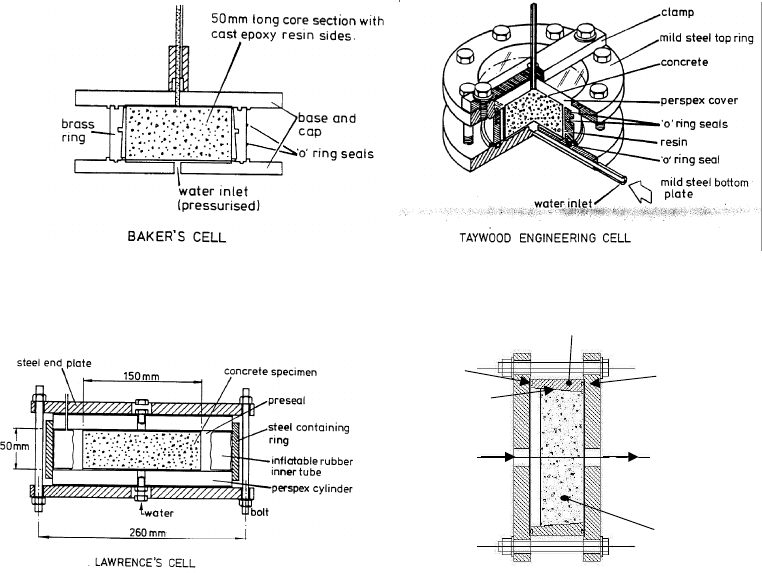
A test cell consists usually of a steel cylinder in which the test specimen is placed.
Between the specimen and the cylinder there must be some sort of sealing to avoid
water leakage. Different types of uniaxial test cells are shown in Fig. 7.18 and in Fig.
7.19.
A passive sealing is made, for example, of bitumen or epoxy that is let to stiff in the
gap between the cell and the specimen (Fig. 7.18). An active sealing can for example
be a rubber tube in the gap between the cell and the specimen and which is filled
with high-pressure air (Fig. 7.19a). Another example is when the specimen is made
conical with a membrane around it. The specimen is pressed down by the applied
pressure and becomes sealed (Fig. 7.19b). Fig. 7.20 shows a test cell used in the
standard method SS 13 72 14 [7.39] that gives the permeability indirectly via the
depth of the penetrated water front.
The test cell shown in Fig. 7.19b was used in an experiment described in [7.17] for
concrete specimens with a thickness of 50 mm and a diameter of 150 mm. For
concrete used in many dams, with aggregate of perhaps 120 mm or more, bigger
specimens and larger devices are needed. A rule-of-thumb is a diameter three times
as big as the biggest aggregate used in the concrete. Example of the permeability
apparatus suitable for testing mass concrete from dams are shown in Fig. 7.21.
Fig. 7.18 - Examples of uniaxial cells with passive sealing [7.14].
Latex membrane
Conical steel ring
Steel plates
Pressure side
(inlet) Downstream side
(outlet)
O-ring
O-ring
Concrete specimen
(a) (b)
Fig. 7.19 - Examples of uniaxial cells with active sealing from (a) [7.14] and (b) [7.17].