
Johnson Michael. North American Indian Tribes of the Great Lakes
Подождите немного. Документ загружается.

marriage to a member of the same clan was forbidden. Ottawa clan titles
included the Sturgeon, Turtle, Swan, Crane, Owl, Bear, Elk, Moose,
Otter, Thunder, and Moon, and those of Potawatomi clans were very
similar. A band of c.400 people would comprise a dozen or so extended
families; ties of kinship recognized all fathers’ brothers as “father” and
mothers’ sisters as “mother,” extending the terms to in-laws of the
same generation.
During the 1820s–30s the Ottawa ceded most of their territory to the
US, moving first to Kansas and then to Indian Territory. The remainder
lived throughout Michigan and Ontario, the largest number on
Manitoulin Island. The Ottawa numbered 6,432 in the US census of
2000, but in Canada they are not returned separately from the Ojibwa.
The Potawatomi actively sided with the French until the end of the
French and Indian War; they were also prominent in the Pontiac War of
1763-64, and took up arms against the United States during the
Revolution and the War of 1812. After the peace of 1815 they sold their
lands piecemeal in two separate bodies – the Potawatomi of the Woods,
and of the Prairies – uniting in Kansas in 1846, with some re-formed
as the Citizen band moving to Oklahoma in 1868. Others moved to
Ontario and mixed with Ojibwa and Ottawa; four other groups survived
in Michigan, and one mainly in Forest County in northern Wisconsin.
The 2000 census reported 15,817 Potawatomi in the US, and in 2005
a Canadian fraction was numbered at 290. All present-day descendants of
Great Lakes Indians, and particularly those whose forebears were forced
to live in Oklahoma, are now of largely mixed ancestry. Although some
participate in Pan-Indian events, their traditional culture, native
language and customs have largely disappeared. By 2000 only 50 speakers
of the Potawatomi tongue remained in the US, but there are several
hundred Ottawa-speakers in Canada.
Menominee (Menomini)
The name is derived from the Ojibwa term meaning “wild rice men,”
and they probably numbered about 3,000 people when first known to
whites. They originally lived along the Menominee River, with their main
village at the mouth of this river on Green Bay. They spoke a dialect of
Algonquian closer to Sauk and Fox than to Ojibwa, but their closest
cultural relations – in kinship systems, social and political organization,
and religious beliefs – were with their Winnebago neighbors to the
south. Their subsistence depended on hunting, fishing and gathering,
but the harvesting of the wild rice that grew abundantly in their territory
was also a major activity. Their cultivation of corn was limited, but they
collected wild plant foods.
The Menominee lived in sedentary villages, in lodges of bark and
woven mats similar to those of the Winnebago and other tribes to the
south. They were excellent weavers of mats and bags of twined vegetable
fiber and sometimes spun buffalo hair; these bags were decorated with
designs of humans, animals, and mythological birds and underwater
creatures. With the arrival of European trade goods they became skilled
in beadwork, ribbonwork, and the use of the cloth that largely replaced
skin and fur for clothing by the 18th century.
The recorded history of the tribe began in 1634 when the French
explorer Jean Nicollet passed through their country, and in 1668 a
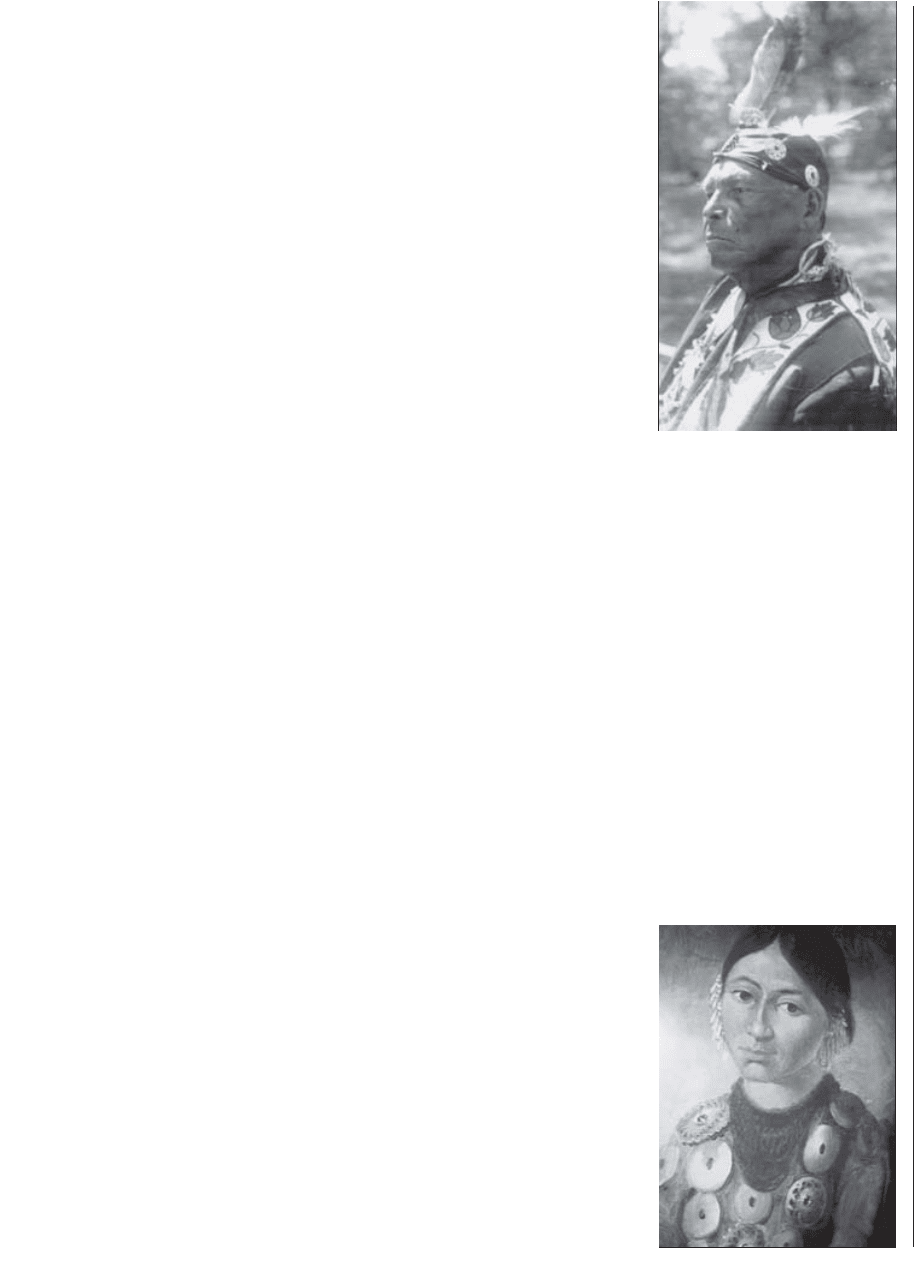
Simon Kaquados, Wisconsin
Potawatomi, c.1915. He
succeeded Chief Charles Kishek
as leader of the Potawatomi of
Forest County and Arpin, and in
the early 20th century became
their principal historian.
Ke-wah-ten, “The North Wind,”
a Menominee woman painted by
Paul Kane in 1846. She wears
multiple silver earrings all round
the rims of her ears, and silver
brooches.
11
© Osprey Publishing • www.ospreypublishing.com
French fur-trader named Perrot was recorded as transporting a
cargo of pelts from La Baye (Green Bay) to New France. By 1671
the French reached a formal agreement at Sault Ste Marie
with 14 tribes, including the Menominee, and soon brought
the whole western Great Lakes area into the French sphere of
influence, and its Indians into the fur-trade economy. Jesuits
were also active in Menominee territory from 1669.
Menominee warriors helped the French in their wars against
the Fox during the 1730s, and later against the British –
Menominees were among Langlade’s Indians who destroyed
Braddock’s force on the Monongahela in 1755. Although there
was considerable intermarriage with French trappers and
settlers, when the British succeeded the French after 1760 the
Menominee became their allies, fighting with them against
Pontiac’s coalition in 1763 and against the Americans in the
Revolution. In 1794 the region became part of the United States
under the provisions of the Jay Treaty, but the Menominee again
sided with the British in the War of 1812.
In 1848 the Menominee ceded their lands to the US in return
for a reservation in Minnesota, which did not materialize;
instead, in 1852 some 2,000 people moved to Keshena on the
Wolf River within their own territory, which by a treaty of 1854
became the Menominee Reservation. (However, 300 mixed-
bloods had accepted payment to relinquish tribal affiliation,
and were thenceforth no longer “Menominees.”) The death-toll
during these movements of 1852–58 was very heavy; however,
the reservation was covered with good timber, which later
brought the tribe some economic benefits from a century of activity in
the logging industry. During the second half of the 19th century the old
economy of hunting, fishing, and gathering wild rice greatly diminished,
along with most visible expressions of native culture.
The tribe provided a number of men for the Union cause in the Civil
War, and for the US Army in the Spanish-American War; in World War
II, 400 tribal members served in the US armed services. In 1954, 3,270
had tribal membership, of whom 2,677 lived on the reservation, but only
71 were known to be full-blood. The tribe’s advanced acculturation
encouraged a policy of complete termination of federal supervision,
and in 1961 a process was completed by which the reservation became
an integrated part of the state of Wisconsin, with a per capita
distribution of tribal assets. However, this was revoked in 1973. In 2001
the Bureau of Indian Affairs reported 8,074 members, although the
community at Zoar has considerable Potawatomi ancestry. Only about
40 fluent speakers of the Menominee language remained in 2000.
Winnebago (Ho-Chunk)
This tribe spoke a Siouan language, which probably links them
historically with the Siouan peoples of the upper Mississippi valley
before they moved west; pottery finds also confirm this association.
Apparently the name Winnebago comes from the Ojibwa term Winipig
(“filthy water”), a reference to Green Bay, the algae-rich but malodorous
body of water that was their original home. They called themselves
Hochagra (“people of parent speech”). When first encountered by the
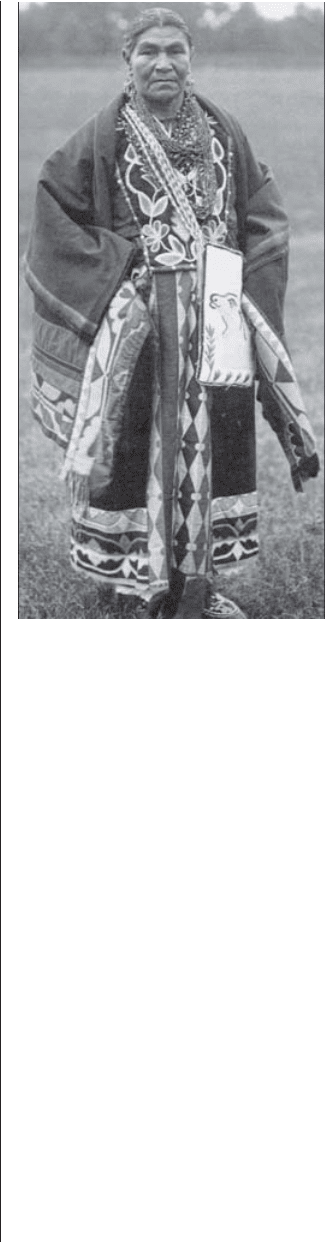
Louise Amor, a Menominee
woman photographed in c.1915,
with a blanket and skirt richly
decorated with appliqué
ribbonwork. The southern Great
Lakes tribes excelled at this
craft, and no doubt took it to
the Missouri River tribes and
to Oklahoma after some tribes
were forced to relocate
westward in the 19th century.
See also Plate G4.
12
© Osprey Publishing • www.ospreypublishing.com
French in the 17th century they lived in northeastern
Wisconsin, but in later times they moved south to
Lake Winnebago, and ultimately to the middle
Wisconsin River region.
Their habitat allowed the raising of corn, beans,
squash, and tobacco, and they also collected wild rice,
nuts and berries. After the crops were harvested they
went on a communal buffalo hunt on the prairies
southwest of their semi-permanent villages. They lived
in dome-shaped wigwams 12ft to 40ft in length,
10–20ft wide and about 15ft high, covered with woven
reed mats or bark on a frame of bent saplings, and
with internal platforms. Their kinship system was
similar to the Sauk and Mesquakie, and dissimilar to
the Ojibwa-Ottawa system, which tended to separate
generations. The Winnebago stressed lineage in
the male line through a mother’s brother, whose
male descendants were also termed “uncles.” The
daughters of these uncles were called “mothers,” and
their children were one’s “brothers and sisters.” This
system, ignoring differences of generation, allowed
a wider spread of wealth and prestige, which also
reflected the abundant food supply and sedentary lifestyle of a milder
and richer natural environment than that available to the Ojibwa.
Children were born into the clan of the father; marriage within the clan
was not allowed, nor within the tribal division to which one belonged.
There were two divisions: the Upper or Air phratry, and the Lower or
Earth, each with its own animal-totem clan fraternities. The
Thunderbird was the leading clan of the Upper division, and the Bear
that of the Lower division, each with its own obligations for war, policing,
and arranging buffalo hunts.
The Winnebago were known to whites since 1634, when Nicollet
reported them living on Green Bay, but by 1671 reports place them on
Lake Winnebago after a war with the Illinois Indians. In 1766 Jonathan
Carver found them on the Fox River in Wisconsin. During this period
they were on friendly terms with most of the surrounding tribes, and
with the French until the fall of French Canada in 1760. They sided with
Britain during the War of 1812, and were among the several tribes that
helped defeat the Americans at the battle of the River Raisin
(“Frenchtown”) in January 1813; this episode was notorious for the
subsequent massacre of 60 disarmed American prisoners.
Part of the tribe remained hostile to the Americans; Red Bird’s warriors
killed a few lead-miners in southern Wisconsin in 1827, and southern
Winnebagos aided Black Hawk’s Sauks during the war of 1832. Following
treaties at Prairie du Chien in 1825, 1832 and 1837, the Winnebago ceded
to the US most of their territory in Wisconsin for a reservation beyond the
Mississippi, and in 1846 they moved to Minnesota (during a period in
which they lost a quarter of their numbers to smallpox). Following
the Sioux war of 1862 the white people of Minnesota demanded that they
be moved again; they were forced first to the Crow Creek Reservation in
South Dakota, but in 1863 they were finally located on the Omaha
Reservation, Nebraska. During this period of great hardship individual
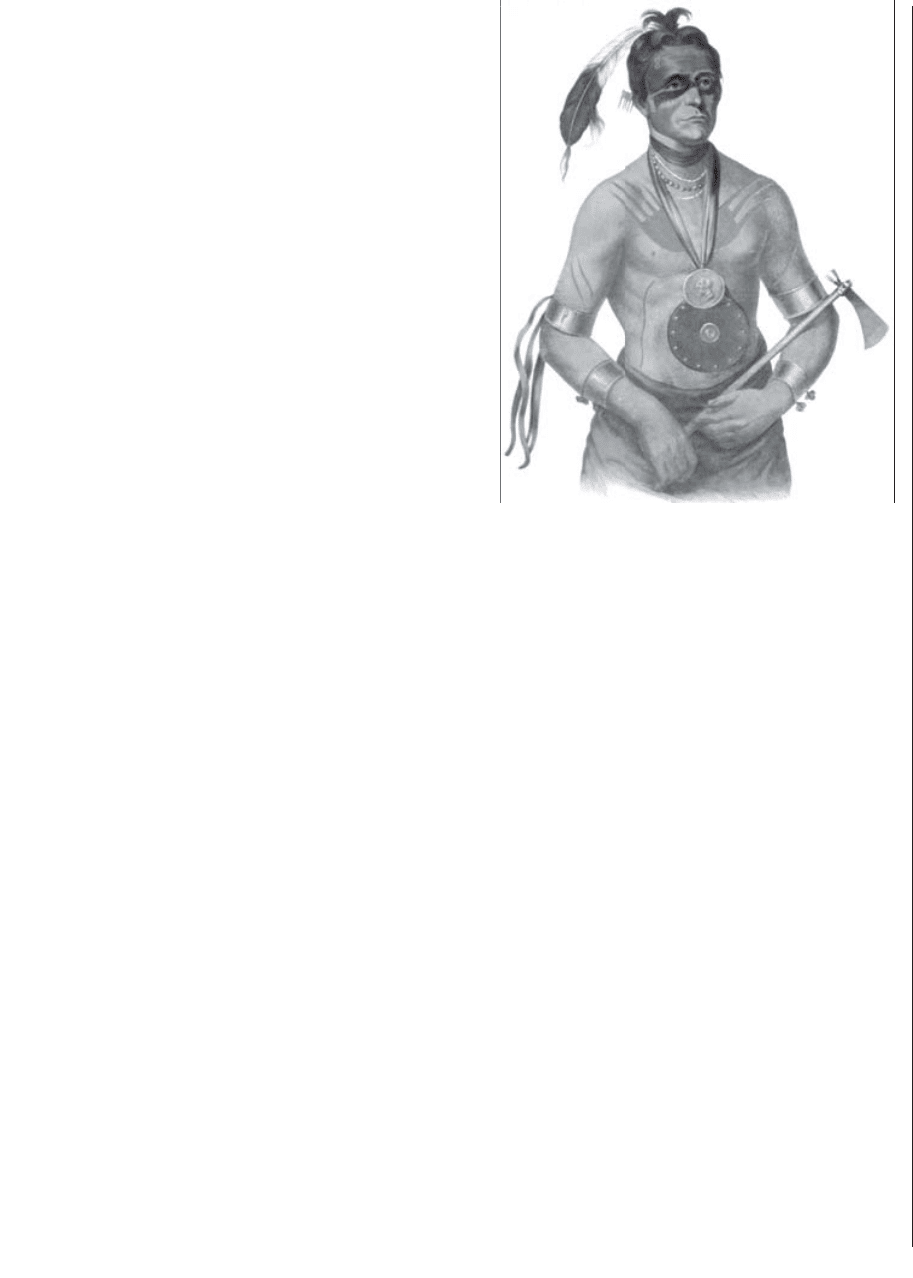
Hoowabneka, “Little Chief,” a
Winnebago who fought for the
British in the War of 1812. He
visited Washington, DC, in 1824,
and signed the treaty with the
US at Prairie du Chien the
following year – note the “peace
medal.” He wears silver armlets;
his face paint is red (hairline)
above black, with small green
details, and his body and arm
paint is red on his right side,
green on his left. (Lithograph
from McKenney & Hall)
13
© Osprey Publishing • www.ospreypublishing.com

families filtered back to Wisconsin, obtaining small parcels of land
scattered throughout their old homelands, particularly around
Black River Falls and Tomah.
In 1910 there were reportedly 1,063 in Nebraska and 1,270 in
Wisconsin. In 2001 the same groups were numbered at 4,033 and
6,145 respectively, the Wisconsin portion now being called
Ho-Chunk. In common with most of the Great Lakes tribes, they
became largely acculturated during the 20th century. They have
been recipients of the Peyote cult (Native American Church – see
under Plate E), and participants in Pan-Indian events. By 2000, fewer
than 250 fluent speakers of the Winnebago language remained.
Sauk (Sac) and Fox (Mesquakie)
The Sauk and Fox have long been associated with Wisconsin’s
deciduous forest zone, and later the grassy prairie of northern
Illinois and Iowa. However, there is evidence that the Sauks’
earliest known home was the eastern peninsula of Michigan, along
with the Potawatomi and Mascouten. The term Sauk, meaning
“people of the inlet” or alternatively “yellow earth people,” may be
a reference to Saginaw Bay, a probable early location. Despite a
long and close association with the Sauk, to whom they were
probably related, the Fox or Mesquakie (“red earth people”) seem
to have lived on the Fox and Wolf rivers and around Lake
Winnebago when first encountered by whites. Neither tribe
probably had an original population of more than 2,000. The Sauk
were first reported in the Jesuit “Relations” for 1640, when the
Hurons referred to them as “westerners.” In 1671 they were
reported around Green Bay, having been driven out of their
original habitat.
The villages of the Sauk and Fox consisted of clusters of
oval-shaped wigwams, made of woven rush and cattail mats tied to
arched saplings. Their subsistence was based upon a combination
of farming and hunting; villages were usually occupied from April
to October, with the winters spent in small temporary hunting
encampments. Women planted and cultivated corn, beans, and squash
in fields cleared by burning the previous year’s dead cornstalks. After
the harvest entire villages moved onto the prairies for the winter buffalo
hunt; elk, deer, bear and beaver were also hunted in their forest regions.
They made some use of dugout canoes; under the influence of the
fur-traders they learned the use of bark canoes and snowshoes, but these
were not typical of their traditional culture. The clothing of the Sauk
and Fox was similar to that of the Winnebago and Miami.
While their political organization more closely resembled that of the
Potawatomi, their kinship systems were also similar to those of the
Winnebago and Miami. The Sauk and Fox stressed lineage through
one’s mother’s brothers and their male descendants, thus extending
relationships beyond each generation. They were divided into
patrilineal clans whose mythical founders had supernatural powers
derived from animals such as the Bear, Wolf, Fox, Elk, Swan, Partridge
and Bass. Their two main religious rituals were the clan festival held
twice a year, which offered thanksgiving to the spirits for a new
agricultural season, and in the summer when the fields ripened; and the
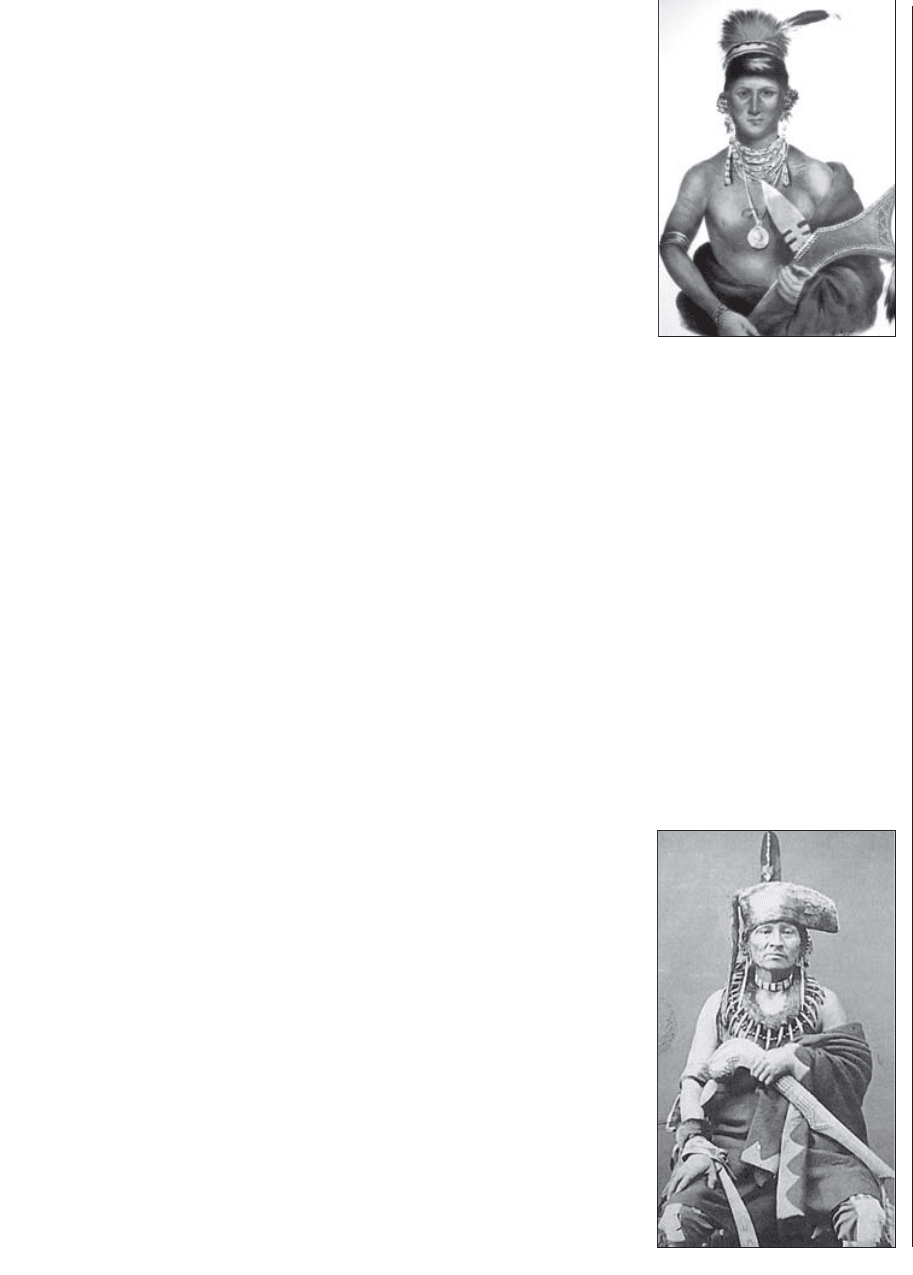
“Standing Buffalo,” a Winnebago
photographed in the 1860s.
He wears a head roach; metal
earrings; necklaces, armlets and
wristlets; an apron, buckskin
leggings with fur garters
(skunk?), and moccasins. He
carries an eagle-feather fan.
(Photo Gurnsey & Illingworth,
Sioux City, IA)
14
© Osprey Publishing • www.ospreypublishing.com
Midewiwin (q.v.), an elaborately organized society entered by invitation
and payment, to ensure long life and health. The Tama Mesquakie, like
the Mexican Kickapoo (q.v.), retained these religious observances until
recent times.
The Fox conceived a hatred of the French traders who had followed
the old Indian trail from Lake Michigan to the Mississippi via the Fox
and Wisconsin rivers, exploiting the fur trade of central Wisconsin, and
aligning other tribes such as the Ojibwa against the Fox. They planned
an attack on Fort Detroit in 1712, which failed, and the French
subsequently carried out a long war of destruction against them.
During the 1720s the Sauk were sympathetic toward their friends the
Fox without totally joining them in all-out war against the French, but
had friendly relations with the Spanish beyond the Mississippi. They
were met by Jonathan Carver in 1766 on the Wisconsin River, and by
Peter Pond in 1773.
In 1804 they began a series of treaties with the US, which required
the Sauk to move west of the Mississippi – a directive that many refused.
Warriors fought with Tecumseh in the War of 1812; and in 1832 some
attempted to resettle on old Sauk territory at Rock Island and along the
Rock River, Illinois. This so-called Black Hawk War (q.v.) resulted in
defeat at Bad Axe Creek, Wisconsin, with the death of many women and
children. In 1837 the Sauk and Fox made their last cessions in Iowa and
reunited in Kansas; but internal dissensions split them, and during the
1850s the Fox purchased land for a new home at Tama, Iowa, which has
remained their settlement. In 1867 the Sauk mostly moved from Kansas
to a reservation in Oklahoma.
In 1820 the combined population of the two tribes was estimated at
3,000. In 1909, 352 were reported in Iowa (nearly all Fox), 536 in
Oklahoma (mostly Sauk), and 87 in Kansas (also chiefly Sauk). In 2001
the Bureau of Indian Affairs numbered the same groups at 1,260 (Iowa),
3,025 (Oklahoma), and 433 (Kansas-Nebraska). The Sauk and Fox near
Stroud, Oklahoma, hold an annual Pan-Indian event, as do the Tama
Mesquakie, including older traditional observances; in 2000 there were
still more than 700 speakers of the Sauk-Fox languages.
Kickapoo and Mascouten
The Kickapoo are an Algonquian-speaking people forming a dialectic
group together with the Sauk and Fox, and more distantly with the
Miami; their name derives from Kwigapaw, “he moves about here and
there.” Their original population was probably some 3,000, and they
were first recorded by Father Allouez in about 1670, when they were
living between the Fox and Wisconsin rivers. Le Sueur mentions them
around the confluence of the Wisconsin River with the Mississippi. Their
culture was essentially the same as that of the Sauk and Fox. They lived
in bark lodges in the summer and oval reed lodges during the winter.
They raised corn, beans, and squashes, but had a reputation for adapting
to the Plains and Prairie environments when on hunting trips beyond
the Mississippi – they learned to use horses in the early 18th century.
About 1765 they moved south into the country of the destroyed
Illinois confederacy along the Illinois River near present-day Peoria,
while another portion of the tribe established themselves along the
Wabash River; these became known as the Prairie and Vermilion bands
Appanoosee, a Sauk warrior
painted by George Cooke in
Washington, DC, in 1837. Note
the “gunstock” warclub fitted
with a large metal trade blade,
and decorated with brass nails.
(Lithograph from McKenney &
Hall)
A Sauk man from Indian
Territory, possibly photographed
during a delegation to
Washington, DC, in c.1868. He
is reputed to be a grandson of
Black Hawk (1767–1838), who
led resistance to the US in 1832.
He wears a fur turban and a
bear-claw necklace, and carries
a horse quirt and a nail-studded
warclub.
15
© Osprey Publishing • www.ospreypublishing.com

respectively. They played a major role in the history of the region, with
Kickapoo warriors joining Tecumseh in his war against the US and the
War of 1812. From 1809 they began a series of treaties with the United
States, ceding all their lands in Illinois by 1819, after which they
gradually settled in Missouri, Kansas, and even Texas. In 1832 a number
of warriors rode with Black Hawk.
In 1852 a large party went to live in Mexico, followed by others in
1863. However, in 1873–74 a number of Kickapoo from Mexico were
forcibly “encouraged” to return, and settled in Indian Territory
(Oklahoma) close to the Sauk and Fox Reservation. The Mexican
settlement became a focal point for disaffected and conservative
Kickapoo. By 1885 only about 560 members of the tribe were reported
in the US, of whom 235 were in Kansas and about 325 in Indian
Territory. In addition, perhaps 200 lived in Mexico near the town of
El Nacimiento in Coahilla, where they continued their traditional
Prairie and Woodland culture adapted to the Mexican environment,
and retained their language. During the 19th century the Mexican
Kickapoo often joined Caddo, Cherokee and other Mexican bands on
raids into Texas.
The Mexican and Oklahoma branches of the tribe have continued
to vacillate in number throughout the 20th century, in pursuit of
seasonal labour. In 1983 the Mexican members of the tribe obtained
US citizenship, and land near Eagle Pass, Texas. In 2001 the Bureau
of Indian Affairs reported 1,605 Kansas Kickapoo, 2,505 in Oklahoma,
and 880 in Texas – the latter presumably all or most of the Mexican
branch of the tribe. (Tribal membership requires one-quarter Kickapoo
ancestry for qualification.) In 2000 there were about 500 reported
Kickapoo speakers, probably mostly from the Mexican group.
The Mascouten are a little-known tribe, whose name comes from
Mashkode or Muskuta (“prairie people”) – a translation that has
confused them with the Prairie band of the Potawatomi, who are unlikely
to have any Mascouten ancestry. They seem to have lived in various places
in present-day lower Michigan, but moved into Wisconsin via the
southern end of Lake Michigan. They were visited in turn by Nicollet,
Allouez and Marquette between 1634 and 1673, when they were in close
association with the Sauk and Kickapoo. In about 1712 they were
reportedly allies of the Kickapoo and Fox against the French and their
Indian allies from the north. By the late 18th century they had been
absorbed into the Sauk and Kickapoo.
Miami and Illinois (Illini)
The name Miami is believed to be derived from the Ojibwa word
Omaumeg, “people on the peninsula,” but this has been challenged. The
Miami were an Algonquian people, living in the Green Bay area of
Wisconsin when first known to European explorers, but by the end of the
17th century they were moving south toward the southern end of Lake
Michigan, around Chicago and the St Joseph River. In 1703 there was
a Miami village near Detroit. By 1711 they had reached the Wabash
and Maumee and later the Great Miami River, the locations in Indiana
and western Ohio with which they are historically associated. Their
linguistic relations are closest to the Illinois tribes to their west, but
culturally they were probably at one with the Sauk and Fox.16
Kenakuk (c.1790–1857), the
so-called “Kickapoo Prophet,”
was painted by George Catlin
c.1830.
© Osprey Publishing • www.ospreypublishing.com
They suffered from Iroquois attacks until 1701, when they were
represented at the Montreal peace conference that ended Iroquois
aggression against the western tribes. The dominance of French traders
was challenged by the establishment of the new Miami town of
Pickawillany on the upper Great Miami River, which opened up trade
with the British from Pennsylvania until 1752, when Pickawillany was
destroyed by the French with Ottawa help under their mixed-blood
leader Langlade (q.v.). Generally, however, the Miami supported French
interests during the inter-colonial warfare of the 18th century. After
the French defeat in 1760 they abandoned their eastern Ohio territory
to the Shawnee and Wyandot.
After the American Revolution a complex coalition of Indian villages
on the Maumee River became the center for Indian resistance to the
organized efforts of the new US government and land speculators to
purchase their territory. During the Indian war of 1789–95 the Miami
under their chief Little Turtle defeated the Americans under Arthur
St Clair (1791); however, following Gen Wayne’s victory at Fallen
Timbers (1794) they were forced to sign the Treaty of Greenville (1795).
After the War of 1812 the Miami began to cede their lands to the US;
although the combined population of the Miami and two subgroups,
the Wea and Piankashaw, had probably been about 4,000 in the
17th century, the same grouping numbered only 1,400 by 1825. By 1845
only the Richardville, Godfrey, Lafontaine and Meshingomesia bands,
mostly mixed-bloods, remained in Indiana; the remainder had moved to
Kansas, and in 1867 they moved on again to Oklahoma. The Wea and
Piankashaw joined the remnant Illinois under the combined name
“Peoria,” who also obtained a reservation in northeastern Oklahoma.
In 1903, just 191 Miami and 195 “Peoria” were reported in Oklahoma.
In 2001 the Oklahoma Miami listed 2,677 enrolled, the Peoria 1,133,
and several hundred others lived near Peru, Indiana, without federal
recognition as Indians; all were of mixed descent. By 2000 there were
no remaining speakers of either the Miami or Illinois languages.
The Illinois were an Algonquian confederacy of at least 12 subtribes,
living principally along the Illinois River in that present-day state. The
name Illinois apparently signifies “men” or “people.” Little is known of
their clan system or religion before the influence of French Jesuits.
Father Allouez met a party of them in 1667 and 1670 within Wisconsin,
but Marquette found others near the Des Moines River’s confluence
with the Mississippi, and the Kaskaskia division on the upper Illinois
River. They were constantly harassed by the Sioux and Fox, and the
Iroquois waged a long war against them due to their association
with the French. During the French era in the western Great Lakes
the numbers of Illinois dropped from around 6,000 to 2,000
through disease, alcohol abuse, and warfare – particularly with
the Iroquois and Chickasaw. The murder of the famous Ottawa
chief Pontiac in 1769 by a Kaskaskia Indian also provoked the
vengeance of the Great Lakes tribes.
By 1800 only 150 were left; in 1832 the remainder sold their
lands and moved to Kansas, and in 1867 on to Indian Territory.
In Oklahoma they combined with the Wea and Piankashaw in the
northeastern corner of the state, now Ottawa County, under
the name “Peoria.” These mixed-bloods of part French extraction
17
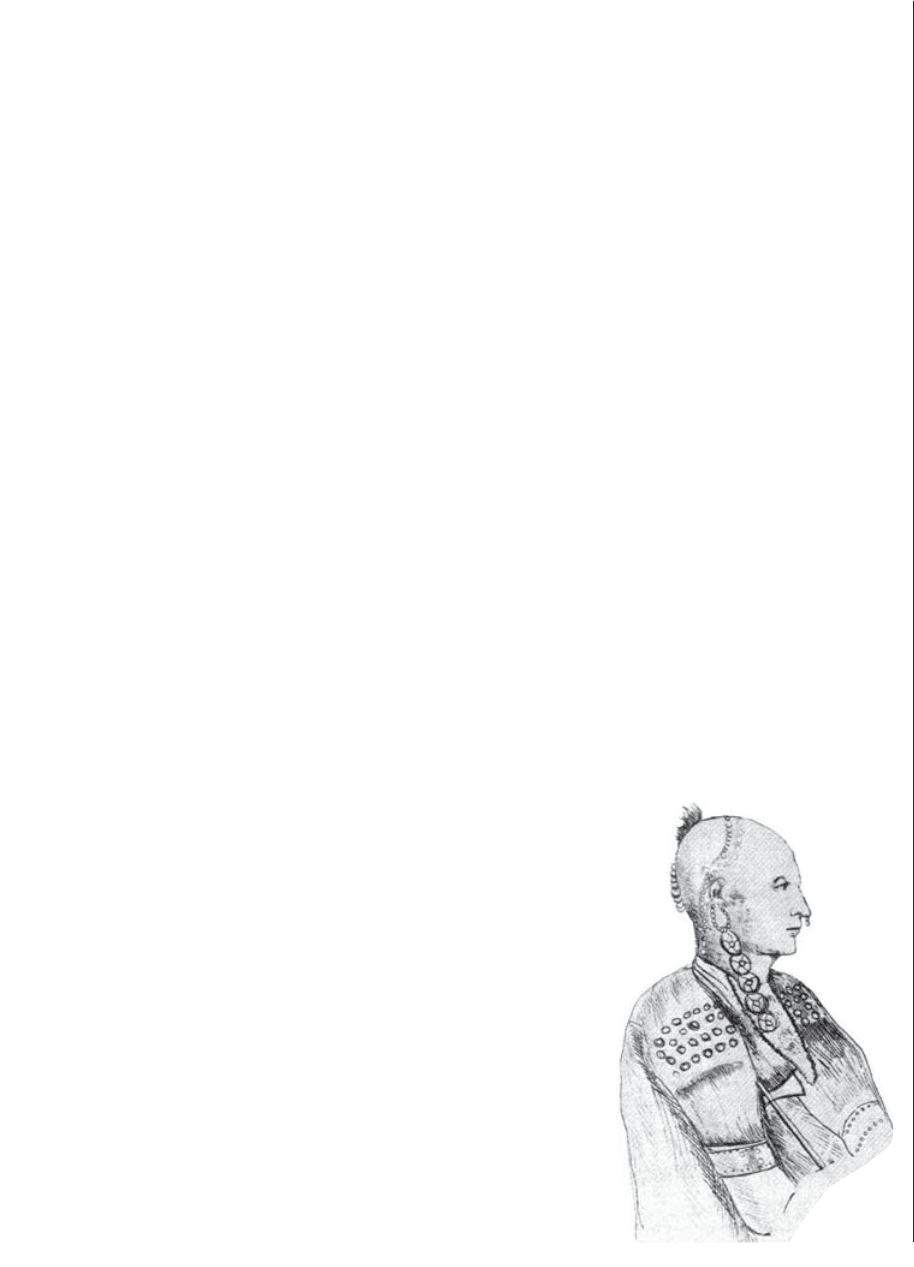
Paccane, a Miami warrior
sketched c.1796 by Elizabeth
Simcoe, wife of the lieutenant-
governor of Upper Canada. He
sports many silver ornaments,
including a nose ring, and
carries a trade tomahawk.
(Archives of Ontario, Toronto)
© Osprey Publishing • www.ospreypublishing.com
numbered 195 in 1905, on lands then allotted per
capita; the same group’s descendants were reported
as numbering 1,133 in 2000.
Shawnee
The Shawnee, probably an ancient people of the Ohio
region, are an Algonquian-speaking tribe whose closest
linguistic relatives are the Sauk and Fox. Their name is
derived from Shawunogi, “southerners,” and although
at least part of the tribe lived in the south they seem
always to have maintained a firm friendship with
northern groups. With an original population of
perhaps 3,000, the Shawnee were separated into five
divisions: the Chillicothe, Mekocke, Hathawekela,
Piqua and Kispoko.
In the early historic period they moved to the
Cumberland River valley in Kentucky and Tennessee,
where French explorers first heard of them. In about
1674 some of the tribe had settled on the Savannah
River, aiding the new British colony of South Carolina
against local tribes. Early in the 18th century some
of the southern Shawnee, of the Piqua and later the
Hathawekela divisions, returned north to Pennsylvania,
while others remained in the south with the Creek,
with whom they have always had friendly relations.
After about 1730, by permission of the Miami and
Wyandot, many Shawnee collected on the north side
of the Ohio River, along its tributary the Scioto.
The Shawnee had a long history as courageous warriors, and from
the time of the French and Indian War until the War of 1812 some of
them were in almost constant warfare against the British or the
Americans. Eventually they were driven from the Scioto to the Great
Miami and Auglaize rivers, and ultimately into Indiana; but in 1793
a number of Shawnee had moved to the then-Spanish territory west of
the Mississippi in present-day Missouri, and later into Texas. In 1805
a Shawnee “Prophet,” Tenskwatawa, began to preach a new doctrine
which exhorted the Indians to return to the communal life of their
ancestors. His followers were bonded into a confederacy under the
leadership of the Prophet’s brother Tecumseh. This prompted
Governor William H. Harrison of Indiana Territory to move against
their main village at Tippecanoe in September 1811 and, in Tecumseh’s
absence, the village was destroyed on November 7. Tecumseh led his
remaining warriors north into British Canada; he would be killed there
while fighting for the British, at the battle of the Thames River in 1813.
In 1825 the Missouri Shawnee, who had taken no part in that war,
moved to Kansas, joined by others from Ohio, and in 1832 a band also
mixed with Senecas from Ohio settled in Indian Territory. Shawnee
from Texas, now known as the “Absentee” Shawnee, also settled in
Indian Territory at various times between 1836 and 1859; after the Civil
War, joined by Black Bob’s band from Kansas, they finally settled in the
southern part of the Potawatomi Reservation, Oklahoma. The Kansas
Shawnees ceded their reservation to the US in 1854, and eventually
18
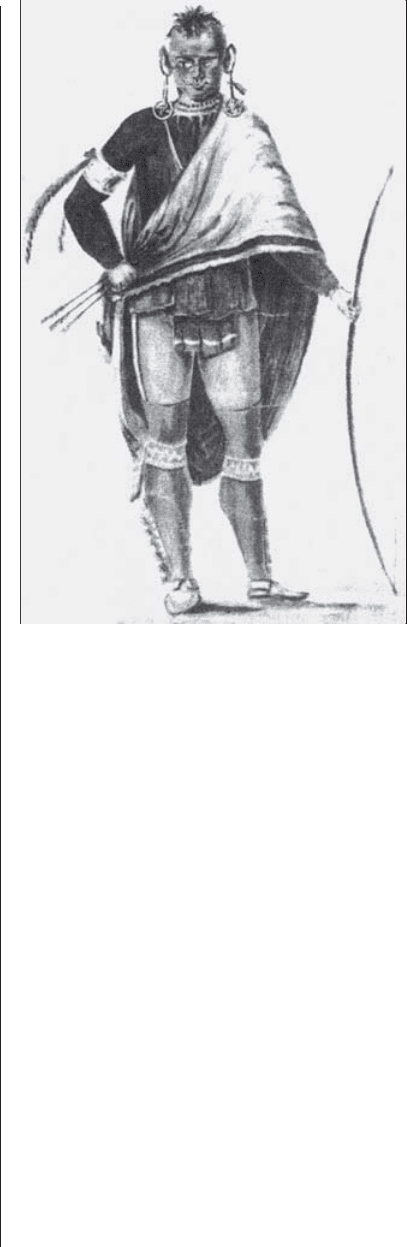
A Shawnee man drawn in the
Illinois country, c.1796. He has
extended auricles (the rims of
his ears) and lobes, and displays
silver ear and nose jewelry and
an armband. Under his blanket
robe he wears a calico shirt
and trade-cloth breechclout; his
leggings are probably buckskin,
with fringing and beaded
garters. Note the length
of his bow.
© Osprey Publishing • www.ospreypublishing.com

agreed to move to Oklahoma to be incorporated into Cherokee Nation.
Three separate groups in Oklahoma have remained on parts of their
allotted lands to the present time, although predominantly of mixed
blood, via the early adoption of white captives and intermarriage with
French and British frontiersmen and with Cherokees. In 1909 their
numbers were reported as 107 Eastern Shawnee, 481 Absentee
Shawnee, and 800 Loyal Shawnee among the Cherokee.
After settling in the West the Shawnee showed prowess as herders of
cattle and horses in trade along the Santa Fe trail. Unlike most tribes
forced to live in Indian Territory, they managed to preserve some
ceremonial and religious observances until recent times, particularly the
Absentee Shawnee of the Little Axe Community in Oklahoma. Among
the old ceremonies to survive were the Cornbread Dance, held annually
in the spring and fall before planting and harvest, and the War Dance.
One of the most important Absentee Shawnee rituals, this latter was
traditionally an opportunity for warriors young and old to recount and
relive their gallant deeds in battle. The War Dance also had a religious
purpose, to give thanks at the height of the growing season to the
Creator deity, “Our Grandmother” – whose female identification is
unusual in Native American beliefs.
The census of 2000 gave 5,773 Shawnee; in 2001 the Bureau of Indian
Affairs figures were 2,101 (Eastern Shawnee) and 2,926 (Absentee
Shawnee), but the Loyal Shawnee in Cherokee Nation were not
reported. A few descendants of the tribe are also reported from Ohio
and Indiana, without federal recognition. There were then no more
than 200 elderly speakers of the Shawnee language remaining.
WARS WITH THE WHITE MAN
Historical background
The beginning of recorded history for the upper Great Lakes Indians
came in 1615, when the French explorer Champlain first saw Lake
Huron. He was followed by expeditions to the Sault Ste Marie area and
Lake Michigan by Brúle, Nicollet, Raymbault and Jogues, who in turn
were followed by fur-traders in pursuit of beaver. The European impact
on the native population was staggering: it changed migratory hunting
and settlement patterns in order to satisfy the white man’s desire
for pelts, and the Indian demand for metal goods. A geographical
rearrangement of tribes also followed the dispersal of the Huron by
the Iroquois in 1649. Huron remnants joined the Ottawa who
dominated the fur trade in the upper lakes, establishing new
settlements at Chequamegon Bay, Michilimackinac and Detroit. These
encouraged the establishment of Jesuit missions, and the fathers’
annual “Jesuit Relations” give us the first descriptions of Indian life
in the region. By the 1680s the Indians were also nominally under
French military control.
By comparison with the Great Lakes area, the Ohio valley was
relatively unknown to Europeans during the 17th century, since English
westward expansion, blocked by the mountain barrier and by the
Iroquois, was much slower. The Ohio country was inhabited by little-
known semi-sedentary tribes, of whom only scant reports are known
Painted in old age in American
clothing, the Shawnee chief
Black Hoof (c.1740–1831)
was a veteran of wars against
the white man over 40 years,
who had fought in “Braddock’s
Massacre” in 1755. He finally
made peace with the Americans
in 1795, and remained a voice
for moderation thereafter.
(Lithograph from McKenney &
Hall)
19
© Osprey Publishing • www.ospreypublishing.com
before the Iroquois “Beaver Wars” of the 17th century violently
dispersed them. Their resettlement of this region followed the general
peace established by the French after 1701. The French made contact
with the Illinois confederacy on the Mississippi by descending that river
via the Great Lakes, not by a direct route via the Ohio from the east. The
French connection quickly brought the Illinois under their influence
and protection, but ultimately led to their near-destruction by the
Iroquois, who at that period were enemies of the French. However,
for 150 years the Indian peoples of the Ohio country fought with
unparalleled bravery against colonialism, vacillating between France,
Britain and the emerging United States in order to survive.
Gift-giving, and the French and Indian War, 1754–60
After the English supplanted the Dutch in New York in 1664, the Iroquois
established relations with the new power in a treaty known as the
Covenant Chain. In Indian metaphorical language the Iroquois had
called their similar treaty with the Dutch the “iron chain”; the link to
the English was an imagined “silver chain.” The significance of this
metaphorical chain was that it needed to be polished periodically with
gifts, which were distinct from the ceremonial exchanges for wampum in
diplomatic contexts.
2
The Indians gradually came to regard gifts as tokens
of friendship, and as time passed they demanded more and more gifts
from both the French and the English for renewing such friendships.
20
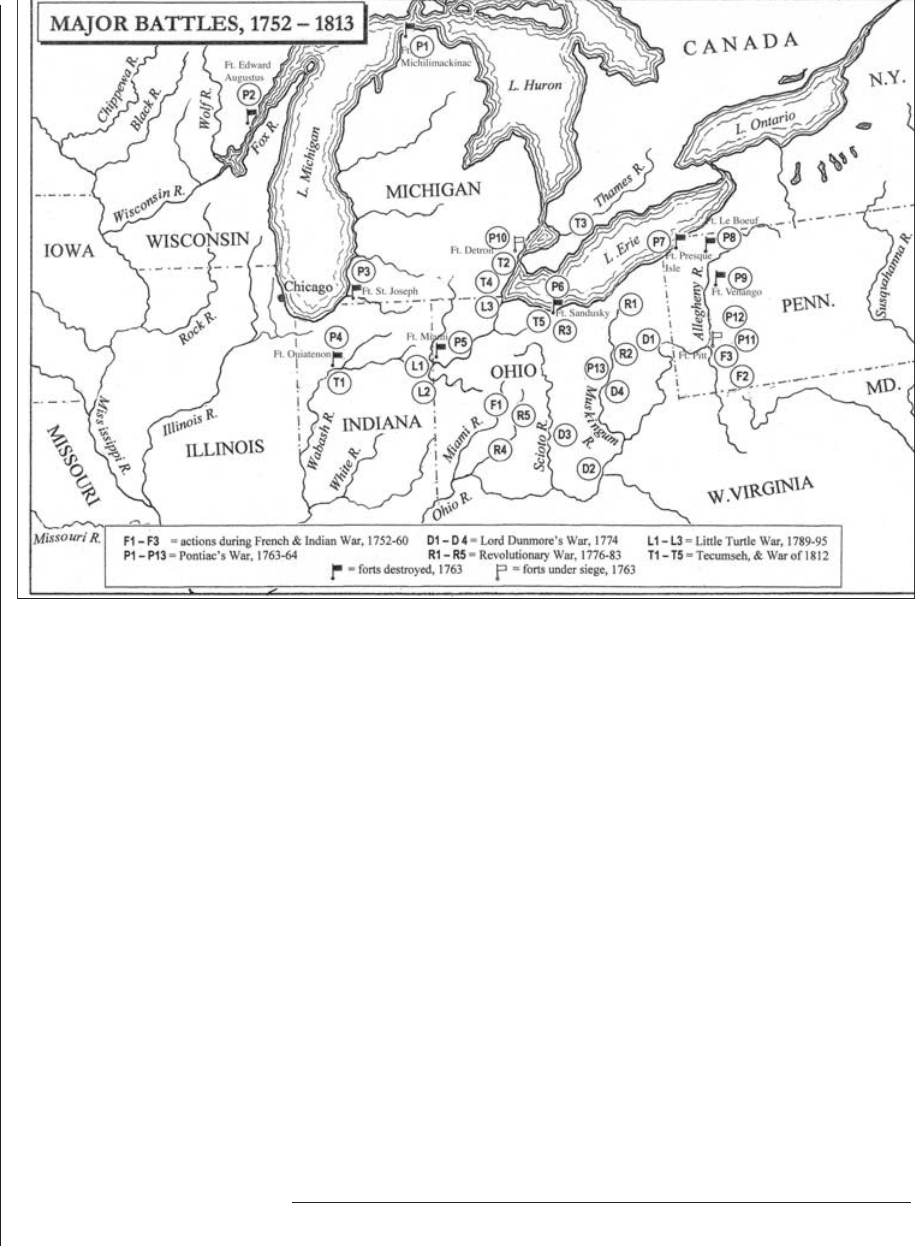
French & Indian War:
(F1) Pickawittany, 1752;
(F2) Washington’s defeat, 1754;
(F3) Braddock’s defeat, 1755
Pontiac’s War: (P1) Ft
Michilmackinac; (P2) Ft Edward
Augustus; (P3) Ft St Joseph;
(P4) Ft Ouiatenon; (P5) Ft Miami;
(P6) Ft Sandusky; (P7) Ft
Presque-Ile; (P8) Ft Le Boeuf;
(P9) Ft Venango; (P10) Ft Detroit;
(P11) Ft Pitt; (P12) Bushy Run,
1763; (P13) Bouquet, 1764
Lord Dunmore’s War: (D1) Yellow
Creek; (D2) Point Pleasant;
(D3) Salt Licks; (D4) Wakatomica
Revolutionary War: (R1) 1778;
(R2) Moravian, 1782;
(R3) Crawford, 1782;
(R4) Bowman, 1779;
(R5) Clark, 1780
Little Turtle War: (L1) Harmar,
1790; (L2) St Clair, 1791;
(L3) Fallen Timbers, 1794
Tecumseh, & War of 1812:
(T1) Tippecanoe, 1811;
(T2) Raisin R./ “Frenchtown,”
1813; (T3) Thames R./
“Moraviantown,”
1813; (T4) Ft Meigs, 1813;
(T5) Ft Stephenson, 1813.
2
Seashell wampum was traded as far inland as the Sioux. Since the Indians had no written language, woven belts
of white and purple wampum shells in mnemonic designs, with superimposed painted colors signifying war, peace
or friendship, were entrusted to important sachems (chiefs) to preserve records of treaties and agreements.
© Osprey Publishing • www.ospreypublishing.com