
Johnson Michael. North American Indian Tribes of the Great Lakes
Подождите немного. Документ загружается.

G
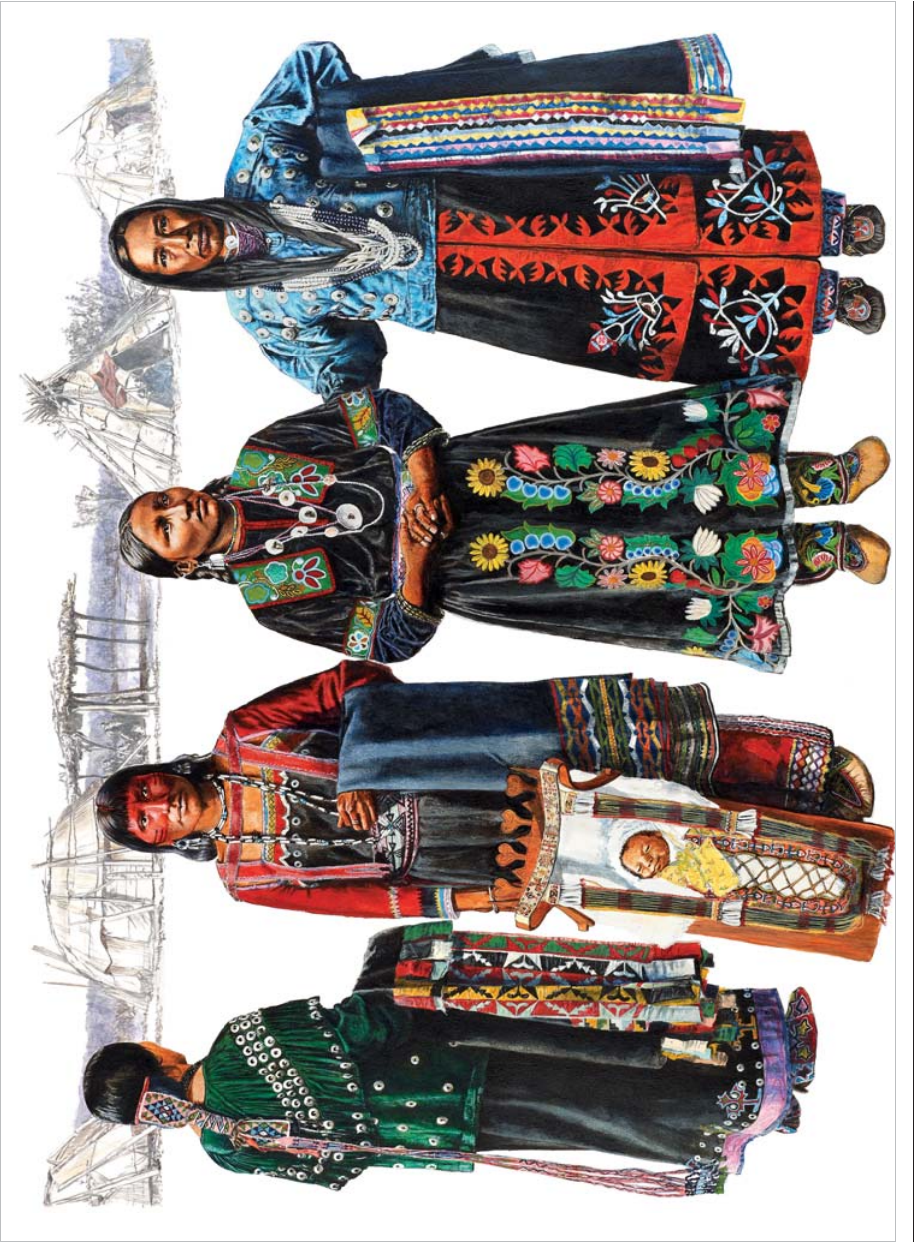
WOMEN, c.1830–95
1: Sauk and Fox woman, 1880
2: Ojibwa woman with infant, 1830
3: Ojibwa woman, c.1895
4: Menominee woman, c.1830
5: Wigwams
3
5
4
2
1
© Osprey Publishing • www.ospreypublishing.com
H
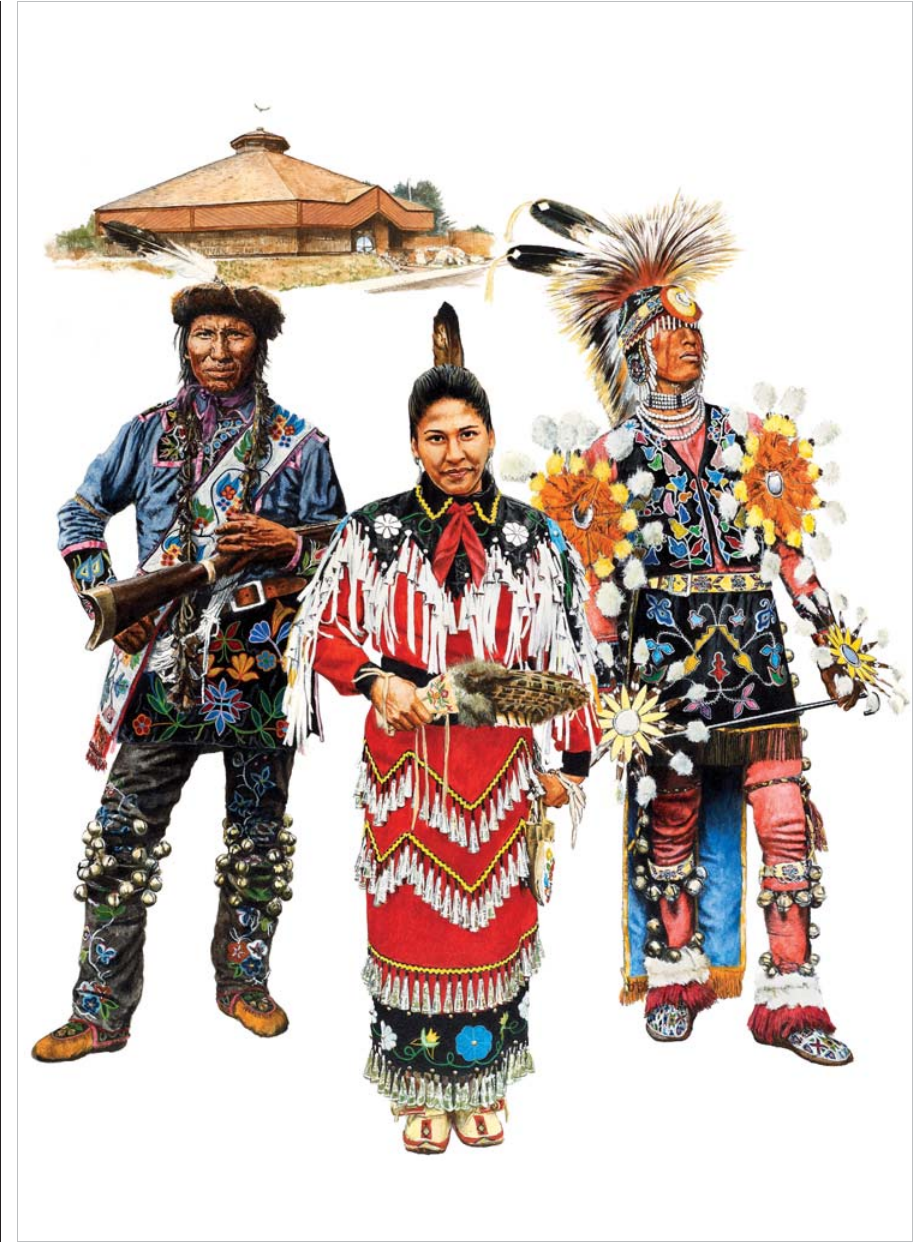
THE 20th CENTURY
1: Ojibwa traditionalist, 1910
2: Ojibwa woman jingle-dress dancer;
Bad River Reservation, 1998
3: Mesquakie male dancer; Tama settlement, 1926
Background: Ojibwe Museum, Lac du Flambeau, Wisconsin
2
3
1
© Osprey Publishing • www.ospreypublishing.com

on villages along the Mad River in 1786, and continued American
aggression, some chiefs agreed to sign the Treaty of Ft Harmar in 1789.
However, unwilling to accept its terms, Miamis, Shawnees and others
attacked settlers in southern Ohio, and in response the military
launched a major campaign against the Indian villages now centered
along the Wabash and Maumee rivers.
This was led in person by Gen Josiah Harmar of Pennsylvania, the
commander of the then-tiny US Army, with some 300 regulars and 1,400
Pennsylvania and Kentucky militia. Harmar’s June 1790 expedition from
Cincinnati to present-day Ft Wayne, Indiana, was unsuccessful; although
crops and several villages were burned, his force was twice ambushed,
with more than 180 Americans killed. In 1791 the government sent
a second expedition almost 2,000 strong against the villages along
the Maumee, under the command of Arthur St Clair, governor of the
Northwest Territory. They had reached the headwaters of the Wabash
River by November 3, when they were routed by a large intertribal
war party of Miamis, Potawatomis, Delawares and others under the
leadership of Little Turtle. More than 630 militiamen and volunteers
were killed, in what was probably the greatest single victory by Native
Americans over a white military force.
Despite the end of the Revolutionary War the British still had troops
in their old northwest territory; encouraged by promises of British help,
tribal delegates who met American agents at Detroit in 1793 insisted
that the whites leave the Ohio country. However, the US Army was being
enlarged and reformed under command of the Pennsylvanian Gen
Wayne, who belied his Revolutionary War nickname of “Mad Anthony”
by his methodical patience in organization, drilling, and securing his
advance with blockhouses. After an Indian attack on Ft Recovery was
beaten off in 1794, that August Wayne led his 2,000-strong regular
“Legion” and 1,000 Kentucky militia under Gen Charles Scott to a
decisive victory at Fallen Timbers, near present-day Toledo, Ohio. He
destroyed nine Indian towns, and the cornfields of the Delaware,
Shawnee, Miami, Wyandot and Ottawa along the Maumee River. (Far
from helping, the British closed the gates of their Ft Miami to the
Indians. By the provisions of the Jay Treaty of 1794, the last British
troops had left by 1796, although traders and settlers were allowed
to remain.) Thirteen tribes were forced to agree to a new treaty at
Greenville, Ohio, in 1795; other Indians, however, began to congregate
beyond the Mississippi.
The Prophet, Tecumseh, and the War of 1812
During the winter of 1804–05, in a Shawnee village near the White River
in Indiana, a man born to a family from an old village on the Mad River
in Ohio had what may have been a drunken fit, and upon recovering
his wits he told a strange story of death, heaven and resurrection. Over
the following months Tenskwatawa, “The Open Door,” experienced
additional visions, and enlarged his doctrine of deliverance from the
demoralized conditions in which the Ohio and Indiana tribes now
found themselves.
He established a new village near Greenville, where some Shawnees
and members of other tribes flocked to hear this new “Prophet.” One of
Tenskwatawa’s brothers was Tecumseh, “Shooting Star,” who had fought 33
© Osprey Publishing • www.ospreypublishing.com

at Fallen Timbers and had refused to acknowledge the Treaty of
Greenville. In 1807, when significant numbers of Indians with former
British sympathies gathered to hear the Prophet preach, the Americans
became apprehensive. Tecumseh and three other chiefs came to a
meeting at Chillicothe, one of many at which protests were made against
the continuing advance of white settlements, but these last appeals
for coexistence were ignored. The Prophet was advised to leave the area
by the now pro-American chief Black Hoof, and was invited to establish
a new village called Prophetstown in Indiana.
Throughout 1808 tribesmen from Michigan, Illinois and Wisconsin
came to hear the Prophet’s revelations, and Tecumseh was quick to
appreciate that a military confederacy could be built upon such religious
enthusiasm. Nevertheless, many chiefs signed away millions of acres of
land in Indiana and Illinois under the Treaty of Ft Wayne in September
1809. In 1810 and 1811 Tecumseh took an active role in demanding
of Indiana’s Governor William H. Harrison that these purchases be
rescinded. In 1811 he traveled south to request that the Creek, long-time
friends of the Shawnee, join him in alliance. However, in his absence
Harrison marched along the Wabash with 1,000 men; arriving near
Prophetstown on November 6, he provoked Tenskwatawa’s followers
to attack the following day, in contravention of Tecumseh’s instructions.
This battle of Tippecanoe was a complete defeat for the Indians.
Tecumseh then allied his warriors to the British in Canada during the
War of 1812, and with some 600 men joined Gen Brock at the siege of
Detroit. Despite their success, Perry’s naval victory on Lake Erie cut
the British supply lines and forced a withdrawal along the Thames River.
Tecumseh informed Brock’s successor Gen Proctor that he would
withdraw no further, and unsuccessfully confronted an invading
American force under Harrison at the battle of the Thames on October
5, 1813. Tecumseh was killed shortly after the battle; the warriors
who had fought with him surrendered to Harrison at Detroit, and were
later allowed to return to US territory. Tenskwatawa, the Prophet,
reluctantly returned to American soil in 1825 and later moved to Kansas,
where he died in 1836.
The Black Hawk War, 1832
This brief conflagration was the climax of a long sequence of events. The
Sauk, Fox and Winnebago had been active confederates since the
American campaign for the Ohio country and Indiana in the 1790s, and
the Sauk helped the British in the War of 1812. After that war the
Sauk became divided, between those under the eventual leadership of
Keokuk, who were conciliatory toward the US, and those who were
opposed to the treaties or chose to ignore them, led by Black Hawk
(b.1767, so 65 years old in 1832). After the minor Red Bird “war” of
1827, the Sauk emerged as the principal core of resistance to American
settlement in the western Great Lakes region. Concerted pan-tribal
action against the Americans proved impossible due to serious quarrels
with the Menominee and divisions among the Winnebago, leaving the
Sauk faction led by Black Hawk, with some allied Fox, as the main
protagonists against the Americans.
The war that broke out in spring 1832 was initially fought in
northwestern Illinois, on the east side of the Mississippi and on the lower
34
© Osprey Publishing • www.ospreypublishing.com
Rock River. This was part of
a large area that the Sauk
and Fox had ceded to the
United States by treaty
in 1804. Thereafter, some
Potawatomis along with a
few Ojibwas and Ottawas
had begun to occupy the
region along the Mississippi
between the mouths of
the Rock and Wisconsin
rivers. The 1804 treaty
notwithstanding, in 1829
the US government made a
treaty with these newcomers
to grant them this part of
the earlier cession. Most of
the Sauk and Fox now lived
on the western (Iowa) side
of the Mississippi, except for
Black Hawk’s vacillating
group, which were called by
the Americans the “British
band” in recognition of their former allegiance.
The Winnebago lived upstream on the Rock River pending their
removal elsewhere, as they too had ceded their lands between the Rock
and Wisconsin rivers in 1829. All the tribes had sold their lands
reluctantly, in the face of superior white strength, and Black Hawk’s
defiance won him sympathizers and a number of active supporters
among both the Potawatomi and Winnebago. Black Hawk’s major
Winnebago ally, the so-called Prophet (Wabokieshiek, or “White Cloud”
– not to be confused with the earlier Shawnee Prophet), was half Sauk,
and his village on the Rock River was located at present-day
Prophetstown approximately on the boundary between the 1804 and
1829 land cessions.
3
While most of the Sauk lived beyond the Mississippi, Black Hawk’s
band continued to return to their old haunts on the Illinois side of the
river in order to plant and harvest corn. However, by spring 1831 white
settlers had occupied the site of his home village, Saukenuk, and the
newcomer Indians now lived on the Sauks’ old lands. In response, a body
of Sauk recrossed the Mississippi and commenced aggression against
whites with the intention of breaking up the settlements along the
frontier of Illinois. They reluctantly returned to the Iowa side of the river
following pressure from MajGen Gaines and the governor of Illinois,
abandoning their crops and facing hunger the next winter. In August
1831, the Sauk and Fox apparently attacked and killed a party of
Menominee near Prairie du Chien. The following spring the Menominee
planned revenge, and Gen Henry Atkinson alerted US troops at posts on
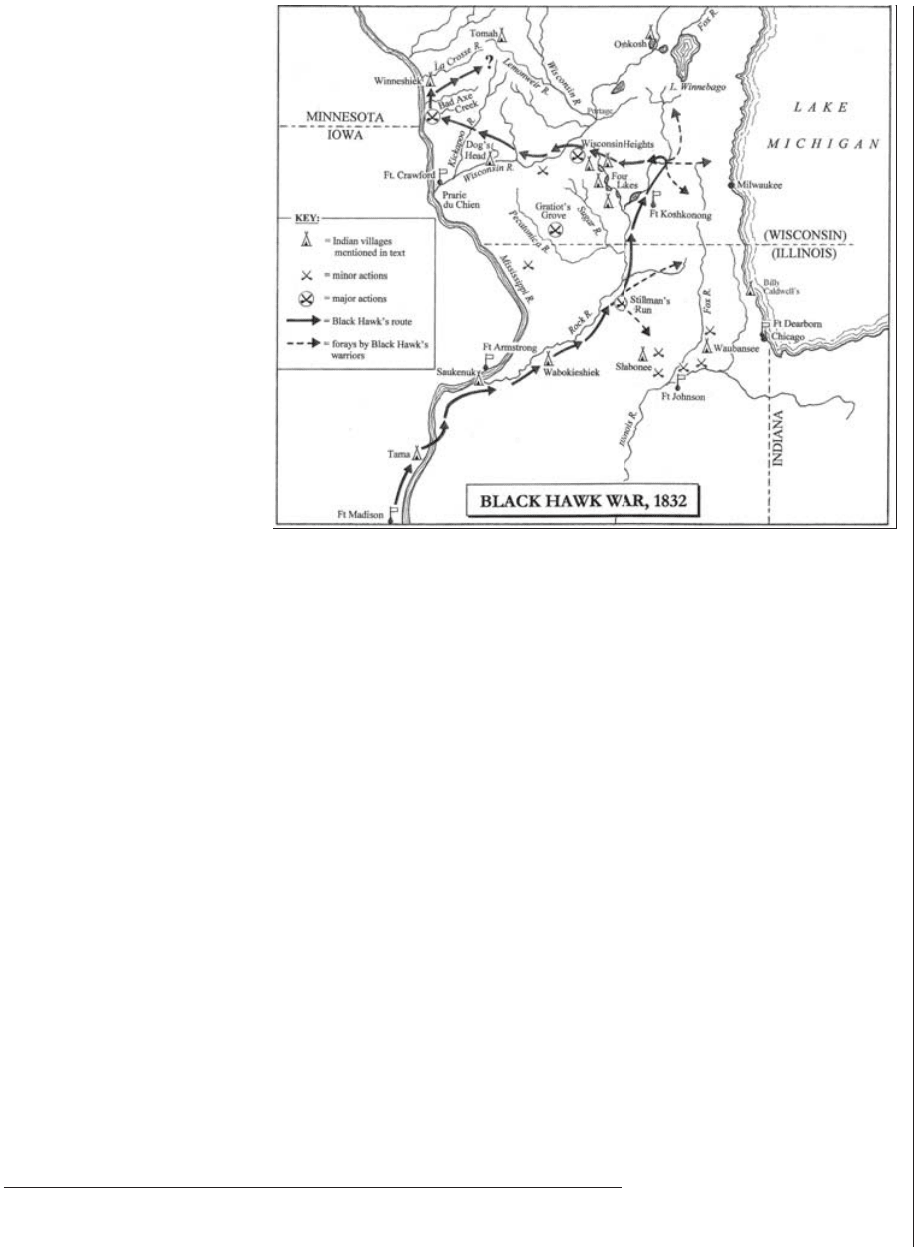
At the time of the Black Hawk
War, many Indian villages were
spread along the shores of lakes
Michigan and Winnebago, and
the valleys of the Illinois, Rock
and Wisconsin rivers and their
numerous tributaries. Only those
mentioned in the text, or near
where actions were fought, are
marked on this sketch map.
35
3
So-called “prophets” preaching movements for religious and moral revitalization arose periodically among the
Indians of the Old Northwest, and are often confused with the Shawnee prophet Tenskwatawa. A Delaware
prophet attracted a following during the Pontiac War of 1763; Kenakuk (q.v.) had often been called the “Kickapoo
Prophet,” and at this time there was a comparable phenomenon amongst the Iroquois.
© Osprey Publishing • www.ospreypublishing.com
the upper Mississippi and at Ft Winnebago that a general Indian war
might break out if the vengeful Menominees were not forestalled. White
refugees exaggerated the numbers of Black Hawk’s Sauk and Fox, and
Atkinson was disinclined to move against such a large body of reported
hostiles – even though his second-in-command Col Zachary Taylor had
at least 1,800 mounted militia assembled by order of Gen Reynolds at
Beardstown and other places along the Illinois River, and 400 regular
infantry were at Dixon’s Ferry on the Rock River by June.
In April 1832, Black Hawk had led his band of about 1,000 people,
including some 500 mounted and armed warriors, across the Mississippi
near Yellow Banks north of Tama. They reoccupied the old site of
Saukenuk, and then proceeded up the Rock through their old territory,
joining with some Winnebagos and Kickapoos at Wabekieshiek’s village,
and making forays further east. Although he insisted that he only wanted
to plant corn, Black Hawk was intercepted and his emissaries were
attacked by a party of 270 Illinois volunteers under Maj Isaiah Stillman,
but in the consequent engagement Stillman’s men “ran like deer” from
a fight still known as Stillman’s Run. Unwilling to face the large forces
at Gen Atkinson’s disposal, Black Hawk retired north and west to the
swamps around Four Lakes, while still sending out war parties against
isolated farms and settlements in southern Wisconsin.
Atkinson pursued the main body of Indians in the direction of Lake
Koshkonong and Four Lakes, dividing his forces in an attempt to find
them. Volunteers under Cols Dodge and Henry discovered the Indians’
northwestward trail some 20 miles south of Ft Winnebago, and the
subsequent battle of Wisconsin Heights left more than 60 Indians dead.
At this point Atkinson was joined by 400 regular infantry under
Col Taylor, and in all 1,300 men crossed the Wisconsin River in pursuit
of the Indians on July 27 and 28, 1832. On the morning of August 2 they
attacked, defeated and dispersed Black Hawk’s main body on the banks
of the Mississippi at Bad Axe Creek, killing more than 150 men, women
and children. Few Indians were able to cross the Mississippi, since the
way had been barred by the arrival, from Ft Crawford at Prairie
du Chien, of a steamboat armed with a field gun. (Of those who did
manage to cross, Wabasha’s Sioux are said to have killed about 50,
mostly women and children.)
Black Hawk, Wabokieshiek and other leaders escaped from the
battlefield and headed north for the Winnebago village of Winneshiek
on the La Crosse River. On August 27, after they were found in the
vicinity of Tomah by the northern Winnebago, Black Hawk and the
remainder of his band were delivered to the Indian agent at Prairie du
Chien, Joseph Street – the northern Winnebago had been much less
sympathetic to Black Hawk’s cause than their southern kinsmen. This
campaign was remarkable in retrospect for the later fame of some of the
Americans who had taken part. Both Zachary Taylor and Winfield Scott
saw service, though the latter arrived too late to see action. Abraham
Lincoln was a lieutenant in Taylor’s command, as was the future
Confederate president, Jefferson Davis; the future Civil War general
Albert Johnston also served, as did Daniel Boone’s son.
After confinement at Jefferson Barracks, in the spring of 1833 Black
Hawk, his son Neapope and Wabokieshiek were taken by steamboat and
overland to Fortress Monroe, Virginia, and subsequently released. Black
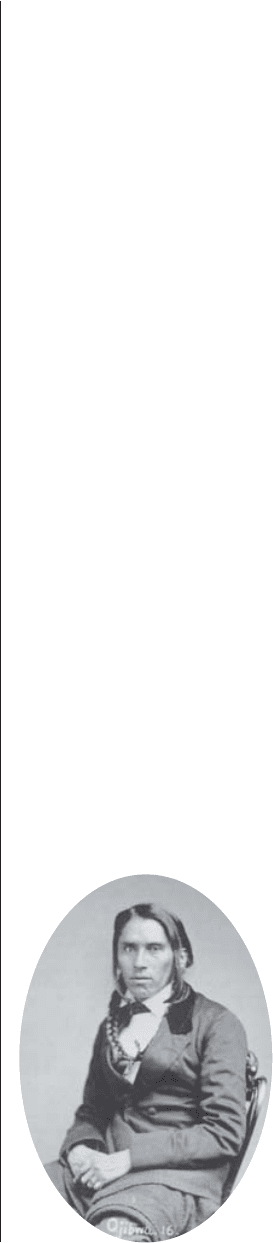
Photographed in Washington,
DC, in 1858, Peg-a-no-ke-shiek
(“Hole-in-the-Day”) the younger
was an Ojibwa chief who
succeeded his father of the
same name as leader of the
Crow Wing band in Minnesota.
During an internal dispute in
1868 he was murdered by
Indians from Leech Lake.
36
© Osprey Publishing • www.ospreypublishing.com
Hawk met President Andrew Jackson, and received much public
attention in various cities during his return to Iowa, where he died
on the Des Moines River in October 1838.
SOME INDIAN LEADERS
(Note: for the Shawnee Prophet Tenskwatawa, and the Sauk chief Black
Hawk, see above.)
Black Hoof (c.1740–1831) A Shawnee chief who was present as a young
warrior at Braddock’s defeat on the Monongahela in July 1755. He
continued to fight first the British, and later the Americans, until the
Treaty of Greenville in 1795. Thereafter he was one of the chiefs who
maintained the peace; they made concerted efforts to accept government
help to pursue farming and erect permanent houses, and accepted
overtures from various Christian groups (see also page 19).
Curly Head (or Hair) An Ojibwa (Chippewa) chief originally from Lake
Superior, who moved to the Crow Wing area of Minnesota in c.1800. His
warriors acted as a bulwark against the Sioux, and were friendly with
white traders; he met Lt Zebulon Pike’s expedition in 1805. Curly Head
died while returning from a conference at Prairie du Chien in 1825.
Flat Mouth (c.1774–1860) A chief of the Pillager Ojibwa around Leech
Lake, Minnesota. As a young warrior he took part in expeditions against
the Cree, Assiniboine, and tribes on the upper Missouri, and his band
suffered at the hands of the Sioux. He was succeeded by his son of the
same name, who took part in a delegation to Washington, DC, in 1899.
Hole-in-the-Day A Mississippi Ojibwa who succeeded Curly Head as war
chief in the vicinity of Crow Wing, Minnesota. He aided Americans
during the War of 1812, and carried on a relentless war against the
Eastern (Santee) Sioux until the US government forced acceptance of
a line of demarcation between the tribes. He died in 1848
and was succeeded by his son of the same name, who was
murdered at Crow Wing in 1868 (see opposite).
Kenakuk (c.1790–1857) A Kickapoo divine who founded a
religious movement of mixed Christian and native beliefs
among the Vermilion band Kickapoo and Potawatomi in the
early 19th century; a church with about 100 adherents is still
active on the Kickapoo Reservation near Horton, Kansas.
The famous artist George Catlin painted Kenakuk in about
1830 near Leavenworth, Kansas (see page 16).
Keokuk (1767–1848) Sauk chief and contemporary of Black
Hawk; leader of the pro-American faction of the combined
Sauk and Fox after ceding all their lands east of the
Mississippi. Made chief by the Americans, he obtained
government agreement to Sauk and Fox claims to lands in
Iowa; however, after the tribes were moved to Kansas they
divided, the Sauk going to Indian Territory and the Fox
(Mesquakie) back to Iowa. His son Moses Keokuk succeeded
him, and continued to urge acceptance of the white lifestyle.
Charles Langlade (c.1729–1800) The son of a French
fur-trader and an Ottawa woman, he led the French and
Indian raid on the British-Miami settlement of Pickawillany
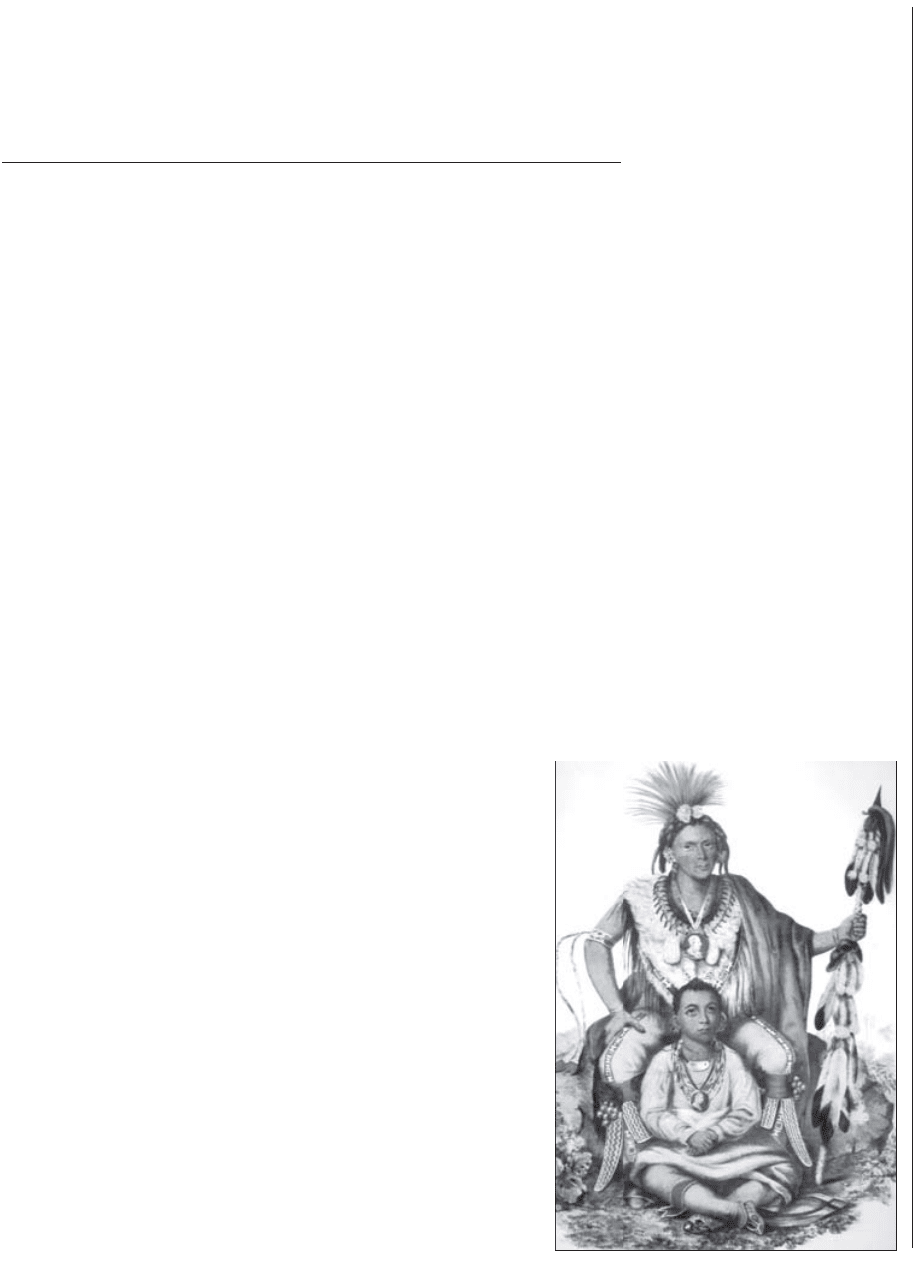
Keokuk (1767–1848), with
his son Musewont or Moses.
Keokuk, who led his people
west of the Mississippi, was
recognized by the Americans
as chief of the combined Sauk
and Fox from about 1830,
while Black Hawk’s followers
remained unreconciled to the
loss of their lands east of the
river. This image is from a
painting probably made by
Charles Bird King in 1837.
Keokuk is shown with a red
(porcupine?) hair headdress;
a red robe trimmed blue; a pale
fur cape; a bear-claw necklace,
and a peace medal; buckskin
leggings with beaded blue,
white and red strips; and red
garters with ribbon bunches,
large beads, and yellow-on-red
beaded lappets. His son wears
a pink shirt and a peace medal,
and a blanket round his waist
over plainer leggings; under
magnification, his moccasins
show an early representation
of Prairie-style floral beadwork.
(Lithograph from McKenney &
Hall)
37
© Osprey Publishing • www.ospreypublishing.com

38
BELIEFS AND RITUALS
Among the tribes of the Great Lakes the Indians recognized
supernatural spirits (Manitos) in all physical phenomena,
animals, trees, rocks, or cosmic forces. Some dwelt in the
sky, some on earth, underground, or underwater; some
were helpful and others malevolent, such as ghosts,
underwater monsters and cannibal ice giants (Windigos),
and spirits were placated through prayers. Over all was a
paramount deity, Kitchi-Manito, although this concept may
be the result of Christian influence. Of major importance
were the Sun, Moon, the Four Winds, the Four Directions,
Thunder, and Lightning. Two great Manitos, the Thunderbird
and the Underwater Panther, are dominant in Great Lakes
mythology. The Thunderbirds were a class of spirits
associated both with war, and with rain to nurture crops.
The horned Underwater Panthers were greatly feared, but
were also associated with healing powers. These two
Manitos were often depicted as highly conventionalized
images on woven bags and incised and beaded objects.
Of personal concern was a guardian spirit, acquired
through vision quest, which would be called upon for help.
Bear ceremonialism recognized the power of the animal,
and those killed for food were ritually respected. Semi-
divine culture heroes could take on human or animal forms
to help mankind in a variety of ways, and were credited for
bringing success in hunting or agriculture. Many of the
southern tribes (e.g. the Winnebago) had an extensive
range of sacred bundles, which were invested with
supernatural powers that were maintained by reverent
ritual, song and other complex observances, and were
invoked to rid the world of evil spirits and giants. These
bundles usually consisted of a skin bag containing
mementos, significant pebbles, relics of animals and birds,
carved fetishes, and so forth.
The religious life of the Huron was more elaborate than
that of their Algonquian-speaking neighbors. They believed
the world rested on the back of a great turtle, and that the
supernatural Creator was a benevolent spirit who lived in
the sky. His grandmother, however, seems to have been an
evil spirit, and between them were numerous spirit forces
with power for good or evil – similar to the Manitos of the
Algonquian tribes. The Huron believed that after death their
soul separated from the body and went to villages in the
sky, or followed the Milky Way. In order to ensure reaching
their respective soul-villages a major ceremony had to be
held every 8, 10 or 12 years. This Feast of the Dead was
a national ceremony, at which the dead from various
villages who had initially been buried in shallow graves
were exhumed, re-dressed or placed in beaver-skin bags,
and after lengthy ceremonies were reburied in mass graves
along with weapons, tools, food, utensils and robes for
their journey to the sky-villages.
The religion of the Ottawa and Potawatomi organized
a set of beliefs and ritual practices involving the concept of
a Great Spirit, with deities of the Sun, Fire, and Water, and
like all Indians they recognized spirit power in animals and
natural objects. Personal guardian spirits were acquired
through fasting and dreaming. After death, the human soul
followed a trail over the Milky Way to the west, where there
was a heaven. Later, both Ottawa and Potawatomi had
the Midewiwin or Grand Medicine
Society (q.v.), which functioned
to heal the sick and prolong life. Cults
were composed of members who
had common dreams or visions.
Ritual objects were contained in clan
and Medicine Society bundles and
bags, which were opened and used
in ceremonials and feasts, when
the eating of dogs was especially
common. The dead were either
buried, cremated, or placed on
scaffolds. The Winnebago also had
a version of the Midewiwin; their
major ceremonies were the Winter
Feast, to increase tribal war and
hunting powers, and the Buffalo
Dance, to call the buffalo.
War rituals
Various ceremonies were held before
a war party went out, to enlist
the power of guardian spirits to aid
warriors and ensure success in
battle. Warriors struck a post or tree
with a warclub, and recounted
the enemies killed in battle; others
would dance, performing a variety of
threatening attitudes of tracking,
fighting, and scalping foes. Among
the sacred objects invoked were the
A Winnebago war dance, Wisconsin Territory, c.1826. The figure at right
has a tall, tiered feather headdress, a white shirt, and a natural-color blanket
wrapped round his waist. Of the others, three warriors have all-red face paint,
one half-red, and one red-over-black. The two at left foreground have a blue
and a red trade-cloth breechclout with white stripes. The fifth from right has
buckskin leggings with large, shaped lappets down the outside; the third from
right has blue trade-cloth leggings with a yellow (beaded?) stripe, a bandolier
and waist belt of blue edged with red, and moccasins with heel-feathers and
red ankle-collars; and both these men have feather back-bustles. All carry
ball-headed or gunstock-shaped warclubs, or metal pipe-tomahawks. (Detail
from painting by Peter Rindisbacher; West Point Museum Art Collection,
US Military Academy, West Point, NY)
© Osprey Publishing • www.ospreypublishing.com

in 1752. At the head of a mixed band of warriors, he was present at the
defeat of Gen Edward Braddock’s command on the Monongahela
River near Ft Pitt (then Ft Duquesne) in 1755; at Lake George in 1757;
and at Quebec in 1759. After the American Revolution he settled at
Green Bay, Wisconsin, and is considered one of the founders of the
state (previously part of Michigan).
Old Briton or La Demoiselle A prominent chief of the Piankashaw
division of the Miami, who emerged as the most outspoken critic of the
French trading system in the 1740s. Enmeshed in the fur trade, the Ohio
country tribes now needed the products of European technology to
provide for their families, and Old Briton favored
a switch to the less expensive and more plentiful
British goods. Under the influence of the British
trader George Croghan, in 1747 he led all the
Miamis who would follow him to a new village,
Pickawillany, on the Great Miami River in western
Ohio. He refused French advances to return to
their alliance, and as a consequence a large war
party of Ottawas and Ojibwas led by Langlade
(q.v.) destroyed the village and killed Old Briton.
The French-allied Indians then boiled his body
and ate it, as a perceived method of absorbing
the power of an enemy.
Old Decora, or Old Grey-Headed Decora or
Kenoka Decora (c.1747–1836) A mixed-blood
Ojibwa snowshoe dance, painted
by George Catlin in 1835–37.
This ritual gave thanks to the
Great Spirit for the Indians’
ability to continue hunting in
winter thanks to their
snowshoes.
39
war bundles, created under spiritual direction and opened
during ritual offerings to supernatural beings associated
with warfare. (In recent times the War Dance became the
Chief’s Dance, and has undergone a complete shift in
purpose. The Woodland tribes have also adopted the
Plains Grass Dance as a secular “war dance” for public
events and modern powwows.)
The Midewiwin Society
The most important Woodland ceremonial complex, which
survived until the 20th century (and in remote areas may
still), was the Midewiwin or Grand Medicine Society, to
promote individual and community success in hunting,
good heath, wellbeing and long life. The geographical
center of the religion was northern Minnesota; it is usually
associated with the Ojibwa, and Ojibwa-derived
terminology is used here, but it was also present among
most of the Great Lakes tribes with only minor variations in
rituals. The Midewiwin is said to have gained prominence
around Chequamegon Bay and La Pointe, Madeline
Island, Wisconsin, where a large body of Ojibwa had
moved from the northern shore of Lake Superior during the
early fur-trade era in the second half of the 17th century.
Rituals were usually held annually or semi-annually, and
lasted from two to five days depending upon the number
of initiates or candidates. Candidates were selected
for membership by application, instruction, and formal
invitation. The ceremony was presided over by an
instructor or sponsor and a number of recognized priests,
each of whom had assistants. At the beginning of the ritual
the candidate, instructor and officiating priests were
obliged to visit a sweat lodge, to appeal for a fine day and
make offerings to the Great Spirit. They entered the
Midewigan (large wigwam) where the spirit of Kitchi-Mainto
resided, after circuiting the enclosure four times outside
and inside. The candidate was led to the western end of the
enclosure, where he knelt. The priest (Midas) held a
medicine pouch containing the Megis (a shell), which he
thrust vigorously toward the candidate’s heart four times,
as if to shoot him. This action in effect “shot” the vital
spiritual power into the soul of the initiate, a baptismal act
which aroused strong emotions. The priest then reapplied
his medicine bags, and the candidate recovered, coughing
out the Megis shell believed to have been shot into his
body. This ceremonial “death and rebirth” initiated him as a
member of the society; he then distributed trade-goods
gifts as a form of membership fee.
There were at least four and sometimes eight major
ascending degrees of membership in the Society, each
representing the animal-spirit volunteers who transmitted
the religion from the Creator to receptive individuals on
Earth. The medicine pouches used in the first degree were
often of otterskin or those of similar small animals, followed
by hawk, owl, and bear, and, if applicable, eagle, wolverine,
lynx, and finally snake. Each ascending degree of
membership required fees of increasing value for the
officiating priests, sponsor and assistants, while the new
member was presented with a Mide pouch representing the
degree to which he had been admitted. (See also Plate E.)
© Osprey Publishing • www.ospreypublishing.com
40
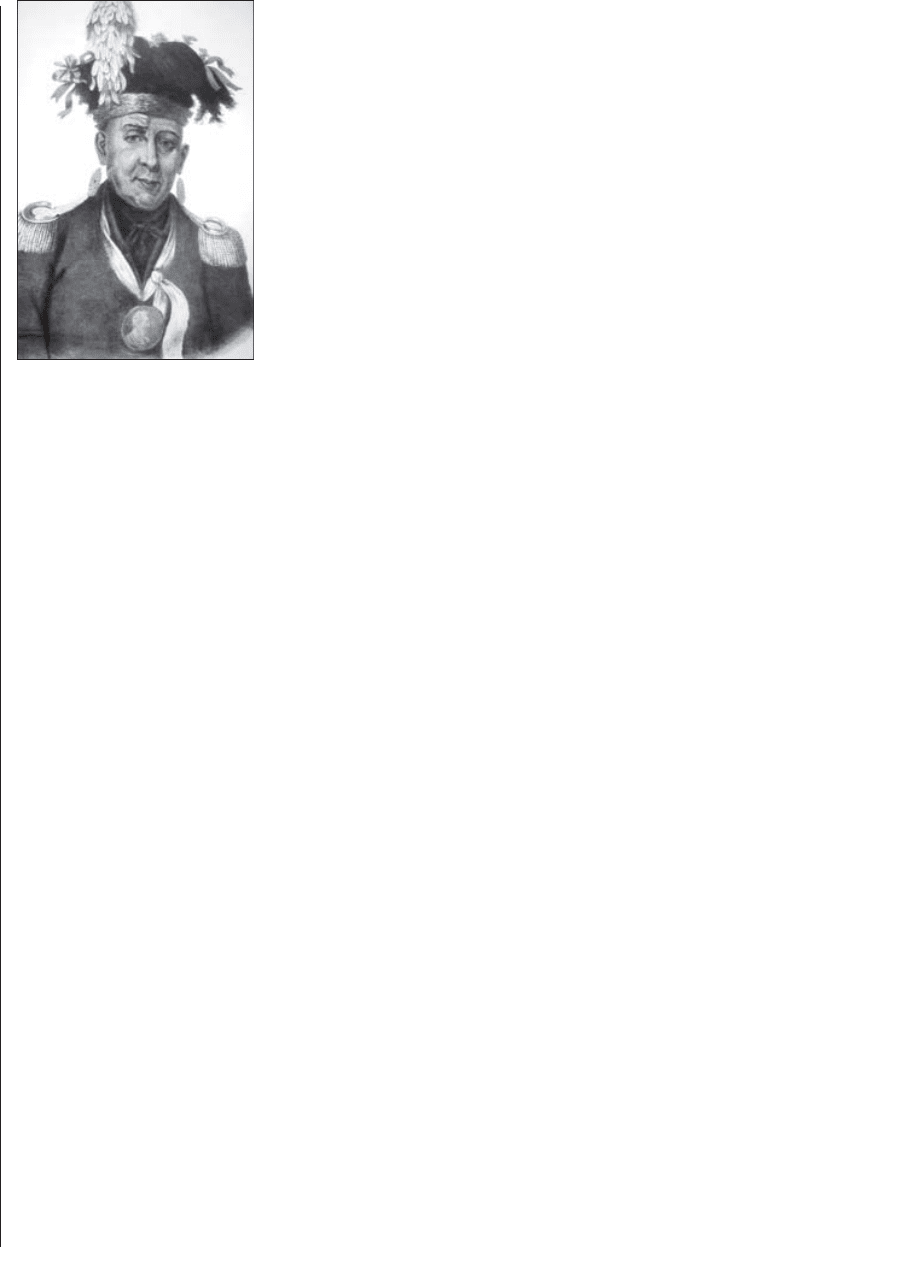
The Potawatomi chief
Wabaunsee (1760–1845), leader
of the Prairie band; his name has
had various translations, among
them “The White Sky.” After
signing the Chicago Treaty
following the Black Hawk War,
he moved from the Fox tributary
of the Illinois River across the
Mississippi to lands near Council
Bluffs, Iowa. Here he is shown
with a black and white feather
headdress with a fur band and
red and green ribbons; a dark
blue US military-style coat with
gold epaulets; a peace medal,
and what seems to be a gold
braid neck ribbon. A serpentine
line of red paint is shown running
from above his left eye to below
his right ear. (Lithograph from
McKenney & Hall)
Winnebago chief whose warriors were staunch supporters of Tecumseh
and his brother the Prophet; his Indian name was Schachipkaka (“War
Eagle”). A Winnebago contingent fought with the British during the
War of 1812 along the Sandusky River and at the battle of the Thames.
Orontory,orNicholas (c.1695–1750) The Indian name of this pro-
British Wyandot chief was “War Pole.” The leader of a general conspiracy
against the French in 1748, he plotted to attack Detroit, but his plans
were thwarted when French officers learned of them. His actions split
the Wyandot around Detroit, and his followers established new villages
on the Lower Sandusky River.
Oshkosh (c.1795–1858) A Menominee chief, sometimes known as “The
Brave.” He and his warriors served with the British at Mackinac, Ft Meigs
and Ft Sandusky during the War of 1812, and with the Americans during
the Black Hawk War in 1832. He signed treaties with the US in 1836 and
1848. In 1842 his band of 105 families was located on the upper
Wisconsin River, settling on the future Menominee Reservation in 1852;
he died six years later on the Wolf River, Wisconsin.
Red Bird (c.1788–1828) A Winnebago chief living near Prairie du Chien,
Wisconsin, and leader of a minor outbreak in 1827. Two of his people
were arrested for killing a family of maple-sugar makers, upon which Red
Bird killed two traders at Prairie du Chien. At Bad Axe Creek his band
of about 37 men attacked a riverboat; they killed four of the crew, but
lost at least seven warriors. He subsequently surrendered to the white
authorities at Prairie du Chien, and died there on February 16, 1828;
others of his band were later pardoned by President John Quincy Adams.
Sagaunash or Billy Caldwell (c.1780–1841) The son of William Caldwell
by a Mohawk girl during his Revolutionary War service in Butler’s
Rangers. He served the British cause until about 1820, when he moved
to the Chicago area and was appointed a nominal Potawatomi chief by
his employers, the traders and mixed-bloods who were dealing with that
tribe. He died near Council Bluffs, Iowa, in 1841. (The name “Caldwell”
has also been used by a formerly landless mixed Potawatomi band
originally from Point Pelée, Ontario, who did not move to the Walpole
Island Reserve but whose descendants have lived in the greater Detroit
area. However, any connection with Billy is almost certainly false.)
Tarhe or “The Crane” A Wyandot chief who fought under Cornstalk
against the Virginians at the battle at Point Pleasant in 1774, and under
Little Turtle at Fallen Timbers in 1794. However, after signing the Treaty
of Greenville in 1795 he remained on friendly terms with the
Americans. He helped Harrison negotiate the return of British-allied
Indians from Upper Canada to the US at the close of the War of 1812.
Wabaunsee (c.1760–1845) A Potawatomi chief of their Prairie band,
born near Greenville, Ohio. When known to whites his main villages
were on the Illinois and Fox rivers in northern Illinois. After making
a warrior reputation fighting the Osage, he was present at the so-called
“massacre” by Potawatomis near Ft Dearborn (Chicago) in 1812,
thereby giving Governor Harrison a reason to attack Indian villages in
Indiana the same year. During and after the War of 1812 he signed
various treaties with the US, including the second Treaty of Greenville
(1814), the Wabash Treaty (1826), and the Chicago Treaty (1833), after
which he moved beyond the Mississippi to near Council Buffs, Iowa. He
died after an accident in Washington, DC.
© Osprey Publishing • www.ospreypublishing.com