
Johnson Michael. North American Indian Tribes of the Great Lakes
Подождите немного. Документ загружается.

The Indians desired colorful cloth,
blankets and ribbons, and iron knives,
tomahawks, kettles, guns, silver gorgets,
and medals; they also demanded food
supplies, and alcoholic liquor. The actual
distribution of gifts was accomplished in
several ways. The French often allowed
the Indians to come to designated forts
or settlements, or to their missions
for distribution by the clergy; the British
often selected frontier rendezvous, such
as Logstown in present-day western
Pennsylvania. During the first half of the
18th century the Ohio country tribes
often played off the French against
the British and vice versa in order
to obtain more and better presents. As
well as securing military alliances, the
relationships cemented by gift-giving helped traders obtain vast amounts
of furs, and in time the Indians became economically dependent on the
white man.
Anglo-French competition in the giving of presents to the Ohio
Indians carried on fairly peacefully between the Treaty of Aix-La-Chapelle
in 1748, at the close of King George’s War (1744–48), and 1751. However,
the Ohio Company of Virginia and that colony’s new Governor
Dinwiddie had extensive schemes for purchasing native lands in the Ohio
country with gifts of merchandize. This, combined with the parallel
interest of the Pennsylvania colony in the Ohio country, prompted
the French to employ aggressive measures in dealing with the Indians.
When the Miami chief La Demoiselle (Old Briton, q.v.) switched his favor
from the French to the Pennsylvania colonists, the French engaged with
Indians who were not connected with the Covenant Chain, and a force
of French Canadians and Indians swept down on the Miami trading
village at Pickawillany in June 1752 and destroyed it – the unfortunate
chief was boiled and eaten before the very eyes of his tribesmen.
This began a general French campaign to sweep all Pennsylvania
traders out of the region, and the French military began to build a chain
of forts down the west side of the Allegheny Mountains, with the object
of bringing the whole Ohio valley under their control. The Ohio
Company responded by trying to enlist the Cherokee to defend the
disputed region, since the Iroquois were no longer strong enough to do
so. The Virginians then sent the young Col George Washington to parley
with the French; this, and a subsequent military attack, both failed,
ending with Washington’s surrender at Fort Necessity on July 4, 1754.
The Ohio tribes were confused and divided, but gloried in their
independence from Iroquois control.
The French and Indian War opened in this theater with the British
Gen Edward Braddock’s notorious defeat at the hands of the French
and their Indian allies on the Monongahela River in July 1755, during
an attempt to capture the French Ft Duquesne at the Forks of the Ohio
(later Ft Pitt, and Pittsburgh.) Indians assisted the French in most
parts of the Great Lakes region, including the tribes around Ft Detroit;
21
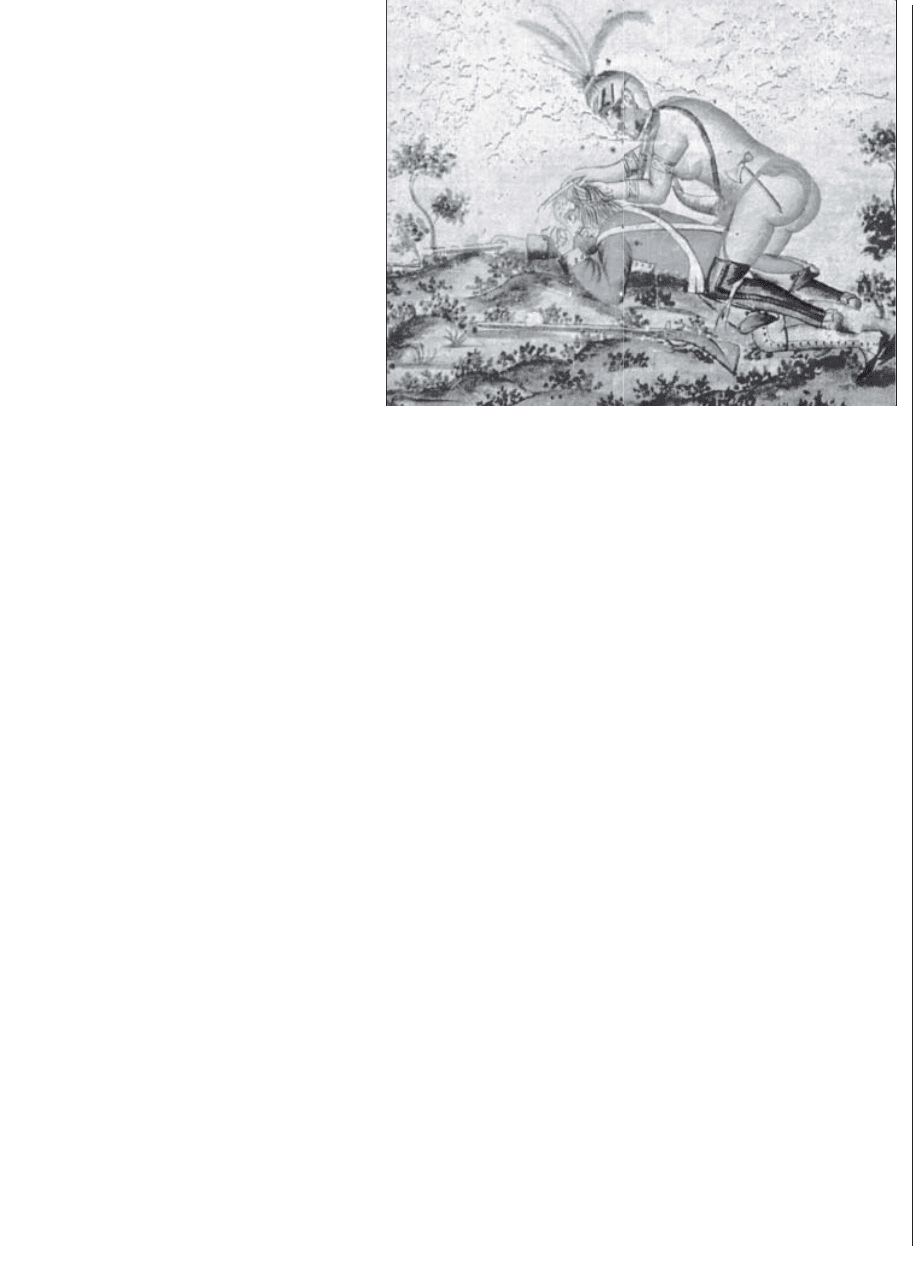
A striking painting by an
unknown 18th-century artist of
a warrior – possibly a Shawnee –
scalping a British redcoat. He is
shown with a feather headdress,
and extensive face-paint in
black, yellow, red and green;
a red cloth breechclout, black
buckskin or cloth leggings, and
buckskin moccasins with ankle
“collars.” Note the incised silver
armlets, the knife sheath
hanging from his neck, the slung
powder horn, and the metal
tomahawk in his belt. The
soldier is shown in an unlaced
red coat with yellow facings.
© Osprey Publishing • www.ospreypublishing.com
the Huron, Ottawa, Ojibwa, and Potawatomi,
and less frequently Delaware and Shawnee,
attacked frontier settlements in Pennsylvania.
Representatives of western tribes were operating
as far east as Lake Champlain and Lake George in
1757 under the French mixed-blood Charles
Langlade, and Sauk, Fox, Miami and Ojibwa were
present at the fall of Quebec to the British in
1759. The war also saw Delaware and Shawnee
settle in eastern Ohio after the British occupation
of Ft Pitt in 1758; the Delaware moved to the
Beaver and Tuscarawas rivers, and the Shawnee to
the Muskingum (Wakatomica) and Scioto rivers.
As the French and Indian War neared its end,
George Croghan, the right-hand man to Sir
William Johnson (Britain’s superintendent of
Indian affairs, whose influence with the Iroquois
and especially the Mohawk was important in
the eastern Great Lakes theater) held a peace
council at Ft Pitt with the Ohio Indians who had
supported the French. Montreal was captured
in 1760; that year the British assumed control of forts Detroit, Miami,
and Ouiatenon on the Wabash, and in 1761 of forts Michilimackinac,
Green Bay and St Joseph. The defeat of the French in North America
was ratified by the Treaty of Paris in 1763, by which France forfeited
to Britain everything east of the Mississippi except the enclave around
New Orleans.
From Pontiac’s rising to the Ft Stanwix treaty, 1763–68
London had given instructions to tighten American expenditure
following the war, and the British, now in control of the western forts,
abandoned the French practice of distributing presents – including
giving powder and shot for hunting, and food in wintertime. This policy
was applied by the British commander, Gen Amherst, against the expert
advice of Sir William Johnson (Amherst’s dislike and distrust of Indians
even extended to an attempt to spread smallpox among them by the
distribution of infected blankets). The Great Lakes tribes had enjoyed
the camaraderie of the French fur traders, and the resulting mixed-
bloods still traversed the area; the new policy led to serious hunger and
consequent unrest among the tribes, and efforts to appease them by
frontiersmen such as Croghan and Alexander McKee failed. Hostilities
broke out in the spring of 1763 when a coalition of tribes was organized
by an Ottawa chief, Pontiac (c.1712–69). In fact his overall involvement
has been exaggerated, as it appears he may only have been present
in person at the siege of Ft Detroit, and the defeat of the British
detachment in the battle of Bloody Run.
The coalition of Ottawas, Ojibwas, Potawatomis, Shawnees, Mingoes
and Wyandots (re-formed Hurons, now in the Ohio country) attacked
and captured the lightly defended forts Sandusky, Miami and
Ouiatenon. The sacking of Ft Michilimackinac is famous for the fact
that the unsuspecting garrison opened the fort gates to watch a game of
lacrosse being played by Indians; at a signal the warriors rushed into the
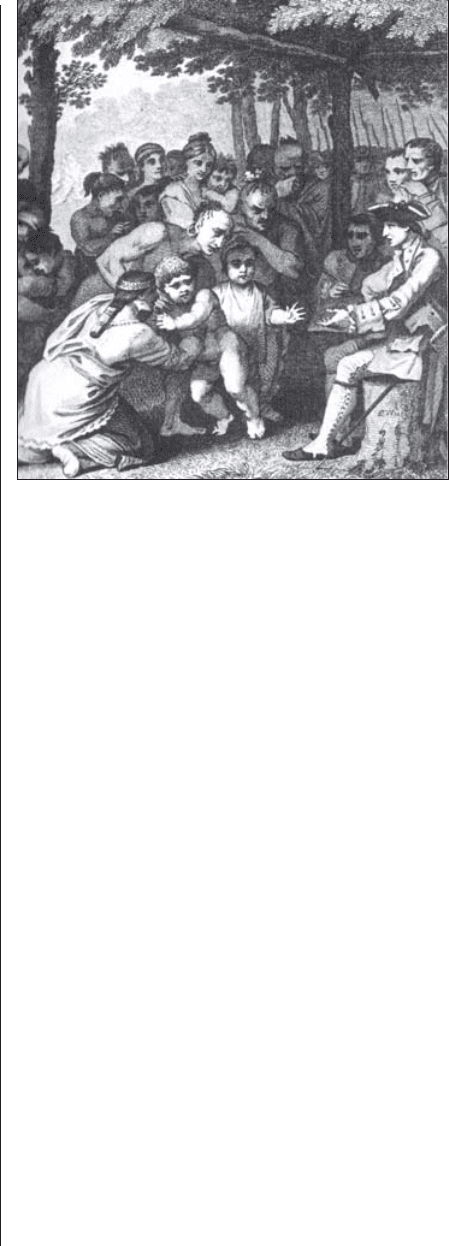
Indians delivering up white
captives to Col Henri Bouquet
at the Forks of the Muskingum
River in November 1764 after
the collapse of the so-called
“Conspiracy of Pontiac.” This
Swiss-born officer was one of
the British Army’s most
effective Indian-fighters from
1756 onward, and was the
brigadier-general commanding
the Southern District at the time
of his early death in 1768.
(Engraving after painting by
Benjamin West, 1766)
22
© Osprey Publishing • www.ospreypublishing.com
fort, and few whites escaped with their lives. In all, eight forts were
captured out of 12 in Indian Country, another was abandoned, and forts
Pitt and Detroit were besieged; however, after six months the siege was
lifted, and Pontiac himself later left for the Wabash and Illinois country.
The British retaliated; Col Bradstreet reinforced Detroit, and Col
Bouquet turned an ambush into victory at Bushy Run while en route to
relieve Ft Pitt in August 1763. The winter of 1763/64 was particularly
harsh for the Indians, and the warriors melted away. Bradstreet offered
peace terms in August 1764; that October, Bouquet took a strong
force west to the Tuscarawas River, and by November he had forced
the release of white prisoners being held by Indians at the Forks of the
Muskingum River. The war gradually came to an end after the coalition
was overawed by this display of British force, and Pontiac and his
followers concluded a peace treaty with Sir William Johnson at Oswego,
New York, in 1766.
In 1768 a major treaty was concluded at Ft Stanwix, New York,
between the colonies and the Great Lakes Indian nations. A firm
boundary was agreed; territories north of the Ohio River were to remain
Indian country, but they were to relinquish much of Pennsylvania and
lands south of the Ohio. The Shawnee would lose their hunting grounds
in Kentucky forever, and were now a major belligerent faction in the
multi-tribal villages lining the Ohio River’s northern tributaries. George
Croghan confirmed the agreement with the western tribes at Ft Pitt, and
the old Covenant Chain was renewed with present-giving. Pontiac
himself was murdered by a Kaskaskia Indian at Cahokia, Illinois, in 1769.
23
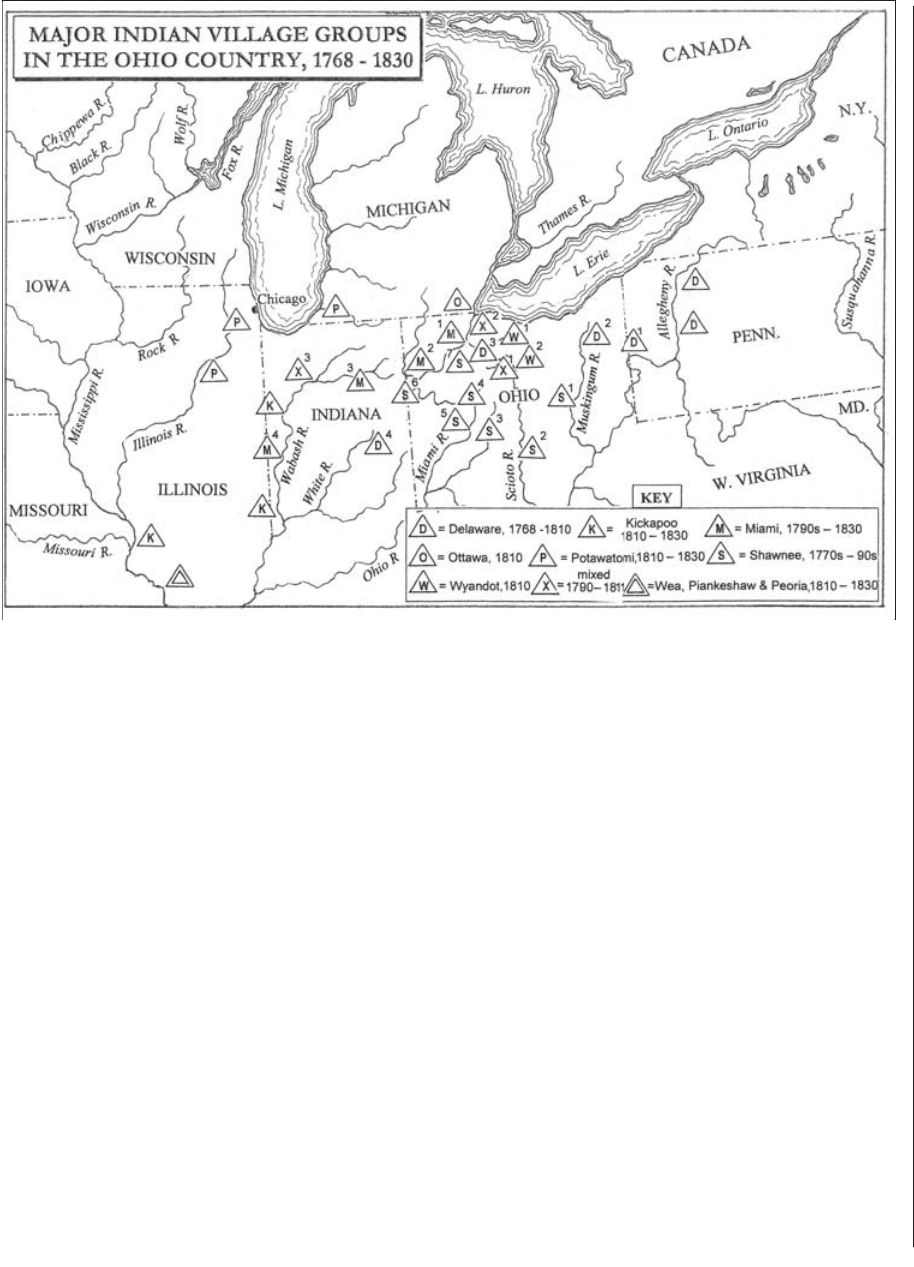
Key to numbered village
symbols:
Delaware: (D1) Beaver R., 1768;
(D2) Tuscarawas R., 1770s;
(D3) Maumee R., 1790s;
(D4) White R., 1810
Miami: (M1) Maumee R., 1790s;
(M2) St Mary’s R., 1790s;
(M3) Wabash R., 1830;
(M4) Lower Wabash R., 1810
Mixed tribes: (X1) Upper
Sandusky R., 1790s;
(X2) Maumee R., 1790s;
(X3) Tippecanoe, 1811
Shawnee: (S1) Muskingum R.,
1770s; (S2) Scioto R., 1770s;
(S3) Little Miami R., 1780s;
(S4) Mad R., 1780s; (S5) Great
Miami R., 1780s; (S6) St Mary’s
R., 1780s; (S7) Maumee R.,
1790s
Wyandot: (W1) Lower Sandusky
R., 1810; (W2) Upper Sandusky
R., 1810.
© Osprey Publishing • www.ospreypublishing.com
From Cornstalk’s resistance to the Revolution,
1774–83
The 1768 treaty was mainly brokered by the Iroquois, and many Ohio
Indians did not recognize the loss of their southern hunting grounds.
Pennsylvania and Virginia now became the springboards for further
westward expansions. Virginia, under its governor the Earl of Dunmore,
seized control of the Ft Pitt region in 1773, and planned settlements west
of the Alleghenies by issuing land warrants to veterans of the French and
Indian War. In 1774 a gang of Virginians occupied the abandoned
Ft Pitt, and massacred John Logan’s Mingoes at Yellow Creek. Logan,
at one-time a friend of the whites, now begged the Shawnee to help
him take revenge; a few warriors attacked white settlers, which gave Lord
Dunmore an excuse to crush the Indians. He launched a two-pronged
attack, leading one force down the Ohio from Ft Pitt and sending
another under Col Lewis down the Kanawha River toward the Ohio.
Shawnees led by their chief Cornstalk made a furious attack upon Lewis’
column at Point Pleasant at the confluence of the Kanawha and the
Ohio. Although vastly outnumbered, they fought the Virginians to a
standstill; but they lost many warriors, and finally had to return white
captives and accept permanent white settlements in Kentucky.
Cornstalk’s making peace with Dunmore led to a schism among the
Shawnee during the American Revolution (1776–83). Cornstalk’s
Shawnees and White Eyes’ Delawares saw no advantage in becoming
entangled in a white man’s war, but both leaders were killed by the
Americans, and before the end of the war the neutral Shawnee and
Delaware had rejoined their hostile kinsmen under the British flag
along the Great Miami River, gradually withdrawing from the Scioto.
The war-captain Blackfish continued to raid into Kentucky, and for
a time in 1778 he held the famous Daniel Boone captive. Blackfish
was killed in a raid on old Chillicothe in May 1779 by Kentuckians
determined to repay the Shawnee for three years of war.
Through the efforts of the British agents McKee and the Girty
brothers, an alliance of Ojibwas, Ottawas, Potawatomis and Wyandots
also moved through the forests on expeditions against the frontiers of
Kentucky and Virginia. Fierce Kentuckian counterattacks were led
by Col Bowman in 1779 and Gen George Rogers Clark in 1780 on the
Little Miami and Mad river villages, and in 1781 and 1782 by Brodhead
and Williamson on villages on the upper reaches of the Muskingum and
Tuscarawas rivers, some of which were Christianized settlements. In June
1782 the Pennsylvania militia under Col William Crawford were
defeated by Wyandots and Delawares on the Upper Sandusky, but Clark
again attacked villages on the Great Miami in retaliation for the British
and Indian victory at Blue Licks. By the end of the Revolutionary War
the Indians’ grip on the Ohio country had undeniably been weakened.
From Harmar’s failure to the Treaty of Greenville,
1789–95
After another Treaty of Paris ended the Revolutionary War in 1783,
American agents informed the Indians that they must give up their
claims to lands east of the Great Miami River and acknowledge the
sovereignty of the new United States. After Col Benjamin Logan’s attack
24
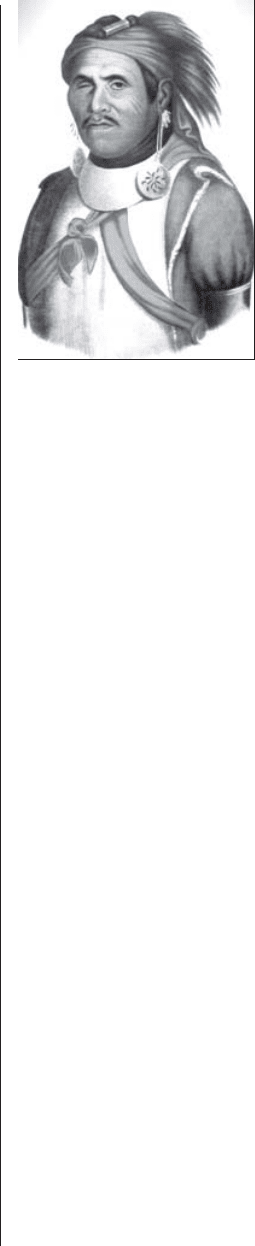
Tenskwatawa (“The Open
Door”), known as “the Prophet.”
A brother of the Shawnee chief
Tecumseh, he preached a
religion of renewal at his village
near present-day Greenville, OH,
in 1805–07, and Tecumseh built
a warrior coalition from the
followers he attracted. He is
shown wearing a red turban
and hair headdress and crossed
sashes, with a large silver
gorget, and ear discs on long
drops. (Lithograph from
McKenny & Hall)
(continued on page 33)
© Osprey Publishing • www.ospreypublishing.com
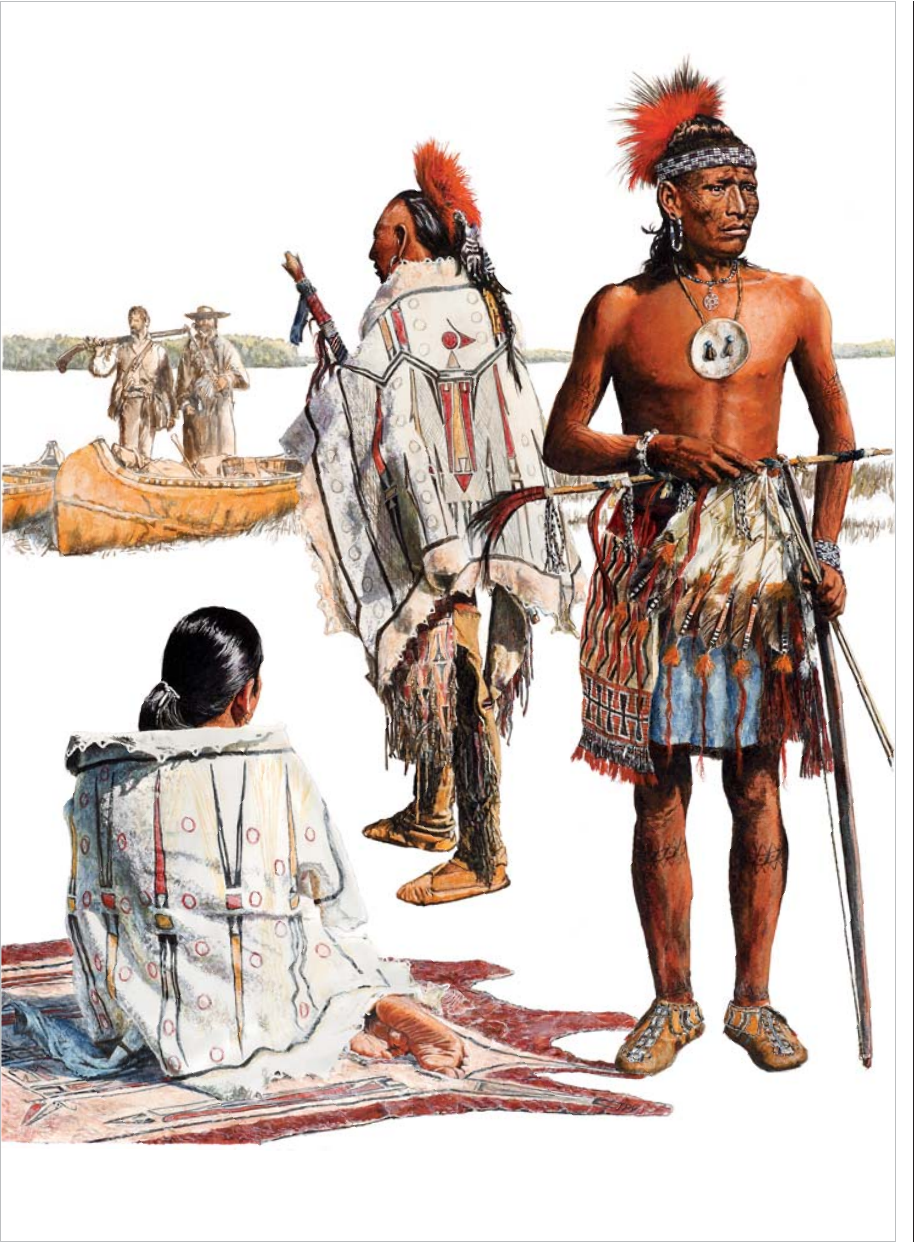
A
JOLIET AND MARQUET MEET THE ILLINOIS, 1673
1: Illinois chief
2: Seated Illinois girl
3: Ottawa warrior, 1680
1
2
3
© Osprey Publishing • www.ospreypublishing.com
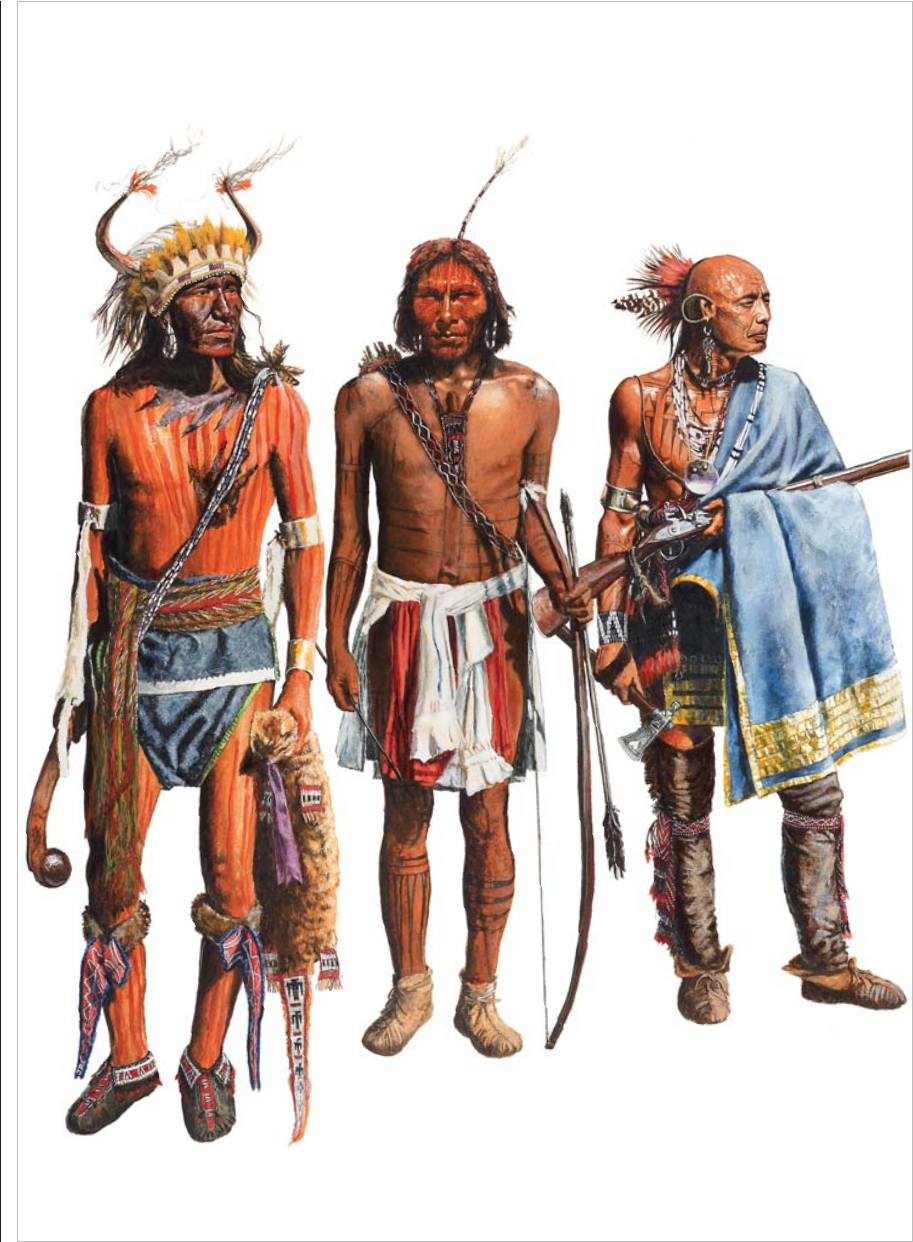
B
WARRIORS, 1720s–1780s
1: Winnebago warrior, 1780
2: Mesquakie (Fox) warrior, first half of 18th C
3: Ottawa warrior, 1755
1
2
3
© Osprey Publishing • www.ospreypublishing.com
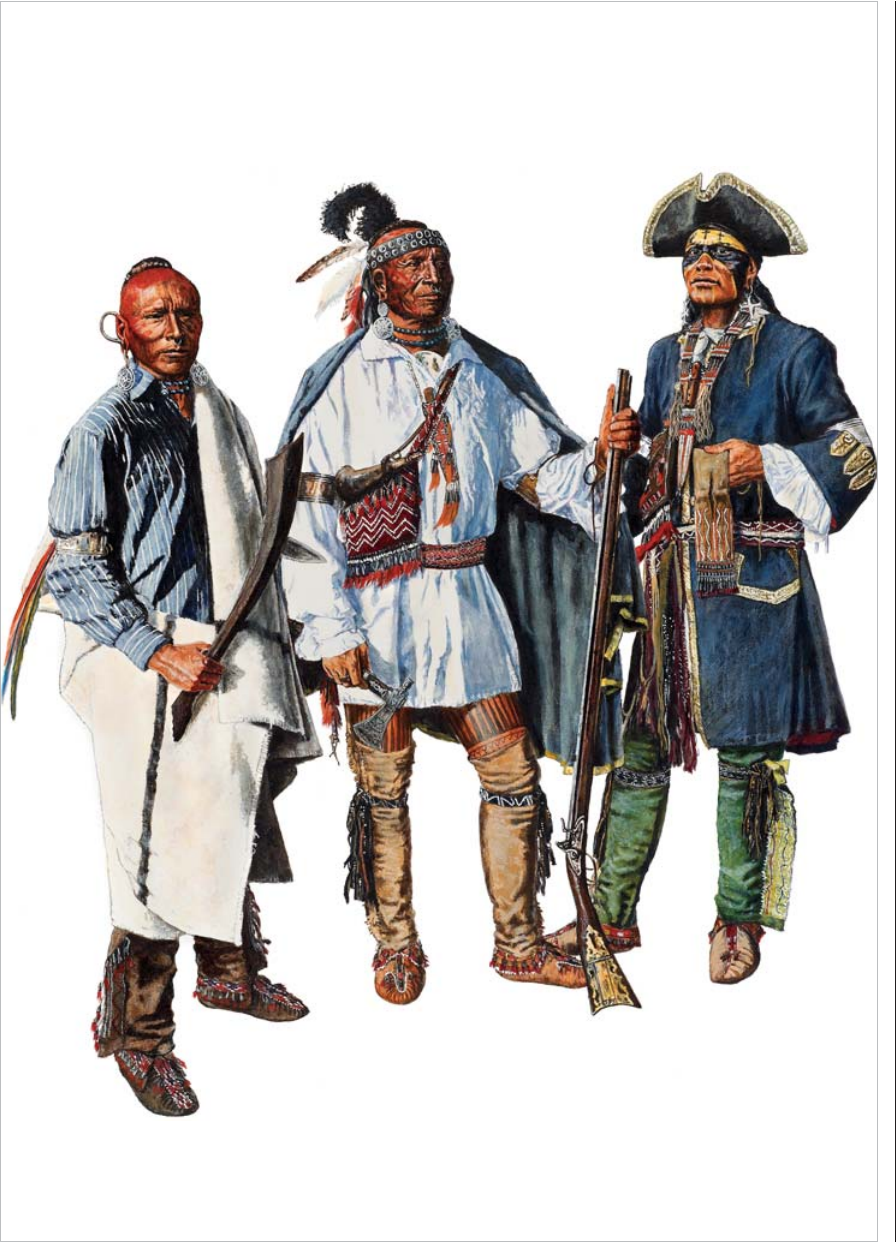
C
WARRIORS, 1760s–1790s
1: Shawnee warrior, c.1774
2: Kaskaskia warrior, 1796
3: Great Lakes warrior, Pontiac War, 1763
1
2
3
© Osprey Publishing • www.ospreypublishing.com
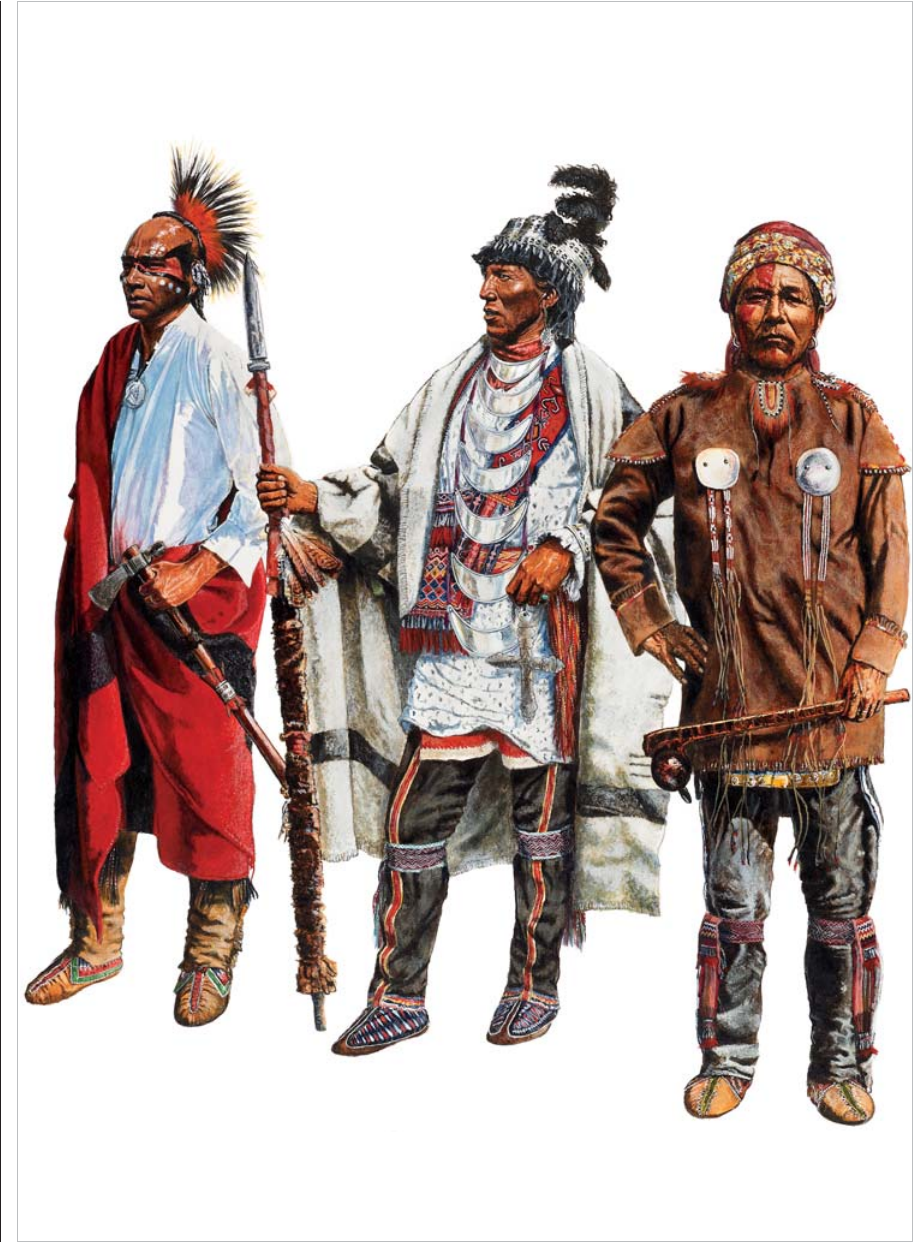
D
3
2
CHIEFS, 1812–1832
1: Sauk chief Black Hawk, 1832
2: Miami chief, c.1830
3: Shawnee chief, War of 1812
1
© Osprey Publishing • www.ospreypublishing.com
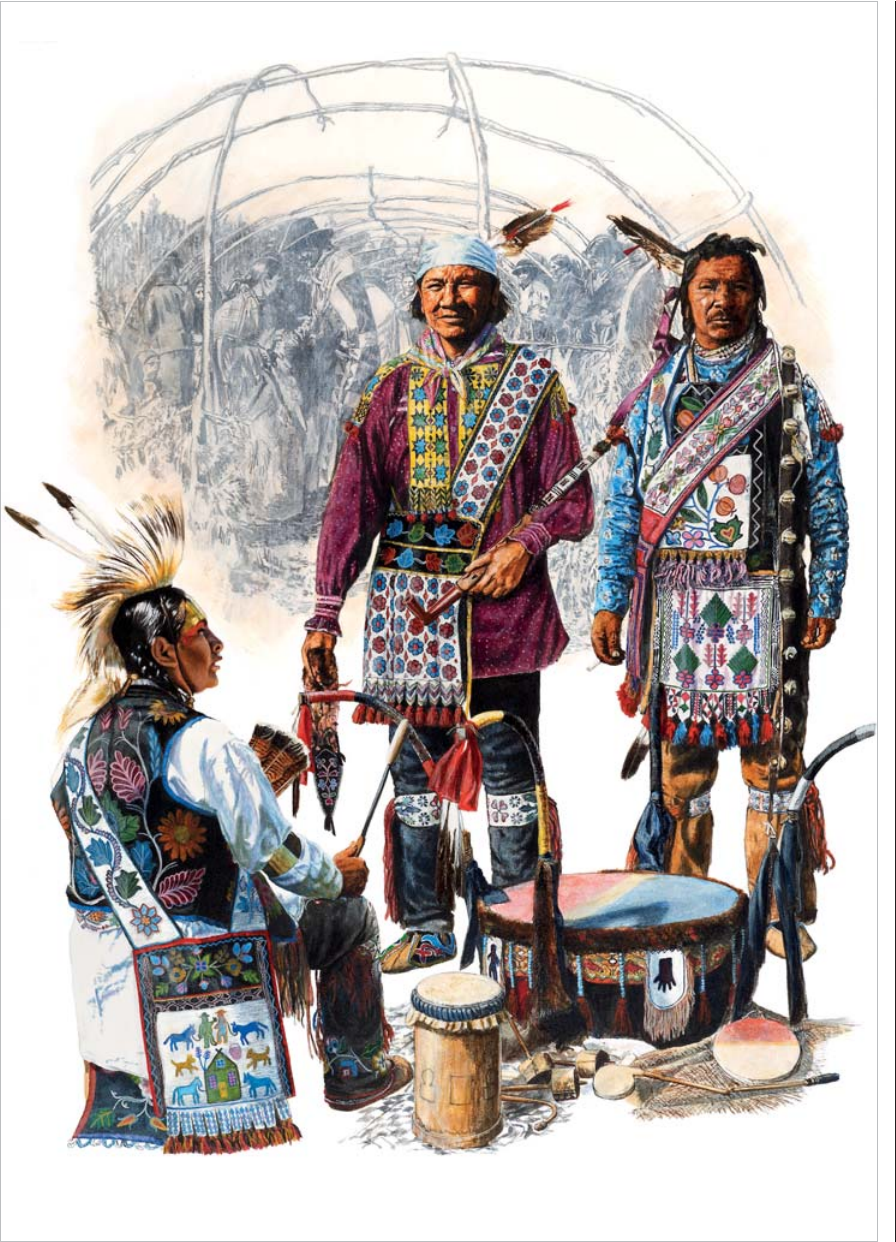
E
RITUAL, 1890s
1: Ojibwa (Chippewa) singer
2: Midewiwin Society priest
3: Midewiwin lodge
4: Dream drum
5: Midewiwin instructor
1
2
3
4
5
© Osprey Publishing • www.ospreypublishing.com
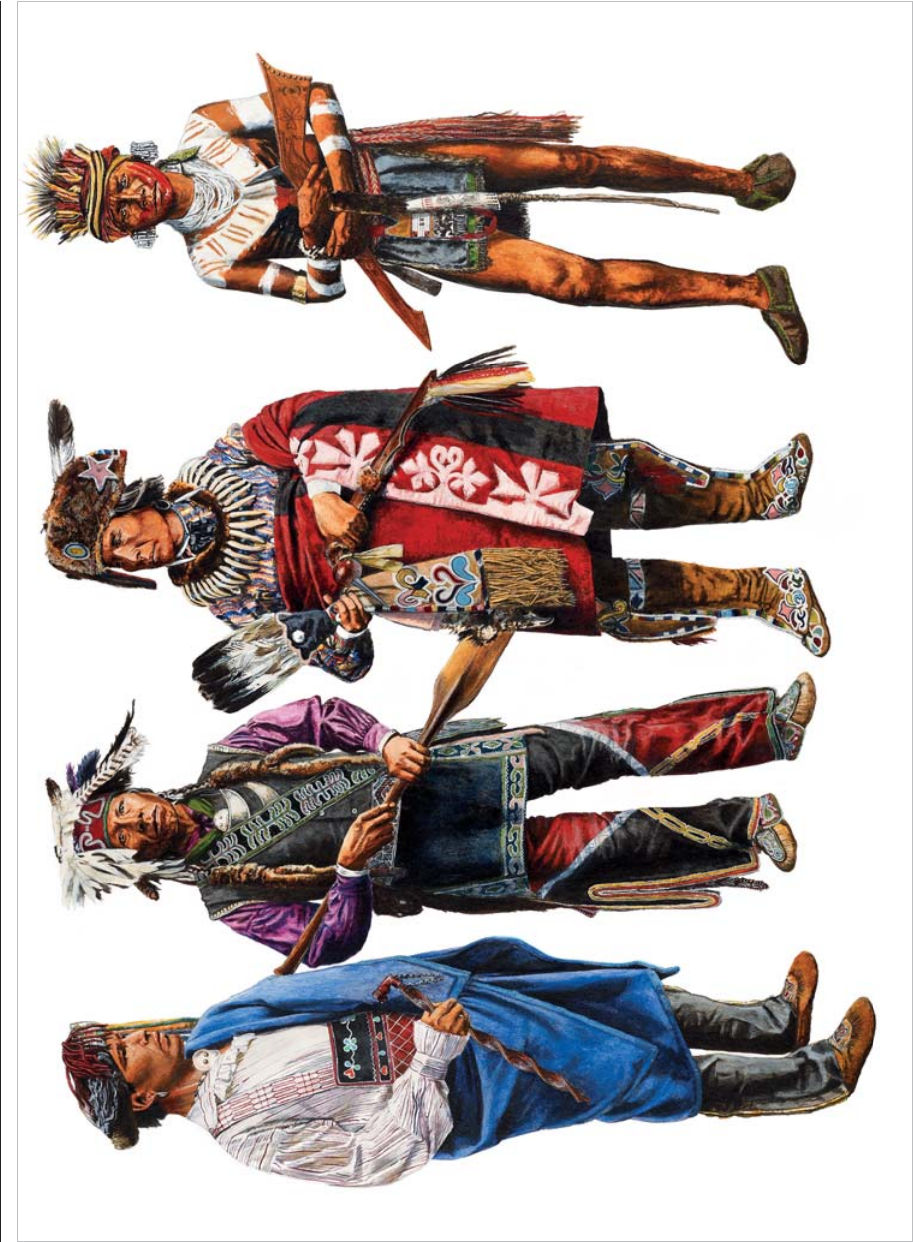
F
SAUK, OJIBWA & MENOMINEE, 1830s–1870s
1: Sauk warrior, 1832
2: Shoppenegons, Michigan Ojibwa, c.1870
3: Sauk chief, 1860s
4: Menominee man, 1850s
3
4
2
1
© Osprey Publishing • www.ospreypublishing.com