
Kasper C., van Griensven M., P?rtner R. (Eds.) Bioreactor Systems for Tissue Engineering II: Strategies for the Expansion and Directed Differentiation of Stem Cells
Подождите немного. Документ загружается.

6 Induced Pluripotent Stem Cells for Drug Screening and Safety Pharmacology . . . . . . . . . . 114
7 Induced Pluripotent Stem Cells for Disease Modeling . . . . . . . . . . . . . . . . . . . . . . . . . . . . . . . . . . . . 116
8 Induced Pluripotent Stem Cells for Cell-Based Therapies . . . . . . . . . . . . . . . . . . . . . . . . . . . . . . . . 118
9 Perspectives . . . . . . . . . . . . . . . . . . . . . . . . . . . . . . . . . . . . . . . . . . . . . . . . . . . . . . . . . . . . . . . . . . . . . . . . . . . . . . . 119
References . . . . . . . . . . . . . . . . . . . . . . . . . . . . . . . . . . . . . . . . . . . . . . . . . . . . . . . . . . . . . . . . . . . . . . . . . . . . . . . . . . . . 120
1 Introduction
The isolation and characterization of embryonic stem (ES) cells from mouse
blastocysts by Evans and Kaufman in the early 1980s [1] represents a hallmark in
stem cell research. Widespread belief was maintained that isolation of ES cells was
only possible from certain mouse inbred strains, and isolation of ES cells from other
species may not be possible at all due to lack of comparable inbred strains in other
species. Just 15 years later, Thomson et al. contradicted this hypothesis by estab-
lishing nonhuman primate (NHP) ES cell cultures from rhesus monkey (Macaca
mulatta)[2], common marmoset (Callithrix jacchus)[3], and finally ES cells from
humans [4]. Although the ultimate proof of pluripotency by generation of chimeric
animals is still pending in these animals, and due to ethical reasons almost impos-
sible in humans, primate ES cells are now generally considered pluripotent based
on their ability to form teratomas and to differentiate in vitro into cells of all three
germ layers. Even redifferentiation into trophoectoderm has been demonstrated [5].
Despite their unlimited potential for differentiation and expansion, the use of
human ES cells in research, pharmascreening and cellular therapies is ethically
controversial due to their isolation from human embryos and the unavailability of
patient-specific cells.
Consequently, a lot of effort was invested into research aiming for generating
pluripotent human cells from other sources than preim plantation embryos, which
finally led to the induction of pluripotency in “terminally differentiated” cells as
demonstrated by Shinya Yamanaka in his groundbreaking Cell paper. This particu-
lar study and his subsequent work were a major stimulus to stem cell research,
because the two major obstacles to clini cal application associated with ES cells
were overcome – destruction of human embryos and allogen eic immune rejection
[6–8].
2 Needs for Patient-Derived Expandable Cell Sources
In regenerative medicine, several concepts focus on individualized therapies which
take advantage of cell-based tissue repair or tissue engineering applications. The
use of patient-derived cells will circumvent immunologic issues like rejection of the
transplants, but is limited by the availability of suitable (tissue-specific) stem cells
108 T. Cantz and U. Martin
and, in the case of genetic mutations, by gene correction strategies which can
be applied to the patients’ cells. Moreover, patient-derived cells, which mimic
the diseased phenotype, may allow the ex vivo exploration of new therapeutic
approaches. However, besides the hematopoietic system hardly any other organ is
as well understood and, therefore, little is known about progenitor cell types within
the cellular hierarchy during organ development which can be expanded in vitro for
future applications.
For instance, the liver is an ideal target organ for cell-based therapy as demon-
strated by the application of hepatocyte transplantation in a number of patients with
hereditary metabolic liver disease and acute liver failure [9–13 ]. In these first
clinical studies, hepatocyte transplantation has been considered either as a full
treatment option, or in more severe situations, as a bridge to transplantation [14].
In some patients, transplanted hepatocytes are able to engraft, repopulate the liver,
and restore the deficient hepatic function for up to 18 months post-transplantation
[15, 16] and, meanwhile, more than 20 such patients have been reported in recent
years [17]. However, hepatocytes prepared from donor organs can only be provided
for a small number of patients and other cell sources are urgently needed. Another
example is the engineering of bioartificial cardiac muscle which may allow replace-
ment of infarcted heart tissue. Cardiac tissue engineering is hampered by the fact that
adult cardiomyocytes (CMs) have almost no potential for proliferation [18]. In
conclusion, for the majority of tissue types, including liver and heart, the lack of
suitable cell sources represents one of the major hurdles to be overcome prior to
clinical application of novel regenerative therapies.
With respect to adult stem cell sources, recent research suggests strong limita-
tions of adult cell sources with regard to differentiation and expansion potential (see
for instance [19–23]), despite a variety of earlier reports suggesting a virtua lly
unlimited plasticity. Consequently, different adult stem cells appear to be u seful for
therapeutic regeneration of those tissue types, which show a high natural capacity
for regeneration, for example, bone or skin. In case of tissue and organs with rather
limited natural regeneration potential, for instance the heart, it is still controversial
whether adult stem and progenitor cells can prevent loss of function or reconstruc-
tion of injured tissue [20–23]. Furthermore, although not proven to the extend, there
is a general impression that in older (and disease d) patients, there are less stem and
progenitor cells of superior functi on than in younger donors, which might be due to
telomere dysfunctions in aged or stressed cells [24].
In contrast to adult stem cells, pluripotent stem cells, such as ES cells, are
characterized by their unlimited potential to grow in vitro and to develop into virtually
any cell type. As outlined above, pluripotent cells can be isolated from early embryos
by collecting blastomeres or by isolating the inner cell mass of blastocysts and
subsequent cultivation in appropriate cell culture conditions. Interestingly, these
conditions differ distinctly between various mammalian species and to date we are
still not able to derive true ES cells from species other than mice [1], NHPs [2, 3],
humans [4], and rats [25]. However, various issues need to be considered with respect
to application of human ES cells for clinical therapies. Besides strong ethical concerns
on destructive use of human embryos, the major limitation for clinical use may be an
Induced Pluripotent Stem Cells: Characteristics and Perspectives 109
immunologic rejection of allogeneic ES cell-derived grafts, which accounts for recent
efforts to explore patient-derived pluripotent stem cells.
Recently, it has been demonstrated that pluripotent stem cells can also be
derived from embryonic/fetal and adult germ cells. Accordingly, in males, testis-
derived cells could serve as an alternative source for autologous pluripotent stem
cells [26–31]. In females, pluripotent (embryonic) stem cells can be generated by
parthenogenetic activation of oocytes, as demonstrated in mice and NHPs [32].
More recently, mouse parthenogenetic pluripotent stem cell lines were thoroughly
described by Kitai Kim [33]. Interestingly, the human stem cell line which was
reported by the Korean scientist Woo-Suk Hwang as somatic nuclear transfer
(SCNT)-derived cell line was actually a pluripotent stem cell line which has
emerged after parthenogenetic activation of an oocyte [33]. The latter two are
both germ line-derived pluripotent stem cells, in theory, could be derived from
patients, but are not very likely to become an easily applicable cell source for
regenerative medicine due to the invasiveness during their isolation procedure.
Finally, pluripotent stem cells can be generated through artificial reprogramming
of somatic cells, as described in detail below.
3 Induction of Pluripotency and Reprogramming
Using the technique of SCNT, pioneered by John Gurdon [34], the birth of the
sheep Dolly in 1996 was the ultimate proof that mammalian cells can be repro-
grammed establishing a fully totipotent state. Hereby a somatic nucleus is intro-
duced into an enucleated oocyte arrested at metaphase II stage. These entities are
considered to share the same developmental potential with fertilized eggs and can
give rise to viable offspring [35]. Other concepts of nuclear reprogramming include
the use of ES cells’ protein extracts [36], which are able to reprogramme nuclei of
fibroblasts into pluripotent cells, or the use of ES cells in fusion approaches
resulting in heterokaryons of ES cell and somatic cell origin, whereas the somatic
nucleus gains a pluripotency-related gene expression profile [37–39]. Cells gener-
ated by these two latter approaches are considered to be pluripotent but not
totipotent, mainly because these cells were generated using ES cells.
In 2006, Shinya Yamanaka presented a new concept of reprogramming using
retroviral expression of key transcription factors which invalidate with the original
transcriptional network of the somatic cells [7 ]. This pioneering work has been
further refine d and adopted to the generation of human pluripotent stem cells in
recent year s [6, 8], and has shown great promise in regenerative medicine (Fig. 1).
Even if these iPS cells are considered to share most – if not all – of their molecular
characteristics with ES cells, we are still far from providing a concise concept of
how reprogramming using the Yamanaka factors (Oct4, Sox2, Klf4, c-Myc) or the
Thomson factors (Oct4, Sox2, Nanog, Lin28) works and how this approach can be
explained describing the molecular mechanisms.
110 T. Cantz and U. Martin
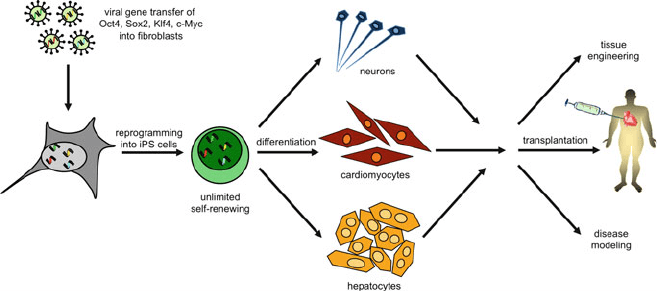
The generation of iPS with doxycycline (dox)-inducible reprogramming vectors
from murine embryonic fibrobl asts (MEFs) carrying an Oct4-GFP reporter gene
knock-in allele enabled first insights into this process [40]. An exposure of dox for at
least 8 days was necessary to obtain iPS cell colonies as analyzed after 20 days. The
number of iPS cell colonies was higher after admission of dox for 10, 11, 12, and 13
days, respectively. Interestingly, during 12 days of dox-induction, the expression of
the fibroblast marker Thy1 was decreasing, while the murine pluripotency-asso-
ciated marker SSEA1 was increasing. The expression of SSEA1 was detectable
earlier than the expression of the canonical pluripotency factors like Oct4 and Sox2
[40]. In a more advanced system, so-called dox-inducible secondary iPS cells were
investigated by generating chimeric mice from dox-inducible iPS which carry a
puromycin resistance [41]. MEFs from these chimeric mice were selected with
puromycin, resulting in a MEF population which originated from one primary iPS
cell line. Adding dox to these MEFs resulted in the generation of secondary iPS with
a much higher efficiency, namely 4% compared to 0.1% in primary iPS cells.
However, the efficiency was far from reaching 100% as one could assume from the
experimental outline. Two reasons for this discrepancy can be discussed as outlined
by a recent comment of Yamanaka [42]. First, an elite cell population (such as a rare
stem/progenitor cell) is more susceptible to iPS reprogramming and, therefore only a
small subset of cells can be successfully reprogrammed into a pluripotent state.
Second, stochastic genetic and epigenetic changes are mandatory for successful
reprogramming, and this might only happen in a subset of cells. Based on recent
literature, Yamanaka favored the latter explanation, which is further strengthened by
Fig. 1 Generation of patient-specific iPS cells. Patients’ fibroblasts were cultivated and transduced
with lenti- or retroviral vectors encoding the four reprogramming factors Oct4, Sox2, Klf4, and
c-Myc. With a limited efficiency, few fibroblasts change their cellular fate and acquire an induced
pluripotent stem cell phenotype. Applying in vitro differentiation protocols, cell derivatives of all
three germ layers (like neurons, cardiomyocytes, and hepatocytes) can be generated. Those cells
might resemble the patient’s diseased cell phenotype and allow studies on new drug targets or
pathophysiological mechanisms and may be used for tissue engineering or cell transplantation
approaches
Induced Pluripotent Stem Cells: Characteristics and Perspectives 111
an elegant recent study: Hanna et al. utilized the dox-induction system for secondary
iPS cells, but started with clonal pre-B-cells as a more homogenous starting popula-
tion than MEFs [43]. Initially, only 3–5% of the cells gave rise to iPS colonies within
2 weeks. But eventually almost all of the cells committed to iPS colonies with
latency times up to 18 weeks. These differences in latency were not predictable by
any experimental parameter which is highly consistent with the necessity of yet
unknown stochastic events during iPS cell reprogramming.
4 Technologies for Generation of Induced Pluripotent
Stem Cells
The recent reprogramming of somatic cells into pluripotent ES-like cells [6, 7]is
generally considered as a revolutionary breakthrough for the development of novel
regenerative therapies. However, the initial technique was very inefficient and
restricted to embryonic and adult fibroblasts as cell source. With respect to genera-
tion of clinically applicable cells, the classical technology based on retroviral
overexpression of several reprogramming factors poses risks including the potential
for insertional mutagenesis [44] and malignant transformation resulting from acti-
vation of oncogenic transgenes.
First reports on the induction of murine and human iPS cells reported repro-
gramming efficiencies of about 0.01–0.1%, resulting in relatively few fully repro-
grammed cell clones. In the meantime, major improvements in reprogramming
efficiencies have been achieved.
Recent results demonstrated reprogramming of a variety of cell types (for example,
[45, 46]) including clinically easily accessible cell types such as keratinocytes, hair
cells [47], and blood cells [48–51]. These results suggest that the majority of somatic
cell types if not all cells can be reprogrammed. Efficiency of reprogramming could be
dramatically increased up to 2% for human cells [52] and up to 28% for secondary
mouse iPS cells in an inducible transgenic mouse model [48]. In addition, it has been
shown that depending on the cell type, and although very inefficient, iPS cells can be
generated using only two [46] and even one reprogramming factor [53, 54].
These remarkable improvements have been achieved mainly through optimized
reprogramming protocols, the use of siRNAs/shRNAs against p53/p21/UTF-1/
DNA methyltransferase [55–57] and application of different small molecules for
inhibition or activation of different factors and pathways (for review, [58]is
recommended). These include inhibitors of histone deacetylase [59], the G9a
histone methyltransferase [60], the TGFß- and MEK-ERK pathways [52], and an
agonist of L-type calcium channels [61]. Inhibitors of GSK-3 [62, 63], MAP Kinase
[63], and TGF-ß [64, 65] have been used to replace KLF4 [66] or SOX-2 (and
c-Myc) [60, 63, 65]. Micro RNA (miR)-based approaches may represent another
way to replace integrating vectors and recent publications indicated the usefulness
of miR-302 and of the miR-290 cluster, the latter being downstream effectors of
c-Myc, for reprogramming of somatic cells [67, 68].
112 T. Cantz and U. Martin
Since most of the typically applied reprogramming factors including OCT4,
SOX2, KLF4, MYC, NANOG, and LIN28 can be considered as oncogenes and may
lead to malignant transformation of iPS-derivatives, permanent presence of those
transgenes in the reprogrammed cells should be avoided and the development of
transgene-free iPS cells is mandatory. In addition, insertional mutagenesis asso-
ciated with integrating vectors may result in malignant transformation and loss of
function. Thus, alternative approaches are desired for production of clinically
applicable iPS cells, and very recent studies have already demonstrated the possibil-
ity of using conventional plasmids [69], nonintegrating adenoviral [70] and episomal
vectors [71], as well as protein transduction [72, 73], instead of integrating vectors.
Very recently, another paper demonstrated the generation of transgene-free human
iPS cells by means of a vector system based on Sendai virus, an RNA virus without
DNA state [74].
Although alternative approaches to induce pluripotent stem cells that avoid
integration of transgenes into the host genome have now been demonstrated
generally feasible, those methods are currently largely far from being technically
mature: episomal approaches are extremely inefficient, genomic integration is not
excluded, and oncogenes such as MYC and large T-antigen are required [71].
Protein transduction is also yet extremely inefficient and, importantly, requires
huge amounts of recombinant proteins [72, 75].
Clearly, the above techniques are extremely promising; nevertheless, further
significant improvement and development of novel and modified techniques is
required.
5 Induced Pluripotent Stem Cells: Risks and Limitations
Although it is now generally accepted that iPS cells are pluripotent, it has been
observed that individual iPS clones show considerable variation in their potential
for differentiation. Whereas such variations can also be observed between different
ES cell lines, variations between individual iPS cells clones may be even higher,
especially due to incomplete transgene silencing, which apparently leads to delayed
and less efficient differ entiation [76]. Thomson et al. very recently reported a lower
neural differentiation efficiency of a series of human iPS cell clones compared to
several established ES cell lines [77]. Interestingly, this was also observed for
transgene-free iPS cell clones generated by means of episomal vectors, thereby
arguing for further reasons underlying the observed variations in differentiation
behavior. Clearly, further work is needed to clarify whether iPS cells hold similar
differentiation potential to ES cells and how the best iPS cell clones for a certain
purpose can be identified.
Of major importance for future clinical application of iPS cells is to overcome
current limitations such as lack of large scale culture technologies and inefficient
specific differentiation, and to assess iPS cell related risks. As in case of ES cells,
there are issues of teratoma formation after transplantation of iPS-cell derivatives
Induced Pluripotent Stem Cells: Characteristics and Perspectives 113
and of chromosomal abnormalities that could arise during stem cell expansion [78–
82]. Whereas teratoma formation is considered to be manageable through suitable
rigorous cell purification approaches and genetic systems enabling the ablation of
contaminating cell grafts [83, 84], it is currently unknown whether and how
chromosomal abnormalities which may result in malignant transformation can be
avoided during extended cell expansion.
Another critical point is the use of oncogenic transgenes, such as MYC, for
reprogramming and the risk of insertional mutagenesis due to the use of retroviruses
to induce pluripotency. As discussed above, alternative technologies for generation
of transgene-free iPS cells are thus crucial for clinical application of iPS-based cell
and tissue transplants.
Another aspect regarding the production of clinically useful iPS cells concerns
the quality of iPS cells derived from somatic cells of aged individuals. Although
mammalian species differ dramatically with respect to their maximum life span and
the incidence of spontaneously occurring tumors, a common observation from
mouse to man is that the risk of cancer increases exponentially during the later
stages of life [85, 86]. In general, epigenetic [87] and genetic modifications, includ-
ing telomere shortening and spontaneous mutations, are considered as underlying
causes. For example, somatic mutations of the epidermal growth factor receptor
have been shown to lead to the development of non-small-cell lung cancer [88].
On the other hand, mitochondrial mutations typically have effects on catabolism
and cell function. Normal mitochondria help to remove free radicals, but somatic
mutations of the mitochondrial DNA over time make them less effective and, thus,
may contribute to the advancement of aging and/or cancer [89].
Whereas epigenetic changes and loss of telomerase activity in cells of aging
individuals may be reversed during induction of pluripotent stem cells [90],
acquired chromosomal abnormalities and/ or point mutations are not corrected
during reprogramming and may lead to iPS-derivatives with reduc ed functionality.
In addition, somatic cell clones with acquired mutations that result in higher
reprogramming efficiency and increased proliferation rates are likely to become
enriched during expansion of the primary cell source. This is further enhanced
during the reprogramming and proliferation of the resultant iPS cells, thereby
supporting an increased cancer risk.
As a consequence, one should consider the use of “young” cell sources such as
cord blood [49] for derivation of clinically useful iPS cells.
6 Induced Pluripotent Stem Cells for Drug Screening
and Safety Pharmacology
Pluripotent stem cells, with theoretically unlimited potential for proliferation and
differentiation, may not only represent a cell source for basic biomedical research
and clini cal cell transplantation, but are rather considered as the most important
114 T. Cantz and U. Martin
prerequisite for the devel opment of novel, high-throughput assays for drug screen-
ing and pharmacology studies.
During the first phase of drug development, the most potent compounds are
identified among several hundred thousands of candidates, followed by the detailed
characterization of selected compounds (several hundred to several thousand) in
primary and secondary pharmacology studies. Finally, safety pharmacology studies
focus on identifying adverse effects on physiological functions.
The cost-effective and available high-throughput assays used in the early phases
of drug screening do not always meet the data quality requirements for detailed
characterization of pharmacodynamic properties and potential of undesired side
effects. Indeed, data of higher quality can be generated only through the use of
sophisticated, costly, and labor-intensive in vitro assays or by in vivo experiments,
for example telemetry studies. Due to high costs of animal experiments, safety
pharmacology studies, required by law, are usually completed in the final phases of
drug development. As non-mammalians and rodents poorly reflect specific aspects
of human physiology and immunology, large animals such as dogs and NHPs are
commonly used in the last phase of preclinic al pharmacology studies and safety
pharmacology.
In contrast, over the past few years, safety pharmacology studies have been
initiated earlier in drug discovery as a way to reduce the rate of failure and thereby
costs. However, to further support this process, as well as to reduce the number of
ethically problematic animal experiments, it is now required to develop cost-
effective in vitro assays producing higher quality data than currently available.
Current assays for cardiac safety pharmacology represent a common example for
pharmacological screening systems. Available assays for cardiac safety pharma-
cology can be separated into three classes: (1) relatively cost-effective assays more
or less suitable for automated high-throughput screening, but with limited predic-
tive value, for example, the dofetilide binding assay or rubidium efflux assay;
(2) labo r (and cost) intensive in vitro assays with higher predictivity, such as
Langendorf heart and patch clamp; and (3) most expensive, animal experiments
in dogs or monkeys, but with the highest predictive value.
One major problem of all cardiac in vitro assays is the cell source. Human CMs
would be optimal; however, these are not available as myocyte-derived tumor cell
lines and adult primary CMs lose proliferation potential. As an alternative, existing
assays use Xenopus oocytes or human tumor cell lines genetically modified to
express hERG channels [91], or primary CMs prepared from hearts of other species,
for example dogs. However, the phenotype of these cell sources is far from being
able to mirror closely the function of human CMs.
The availability of ES cells and iPS cells from huma ns with their high expansion
capacities now offers the possibility to generate almost unlimited numbers of
functional CMs [49] as the perfect tool for the development of novel high-through-
put pharmacological screening systems. Such assays can be based not only on
electrophysiological dete ction of prolongation of QT-intervals, but also on detec-
tion of Ca
2+
-transients or the biochemical/biophysical analysis of specific ion
channels. Furthermore, the influence of drugs on cardiovascular differentiation and
Induced Pluripotent Stem Cells: Characteristics and Perspectives 115
development [92] can be tested by means of pluripotent stem cell lines, transgenic
for fluorescent reporter genes under control of specific promoters.
In case of screening for prolongation of the QT-interval [93], pluripotent stem
cell-derived CMs are probably better qualified than adult CMs, from a functional
point of view, as they represent embryonic CMs with a typical reduced repolariza-
tion reserve similar to CMs of diseased hearts. Therefore, prolongation effects on
repolarization can be detected at much lower concentrations as compared with cells
from healthy adult tissue. This may even be an advantage over animal experiments
and first stages of clinical studies where as, in these cases, usually healthy individuals
are tested.
In addition to iPS-derived CMs from healthy individuals, iPS-derived CMs from
patients with genetically based diseases, for instance from long QT patients, may be
highly useful for drug screening purposes. Although not shown so far for iPS-
derived CMs from long QT patients, it is supposed that such cells are more sensitive
to certain QT-interval prolonging drugs than control cells.
Similar to cardiac drug screening, the cell source represents one if not the
bottleneck for development of novel in vitro assays in other fields, for instanc e,
safety screening for hepatotoxicity. So far, only limited numbers of human hepa-
tocytes have been available from donor organs that are unsuitable for clinical organ
transplantation, and unlimited suppl y with iPS cell-derived functional hepatic cells
would overcome the major bottleneck of in vitro drug evaluation of hepatotoxicity.
Recently, two groups described successful adaption of human ES cell differentia-
tion protocols to human iPS cell lines, which give rise to hepatic cells exhibiting all
major metabolic liver functions [94, 95].
7 Induced Pluripotent Stem Cells for Disease Modeling
The generation of human iPS cells from various types of somatic cells provides
improved iPS cell generation strategies for adequate patient-specific cell culture
models for a variety of diseases and disorders, including hematopoietic disorders,
neurological disorders, arrhythmic heart disorders, pulmonary diseases, and meta-
bolic liver diseases (Fig. 1). Implications of the genetic defect during the specifica-
tion of the affected cell type can be investigated and the severity of the defect can be
correlated to the individual course of the disease. Most importantly, derivatives of
disease-specific iPS offer an unlimited cell resource for in vitro studies allowing not
only advanced studies on the pathophysiology of such diseases but also evaluation
of future therapeutic interventions, including gene therapeutic approaches.
With respect to patients suffering from myeloproliferative disorders (MPDs),
studying disease-specific iPS cells might be of particular interest if the disease was
caused by a specific genetic mutation. Ye and colleagues recently described the
generation of iPS cells from patients’ CD34-positive blood cells that carry the
JAK2-V617F mutation leading to MPD [96]. These MDP-iPS were morphological
undistinguishable from normal human iPS cells and did not show alterations with
116 T. Cantz and U. Martin
respect to their pluripotent phenotype. Nevertheless, in vitro differentiation into blood
cells demonstrated an increased erythropoiesis, resembling the primary disease of the
patients [96]. In a recent letter, a Chinese group reports on the generation of iPS cells
from patients suffering from b-thalassemia, which is an inherited disease character-
ized by reduced synthesis of hemoglobin beta subunit [97], but the authors did not
provide analyses of the diseased phenotype after in vitro erythropoiesis.
Aiming at neurological disorders, numerous groups are interested in studying
iPS from patients, who suffer from an inherited form of amytrophic lateral sclerosis
(ALS). One future goal might be to generate patient-derived transplantable motor
neurons but today’s efforts focus on modeling the disease phenotype by analyzing
and influencing the motor neuron destruction. The first crucial step for those studies
has already been achieved by generating ALS-specific iPS cell lines that were
differentiated into motor neurons in vitro [98].
Spinal muscular atrophy is a genetic disease affecting motor neurons, which, in
contrast to ALS, leads to symptoms in early childhood. In an elegant study, Ebert
et al. describ ed the generation of disease-specific iPS cells from patients’ skin
fibroblast and compared these cells with iPS cells derived from fibroblasts of the
unaffected mothers [99]. Importantly, the authors were able to demonstrate that the
patient iPS cell-derived motor neurons showed selective defici ts and, thereby,
maintained the disease phenotype.
One pitfall of using iPS cells for disease modeling might be that the cells acquire
mutations in relevant pathways due to insertional mutagenesis caused by the
retroviral delivery of the reprogramming factors. This issue is addressed in one
study on iPS cells that were derived from five individual patients suffering from
Parkinsons disease [100]. Using Cre-excisable reprogrammin g factors, the authors
generated factor-free iPS cell lines that were a superior source of cells for studying
iPS cell-derived dopaminergic neurons. A very rare disease of the peripheral
nervous system was studied using iPS cells derived from patients’ fibroblasts
suffering from familial dysautonomia, FD [101]. A point mutation in the IKBKAP
gene results in mis-splicing, but to date little is known about the detailed mecha-
nism of the loss of autonomic and sensory neurons in the peripheral nervous system.
FD-derived iPS cells could be differentiated into peripheral neurons, which mimic
the underlying disease phenotype by showing alter ations in the levels of normal
IKBKAP transcripts and marked defects in neurogenic different iation and migra-
tion behavior. Moreover, FD-iPS cells were used to evaluate candidate drugs such
as kinetin, epigallocatechin gallate, and tocotrienol.
Besides hematologic and neurologic disorders, iPS cells were also generated to
study metabolic disease s, such as type 1 diabetes mellitus. In recent years intense
basic science has led to improved protocol s to differentiate human ES cells into
insulin-producing b-cells [102, 103] but still more insights with respect to the (auto-)
immunologic reactions causing the loss of b-cells are desi red. The lack of available
patient-derived type 1 diabetes (T1D)-specific b-cells is regarded as one of the
major obstacles that limit the current knowledge of the disease mechanism. Maehr
and colleagues from Doug Melton’s lab were demonstrating that T1D-iPS could be
generated for various patients and could be differentiated into insulin-producing
Induced Pluripotent Stem Cells: Characteristics and Perspectives 117