
Kasper C., van Griensven M., P?rtner R. (Eds.) Bioreactor Systems for Tissue Engineering II: Strategies for the Expansion and Directed Differentiation of Stem Cells
Подождите немного. Документ загружается.

Contents
1 Pluripotency and Induced Pluripotency . . . . . . . . . . . . . . . . . . . . . . . . . . . . . . . . . . . . . . . . . . . . . . . . . . . 128
1.1 Embryonic Stem Cells . . . . . . . . . . . . . . . . . . . . . . . . . . . . . . . . . . . . . . . . . . . . . . . . . . . . . . . . . . . . . . 128
1.2 Pluripotency and Its Regulators . . . . . . . . . . . . . . . . . . . . . . . . . . . . . . . . . . . . . . . . . . . . . . . . . . . . . 130
1.3 Induced Pluripotent Stem Cells . . . . . . . . . . . . . . . . . . . . . . . . . . . . . . . . . . . . . . . . . . . . . . . . . . . . . 132
2 Conclusions . . . . . . . . . . . . . . . . . . . . . . . . . . . . . . . . . . . . . . . . . . . . . . . . . . . . . . . . . . . . . . . . . . . . . . . . . . . . . . . 137
References . . . . . . . . . . . . . . . . . . . . . . . . . . . . . . . . . . . . . . . . . . . . . . . . . . . . . . . . . . . . . . . . . . . . . . . . . . . . . . . . . . . . 138
Abbreviations
bFGF Basic fibroblast growth factor
BMP Bone morphogenetic protein
EpiSCs Epiblast stem cells
ERK Extracellular signal-regulated kinase-1
ESCs Embryonic stem cells
GFP Green fluorescent protein
GSK3B Glycogen synthase kinase 3 beta
ICM Inner cell mass
iPSCs Induced pluripotent stem cells
LIF Leukemia inhibitory factor
Oct4 Octamer-4
POU5F1 POU class 5 homeobox 1
SCNT Somatic cell nucl ear transfer
SKOM Sox2, Klf4, Oct4, c-Myc
SKONL Sox2, Klf4, Oct4, Nanog, Lin28
STAT Signal transducer and activator of transcription
Tgfb Transforming growth factor beta
1 Pluripotency and Induced Pluripotency
1.1 Embryonic Stem Cells
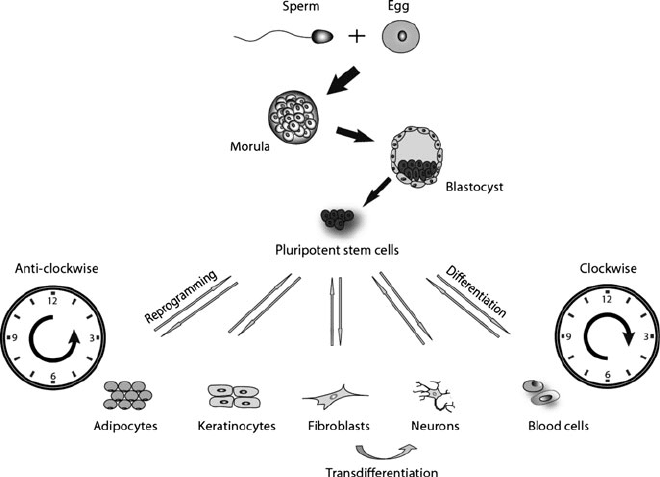
After fertilization the mammalian zygote undergoes a series of quick symmetric
cell divisions to reach the morula stage. Soon afterwards the first differentiation
event produces the blastocyst, which is composed of an outer layer or trophecto-
derm and the inner cell mass (ICM) [1] (Fig. 1). The blastocyst stage embryo
implants into the receptive uterine wall and then the trophectoderm transforms into
the placenta, which connects the developing fetus to the maternal uterine wall and is
responsible for the exchange of nutrients and oxygen. The ICM transform into the
128 M.A. Esteban et al.
epiblast, which later differentiates into the three germ layers (ectoderm, mesoderm,
and endoderm) through a process known as gastrulation, and these three lineages
form all the tissues of the newborn individual [2]. Embryonic stem cell (ESC) lines
are considered in vitro representations of the ICM, and they are derived from
preimplantation blastocysts once these are broken and the cells cultured in specific
tissue culture conditions [3, 4]. Human ESCs are phenotypically and functionally
very distinct from mouse ESCs; for example, they are flat and require basic
fibroblast growth factor (bFGF) and Activin A/transforming growth factor beta
(Tgfb) signaling to maintain their pluripotent state, whereas mouse ESCs are tightly
clustered and require leukemia inhibiting factor (LIF)/Stat3 and Bmp4 signaling
[5–7]. Human ESCs also differ epigenetically from mouse ESCs by several criteria
such as X chromosome inactivation, their pattern of gene expression, and pluripo-
tency factor promoter occupancy across the genome [8]. A different type of stem
cells termed epiblast stem cells or EpiSCs can also be derived from the postimplan-
tation mouse epiblast, and these cells share many characteristics with human ESCs
including the flat morphology and tissue culture requirements [9, 10]. EpiSCs have
a very restricted developmental potential but they can produce teratomas composed
of the three germ layers. Interestingly, they can be reversed into bona fide ESCs by
manipulating the culture conditions or using chemical inhibitors [8, 11]. Altogether
these findings have provok ed questions concerning the true identity of human ESCs
and whether they can also be reset to a mouse ESC-like status. In mouse,
Fig. 1 Schematic representation of embryonic stem cell differentiation and reprogramming
Induced Pluripotent Stem Cell Technology in Regenerative Medicine and Biology 129
pluripotency is routinely tested by injecting cells into blastocysts of a mouse strain
with different coat color, but this approach cannot be used in humans and thus many
questions remain. The failure to isolate true ESCs from other relevant mammal ian
species like ungulates (e.g., pig) [12] a nd even from many (defined as non-
permissive) mouse strains [8] has also been a major roadblock in making cross-
comparisons. Nevertheless, given their ability to differentiate into all possible
lineages of the body, human ESCs have longbeenviewedasapotential “fountain
of youth” for regen erat ive medic ine purposes and a major scientific advance [13]
(Fig. 1). Adult stem cells of mesenchymal originhavealsoraisedmuchinterest
for transplantation purposes and are poorly immunogenic, but they have a rather
limited differentiation potential and are difficult to expand ex vivo [ 14].
1.2 Pluripotency and Its Regulators
Despite the immense potential of human ESCs, the use of human embryos, even if
from in vitro fertilization, remains controve rsial, and the problem of immune
rejection following transplantation in patients is difficult to solve [15]. This has
stimulated scientists to find alter native ways to produce pluripotent cells in vitro by
resetting the nuclei of somatic cells to an embryonic-like stage. These methods are
generically termed nuclear reprogramming or reprogramming, and the two most
extended variants are somatic cel l nuclear transfer (SCNT) [16] and direct repro-
gramming using exogenous factors [17, 18]. Pioneer studies by King, Briggs, and
Gurdon had shown decades earlier that when an undifferentiated [19] or a somatic
nucleus [20] is transferred to a frog egg deprived of its own nucleus, the egg bearing
the exogenous DNA can produce a normal tadpole. This was proof of concept that
developmental fates are not a fixed state and sugges ted that somatic cells contain all
the necessary information to direct the development of a new individual. The
successful cloning of Dolly in 1997 proved this idea and made human SCNT a
top scientific objective for producing patient specific human ESC-like pluripotent
cell lines. But even though SCNT was successful in a number of other species
including non-human primates [21, 22 ], many technical challenges persist in
humans and early reports turned out to be fraudulent. After this, thanks at least in
part to improved technologies for high throughput functional screening, studies
worldwide progressively narrowed into the identification of key transcriptional
networks that govern ESC function [23, 24]. Given the existing restrictions in
many countries, most of these analyses were done with mouse ESCs, but the
existing paradigms apply to a great extent in humans and possibly other mammals
as well. Among other key transcription factors, Octamer-4 (Oct4), identified by
Austin Smith and collaborators [25], and Nanog, identified by Austin Smith [26]
and Shinya Yamanaka [27], are essential regulators of pluripotency. For example,
levels of the homeobox-containing protein Oct4 (also termed POU5F1) only 50%
higher than normal induce mesodermal differentiation, while if 50% lower ESC
fate is shifted towards the trophectoderm. Likewise, knock-down of Oct4 prevents
130 M.A. Esteban et al.
proliferation of ICM cells and induces differentiation into trophectoderm in mouse
embryos [25]. In contrast, the homeodomain containing protein Nanog is not
absolutely required to sustain mouse ESC characteristics [28], but its overexpres-
sion renders them resist ant to differentiation upon LIF withdrawal [26–28]. Oct4,
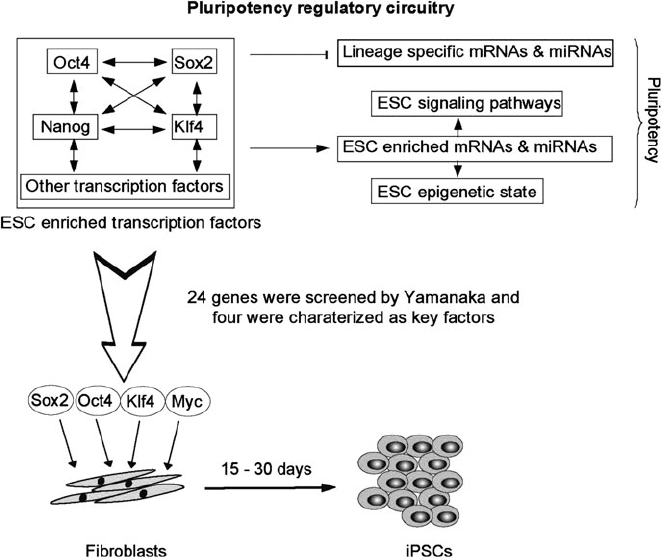
Nanog, and other ESC transcription factors coordinately bind to DNA-binding sites
in target promoters along the genome [24], and act as gene activators or repressors
depending on the identity of extra proteins that are recruited to these promoters; for
example, recruitment of the transactivator P300 associates with active transcription,
and proteins of the Polycomb group with repression [29, 30] (Fig. 2). This duality
has the purpose of coordinating the activation of pluripotency genes with the
silencing of others that are involved in lineage differentiation progr ams, and is
tightly related to the nature of the concomitant histone modifications (e.g., acetyla-
tion, methylation) [31]. In addition, ESC transcription factors usually bind to their
own promoters in an autoregulatory loop, and can induce the transcr iption of
each other [24]. The accessible amount of information regarding ESC pluripotency
is nowadays impressive, and although knowledge is not yet fully digested, it was
determinant to allow Takahashi and Yamanaka to generate induced pluripotent stem
cells (iPSCs) from mouse somatic cells in 2006 [17], an outstanding achievement.
Fig. 2 Schematic representation of the transcriptional networks controlling ESC pluripotency and
how this knowledge was employed to discover iPSCs
Induced Pluripotent Stem Cell Technology in Regenerative Medicine and Biology 131
1.3 Induced Pluripotent Stem Cells
Takahashi and Yamanaka had a simple yet sophisticated approach to nuclear
reprogramming: they first selected a combination of transcription factors and
other proteins with well established roles in ESC behavior, which were delivered
as a pool into mouse fibroblasts by means of retroviral vectors (Fig. 2). The
transduced cells were cultured in conditions similar to mouse ESCs and after
approximately 15 days colonies with mouse ESC characteristics formed; then the
exogenous factors were eliminated one by one until it appeared that the SKOM
(Sox2, Klf4, Oct4, and c-Myc) cocktail was necessary and sufficient (Fig. 2)[17].
The first generation iPSCs formed teratomas but had a different global gene
expression pattern from ESCs and failed to produce adult chimeric mice. The use
of genetically engineered knock in mice with reporter systems (green fluorescent
protein, GFP) and resistance to antibiotics inserted into the promoter of key ESC
pluripotent regulators (e.g., Nanog) allow ed the generation of chimera competent
iPSCs with germ line transmission by the Yamanaka and Jaenisch labs [32, 33], and
ever since the field has been an explosion of remarkable achievements one after the
other. In particular, the Yamanaka and Thomson laboratories were the first to
produce human iPSCs using retroviral or vectors and SKOM [34] o r SKONL (NL
stands for Nanog and Lin28) factor combinations [35].
1.3.1 Delivery Methods
Methods for generating iPSCs are evolving very quickly and the choice is very
varied but can basically be divided into integrating and non-integrating approaches.
The initial experiments by Takahashi and Yamanaka used retroviral vectors [17],
and this turned out to be particularly useful given that ESCs have self defense
mechanisms (DNA methylation of the integrated virus) against invading genomes
such as retroviruses. Accordingly, silencing of the exogenous retroviral vectors
was established as a relevant criterion to discern fully reprogrammed from partially
reprogrammed colonies [17]. iPSCs have also been generated with lentiviruses,
which have a less reliable degree of silencing in ESCs/iPSCs but can be com-
bined with an inducible doxy cycline-dependent system. Retroviral and lentiviral
approaches, although robust and reproducible, have the problem of possible reacti-
vation of the viral vector, in particular after transplantation, and for example mice
generated with SKOM retroviruses had a high frequency of tumors and other
abnormalities [32]. This is possibly related to c-Myc and over time the need for
this oncogene (and othe r factors as well) in the cocktail has been bypassed [36, 37],
but we should not forget that in some instances Klf4 has also been regarded as an
oncogene and overexpression of Oct4 in adult tissues can cause dysplasia [38, 39].
To avoid this problem, Jaenisch and collaborators induced iPSCs using a polycy-
stronic cassette that could be removed by adding CRE recombinase [40]. Intere st-
ingly, the authors found a change in gene expression in iPSC cell lines before and
132 M.A. Esteban et al.
after excision with the recombinase, which points to minor presence of the viral
transcripts having a substantial impact on gene expression. Nevertheless, this
approach, although appealing, leaves a genetic scar after the excision and still
does not preclude the risk of insertional mutation. Hochedlindger and collaborators
also made mouse iPSCs using adenoviruses [41] and afterwards this was achieved
in human cells [42]. More recently human iPSCs were produced by Yu et al. using
episomal vectors [43], and mouse and human iPSCs by Zhou et al. and Kim et al.
using proteins [44, 45]. These non-integrating approaches have very low efficiency
compared to retroviruses/lentiviruses and the challenge is to improve the reproduc-
ibility of existing protocols. The addition of com pounds such as the histone
deacetylase inhibitor valproic acid [46], vitamin C [47], or chemical inhibitors of
Tgfb receptors [48–50], and a careful donor cell selection will definitely facilitate
this objective. The number of cell types that can be used to generate iPSCs is
growing steadily [51–56]. So far, superior cell sources are defined mainly on the
basis of such a weak criterion as human ESC-like morphology and alkaline
phosphatase staining, but this may be misleading and it is important to evaluate
the epigenetic reprogramming and safety of the resulting colonies using more
accurate methods (see Sect. 1.3.3 below). Understanding why some cells are
more amenable to reprogramming than others and how these compounds work
will also shed light into the reprogramming.
1.3.2 Modeling Human Disease with iPSCs
Mouse transgenic and knock out models are extremely valuable for studying human
disease but in many cases the parallelism between both species does not exist due to
differences in animal physiology or in gene function. This has made it increasingly
necessary to develop more accurate human disease models for mechanistic studies
and drug discovery. One possible way to do this is using in vitro fertilized ovules
after the corresponding preimplantation genetic diagnosis. This has produced
human ESCs from diseases such as cystic fibrosis [57] or Huntington disease
[58], but is severely constrained by ethical considerations and the diseases that
are routinely screened. Another option is to modify genetically existing human ESC
cell lines by means of homologous gene recombination, but apart from ethical
concerns this area of research has been largely stalled due to technical difficulty in
achieving DNA recombination compared to mouse ESCs [59, 60]. In this regard, if
the targeting efficiency is low for knocking out one gene, it is almost negligible for
eliminating the two. This approach may still be feasible for X chromosome-linked
syndromes, in which only one allele needs to be abrogated, for example Lesch–
Nyhan disease [61], but among other considerations the selection procedure may
alter the epigenetic state and quality of the resulting ESC cell lines. More recently,
successful homozygous gene disruption in human ESCs using zinc-finger nuclease-
mediated genome editi ng [62] or a bacterial artificial chromosome (BAC)-based
targeting approach has also been reported [63]. Regarding the zinc-finger nuclease
Induced Pluripotent Stem Cell Technology in Regenerative Medicine and Biology 133
technology, not every gene is susceptible and the DNA-binding specificity of the
designed zinc-finger proteins remains to be validated with vigorous genomic
analysis. The generation of iPSCs from indivi duals with genetic diseases could
solve these problems but caution is needed as there are also potential caveats [59,
60]. One fundamental consideration is that many diseases have a late onset and the
neurons or other progeny derived from iPSCs may not reproduce the age related
phenotype. In addition, some diseases are non-cell autonomous and require not only
time to develop but also the existence of a body context (e.g., neurons affected by
secretions of glia cells). Another perhaps more incapacitating problem is that
differentiation protocols are still inefficient and the lack of a homogeneous popula-
tion can be a major problem for detecting biomarkers and performing drug screen-
ing or transcriptomic/proteomics analysis. Nevertheless, recent reports have
succeeded in finding either an in vitro phenotype or using patient-specific iPSC
cell line generation to shed light onto the reprogramming. For example, Ebert et al.
produced iPSCs from spinal muscular atrophia [64], Lee et al. from familial
dysautonomia [65], and Agarwal et al. from dyskeratosis congenita [66], and this
list is likely to increase steadily. Although setting up meaningful in vitro models
will likely take several years and for many diseases it may never be achieved, this
research will revitalize the interest on rare human conditions touching essential
aspects of human physiology (e.g., DNA repair) for which the availability of
patients (not to mention the tissue) is reduced.
1.3.3 Accuracy of the Epigenetic Reprogramming
iPSCs have been repeatedly described as identical or almost identical to ESCs but
the initial comparisons were too vague for a matter of such importance and defining
the epigenetic identity of iPSCs compared to ESCs is now a very active aspect of
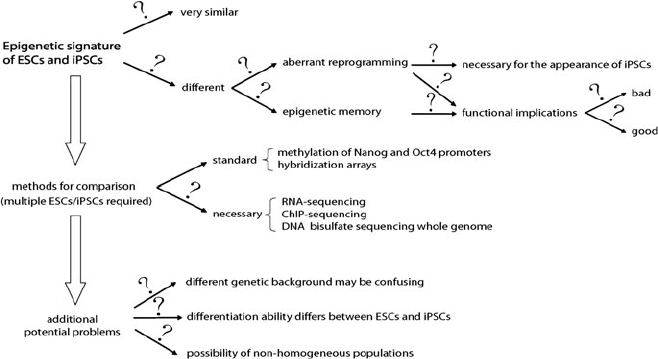
research. Among other major questions (Fig. 3) that are steadily discussed in all
forums we have: is the epigenetic reprogramming of iPSCs complete or only an
effective makeup? If it is only a makeup, then – as long as it works and is safe –
does it matter? Also, is there any epigenetic memory from the tissue of origin and
does this memory have any functional implications? Related to the latter, an
interesting possibility is that the existence of a tissue-specific epigenetic memory
confers an advantage rather than being negative, which could thus be exploited to
develop iPSCs that retain a relevant functional ability. On the other hand, it could
happen that the abnor mal epigenetic reprogramming (either epigenetic memory or
of a different kind) is a requisite for generating iPSCs. As was discussed above, in
the mouse it is easy to test for the acquisition of pluripotency and recently adult
animals were produced entirely from mouse iPSCs by means of tetraploid comple-
mentation [67–69]. This suggests that mouse ESCs and iPSCs are either epigeneti-
cally identical or that putative abnormally reprogrammed genes are not functionally
relevant. However, this procedure still has a very poor success rate and it remains to
be found whether these animals or their progeny are exempt of any physiological
abnormalities. In this regard, for example, mice produced by SCNT are more prone
134 M.A. Esteban et al.
to disease and can have d evelopmental abnormalities [70, 71]. In the case of human
iPSCs, epigenetic reprogramming is no rmally defined by complete DNA demeth-
ylation of selected regions of Oct4 and Nanog promoters and by hybridization
arrays that compare the gene expression profile (DNA or microRNA microarrays)
and the pattern of histone modifications (mainly histone methylation). Interestingly,
a recent meta-analysis of published DNA microarrays by Chin et al. showed that
mouse and human iPSCs retain a common gene expression signature especially
during the first passages [72], and Ghosh et al. showed the retention in iPSCs from
different tissues of patterns of gene expression reminiscent of the tissue of origin
[73]. Both studies have compared iPSCs generated by different methods in different
laboratories and although the conclusions are attractive their analysis is not exempt
of problems. For example, Chin et al. defined abnormal reprogra mming as those
genes changed mor e than 1.5-fold between the average of a panel of iPSCs and a
panel of ESCs [72], which can be misleading because gene expression of ESCs is
known to differ between cell lines and so is expected of iPSCs. Besides, although
they identified up-regulated genes that belong to developmental pathways, this
could be a consequence of partial differentiation in the borders of some colonies,
which for example is not infrequent during the first passages of freshly isolated
human iPSCs. Ghosh et al. also stated that the retention of a footprint from the
tissue of origin could be due to those iPSC cell lines being a heterogeneous
population of both reprogrammed and partially reprogrammed cells [73]. In any
case, DNA arrays have limitations, and a rather more accurate comparison should
require digital sequencing technologies: deep transcriptomic sequencing, and
whole genome ChIP-on-Chip sequencing and DNA bisulfate sequencing for asses-
sing DNA methylation. The latter was recently achieved with human ESCs and
these available data are a powerful resource for future comparisons with human
iPSCs [74]. On the other hand, Doi et al. also used comprehensive high throughput
Fig. 3 Possibilities regarding the extent of the epigenetic reprogramming in iPSCs
Induced Pluripotent Stem Cell Technology in Regenerative Medicine and Biology 135
array-based relative methylation (CHAR M) to identify in a more restricted part of
the genome series of differentially methylated regions (DMRs) between multiple
ESCs and hu man iPSCs and their respective donor cells [75]. Pick et al. also
described the inadequate maintenance of imprinted genes, which was demonstrated
by abnormal DNA methylation of their respective promoters, between donor cells
and some of the resulting h uman iPSCs cell lines [76].
1.3.4 iPSCs from Other Species
After the existing technical hurdles and safety concerns are solved, the jump of
human iPSCs to the first clinical trials will be a monume ntal step that cannot be
made without prior animal validation. Given its ease and reproducibility, mouse
iPSCs are unquestionably the preferred tool for mechanistic studies and technical
innovations that subsequently become validated in the human model. Besides,
proof of the principle that iPSCs have huge therapeutic potential was achieved
early by the Jaenisch laboratory, which showed that mous e iPSC s from a mouse
with sickle cell anemia can be used to correct the mutation using homologous
differentiation followed by hematopoietic progenitor differentiation and transplan-
tation [77]. However, in general the differences in size, physiology, and life span
between mice and humans are too big for valuable comparisons. For example, the
heart beat frequency in mice is several hundred per minute compared to around 70
in humans, challenging if not invaliding any possible conclusions mad e after iPSC
derived-cardiomyocytes transplantation. This has encouraged researchers to
develop iPSCs from other mammalian species, specifically the rat, monkey, and
pig in this order. Rat iPSCs were generated by two independent groups [78, 79]
following the successful isolation of rat ESCs using extracellular signal-regulated
kinase-1 (ERK) and glycogen synthase kinase 3 beta (GSK3B) inhibitors by Smith
and Ying [80, 81]. Li et al. used fibroblasts and SKOM retroviruses [78], while Liao
et al. used fibroblasts and bone marrow mesenchymal cells infected with inducible
lentiviruses [79]. In both studies, rat iPSC pluripotency was demonstrated by
teratomas, and the formation of chimeric animals (without germ lin e transmission)
was only reported by Li et al. [78]. Rats are larger than mice and, although their life
span and physiology also differ from humans, they are excellent laboratory animals
for a wide range of diseases. Monkey iPSCs were then produced from Rhesus
monkey (Macaca mulatta) skin fibroblasts using SKOM retroviruses by Deng and
collaborators, whose pluripotency was judged on the base of teratoma formation
[82]. A problem of monkeys is that their close phylogenetic relationship with
humans still raises ethica l concerns and, besides, in most countries there is no
easy access to these animals. Aiming to develop a large animal model which is
exempt of these problems, Esteban et al. [83] and later on Wu et al. [84] and Ezashi
et al. [85] reported the generation of porcine iPSCs using retroviruses or lentiviruses
and fibroblasts or bone marrow mesenchymal stem cells from Tibetan mini-pig and
farm pig (Sus scrofa). Although chimeric animals were not presented, pluripotency
was demonstrated by teratoma formation. Notably, reliable teratomas had not been
136 M.A. Esteban et al.
shown in numerous previous attempts to isolate pig ESCs [86]. Given that the
porcine physiology is strikingly similar to humans and their maintenance is easy
and relatively inexpensive, the pig stands arguably as the best model for preclinical
trials using iPSCs [87]. Difficulties of this model include the mentioned lack of
bona fide porcine ESCs with which to establish comparisons, the incomplete
sequencing and annotation of the pig genome, and the limited availability of tested
reagents, specifically antibodies, that can assist with the characterization of these
iPSCs or their derivatives [87]. Besides, in all three studies either the transgenes
were not properly silenced [83, 85] or if doxycline was removed the cells differ-
entiated [84], which raises important questions as to whethe r the reprogramming
was indeed complete. Nevertheless, improvement of the current derivation proto-
cols is expected soon and pig iPSCs could play a major role in accelerating the
clinical application of human iPSCs.
2 Conclusions
Two major trends have arisen after roughly 4 years of intense iPSC research: the
possibility of personalized stem cell therapies using human iPSCs and the creation
of in vitro models of human disease. At the current pace of discovery these two
types of research may progressively divert and their respective standards could be
different. For clinical application iPSC cell lines will have to meet the most
stringent criteria of quality and be exempt of transgene insertions. Analyzing the
extent of the epigenetic reprogramming in human iPSCs will almost inevitably
involve the next generation sequencing technologies. But the analysis of multiple
iPSCs is not enough and this will need to be contrasted with ESCs from different
sources in order to exclude differences related to the genetic background. This will
raise the costs considerably, at least with currently available tec hnologies, and
reinforces the idea that further research on human ESCs is important to understand
iPSCs, which would surely find many detractors [88]. Altogether this may imply
that the long awaited objective of having patient specific pluripotent stem cells is
not feasible or at least will take longer than expected. Potential solutions include
the creation of a bank of iPSCs matching as many haplotypes as possible, or the
production of iPSCs engineered to have low immunogenicity. In both cases the use
of fetal sources (e.g., cord blood [54, 55 ] and umbilical cord matrix mesenchymal
cells [89]) should be preferred as these cells do not have the risk of incorporated
mutations that is omnipresent in more aged tissues (especially skin cells). By
creating iPSC banks, only those iPSC cell lines of the highest quality would be
selected, further expanded in the absence of animal products or xenobiotics, and
scrupulously tested before clinical trials are approved. Besides, any abnormalities
happening afterwards would be immediately noticed and recorded. On the other
hand, for modeling genetic diseases in vitro, safety and near perfect epigenetic
reprogramming is a priori less of a concern and this parallel field may thus move
quicker and face less criticism s. Of course, genetic and epigenetic abnormalities
Induced Pluripotent Stem Cell Technology in Regenerative Medicine and Biology 137