
Kasper C., van Griensven M., P?rtner R. (Eds.) Bioreactor Systems for Tissue Engineering II: Strategies for the Expansion and Directed Differentiation of Stem Cells
Подождите немного. Документ загружается.

reports. Only then can an objective unbiased evaluation be made. Another impor-
tant setback is the use of heterogeneous populations of stem cells that did not go
through in vitro characterization before patient testing [41–43].
A more insightful clinical study investigating the use of autologous BM-MSCs
in conjunction with a hydroxyapatite based scaffold for regenerating osseo us jaw
bone defects prior to dental implant placement documented de novo bone formation
in only one of six patients after 4 months [44]. At the same time, a set of
synchronized experiments were performed implanting cells from each patient in
immunodeficient mice. These revealed ectopic bone formation with cells from all
patients;, however, the failure to confi rm this clinically was explained by a lack of
sufficient vascu lar supply leading to immediate death of the cells following trans-
plantation. It is hence plausible that bone marrow stem cell–scaffold based strate-
gies need to address the issue of reconstituting a developmentally conductive
“niche” which would ensure establishment of a vascular network while maintaining
a bed of self-renewing stem cells ensuring dynamic turnover of the tissue [45].
It is apparent that stem cel l based clinical therapy is steadfastly gaining momen-
tum yet, until stringent parameters are applied and generalized, a standard clinical
application will remain far-fetched. On this basis, more in-depth basic studies have
resurfaced, aiming to arrive at more comprehensive explanations for clinical
observations.
2 Redefining the Bone Marrow Niche: Implications
for Clinical Application
A clinically appealing concept for the use of stem cells is one that allows manipula-
tion of these cells in vivo rather than relying solely on the cumbersome process of
ex vivo culture and expansion. These newly founded methodologies would thereby
be capable of triggering in-house recruitment and expansion of stem cell populations
in a way that would boost the body’s own regenerative capacity. This entails a deeper
probing of the bone marrow stem cell microenvironment (the bone marrow niche).
A niche is a local microenvironm ent within which one or more stem cells are
housed and maintained. Initially, the niche concept was defined by Grinnell and it
was introduced in mammals by Schofield to delineate a microenvironment capable
of supporting hematopoiesis [46, 47]. An ideal niche is one that, after a complete
elimination of its host stem cell population, could retake a new stem cell and in turn
maintain it. Hence, a niche is difficult to replicate in in vitro cultures since these
newly introduced environments can alter the patterning of the cells and modify their
behavior later in vivo. The existence of facultative niches is a facilitating mecha-
nism to allow homing of stem cells in response to stress or injury. Indeed, signaling
profiles of stem cells vary according to the neighboring cells and the physical
environment, which further complicates the identification and purification of a
purely genuine stem cell [48].
Bone Marrow Stem Cells in Clinical Application: Harnessing Paracrine Roles 271
The existence of stem cell niches in the organism is a vital prerequisite to
maintaining a constant supply of naı
¨
ve, undifferentiated stem cells while maintain-
ing lineage development required for the individual’s long-term survival. For
successful cell based therapy, transplanted stem cells must be capable of homing
to appropriate niches, thereby maintaining their lineage development potential and
at the same time a constant supply of native cells. In a tissue engineering approach,
the ultimate goal would be to engineer an appealing niche within the scaffold,
thereby creating a suitable microenvironment for the delivered cells which can be
sustained in vivo [49].
2.1 The Bone Marrow Niche: An Orchestra of Cells and Signals
Although stem cell niches should by concept exist in all organs and tissues, little
information exists on the nature and mechanism that control these niches. So far,
most studies have b een concerned with the bone marrow stem cell niche. This is the
particular niche within the bone marrow representing a harmonious microenviron-
ment whereby the coexistence of hematopoietic stem cells within their physical
microenvironment with bone marrow derived mesenchymal stem cells brings about
this balance. In the following section, we will present available information on the
bone marrow niche as well as a paradigm of other stem cell niches. Indeed the stem
cell niche represents the physical 3D micro environment within which stem cells are
either maintained in a quiescent state, protecting the stem cell reservoir from
exhaustion, or under triggering circumstances are prompted to enter the cell cycle
and proliferate, mature, or differentiate. From a bone engineering perspective,
recreating the stem cell niche is required if a truly hematopoiesis supporting stroma
is to be developed within the newly regenerating bone [50–52].
Mesenchymal stem cells have been redefined on a more precise basis as being
cells that display plastic adherence, express CD105, CD90, and CD73 in greater
than 95% of the culture, and display a lack of expression of markers including
CD34, CD45, CD14 or CD11b, CD79a or CD19, and HLA-DR in greater than 95%
of the culture, in addition to their capacity to differentiate into bone, fat and
cartilage [53].
Hematopoietic stem cells are cells capable of self-renewal and giving rise to a
cascade of differentiation leading to the creation of all types of blood cells [48].
Hematopoietic stem cells found in adult bone marrow develop from preexisting
hematopoietic stem cells that emerged early in ontogenesis, when the bone
marrow had not yet formed. In mouse bone marrow, genuine hematopoietic
stem cells appear in the bone marrow only after 4–5 days of birth, meaning that
they are n ot r es pons ib le f or th e i ni tial e s tabl is hmen t of hematopoies is b ut p lay a
major role in its long-term sustenance [54]. Durin g human embryon ic develo p-
ment, hematopoiesis sequentially includes the yolk sac, an area surrounding the
dorsal aorta termed the aorta–gonad mesonephros (AGM) region, the fetal liver,
the bone marrow, and the placenta. However, the properties of hematopoietic
272 R.M. El Backly and R. Cancedda
stem cells differ in each of these sites, shining additional evidence o n the
influential effects of various niches [55].
Within adult bone marrow, hematopoietic stem cells can be more precisely
described as groups of cells with varying developmental potentials depending
upon signals derived from their cellular niches. It is within this microenvironment
that they receive prompting “instructions” either towards blood lineage develop-
ment or maintenance of self-renewal, i.e., there is a presence of a continuous pool of
undifferentiated cells [55].
Identification of hematopoietic stem cells within their niches has been facilitated
by the evolution of SLAM family proteins [48, 56]. The identification of SLAM
family receptors, including CD150, CD244, and CD48 on the cel l surface allowed
the definition of the majority of hematopoietic stem cells as related to endothelial
cells in vivo [ 46].
Four possible models of a bone marrow stem cell niche have been depicted:
(1) the first relies on adherence of HSCs to perivascular cells and is influenced by
nearby endosteal cells; (2) according to the second mode l stem cells may reside in
endosteal niches but can migrate and are subsequently controlled in the perivascular
microenvironment by perivascular cells; (3) in the third, stem cells reside in
spatially distinct endosteal and perivascular niches; (4) in the last model the stem
cells exist in a niche with equal contributions from endosteal and perivascular
cells [48].
A positive role of osteoblasts (osteogenic endosteal lining cells) has been
depicted using constitutively active PPR (col1-caPPR) under the control of the
a1 (I) collagen promoter active in osteoblastic cells in a transgenic mouse. These
mice, which had an increased number of trabeculae and trabecular osteoblasts,
presented a significantly higher stem-cell-enriched lineage negative (Lin
) Sca-1
+
c-Kit
+
subpopulation of cells as compared to the wild type animals. This increase
was found to be stroma-determined, yet the number of cells in G0 vs G1 was not
different between the two types. Furthermore, the PPR activation on the osteoblasts
increased the overall production of Jag1 thereby activating Notch signals which led
to the expansion of the stem cell fraction [57].
Furthermore, it has been shown that cell-to-cell contact between osteoblasts and
hematopoietic stem cells ensures hemopoietic stem cell survival. The physical
adjacency of CD34+ bone marrow cells to the osteoblasts trigge rs the release of
several cytokines such as interleukin (IL)-6, leukemia inhibitory factor (LIF),
transforming growth factor -b1 (TGF-b1), macrophage inhibitory protein-1a,
hepatocyte growth factor (HGF), CXCL12, and IL-7. It has been suggested that
quiescent hematopoietic stem cells are maintained by close contact with osteoblasts
while their proliferation and differentiation is a function of endothelial cells [46].
Quiescent long-term populating hematopoietic stem cells (LT-HSCs) were
found to express Tie 2 tyrosine kinase receptor that interacts with Angiopoietin-1
(Ang)-1 secreted b y osteoblasts [58]. They have also been found to be attached to
N-cadherin osteoblasts where increased numbers of LT-HSCs were found to be
associated with an increase of CD45
N-cadherin
+
osteoblastic cells presenting
evidence for the role of N-cadherin in supporting HSCs [59]. However, others have
Bone Marrow Stem Cells in Clinical Application: Harnessing Paracrine Roles 273
shown that N-cadherin is not essential for proper hematopoiesis. Through genetic
deletion of N-cadherin from HSCs in adult Mx-1
Cre
+
N-cadherin
fl/
mice, no
effects on hematopoietic stem cell maintenance were found. It remains possible that
the effect of N-cadherin deficiency acts indirectly or that a subset of HSCs do not
rely on N-cadherin to localize to the endosteum, and again raises the possibility of
perivascular niches [60, 61]. Supportive facts seem to point to hematopoietic stem
cell localization to different niches with diverse effects on their properties.
Further evidence for the role of osteoblasts in preserving the quiescent state of
HSCs comes from models aiming to devise the osteoblastic niche in vitro. By
coculturing osteoblastically differentiated human mesenchymal stem cells with
megakaryocytes in the presence of hypoxia, maturation and differentiation of
megakaryoctyes into proplatelets was prevented. At the same time, this dynamic
interaction led to the deposition of more regularly oriented fibrillar collagen by the
human osteoblasts. This in turn led to a feedback inhibitory effect on proplatelet
formation mediated through a binding with the integrin a2b1 receptors [62].
In considering the role played by the cells of the osteoblastic cell lineage in the
HSC niche, one should notice the major role which is apparently played by stromal
preosteoblast cells rather than mature osteoblasts [63]. This sheds light on the rather
crucial role that bone marrow mesenchymal stem cells play in regulatory mechan-
isms of the hematopoietic stem cell niche.
The endochondral ossification route to bo ne formation also provides additional
evidence for modulator functions within the hematopoietic stem cell niche where
the formation of a hematopoietic territory appears to take place only via endochon-
dral ossification [16]. Upon ectopic transplantation of mesenchymal stem cells,
only CD105
+
Thy1
mesenchymal stem cells were found to reconstitute both bone
and marrow, i.e., they reconstituted a niche generating environment. This was
explained by the fact that CD105
+
Thy1
formed bone through a cartilage interme-
diate whereas CD105
+
Thy1
+
cells did not. Expression of osteoblastic markers was
found to be fivefold higher for the latter cells. The mechanism of niche generation
was initiated by formation of donor-derived chondrocytes which then recruited
host-derived vasculature into the center of the developing graft. As endochondral
ossification progressed, hematopoietic centers began to appear first by appearance
of erythroid and myeloid, followed by c-kit
+
progenitors, and finally the HSCs [16].
This evidence also poses questions as to the optimal differentiation route
required to optimize bone engineering in a bone marrow mesenchymal stem cell
based approach in vivo [64–67]. This is of the utmost clinical relevance and should
be used in the future to develop more targeted strategies for tissue engineering, in
particular by providing enhanced vascularization. Prepriming of bone marrow
mesenchymal stem cells for bone engineering is a rapidly evolving issue for clinical
exploitation but it is beyond the scope of this review.
Cross-talk between hematopoietic stem cells and various niche cells has also
been demonstrated through other mode ls [62, 68]. Ex vivo real time imaging of
stem cells has shown dynamic interaction between HSCs and the bone marrow
upon their transplantation in irradiated mice. The HSCs preferentially homed to the
endosteal region, yet this preference disappeared in the absence of bone marrow
274 R.M. El Backly and R. Cancedda
damage. A mechanism was proposed throug h expression of SDF-1(CXCL12)
which had an increased expression in the trabecular bone area in response to
irradiation. In the central marrow zone, vascular signals appear to predominate
and the presence of bone marrow damage may give rise to a transient stimulatory
environment where osteoblastic signals are reduced and vascu lar signals are
enhanced [60].
The correlation between HSCs and MSCs has likewise been studied. The spatial
relationships within the niche through cell-to-cell contacts studied in a three-com-
partment coculture system of HSCs and MSCs provide insight into their behavioral
interconnectivity. Within this system, the cellular localization of HSCs in relation to
MSCs affected their expansion. HSCs that had migrated beneath the MSCs retained
their stem cell characteristics and proliferated more slowly. b1 integrins and the
SDF-1/CXCR4 axis were involved in their migration beneath the feeder layer of
MSCs [69]. It has also been shown that contact with MSCs alters the migratory
behavior and genetic profiles of CD133+ HSCs ex vivo [70]. Others showed the
importance of MSCs in maintaining the hematopoietic environment [71].
Nonetheless, the intricate bond between HSCs and MSCs seems to rely on
more than just their physical coexistence. Cotransplantation of HSCs with naı
¨
ve
MSCs alone did not seem to support their self-renewal whereas b-catenin-acti-
vated M SCs gave rise to a 4.5-fold increase in the frequency of competitive
repopulating units (CRUs) while bone marrow cellularity remained normal.
This implies activation of Wnt/b-catenin signals, a concept which may be
employed to enhance engraftment of allo geneic transplanted HSCs for patient
therapy. It also denotes that successful engraftment may require the preexistence
of an activated nic he environment [ 72].
Furthermore, three-dimensional spheroidal culture encompassing noninduced
and 1-week osteoblastic induced human bone marrow stromal cells were con-
structed. In this model, hematopoietic CD34+ cells were seen to migrate freely
and lodge to and from the spheroids and could maintain a hematopoietic conductive
environment; however, the osteo-induced BM-MSCs displayed more strained
migration. Specific localization of the CD34+ cells was shown only in mixed
spheroids containing both BM-MSCs and osteo-induced BMSCs, showing that
both BM-MSCs and active osteoblasts are required for an informative microenvi-
ronment. CXCL12 expression increased in the BM-MSCs in the presence of
hypoxia [73].
Recent relevance has been given to oxygen levels in the niche microenvironment
with discernible proof of the detrimental effects of high oxygen levels on self-
renewal of HSCs. Engraftment potential and primitive phenotypes of HSCs appear
to be maintained in a hypoxic environment [58]. Slow -cycling HSCs appear to exist
in hypoxic zones close to the bone surface and distant from capillaries [74]. SDF-1,
which has been shown to be important for HSC homing, is induced by hypoxia
inducible factor-1 (HIF-1) and has been found to be abundantly expressed in
hypoxic areas of the bone marrow [75].
It is possible that a hypoxic environment functions as a protective mechanism to
maintain a pool of quiescent stem cells [58, 62]. This knowledge can again be
Bone Marrow Stem Cells in Clinical Application: Harnessing Paracrine Roles 275
tailored to clinical application as many of the diseases showing beneficial effects
with bone marrow stem cell therapy share a common phenomenon of oxygen
deprivation. Creation of hypoxic zones could provide an effective method of
enhancing stem cell recruitment to ischemic tissues and improving repair capabil-
ities. However, the exact oxygen concentration and its duration are not irrefutable and
require additional studies, although MSCs cultured in 1% O
2
appear to have reduced
proliferation in culture supplemented with platelet lysate over prolonged durations
and this appears to be a protective mechanism against DNA damage that may arise
with successive replications as well as from free oxygen radical species [76].
Concomitantly shown is the fact that the alterations in the bone marrow micro-
environment may be a causative factor in the development of diseases with osteo-
lytic bone lesions such as multiple myeloma. However, repair of these bone lesions,
that should operate through mesenchymal stem cells, d oes not occur in these
patients [77]. Similar observations on disease associated changes of the bone
marrow niche have been reflected through the altered colony forming efficiency
(CFE) of bone marrow stromal cells in a multitude of metabolic, skeletal, and
hematological pathologies [78].
As for the long-standing debate as to the location and origin of the bone marrow
mesenchymal stem cell and, in turn, the definition of its niche, the European
GENOSTEM consortium has recently published an extensive report. They accu-
rately define native bone marrow mesenchymal stem cells to be located on the
abluminal side of endothelial cells in sinusoids and that they are the same entity as
the stromal cells forming the hem atopoietic stem cell niche [79]. It has also been
demonstrated by others that mesenchymal stem cells may have originated from the
pericytes. Isolated purified pericytes display multipotency and secretion of multiple
growth factors similar to those secreted by MSCs. They also express all commonly
accepted MSC markers, including CD44, CD73, CD90, and CD105. This could
explain the continued presence of progenitor cells with multilineage potential found
in virtually all organs. They go further as to illuminate the possibility of the
existence of an even more primitive stem cell in human vascular structures [80, 81].
Based on the GENOSTEM experience, they deduce that bone marrow mesen-
chymal stem cel ls may in the future be selected using markers of marrow mural/
pericyte cells as they have been shown to be multipotential yet preferentially
primed to differentiate along mesenchymal and vascular smooth muscle lineage s.
They also conclude that bona fide stem cells are in fact those that represent clonal
highly proliferative culture expandable cells [79].
2.2 Niche Mechanisms and Bases for Stem Cell Homing
and Recruitment
Migration, homing, and recruitment of bone marrow stem cells are reliant on their
respective niches and their interaction mechanisms. In the previous sections, cell–
cell communications within the niche have been discussed with some clarifications
276 R.M. El Backly and R. Cancedda
as regards mechanisms controlling these interactions, yet stem cell trafficking is a
whole new face of the coin.
It has been shown from a number of clinical trials that bone marrow derived stem
cell therapy may provide an efficient means of reconstituting host bone marrow.
This may occur through mechanisms involving the recapitulation of signals
required to reestablish an appealing host niche, as successful engraftment relies
on the availability of open niches with low turnover rates that will support self-
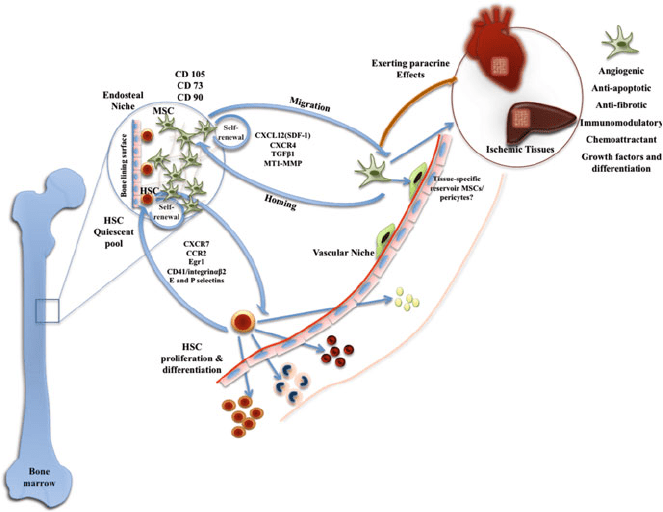
renewal, maturation, and differentiation (Fig. 1). Homing is essentially a multi-
cascade process that involves intravascular dissemination of stem cells coupled
with active migration occurring both before and after the dissemination step. For
efficient homing to take place, the cells arriving at the target site must distinguish
target-specific sign als and enter into a multistep adhesion cascade to adhere to
vessel walls in the target organ. Interstitial migration, which is another trafficking
mechanism, differs from homing in that it does not require blood flow yet necessi-
tates active ameboid movement of the cells [82].
CXCL12 and angiopoietin-1 expression has been found in endosteal as well as
perivascular cells and are thought to be important regulators important for their
maintenance [50]. Notch and Wnt signaling have also been suggested although they
Fig. 1 Schematic diagram depicting some of the numerous stem cell niche interactions and
specific roles within played by hematopoietic and mesenchymal stem cells during homeostasis
and injury
Bone Marrow Stem Cells in Clinical Application: Harnessing Paracrine Roles 277
may not be necessary for adult HSC maintenance in stable conditions but rather
upon stress induction. Coordinated processes of symmetric and asymmetric divi-
sion could also contribute to maintenance of HSCs [48].
A concise review has summed up the major cell-extrinsic factors within the bone
marrow microenvironment that are mostly responsible for hematopoietic stem cell
regulation. The CXCL12/CXCR4 axis is important for controlling retention of
HSCs within the bone marrow as well as the presence of calcium sensing receptors
on the surface of HSCs, and a lack of osteopontin may lead to increase in the HSC
pool. N-Cadherin appears to play a role although it continues to be controversial
and so does the role of Jagged-1 in the activa tion of Notch1 pathways. On the other
hand, maintenance of a quiescent population of HSCs appears to be clearly linked to
stem cell factor (SCF), Ang-1, and thrombopoietin [63]. These are in addition to
Annexin II, very late antigen-4 (VLA-4)/fibronectin (FN) or vascular cell adhesion
molecule-1 (VCAM-1) and leukocyte function associated antigen-1 (LFA-1)/inter-
cellular adhesion molecule-1 (ICAM-1) [46].
Some cell intrinsic factor s have also been identified. Profound exploration of
intercellular signals reveals molecular mechanisms involved in cellular crosstalk
in the bone marrow niche. Upon hematopoietic progenitor and osteoblast cell
contact, intercellular transfer takes place. Parts of the hematopoietic progenitor
cell membrane are endocytosed at the interface by osteoblasts and delivered to
SARA (Smad Anchor for Receptor Activation) – positive signaling endosomes.
SARA endosomes specialize in the propagation of extracellular signals such as
TGFb3 and are known to signal through SMAD activation. In response to intercel-
lular transfer, the osteoblasts exhibit greater production of SDF-1 as consequence of
a decreased SMAD signaling. This probably occurs because the transferred material
in the SARA endosomes sequesters SARA away from its cofactor function in
SMAD activation leading to increased SDF-1 production. The cumulative result
of these events may influence migration, homing and function of hematopoietic
progenitors [83].
Microvesicles (MVs) which are vehi cles for mRNA transport have been incri-
minated in intracellular niche communications as well. They interact with cells
through specific receptor ligand interactions leading to direct cell stimulation or by
cell surface receptor transfer. Endothelial stem cells (ESCs) are an ample source of
MVs and ESC derived MVs can reprogra m hematopoietic proge nitors by a hori-
zontal transfer of mRNA and protein delivery. The ESC derived MVs can shuttle a
specific subset of cellular mRNA such as that associated with eNOS and P13K/
AKT pathways [84].
Hematopoietic stem cell homing and migration show a strong involvement of
CD41/integrinab2 during mouse embryogenesis stem cell trafficking. CXCR7 may
also be involved. A switch from rapid proliferation to quiescence takes place
shortly after HSC homing to bone marrow. The Egr1 transcription factor is the
direct molecular link between HSC proliferation and in vivo localization [69, 82].
In addition, CCR2 has been identified as a possible player during hematopoietic
stem cell recruitment to the damaged liver in mice, as active recruitment occurred
only in wild type mice and not in CCR2
/
mice [85].
278 R.M. El Backly and R. Cancedda
For hematopoietic stem cell reengraftment in the host bone marrow, it is likely
that preexisting pathways normally used to support HSC physiological circulation
to maintain hematopoiesis are also involved to guide efficient engraftment. In vivo
stem cell homing and migration patterns, however, vary between stem cell lineages
and rely to a great extent on how they normally interact with their niches. By
understanding these innate migratory mechanisms, stem cells may be exploited as
clinical drug or gene delivery vehicles with precise aiming properties [82].
A unique multistep adhesion cascade for HSC homing involves, first, free-
flowing HSCs being tethered to the vessel by the vascular selectins, E- and
P-selectin, which bind to sialyl-Lewis-like carbohydrate ligands that are associated
with PSGL-1 and CD44 on HSCs. Selectin binding, together with engagement of
endothelial VCAM-1 with the integrin VLA-4 (a4b1), mediates HSC rolling in
marrow sinusoids. The rolling HSCs are then activated by the chemokine CXCL12,
which binds to the G protein-coupled receptor, CXCR4. The chemokine signal is
thought to induce a rapid conformational change in the VLA-4 heterodimer (VLA-4)
that results in increased affinity for VCAM-1 and permits the rolling cells to arrest.
Adherent HSCs then migrate into the extravascular bone marrow compartment.
Some blood-borne HSCs exit the blood in various peripher al organs where they
spend almost 36 h before entering the draining lymphatics. While in peripheral
tissues, HSCs can divide and differentiate, presumably to replenish tissue-resident
myeloid cells. Through this mechanism, migratory HSCs contribute to immune
surveillance by the innate immune system [82].
Hematopoietic stem and progenitor cells (HSPCs) apparently also follow extra-
medullary traffic routes shown by the presence of clonogenic HSPCs in mouse
thoracic duct lymph, which are capable of short and long-term multilineage recon-
stitution. HSPCs travel to extramedullary sites where they remain for 2 days before
they enter the draining lymphatics and return to the blood. The release of tissue-
residing HSPCs into lymphatics seems to occur in response to a lipid S1P g radient
which in a similar way regulates the egress of lymphocytes from thymus, spleen,
and lymph nodes. This mechanism may serve as part of the innate immune system
by which quiescent HPSCs which express TLRs (TLRs recognize foreign mole-
cules such as the bacterial outer membrane component LPS) are forced to enter the
cell cycle of myeloid differentiation upon TLR-LPS binding to provide large
numbers of cells to boost the number of innate immune effector cells in response
to infection or damage [86].
As for migratory mechanisms invoked by mesenchymal stem cells injected in
AMI, these maybe confronted with those utilized by leucocytes in response to
inflammation. Inflammation-released chemokines trigge r an intense release of
integrins which propagate firm adhesion to extracellular components followed by
their migration from the endothelium through the extracellular matrix (ECM) via
the action of ECM degrading matrix metalloproteinases (MMPs). Of these MMPs,
MT1-MMP appears to control human MSC collagenolysis and invasion as well as
controlling MSC differentiation in 3D in a specific fash ion [87]. The adhesion
cascade constitutes several steps which start with tethering and rolling, followed
by a chemotactic/activating stimulus provided by soluble or surface-bound
Bone Marrow Stem Cells in Clinical Application: Harnessing Paracrine Roles 279
chemoattractants, and finally sticki ng. Both selectin and integrin mediation appear
crucial for adhesion [82, 88, 89].
Integrin-mediated adhesion is mandatory if the cells are to cope with shear
stresses encountered associated with transen dothelial migration. Yet although this
maybe the probable mechanism, critical chemokines specifically responsible for
MSC migration remain under speculation. It is factual that MSCs have been shown
to express various adhesion molecules including CD106 (VCAM-1), CD54
(ICAM-1), CD50 (ICAM-3), CD166 (ALCAM), CD44, and integrins including
a1, a2, a3, a4, a5, av, b1, b3, and b4, many of which are thought to be involved in
migration. In particular, high levels of expression of CD44 by MSCs may be
directly responsible as blocking CD44 expression markedly reduces the migration
of MSCs to damaged kidneys in mice. Signal transduc tion pathways have gained
less attention although Wnt signaling has lately been pinpointed as vital for
migration, yet may negatively affect self-renewal propert ies [88, 89].
In animal models of AMI, myocardial ischemia is found to be responsible for
the release of CCL2 (MCP-1), CCL3 (MIP-1a/), CCL4 (MIP-1b), CXCL8 (IL-8),
CXCL10 (IP-10), and CXCL12 (SDF-1). At the same time, MSCs have been found
to express CXCR4 which allow them to migrate in response to CXCL12. However,
their expression of CXCR4 appears to be reduced with ex vivo expansion, yet can
be enhanced by stimulation with cytokines Flt-3 ligand, SCF, interleukin (IL)-6,
HGF, and IL-3. Electin-mediated adhesion has also been suggested to be involved
despite the presence of fucosyl transferase in MSCs; an enzyme necessary to
generate functional P and E-selectin receptors, remains contradictory in the sense
that some researchers have found that MScs have fucosyl transferase (necessary for
functional P and E selectin binding) while others (discussed in this reference) have
found that they DO NOT have the enzyme and so doubt the involvment of P and E
selectin adhesion in MSc migration [88].
High mobility group box 1 (HMGB-1) as well as SDF-1a act as strong chemoat-
tractants for a variety of cell types including stem cells. HMGB-1 is a chemoattractant
released during inflammation and cell necrosis and may be involved in recruitment.
Furthermore, Rho GTPases which function during adhesion and migration events
through actin cytoskeletal regulation have been investigated in trafficking of MSCs.
However, neither the Rho nor the Rho effector Rho kinase (ROCK) were found
crucial for migration of MSCs in a 3D model. Although others have shown that Rho
inhibition induced cytoskeletal reorganization in MSCs, rendering them more sus-
ceptible to induction of migration, data remain inconclusive. On the other hand,
enhanced migration velocity of MSCs in response to PDGF-B activated fibroblasts
points to a positive role of growth factor (bFGF) and epithelial neutrophil activating
peptide-78 (ENA-78 or CXCL5) in mediating MSC trafficking. Blocking both bFGF
and CXCL5 inhibited both trafficking and differentiation of MSCs while invasion
and migration were enhanced when these factors were added exogenously [89].
The SDF-1/CXCR4 axis has repeatedly been shown to play a major role
in migration and homing of both mesenchymal and hematopoietic stem cells
[82, 90–93]. Hematopoietic stem cells are retained within the bone marrow in a
quiescent state by virtue of the SDF-1a/CX CR4 axis, and their mobilization may be
280 R.M. El Backly and R. Cancedda