
Kaynar D.K., Lynch N., Segala R., Vaandrage F. The Theory of Timed I-O Automata
Подождите немного. Документ загружается.


P1: IML/FFX P2: IML/FFX QC: IML/FFX T1: IML
MOBK015-02 MOBK015-Lynch.cls April 1, 2006 16:59
MATHEMATICAL PRELIMINARIES 9
Lemma 2.2 Let P ={c
ij
| i ∈ I, j ∈ J } be a doubly indexed subset of a cpo S. Let P
i
denote the
set {c
ij
| j ∈ J } for each i ∈ I. Suppose
1. P is directed,
2. each P
i
is directed with lub c
i
, and
3. the set {c
i
| i ∈ I} is directed.
Then P ={c
i
| i ∈ I}.
A finite or infinite sequence of elements, c
0
c
1
c
2
···, of a partially ordered set (S, )is
called a chain if c
i
c
i+1
for each nonfinal index i. We define the limit of the chain, lim
i→∞
c
i
,
to be the lub of the set {c
0
, c
1
, c
2
,...} if S contains such a bound; otherwise, the limit is
undefined. Since a chain is a special case of a directed set, each chain of a cpo has a limit.
A function f : S → S
between posets S and S
is monotone if f (c ) f (d) whenever
c d.If f is monotone and P is a directed set, then the set f (P) ={f (c ) | c ∈ P} is directed
as well. If f is monotone and f (
P) =
f (P) for every directed P, then f is said to be
continuous.
An element c of a cpo S is compact if, for every directed set P such that c
P, there
is some d ∈ P such that c d. We define K(S) to be the set of compact elements of S. A cpo
S is algebraic if every c ∈ S is the lub of the set {d ∈ K(S) | d
c }. A simple example of an
algebraic cpo is the set of finite or infinite sequences over some given domain, equipped with
the prefix ordering. Here the compact elements are the finite sequences.
2.4 A BASIC GRAPH LEMMA
We require the following lemma, a slight generalization of K
¨
onig’s Lemma [31]. If G is a
directed graph, then a root of G is defined to be a node with no incoming edges.
Lemma 2.3 Let G be an infinite directed graph that satisfies the following properties:
1. G has finitely many roots.
2. Each node of G has finite outdegree.
3. Each node of G is reachable from some root of G.
Then, there is an infinite path in G starting from some root.
Proof: An extension of the usual proof of K
¨
onig’s Lemma [31].
P1: IML/FFX P2: IML/FFX QC: IML/FFX T1: IML
MOBK015-02 MOBK015-Lynch.cls April 1, 2006 16:59
10

P1: JYS
MOBK015-03 MOBK015-Lynch.cls April 1, 2006 17:0
11
CHAPTER 3
Describing Timed System Behavior
In this chapter, we present the basic definitions that are useful for describing discrete and
continuous changes to the system’s state. The key notions are static and dynamic types for
variables, trajectories, and hybrid sequences. Most of the material in this chapter comes from the
paper on the HIOA modeling framework [6]. The reader may refer [6] for the proofs that are
not included here.
3.1 TIME
Throughout this chapter, we fix a time axis T, which is a subgroup of (R, +), the real numbers
with addition. We assume that every infinite, monotone, bounded sequence of elements of T
has a limit in T. The reader may find it convenient to think of T as the set R of real numbers,
but the set Z of integers and the singleton set {0} are also examples of allowed time axes. We
define T
≥0
={t ∈ T | t ≥ 0}.
An interval J is a nonempty, convex subset of T. We denote intervals as usual: [t
1
, t
2
] =
{t ∈T | t
1
≤ t ≤ t
2
},[t
1
, t
2
) ={t ∈T | t
1
≤ t < t
2
}, etc. An interval J is left-closed (right-closed)
if it has a minimum (resp., maximum) element and is left-open (right-open) otherwise. It is closed
if it is both left-closed and right-closed. We write min( J ) and max( J ) for the minimum and
maximum elements, respectively, of an interval J (if they exist), and inf( J ) and sup( J ) for the
infimum and supremum, respectively, of J in R ∪{−∞, ∞}.ForK ⊆ T and t ∈ T, we define
K + t
={t
+ t | t
∈ K}. Similarly, for a function f with domain K, we define f + t to be
the function with domain K + t satisfying, for each t
∈ K + t,(f + t)(t
) = f (t
− t).
In some definitions and theorems in this chapter when we use R as the time domain we
assume that the relation ≤ on R extends to a relation on R ∪{∞} such that ∞≤∞and for
all t ∈ R, t < ∞.
3.2 STATIC AND DYNAMIC TYPES
We assume a universal set V of variables. A variable represents a location within the state of a
system. For each variable v, we assume both a (static) type, which gives the set of values it may
P1: JYS
MOBK015-03 MOBK015-Lynch.cls April 1, 2006 17:0
12 THEORY OF TIMED I/O AUTOMATA
take on, and a dynamic type, which gives the set of trajectories it may follow. Formally, for each
variable v we assume the following:
1.
type(v), the (static) type of v. This is a nonempty set of values.
2.
dtype(v), the dynamic type of v. This is a set of functions from left-closed intervals of
T to
type(v) that satisfies the following properties.
a) Closure under time shift : For each f ∈
dtype(v) and t ∈ T, f + t ∈ dtype(v).
b) Closure under subinterval : For each f ∈
dtype(v) and each left-closed interval J ⊆
dom( f ), f J ∈ dtype(v).
c) Closure under pasting :Let f
0
f
1
f
2
··· be a sequence of functions in dtype(v)
such that, for each nonfinal index i,
dom( f
i
) is right-closed and max(dom( f
i
)) =
min(
dom( f
i+1
)). Then the function f defined by f (t)
= f
i
(t), where i is the small-
est index such that t ∈
dom( f
i
), is in dtype(v).
Example3.1 (Discrete variables). Let v be any variable and let Constant be the set of constant
functions from a left-closed interval of T to
type(v). Then Constant is closed under time shift
and subinterval. If the dynamic type of v is obtained by closing Constant under the pasting
operation, then v is called a discrete variable. This is essentially the same as the definition of a
discrete variable in [12].
Example 3.2 (Analog variables). Assume that T = R.Letv be any variable whose static type
is an interval of R and Continuous be the set of continuous functions from a left-closed interval
of T to
type(v). Then Continuous is closed under time shift and subinterval. If the dynamic
type of v is obtained by closing
Continuous under the pasting operation, then v is called an
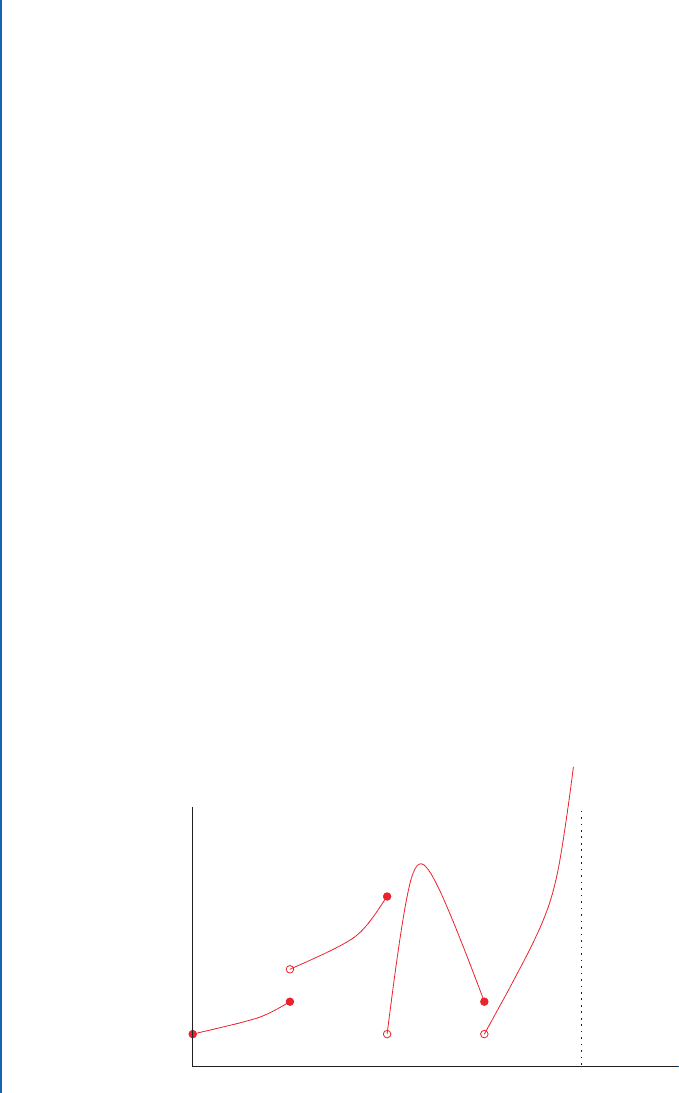
analog variable. Fig. 3.1 shows an example of a function f in the dynamic type of an analog
0
4
FIGURE 3.1: Example of a function in the dynamic type of an analog variable.

P1: JYS
MOBK015-03 MOBK015-Lynch.cls April 1, 2006 17:0
DESCRIBING TIMED SYSTEM BEHAVIOR 13
variable. Function f is defined on the interval [0, 4) and is obtained by pasting together four
pieces. At the boundary points between these pieces, f takes the value specified by the leftmost
piece, which makes f continuous from the left. Note that f is undefined at time 4.
Example 3.3 (Standard real-valued function classes). If we take T = R and
type(v) = R,
then other examples of dynamic types can be obtained by taking the pasting closure of standard
function classes from real analysis, the set of differentiable functions, the set of functions that are
differentiable k times (for any k), the set of smooth functions, the set of integrable functions, the
set of L
p
functions (for any p), the set of measurable locally essentially bounded functions [32],
or the set of all functions.
Standard function classes are closed under time shift and subinterval, but not under
pasting. A natural way of defining a dynamic type is as the pasting closure of a class of functions
that is closed under time shift and subinterval. In such a case, it follows that the new class is
closed under all three operations.
3.3 TRAJECTORIES
In this section, we define the notion of a trajectory, define operations on trajectories, and prove
simple properties of trajectories and their operations. A trajectory is used to model the evolution
of a collection of variables over an interval of time.
3.3.1 Basic Definitions
Let V be a set of variables, that is, a subset of V.Avaluation v for V is a function that associates
with each variable v ∈ V a value in
type(v). We write val(V ) for the set of valuations for V .
Let J be a left-closed interval of T with left endpoint equal to 0. Then a J -trajectory for V is
a function τ : J →
val(V ), such that for each v ∈ V , τ ↓ v ∈ dtype(v). A trajectory for V is
a J -trajectory for V , for any J . We write
trajs(V ) for the set of all trajectories for V .IfQ is
a set of valuations for some set V of variables, we write
trajs(Q) for the set of all trajectories
whose range is a subset of Q.
A trajectory for V where V =∅is simply a function from a time interval to the special
function with the empty domain. Thus, the only interesting information represented by such a
trajectory is the length of the time interval that constitutes the domain of the trajectory. We use
trajectories over the empty set of variables when we wish to capture the amount of time-passage,
but abstract away the evolution of variables.
A trajectory for V with domain [0, 0] is called a point trajectory for V.Ifv is a valuation
for V then ℘(v) denotes the point trajectory for V that maps 0 to v. We say that a J -trajectory
is finite if J is a finite interval, closed if J is a (finite) closed interval, open if J is a right-open
interval, and full if J = T
≥0
.IfT is a set of trajectories, then finite(T ), closed(T ), open(T ),

P1: JYS
MOBK015-03 MOBK015-Lynch.cls April 1, 2006 17:0
14 THEORY OF TIMED I/O AUTOMATA
and full(T ) denote the subsets of T consisting of all the finite, closed, open, and full trajectories
in T, respectively.
If τ is a trajectory then τ.
ltime, the limit time of τ , is the supremum of dom(τ ). We
define τ.
fval, the first valuation of τ ,tobeτ (0), and if τ is closed, we define τ.lval, the last
valuation of τ ,tobeτ (τ.
ltime). For τ a trajectory and t ∈ T
≥0
, we define
τ t
= τ [0, t],
τ t
= τ [0, t),
τ t
= (τ [t, ∞)) − t.
Note that, since dynamic types are closed under time shift and subintervals, the resultof applying
the above operations is always a trajectory, except when the result is a function with an empty
domain. By convention, we also write τ ∞
= τ and τ ∞
= τ .
3.3.2 Prefix Ordering
Trajectory τ is a prefix of trajectory υ, denoted by τ ≤ υ,ifτ can be obtained by restricting υ to a
subset of its domain. Formally, if τ and υ are trajectories for V, then τ ≤ υ iff τ = υ
dom(τ ).
Alternatively, τ ≤ υ iff there exists a t ∈ T
≥0
∪ {∞} such that τ = υ t or τ = υ t.If
τ ≤ υ, then clearly
dom(τ ) ⊆ dom(υ). If T is a set of trajectories for V , then pref (T ) denotes
the prefix closure of T, defined by
pref (T )
={τ ∈ trajs(V ) |∃υ ∈ T : τ ≤ υ}.
We say that T is prefix closed if T =
pref (T ).
The following lemma gives a simple domain-theoretic characterization of the set of
trajectories over a given set V of variables:
Lemma 3.4 Let V be a set of variables. The set
trajs(V ) of trajectories for V , together with the
prefix ordering ≤, is an algebraic cpo. Its compact elements are the closed trajectories.
3.3.3 Concatenation
The concatenation of two trajectories is obtained by taking the union of the first trajectory
and the function obtained by shifting the domain of the second trajectory until the start time
agrees with the limit time of the first trajectory; the last valuation of the first trajectory, which
may not be the same as the first valuation of the second trajectory, is the one that appears in
the concatenation. Formally, suppose τ and τ
are trajectories for V , with τ closed. Then the
concatenation τ
τ
is the function given by
τ
τ
= τ ∪ (τ
(0, ∞) +τ.ltime).

P1: JYS
MOBK015-03 MOBK015-Lynch.cls April 1, 2006 17:0
DESCRIBING TIMED SYSTEM BEHAVIOR 15
Because dynamic types are closed under time shift and pasting, it follows that τ
τ
is a
trajectory for V. Observe that τ
τ
is finite (resp., closed, full) iff τ
is finite (resp., closed,
full). Observe also that concatenation is associative.
The following lemma, which is easy to prove, shows the close connection between con-
catenation and the prefix ordering.
Lemma 3.5 Let τ and υ be trajectories for V with τ closed. Then
τ ≤ υ ⇔∃τ
: υ = τ
τ
.
Note that if τ ≤ υ, then the trajectory τ
such that υ = τ
τ
has an arbitrary value
for τ
.fval and the remainder of the trajectory is unique. Note also that the ⇐ implication in
Lemma 3.5 would not hold if the first valuation of the second argument, rather than the last
valuation of the first argument, were used in the concatenation.
We extend the definition of concatenation to any (finite or countably infinite) number of
arguments. Let τ
0
τ
1
τ
2
··· be a (finite or infinite) sequence of trajectories such that τ
i
is closed
for each nonfinal index i. Define trajectories τ
0
,τ
1
,τ
2
,...inductively by
τ
0
= τ
0
,
τ
i+1
= τ
i
τ
i+1
for nonfinal i.
Lemma 3.5 implies that for each nonfinal i, τ
i
≤ τ
i+1
. We define the concatenation τ
0
τ
1
τ
2
··· to be the limit of the chain τ
0
τ
1
τ
2
···; existence of this limit follows from Lemma 3.4.
3.4 HYBRID SEQUENCES
In this section, we introduce the notion of a hybrid sequence, which is used to model a com-
bination of changes that occur instantaneously and changes that occur over intervals of time.
Our definition is parameterized by a set A of actions, which are used to model instantaneous
changes and instantaneous synchronizations with the environment, and a set V of variables,
which are used to model changes over intervals of time. We also define some special kinds of
hybrid sequences and some operations on hybrid sequences, and give basic properties.
3.4.1 Basic Definitions
Fix a set A of actions and a set V of variables. An (A, V )-sequence is a finite or infinite alternating
sequence α = τ
0
a
1
τ
1
a
2
τ
2
···, where
1. each τ
i
is a trajectory in trajs(V ),
2. each a
i
is an action in A,

P1: JYS
MOBK015-03 MOBK015-Lynch.cls April 1, 2006 17:0
16 THEORY OF TIMED I/O AUTOMATA
3. if α is a finite sequence, then it ends with a trajectory, and
4. if τ
i
is not the last trajectory in α, then τ
i
is closed.
A hybrid sequence is an (A, V )-sequence for some A and V .
Since the trajectories in a hybrid sequence can be point trajectories our notion of hybrid
sequence allows a sequence of discrete actions to occur at the same real time, with corresponding
changes of variable values. An alternative approach is described in [33], where state changes at
a single real time are modeled using a notion of “superdense time.” Specifically, hybrid behavior
is modeled in [33] using functions from an extended time domain, which includes countably
many elements for each real time, to states.
If α is a hybrid sequence, with notation as above, then we define the limit time of α,
α.
ltime,tobe
i
τ
i
.ltime. A hybrid sequence α is defined to be
•
time bounded if α.ltime is finite.
•
admissible if α.ltime =∞.
•
closed if α is a finite sequence and its final trajectory is closed.
•
Zeno if α is neither closed nor admissible, that is, if α is time bounded and is either
an infinite sequence, or else a finite sequence ending with a trajectory whose domain is
right-open.
•
non-Zeno if α is not Zeno.
For any hybrid sequence α, we define the first valuation of α, α.
fval,tobehead (α).fval. Also, if
α is closed, we define the last valuation of α, α.
lval,tobelast(α).lval, that is, the last valuation
in the final trajectory of α.
If α is a closed (A, V )-sequence, where V =∅and β ∈
trajs(∅), we call α
β a time-
extension of α.
3.4.2 Prefix Ordering
We say that (A, V )-sequence α = τ
0
a
1
τ
1
··· is a prefix of (A, V )-sequence β = υ
0
b
1
υ
1
···,
denoted by α ≤ β, provided that (at least) one of the following holds:
1. α = β.
2. α is a finite sequence ending in some τ
k
; τ
i
= υ
i
and a
i+1
= b
i+1
for every i,0≤ i < k;
and τ
k
≤ υ
k
.
Similar to the set of trajectories over V , the set of (A, V )-sequences is also an algebraic
cpo.

P1: JYS
MOBK015-03 MOBK015-Lynch.cls April 1, 2006 17:0
DESCRIBING TIMED SYSTEM BEHAVIOR 17
Lemma 3.6 Let V be a set of variables and A a set of actions. The set of (A, V )-sequences, together
with the prefix ordering ≤, is an algebraic cpo. Its compact elements are the closed (A, V )-sequences.
3.4.3 Concatenation
Suppose α and α
are (A, V )-sequences with α closed. Then the concatenation α
α
is the
(A, V )-sequence given by
α
α
= init(α)(last(α)
head (α
)) tail(α
).
(Here, init, last, head, and tail are ordinary sequence operations.)
Lemma 3.7 Let α and β be (A, V )-sequences with α closed. Then
α ≤ β ⇔∃α
: β = α
α
.
Note that if α ≤ β, then the (A, V )-sequence α
, such that β = α
α
, is unique except that
it has an arbitrary value in
val(V ) for α
.fval.
As we did for trajectories, we extend the concatenation definition for (A, V )-sequences
to any finite or infinite number of arguments. Let α
0
α
1
... be a finite or infinite sequence of
(A, V )-sequences such that α
i
is closed for each nonfinal index i. Define (A, V )-sequences
α
0
,α
1
,...inductively by
α
0
= α
0
,
α
i+1
= α
i
α
i+1
for nonfinal i.
Lemma 3.7 implies that for each nonfinal i, α
i
≤ α
i+1
. We define the concatenation α
0
α
1
···
to be the limit of the chain α
0
α
1
···; existence of this limit is ensured by Lemma 3.6.
3.4.4 Restriction
Let A and A
be sets of actions and let V and V
be sets of variables. The (A
, V
)-restriction of
an (A, V )-sequence α, denoted by α (A
, V
), is obtained by first projecting all trajectories of
α on the variables in V
, then removing the actions not in A
, and finally concatenating all ad-
jacent trajectories. Formally, we define the (A
, V
)-restriction first for closed (A, V )-sequences
and then extend the definition to arbitrary (A, V )-sequences using a limit construction. The
definition for closed (A, V )-sequences is by induction on the length of those sequences:
τ (A
, V
) = τ ↓ V
if τ is a single trajectory,
α a τ (A
, V
) =
(α (A
, V
)) a (τ ↓ V
)ifa ∈ A
,
(α (A
, V
))
(τ ↓ V
) otherwise.

P1: JYS
MOBK015-03 MOBK015-Lynch.cls April 1, 2006 17:0
18 THEORY OF TIMED I/O AUTOMATA
It is easy to see that the restriction operator is monotone on the set of closed (A, V )-
sequences. Hence, if we apply this operation to a directed set, the result is again a directed set.
Together with Lemma 3.6, this allows us to extend the definition of restriction to arbitrary
(A, V )-sequences by
α (A
, V
) ={β (A
, V
) | β is a closed prefix of α}.
The next four lemmas state some basic properties of the restriction operation.
Lemma 3.8 (A
, V
)-restriction is a continuous operation.
Lemma 3.9 (α
0
α
1
···) (A, V ) = α
0
(A, V )
α
1
(A, V )
···.
Lemma 3.10 (α (A, V )) (A
, V
) = α (A ∩ A
, V ∩ V
).
Lemma 3.11 Let α be a hybrid sequence, A a set of actions and V a set of variables.
1. α is time bounded iff α (A, V ) is time bounded.
2. α is admissible iff α (A, V ) is admissible.
3. If α is closed, then α (A, V ) is closed.
4. If α is non-Zeno, then α (A, V ) is non-Zeno.
Example 3.12 (A Zeno execution with a closed (A, V )-restriction). In order to understand
why in Lemma 3.11 we have an implication in only one direction in points 3 and 4, consider
the Zeno sequence α of the form ℘(v) a ℘(v) a ℘(v) ···.LetA be a set such that a /∈ A and
let V consist of the variables in
dom(v). Obviously, α (A, V ), which is ℘(v), is closed, and
hence also non-Zeno. This shows that the fact that α (A, V ) is closed (resp., non-Zeno) does
not imply that α is closed (resp., non-Zeno).