
Kelly J.J. Graduate Mathematical Physics, With MATHEMATICA Supplements
Подождите немного. Документ загружается.


306 8 Legendre and Bessel Functions
such that
n
z
1
Π
2
z
1/ 2
z
2
1
2
m0
1
A
m
1
2
m!
z
2
4
m
(8.281)
and
A
1
2
Π
2
2 1!!
(8.282)
to obtain
n
zz
1
m0
2 2m 1!!
m!
z
2
2
m
(8.283)
Thus, the limiting behavior near the origin is described by
zI1 j
z*
z
2 1!!
,n
z*
2 1!!
z
1
(8.284)
where
n!! n n 2!! (8.285)
1!! 0!! 1!! 1 (8.286)
is the double factorial function for nonnegative integers.
8.4 Fourier–Bessel Transform
The plane wave
kz
, where z r CosΘ is the distance along the polar axis, can be
expanded in a Legendre series according to
Exp
kr CosΘ
0
f
krP
CosΘ
(8.287)
where the coefficients f
depend upon kr, treated as a parameter for the purpose of the
Legendre expansion. Using the orthogonality properties of Legendre polynomials, we find
f
kr
2 1
2
1
1
ExpkrxP
xx (8.288)
The most direct method to evaluate these coefficients is to expand the exponential
f
kr
2 1
2
m0
kr
m
m!
1
1
x
m
P
xx (8.289)

8.4 Fourier–Bessel Transform 307
and to use a result
m n even
1
1
x
m
P
xx 2
m!
m !
m 1!!
m 1!!
(8.290)
that is proven in the exercises using Rodrigues’ formula and partial integration. Thus,
a leading power kr
can be factored out and the remaining series contains only even
powers, kr
2m
for m 2 0, such that
m ! 2 j f
kr2 1kr
j0
j
kr
2 j
2 j 1!!
2 j!2 j 2 1!!
2 1kr
j0
1
j!2 j 2 1!!
k
2
r
2
2
j
2 1
j
kr
(8.291)
is proportional to the power series for j
kr. Therefore, we obtain Rayleigh’s expansion
Exp
kr CosΘ
0
2 1
j
krP
CosΘ
(8.292)
for a plane wave. (This is sometimes named Bauer’s formula instead.) Finally, the Legendre
addition theorem
P
ˆr , ˆr
'
4Π
2 1
Y
ˆr,Y
ˆr
'
(8.293)
provides a more symmetrical form
Exp
k ,
r4Π
0
j
krY
ˆ
k,Y
ˆr (8.294)
which depends upon the angle between the
ˆ
k and ˆr directions and is independent of the
orientation of the coordinate axes. This very important formula finds myriad applications,
including radiation and scattering theory, and should be committed to memory.
Consider a three-dimensional Fourier transform
˜
f
k
f
r Exp
k ,
r
3
r (8.295)
where the integral extends over all space. It is useful to perform a multipole expansion
f
r
0
m
f
,m
rY
,m
ˆr (8.296)
f
,m
r
f
rY
,m
ˆr
E (8.297)

308 8 Legendre and Bessel Functions
for the angular dependence of f
r. Applying the Rayleigh expansion and assuming that
the order of integration and summation can be interchanged, such that
˜
f
k4Π
0
f
r j
krY
ˆ
k,Y
ˆr
3
r (8.298)
and using the orthogonality of spherical harmonics, we obtain
˜
f
k4Π
0
m
˜
f
,m
kY
,m
ˆ
k (8.299)
where
˜
f
,m
k
0
f
,m
r j
krr
2
r (8.300)
is the Fourier–Bessel transform of the radial dependence of the , m multipole.
Alternatively, we could apply the Rayleigh expansion to the inverse Fourier transform
f
r
˜
f
k Exp
k ,
r
3
k
2Π
3
(8.301)
to obtain
f
,m
r
2
Π
0
˜
f
,m
k j
krk
2
k (8.302)
where the numerical coefficient is simply 4Π
2
/ 2Π
3
. Substituting the definition for
˜
f
,m
k
into
f
,m
r
2
Π
0
kk
2
0
r
'
r
'2
f
,m
r
'
j
kr
'
j
kr (8.303)
we require
2
Π
0
kk
2
j
kr j
kr
'
∆r r
'
rr
'
(8.304)
to produce the necessary radial delta function. Although this is an admittedly heuristic
derivation, the same orthogonality condition can be obtained more rigorously by evaluating
the limit of the orthogonality integral for Bessel functions over a finite range as that range
becomes infinite. Thus, the completeness of the Fourier–Bessel transform is expressed in
spherical coordinates as
∆
r
r
'
∆r r
'
rr
'
∆ˆr ˆr
'
(8.305)
∆r r
'
rr
'
2
Π
0
kk
2
j
kr j
kr
'
(8.306)
∆ˆr ˆr
'
Y
ˆr,Y
ˆr
'
(8.307)

8.4 Fourier–Bessel Transform 309
8.4.1 Example: Fourier–Bessel Expansion of Nuclear Charge Density
The differential cross-section for scattering of a high-energy electron from the charge den-
sity of an atomic nucleus takes the schematic form
Σ
E
Σ
pt
F
2
q (8.308)
where Σ
pt
is the cross-section for a point charge, is the angular momentum transfer, q is
the momentum transfer, and F
q is the form factor. The form factor
F
q
0
Ρ
r j
qrr
2
r (8.309)
is the Fourier–Bessel transform
Ρ
r
f
$
$
$
$
$
$
$
$
$
$
$
Z
k1
∆r r
k
rr
k
Y
ˆr,Y
ˆr
k
$
$
$
$
$
$
$
$
$
$
$
i
!
(8.310)
of the transition charge density, which is a reduced matrix element of the charge density
operator between initial and final states i and f . We neglect convection current, magne-
tization, and other complications in this introductory discussion. In its simplest form the
charge density operator sums over all Z protons in the nucleus where the radial delta func-
tion specifies their positions. Given measurements of the form factor for a set of momen-
tum transfers in the range q
min
q q
max
, how does one reconstruct the radial charge
density Ρ
r? If the measurements produced a continuous function over an infinite range,
one would simply use the orthonormality relation for spherical Bessel functions to invert
the Fourier transform according to
Ρ
q
2
Π
0
F
q j
qrq
2
q (8.311)
but experiments are limited in range and provide only discrete points with finite precision.
A more practical method is to expand the radial density in a complete set of basis functions
Ρ
r
n1
a
n
Ρ
,n
rF
q
n1
a
n
˜
Ρ
,n
q (8.312)
where
˜
Ρ
,n
q
0
Ρ
,n
r j
qrr
2
r (8.313)
and to use the method of least-squares to fit the coefficients a
n
to the data.
Recognizing that the charge density occupies a finite volume, a common choice of
radial basis functions is the Fourier–Bessel expansion (FBE)
Ρ
,n
r j
q
,n
r<r R ,j
q
,n
R0 (8.314)
with Dirichlet boundary conditions. Here R should be large enough to comfortably enclose
practically all of the charge but not so large that there are too many q
,n
<q
max
to determine
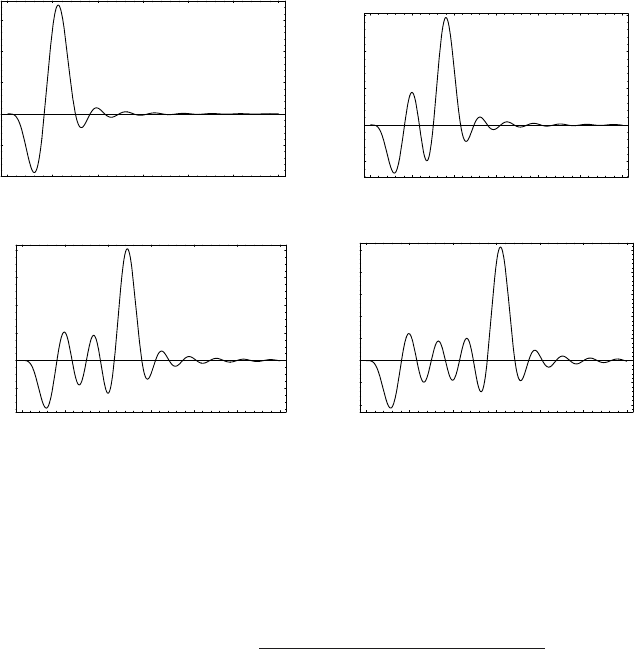
310 8 Legendre and Bessel Functions
0 10 20 30 40 50 60
qR
0.2
0
0.2
0.4
0.6
0.8
Ρ
,n
10
3
,n4,6
0 10 20 30 40 50 60
qR
0.2
0.1
0
0.1
0.2
0.3
0.4
0.5
,n4,8
0 10 20 30 40 50 60
qR
2
1
0
1
2
3
Ρ
,n
10
3
,n4,2
0 10 20 30 40 50 60
qR
0.5
0
0.5
1
1.5
,n4,4
Figure 8.10. FBE form factor basis.
the corresponding expansion coefficients. An important feature of this expansion is that the
basis functions for the form factor
˜
Ρ
,n
q
R
0
j
q
,n
r j
qrr
2
r R
2
q
,n
j
qR j
'
q
,n
Rqj
q
,n
R j
'
qR
q
2
q
2
,n
(8.315)
exhibit a strong peak around q
,n
and small oscillations elsewhere. Therefore, reasonable
approximations to the expansion coefficients can be obtained by inspection of the data
for q * q
,n
. Representative basis functions are displayed in Fig. 8.10 for 4. The domi-
nant peak moves out as n increases. As R increases it moves inward and becomes taller and
narrower, approaching a delta function in the continuum limit R !. Clearly experimen-
tal data cannot determine the amplitude for oscillations with q D q
max
; therefore, physics
arguments are needed to estimate the uncertainty in the reconstructed radial density due
to the unmeasured form factor for large momentum transfers, q>q
max
, known as incom-
pleteness error. However, a discussion of that issue would bring us too far from the main
topic.
8.5 Summary
Here we collect some of the most useful results for Legendre and Bessel functions in order
to provide a convenient reference for later work on boundary-value problems. Additional
formulas are found in the problems, the chapter, and standard compendia. Unless stated

8.5 Summary 311
otherwise, we assume n, ,m are nonnegative integers, x, t are real, and Ν,z are arbi-
trary (possibly complex). We also assume that a, b are constant coefficients independent
of the degree or order of any functions. Note that some of these results are proven in the
exercises or are generalizations of results obtained in the text. When working problems,
do not quote without proof any results beyond those presented in the text itself.
8.5.1 Legendre Functions
8.5.1.1 Generating Function
1
1 2xt t
2
n0
P
n
xt
n
(8.316)
1
r
r
'
n0
r
n
<
r
n1
>
P
n
x (8.317)
P
n
z
1
2
n
n!
z
n
z
2
1
n
(8.318)
8.5.1.2 Orthonormality
1
1
P
n
xP
m
xx
2
2n 1
∆
n,m
(8.319)
8.5.1.3 Differential Equation
1 z
2
f
''
z2zf
'
zΝΝ1 f z0 f
Ν
zaP
Ν
zbQ
Ν
z (8.320)
8.5.1.4 Recursion Relations
Ν 1 f
Ν1
2Ν1zf
Ν
Νf
Ν1
0 (8.321)
f
'
Ν1
2zf
'
Ν
f
'
Ν1
f
Ν
(8.322)
f
'
Ν1
f
'
Ν1
2Ν1 f
Ν
(8.323)
z
2
1 f
'
Ν
Νzf
Ν
Νf
Ν1
(8.324)

312 8 Legendre and Bessel Functions
8.5.1.5 Special Values
P
n
11 (8.325)
P
n
x
n
P
n
x (8.326)
P
2n
0
n
2n!
2
2n
n!
2
,P
2n1
00 (8.327)
8.5.1.6 Integral Representations
P
Ν
z
2
Ν
2Π
t
2
1
Ν
t z
Ν1
t (8.328)
Q
Ν
z
2
Ν
4 SinΝΠ
t
2
1
Ν
z t
Ν1
t (8.329)
See Fig. 8.3 for contours.
8.5.2 Associated Legendre Functions
8.5.2.1 Differential Equation
1 z
2
f
''
z2zf
'
z
ΝΝ 1
Μ
2
1 z
2
f z0 f
Ν,Μ
zaP
Ν,Μ
zbQ
Ν,Μ
z
(8.330)
8.5.2.2 Orthonormality
1
1
P
,m
xP
'
,m
xx
2
2 1
m!
m!
∆
,
'
(8.331)
8.5.2.3 Rodrigues’ Formula
P
,m
x
m
1 x
2
m/2
x
m
P
x (8.332)
P
,m
x
m
m!
m!
P
,m
x (8.333)

8.5 Summary 313
8.5.2.4 Special Values
P
,m
1P
1∆
m,0
1
∆
m,0
(8.334)
P
2nm,m
0
mn
2m!
2
mn
m!n!
n
k1
2m 2k 1 (8.335)
P
2nm1,m
00 (8.336)
8.5.2.5 Recursion Relations
P
,m2
xm 1
2x
1 x
2
P
,m1
x
1mm 1
P
,m
x0 (8.337)
xP
,m
m 11 x
2
1/ 2
P
,m1
P
1,m
0 (8.338)
P
1,m1
2 11 x
2
1/ 2
P
,m
P
1,m1
0 (8.339)
m 1P
1,m
2 1xP
,m
mP
1,m
0 (8.340)
8.5.3 Spherical Harmonics
8.5.3.1 Definition
Y
,m
Θ, Φ
2 1
4Π
m!
m!
1/ 2
P
,m
cos Θ
mΦ
(8.341)
8.5.3.2 Symmetries
Y
,m
Θ, Φ
m
Y
,m
Θ, Φ (8.342)
Y
,m
ˆr
Y
,m
ˆr (8.343)
8.5.3.3 Special Values
Y
,m
Θ, 0
2 1
4Π
1/ 2
P
cos Θ∆
m,0
(8.344)
Y
,m
ˆzY
,m
0, 0
2 1
4Π
1/ 2
∆
m,0
(8.345)

314 8 Legendre and Bessel Functions
8.5.3.4 Orthonormality
Y
,m
ˆrY
'
,m
'
ˆrE∆
,
'
∆
m,m
'
(8.346)
8.5.3.5 Addition Theorem
P
ˆr , ˆr
'
4Π
2 1
m
Y
,m
ˆrY
,m
ˆr
'
4Π
2 1
Y
ˆr,Y
ˆr
'
(8.347)
1
r
r
'
0
4Π
2 1
r
<
r
1
>
Y
ˆr,Y
ˆr
'
(8.348)
8.5.4 Cylindrical Bessel Functions
8.5.4.1 Differential Equation
z
2
f
''
zzf
'
zz
2
Ν
2
f z0 f
Ν
zaJ
Ν
zbN
Ν
z (8.349)
8.5.4.2 Series
J
Ν
z
z
2
Ν
m0
1
AΝ m 1Am 1
z
2
4
m
(8.350)
N
Ν
zCotΝΠJ
Ν
zCscΝΠJ
Ν
z (8.351)
8.5.4.3 Hankel Functions
H
1
Ν
zJ
Ν
zN
Ν
z (8.352)
H
2
Ν
zJ
Ν
zN
Ν
z (8.353)

8.5 Summary 315
8.5.4.4 Asymptotic Forms
J
Ν
z
2
Π
z
1/ 2
Cos
z 2Ν1
Π
4
(8.354)
N
Ν
z
2
Π
z
1/ 2
Sin
z 2Ν1
Π
4
(8.355)
H
1
Ν
z
2
Π
z
1/ 2
Exp
z 2Ν1
Π
4
(8.356)
H
2
Ν
z
2
Π
z
1/ 2
Exp
z 2Ν1
Π
4
(8.357)
8.5.4.5 Recursion Relations
f
Ν1
z f
Ν1
z
2Ν
z
f
Ν
z (8.358)
f
Ν1
z f
Ν1
z2 f
'
Ν
z (8.359)
z
z
Ν
f
Ν
z z
Ν
f
Ν1
z (8.360)
8.5.4.6 Orthonormality
R
0
J
Ν
k
1
ΞJ
Ν
k
2
ΞΞ Ξ R
k
2
J
Ν
k
1
RJ
'
Ν
k
2
Rk
1
J
Ν
k
2
RJ
'
Ν
k
1
R
k
2
1
k
2
2
0
J
Ν
kΞJ
Ν
k
'
ΞΞ Ξ
∆k k
'
kk
'
(8.361)
0
J
Ν
kΞJ
Ν
kΞ
'
k k
∆Ξ Ξ
'
ΞΞ
'
(8.362)
8.5.5 Spherical Bessel Functions
8.5.5.1 Differential Equation