
Kelly J.J. Graduate Mathematical Physics, With MATHEMATICA Supplements
Подождите немного. Документ загружается.

Contents XI
7.6.1 Example:VibratingString ..................... 259
8 Legendre and Bessel Functions 267
8.1 Introduction . . . .............................. 267
8.2 Legendre Functions ............................. 268
8.2.1 Generating Function for Legendre Polynomials .......... 268
8.2.2 Series Representation and Rodrigues’ Formula .......... 272
8.2.3 Schläfli’s Integral Representation . ................ 273
8.2.4 Legendre Expansion . . . ..................... 273
8.2.5 Associated Legendre Functions . . ................ 275
8.2.6 Spherical Harmonics . . . ..................... 279
8.2.7 Multipole Expansion . . . ..................... 280
8.2.8 Addition Theorem ......................... 281
8.2.9 Legendre Functions of the Second Kind . . . ........... 284
8.2.10 Relationship to Hypergeometric Functions . ........... 285
8.2.11 Analytic Structure of Legendre Functions . . ........... 287
8.3 Bessel Functions .............................. 289
8.3.1 Cylindrical ............................. 289
8.3.2 Hankel Functions . ......................... 295
8.3.3 Neumann Functions . . . ..................... 297
8.3.4 Modified Bessel Functions ..................... 301
8.3.5 Spherical Bessel Functions ..................... 303
8.4 Fourier–BesselTransform ......................... 306
8.4.1 Example: Fourier–Bessel Expansion of Nuclear Charge Density . 309
8.5 Summary .................................. 310
8.5.1 Legendre Functions ......................... 311
8.5.2 Associated Legendre Functions . . ................ 312
8.5.3 Spherical Harmonics . . . ..................... 313
8.5.4 Cylindrical Bessel Functions .................... 314
8.5.5 Spherical Bessel Functions ..................... 315
8.5.6 Fourier–Bessel Expansions ..................... 317
9 Boundary-Value Problems 327
9.1 Introduction . . . .............................. 327
9.1.1 Laplace’s Equation in Box with Specified Potential on one Side . 328
9.1.2 Green Function for Grounded Box . ................ 329
9.2 Green’s Theorem for Electrostatics ..................... 332
9.3 Separable Coordinate Systems . . ..................... 335
9.3.1 Spherical Polar Coordinates .................... 336
9.3.2 CylindricalCoordinates ...................... 338
9.4 Spherical Expansion of Dirichlet Green Function for Poisson’s Equation . 339
9.4.1 Example: Multipole Expansion for Localized Charge Distribution 342
9.4.2 Example: Point Charge Near Grounded Conducting Sphere . . . . 342
9.4.3 Example: Specified Potential on Surface of Empty Sphere . . . . 344
XII Contents
9.4.4 Example: Charged Ring at Center of Grounded Conducting Sphere 346
9.5 Magnetic Field of Current Loop ...................... 346
9.6 Inhomogeneous Wave Equation ...................... 349
9.6.1 Spatial Representation of Time-Independent Green Function . . . 349
9.6.2 Partial-Wave Expansion ...................... 352
9.6.3 Momentum Representation of Time-Independent Green Function 354
9.6.4 Retarded Green Function ...................... 356
9.6.5 Lippmann–Schwinger Equation . ................. 358
10 Group Theory 369
10.1 Introduction . ................................ 369
10.2 Finite Groups ................................ 370
10.2.1 Definitions ............................. 370
10.2.2 Equivalence Classes . . ...................... 373
10.2.3 Subgroups . . ........................... 374
10.2.4 Homomorphism .......................... 375
10.2.5 Direct Products ........................... 376
10.3Representations............................... 376
10.3.1 Definitions ............................. 376
10.3.2 Example: Vibrating triangle . . . ................. 380
10.3.3 Orthogonality Theorem . ...................... 383
10.3.4 Character.............................. 388
10.3.5 Example: Character table for symmetries of a square ....... 393
10.3.6 Example: Vibrational eigenvalues of square ............ 397
10.3.7 Direct-Product Representations . ................. 400
10.3.8 Eigenfunctions ........................... 403
10.3.9 Wigner–Eckart Theorem ...................... 404
10.4 Continuous Groups . . ........................... 405
10.4.1 Definitions ............................. 405
10.4.2 Transformation of Functions . . . ................. 408
10.4.3 Generators . . ........................... 409
10.4.4 Example: Linear coordinate transformations in one dimension . . 413
10.4.5 Example:SO(2) .......................... 414
10.4.6 Example:SU(2) .......................... 416
10.4.7 Example:SO(3) .......................... 417
10.4.8 Total angular momentum ...................... 418
10.4.9 TransformationofOperators.................... 419
10.4.10 Invariant Functions . . . ...................... 420
10.5 Lie Algebra . ................................ 422
10.5.1 Definitions ............................. 422
10.5.2 Example:SU(2) .......................... 423
10.6 Orthogonality Relations for Lie Groups . ................. 425
10.7 Quantum Mechanical Representations of the Rotation Group ....... 428
10.7.1 Generators and Commutation Relations . . ............ 428
Contents XIII
10.7.2 EulerParametrization........................ 430
10.7.3 HomomorphismBetweenSU(2)andSO(3)............ 431
10.7.4 Irreducible Representations of SU(2) ............... 433
10.7.5 Orthogonality Relations for Rotation Matrices ........... 437
10.7.6 Coupling of Angular Momenta . . . ................ 438
10.7.7 Spherical Tensors . ......................... 442
10.8UnitarySymmetriesinNuclearandParticlePhysics............ 445
11 Bibliography 459

Note to the Reader
I chose to prepare my lecture notes and subsequent textbook using because
I am very enamored of its facility for combining mathematical typesetting with symbolic
manipulation, numerical computation, and graphics into notebook documents approaching
publication quality. However, because students must learn the mathematical techniques in
this course, not just the syntax of a program, practically all derivations in the body of the
text are performed by hand with serving primarily as a word processor.
The figures were also produced using , but most of the code for the figures
has been removed from the main text. And, of course, I often checked my work using the
symbolic manipulation tools of the program. However, I also discovered a disturbingly
large number of integrals that evaluated incorrectly. Some of those errors
have been corrected in later versions, perhaps due in part to my error reports, but inevitably
new errors emerged even for integrals that were evaluated correctly in earlier versions! The
lessons that students should learn from my experience is either caveat emptor (let the buyer
beware) and trust but verify. The student must understand the mathematics well enough
to recognize probable errors (the smell test) and to check the results of any mathematical
software. Software is helpful, but no software is perfect! The wetware between your ears
must evaluate the results of the software.
I also adopted some of the notation of because it is often superior to
the traditional notation of mathematical literature. For example, f x with square brack-
ets indicates a function f whose argument is x while f x with parentheses indicates the
product f x. Although the target audience would rarely confuse delimiters intended for
grouping with delimiters intended for arguments, anyone who has taught lower-level cour-
ses has witnessed the havoc wrought by ambiguous notations. Therefore, I have gotten
into the habit of using parentheses only for grouping terms, square brackets primarily for
arguments (and commutators), and curly brackets for lists or iterators. Similarly, I use
’s double-struck symbols for
1, for the base of the natural loga-
rithm, for differential, etc. Furthermore, I often distinguish between assignments () and
equations () intended to be solved. I hope that most readers eventually agree that some
of these nontraditional typesetting practices are actually preferable to traditional notation.
Finally, I use several convenient acronyms: wrt for with respect to, rhs for right-hand side,
lhs for left-hand side, and iff for if and only if.
I encourage students to use mathematical software to perform some of the mundane
tasks encountered in homework problems and to plot their solutions. Several examples
are given in the text, where code is sometimes used to perform simple but
tedious algebraic manipulations. However, software should not be used to circumvent the
object of an exercise. For example, if the objective of a problem is to practice an integra-
tion method, then simply quoting ’s answer is not sufficient and sometimes
would even be incorrect. It should be obvious when computer assistance is appropriate
Graduate Mathematical Physics. James J. Kelly
Copyright © 2006 WILEY-VCH Verlag GmbH & Co. KGaA, Weinheim
ISBN: 3-527-40637-9
XVI Note to the Reader
and when it is not. Also, please take care to specify the assumptions made in the solu-
tion of problems, carefully identifying the range of validity with respect to any parameters
present.
The student CD that accompanies this book includes the original note-
book files used to prepare the text and supplementary notebooks that provide solutions to
selected exercises, the code used to prepare figures, and some additional material where
appropriate. We also provide a basic introduction to .

1 Analytic Functions
Abstract. We introduce the theory of functions of a complex variable. Many familiar
functions of real variables become multivalued when extended to complex variables,
requiring branch cuts to establish single-valued definitions. The requirements for
differentiability are developed and the properties of analytic functions are explored
in some detail. The Cauchy integral formula facilitates development of power series
and provides powerful new methods of integration.
1.1 Complex Numbers
1.1.1 Motivation and Definitions
The definition of complex numbers can be motivated by the need to find solutions to
polynomial equations. The simplest example of a polynomial equation without solutions
among the real numbers is z
2
1. Gauss demonstrated that by defining two solutions
according to
z
2
1 z (1.1)
one can prove that any polynomial equation of degree n has n solutions among complex
numbers of the form z x y where x and y are real and where
2
1. This powerful
result is now known as the fundamental theorem of algebra. The object is described as
an imaginary number because it is not a real number, just as
2 is an irrational number
because it is not a rational number. A number that may have both real and imaginary com-
ponents, even if either vanishes, is described as complex because it has two parts. Through-
out this course we will discover that the rich properties of functions of complex variables
provide an amazing arsenal of weapons to attack problems in mathematical physics.
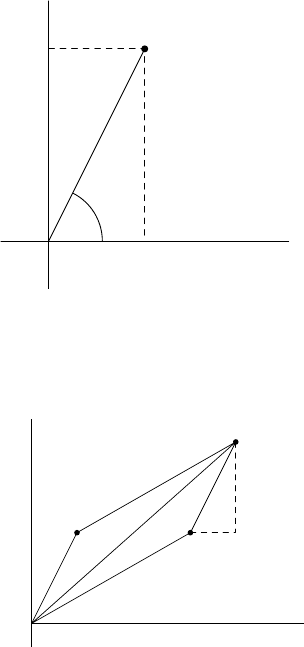
The complex numbers can be represented as ordered pairs of real numbers z x, y
that strongly resemble the Cartesian coordinates of a point in the plane. Thus, if we treat
the numbers 1 1, 0 and 0, 1 as basis vectors, the complex numbers z x, y
x 1 y x y can be represented as points in the complex plane, as indicated in
Fig. 1.1. A diagram of this type is often called an Argand diagram. It is useful to define
functions Re or Im that retrieve the real part x Rez or the imaginary part y Imz
of a complex number. Similarly, the modulus, r, and phase, Θ, can be defined as the polar
coordinates
r
x
2
y
2
, ΘArcTan
y
x
(1.2)
by analogy with two-dimensional vectors.
Graduate Mathematical Physics. James J. Kelly
Copyright © 2006 WILEY-VCH Verlag GmbH & Co. KGaA, Weinheim
ISBN: 3-527-40637-9
2 1 Analytic Functions
xRez
yImz
r
Θ
z x y
x
y
Figure 1.1. Cartesian and polar representations of complex numbers.
xRez
yImz
z
1
z
2
z
1
z
2
x
1
y
1
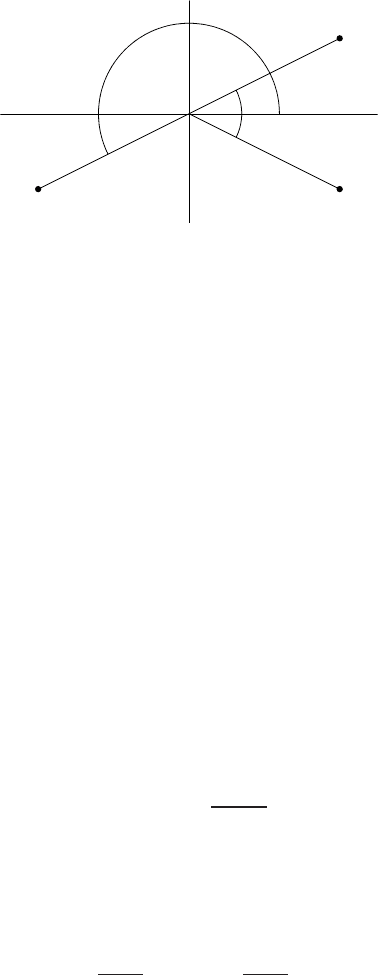
Figure 1.2. Addition of complex numbers.
Continuing this analogy, we also define the addition of complex numbers by adding
their components, such that
z
1
z
2
x
1
x
2
,y
1
y
2
z
1
z
2
x
1
x
2
1
y
1
y
2
(1.3)
as diagrammed in Fig. 1.2. The complex numbers then form a linear vector space and
addition of complex numbers can be performed graphically in exactly the same manner as
for vectors in a plane.
However, the analogy with Cartesian coordinates is not complete and does not extend
to multiplication. The multiplication of two complex numbers is based upon the distribu-
tive property of multiplication
z
1
z
2
x
1
y
1
x
2
y
2
x
1
x
2
2
y
1
y
2
x
1
y
2
x
2
y
1
x
1
x
2
y
1
y
2
x
1
y
2
x
2
y
1
(1.4)
1.1 Complex Numbers 3
xRez
yImz
zx,y
z
x, y
zx,y
Θ
Θ
ΘΠ
Figure 1.3. Inversion and complex conjugation of a complex number.
and the definition
2
1. The product of two complex numbers is then another complex
number with the components
z
1
z
2
x
1
x
2
y
1
y
2
,x
1
y
2
x
2
y
1
(1.5)
More formally, the complex numbers can be represented as ordered pairs of real numbers
z x, y with equality, addition, and multiplication defined by:
z
1
z
2
x
1
x
2
y
1
y
2
(1.6)
z
1
z
2
x
1
x
2
,y
1
y
2
(1.7)
z
1
z
2
x
1
x
2
y
1
y
2
,x
1
y
2
x
2
y
1
(1.8)
One can show that these definitions fulfill all the formal requirements of a field, and we
denote the complex number field as . Thus, the field of real numbers is contained as a
subset, .
It will also be useful to define complex conjugation
complex conjugation: z x, yz
x, y (1.9)
and absolute value functions
absolute value: z
x
2
y
2
(1.10)
with conventional notations. Geometrically, complex conjugation represents reflection
across the real axis, as sketched in Fig. 1.3.
The Re, Im, and Abs functions can now be expressed as
Rez
z z
2
, Imz
z z
2
, z
2
zz
(1.11)

4 1 Analytic Functions
Thus, we quickly obtain the following arithmetic facts:
0, 1
2
1
3
4
1
scalar multiplication: c cz cx, cy
additive inverse: z x, yz x, yz z0
multiplicative inverse: z
1
1
x y
x y
x
2
y
2
z
z
2
(1.12)
1.1.2 Triangle Inequalities
Distances between points in the complex plane are calculated using a metric function.
A metric da, b is a real-valued function such that
1. da, b > 0 for all a b
2. da, b0 for all a b
3. da, bdb, a
4. da, bda, cdc, b for any c.
Thus, the Euclidean metric dz
1
,z
2
z
1
z
2
x
1
x
2
2
y
1
y
2
2
is suitable for
. Then with geometric reasoning one easily obtains the triangle inequalities:
triangle inequalities
z
1
z
2
z
1
z
2
z
1
z
2
(1.13)
Note that cannot be ordered (it is not possible to define < properly).
1.1.3 Polar Representation
The function
Θ
can be evaluated using the power series
Θ
n0
Θ
n
n!
n0
n
Θ
2n
2n!
n0
n
Θ
2n1
2n 1!
CosΘ SinΘ (1.14)
giving a result known as Euler’s formula. Thus, we can represent complex numbers in
polar form according to
z r
Θ
x r CosΘ , (1.15)
y r SinΘ with r z
x
2
y
2
and Θargz (1.16)
where r is the modulus or magnitude and Θ is the phase or argument of z. Although addition
of complex numbers is easier with the Cartesian representation, multiplication is usually

1.1 Complex Numbers 5
easier using polar notation where the product of two complex numbers becomes
z
1
z
2
r
1
r
2
CosΘ
1
SinΘ
1
CosΘ
2
SinΘ
2
r
1
r
2
CosΘ
1
CosΘ
2
SinΘ
1
SinΘ
2
SinΘ
1
CosΘ
2
CosΘ
1
SinΘ
2
r
1
r
2
CosΘ
1
Θ
2
SinΘ
1
Θ
2
r
1
r
2
Θ
1
Θ
2
(1.17)
Thus, the moduli multiply while the phases add. Note that in this derivation we did not
assume that
z
1
z
2
z
1
z
2
, which we have not yet proven for complex arguments, relying
instead upon the Euler formula and established properties for trigonometric functions of
real variables.
Using the polar representation, it also becomes trivial to prove de Moivre’s theorem
Θ
n
nΘ
CosΘ SinΘ
n
CosnΘ SinnΘ for integer n. (1.18)
However, one must be careful in performing calculations of this type. For example, one
cannot simply replace
nΘ
1/n
by
Θ
because the equation, z
n
w has n solutions z
k
,k
1,n while
Θ
is a unique complex number. Thus, there are n, n
th
-roots of unity, obtained
as follows.
z r
Θ
z
n
r
n
nΘ
(1.19)
z
n
1 r 1,nΘ2kΠ (1.20)
z Exp
2Πk
n
Cos
2Πk
n
Sin
2Πk
n
for k 0, 1, 2,...,n 1 (1.21)
In the Argand plane, these roots are found at the vertices of a regular n-sided polygon
inscribed within the unit circle with the principal root at z 1. More generally, the roots
z
n
w Ρ
Φ
z
k
Ρ
1/n
Exp
Φ2Πk
n
for k 0, 1, 2,...,n 1 (1.22)
of
Φ
are found at the vertices of a rotated polygon inscribed within the unit circle, as
illustrated in Fig. 1.4.
1.1.4 Argument Function
The graphical representation of complex numbers suggests that we should obtain the phase
using
Θ
?
arctan
y
x
(1.23)
but this definition is unsatisfactory because the ratio y/x is not sensitive to the quadrant,
being positive in both first and third and negative in both second and fourth quadrants. Con-
sequently, computer programs using arctan
y
x
return values limited to the range (
Π
2
,
Π
2
).