
Kojeve Alexandre. Introduction to the Reading of Hegel: Lectures on the Phenomenology of Spirit
Подождите немного. Документ загружается.

Eilitalc lnbo&rcrbn
that contemporary
concerns are
best
understood
in
the
permanent
Iight
of
Hegel's teaching.
Kojdve's book
is a
model of
textual
in-
tCrpretation;
the book
is suffused with the
awereness
that
it
is of
pressing concern to
6nd out
precisely
what
such
a thinker
meent'
for he may well
know much
more
than
we
do about
the things
that we need to
know. Here scholarship
is in rhe service
of philos-
ophy, and Kojdve gives us a
glimpse
of the
power
of great
minds
,and
respect for the humble
and
unfashionable
business
of spending
t'
yeeg studying
an old book. His own
teaching
is but the
distillation
of
more than
six
years devoted
to
nothing
but reading
a single
book, line by line. INrnooucrtoN To rHE Rpeowc
or
Hocei-
con-
'stitutes
the
most authoritative interpretation of
Hegel.
Such a careful and
comprehensive study
which
makes
sense of
Hegel's
very difficult
texts
will be
of great
value
in
America
where,
though
his influence has been
great and
is ever greater,
very
few
people
read, let
alone understand, him.
He
has regularly been
ig-
nored by
academic
positivists
who are
put
off
by his
language and
are
unawere of the problems involved in their own
understanding
of science
and the
relation
of science to the
world of
human
con-
;ccrn.
Hegel
is
now becoming
popular
in
literary and
artistic circles,
but in a superficial form
adapted to please
dilettantes
and
other
seekers after the
sensc of depth who
wish to use
him
rather than
understand
him.
Koidve
presents
Hegel's teaching
with a
force
and rigor which
should counterpoise both tendencies.
What distinguishes
Koidve's treatment of
Hegel
is
the
recogni-
tion
that
for Hegel
the primary concern
is not the
knowledge of
anything outside himself-be it
of nature
or history-but
knowl-
edge of himself,
that
is, knowledge
of what the philosopher
is and
how
he
can know what he knows.
The philosopher
must
be able
tt_glplg1 lir
own
doingp;
an
explanation of the
heavens,
of
ani-
mals, or
of
nonphilosophic
men which does not
leave
room for,
or
does not talk about,
the philosopher
is radically incomplete be-
cause it
cennot eccount for
the posibility
of its
own existence
as
knowledge. The world
known by philosophy must be such that
it
supports philosophy
and makes the philosopher the highest
or
{
most
complete
khd
of human being.
Koilve learned from Hegel
that the
philosopher
seeks to
know
himself
or to possess full
self-consciousness, and that, therefore,
thc
tnrc philosophic endeavor is a
coherent
explanation
of all things
lx
Eilltor\ Iafioilractut
that
culminetes
in the explenation of philosophy.
The
man
who
seeks
any
other form
of
knowledge, who
cannot
explain
his own
doings, cennot
be
called
a
philosopher.
Discussion
of
the
retionel
$ate is only a corollary
of
the proof that the
world can be
known
or
is
rational. Koilve insists
that
Hegel is the
only man
who
suc-
ceeded in making this proof,
and his interpretation of the
Phenom-
enology
expands and
clarifies Hegel's assertion that
realiry is
ra-
tional
and hence
iustifies
rationel
discourse
about
it. According to
Kojive, Hegel is
the
fulfillment of
what Plato
and Aristotle could
i
only
pray for;
he is
the
modern Aristotle
who responded
to-or,
I
better, incorporated-the
objections
made to
Aristotelian philoso-
I
phy by modern
natural
rnd human science.
Koilve
intransigently
n
uies
to
make plausible
Hegel's
claim
that
he
hed achieved
absolute
1
/
wisdom. He argues that
without the possibility
of absolute
wisdom,
"'\.
all knowledge,
science, or philosophy
is impossible.
It may
indeed
be doubted
whether
Koidve
is fully persuasive to
the modern
consciousnes,
particularly
since
he
fnds
himself
com-
pelled to
abandon
Hegel's philosophy
of
nature
as indefensible
and
sugEesa
that
Heidegger's
meditation
on
being
may
provide
a
substimrc
for
it. The
ablndoned
philosophy
of nature
may well
be
e
necesaiji
Cosmic
suPPoft
for Hegel's
human,
historical
teach-
ing.
One
might
ask
whether
Koidve
is not
really-somewhere
be-
ttJ"en
Hegel
and
Heidegger,
but it should
be added
that
Kofdve
himself
leads the
reader to
this
question'
which
is a proper
theme
of philosophical
reflection.
Koilve
describes
the
charecter
of wis-
dom
evenlf
he does
not
Prove
it has
been actualized.
Now,
the
most
striking
feature
of
Koi€ve's
thought
is his in-
sistence-fully
lustifed-that
for Hegel,
and
for all
followers of
ffegel,
history
is complet-ed,
that
-nothing
really new
can again
Iffi
i. the
world.
To most
of us,
such
a position
seems
utterly
p"t"do*i""I
and
wildly
implausible.
But Koidve
easily shows
the
ineluctable
necessity
of this
consequence
for
anyone
who under-
stands
human
life to
be
historically
determined,
for
anyone
who
believes
that thought
is relative to
time-that
is,
for
most
modern
'\-'
men.
For
if thought
is
historical,
it
is only
at the end
of
history
,
\that this
fact
can-be
known;
there
can
only
be knowledge
if his-
tory
et some
point stops.
Koidve
elaborates
the meaning
of this
logical
necessity
throughout
the course
of the book
and attemPts
to
indicate
how
a sensible
mrn
could
eccePt
it and
interpret the
I
Edlar's
Introd.uctbn
world
in accordence
with
it.
It is precisely
Mam's
failure
to
thinki
through
the
meaning
of
his
own historical
thought
that_ proves
I
his philosophical
inadequacy
and
cornpels
us
to turn
to
the
Pro-
I
founder
Hegel.
i
If concreie
historical
reality
is all
that
the
human mind
can
know,
if
there
is no-tg1lgl
Eilltor't llndrudgctton
of his
powerq
emencipated
from
thc
bonds
of prciudicc
md
op-
prcssion.
But
looking
around
us, Koidvc, like
every
other pcne-
trating observer,
sees thar thc completion
of the
human
task may
very
wcll coincide
with the
decay
of
humaniry,
the
rebarbarizrtion
or even reanimalization
of man.
He addresses this problcm
pefticu-
,l*ly
in the
note on
Japan
added to
the second edition
(pp.
rrg-
I
16z).
After
reading
it,
one wonders whether
the citizcn of the
\univenal
homogeneous
state is
not
identicel
to
Nietzsche's
Last
lMan,
and
whether
Hegel's historicism
does
not by
an
inevitable
''dialectic
force
us
to a
-*orc
somber and more
radical
historicism
which reiects
rcason. We
are
led
to a confrontation
berween Hegel
end Nieusche
and
perhaps,
even
funher,
toward a
reconsideration
of the
classicd
philosophy of Plato and Arl*otle,
who
rciectcd his-
toricism before
the fact and whom Hegel believed he had
zur-
pased.
It
is
the speciel merit of
Koilve
to bc one
of
the
very few
srre guides
to the contempladon
of the
fundamental alternatives.
ALLIIN
BLOOM
Itbaca, Ne,ut
Yotk
[Shonly
after the
completion of this
$atement I learncd that
Alcxandrc Koilve had died in
Bmsels in
May, 1968.1
TRANSLATOR'S
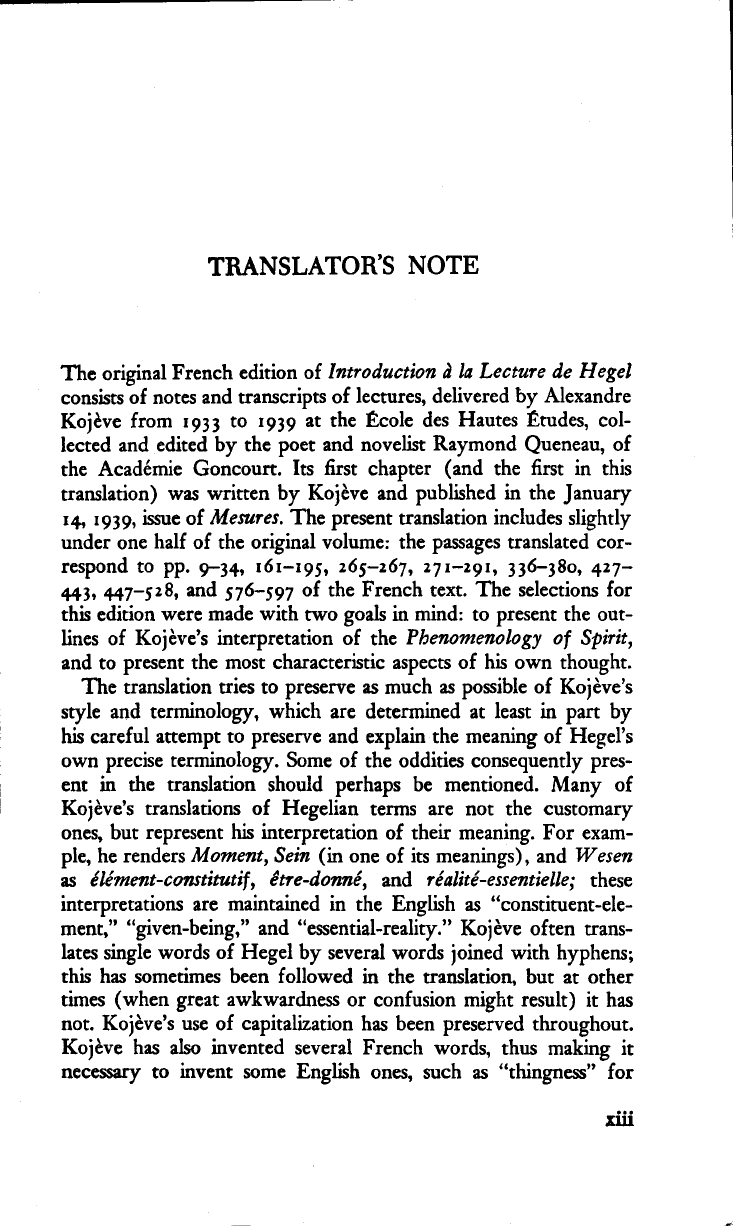
NOTE
Thc original
French edition
of.
Introduction I la Lecture de
Hegel
consists
of notes and transcripts
of
lectures, delivered
by Alexandre
Koi0ve
from
1933 to
1939 at the Ecole des
Hautes Erudes,
col-
lected and
edited by the poet
and novelist
Raymond
Queneau,
of
the
Acad6mie Goncourt.
Its first
chapter
(and
the
first in
this
translation)
was written by Kojdve and published
in
the
January
14, r9j9,
issue of
Mesres. The
present translation
includes
slightly
under
one
half
of the original volume: the
pasages
translated
cor-
respond to
pp.
y3q,
16r-195, 265-267t 27r-2grt
33618o, 427-
44f,447-528,
arnd
576-597
of the French
text.
The selections for
this
edition
were made with
rwo goals in
mind:
to present the out-
lines of Koj0ve's
interpretation of
the
Pbenomenobgy of
Spirit,
and to present the
most characteristic espects of his own thought.
The uanslation tries to preserve
as
much
as
posible
of
Koilve's
style
and terminology, which are determined at least in
part
by
his careful
ettempt to
preserve
and
explain the meaning of
Hegel's
own precise
terminology. Some
of the oddities consequently pres-
ent in the translation should perhaps be mcntioned.
Many
of
Koidve's
translations of Hegelian
tenns are not the customery
ones, but
represcnt his interpretation
of their meaning. For exam-
ple, he
renders
Moment,
Seiz
(in
one
of
its meanings),
and
Wesen
as
6Vment-constitutif,
€tte-donn6,
nd
rdalit6-essmtiellel
these
interpretations are
maintained
in the English as
"constituent-ele-
ment,"
"given-being,"
end
"esential-reality."
Kofdve often trans-
lates
single
words of Hegel
by several words
foined
with hyphens;
this has sometimes been followed
in the translation, but at other
times
(when
great
awkwardnes
or
confusion might
result)
it has
not. Kojlve's
use
of
capitalization
has been preserved throughout.
Koilve hes also invented several French words,
thus making it
necessaq/ to
invent
some English
ones, such as
"thingness"
for
IIu
Trcnslator't
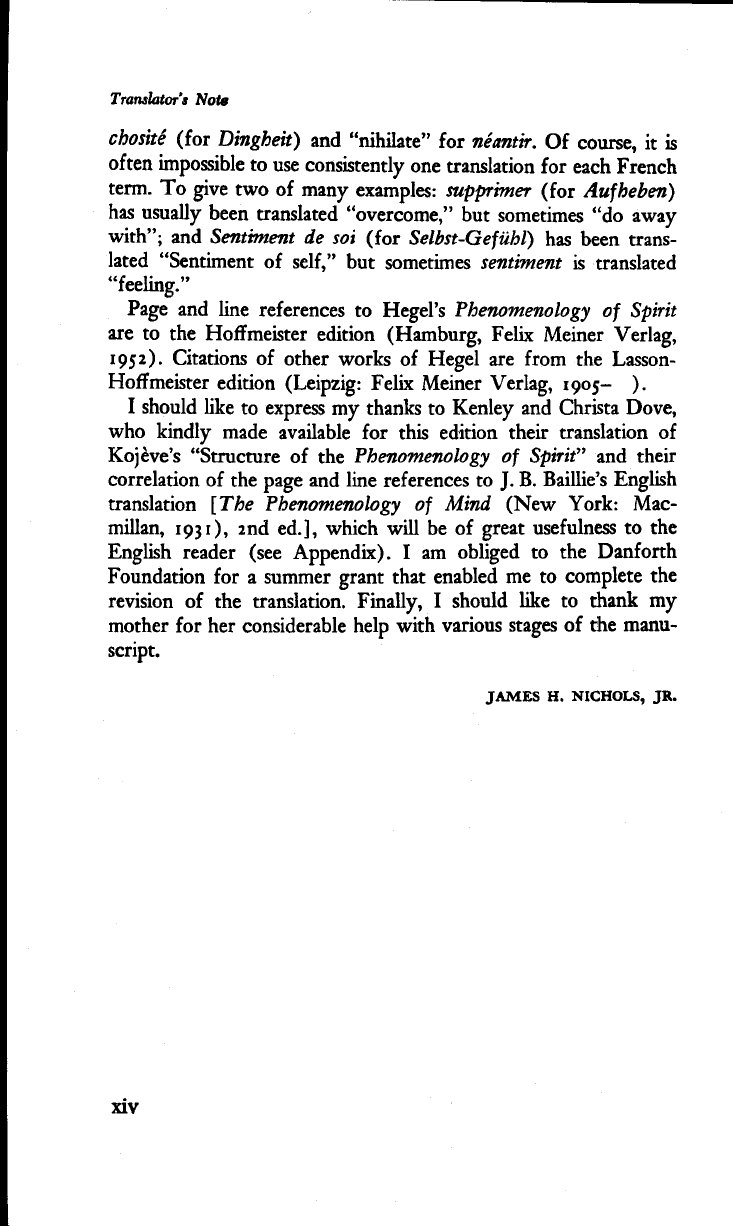
Note
cbositd
(f.ot
Dingheil)
and
"nihilate"
for n6antir.
Of
course, it is
often imposible
to
use consistently
one
uanslation
for each
French
term. To
give two of many
examples:
suppimer
(for
Aufbebm)
has
usually
been
translated
"overcome,"
but
sometimes
"do
away
with";
nd Sentiment
de soi
(for
Selbst-Gefilhl)
has been trans-
lated
"Sentiment
of self,"
but
sometimes
sentiment
is
translated
"feeling."
Page
and line
references
to
Hegel's
Phenomenology
of
Spirit
ere
to
the Hoffmeister
edition
(Hamburg,
Felix
Meiner Verlag,
rgjz).
Citations of
other
worla of Hegel are
from
the
Lasson-
Hoffmeister
edition
(Leipzig:
Felix
Meiner
Verlag,
r9o5-
).
I should
like
to express
my thenks to Kenley
and
Christe
Dove,
who kindly
made
available for this edition their
uanslation of
Kojdve's
"Structure
of
the
Phenomenobgy of
Sphit" and their
correlation
of
the page
and line
references to
J.
B.
Baillie's English
translation
lThe
Phenommobgy
of Mind
(New
York:
Mac-
millan,
r93r),
znd ed.], which will be of great
usefulness
to the
English reader
(see
Appendix). I am
obliged to the
Danforth
Foundation
for a summer
grant that
enabled
me to
cornplete the
revision
of the translation. Finally,
I
should
like
to thank
my
mother for her
considerable
help with
various
stages of the
manu-
script.
JAMES
H.
NICHOLS,
JR.
xtv
I
2
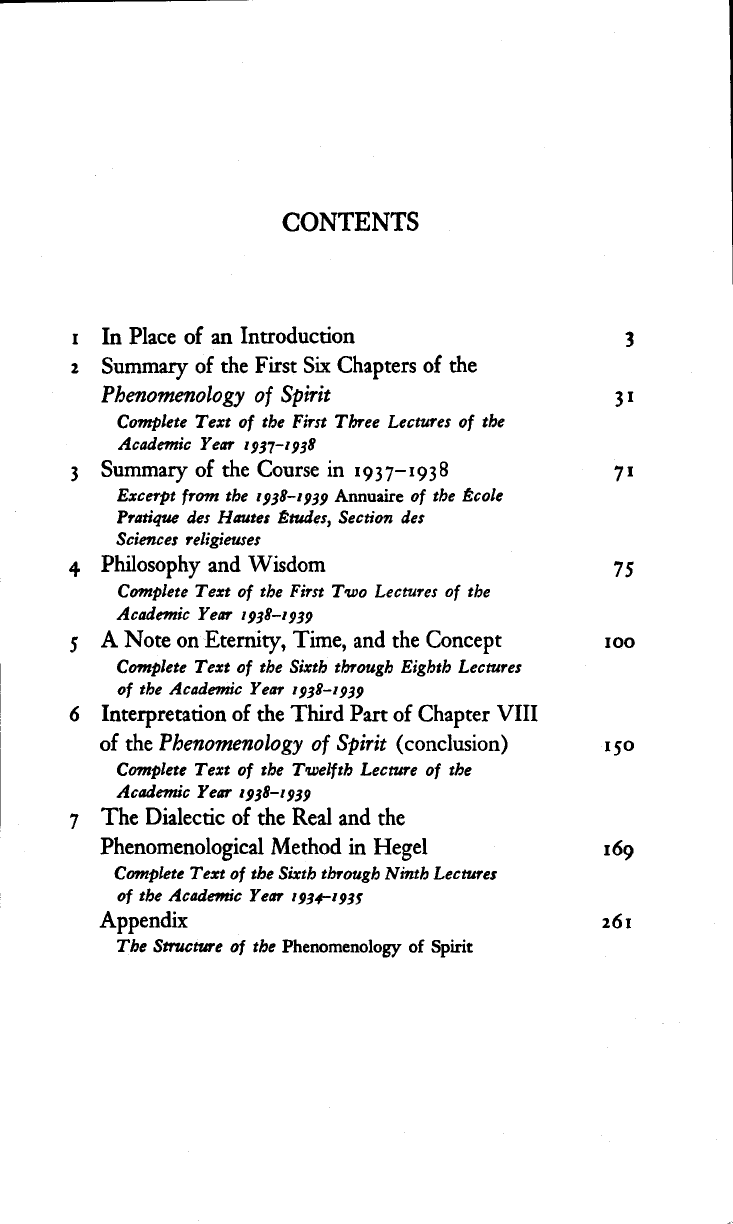
CONTENTS
In Place of
an
Introduction
Summary
of
the First Six Chapters of the
Phenomenology of Spirit
Conplete
Tert of
the
First Tltee Lectures of
the
Academic Yem tg7-tgt
Summary of the Course in r937-r938
Ercerpt
frotn
the tg8-r939
Annuaire of
the Ecole
Pratiqu des Hautet Entdes, Section des
Scimces
religieuses
Philosophy
and
Wisdom
Cornplete
Te*
of
the First
Tuo Lecrures
of the
Acadetnic Yem t9g-t939
A Note on Eternity, Time,
and the Concept
Cotnplete
Text of the Sisth tbrough Eighth Lecrures
of
the
Acadenic
Year
t98-t939
Intelpretation of
the Third Part of
Chapter
VIII
of the
Phenomenology
of Spirir
(conclusion)
Cotttplete
Te*t
of
the
Tuelfth Lecrure of
tbe
Acadetnic Y ear t
g$-t
939
The
Dialectic
of
the
Real
and the
Phenomenological Method in Hegel
Cotnpletc Text of tbe Sbth
throagh
Nintb Lecanes
of
the
Acadenic Yeot t934-1939
Appendix
The
Saacnne of tbe
Phetomenology of Spirit
3r
7r
75
r50
z6r
r69
INTRODUCTION
TO
THE
READING
OF
HEGEL
IN
PLACE
OF
AN
INTRODUCTION.
Hegel
,
.
. erfasst die
Arbeit ds des
Wesm,
als
das
sich
beddhrende
Wesen
des
Menschen.
Karl
Marx
[Man
is
Self-Consciousness.
He
is
conscious
of
himself, conscious
of his human reality
and
dignity;
end it is
in this that
he is
essen-
tially different from animals,
*iri"h
do
not
go
beyond the
level
*'
)(
simple Sentiment
of self. Man becomes conscious
of himself at the
moment when-for the
"first"
time-he
says
"I." To
understand
man by understgnding his
"origin"
is, therefore,
to
understand
the
origin of
th6 I
revealed
by speech.
[Now,
the analysis
of
"thoughtr" "reason,"
"understandingr"
and so on-in
general,
of
the
cognitive, contemplative,
pasive
behavior
of a being or a
"knowing
subject"-never
reveals the
why or the how of the birth of the word
"I,"
and
consequently
of
self-consciousness-thet is, of the human reality. The
man who
contemplates is
"absorbed"
by what he contemplates; the
"know-
ing
subject"
"loses"
himself
in the object that is
known.
Con-
templation reveals
the
object, not
the subject. The
obfect, and not
the subiect,
is
what shows itself
to
him in
and
by-+r
befter, as-
the
act
of
knowing.
The
man who
is
"absorbed"
by the obiect
that
he is
contemplating can be
"brought
back to
himself"
only
by
a
Desire; by
the
desire
to eat,
for example. The
(conscious)
Desire of
a being is what
constitutes
that
being as I and reveals
it
as such by
moving it to say
"I.
.
.
." Desire is what
transforms
Being, revealed to itself
by itself in
(true)
knowledge,
into
an
'A
translation with
commentary
of Section A of
Chapter
IV of the Phmome-
nology
of Spirit,
entided:
"Autonomy
and
Dependence of Self4onscioumes:
Mestery
and Slavery."
The commentary
is in brackets.
Words
ioined
by hyphens
correspond to
a
single
Germen
word.
INTNODUCTION
TO
THE
NEADING
OF
HECEL
"object"
revcaled
to
a
"zubiect"
by
"
subject
different
from
the
gbigo
and
"opposed" to it.
It
is
in and
by-or
gs6s1stiil,
,s-,,his"
Desire
that
man
is
formed
and is
revealed-to
himself
and
to
others-as
an
I, as
the
I that
is esentially
difrerent
from,
and
radically
opposed
to, the
non-I.
The
(human)
I
is
the
I
of
a
Desire
or
of
Desire.
[The
very
being
of
man,
rhe self-conscious
being,
therefore,
implies
and
presupposes
Desire.
ConsequentlS the human
realiry
can
be formed
and
maintained
only within a biological
reality,
an
animal
life.
But,
if animal
Desire
is the necessary
condition
of
Self-Consciousness,
it is
not
the sufficient condition.
By itself,
this
Desire
constitutes
only
the
Sentiment
of self.
[In
contrast
to the knowledge
that keeps man
in
a
passive
quietude,
Desire
dis-quiets him
and moves
him
to action.
Born of
Desire,
action
tends to satisfy it,
and can do so only
by the
"nege-
tior1"
the destruction,
or
at least the
transformation, of the
desired
object:
to
satisfy hunger,
for example, the food must be
destroyed
or, in
any
case,
transformed.
Thus, all action
is "negating."
Far
from
leaving
the
given
as it is,
acion destroys
it;
if not
in
its
being,
at
least
in its
given
form.
And all
"negating-negativity"
with
re-
spect
to the
given
is
necessarily
active.
But negating
action is not
purely
destructive,
for if
action destroys an obiective rcaliry,
for
the sake
of satisfying
the Desire from which
it is born,
it
creates
in its place,
in and by
that very
destruction"
a subiective
realiry.
The
being that
eats,
for
example, creates and
preserves
its own
reality
by
the
overcoming
of a realiry other than irs own,
by
the
. ,
"transformation"
of
an alien reality into
ia
own realty,
by the
\,,rlf,"assimilation,"
the
"internalization"
of a
"foreign,"
"externel"
\1^t' {*ieality.
Generally speaking, the
I
of
Desire
is
an emptiness
that
i_f I
receives
a real positive
content
only by negating action
that
satis-
-
!
t
|
fies
Desire
in
desuoying, transforming, and
"assimiladng"
the
\,J-
fulesired
non-I.
And the
posirive
conrenr
of the I, constituted
by
negadon,
is a function
of the
positive
content of the negated non-I.
If, then,
the
Desire
is
directed toward e
"netural"
non-I,
the
I, too,
will
be
"naturel."
The I created
by the
active satisfaction
of such
a Desire
will have
the same nature as the things toward which
that
Desire
is directed: it will
be a
"thingish"
I,
a merely
living
I,
an
animal
I. And
this naturd I, a function of the natural object, can