
Korn G.A. Advanced Dynamic-system Simulation: Model-replication Techniques and Monte Carlo Simulation
Подождите немного. Документ загружается.

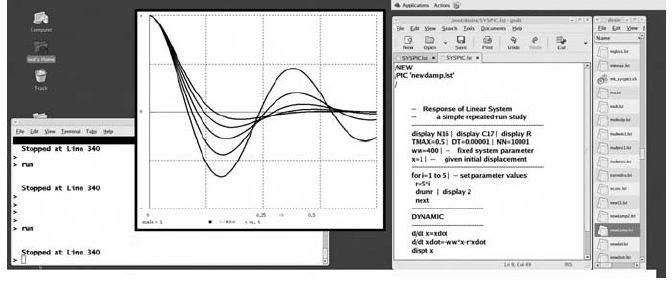
82 Parameter-influence Studies, Model Replication, and Monte Carlo Simulation
This experiment protocol calls n = 5 simulation runs of the model (4-3) with
the damping coefficient
r successively set to 5, 10, 15, 20, and 25 (Figure 4-1).
(b) Model Replication
Instead of repeating simulation runs with different parameter values, a single
simulation run can exercise
n = 5 replicas of the model with different param-
eter values. We replicate the model (4-3) by declaring the state variables
x, xdot and the parameter r as n-dimensional vectors
x
≡
(x[1], x[2], …, x[n]) xdot
≡
(xdot[1], xdot[2], …, xdot[n])
r
≡
(r[1], r[2], …, r[n])
This is done with the new experiment-protocol script
TMAX=0.5 | DT=0.0001 | NN=1000
ww = 400 | -- fixed system parameter
-----------------------------------------------------------
n = 5 | STATE x[n], xdot[n] | ARRAY r[n]
----------------------------------------------------------
for i = 1 to n
x[i] = 1 | -- set n initial displacements
r[i] = 5 * i | -- set n parameter values
next
drun (4-5)
FIGURE 4-1. Linux dual-screen display of the small repeated-run study in Section 4-2a.
Double-clicking the file
newdamp.lst in the file-manager window on the right has loaded the
program into DESIRE. The original display was in color.

This script “fills” the parameter array r with the n desired parameter values
1
r[1] = 5, r[2] = 10, r[3] = 15, r[4] = 20, r[5] = 25 (4-6)
Next, a new DYNAMIC program segment replaces the model (4-3) with the
corresponding vectorized model
DYNAMIC
-----------------------------------------------------------
Vectr d/dt x = xdot
Vectr d/dt xdot = – ww * x – r * xdot
dispt x[1], x[2], x[3], x[4], x[5] | -- display 5 curves (4-7)
DESIRE’s vectorizing compiler (Sections 3-2 and 3-3) automatically com-
piles this vector model into
n replicated scalar state-equation systems
d/dt x[i] = xdot[i]
d/dt xdot[i] = – ww * x[i] – r[i] * xdot[i] (i = 1, 2, …, n) (4-8)
The n state-variable initial values xdot[i] default to 0, and ww is a scalar
parameter common to all
n models. Our program effectively replicates the
original model (4-3)
n times with different parameter values [Eq. (4-6)] and
exercises all
n replicated models in a single simulation run. The resulting
solutions
x[1], x[2], x[3], x[4], x[5] are exactly the same as the solutions x
obtained for r = 5, 10, 15, 20, 25 in Figure 4-1.
The DESIRE vector compiler makes model replication automatic.
Vectorization works for both differential-equation systems and sampled-data
assignments. Replicated models can involve user-defined functions, table-
lookup functions, and submodels; each function or submodel definition is
necessarily the same for all
n models. Vector and matrix operations (Chapter 3),
and also time delays and
store/get operations (see the DESIRE reference
manual in CD) cannot be replicated.
Model replication improves computing speed by eliminating the runtime
loop and run-starting overhead of repeated-run studies. Model replication
requires extra memory; a compact vector model can generate a large equation
system. DESIRE currently admits up to 150,000 double-precision defined
variables, plus up to 40,000 differential-equation state variables for fixed- and
Parameter-influence Studies and Vectorization 83
1
Instead of filling state and parameter arrays with a program loop, array elements can also be
given individual assignments such as
b[17] = 9.8887, and multiple vector arrays can be filled with
a single
data/read assignment such as data 0.1, – 7.8, cos (gamma), 12.1,
…
read b,x
84 Parameter-influence Studies, Model Replication, and Monte Carlo Simulation
variable-step Runge–Kutta integration rules. This is enough for 1000 40th-
order differential-equation models. Our variable-step/variable-order Gear-
type and Adams integration rules need more memory and are therefore limited
to 600 state variables. For larger problems, there is an easy combination tech-
nique: we simply program repeated runs of a vectorized model with new
parameter values (Section 4-11).
(c) Dealing with Multiple Parameters
Our example varied only one parameter, but we can readily deal with multiple
parameters. Suppose we have a variable parameter
a with n1 = 4 values
– 5.0, – 2.0, 3.0, 4.0
and a second variable parameter b with n2 = 3 values,
2.7, 0, 10.0
Our experiment-protocol script must then assign the n = n1 * n2 = 12
values
– 5.0, – 2.0, 3.0, 4.0; – 5.0, – 2.0, 3.0, 4.0; – 5.0, – 2.0, 3.0, 4.0
to a[1], a[2], …, a[n], and also the corresponding n values
2.7, 2.7, 2.7, 2.7; 0, 0, 0, 0; 10.0, 10.0, 10.0, 10.0
to b[1], b[2], …, b[n]. To simplify this task, we declare and fill an n1-dimen-
sional array
aa and an n2-dimensional array bb with
n1 = 4 | n2 =3 | ARRAY aa[n1], bb[n2]
data – 5.0, – 2.0, 3.0, 4.0; 2.7, 0, 10.0 | read aa, bb
We now declare and fill the desired n-dimensional parameter arrays a and
b with
n = n1 * n2 | ARRAY a[n],b[n]
for k = 1 to n2
for i = 1 to n1
a[i + (k - 1) * n1] = aa[i] | b[i + (k - 1) * n1] = bb[k]
next
next
The [i + (k – 1) * n1] th model has the parameter combination aa[i], bb[k].
The smaller arrays
aa and bb are much easier to read, write, and store than

Parameter-influence Studies and Vectorization 85
the repetitious a and b arrays. This procedure can be extended to three or
more parameters.
4-3. Programming Parameter-influence Studies
(a) Introduction
Before vectorizing a model, we usually check it out in scalar form. This also
simplifies sorting defined-variable assignments (Sections 1-9 and 2-1). When
the simulation works, one will want to program output procedures specifi-
cally designed to evaluate the effects of changing parameters.
Our toy example was simple enough. But real parameter-influence studies
involve multiple parameters and possibly very many parameter combina-
tions. We must vary
• the design parameters that we want to optimize under different conditions,
• parameters that represent these different conditions (e.g., different tem-
peratures and different initial conditions).
As we noted in Section 1-17, simulations quickly produce large volumes
of time-history graphs and numerical tables. Meaningful evaluation of such
results is a very real problem.
DESIRE experiment-protocol commands can list successive parameter set-
tings and simulation results—even entire arrays—in a journal file.
2
This pre-
serves the data, but may not relate successive results in a meaningful way. A
better plan is to let experiment-protocol scripts or DYNAMIC program seg-
ments write data tables directly into space-delimited text files. These can then
be fed to standard spreadsheet and relational-database programs for analysis
(data mining), presentations, and storage. DESIRE experiment-protocol
scripts can readily access external programs and exchange file data with them.
(b) Measures of System Effectiveness
A system combines hardware, people, and/or modes of operation for some
purpose. Then, the very definition of an engineering system requires that
quantitative measures of its effectiveness be defined. These measures are nor-
mally numerical functions of system parameters. We often use cost-related
functionals such as integrals of system-variable time histories, such as the
control-system error measures in Section 1-14. Parameter-influence studies
must define effectiveness measures and compute their values for each param-
eter combination.
2
Refer to the DESIRE reference manual in the book CD.
86 Parameter-influence Studies, Model Replication, and Monte Carlo Simulation
We shall want to maximize measures of system effectiveness (or minimize
cost measures) as functions of system parameters. More often than not, how-
ever, practical design is not the result of straightforward global optimization
but involves compromises:
• Conflicting measures (say cost and performance) may need individual
consideration—a single measure (e.g., performance per unit cost) may
not do.
• One may have to compromise between performance results obtained
under different conditions (e.g., different signal amplitudes, tempera-
tures, or initial conditions).
Simulation results are only raw material for making such decisions. The
user has to make intelligent compromises.
(c) Crossplotting Results
Consider a model producing a performance measure such as the control-
system integrated squared error
ISE in Section 1-14,
d/dt ISE = (x – u)
2
(ISE, integral squared error) (4-9)
Its value
ISE = ISE(t0 + TMAX) at the end of a simulation run can be a useful
control-system performance measure. To see clearly how
ISE depends on a
system parameter, say the servo damping coefficient
r, we may want to plot a
graph of
ISE versus r.
1.An
n-run repeated-run study (Section 4-2a) makes n simulation runs
with
n parameter values of r = r0, r0 + DELr, r0 + 2 DELr, … and pro-
duces a corresponding
ISE value [Eq. (4-9)] at the end of each run. If a
runtime time-history display is not needed, the experiment-protocol
script can crossplot
ISE versus r as successive runs proceed:
for i = 1 to n
r = r + (i – 1) * DELr
drun
plot r, ISE, c | -- (c = 1, 2, … is a graph color)
reset
next
Instead, one may want to watch a runtime time-history display and save cor-
responding values of
r and ISE in two n-dimensional arrays declared with
ARRAY rr[n], ise[n]
Parameter-influence Studies and Vectorization 87
The plot line in the above script loop can be simply replaced with
rr[i] = r | ise[i] = ISE
One can then plot, cross-list, and analyze corresponding ise[i] and r[i] values
later on.
2. A replicated-model (vectorized) study (Section 4-2b) inherently
implies declaration of an
n-dimensional parameter array (vector) r and
an
n-dimensional state vector ISE. The experiment-protocol script fills
the
r array and makes a single simulation run:
ARRAY r[n], … | STATE x[n], … , ISE[n]
......................
for i = 1 to n | -- set parameter values
r = r0 + (i –1) * DELr
next
-------------------------
drun
The corresponding n-dimensional arrays (vectors) r and ISE are then avail-
able for crossplotting, or for any other purpose.
(d) Maximum/Minimum Selection
If there is an n-dimensional array (vector) of performance-measure values,
say the array
ISE in Section 4-3c, the maximum-selection techniques of
Section 3-8 can conveniently determine the index
i = I of the largest or
smallest performance-measure value
ISE[i] and compute that value. One
should remember, though, that maximum/minimum selection works only in
DYNAMIC program segments and is therefore more easily applied in vec-
torized parameter-influence studies than in repeated-run studies.
(e) Iterative Parameter Optimization
Parameter-influence studies produce performance measures as functions F(a,
b, …) of parameter values a, b, … . Repeated-run simulation studies can
relate a selection of successive parameter combinations
a, b, … to past results
in such a way that
F(a, b, …) converges to its global maximum or minimum.
A primitive experiment protocol for minimizing
F might simply change one
parameter at a time in the direction that turns out to decrease
F. This may work
if
F(a, b, …) is continuous and has only one minimum and no “flat spots”
where it is locally constant. As an example, the following experiment-protocol
script finds the value of a servomechanism damping coefficient
r that mini-
mizes the integral squared error
ISE (see also Section 1-14).

88 Parameter-influence Studies, Model Replication, and Monte Carlo Simulation
(set TMAX, DT, parameters, and initial conditions … )
...................
drun | -- initial run with trial value r produces ISE
repeat
oldISE = ISE
r = r + DELr | -- increment r
reset | drun | -- run with r + DELr
DELISE = ISE - oldISE | -- measure the gradient
if abs(DELISE) < crit then exit | -- no more change
else proceed
r = r - DELr - opgain * DELISE | -- working step
reset | drun
until 0 > 1 | -- keep trying
write ‘optimal values: r =
⬘
;r,
⬘
ISE =
⬘
;ISE | -- report result
Such simple one-parameter optimizations make nice demonstrations [2], but
real-life optimization studies are usually far more difficult. They must handle
multiple parameters and performance-measure “landscapes” with flat spots
and local minima. Every parameter-improvement step will require multiple,
cleverly designed trial evaluations of
F(a, b, …). Parameter optimization is a
complicated subject requiring separate study [3]. For serious optimization
projects, the simulation experiment protocol may have to interact with an
external specialized optimization program [3].
RANDOM PROCESSES AND RANDOM PARAMETERS
4-4. Random Processes and Monte Carlo Simulation
A random process generates sample functions
x(t) that depend on random
parameters, random initial conditions, and/or random inputs. By “random”
we mean quantities whose behavior can be predicted only by the values of
statistics. Statistics are functions of repeated measurements, for example,
sample averages and statistical relative frequencies. We use statistics because
serendipitous experience indicates that suitably defined statistics often fluc-
tuate less than individual measurements and are thus more predictable.
Statistics, in fact, often fluctuate less and less as the sample size increases.
3
3
This fortunate fact—an empirical law of large numbers—is not derived from probability theory
but is based on observations, just like a law of nature in physics. Similar mathematical laws of
large numbers (e.g., the central limit theorem) relate to expected values and probabilities, that is,
to properties of models. Validation of mathematical laws by empirical laws of large numbers
indicates that specific probability models can match and predict real-world experience.
Monte Carlo Simulation of Dynamic Systems 89
Probability models describe random processes in terms of joint probabil-
ity distributions of different sample values
x(t1), x(t2), … [4,5]. Such models
try to fit observed statistics with theoretical concepts such as probabilities
and expected values. A random process is stationary if its joint probability
distributions are unaffected when we shift the time origin by adding the same
time shift
τ
to all sampling times ti.
We are going to simulate random processes generated by dynamic systems
with random parameters (this includes random initial conditions) and/or ran-
dom time-function inputs (noise). A Monte Carlo simulation study repeats or
replicates simulations of such systems to produce a sample of different random-
process sample functions
x(t). We then compute statistics such as sample aver-
ages over corresponding values read from different sample functions. Monte
Carlo statistics typically measure various aspects of system performance.
4-5. Generating Random Parameters and Random Initial Values
Experiment-protocol scripts generate random parameter values
a, b, … with
assignments such as
a = ran() | b = cos(ran() + c) |
…
State-variable initial values are simply additional parameters. Each call of the
DESIRE library function
ran() produces a new sample of a pseudorandom-
noise sequence. Pseudorandom noise is really not random but a programmed
number sequence that repeats after a large number of samples.
ran() output is
uniformly distributed between –1 and 1 with theoretical mean 0 and variance
1/3. Different samples are uncorrelated but not statistically independent; this
problem will be discussed in Section 5-4. The experiment-protocol command
seed m can start or restart the noise sequence with a specific fixed value.
This can be useful for testing programs.
Various functions of the uniformly distributed
ran() output can produce
samples with different known probability distributions (see the references to
Chapter 5). Sums
y = ran() + ran() + … with 4–7 terms are approximately
Gaussian with mean 0 and variance
N/3, where N is the number of terms. But
multiple samples of
y are not necessarily jointly Gaussian.
MONTE CARLO SIMULATION OF DYNAMIC SYSTEMS
4-6. Repeated-run Monte Carlo Simulation
(a) Taking Statistics on Repeated Simulation Runs
Repeated-run Monte Carlo simulation programs loop to exercise a
DYNAMIC program segment
n times with new random inputs and then take
statistics on the results.

90 Parameter-influence Studies, Model Replication, and Monte Carlo Simulation
In the following experiment-protocol script, each of n passes through a
program loop assigns new random values to a parameter
b and to a state-
variable initial value
q(0) and then calls a simulation run. The n successive
simulation runs produce end-of-run sample values
x[i] = x(t0 + TMAX) of a
system time history
x(t) for i = 1, 2, …, n. x can be a state variable or a defined
variable; it is usually a system-performance measure similar to
ISE in Section
4-3. After completing
n runs, the program computes
• the sample average xAvg = <x> = (x[1] + x[2] + … + x[n])/n
•
the sample mean square xxAvg = <x
2
> = (x
2
[1] + x
2
[2] + … +
x
2
[n])/n
• the sample variance xVar = xxAvg – xAvg
2
.
We employ the convenient
DOT operations described in Section 3-7 to pro-
duce the
n-term sums xSum and xxSum needed to compute xAvg and
xxAvg.
(first set fixed system parameters, initial conditions, etc. ...... )
n = 1000 | ARRAY x[n] | -- declare an array of sample values
--
for i = 1 to n | -- Monte Carlo loop
b = b0 + B * f1(ran()) | -- set a new random parameter value
q = q0 + C * f2(ran()) | -- set a new random initial value
--
drunr | -- make a simulation run and reset state variables
x[i] = X | -- read successive sample values of x =X(t0 + TMAX)
next
-- now compute statistics
DOT xSum = X * 1 | xAvg = xSum/n
DOT xxSum = x * x | xxAvg = xxSum/n
xVar = xxAvg - xAvg^2 | s = sqrt(xVar)
drunr (or drun | reset) calls a simulation run and then resets differential-
equation-system initial values.
4
It would be just as easy to take statistics on two or more performance meas-
ures
x, y, …. More complicated statistics such as correlation and regression
coefficients, probability and probability-density estimate, and test statistics
such as
t and
2
can all be computed as functions of various sample averages
(see also Section 4-9). As always, Monte Carlo results have to be checked with
different pseudorandom-noise generators (see also Section 5-11).
4
For simplicity, we have assumed that the only state variables are differential-equation state
variables (see also Section 2-5).

Monte Carlo Simulation of Dynamic Systems 91
(b) Sequential Monte Carlo Studies
Instead of computing Monte Carlo statistics after n repeated simulation runs,
we can accumulate sample averages after every simulation run. The follow-
ing experiment-protocol script first initializes the sample averages
xAvg and
xxAvg and then again loops to make n simulation runs with new parameter
and initial-condition values. At the end of the
ith run, the program reads x =
x(t0 + TMAX) = x(i) and updates the statistics values:
xAvg = 0 | xxAvg = 0 | -- initialize statistics computation
for i = 1 to n | -- Monte Carlo loop
b = b0 + B * f1(ran()) | -- set a new random parameter value
q = q0 + C * f2(ran()) | -- set a new random initial value
--
drunr | -- make a simulation run and reset state variables
x[i] = X | -- read successive sample values of x =X(t0 + TMAX)
------------------------------------------------ now accumulate statistics!
xAvg = xAvg + (x - xAvg)/n
xxAvg = xxAvg + (x^2 - xxAvg)/n
xVar = xxAvg - xAvg^2
next | -- and loop back
This technique can save time, for it permits us to terminate the study when
the sample variance has become sufficiently small (sequential Monte Carlo
simulation).
(c) Example: Effects of Gun-elevation Errors on the 1776 Cannon
We will study a continuous random process generated by a differential-
equation system with a random parameter, specifically a random initial value.
Similar programs apply directly to many Monte Carlo studies of manufactur-
ing-tolerance effects.
Simulation of the 1776 cannon
5
in Figure 4-2 has been used as a textbook
problem for over 50 years [6,7]. Assuming that the wind force
W(t) is zero, the
only forces acting on the spherical cannonball are its weight
mg and aerody-
namic drag opposing the velocity vector. Airspeed is relatively low, so that the
drag is roughly proportional to the square of the velocity. Referring to Figure
4-2, the equations of motion in the horizontal and vertical directions are
(d/dt) x = xdot (d/dt) xdot = – R v
2
cos
θ
= – R v xdot
(d/dt) y = ydot (d/dt) ydot = – R v
2
sin
θ
– g = – R v ydot – g
5
1776 gun elevations were not really affected by manufacturing errors. Elevations of land-based
guns were usually set with wedges under the rear part of the barrel, and naval-gun elevation also
required judgment of the ship’s roll angle. Either way, there were lots of random errors.