
Korn G.A. Advanced Dynamic-system Simulation: Model-replication Techniques and Monte Carlo Simulation
Подождите немного. Документ загружается.

variable; q can be a “continuous” variable used in a differential-equation sys-
tem. In any case, DESIRE recognizes recursive assignments (2-19) as differ-
ence equations and automatically assigns the difference-equation state
variable
q the default initial value 0, as in Section 2-2. As already noted for
sampled-data state variables (Section 2-5), difference-equation state vari-
ables are not automatically reset by
reset or drunr statements. The experi-
ment protocol must reset them explicitly as needed.
If the function
F in Eq. (2-19) involves limiters or switches (as in the fol-
lowing examples), then the difference equation should follow a
step, OUT, or
SAMPLE m statement at the end of the DYNAMIC program segment.
(b) Track-hold Simulation
The difference equation
y = y + swtch(ctrl) * (x – y) (2-20)
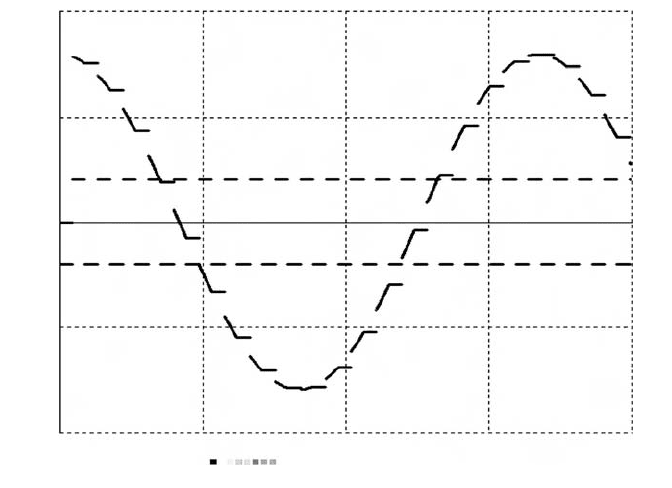
models a track-hold (sample-hold) circuit. The “continuous” difference-equation
state variable
y tracks the input x when the control variable ctrl is positive and
holds its last value when
ctrl is less than or equal to 0. Figure 2-8 illustrates the
track-hold action.
52 Models with Difference Equations, Limiters, and Switches
→
y
+
0
–
0 7.5 15
scale = 5
p
,U vs. t
ctrl
FIGURE 2-8. Track-hold operation modeled with the difference equation y = y + swtch(ctrl)
* (x – y)
. The control waveform was obtained with the program of Figure 2-14.
(c) Maximum- and Minimum-value Holding
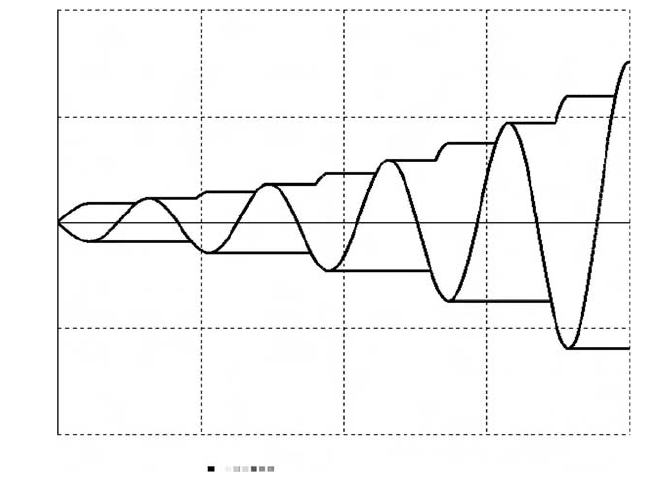
The difference-equation state variable
max = x + lim(max – x) (2-21)
tracks and holds the largest past value of
x = x(t) (Fig. 2-9; see also Section
2-13; [3]). DESIRE automatically assigns
max the initial value 0; since that
would keep
max from remembering negative values of x, we initialize max
with a large negative value such as –1.0E+30.
As also shown in Figure 2-9, the difference-equation state variable
min = x – lim(x – min) (2-22)
similarly holds the smallest past value of
x; we initialize min with 1.0E+30
An example in the book CD applies Eq. (2-21) to hold the largest past value
of
|x| for automatic display scaling [9].
(d) Simple Backlash and Hysteresis Models
The difference equation
y = y + a * deadz((x – y)/a) (2-23)
Limiters, Switches, and Difference Equations 53
+
0
–
015→ 30
scale = 2.5
min
max
x, max, min vs. t
FIGURE 2-9. Maximum and minimum holding with the difference equations (2-21) and (2-22).
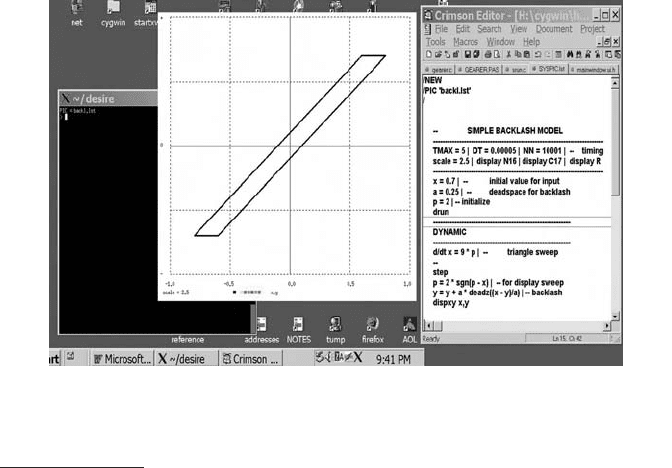
models the transfer characteristic of one-way simple backlash (e.g., gear
backlash) from
x to y (Fig. 2-10; [3]). We can use y to drive various continu-
ous-function generators, for example,
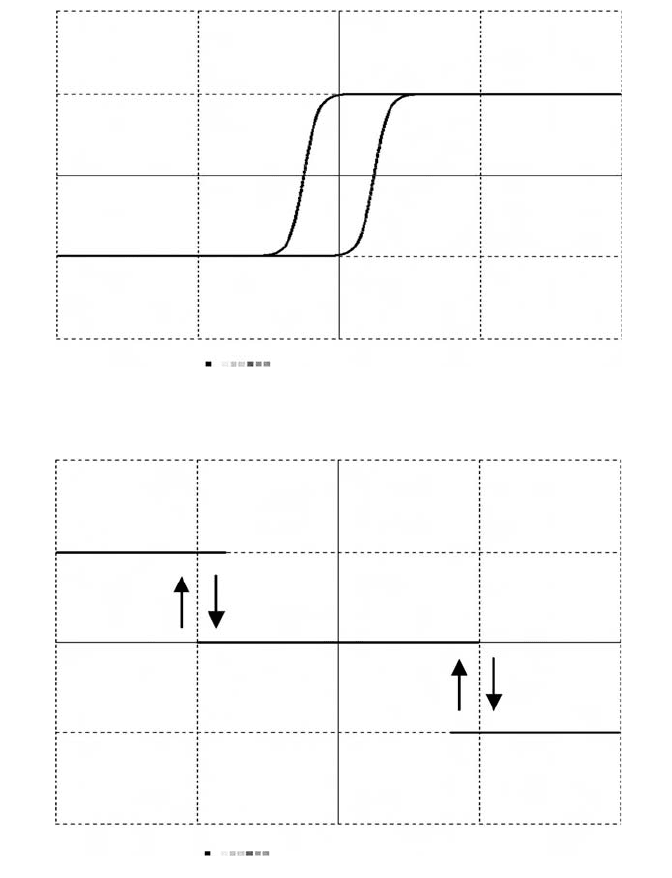
z = tanh(10 * y)
to obtain other transfer characteristics exhibiting hysteresis or memory of
past input values (Fig. 2-11). Truly realistic hysteresis models, though,
should be developed directly from physics; they are likely to involve differ-
ential equations as well as difference equations.
A different example, the difference equation
y = deadc(A * y – x ) (2-24)
produces the transfer characteristic of a deadspace comparator with hystere-
sis (Fig. 2-12). This has been used to model the operation of pairs of space-
vehicle on–off vernier control rockets.
9
(e) The Comparator with Hysteresis (Schmitt Trigger)
The most useful of our hysteresis-type difference equations
p = A * sgn(p – x) (2-25)
directly models a comparator with regenerative feedback, the Schmitt trigger
circuit widely used by electrical engineers (Fig. 2-13; [2,3,10]). The
54 Models with Difference Equations, Limiters, and Switches
FIGURE 2-10. This Cygwin display shows a simple backlash transfer characteristic with a
demonstration program sweeping
x with the sawtooth waveform of Section 2-15.
9
Equation (2-24) corrects a printing error in Reference [4].
difference-equation state variable p defaults to 0 but is usually initialized to
–A or +A. This modeling trick was already used with early fixed-point block-
diagram simulation languages [2,3].
Simulated Schmitt triggers often replace deadspace comparators in control
systems (Example 2.1), but perhaps their most useful application is to the
generation of periodic signals (Section 2-17).
Limiters, Switches, and Difference Equations 55
+
0
–
–1.0 –0.5 0.0 0.5 1.
0
scale = 2 x,z
FIGURE 2-11. A simple hysteresis transfer characteristic.
+
0
–
–1.0 –0.5 0.0 0.5 1.0
scale = 2 x,y
FIGURE 2-12. Transfer characteristic (y versus x) of a deadspace comparator with hysteresis.
2-17. Signal Generators and Signal Modulation
Feeding the time-integrated output of a hardware or software Schmitt
trigger back to the input (Fig. 2-14) recreates the classical Hewlett-
Packard signal generator [2,3,10]. This is implemented with the simple
program
TMAX = 5 | DT = 0.0001 | NN = 5000
----------------------------------------------------------
A = 0.22 | a = 4 | — signal parameters
x = 1 | p = 1 | — initialize
drun
56
Models with Difference Equations, Limiters, and Switches
+
0
–
p
sgn
-x
–1.0 –0.5 0.0 0.5 1.0
scale = 2 x,y
FIGURE 2-13. A comparator with regenerative feedback (Schmitt trigger) implemented
with
p = A * sgn(p – x), and its transfer characteristic p versus x.
-x
p
∫
sgn
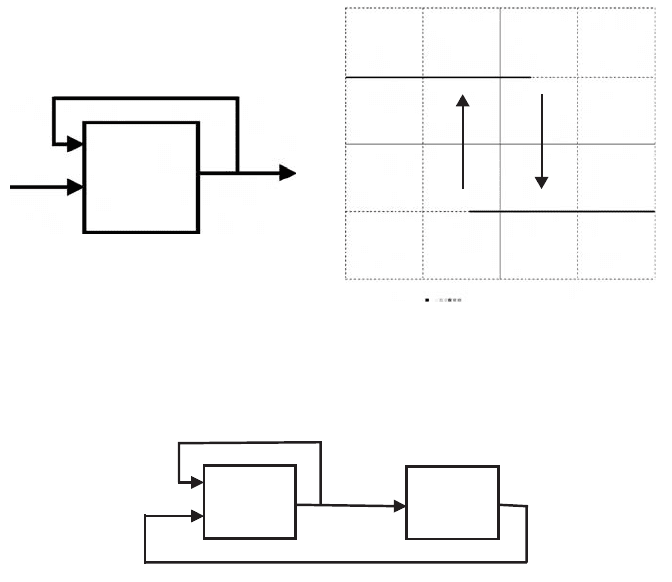
FIGURE 2-14. Integrator feedback around a Schmitt trigger model produces a useful signal
generator. The resulting square waves
p(t) and triangle waves x(t) are shown in Figure 2-15.
----------------------------------------------------------
DYNAMIC
----------------------------------------------------------
d/dt x = a * p | -- triangle waves
step
p = sgn(p – x) | -- square waves (2-26)
The experiment protocol usually initializes the difference-equation state vari-
able
p and the differential-equation state variable x with p = A and x = –A.
When
p = A, the integrator output x increases until –x overcomes the pos-
itive Schmitt-trigger bias
p = A in Eq. (2-25). p now switches to –A, and x
decreases until it reaches the new trigger level –A. This process repeats and
generates a square wave
p = p(t) and a triangle wave x = x(t), both of ampli-
tude
A and frequency a/(4 * A) (Fig. 2-15). Frequency resolution is deter-
mined by the switching-time resolution, that is, by the largest
DT value used
in the integration routine (Sections 2-10 and 2-11).
These periodic functions are useful as computer-generated test signals and
control signals.
10
An added assignment
y = p * x (2-27)
Limiters, Switches, and Difference Equations 57
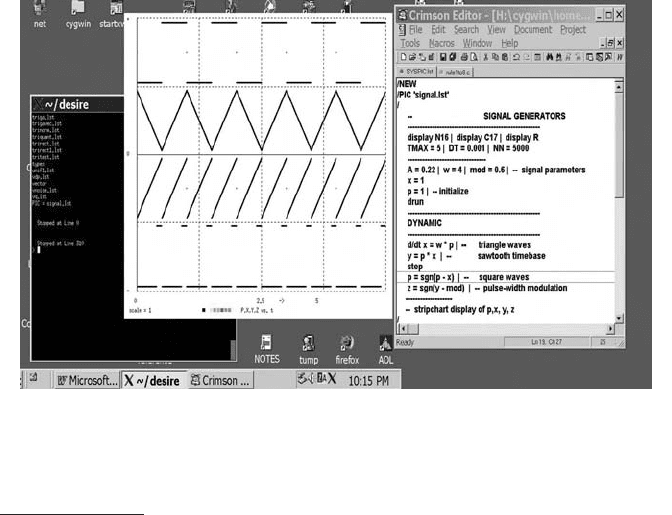
FIGURE 2-15. This Cygwin (Unix under Windows
TM
) screen shows a terminal window, an
editor window, and graphics demonstrating the signal-generator program in Section 2-17. The
original display showed different curves in different colors.
10
We used the triangle wave x(t) to sweep the input to all the function-generator displays shown
in this chapter.
generates a sawtooth waveform y that sweeps between –A and A with fre-
quency
0.5 * a/A. One can produce a large variety of more general periodic
waveforms by feeding
p(t) or y(t) to various function generators, as in
z = f(y) (2-28)
f(y) can be a library function, a user-defined function, or a table-lookup function.
We can frequency-modulate all these periodic waveforms by making the
parameter
a a variable. One can also add a variable bias –mod to the saw-
tooth waveform
y and send the result to a comparator whose output
z = sgn(y – mod)
is then a train of pulse width-modulated pulses (Fig. 2-15). We note here that
computer-generated sinusoidal signals
s = A * sin(w * t + phi) can also be
amplitude-, frequency-, and/or phase-modulated by making the parameters
a,
w, and phi variable.
REFERENCES
1. G. F. Franklin, Digital Control of Dynamic Systems, Addison-Wesley, Reading,
MA, 1990.
2. G. A. Korn and J.V. Wait, Digital Continuous-System Simulation, Prentice-Hall,
Englewood Cliffs, NJ, 1978.
3. G. A. Korn, Tricks and treats: Nonlinear operations in digital simulation, Math
and Computers in Simulation, 29, 1987, pp. 129–143.
4. G. A. Korn, Interactive Dynamic-System Simulation with Microsoft Windows,
Taylor and Francis, London, 1998.
5. F. E. Cellier and D. F. Rufer, Algorithm for the solution of initial-value problems,
Math and Computers in Simulation, 20, 1978, pp. 160–165.
6. F. Cellier and E. Kofman, Continuous-System Simulation, Springer, New York,
2006.
7. M. B. Carver, Efficient integration over discontinuities, Math and Computers in
Simulation, 20, 1978, pp. 190–196.
8. D. Ellison, Efficient automatic integration of ordinary differential equations with
discontinuities, Math and Computers in Simulation, 23, 1981, pp. 12–20.
9. C. W. Gear, Efficient step-size control for output and discontinuities, Transactions
SCS, 1, 1984, pp. 27–31.
10. G. A. Korn and T. M. Korn, Electronic Analog and Hybrid Computers, 2nd Ed.,
McGraw-Hill, New York, 1964.
58
Models with Difference Equations, Limiters, and Switches

3
Programs with Vector/Matrix
Operations and Submodels
VECTOR ASSIGNMENTS AND VECTOR
DIFFERENTIAL EQUATIONS
3-1. Arrays, Subscripted Variables, and
State-variable Declarations
Array declarations such as
ARRAY x[n] | ARRAY A[n, m] or ARRAY x[n], A[n, m]
in DESIRE experiment-protocol scripts define one- and two-dimensional
arrays (vectors
1
and matrices
2
) of subscripted real variables x[1], x[2], …,
x[n] and A[i, k] (i = 1, 2, …, n; k = 1, 2, …, m). Note that vectors and
matrices are much more than a shorthand notation—they are intuitively
meaningful abstractions in many useful models (e.g., forces and velocity
vectors).
59
Advanced Dynamic-system Simulation: Model-replication Techniques
and Monte Carlo Simulation By Granino A. Korn
Copyright © 2007 by John Wiley & Sons, Inc.
1
Our vectors are indeed vectors in the mathematical sense, since Section 3.1.2 provides a suit-
able definition of vector addition, and multiplication of vectors by scalars.
2
An n × m matrix declared with ARRAY A[n, m] has n rows and m columns. DESIRE can also
declare arrays with more dimensions, but they are rarely used.

60 Programs with Vector/Matrix Operations and Submodels
All subscripted variables (array elements) initially default to 0. Experiment-
protocol scripts can “fill” arrays with assignments to subscripted variables, as in
A[19, 4] = 7.3 | v[2] = a – 3 * b
for i = 1 to n | x[i] = 20 * i | next
or from data lists or files and read assignments, as in
data 1.2, – 4, a + 4 * b, 7.882, … | read v, A, …
Once declared, vectors and matrices, and the resulting subscripted variables,
can be freely used both in the experiment protocol
3
and in DYNAMIC pro-
gram segments. DYNAMIC segments can assign time-variable expressions
to array elements. The program flags undeclared subscripted variables, vec-
tors, or matrices as undefined.
Before subscripted variables
x[i], y[i], … or vectors x, y, … can be used as
state variables in differential equations (Section 1-2), the experiment-protocol
script must declare one-dimensional state-variable arrays (state vectors) with
a
STATE declaration such as
STATE x[n], y[m], …
Scalar state variables need not be declared, unless they are to be used in sub-
models (Section 3-17) or in more than one DYNAMIC program segment.
3-2. Vector Operations in DYNAMIC Program Segments—
The Vectorizing Compiler
(a) Vector Assignments and Vector Expressions
Assume that the experiment protocol has declared vectors y1, y2, y3, … all of
the same dimension
n, say with
ARRAY y1[n], y2[n], y3[n], … (3-1)
Then a vector assignment [1]
Vector y1 = g(t; y2, y3, … ) (3-2a)
3
The detailed syntax of the script language is described in the DESIRE reference manual sup-
plied in the book CD.
in a DYNAMIC program segment compiles automatically into n scalar
assignments
y1[i] = g(t; y2[i], y3[i], …) (i = 1, 2, …, n) (3-2b)
The simulation time variable is t. g() stands for any expression that can be
used in a scalar assignment. Such a vector expression may involve literal num-
bers, scalar parameters, parentheses, library functions, user-defined functions,
or table-lookup functions. An error is returned when one tries to combine vec-
tors with unequal dimensions.
For example, if
y, u, v, and z are n-dimensional vectors, then
Vector y = (1 – v) * (cos(alpha * z * t) + 3 * u)
compiles into
y[i] = (1 – v[i]) * (cos(alpha * z[i] * t) + 3 * u[i]) (i = 1, 2, ..., n)
Note that the expression g() is the same for all n vector components y1[i]. The
DESIRE compiler reads the vector dimension
n from the array data structure.
The code for
n successive vector components is then generated by a compiler
loop. Each pass through this loop compiles all the operations for the expres-
sion
g(y2[i], y3[i], … ) and then automatically increments the vector index i.
The resulting “vectorized” code is fast, for there is no runtime loop overhead.
A DYNAMIC program segment can have multiple vector assignments with
the same or different dimensions.
(b) Vector Differential Equations
Assume that the experiment protocol has declared the n-dimensional arrays
(3.1) and has also declared an
n-dimensional state vector x with
STATE x[n]
Then a vector differential equation (vector state equation)
Vectr d/dt x = f(t; x, y1, y2, …) (3-3a)
in a DYNAMIC program segment compiles automatically into n scalar dif-
ferential equations
d/dt x[i] = f(t; x[i], y1[i], y2[I], …) (i = 1, 2, …, n) (3.3b)
f() represents an arbitrary vector expression, just as in Section 3-2a. The ini-
tial values of the subscripted state variables
x[i] default to 0 unless the exper-
iment protocol assigns other values. After a simulation run, initial values of
Vector Assignments and Vector Differential Equations 61