
Korn G.A. Advanced Dynamic-system Simulation: Model-replication Techniques and Monte Carlo Simulation
Подождите немного. Документ загружается.

MODELING LIMITERS AND SWITCHES
2-8. Limiters, Switches, and Comparators
The piecewise-linear library functions listed in Figure 2-5 work both in
experiment-protocol scripts and DYNAMIC program segments. These func-
tions are used in many engineering applications (see also [2–4]).
(a) Limiter Functions
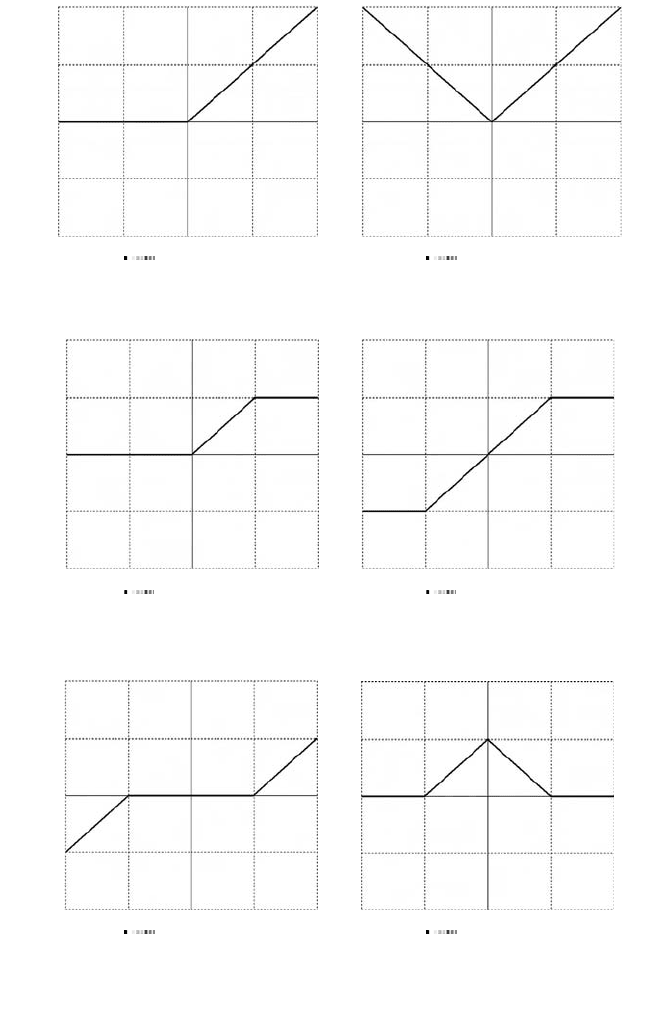
lim(x) is a simple unit-gain limiter or half-wave rectifier (see also Section 2-13).
The unit-gain saturation limiter
sat(x) limits its output between –1 and 1, and
SAT(x) limits its output between 0 and 1. More general unit-gain saturation lim-
iters are obtained with
y = a * sat(x/a) (limits between – a and a > 0) (2-3)
y = lim(x – min) – lim(x – max) (limits between min and max > min) (2-4)
It is possible to approximate any reasonable continuous function of
x as a
sum of simple limiter functions,
a0 + a1 * lim(x – x1) + a2 * lim(x – x2) + … (2-5)
(b) Switching Functions and Comparators
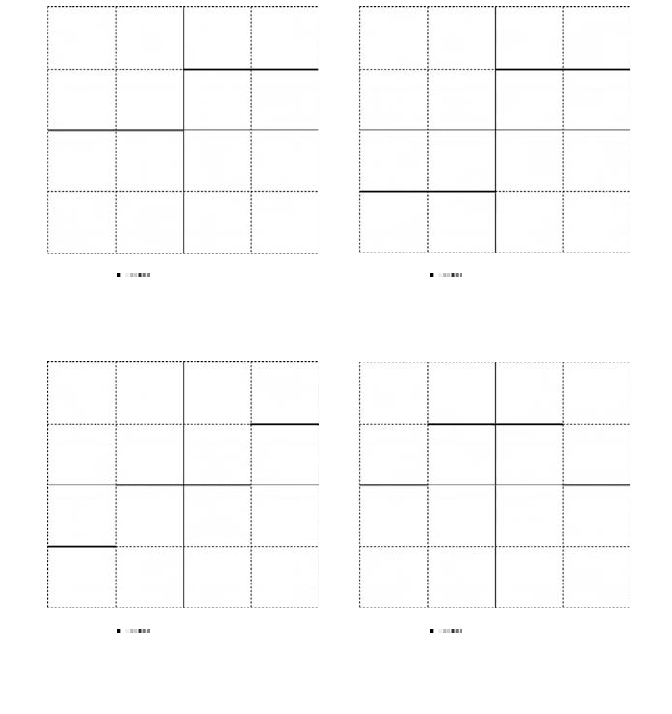
The switch function swtch(x – a) in Figure 2-5b switches between 0 and 1
when
x = a (see also Section 2-16). Combining two swtch functions,
u = swtch(t – t1) – swtch(t – t2) (t1 < t2) (2-6)
we obtain a unit-amplitude pulse
u(t) starting at t = t1 and ending at t = t2. y
= v * u models the result of switching the function v(t) on at t = t1 and off at
t = t2.
Referring again to Figure 2-5b,
swtch(x) and sgn(x) model the transfer
characteristics of comparators that switch their output when their input
x
crosses zero. The useful function
y = minus + (plus – minus) * swtch(x – a) (2-7)
models a relay comparator or function switch. Its output
y switches between
the values
minus and plus when the input variable x crosses the comparison
42 Models with Difference Equations, Limiters, and Switches
Modeling Limiters and Switches 43
+
0
–
–1.0
scale = 2
lim(x) = abs(x) = |
a
|
0 (x ≤ 0)
x (x > 0)
SAT(x) =
0 (x ≤ 0)
1 (x > 0)
sat(x) = x (-1 ≤ x ≤ 1)
0 (x ≤ -1)
1 (x > 1)
dead(x) = 0 (-1 < x ≤ 1)
x + 1 (x ≤ -1)
x - 1 (x > 1)
lim(tri(x)) =
0 (|
x
| > 1)
1 - |
x
| (|
x
| < 1)
x,y
–0.5 0.0 0.5 1.0
+
0
–
–1.0
scale = 2 x,y
–0.5 0.0 0.5 1.0
+
0
–
–1.0
scale = 2 x,y
–0.5 0.0 0.5 1.0
+
0
–
–1.0
scale = 2 x,y
–0.5 0.0 0.5 1.0
+
0
–
–1.0
scale = 2 x,y
–0.5 0.0 0.5 1.0
+
0
–
–1.0
scale = 2 x,y
–0.5 0.0 0.5 1.0
FIGURE 2-5
a
. Limiter functions.
level a. a, minus, and plus can be variable expressions. A relay comparator
can also be modeled with the library function
comp(x, minus, plus) =
plus (x > 0)
minus (x <
–
0)
The library function deadc(x) represents a comparator with a deadspace
between
x = –1 and x = 1. The function
y = minus * swtch(a – x – delta) + plus * swtch(x – a – delta) (2-8)
implements a relay comparator with the symmetrical deadspace
±delta.
44 Models with Difference Equations, Limiters, and Switches
+
0
–
–1.0 –0.5 0.0
swtch(x) =
0 (x ≤ 0)
1 (x > 0)
sgn(x) = 0 (x = 0)
-1 (x < 0)
1 (x > 0)
deadc(x) = 0 (-1 < x ≤ 1)
-1 (x ≤ -1)
1 (x > 1)
rect(x) =
0 (|
x
| > 1)
1 (|
x
| < 1)
0.5 1.0
scale = 2 x,y
+
0
–
–1.0 –0.5 0.0 0.5 1.0
scale = 2 x,y
+
0
–
–1.0 –0.5 0.0 0.5 1.0
scale = 2 x,y
+
0
–
–1.0 –0.5 0.0 0.5 1.0
scale = 2 x,y
FIGURE 2-5
b
. Switching functions.

2-9. Numerical Integration of Switch and Limiter Outputs,
Event Prediction, and Display Problems
Switch-function outputs are discontinuous step functions, and limiter out-
puts have discontinuous derivatives.
7
Numerical-integration steps must not
cross such discontinuities, which violate the smooth-interpolation assump-
tions underlying all higher-order integration formulas. We already encoun-
tered the same problem with sampled-data integrands and solved it by
providing integration routines that never step across the periodic sampling
points (Section 1-8). But switch and limiter functions used in differential-
equation problems will not, in general, switch at known periodic sampling
times. To ensure correct numerical integration we must, therefore, modify
either integration steps or switching times.
Early simulation projects simply reduced the integration step size
DT, typ-
ically with a variable-step Runge–Kutta routine, and then ignored the prob-
lem. This often works (perhaps because models of stable control systems
tend to reduce computing errors), but it is not the way to get reliable results.
In particular, variable-step integration may fail at the switching points as it
tries to decrease the integration-step size. Models requiring frequent switch-
ing (e.g., models of solid-state ac motor controllers) are especially vulnerable
[5,6]. The situation is worse when simulations of mechanical and electrical
systems involve several switching devices.
Two alternative methods can produce correct integration:
1. Some simulation programs predict the time
Tevent when a function
such as
swtch(x) will switch by extrapolating future values of x from a
number of past values. The integration routine is then designed to force
the nearest integration step to end at
t = Tevent. The software must
select the first function likely to switch, and the extrapolation formula
must be as accurate as the integration rule [6–9].
2. We can execute program lines containing switch and limiter functions
only at the end of integration steps (Section 2-11). This involves a com-
promise between switching-time resolution and integration step size;
small integration steps slow down the computation.
The following sections describe two simple schemes for correct integra-
tion, but another problem remains. Computer displays cannot correctly dis-
play switched functions that switch more than once between display
Modeling Limiters and Switches 45
7
Sometimes one can replace switch or limiter functions with smooth approximations. One
can, for instance, approximate
sat(x) with tanh(a * x). Note that this technique also requires
small integration steps.
sampling points. The only way to avoid multiple switching between display
points is to increase the number of display points
NN (or NN/MM, Section
1-6) and thus the minimum number of integration steps (Section 1-8). This
display problem, though, does not affect computing accuracy, and continuous
functions will display correctly.
2-10. Using Sampled-data Assignments
Since DESIRE integration routines never step across the periodic sampling
points (1-2), all is well when switch and limiter operations are sampled-data
assignments following an
OUT or SAMPLE m statement at the end of the
DYNAMIC program segment (Section 1-6). That is true, for instance, in sim-
ulated digital controllers.
In principle, all switch and limiter operations can be modeled as sampled-
data assignments with a sufficiently high sampling rate. To obtain a desired
switching-time resolution, one is then likely to require a sampling rate differ-
ent from the input/output sampling rate used, for example, for displays. One
can easily implement slower sampling with
SAMPLE m or faster sampling by
setting the DESIRE system variable
MM to values greater than 1 (Section 1-6).
In the latter case, the number of output samples for displays or listings will be
less than
NN, so that one cannot observe the switch output itself, only its
effects on slower model variables (see also Section 2-9).
This simple solution of the switching problem again implies a compromise
between switching-time resolution and computing speed, for no integration
step can be larger than the sampling interval
COMINT = TMAX/(NN – 1)
(Section 1-9). This may be wasteful when we need only a few switch and/or
limiter operations.
2-11. Using the
step Operator and Heuristic
Integration-step Control
A better way to obtain correct integration of switch and limiter functions is to
program all such operations following a DESIRE
step statement placed at
the end of the differential equation program section. Sampled-data assign-
ments following
OUT and/or SAMPLE m, if any, would then be programmed
after
step assignments.
Assignments following the DESIRE
step statement do not execute at
every derivative call but only at
t = t0 and at the end of every integration step.
The experiment protocol must initialize the targets of assignments following
step, for they would otherwise be undefined at t = t0. They are, in fact, state
variables relating past and present, just like sampled-data inputs.
46 Models with Difference Equations, Limiters, and Switches

Use of the step statement clearly solves our problem. As we already noted in
Section 2-9, proper switching-time resolution requires the experiment protocol
to set a sufficiently low value of
DT for fixed-step integration rules, or of
DTMAX or TMAX/(NN – 1) for variable-step-integration rules.
8
But we can do much better. DESIRE integration rules 2, 3, and 5 (respec-
tively Euler and fourth- and second-order Runge–Kutta rules) permit user-
programmed changes of the integration step
DT during simulation runs. We
can thus start with some desired value
DT = DT0 and reduce DT heuristi-
cally when we are close to a switching time, for example, when the
absolute value of a servo error is small. This technique reduces the com-
puting-time loss, especially for simulations that need only occasional
switching or limiting.
2-12. Example: Simulation of a Bang-bang Servomechanism
The bang-bang servomechanism modeled in Figure 2-6a is identical with the
continuous-control servo in Section 1-14, except that now the control voltage
does not vary continuously but switches between positive and negative val-
ues. We programmed the assignment
voltage = – sgn(k * error + r * xdot – 0.01* voltage)
following a step statement at the end of the DYNAMIC segment. For added
realism, we implemented a Schmitt trigger (Section 2-16e) instead of a sim-
ple comparator by subtracting a fraction of
voltage in the sgn argument.
The experiment protocol script sets an initial value for
voltage, which
would otherwise be undefined at
t = 0. DESIRE’s integration rule 5 (irule 5)
implements second-order Runge–Kutta integration and allows one to program
DT = DT0 * SAT(abs(error * pp)) + DTMIN
where DT0, DTMIN, and pp are parameters set by the experiment protocol.
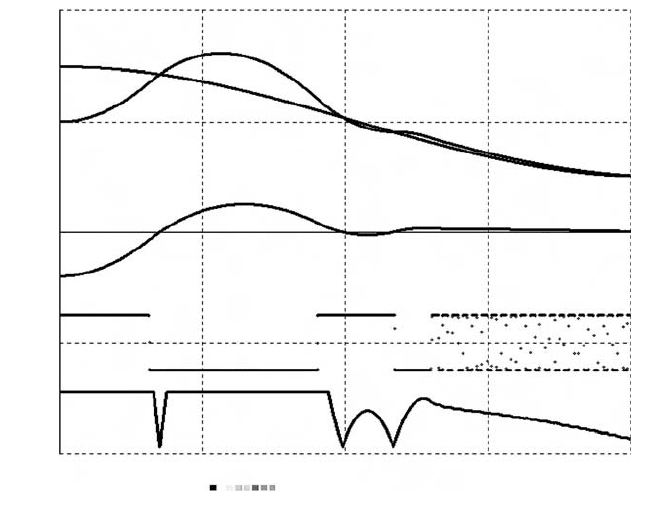
DT decreases to DTMIN when the servo error error is small. Figure 2-6a lists
the program, and Figure 2-6b shows results, including the interesting time
history of the programmed integration step.
If there is more than one discontinuous function, two or more
DT expres-
sions must be multiplied together
Modeling Limiters and Switches 47
8
DESIRE integration rules 4–8 let one set DTMAX explicitly. For integration rules 9–15, we
resort to the method of Section 2-11 and make
NN large enough to obtain the desired time res-
olution. We can use
MM > 1 to get more sampling points than input/output points.
48 Models with Difference Equations, Limiters, and Switches
-- BANG-BANG SERVOMECHANISM
-- ensures correct integration with step operator
--
-- DT is programmed heuristically with irule 5
------------------------------------------------------------------------
irule 5 | -- permits user-programmed DT
------------------------------------------------------------------------
scale = 2 | display N1 | display C8 | -- display
TMAX = 2.5 | NN = 10000
------------------------------------------------------------------------
A = 0.1 | w = 1.2 | -- signal parameters
B = 100 | maxtrq = 1 | -- motor parameters
g1 = 10000 | g2 = 1 | R = 0.6
k = 40 | r = 2.5 | -- control parameters
--
pp = 100 | DT0 = 0.0002 | DTMIN = DT0/10
-------
voltage = 0 | -- must initialize this!
drun
write "maxDT = ";DT0 + DTMIN
------------------------------------------------------------------------
DYNAMIC
------------------------------------------------------------------------
u = A * cos(w * t) | -- input
error = x - u | -- servo error
torque = maxtrq * tanh(g2 * V/maxtrq)
------------------------------------------------------------------------
d/dt V = - B * V + g1 * voltage | -- motor field delay
d/dt x = xdot |
d/dt xdot = torque - R * xdot
-----------------------------------------
step
voltage = - sgn(k * error + r * xdot - 0.01 * voltage)
DT = DT0 * SAT(abs(error * pp)) + DTMIN
--
-------------------------- rescaled stripchart display
--
X = 5 * x + 0.5 * scale | U = 5 * u + 0.5 * scale
ERROR = 4 * error
TORQUE = 0.25 * torque - 0.5 * scale
dt = 2500 * DT- scale
dispt X, U,TORQUE, ERROR, dt
FIGURE 2-6
a
. DESIRE program for the bang-bang servomechanism.
LIMITERS, SWITCHES, AND DIFFERENCE EQUATIONS
2-13. Limiters, Absolute Value, and Maximum/Minimum Selection
In most digital computers, the fastest nonlinear floating-point operation is not
the simple limiter function (Section 2-8; see also [2–4,10]) but the absolute-
value function
abs(x)
≡
|x| =
–x (x<0)
(2-9)
x(x<
–
0)
(full-wave rectifier), which only needs to change the sign bit of a floating-
point number. It is therefore profitable to remember the relations
lim(x)
≡
0.5 * [x + abs(x)]
≡
0.5 * x + abs(0.5 * x) (2-10)
sat(x)
≡
lim(x + 1) – lim(x – 1) – 1
≡
0.5 * [abs(x + 1) – abs(x – 1)] (2-11)
Limiters, Switches, and Difference Equations 49
+
0
u
error
torque
DT
–
0 1.25 2.5→
scale = 2 X,U,TORQUE,ERROR,dt vs. t
FIGURE 2-6
b
. Scaled stripchart display for the bang-bang servomechanism. The display
shows time histories of the input
u, output x, servo error, motor torque, and programmed time
step
DT. The original display showed each curve in a different color.
SAT(x)
≡
lim(x) – lim(x – 1)
≡
0.5 * [1 + abs(x) – abs(x – 1)] (2-12)
deadz(x)
≡
x – sat(x)
≡
x – 0.5 * [abs(x + 1) – abs(x – 1)] (2-13)
tri(x)
≡
1 – abs(x) lim[tri(x)]
≡
tri[sat(x)]
≡
TRI(x) (2-14)
These identities are, in fact, used to implement DESIRE’s library functions.
To find the largest and smallest of two arguments
x, y, we use
max(x, y)
≡
x + lim(y – x)
≡
y + lim(x – y)
≡
0.5 * [x + y + abs(x – y)] (2-15a)
min(x, y)
≡
x – lim(x – y)
≡
y – lim(y – x)
≡
0.5 * [x + y – abs(x – y)] (2-15b)
Note also
max(x, y) – min(x, y)
≡
x + y (2-16)
lim(x)
≡
max(x, 0) (2-17)
2-14. Output-limited Integration
Integration of the switched function
ydot = swtch(max – y) * lim(x)
+ swtch(y – min) * lim(–x) (min < max) (2-18)
stops whenever the integral
y produced by d/dt y = ydot exceeds preset
bounds [8]. Note that this is not the same as an integrator followed by an out-
put limiter.
2-15. Modeling Signal Quantization
The model digital controllers in Sections 2-6 and 2-7 processed ordinary
floating-point numbers [4]. But one may want to study the effects of signal
quantization in digital control systems or in simulated signal processors and
50 Models with Difference Equations, Limiters, and Switches
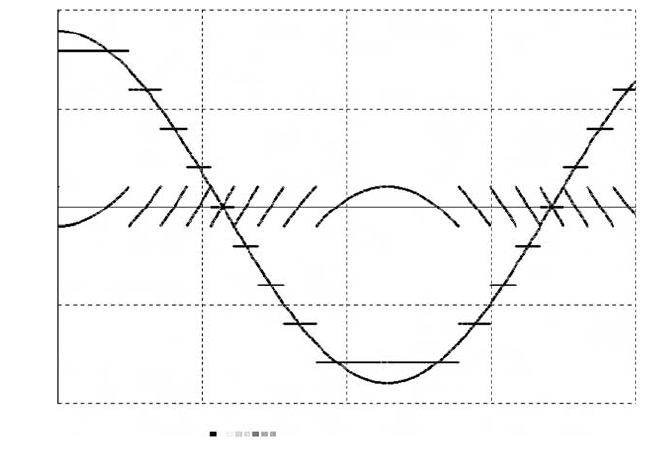
digital measurement systems. Figure 2-7 illustrates quantization of a sine
wave with the assignment
y = a * round(x/a)
where a is the quantization interval. The error y – x caused by signal quanti-
zation is the quantization noise.[4] The DESIRE library function
round(x)
returns floating-point numbers rounded to the nearest integer value, not inte-
gers.
round(x) is a switched step function that needs to follow a step, OUT,
or
SAMPLE m at the end of a DYNAMIC program segment. round(x) can
also implement rounding in experiment-protocol scripts.
2-16. Continuous-variable Difference Equations with Switching
and Limiter Operations
(a) Introduction
This section presents a number of powerful modeling tricks that implement
simple recursive assignments
q = F(t; q) (2-19)
in DYNAMIC program segments. We already discussed sampled-data assign-
ments of this form in Section 2-2. But
q is not necessarily a sampled-data
Limiters, Switches, and Difference Equations 51
+
0
–
0 0.55 → 1.1
scale = 1 x,
y
,z vs. t
FIGURE 2-7. Signal quantization and quantization noise.