
Korn G.A. Advanced Dynamic-system Simulation: Model-replication Techniques and Monte Carlo Simulation
Подождите немного. Документ загружается.


1-9. Sorting Defined-variable Assignments
DYNAMIC-segment operations (1-1) preceding an
OUT or SAMPLE m state-
ment (if any) execute at every derivative call of the differential-equation-solv-
ing integration routine. Each derivative or defined-variable assignment uses the
value of
t and the values of the state variables xi computed by the last deriva-
tive call. Derivative and defined-variable values for
t = t0 are derived from the
initial state-variable values and
t0 by an extra initial derivative call.
The defined-variable assignments (1-1b) must execute in the correct pro-
cedural order to derive each
yj value from the state-variable values and t, pos-
sibly using already computed
yi values. An out-of-order assignment would
incorrectly try to use defined-variable values from an earlier derivative call.
The state equations (1-1a) are normally programmed following the defined-
variable assignments (1-1b).
Conventional simulation programs such as ACSL
©
automatically sort the
defined-variable assignments so that they use only
yi values already com-
puted during the current derivative call. If that is impossible due to an “alge-
braic loop,” the program returns an error message (sort error). DESIRE’s
more general program system does not sort statements automatically. But in
programs without subscripted variables or vectors (Chapter 3), DESIRE pre-
vents assignments to undefined variables, and thus algebraic loops, by return-
ing an error message (see also Section 3-5).
3
EXAMPLES OF SIMPLE APPLICATIONS
1-10. Oscillators and Computer Displays
(a) A Linear Harmonic Oscillator
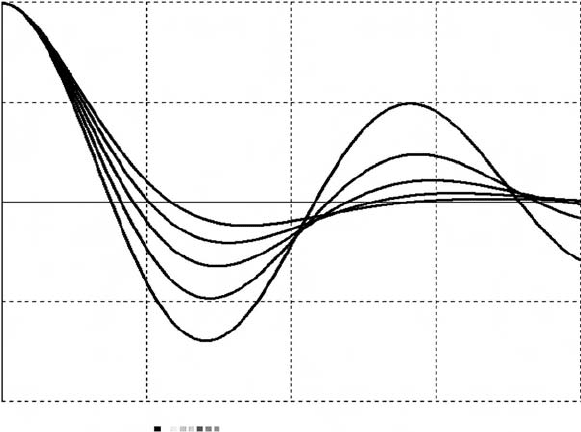
The complete small program in Figure 1-3 illustrates the main features of a
DESIRE simulation. The DYNAMIC program segment following the
DYNAMIC statement in Figure 1-3a defines our model. We have modeled a
simple damped harmonic oscillator or mass–spring–dashpot system with the
differential equations
d/dt x = xdot | d/dt xdot = – ww * x – r * xdot
12
Introduction to Dynamic-system Simulation
3
Recursive assignments that input the assigned-to variable on the right-hand side, as in
y = y + x y = a * x1 + y * x2
do not ordinarily appear in differential-equation code. If they do, DESIRE does not flag them
with error messages but considers them as difference equations and assigns
y the initial value 0
(Sections 2-1 and 2-2).
Examples of Simple Applications 13
+
0
-
0510→
scale = 1 x vs. t
FIGURE 1-3
a
. This complete simulation program for a linear oscillator produces five simu-
lation runs with different values of the damping coefficient
r.
A LINEAR OSCILLATOR
------------------------------------------------------------------------------
display N1 | display C8 | display Q
TMAX = 10 | DT = 0.0001 | NN = 10001
ww=0.8 | -- parameter value
x = 1 | -- initial value
-------------------------------------------------------------------------------
for i = 1 to 5 | -- set parameter values
r = 0.2 * i
drunr | display 2 | -- don't erase display
next
---------------------------------
DYNAMIC
--------------------------------
d/dt x = xdot | d/dt xdot = - ww * x - r * xdot
dispt x
14 Introduction to Dynamic-system Simulation
+
0
–
–1.0
scale = 1 x,xdot
–0.5 0.0 0.5 1.0
FIGURE 1-3
b
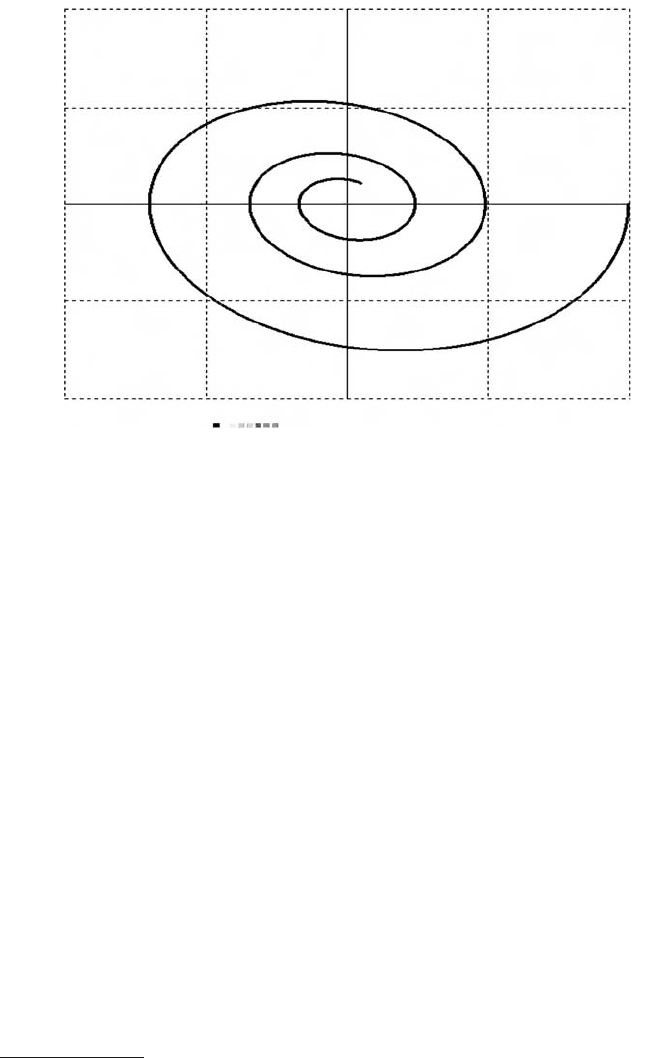
. A phase-plane plot (xdot versus x) for the linear oscillator in Figure 1-3a.
We can add a display specification:
• dispt x, xdot displays the variables x and xdot versus the simulation
time
t.
• dispxy x, xdot displays xdot versus x (phase-plane plot).
Model and display are exercised by the experiment-protocol script preced-
ing the
DYNAMIC statement. Successive experiment-protocol lines specify
• display colors and curve thickness
• the runtime TMAX, the integration step DT, and the number NN of dis-
play points
• a model parameter ww
• the initial value of the state variable x
Initial values of time t and of the state variable xdot are not specified and
default to 0. The integration routine defaults to a fixed-step second-order
Runge–Kutta rule.
4
A simple experiment-protocol loop next calls for five simulation runs with
five different values of the oscillator damping parameter
r. The resulting displays
are reproduced at the top of Figure 1-3a. Figure 1-3b shows a phase-plane plot.
4
The OPEN DESIRE reference manual in the book CD describes the complete program syn-
tax, default values of different simulation parameters, and operating instructions.
Examples of Simple Applications 15
(b) A Nonlinear Oscillator and Duffing’s Differential Equation
The differential equations
d/dt x = xdot | d/dt xdot = – x * x * x – a * xdot
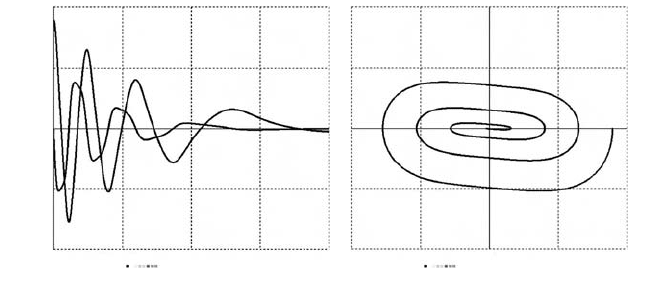
model an oscillator with a nonlinear spring. Figures 1-4a and b show the
resulting time histories and a phase-plane plot obtained with
a = 0.02. These
results are clearly different from the linear-oscillator response in Figure 1-3.
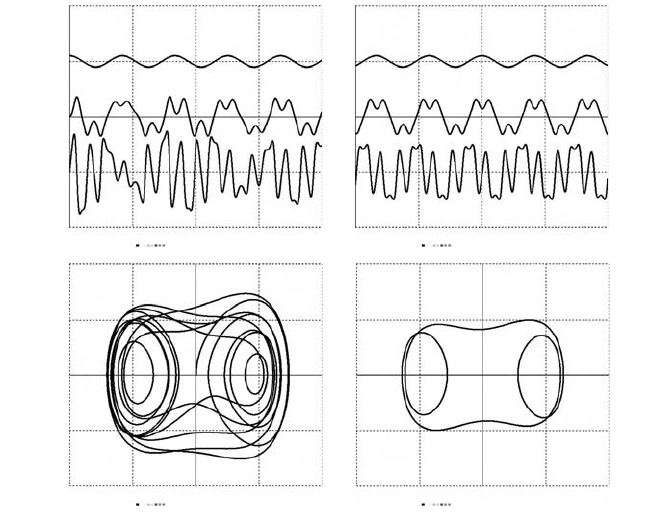
If we drive the nonlinear oscillator with a sinusoidal voltage
b cos(t),we
obtain Duffing’s differential-equation system
d/dt x = xdot | d/dt xdot = – x * x * x – a * xdot + b * cos(t)
Figure 1-4b shows solution displays and a program. The experiment-protocol
script is interesting in that it first calls a simulation run to exhibit the initial tran-
sient, then a long simulation run with the display turned off to establish steady-
state conditions, and finally a third run to display the steady-state solution.
Reference [9] discusses DESIRE programs for several other small physics
problems.
1-11. Space Vehicle Orbits—Variable-step Integration
The space-vehicle orbit simulation in Figure 1-5 assumes a fixed earth exert-
ing a simple inverse-square-law gravitational force on the satellite; effects of
planets, moons, and so on are neglected. With the sun at the coordinate ori-
gin, the inverse-square-law accelerations in the
x and y directions are
(d/dt) xdot = – (a/R2) x/R (d/dt) | ydot = – (a/R2) y/R
+
0
–
+
0
–
04080
x
xdot
→
scale = 1
–1.0 –0.5 0.0 0.5 1.0
scale = 1x,xdot vs. t x,xdot
FIGURE 1-4
a
. Time histories and phase-plane plot for the nonlinear oscillator modeled with
d/dt x = xdot | d/dt xdot = – x * x * x – a * xdot + b * cos(t).
16 Introduction to Dynamic-system Simulation
→→
+
0
–
+
0
–
–1.0 –0.5 0.0 0.5 1.0
scale = 10 X,xdot
–1.0 –0.5 0.0 0.5 1.0
scale = 10 X,xdot
+
0
–
+
0
–
0 15 30 230 245 260
scale = 10 z,x,xdot vs. t scale = 10 z,x,xdot vs. t
-- DUFFING'S DIFFERENTIAL EQUATION
----------------------------------------------------------------------------------------------------
scale = 10 | display N1 | display C8 | display Q
a = 0.099 | b = 15
TMAX = 30 | DT = 0.0002 | NN = 10000
X = 0.02
drun
write "type go to continue" | STOP
TMAX = 200 | display 0 | drun
write " note how solution becomes periodic!"
TMAX = 30 | display 1 | drun
--------------------------------------------------------------
DYNAMIC
--------------------------------------------------------------
d/dt x = xdot | d/dt xdot = - a * xdot - x * x * x + b * cos(t)
--
z = cos(t)
Z = 0.5 * (z + scale) | X = 0.5 * x | XDOT = 0.5 * (xdot - scale)
dispt Z, X, XDOT
FIGURE 1-4
b
. A simulation program for Duffing’s differential-equation system. The exper-
iment protocol first calls a simulation run demonstrating the initial transient, then a long run
without display to obtain a steady state
(TMAX = 200, display 0), and finally a third run show-
ing the steady-state solution with the display turned on again (
display 1). Phase-plane plots are
shown as well.
Examples of Simple Applications 17
+
0
–
+
y
25 DT
0
–
–1.0 –0.5 0.0 0.5 1.0
scale = 1
024→
scale = 2 y,dt vs. t
x,y
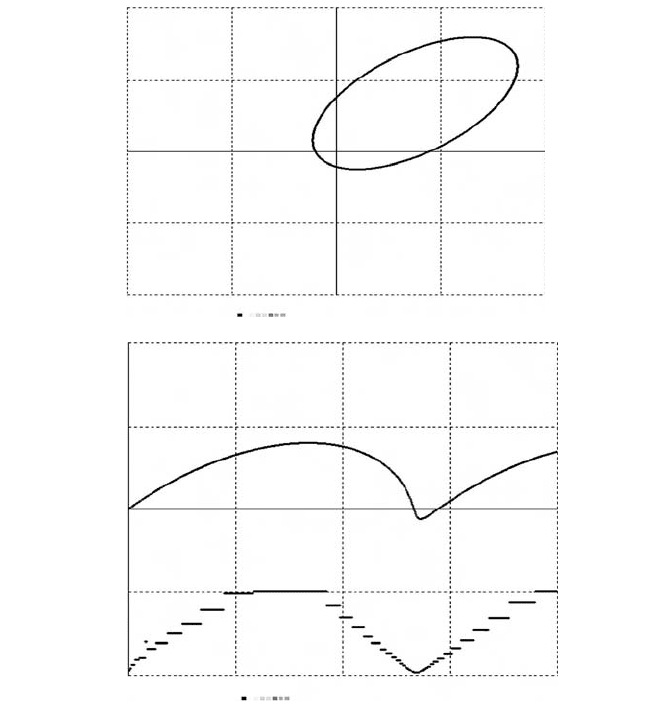
FIGURE 1-5. Space-vehicle-orbit simulation program, orbit display, and stripchart time his-
tories of
y and DT, showing the variable integration steps. For simplicity, the problem was
scaled so that all coefficients equal unity.
-- SPACE-VEHICLE-ORBIT SIMULATION
--------------------------------------------------------------------------------------------------
irule 15 | ERMAX = 0.0000001 | -- Gear-type integration
xdot = 1.4 | dot = 0.9 | x = 0.45 | y = 0
TMAX = 4 | DT = 0.0001 | NN = 10000
drun
--------------------------------------------------------------------------------------------------
DYNAMIC
--------------------------------------------------------------------------------------------------
rr = (x^2 + y^2)^(-1.5)
d/dt x = xdot | d/dt y = ydot
d/dt xdot = - x * rr | d/dt ydot = - y * rr

18 Introduction to Dynamic-system Simulation
With the program scaled so that the gravitational constant a = 1, we obtain
the simple differential-equation system
5
rr = (x^2 + y^2)^(–1.5)
d/dt x = xdot | d/dt y = ydot
d/dt xdot = – x * rr | d/dt ydot = – y * rr
In Figure 1-5, an orbit starts around the sun to gain velocity for a trip to the
outer planets. This involves dramatic velocity changes, and the small integra-
tion steps required during the high-velocity portion of the trajectory would
slow the rest of the simulation. For this reason, such simulations employ an
implicit variable-step/variable-order integration rule (
irule 15). The second
display in Figure 1-5 illustrates the integration-step changes.
1-12. A Population-dynamics Model
Typical population-dynamics models represent population counts by continu-
ous differential-equation state variables. There can be any number of popula-
tions, including subpopulations such as age and gender cohorts. Assignments
to the state derivatives describe interactions of different populations that may
breed, die, contract diseases, and fight or eat one another. Quite similar state-
equation systems also describe the reaction rates of “populations” of chemical
compounds or radioactive isotope mixtures (Section 7-1).
The classical example of a two-population predator–prey interaction is
modeled by the Volterra–Lotka differential equations
d/dt prey = (a1 – a4 * predator) * prey
d/dt predator = (– a2 + a3 * prey) * predator
The rate of increase of each population is proportional to the population
size.
a1 is the difference between the natural birth and death rates of the prey
(say of a local population of rabbits). The prey has an additional death rate
a4 * predator proportional to the size of the predator population (say a popu-
lation of foxes). The predator population has a death rate
a2, and its birth rate
a3 * prey is proportional to the prey population, which is its food supply.
5
This Cartesian-coordinate formulation is simpler than the polar-coordinate differential-
equation system:
x = r * cos(theta) | y = r * sin(theta)
d/dt r = rdot | d/dt rdot = - GK/(r^2) + r * thdot^2
d/dt theta = thdot | d/dt thdot = 2 * rdot * thdot/r
used in References [1,2].
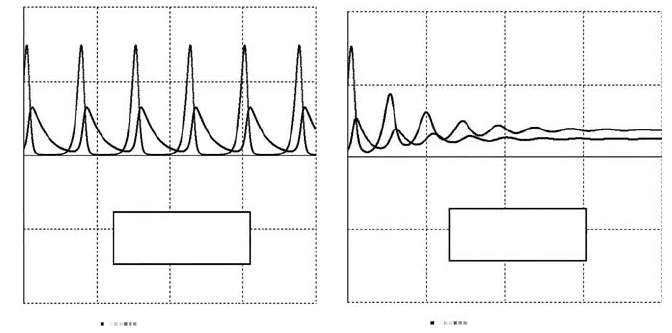
The simulation program in Figure 1-6 demonstrates how easily such
simple population-dynamics models can be modified. We added an extra
predator death rate
b * predator to account for the effect of crowding as the
predator population increases and some predators kill one another. For
b = 0
(no crowding) we obtain the classical periodic Volterra–Lotka solution: as
the rabbits breed, the foxes have more food; their number increases until
they seriously reduce the rabbit population and thus their food supply. The
Examples of Simple Applications 19
+
0
–
+
0
–
0
b = 0
(no crowding)
b > 0
(crowding)
1e+03 2e+03
scale = 4000 prey,predator vs. t
→
0 1e+03 2e+03
scale = 4000 prey,predator vs. t
→
FIGURE 1-6. A population-dynamics simulation. For b = 0 the program implements the clas-
sical Volterra–Lotka differential equations, which produce steady-state periodic fluctuations of
the predator and prey populations. Positive values of
b model an increased predator death rate
due to crowding, for example, by predator cannibalism. Predator and prey populations then
converge to constant steady-state values.
-- A PREDATOR-PREY PROBLEM
-- showing the effect of crowding
--------------------------------------------------------------------------------------------------
display N1 | display C8
TMAX = 2000 | DT = 0.01 | NN = 5000 | scale = 4000
a1 = 0.05 | a2 = 0.01 | a3 = 2.0E-05 | a4 = 1.0E-04
b = 0
prey = 2000 | predator = 200 | -- initial values
drunr
write " type go to see effect of predator crowding"
STOP
b = 1.0E-05 | drun
--------------------------------------------------------------------------------------------------
DYNAMIC
--------------------------------------------------------------------------------------------------
d/dt prey = (a1 - a4 * predator) * prey
d/dt predator = (- a2 + a3 * prey - b * predator) * predator
dispt prey, predator
20 Introduction to Dynamic-system Simulation
number of rabbits then increases again, and the process repeats. But crowd-
ing (
b > 0) limits the predator population, and both populations converge to
steady-state values.
1-13. Splicing Multiple Simulation Runs:
Billiard-ball Simulation
The DYNAMIC program segment in Figure 1-7 models a billiard ball as a point
(x, y) on a table bounded by elastic barriers at x = a, x = – a, y = b, and y = – b.
For x, y within the barriers, the only acceleration is due to constant friction in
the negative velocity direction, so that we program
d/dt x = xdot | d/dt y = ydot
d/dt xdot = – fric * xdot/v | d/dt ydot = – fric * ydot/v
where the velocity v is obtained with the defined-variable assignment
v = sqrt(xdot^2 + ydot^2)
A differential-equation model of barrier impacts would need to formulate
elastic and dissipative forces produced as the ball penetrates each barrier.
This is not only complicated but involves very large accelerations and thus
small integration steps. We neatly avoid these problems by terminating the
simulation run when a barrier is reached, that is, for
|x| > a or |y| > b:
term abs(x) – a | term abs(y) – b
The DESIRE experiment-protocol script then starts a new simulation run with
the current position coordinates
x, y and “reflected” velocity components
xdot, ydot:
if abs(x) > a then xdot = – R * xdot | ydot = R * ydot
else proceed
if abs(y) > b then xdot = R * xdot | ydot = – R * ydot
else proceed
where the restitution parameter R measures the energy absorbed by the
impact. A repeat loop continues this process until
t > Tstop. The detailed
syntax of
if/then/else and repeat/until statements in DESIRE experiment-
protocol scripts is found in the reference manual in the book CD. Figure 1-7
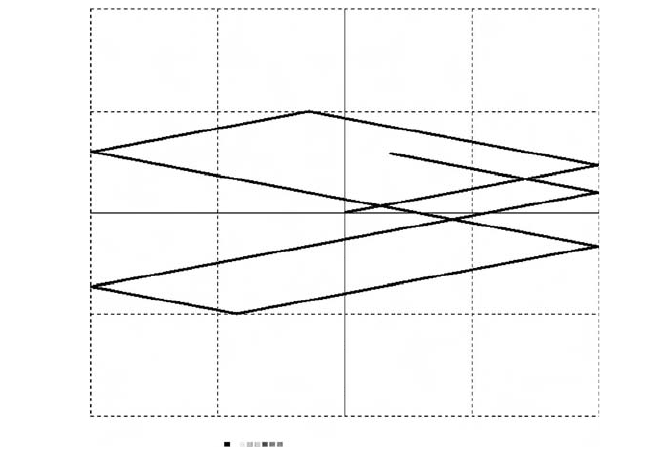
shows typical results as friction eventually brings the billiard ball to rest.
The
display 2 statement keeps the program from erasing the display
between runs.
Examples of Simple Applications 21
+
0
–
–1.0 –0.5 0.0 0.5 1.0
scale = 1 x,y
FIGURE 1-7. Billiard-ball simulation. The experiment-protocol script splices multiple
simulation runs terminated by impact on one of four barriers at
x = a, x = – a, y= b, y = – b.
-- BILLIARDS
--------------------------------------------------------------------------------------------------
NN = 2000 | DT = 0.01
TMAX = 20 | Tstop = 1000
-----
R = 0.9 | -- restitution parameter
fric = 0.0005 | -- acceleration due to friction
a = 1 | ^ b = 0.5
xdot = 0.15 | ydot = 0.035
repeat
drun | display 2 | -- don't erase the display
if abs(x) > a then xdot = - R * xdot | ydot = R * ydot
else proceed
if abs(y) > b then xdot = R * xdot | ydot = - R * ydot
else proceed
until t > Tstop
-------------------
DYNAMIC
--------------------------------------------------------------------------------------------------
v = sqrt(xdot^2 + ydot^2)
d/dt x = xdot | d/dt y = ydot
d/dt xdot = - fric * xdot/v | d/dt ydot = - fric * ydot/v
term abs(x) - a | term abs(y) - b
term t - Tstop
dispxy x,y