
Manning Ch. D., Raghavan P., Sch?tze H. Introduction to Information Retrieval - Введение в информационный поиск
Подождите немного. Документ загружается.


Online edition (c)2009 Cambridge UP
466 21 Link analysis
A
B
C
-
1
-
0.5
0.5
1
◮
Figure 21.2 A simple Markov chain with three states; the numbers on the links
indicate the transition probabilities.
In a Markov chain, the probability distribution of next states for a Markov
chain depends only on the current state, and not on how the Markov chain
arrived at the current state. Figure
21.2 shows a simple Markov chain with
three states. From the middle state A, we proceed with (equal) probabilities
of 0.5 to either B or C. From either B or C, we proceed with probability 1 to
A. The transition probability matrix of this Markov chain is then
0 0.5 0.5
1 0 0
1 0 0
A Markov chain’s probability distribution over its states may be viewed as
a probability vector: a vector all of whose entries are in the interval [0, 1], andPROBABILITY VECTOR
the entries add up to 1. An N-dimensional probability vector each of whose
components corresponds to one of the N states of a Markov chain can be
viewed as a probability distribution over its states. For our simple Markov
chain of Figure
21.2, the probability vector would have 3 components that
sum to 1.
We can view a random surfer on the web graph as a Markov chain, with
one state for each web page, and each transition probability representing the
probability of moving from one web page to another. The teleport operation
contributes to these transition probabilities. The adjacency matrix A of the
web graph is defined as follows: if there is a hyperlink from page i to page
j, then A
ij
= 1, otherwise A
ij
= 0. We can readily derive the transition
probability matrix P for our Markov chain from the N × N matrix A:
1. If a row of A has no 1’s, then replace each element by 1/N. For all other
rows proceed as follows.
2. Divide each 1 in A by the number of 1’s in its row. Thus, if there is a row
with three 1’s, then each of them is replaced by 1/3.
3. Multiply the resulting matrix by 1 − α.

Online edition (c)2009 Cambridge UP
21.2 PageRank 467
4.
Add α/N to every entry of the resulting matrix, to obtain P.
We can depict the probability distribution of the surfer’s position at any
time by a probability vector ~x. At t = 0 the surfer may begin at a state whose
corresponding entry in ~x is 1 while all others are zero. By definition, the
surfer’s distribution at t = 1 is given by the probability vector ~xP; at t = 2
by (~xP)P = ~xP
2
, and so on. We will detail this process in Section
21.2.2. We
can thus compute the surfer’s distribution over the states at any time, given
only the initial distribution and the transition probability matrix P.
If a Markov chain is allowed to run for many time steps, each state is vis-
ited at a (different) frequency that depends on the structure of the Markov
chain. In our running analogy, the surfer visits certain web pages (say, pop-
ular news home pages) more often than other pages. We now make this in-
tuition precise, establishing conditions under which such the visit frequency
converges to fixed, steady-state quantity. Following this, we set the Page-
Rank of each node v to this steady-state visit frequency and show how it can
be computed.
Definition: A Markov chain is said to be ergodic if there exists a positiveERGODIC MARKOV
CHAIN
integer T
0
such that for all pairs of states i, j in the Markov chain, if it is
started at time 0 in state i then for all t > T
0
, the probability of being in state
j at time t is greater than 0.
For a Markov chain to be ergodic, two technical conditions are required
of its states and the non-zero transition probabilities; these conditions are
known as irreducibility and aperiodicity. Informally, the first ensures that there
is a sequence of transitions of non-zero probability from any state to any
other, while the latter ensures that the states are not partitioned into sets
such that all state transitions occur cyclically from one set to another.
Theorem 21.1. For any ergodic Markov ch ain, there is a unique steady-state prob-STEADY-STATE
ability vector
~
π that is the principal left eigenvector of P, such that if η(i, t) is the
number of visits to sta te i in t steps, t hen
lim
t→∞
η(i, t)
t
= π(i),
where π(i) > 0 is the steady-state probability for state i.
It follows from Theorem
21.1 that the random walk with teleporting re-
sults in a unique distribution of steady-state probabilities over the states of
the induced Markov chain. This steady-state probability for a state is the
PageRank of the corresponding web page.

Online edition (c)2009 Cambridge UP
468 21 Link analysis
21.2.2 T he PageRank computation
How do we compute PageRank values? Recall the definition of a left eigen-
vector from Equation
18.2; the left eigenvectors of the transition probability
matrix P are N-vectors
~
π such that
~
π
P
= λ
~
π.
(21.2)
The N entries in the principal eigenvector
~
π are the steady-state proba-
bilities of the random walk with teleporting, and thus the PageRank values
for the corresponding web pages. We may interpret Equation (
21.2) as fol-
lows: if
~
π is the probability distribution of the surfer across the web pages,
he remains in the steady-state distribution
~
π. Given that
~
π is the steady-state
distribution, we have that πP = 1π, so 1 is an eigenvalue of P. Thus if we
were to compute the principal left eigenvector of the matrix P — the one with
eigenvalue 1 — we would have computed the PageRank values.
There are many algorithms available for computing left eigenvectors; the
references at the end of Chapter
18 and the present chapter are a guide to
these. We give here a rather elementary method, sometimes known as power
iteration. If ~x is the initial distribution over the states, then the distribution at
time t is ~xP
t
. As t grows large, we would expect that the distribution ~xP
t2
is very similar to the distribution ~xP
t+1
, since for large t we would expect
the Markov chain to attain its steady state. By Theorem
21.1 this is indepen-
dent of the initial distribution ~x. The power iteration method simulates the
surfer’s walk: begin at a state and run the walk for a large number of steps
t, keeping track of the visit frequencies for each of the states. After a large
number of steps t, these frequencies “settle down” so that the variation in the
computed frequencies is below some predetermined threshold. We declare
these tabulated frequencies to be the PageRank values.
We consider the web graph in Exercise
21.6 with α = 0.5. The transition
probability matrix of the surfer’s walk with teleportation is then
P =
1/6 2/3 1/6
5/12 1/6 5/12
1/6 2/3 1/6
.
(21.3)
Imagine that the surfer starts in state 1, corresponding to the initial proba-
bility distribution vector ~x
0
= (1 0 0). Then, after one step the distribution
is
~x
0
P =
1/6 2/3 1/6
= ~x
1
.
(21.4)
2. Note that P
t
represents P raised to the tth power, not the transpose of P which is denoted P
T
.

Online edition (c)2009 Cambridge UP
21.2 PageRank 469
~x
0
1 0 0
~x
1
1/6 2/3 1/6
~x
2
1/3 1/3 1/3
~x
3
1/4 1/2 1/4
~x
4
7/24 5/12 7/24
. . . ··· ··· ···
~x 5/18 4/9 5/18
◮
Figure 21.3 The sequence of probability vectors.
After two steps it is
~x
1
P =
1/6 2/3 1/6
1/6 2/3 1/6
5/12 1/6 5/12
1/6 2/3 1/6
=
1/3 1/3 1/3
= ~x
2
.
(21.5)
Continuing in this fashion gives a sequence of probability vectors as shown
in Figure
21.3.
Continuing for several steps, we see that the distribution converges to the
steady state of ~x = (5/18 4/9 5/18). In this simple example, we may
directly calculate this steady-state probability distribution by observing the
symmetry of the Markov chain: states 1 and 3 are symmetric, as evident from
the fact that the first and third rows of the transition probability matrix in
Equation (
21.3) are identical. Postulating, then, that they both have the same
steady-state probability and denoting this probability by p, we know that the
steady-state distribution is of the form
~
π = (p 1 −2p p). Now, using the
identity
~
π =
~
πP, we solve a simple linear equation to obtain p = 5/18 and
consequently,
~
π = (5/18 4/9 5/18).
The PageRank values of pages (and the implicit ordering amongst them)
are independent of any query a user might pose; PageRank is thus a query-
independent measure of the static quality of each web page (recall such static
quality measures from Section
7.1.4). On the other hand, the relative order-
ing of pages should, intuitively, depend on the query being served. For this
reason, search engines use static quality measures such as PageRank as just
one of many factors in scoring a web page on a query. Indeed, the relative
contribution of PageRank to the overall score may again be determined by
machine-learned scoring as in Section
15.4.1.
Online edition (c)2009 Cambridge UP
470 21 Link analysis
d
0
d
2
d
1
d
5
d
3
d
6
d
4
car
benz
ford
gm
honda
jaguar
jag
cat
leopard
tiger
jaguar
lion
cheetah
speed
◮
Figure 21.4 A small web graph. Arcs are annotated with the word that occurs in
the anchor text of the corresponding link.
✎
Example 21.1: Consider the graph in Figure
21.4. For a teleportation rate of 0.14
its (stochastic) transition probability matrix is:
0.02 0.02 0.88 0.02 0.02 0.02 0.02
0.02 0.45 0.45 0.02 0.02 0.02 0.02
0.31 0.02 0.31 0.31 0.02 0.02 0.02
0.02 0.02 0.02 0.45 0.45 0.02 0.02
0.02 0.02 0.02 0.02 0.02 0.02 0.88
0.02 0.02 0.02 0.02 0.02 0.45 0.45
0.02 0.02 0.02 0.31 0.31 0.02 0.31
The PageRank vector of this matrix is:
~x = (0.05 0.04 0.11 0.25 0.21 0.04 0.31)
(21.6)
Observe that in Figure 21.4, q
2
, q
3
, q
4
and q
6
are the nodes with at least two in-links.
Of these, q
2
has the lowest PageRank since the random walk tends to drift out of the
top part of the graph – the walker can only return there through teleportation.
Online edition (c)2009 Cambridge UP
21.2 PageRank 471
21.2.3 Topic-specific PageRank
Thus far we have discussed the PageRank computation with a teleport op-
eration in which the surfer jumps to a random web page chosen uniformly
at random. We now consider teleporting to a random web page chosen non-
uniformly. In doing so, we are able to derive PageRank values tailored to
particular interests. For instance, a sports aficionado might wish that pages
on sports be ranked higher than non-sports pages. Suppose that web pages
on sports are “near” one another in the web graph. Then, a random surfer
who frequently finds himself on random sports pages is likely (in the course
of the random walk) to spend most of his time at sports pages, so that the
steady-state distribution of sports pages is boosted.
Suppose our random surfer, endowed with a teleport operation as before,
teleports to a random web page on the topic of sports instead of teleporting to a
uniformly chosen random web page. We will not focus on how we collect all
web pages on the topic of sports; in fact, we only need a non-zero subset S of
sports-related web pages, so that the teleport operation is feasible. This may
be obtained, for instance, from a manually built directory of sports pages
such as the open directory project (http://www.dmoz.org/) or that of Yahoo.
Provided the set S of sports-related pages is non-empty, it follows that
there is a non-empty set of web pages Y ⊇ S over which the random walk
has a steady-state distribution; let us denote this sports PageRank distribution
by
~
π
s
. For web pages not in Y, we set the PageRank values to zero. We call
~
π
s
the topic-specific PageRank for sports.TOPIC-SPECIFIC
PAGERANK
We do not demand that teleporting takes the random surfer to a uniformly
chosen sports page; the distribution over teleporting targets S could in fact
be arbitrary.
In like manner we can envision topic-specific PageRank distributions for
each of several topics such as science, religion, politics and so on. Each of
these distributions assigns to each web page a PageRank value in the interval
[0, 1). For a user interested in only a single topic from among these topics,
we may invoke the corresponding PageRank distribution when scoring and
ranking search results. This gives us the potential of considering settings in
which the search engine knows what topic a user is interested in. This may
happen because users either explicitly register their interests, or because the
system learns by observing each user’s behavior over time.
But what if a user is known to have a mixture of interests from multiple
topics? For instance, a user may have an interest mixture (or profile) that is
60% sports and 40% politics; can we compute a personalized PageRank for thisPERSONALIZED
PAGERANK
user? At first glance, this appears daunting: how could we possibly compute
a different PageRank distribution for each user profile (with, potentially, in-
finitely many possible profiles)? We can in fact address this provided we
assume that an individual’s interests can be well-approximated as a linear
Online edition (c)2009 Cambridge UP
472 21 Link analysis
◮
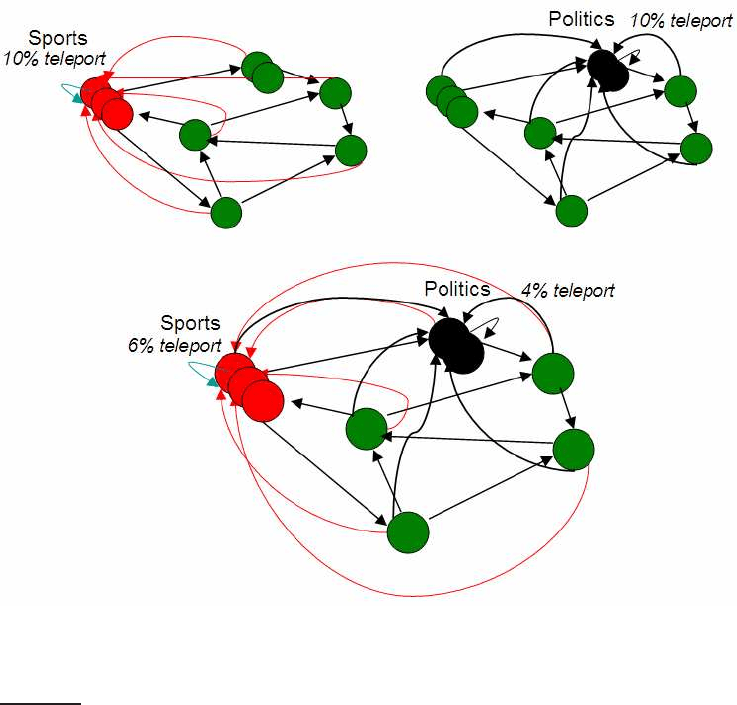
Figure 21.5 Topic-specific PageRank. In this example we consider a user whose
interests are 60% sports and 40% politics. If the teleportation probability is 10%, this
user is modeled as teleporting 6% to sports pages and 4% to politics pages.
combination of a small number of topic page distributions. A user with this
mixture of interests could teleport as follows: determine first whether to tele-
port to the set S of known sports pages, or to the set of known politics pages.
This choice is made at random, choosing sports pages 60% of the time and
politics pages 40% of the time. Once we choose that a particular teleport step
is to (say) a random sports page, we choose a web page in S uniformly at
random to teleport to. This in turn leads to an ergodic Markov chain with a
steady-state distribution that is personalized to this user’s preferences over
topics (see Exercise
21.16).
While this idea has intuitive appeal, its implementation appears cumber-
some: it seems to demand that for each user, we compute a transition prob-
Online edition (c)2009 Cambridge UP
21.2 PageRank 473
ability matrix and compute its steady-state distribution. We are rescued by
the fact that the evolution of the probability distribution over the states of
a Markov chain can be viewed as a linear system. In Exercise
21.16 we will
show that it is not necessary to compute a PageRank vector for every distinct
combination of user interests over topics; the personalized PageRank vector
for any user can be expressed as a linear combination of the underlying topic-
specific PageRanks. For instance, the personalized PageRank vector for the
user whose interests are 60% sports and 40% politics can be computed as
0.6
~
π
s
+ 0.4
~
π
p
,
(21.7)
where
~
π
s
and
~
π
p
are the topic-specific PageRank vectors for sports and for
politics, respectively.
?
Exercise 21.5
Write down the transition probability matrix for the example in Figure 21.2.
Exercise 21.6
Consider a web graph with three nodes 1, 2 and 3. The links are as follows: 1 →
2, 3 → 2, 2 → 1,2 → 3. Write down the transition probability matrices for the surfer’s
walk with teleporting, for the following three values of the teleport probability: (a)
α = 0; (b) α = 0.5 and (c) α = 1.
Exercise 21.7
A user of a browser can, in addition to clicking a hyperlink on the page x he is cur-
rently browsing, use the back button to go back to the page from which he arrived at
x. Can such a user of back buttons be modeled as a Markov chain? How would we
model repeated invocations of the back button?
Exercise 21.8
Consider a Markov chain with three states A, B and C, and transition probabilities as
follows. From state A, the next state is B with probability 1. From B, the next state is
either A with probability p
A
, or state C with probability 1 − p
A
. From C the next state
is A with probability 1. For what values of p
A
∈ [0, 1] is this Markov chain ergodic?
Exercise 21.9
Show that for any directed graph, the Markov chain induced by a random walk with
the teleport operation is ergodic.
Exercise 21.10
Show that the PageRank of every page is at least α/N. What does this imply about
the difference in PageRank values (over the various pages) as α becomes close to 1?
Exercise 21.11
For the data in Example 21.1, write a small routine or use a scientific calculator to
compute the PageRank values stated in Equation (
21.6).
Online edition (c)2009 Cambridge UP
474 21 Link analysis
Exercise 21.12
Suppose that the web graph is stored on disk as an adjacency list, in such a way that
you may only query for the out-neighbors of pages in the order in which they are
stored. You cannot load the graph in main memory but you may do multiple reads
over the full graph. Write the algorithm for computing the PageRank in this setting.
Exercise 21.13
Recall the sets S and Y introduced near the beginning of Section 21.2.3. How does the
set Y relate to S?
Exercise 21.14
Is the set Y always the set of all web pages? Why or why not?
Exercise 21.15 [⋆ ⋆ ⋆]
Is the sports PageRank of any page in S at least as large as its PageRank?
Exercise 21.16 [⋆ ⋆ ⋆]
Consider a setting where we have two topic-specific PageRank values for each web
page: a sports PageRank
~
π
s
, and a politics PageRank
~
π
p
. Let α be the (common)
teleportation probability used in computing both sets of topic-specific PageRanks.
For q ∈ [0, 1], consider a user whose interest profile is divided between a fraction q in
sports and a fraction 1 − q in politics. Show that the user’s personalized PageRank is
the steady-state distribution of a random walk in which – on a teleport step – the walk
teleports to a sports page with probability q and to a politics page with probability
1 − q.
Exercise 21.17
Show that the Markov chain corresponding to the walk in Exercise 21.16 is ergodic
and hence the user’s personalized PageRank can be obtained by computing the steady-
state distribution of this Markov chain.
Exercise 21.18
Show that in the steady-state distribution of Exercise 21.17, the steady-state probabil-
ity for any web page i equals qπ
s
(i) + (1 − q)π
p
(i).
21.3 Hubs and Authorities
We now develop a scheme in which, given a query, every web page is as-
signed two scores. One is called its hub score and the other its authority score.HUB SCORE
AUTHORITY SCORE
For any query, we compute two ranked lists of results rather than one. The
ranking of one list is induced by the hub scores and that of the other by the
authority scores.
This approach stems from a particular insight into the creation of web
pages, that there are two primary kinds of web pages useful as results for
broad-topic searches. By a broad topic search we mean an informational query
such as "I wish to learn about leukemia". There are authoritative sources of
information on the topic; in this case, the National Cancer Institute’s page on
Online edition (c)2009 Cambridge UP
21.3 Hubs and Authorities 475
leukemia would be such a page. We will call such pages authorities; in the
computation we are about to describe, they are the pages that will emerge
with high authority scores.
On the other hand, there are many pages on the Web that are hand-compiled
lists of links to authoritative web pages on a specific topic. These hub pages
are not in themselves authoritative sources of topic-specific information, but
rather compilations that someone with an interest in the topic has spent time
putting together. The approach we will take, then, is to use these hub pages
to discover the authority pages. In the computation we now develop, these
hub pages are the pages that will emerge with high hub scores.
A good hub page is one that points to many good authorities; a good au-
thority page is one that is pointed to by many good hub pages. We thus
appear to have a circular definition of hubs and authorities; we will turn this
into an iterative computation. Suppose that we have a subset of the web con-
taining good hub and authority pages, together with the hyperlinks amongst
them. We will iteratively compute a hub score and an authority score for ev-
ery web page in this subset, deferring the discussion of how we pick this
subset until Section
21.3.1.
For a web page v in our subset of the web, we use h(v) to denote its hub
score and a(v) its authority score. Initially, we set h(v) = a(v) = 1 for all
nodes v. We also denote by v 7→ y the existence of a hyperlink from v to
y. The core of the iterative algorithm is a pair of updates to the hub and au-
thority scores of all pages given by Equation
21.8, which capture the intuitive
notions that good hubs point to good authorities and that good authorities
are pointed to by good hubs.
h(v) ←
∑
v7→y
a (y)
(21.8)
a (v) ←
∑
y7→v
h(y).
Thus, the first line of Equation (
21.8) sets the hub score of page v to the sum
of the authority scores of the pages it links to. In other words, if v links to
pages with high authority scores, its hub score increases. The second line
plays the reverse role; if page v is linked to by good hubs, its authority score
increases.
What happens as we perform these updates iteratively, recomputing hub
scores, then new authority scores based on the recomputed hub scores, and
so on? Let us recast the equations Equation (
21.8) into matrix-vector form.
Let
~
h and~a denote the vectors of all hub and all authority scores respectively,
for the pages in our subset of the web graph. Let A denote the adjacency
matrix of the subset of the web graph that we are dealing with: A is a square
matrix with one row and one column for each page in the subset. The entry