
Manning Ch. D., Raghavan P., Sch?tze H. Introduction to Information Retrieval - Введение в информационный поиск
Подождите немного. Документ загружается.

Online edition (c)2009 Cambridge UP
436 19 Web search basics
that many hosts might share one IP (due to a practice known as virtual
hosting) or not accept http requests from the host where the experiment
is conducted. Furthermore, this technique is more likely to hit one of the
many sites with few pages, skewing the document probabilities; we may
be able to correct for this effect if we understand the distribution of the
number of pages on websites.
3. Random walks: If the web graph were a strongly connected directed graph,
we could run a random walk starting at an arbitrary web page. This
walk would converge to a steady state distribution (see Chapter
21, Sec-
tion 21.2.1 for more background material on this), from which we could in
principle pick a web page with a fixed probability. This method, too has
a number of biases. First, the Web is not strongly connected so that, even
with various corrective rules, it is difficult to argue that we can reach a
steady state distribution starting from any page. Second, the time it takes
for the random walk to settle into this steady state is unknown and could
exceed the length of the experiment.
Clearly each of these approaches is far from perfect. We now describe a
fourth sampling approach, random queries. This approach is noteworthy for
two reasons: it has been successfully built upon for a series of increasingly
refined estimates, and conversely it has turned out to be the approach most
likely to be misinterpreted and carelessly implemented, leading to mislead-
ing measurements. The idea is to pick a page (almost) uniformly at random
from a search engine’s index by posing a random query to it. It should be
clear that picking a set of random terms from (say) Webster’s dictionary is
not a good way of implementing this idea. For one thing, not all vocabulary
terms occur equally often, so this approach will not result in documents be-
ing chosen uniformly at random from the search engine. For another, there
are a great many terms in web documents that do not occur in a standard
dictionary such as Webster’s. To address the problem of vocabulary terms
not in a standard dictionary, we begin by amassing a sample web dictionary.
This could be done by crawling a limited portion of the Web, or by crawling a
manually-assembled representative subset of the Web such as Yahoo! (as was
done in the earliest experiments with this method). Consider a conjunctive
query with two or more randomly chosen words from this dictionary.
Operationally, we proceed as follows: we use a random conjunctive query
on E
1
and pick from the top 100 returned results a page p at random. We
then test p for presence in E
2
by choosing 6-8 low-frequency terms in p and
using them in a conjunctive query for E
2
. We can improve the estimate by
repeating the experiment a large number of times. Both the sampling process
and the testing process have a number of issues.
1. Our sample is biased towards longer documents.
Online edition (c)2009 Cambridge UP
19.6 Near-duplicates and shingling 437
2.
Picking from the top 100 results of E
1
induces a bias from the ranking
algorithm of E
1
. Picking from all the results of E
1
makes the experiment
slower. This is particularly so because most web search engines put up
defenses against excessive robotic querying.
3. During the checking phase, a number of additional biases are introduced:
for instance, E
2
may not handle 8-word conjunctive queries properly.
4. Either E
1
or E
2
may refuse to respond to the test queries, treating them as
robotic spam rather than as bona fide queries.
5. There could be operational problems like connection time-outs.
A sequence of research has built on this basic paradigm to eliminate some
of these issues; there is no perfect solution yet, but the level of sophistica-
tion in statistics for understanding the biases is increasing. The main idea
is to address biases by estimating, for each document, the magnitude of the
bias. From this, standard statistical sampling methods can generate unbi-
ased samples. In the checking phase, the newer work moves away from
conjunctive queries to phrase and other queries that appear to be better-
behaved. Finally, newer experiments use other sampling methods besides
random queries. The best known of these is document random walk sampling,
in which a document is chosen by a random walk on a virtual graph de-
rived from documents. In this graph, nodes are documents; two documents
are connected by an edge if they share two or more words in common. The
graph is never instantiated; rather, a random walk on it can be performed by
moving from a document d to another by picking a pair of keywords in d,
running a query on a search engine and picking a random document from
the results. Details may be found in the references in Section
19.7.
?
Exercise 19.7
Two web search engines A and B each generate a large number of pages uniformly at
random from their indexes. 30% of A’s pages are present in B’s index, while 50% of
B’s pages are present in A’s index. What is the number of pages in A’s index relative
to B’s?
19.6 Near-duplicates and shingling
One aspect we have ignored in the discussion of index size in Section
19.5 is
duplication: the Web contains multiple copies of the same content. By some
estimates, as many as 40% of the pages on the Web are duplicates of other
pages. Many of these are legitimate copies; for instance, certain information
repositories are mirrored simply to provide redundancy and access reliabil-
ity. Search engines try to avoid indexing multiple copies of the same content,
to keep down storage and processing overheads.
Online edition (c)2009 Cambridge UP
438 19 Web search basics
The simplest approach to detecting duplicates is to compute, for each web
page, a fingerprint that is a succinct (say 64-bit) digest of the characters on that
page. Then, whenever the fingerprints of two web pages are equal, we test
whether the pages themselves are equal and if so declare one of them to be a
duplicate copy of the other. This simplistic approach fails to capture a crucial
and widespread phenomenon on the Web: near duplication. In many cases,
the contents of one web page are identical to those of another except for a
few characters – say, a notation showing the date and time at which the page
was last modified. Even in such cases, we want to be able to declare the two
pages to be close enough that we only index one copy. Short of exhaustively
comparing all pairs of web pages, an infeasible task at the scale of billions of
pages, how can we detect and filter out such near duplicates?
We now describe a solution to the problem of detecting near-duplicate web
pages. The answer lies in a technique known as shingling. Given a positiveSHINGLING
integer k and a sequence of terms in a document d, define the k-shingles of
d to be the set of all consecutive sequences of k terms in d. As an example,
consider the following text: arose is a rose is a rose. The 4-shingles for this text
(k = 4 is a typical value used in the detection of near-duplicate web pages)
are a rose is a, rose is a rose and is a rose is. The first two of these shingles
each occur twice in the text. Intuitively, two documents are near duplicates if
the sets of shingles generated from them are nearly the same. We now make
this intuition precise, then develop a method for efficiently computing and
comparing the sets of shingles for all web pages.
Let S(d
j
) denote the set of shingles of document d
j
. Recall the Jaccard
coefficient from page
61, which measures the degree of overlap between
the sets S(d
1
) and S(d
2
) as |S(d
1
) ∩ S(d
2
)|/|S(d
1
) ∪ S(d
2
)|; denote this by
J(S(d
1
), S(d
2
)). Our test for near duplication between d
1
and d
2
is to com-
pute this Jaccard coefficient; if it exceeds a preset threshold (say, 0.9), we
declare them near duplicates and eliminate one from indexing. However,
this does not appear to have simplified matters: we still have to compute
Jaccard coefficients pairwise.
To avoid this, we use a form of hashing. First, we map every shingle into
a hash value over a large space, say 64 bits. For j = 1, 2, let H(d
j
) be the
corresponding set of 64-bit hash values derived from S(d
j
). We now invoke
the following trick to detect document pairs whose sets H() have large Jac-
card overlaps. Let π be a random permutation from the 64-bit integers to the
64-bit integers. Denote by Π(d
j
) the set of permuted hash values in H(d
j
);
thus for each h ∈ H(d
j
), there is a corresponding value π(h) ∈ Π(d
j
).
Let x
π
j
be the smallest integer in Π(d
j
). Then
Theorem 19.1.
J(S(d
1
), S(d
2
)) = P(x
π
1
= x
π
2
).
Online edition (c)2009 Cambridge UP
19.6 Near-duplicates and shingling 439
-
-
-
-
-
-
-
-
0
0
0
0
0
0
0
0
2
64
−1
2
64
−1
2
64
−1
2
64
−1
2
64
−1
2
64
−1
2
64
−1
2
64
−1
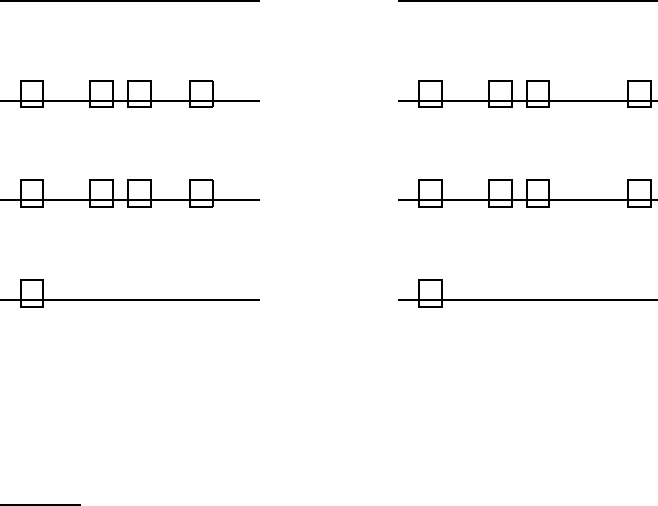
Document 1 Document 2
H(d
1
) H(d
2
)
u
1
u
1
u
2
u
2
u
3
u
3
u
4
u
4
H(d
1
) and Π(d
1
) H(d
2
) and Π(d
2
)
u uu uu uu u
3 31 14 42 2
3 31 14 42 2
3 3
Π(d
1
) Π(d
2
)
x
π
1
x
π
2
◮
Figure 19.8 Illustration of shingle sketches. We see two documents going through
four stages of shingle sketch computation. In the first step (top row), we apply a 64-bit
hash to each shingle from each document to obtain H(d
1
) and H(d
2
) (circles). Next,
we apply a random permutation Π to permute H(d
1
) and H(d
2
), obtaining Π(d
1
)
and Π(d
2
) (squares). The third row shows only Π(d
1
) and Π(d
2
), while the bottom
row shows the minimum values x
π
1
and x
π
2
for each document.
Proof. We give the proof in a slightly more general setting: consider a family
of sets whose elements are drawn from a common universe. View the sets
as columns of a matrix A, with one row for each element in the universe.
The element a
ij
= 1 if element i is present in the set S
j
that the jth column
represents.
Let Π be a random permutation of the rows of A; denote by Π(S
j
) the
column that results from applying Π to the jth column. Finally, let x
π
j
be the
index of the first row in which the column Π(S
j
) has a 1. We then prove that
for any two columns j
1
, j
2
,
P(x
π
j
1
= x
π
j
2
) = J(S
j
1
, S
j
2
).
If we can prove this, the theorem follows.
Consider two columns j
1
, j
2
as shown in Figure
19.9. The ordered pairs of
entries of S
j
1
and S
j
2
partition the rows into four types: those with 0’s in both
of these columns, those with a 0 in S
j
1
and a 1 in S
j
2
, those with a 1 in S
j
1
and a 0 in S
j
2
, and finally those with 1’s in both of these columns. Indeed,
the first four rows of Figure
19.9 exemplify all of these four types of rows.
Online edition (c)2009 Cambridge UP
440 19 Web search basics
S
j
1
S
j
2
0 1
1 0
1 1
0 0
1 1
0 1
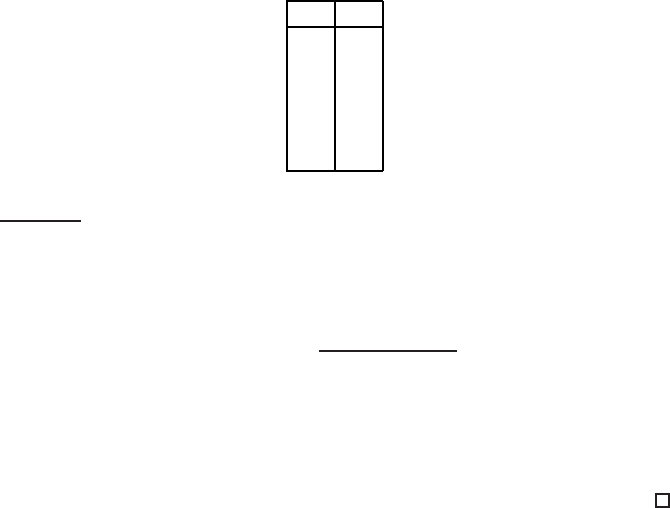
◮
Figure 19.9 Two sets S
j
1
and S
j
2
; their Jaccard coefficient is 2/5.
Denote by C
00
the number of rows with 0’s in both columns, C
01
the second,
C
10
the third and C
11
the fourth. Then,
J(S
j
1
, S
j
2
) =
C
11
C
01
+ C
10
+ C
11
.
(19.2)
To complete the proof by showing that the right-hand side of Equation (19.2)
equals P(x
π
j
1
= x
π
j
2
), consider scanning columns j
1
, j
2
in increasing row in-
dex until the first non-zero entry is found in either column. Because Π is a
random permutation, the probability that this smallest row has a 1 in both
columns is exactly the right-hand side of Equation (
19.2).
Thus, our test for the Jaccard coefficient of the shingle sets is probabilis-
tic: we compare the computed values x
π
i
from different documents. If a pair
coincides, we have candidate near duplicates. Repeat the process indepen-
dently for 200 random permutations π (a choice suggested in the literature).
Call the set of the 200 resulting values of x
π
i
the sketch ψ(d
i
) of d
i
. We can
then estimate the Jaccard coefficient for any pair of documents d
i
, d
j
to be
|ψ
i
∩ψ
j
|/200; if this exceeds a preset threshold, we declare that d
i
and d
j
are
similar.
How can we quickly compute |ψ
i
∩ ψ
j
|/200 for all pairs i, j? Indeed, how
do we represent all pairs of documents that are similar, without incurring
a blowup that is quadratic in the number of documents? First, we use fin-
gerprints to remove all but one copy of identical documents. We may also
remove common HTML tags and integers from the shingle computation, to
eliminate shingles that occur very commonly in documents without telling
us anything about duplication. Next we use a union-find algorithm to create
clusters that contain documents that are similar. To do this, we must accom-
plish a crucial step: going from the set of sketches to the set of pairs i, j such
that d
i
and d
j
are similar.
To this end, we compute the number of shingles in common for any pair of
documents whose sketches have any members in common. We begin with
the list < x
π
i
, d
i
> sorted by x
π
i
pairs. For each x
π
i
, we can now generate
Online edition (c)2009 Cambridge UP
19.7 References and further reading 441
all pairs i, j for which x
π
i
is present in both their sketches. From these we
can compute, for each pair i, j with non-zero sketch overlap, a count of the
number of x
π
i
values they have in common. By applying a preset threshold,
we know which pairs i , j have heavily overlapping sketches. For instance, if
the threshold were 80%, we would need the count to be at least 160 for any
i, j. As we identify such pairs, we run the union-find to group documents
into near-duplicate “syntactic clusters”. This is essentially a variant of the
single-link clustering algorithm introduced in Section
17.2 (page 382).
One final trick cuts down the space needed in the computation of |ψ
i
∩
ψ
j
|/200 for pairs i, j, which in principle could still demand space quadratic
in the number of documents. To remove from consideration those pairs i, j
whose sketches have few shingles in common, we preprocess the sketch for
each document as follows: sort the x
π
i
in the sketch, then shingle this sorted
sequence to generate a set of super-shingles for each document. If two docu-
ments have a super-shingle in common, we proceed to compute the precise
value of |ψ
i
∩ ψ
j
|/200. This again is a heuristic but can be highly effective
in cutting down the number of i, j pairs for which we accumulate the sketch
overlap counts.
?
Exercise 19.8
Web search engines A and B each crawl a random subset of the same size of the Web.
Some of the pages crawled are duplicates – exact textual copies of each other at dif-
ferent URLs. Assume that duplicates are distributed uniformly amongst the pages
crawled by A and B. Further, assume that a duplicate is a page that has exactly two
copies – no pages have more than two copies. A indexes pages without duplicate
elimination whereas B indexes only one copy of each duplicate page. The two ran-
dom subsets have the same size before duplicate elimination. If, 45% of A’s indexed
URLs are present in B’s index, while 50% of B’s indexed URLs are present in A’s
index, what fraction of the Web consists of pages that do not have a duplicate?
Exercise 19.9
Instead of using the process depicted in Figure 19.8, consider instead the following
process for estimating the Jaccard coefficient of the overlap between two sets S
1
and
S
2
. We pick a random subset of the elements of the universe from which S
1
and S
2
are drawn; this corresponds to picking a random subset of the rows of the matrix A in
the proof. We exhaustively compute the Jaccard coefficient of these random subsets.
Why is this estimate an unbiased estimator of the Jaccard coefficient for S
1
and S
2
?
Exercise 19.10
Explain why this estimator would be very difficult to use in practice.
19.7 Ref erences and further reading
Bush (1945) foreshadowed the Web when he described an information man-
agement system that he called memex. Berners-Lee et al. (1992) describes
one of the earliest incarnations of the Web. Kumar et al. (2000) and Broder
Online edition (c)2009 Cambridge UP
442 19 Web search basics
et al. (2000) provide comprehensive studies of the Web as a graph. The use
of anchor text was first described in McBryan (1994). The taxonomy of web
queries in Section
19.4 is due to Broder (2002). The observation of the power
law with exponent 2.1 in Section
19.2.1 appeared in Kumar et al. (1999).
Chakrabarti (2002) is a good reference for many aspects of web search and
analysis.
The estimation of web search index sizes has a long history of develop-
ment covered by Bharat and Broder (1998), Lawrence and Giles (1998), Rus-
mevichientong et al. (2001), Lawrence and Giles (1999), Henzinger et al. (2000),
Bar-Yossef and Gurevich (2006). The state of the art is Bar-Yossef and Gure-
vich (2006), including several of the bias-removal techniques mentioned at
the end of Section
19.5. Shingling was introduced by Broder et al. (1997) and
used for detecting websites (rather than simply pages) that are identical by
Bharat et al. (2000).
Online edition (c)2009 Cambridge UP
DRAFT! © April 1, 2009 Cambridge University Press. Feedback welcome. 443
20 Web crawling and indexes
20.1 Overview
Web crawling is the process by which we gather pages from the Web, in
order to index them and support a search engine. The objective of crawling
is to quickly and efficiently gather as many useful web pages as possible,
together with the link structure that interconnects them. In Chapter
19 we
studied the complexities of the Web stemming from its creation by millions of
uncoordinated individuals. In this chapter we study the resulting difficulties
for crawling the Web. The focus of this chapter is the component shown in
Figure
19.7 as web crawler; it is sometimes referred to as a spider.WEB CRAWLER
SPIDER
The goal of this chapter is not to describe how to build the crawler for
a full-scale commercial web search engine. We focus instead on a range of
issues that are generic to crawling from the student project scale to substan-
tial research projects. We begin (Section
20.1.1) by listing desiderata for web
crawlers, and then discuss in Section 20.2 how each of these issues is ad-
dressed. The remainder of this chapter describes the architecture and some
implementation details for a distributed web crawler that satisfies these fea-
tures. Section
20.3 discusses distributing indexes across many machines for
a web-scale implementation.
20.1.1 Features a crawler must provide
We list the desiderata for web crawlers in two categories: features that web
crawlers must provide, followed by features they should provide.
Robustness: The Web contains servers that create spider traps, which are gen-
erators of web pages that mislead crawlers into getting stuck fetching an
infinite number of pages in a particular domain. Crawlers must be de-
signed to be resilient to such traps. Not all such traps are malicious; some
are the inadvertent side-effect of faulty website development.
Online edition (c)2009 Cambridge UP
444 20 Web crawling and indexes
Politeness:
Web servers have both implicit and explicit policies regulating
the rate at which a crawler can visit them. These politeness policies must
be respected.
20.1.2 Features a crawler should provide
Distribute d: The crawler should have the ability to execute in a distributed
fashion across multiple machines.
Scalable: The crawler architecture should permit scaling up the crawl rate
by adding extra machines and bandwidth.
Performance and efficiency: The crawl system should make efficient use of
various system resources including processor, storage and network band-
width.
Quality: Given that a significant fraction of all web pages are of poor util-
ity for serving user query needs, the crawler should be biased towards
fetching “useful” pages first.
Freshness: In many applications, the crawler should operate in continuous
mode: it should obtain fresh copies of previously fetched pages. A search
engine crawler, for instance, can thus ensure that the search engine’s index
contains a fairly current representation of each indexed web page. For
such continuous crawling, a crawler should be able to crawl a page with
a frequency that approximates the rate of change of that page.
Extensible: Crawlers should be designed to be extensible in many ways –
to cope with new data formats, new fetch protocols, and so on. This de-
mands that the crawler architecture be modular.
20.2 Cra wling
The basic operation of any hypertext crawler (whether for the Web, an in-
tranet or other hypertext document collection) is as follows. The crawler
begins with one or more URLs that constitute a seed set. It picks a URL from
this seed set, then fetches the web page at that URL. The fetched page is then
parsed, to extract both the text and the links from the page (each of which
points to another URL). The extracted text is fed to a text indexer (described
in Chapters
4 and 5). The extracted links (URLs) are then added to a URL
frontier, which at all times consists of URLs whose corresponding pages have
yet to be fetched by the crawler. Initially, the URL frontier contains the seed
set; as pages are fetched, the corresponding URLs are deleted from the URL
frontier. The entire process may be viewed as traversing the web graph (see
Online edition (c)2009 Cambridge UP
20.2 Crawling 445
Chapter 19). In continuous crawling, the URL of a fetched page is added
back to the frontier for fetching again in the future.
This seemingly simple recursive traversal of the web graph is complicated
by the many demands on a practical web crawling system: the crawler has to
be distributed, scalable, efficient, polite, robust and extensible while fetching
pages of high quality. We examine the effects of each of these issues. Our
treatment follows the design of the Mercator crawler that has formed the ba-MERCATOR
sis of a number of research and commercial crawlers. As a reference point,
fetching a billion pages (a small fraction of the static Web at present) in a
month-long crawl requires fetching several hundred pages each second. We
will see how to use a multi-threaded design to address several bottlenecks in
the overall crawler system in order to attain this fetch rate.
Before proceeding to this detailed description, we reiterate for readers who
may attempt to build crawlers of some basic properties any non-professional
crawler should satisfy:
1. Only one connection should be open to any given host at a time.
2. A waiting time of a few seconds should occur between successive requests
to a host.
3. Politeness restrictions detailed in Section 20.2.1 should be obeyed.
20.2.1 C rawler architecture
The simple scheme outlined above for crawling demands several modules
that fit together as shown in Figure 20.1.
1. The URL frontier, containing URLs yet to be fetched in the current crawl
(in the case of continuous crawling, a URL may have been fetched previ-
ously but is back in the frontier for re-fetching). We describe this further
in Section
20.2.3.
2. A DNS resolution module that determines the web server from which to
fetch the page specified by a URL. We describe this further in Section
20.2.2.
3. A fetch module that uses the http protocol to retrieve the web page at a
URL.
4. A parsing module that extracts the text and set of links from a fetched web
page.
5. A duplicate elimination module that determines whether an extracted
link is already in the URL frontier or has recently been fetched.