
Masujima M. Applied Mathematical Methods in Theoretical Physics
Подождите немного. Документ загружается.


105
3
Integral Equations of the Volterra Type
3.1
Iterative Solution to Volterra Integral Equation of the Second Kind
Consider the inhomogeneous Volterra integral equation of the second kind,
φ
(
x
)
= f
(
x
)
+ λ
x
0
K(x, y)φ(y)dy,0≤ x, y ≤ h, (3.1.1)
with f
(
x
)
and K(x, y ) square-integrable,
f
2
=
h
0
f
(
x
)
2
dx < ∞, (3.1.2)
K
2
=
h
0
dx
x
0
dy
K(x, y)
2
< ∞. (3.1.3)
Also, define
A(x) =
x
0
K(x, y)
2
dy. (3.1.4)
Note that the upper limit of y integration is x. Note also that the Volterra integral
equation is a special case of the Fredholm integral equation with
K(x, y) = 0forx < y < h. (3.1.5)
We will prove in the following facts for Eq. (3.1.1):
(1) A solution exists for all values of λ.
(2) The solution is unique for all values of λ.
(3) The iterative solution is convergent for all values of λ.
We start our discussion with the construction of an iterative solution.Considera
series solution of the usual form
φ
(
x
)
= φ
0
(
x
)
+ λφ
1
(
x
)
+ λ
2
φ
2
(
x
)
+···+λ
n
φ
n
(
x
)
+···. (3.1.6)
Applied Mathematical Methods in Theoretical Physics, Second Edition. Michio Masujima
Copyright
2009 WILEY-VCH Verlag GmbH & Co. KGaA, Weinheim
ISBN: 978-3-527-40936-5

106 3 Integral Equations of the Volterra Type
Substituting the series solution (3.1.6) into Eq. (3.1.1), we have
∞
k=0
λ
k
φ
k
(
x
)
= f (x) + λ
x
0
K(x, y)
∞
j=0
λ
j
φ
j
(y)dy.
Collecting like powers of λ,wehave
φ
0
(x) = f (x), φ
n
(x) =
x
0
K(x, y)φ
n−1
(y)dy, n = 1, 2, 3, .... (3.1.7)
We now examine the convergence of the series solution (3.1.6). Applying the
Schwarz inequality to Eq. (3.1.7), we have
φ
1
(
x
)
=
x
0
K(x, y)f (y)dy
⇒
|
φ
1
(
x
)
|
2
≤ A(x)
x
0
f (y)
2
dy ≤ A(x)
f
2
,
φ
2
(
x
)
=
x
0
K(x, y)φ
1
(y)dy
⇒
|
φ
2
(
x
)
|
2
≤ A(x)
x
0
φ
1
(y)
2
dy ≤ A(x)
x
0
dx
1
A(x
1
)
f
2
.
In general, we have
|
φ
n
(
x
)
|
2
≤
1
(n − 1)!
A(x)
x
0
dyA(y)
n−1
f
2
, n = 1, 2, 3, .... (3.1.8)
Define
B(x) ≡
x
0
dyA(y). (3.1.9)
Thus, from Eqs. (3.1.8) and (3.1.9), we obtain the following bound on φ
n
(
x
)
:
|
φ
n
(
x
)
|
≤
1
(n − 1)!
A(x)
B(x)
(n−1)2
f
, n = 1, 2, 3, .... (3.1.10)
We now examine the convergence of the series solution (3.1.6):
φ
(
x
)
− f (x)
=
∞
n=1
λ
n
φ
n
(
x
)
≤
∞
n=1
|
λ
|
n
1
(n − 1)!
A(x)
B(x)
(n−1)2
f
=
A(x)
f
∞
n=1
|
λ
|
n
B(x)
(
n−1
)
2
1
(n − 1)!
. (3.1.11)
3.1 Iterative Solution to Volterra Integral Equation of the Second Kind 107
Letting
a
n
=
|
λ
|
n
B(x)
(n−1)2
1
(n − 1)!
,
and applying the ratio test on the right-hand side of Eq. (3.1.11), we have
a
n+1
a
n
=
|
λ
|
n+1
B(x)
n2
(n − 1)!
|
λ
|
n
B(x)
(n−1)2
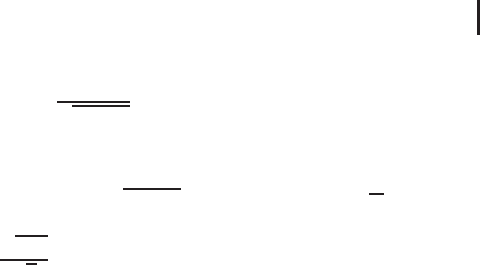
√
n!
=
|
λ
|
B(x)
√
n
,
whence we have
lim
n→∞
(a
n+1
a
n
) = 0forallλ. (3.1.12)
Thus the series solution (3.1.6) converges for all λ,providedthat
f
, A(x), and
B(x)existandarefinite.
We have proven statements (1) and (3) with the condition that the kernel K(x, y)
and the inhomogeneous term f (x) are square-integrable , Eqs. (3.1.2) and (3.1.3).
To show that Eq. (3.1.1) has a unique solution which is square-integrable
(
φ
< ∞), we shall prove that
R
n
(x) → 0asn →∞, (3.1.13)
where
λ
n+1
R
n+1
(x) ≡ φ(x) −
k=n
k=0
λ
k
φ
k
(x), (3.1.14)
and
R
n
(x) =
x
0
K(x, y)R
n−1
(y)dy, R
0
(x) = φ(x).
Repeating the same procedure as above, we can establish
[R
n
(x)]
2
≤
φ
2
A(x)[B(x)]
n−1
(n − 1)!. (3.1.15)
R
n+1
(x)R
n
(x)vanishesasn →∞. Returning to Eq. (3.1.14), we see that the
iterative solution φ(x), Eq. (3.1.6), is unique.Theuniqueness of the solution of the
inhomogeneous Volterra integral equation implies that the square-integrable solution
of the homogeneous Volterra integral equation
ψ
H
(x) = λ
x
0
K(x, y)ψ
H
(y)dy (3.1.16)
is trivial, ψ
H
(x) ≡ 0. Otherwise, φ(x) + cψ
H
(x) would also be a solution of the
inhomogeneous Volterra integral equation (3.1.1), in contradiction to our conclu-
sion that the solution of Eq. (3.1.1) is unique.

108 3 Integral Equations of the Volterra Type
3.2
Solvable Cases of the Volterra Integral Equation
We list a few solvable cases of the Volterra integral equation.
Case (1):Kernelisequaltoasumofnfactorizedterms.
We demonstrated the reduction of such integral equations into an nth-order
ordinary differential equation in Problem 6 in Chapter 2.
Case (2):Kernelistranslational.
K(x, y) = K(x − y). (3.2.1)
Consider
φ
(
x
)
= f
(
x
)
+ λ
x
0
K(x − y)φ(y)dy on 0 ≤ x < ∞. (3.2.2)
We shall use the Laplace transform,
L
F(x)
≡ F(s) ≡
∞
0
dxF(x)e
−sx
. (3.2.3)
Taking the Laplace transform of the integral equation (3.2.2), we obtain
φ
(
s
)
= f
(
s
)
+ λK
(
s
)
φ
(
s
)
. (3.2.4)
Solving Eq. (3.2.4) for φ
(
s
)
,weobtain
φ
(
s
)
= f
(
s
)
1 − λK
(
s
)
. (3.2.5)
Applying the inverse Laplace transform to Eq. (3.2.5), we obtain
φ
(
x
)
=
γ +i∞
γ −i∞
ds
2πi
e
sx
f
(
s
)
1 − λK
(
s
)
, (3.2.6)
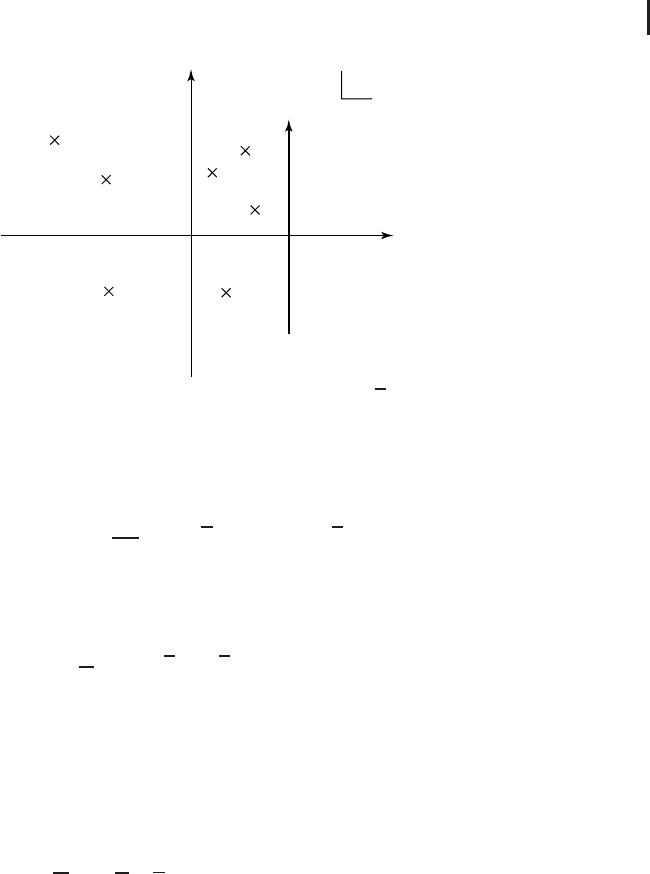
where the inversion path (γ ± i∞) in the complex s plane lies to the right of all
singularities of the integrand as indicated in Figure 3.1.
Definition: Suppose F(t) is defined on [0, ∞)withF(t) = 0fort < 0. Then the
Laplace transform of F(t )isdefinedby
F
(
s
)
≡ L
{
F
(
t
)
}
≡
∞
0
F(t)e
−st
dt. (3.2.7)
3.2 Solvable Cases of the Volterra Integral Equation 109
γ+
i
∞
γ−
i
∞
s
s
1
s
2
Fig. 3.1 The inversion path of the Laplace transform φ(s)
in the complex s plane from s = γ − i∞ to s = γ + i∞,
which lies to the right of all singularities of the integrand.
The inversion is given by
F
(
t
)
=
1
2πi
γ +i∞
γ −i∞
F
(
s
)
e
st
ds = L
−1
F
(
s
)
. (3.2.8)
Properties:
L
d
dt
F(t)
= s
F
(
s
)
− F
(
0
)
. (3.2.9)
The Laplace transform of convolution
H (t) =
t
0
G
t − t
F
t
dt
=
t
0
G(t
)F(t − t
)dt
(3.2.10)
is given by
H
(
s
)
= G
(
s
)
F
(
s
)
, (3.2.11)
which is already used in deriving Eq. (3.2.4).
The Laplace transforms of 1 and t
n
are, respectively, given by
L
{
1
}
= 1s (3.2.12)
and
L
t
n
=
(
n + 1
)
s
n+1
. (3.2.13)
110 3 Integral Equations of the Volterra Type
Gamma Function:
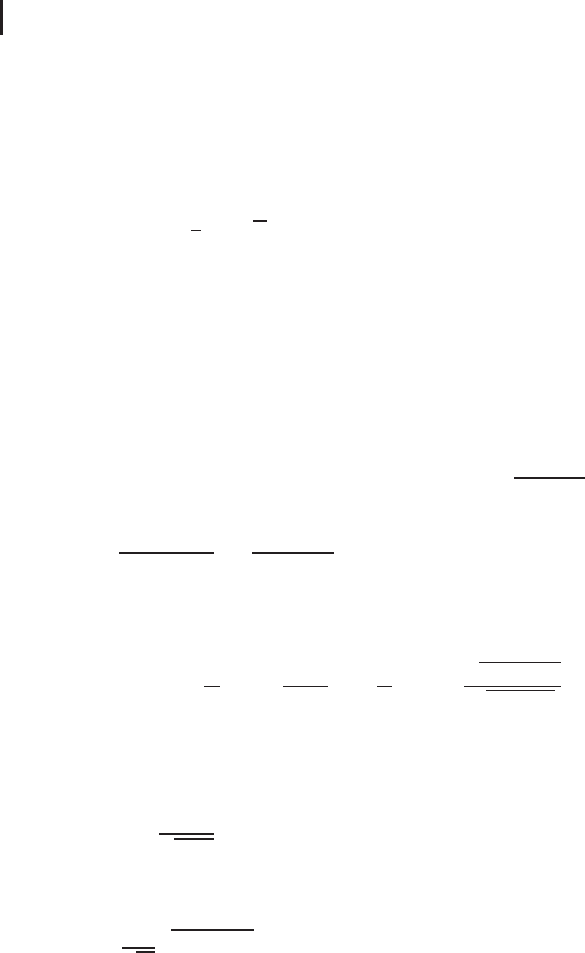
(
z
)
is defined by
(
z
)
=
∞
0
t
z−1
e
−t
dt. (3.2.14)
Properties of Gamma Function:
(
1
)
= 1,
1
2
=
√
π,
(
n + 1
)
= n!, (3.2.15a)
(
z + 1
)
= z
(
z
)
,
(
z
)
(
1 − z
)
= π sin
(
πz
)
, (3.2.15b)
(
z
)
is singular at z = 0, −1, −2, .... (3.2.15c)
Derivation of the Abel integral equation: The descent time of a frictionless ball
on the side of a hill is known as a function of its initial height x.Letusfindthe
shape of the hill. Starting with initial velocity zero, the speed of the ball at height
y is obtained by solving mv
2
2 = mg(x − y), from which v =
2g(x − y). Let the
shape of the hill be given by ξ = f (y). Then the arclength is given by
ds =
(dy)
2
+ (dξ )
2
=
1 + (f
(y))
2
dy
.
The descent time to height y = 0isgivenby
T(x) =
dt =
dt
ds
ds =
ds
dsdt
=
ds
v
=
y=0
y=x
1 + (f
(y))
2
2g(x − y)
dy
.
Since y is decreasing, dy is negative so that
dy
=−dy. Thus the descent time is
given by
T
(
x
)
=
x
0
φ(y)
√
x − y
dy (3.2.16)
with
φ(y) =
1
2g
1 + (f
(y))
2
. (3.2.17)
So, given the descent time T(x) as a function of the initial height x,wesolvethe
Abel integral equation (3.2.16) for φ
(
x
)
, and then solve (3.2.17) for f
(y)whichgives
the shape of the curve ξ = f (y).
We solve an example of the Volterra integral equation with a translational kernel
derived above, Eq. (3.2.16).

3.2 Solvable Cases of the Volterra Integral Equation 111
Example 3.1. Abel Integral Equation:
x
0
φ
x
√
x − x
dx
= f (x), with f (0) = 0. (3.2.18)
Solution. The Laplace transform of Eq. (3.2.18) is
π
s
φ
(
s
)
= f
(
s
)
.
Solving for φ
(
s
)
,weobtain
φ
(
s
)
=
s
π
f
(
s
)
.
√
s is not the Laplace transform of anything. Thus we rewrite
φ
(
x
)
=
1
2πi
γ +i∞
γ −i∞
e
sx
(f
(
s
)
√
s
√
π)ds
=
1
2πi
d
dx
γ +i∞
γ −i∞
1
π
π
s
f
(
s
)
e
sx
ds =
1
π
d
dx
x
0
f
x
√
x − x
dx
, (3.2.19)
where the convolution theorem, Eqs. (3.2.10) and (3.2.11), has been applied.
As an extension of Case (2), we can solve a system of Volterra integral equations
of the second kind with the translational kernels,
φ
i
(x) = f
i
(x) +
n
j=1
x
0
K
ij
(x − y)φ
j
(y)dy, i = 1, ..., n, (3.2.20)
where K
ij
(x)andf
i
(x) are known functions with Laplace transforms K
ij
(s)andf (s).
Taking the Laplace transform of (3.2.20), we obtain
φ
i
(s) = f
i
(s) +
n
j=1
K
ij
(s)φ
j
(s), i = 1, ..., n. (3.2.21)
Equation (3.2.21) is a system of linear algebraic equations for φ
i
(s)’s. We can solve
(3.2.21) for
φ
i
(s)’s easily and apply the inverse Laplace transform to φ
i
(s)’s to obtain
φ
i
(x)’s.

112 3 Integral Equations of the Volterra Type
3.3
Problems for Chapter 3
3.1. Consider the Volterra integral equation of the first kind,
f (x) =
x
0
K(x, y)φ(y)dy,0≤ x ≤ h.
Show that by differentiating the above equation with respect to x,wecan
transform this integral equation to a Volterra integral equation of the
second kind as long as
K(x, x) = 0 .
3.2. Transform the radial Schr
¨
odinger equation
d
2
dr
2
−
l(l + 1)
r
2
+ k
2
− V(r)
ψ(r) = 0, with ψ(r) ∼ r
l+1
as r → 0,
to a Volterra integral equation of the second kind.
Hint: There are two ways to define the homogeneous equation.
(i)
d
2
dr
2
−
l(l + 1)
r
2
+ k
2
ψ
H
(r) = 0 ⇒ ψ
H
(r) =
krj
l
(kr)
krh
(1)
l
(kr)
,
where j
l
(kr)isthelth order spherical Bessel function and h
(1)
l
(kr)isthe
lth order spherical Hankel function of the first kind.
(ii)
d
2
dr
2
−
l(l + 1)
r
2
ψ
H
(r) = 0 ⇒ ψ
H
(r) = r
l+1
and r
−l
.
There exist two equivalent Volterra integral equations of the second
kind for this problem.
3.3. Solve the generalized Abel equation,
x
0
φ(y)
(x − y)
α
dy = f (x), 0 <α<1.

3.3 Problems for Chapter 3 113
3.4. Solve
x
0
φ(y)ln(x − y)dy = f (x), with f (0) = 0 .
3.5. Solve
φ(x) = 1 +
∞
x
e
α(x−y)
φ(y)dy, α>0.
Hint: Reduce the integral equation to the ordinary differential equation.
3.6. Solve
φ(x) = 1 + λ
x
0
e
−(x−y)
φ(y)dy.
3.7. (due to H. C.). Solve
φ(x) = 1 +
x
1
1
x + y
φ(y)dy, x ≥ 1.
Find the asymptotic behavior of φ(x)asx →∞.
3.8. (due to H. C.). Solve the integro-differential equation,
∂
∂t
φ(x, t) =−ixφ(x, t ) + λ
+∞
−∞
g(y)φ(y, t)dy,withφ(x,0)= f (x),
where f (x)andg(x) are given. Find the asymptotic form of φ(x, t)ast →∞.
3.9. Solve
x
0
1
√
x − y
φ(y)dy +
1
0
2xyφ(y)dy = 1.
3.10. Solve
λ
x
0
1
(x − y)
13
φ(y)dy + λ
1
0
φ(y)dy = 1.
3.11. Solve
λ
1
0
K(x, y)φ(y)dy = 1,
where
K(x, y) =
(x − y)
−14
+ xy for 0 ≤ y ≤ x ≤ 1,
xy for 0 ≤ x < y ≤ 1.

114 3 Integral Equations of the Volterra Type
3.12. (due to H. C.). Solve
φ(x) = λ
x
0
J
0
(xy)φ(y)dy,
where J
0
(x) is the 0th-order Bessel function of the first kind.
3.13. Solve
x
2
φ
µ
(x) −
x
0
K
(µ)
(x, y)φ
µ
(y)dy =
0forµ ≥ 1,
−x
2
for µ = 0,
where
K
(µ)
(x, y) =−x − (x
2
− µ
2
)(x − y).
Hint: Setting
φ
µ
(x) =
∞
n=0
a
(µ)
n
x
n
,
find the recursive relation of a
(µ)
n
and solve for a
(µ)
n
.
3.14. Solve a system of the integral equations,
φ
1
(x) = 1 − 2
x
0
exp[2(x − y)]φ
1
(y)dy +
x
0
φ
2
(y)dy,
φ
2
(x) = 4x −
x
0
φ
1
(y)dy + 4
x
0
(x − y)φ
2
(y)dy.
3.15. Solve a system of the integral equations,
φ
1
(x) + φ
2
(x) −
x
0
(x − y)φ
1
(y)dy = ax,
φ
1
(x) − φ
2
(x) −
x
0
(x − y)
2
φ
2
(y)dy = bx
2
.
3.16. (due to D. M.) Consider the Volterra integral equation of the second kind,
φ(x) = f (x) + λ
x
0
exp[x
2
− y
2
]φ(y)dy , x > 0.
(a) Sum up the iteration series exactly and find the general solution to this
equation. Verify that the solution is analytic in λ.
(b) Solve this integral equation by converting it into a differential equation.
Hint: Multiply both sides by exp[−x
2
] and differentiate.