
Masujima M. Applied Mathematical Methods in Theoretical Physics
Подождите немного. Документ загружается.


136 4 Integral Equations of the Fredholm Type
However, in order for the integral equation to make sense, we must require the
integral
∞
x
dyφ(y)
to converge. This requires
Re α<0,
which in turn requires
λ>0. (4.5.9)
Thus, for λ ≤ 0, we have no solution, and for λ>0, we have
φ(x) = C
(e
α
1
x
α
1
) − (e
α
2
x
α
2
)
, (4.5.10)
with α
1
and α
2
given by Eq. (4.5.7).
Note that, in this case, we have a continuous spectrum of eigenvalues (λ>0) for
which the homogeneous problem has a solution. The reason why the eigenvalue is
not discrete is that K(x, y) is not square-integrable.
4.6
Fredholm Integral Equation with a Translation Kernel
Suppose x ∈ (−∞, +∞) and the kernel is translation invariant, i.e.,
K(x, y) = K(x − y). (4.6.1)
Then the inhomogeneous Fredholm integral equation of the second kind is given
by
φ(x) = f (x) +λ
+∞
−∞
K(x − y)φ(y)dy. (4.6.2)
Take the Fourier transform of both sides of Eq. (4.6.2) to find
ˆ
φ(k) =
ˆ
f (k) +λ
ˆ
K(k)
ˆ
φ(k).
Solve for
ˆ
φ(k)tofind
ˆ
φ(k) =
ˆ
f (k)
1 −λ
ˆ
K(k)
. (4.6.3)

4.6 Fredholm Integral Equation with a Translation Kernel 137
Solution φ(x) is provided by inverting the Fourier transform
ˆ
φ(k) obtained above.
It seems so simple, but there are some subtleties involved in the inversion of
ˆ
φ(k).
We present some general discussion of the inversion of the Fourier transform.
Suppose that the function F(x) has the asymptotic forms
F(x) ∼
e
ax
as x →+∞ (a > 0),
e
bx
as x →−∞ (b > a > 0).
(4.6.4)
Namely, F(x) grows exponentially as x →+∞and decays exponentially as x →
−∞. Then the Fourier transform
ˆ
F(k) =
+∞
−∞
e
−ikx
F(x)dx (4.6.5)
exists as long as
−b < Im k < −a. (4.6.6)
This is because the integrand has the magnitude
e
−ikx
F(x)
∼
e
(k
2
+a)x
as x →+∞,
e
(k
2
+b)x
as x →−∞,
whereweset
k = k
1
+ ik
2
,withk
1
and k
2
real.
With
−b < k
2
< −a,
the magnitude of the integrand vanishes exponentially at both ends.
The inverse Fourier transformation then becomes
F(x) =
1
2π
+∞−iγ
−∞−iγ
e
ikx
ˆ
F(k)dk with a <γ <b. (4.6.7)
Now if b = a such that F(x) ∼ e
ax
for
|
x
|
→∞(a > 0), then the inversion contour
is on γ = a and the Fourier transform exists only for k
2
=−a.
Similarly if the function F(x) decays exponentially as x →+∞and grows as
x →−∞, we are able to continue defining the Fourier transform and its inverse
by going in the upper half plane.
As an example, a function like
F(x) = e
−α
|
x
|
,
(4.6.8)

138 4 Integral Equations of the Fredholm Type
which decays exponentially as x →±∞, has a Fourier transform which exists and
is analytic in
−α<k
2
<α. (4.6.9)
Withthesequalifications,weshouldbeabletoinvert
ˆ
φ(k)toobtainthesolution
to the inhomogeneous problem (4.6.2).
Now comes the homogeneous problem,
φ
H
(x) = λ
+∞
−∞
K(x − y)φ
H
(y)dy. (4.6.10)
By Fourier transforming Eq. (4.6.10), we obtain
(1 −λ
ˆ
K(k))
ˆ
φ
H
(k) = 0. (4.6.11)
If 1 −λ
ˆ
K(k) has no zeros for all k,thenwehave
ˆ
φ
H
(k) = 0 ⇒ φ
H
(x) = 0, (4.6.12)
i.e., no nontrivial solution exists for the homogeneous problem. If, on the other
hand, 1 −λ
ˆ
K(k) has a zero of order n at k = α,
ˆ
φ
H
(k) can be allowed to be of the
form
ˆ
φ
H
(k) = C
1
δ(k − α) + C
2
d
dk
δ(k − α) +···+C
n
d
dk
n−1
δ(k − α).
On inversion, we find
φ
H
(x) = C
1
e
iαx
+ C
2
xe
iαx
+···+C
n
x
n−1
e
iαx
= e
iαx
n
j=1
C
j
x
j−1
. (4.6.13)
For the homogeneous problem, we choose the inversion contour of the Fourier
transform based on the asymptotic behavior of the kernel, a point to be discussed
in the following example.
Example 4.3. Consider the homogeneous integral equation,
φ
H
(x) = λ
+∞
−∞
e
−
|
x−y
|
φ
H
(y)dy. (4.6.14)
Solution. Since the kernel vanishes exponentially as e
−y
as y →∞and as e
+y
as
y →−∞, we need not require φ
H
(y)tovanishasy →±∞; rather, more generally
we may permit
φ
H
(y) →
e
(1−ε)y
as y →∞,
e
(−1+ε)y
as y →−∞,

4.6 Fredholm Integral Equation with a Translation Kernel 139
and the integral equation still makes sense. So in the Fourier transform, we may
allow
−1 < k
2
< 1, (4.6.15)
and we still have a valid solution.
The Fourier transform of e
−α
|
x
|
is given by
+∞
−∞
e
−ikx
e
−α
|
x
|
dx = 2α
k
2
+ α
2
. (4.6.16)
Taking the Fourier transform of the homogeneous equation with α = 1, we find
ˆ
φ
H
(k) = (2λ(k
2
+ 1))
ˆ
φ
H
(k),
from which, we obtain
k
2
+ 1 −2λ
k
2
+1
ˆ
φ
H
(k) = 0.
So there exists no nontrivial solution unless k =±i
√
1 − 2λ. By the inversion
formula, φ
H
(x) is a superposition of e
+ikx
terms with amplitude
ˆ
φ
H
(k). But
ˆ
φ
H
(k)is
zero for all but k =±i
√
1 − 2λ. Hence we may conclude tentatively
φ
H
(x) = C
1
e
−
√
1−2λx
+ C
2
e
+
√
1−2λx
.
However, we can at most allow φ
H
(x)togrowasfastase
x
as x →∞and as e
−x
as
x →−∞, as we discussed above. Thus further analysis is in order.
Case (1). 1 −2λ<0, or λ>12.
φ
H
(x) is oscillatory and is given by
φ
H
(x) = C
1
e
−i
√
2λ−1x
+ C
2
e
+i
√
2λ−1x
. (4.6.17a)
Case (2). 0 < 1 −2λ<1, or 0 <λ<12.
φ
H
(x) grows less fast than e
|
x
|
as
|
x
|
→∞:
φ
H
(x) = C
1
e
−
√
1−2λx
+ C
2
e
+
√
1−2λx
. (4.6.17b)
Case (3). 1 −2λ ≥ 1, or λ ≤ 0.
No acceptable solution for φ
H
(x) exists, since e
±
√
1−2λx
grows faster than e
|
x
|
as
|
x
|
→∞.
Case (4). λ = 12.
φ
H
(x) = C
1
+C
2
x . (4.6.17c)
Now consider the corresponding inhomogeneous problem.

140 4 Integral Equations of the Fredholm Type
Example 4.4. onsider the inhomogeneous integral equation,
φ(x) = ae
−α
|
x
|
+ λ
+∞
−∞
e
−
|
x−y
|
φ(y)dy. (4.6.18)
Solution. On taking the Fourier transform of Eq. (4.6.18), we obtain
ˆ
φ(k) = (2aα (k
2
+ α
2
)) +(2λ(k
2
+ 1))
ˆ
φ(k).
Solving for
ˆ
φ(k), we obtain
ˆ
φ
k
=
2aα(k
2
+ 1)
(k
2
+ 1 −2λ)(k
2
+ α
2
)
.
To invert the latter transform, we note that depending on whether λ is larger or
smaller than 12, the poles k =±
√
2λ − 1 lie on the real or imaginary axis of the
complex k plane. What we can do is to choose any contour for the inversion within
the strip
−min(α,1)< k
2
< min(α, 1) (4.6.19)
to get a particular solution to our equation and we may then add any multiple of
the homogeneous solution when the latter exists. The reason for choosing the strip
(4.6.19) instead of
−1 < k
2
< 1
in this case is that, in order for the Fourier transform of the inhomogeneous term
e
−α
|
x
|
to exist, we must also restrict our attention to
−α<k
2
<α.
Consider the first three cases given in Example 4.3.
Cases (2) and (3). λ<12.
In these cases, we have 1 − 2λ>0. Hence
ˆ
φ
k
has simple poles at k =±iα and
k =±i
√
1 − 2λ. To find a particular solution, use the real k-axis as the integration
contour for the inverse Fourier transformation. Then φ
P
(
x
)
is given by
φ
P
(
x
)
=
2aα
2π
+∞
−∞
dke
ikx
(k
2
+ 1)
(k
2
+ 1 −2λ)(k
2
+ α
2
)
.
For x > 0, we close the contour in the upper half plane to obtain
φ
P
(
x
)
=
a
1 −2λ − α
2
1 −α
2
e
−αx
−
2λα
√
1 −2λ
e
−
√
1−2λx
.
4.6 Fredholm Integral Equation with a Translation Kernel 141
For x < 0, we close the contour in the lower half plane to get an identical result
with x replaced with −x. Our particular solution φ
P
(
x
)
is given by
φ
P
(
x
)
=
a
1 −2λ − α
2
1 −α
2
e
−α
|
x
|
−
2λα
√
1 −2λ
e
−
√
1−2λ
|
x
|
. (4.6.20)
For Case (3), this is the unique solution because there exists no acceptable
homogeneous solution, while for Case (2) we must also add the homogeneous part
given by
φ
H
(
x
)
= C
1
e
−
√
1−2λx
+ C
2
e
+
√
1−2λx
.
Case (1). λ>12.
In this case, we have 1 −2λ<0. Hence
ˆ
φ
k
has simple poles at k =±iα and
k =±
√
2λ − 1. To do the inversion for the particular solution, we can take any
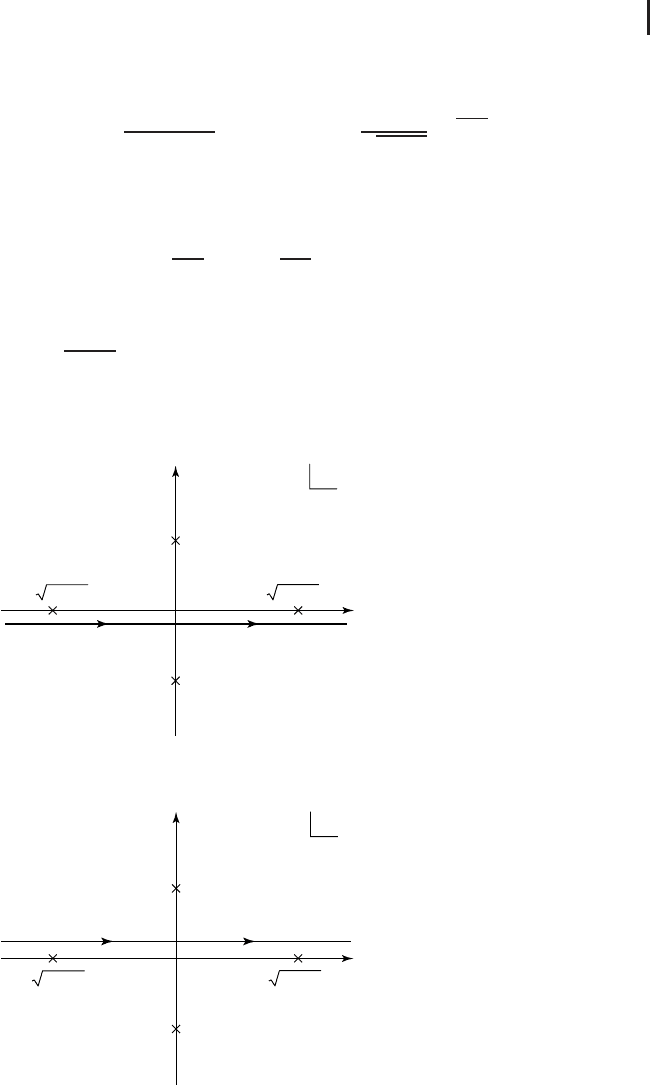
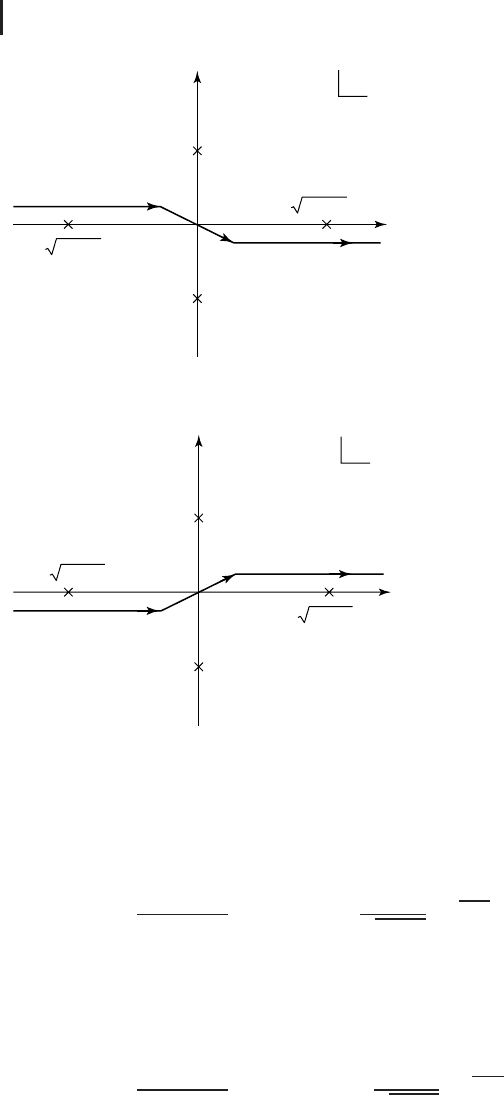
of the contours (1), (2), (3), or (4) as displayed in Figures 4.1–4.4, or Principal
Value contours which are equivalent to half the sum of the first two contours
k
k
1
k
2
(1)
2l − 1
i
a
−
i
a
−
2l − 1
Fig. 4.1 The inversion contour (1) for Case (1).
k
1
k
2
i
a
−
i
a
2l − 1
2l − 1
−
k
(2)
Fig. 4.2 The inversion contour (2) for Case (1).
142 4 Integral Equations of the Fredholm Type
k
1
k
2
i
a
−
i
a
2l − 1
−
2l − 1
k
(3)
Fig. 4.3 The inversion contour (3) for Case (1).
k
1
k
2
i
a
−
i
a
2l − 1
2l − 1
−
k
(4)
Fig. 4.4 The inversion contour (4) for Case (1).
or half the sum of the latter two contours. Any of these differs by a multiple of
the homogeneous solution. Consider a particular choice (4) for the inversion. For
x > 0, we close the contour in the upper half plane. Then our particular solution
φ
P
(
x
)
is given by
φ
P
(
x
)
=
a
1 −2λ − α
2
(1 −α
2
)e
−αx
+
2λαi
√
2λ − 1
e
−i
√
2λ−1x
.
For x < 0, we close the contour in the lower half plane to get an identical result
with x replaced with −x. So, in general, we can write our particular solution with
the inversion contour (4) as,
φ
P
(
x
)
=
a
1 −2λ − α
2
1 −α
2
e
−α
|
x
|
+
2λαi
√
2λ − 1
e
−i
√
2λ−1
|
x
|
, (4.6.21)

4.8 Problems for Chapter 4 143
to which must be added the homogeneous part for Case (1) which reads
φ
H
(
x
)
= C
1
e
−i
√
2λ−1x
+ C
2
e
+i
√
2λ−1x
.
4.7
System of Fredholm Integral Equations of the Second Kind
We solve the system of Fredholm integral equations of the second kind,
φ
i
(x) − λ
b
a
n
j=1
K
ij
(x, y)φ
j
(y)dy = f
i
(x), i = 1, 2, ..., n , (4.7.1)
where the kernels K
ij
(x, y) are square-integrable. We first extend the basic interval
from [a, b]to[a, a + n(b − a)], and set
x + (i − 1)(b − a) = X < a + i(b − a), y + (j − 1)(b − a) = Y < a + j(b − a),
(4.7.2)
φ(X) = φ
i
(x), K(X, Y) = K
ij
(x, y), f (X) = f
i
(x). (4.7.3)
We then obtain the Fredholm integral equation of the second kind,
φ(X) − λ
a+n(b−a)
a
K(X, Y)φ(Y)dY = f (X), (4.7.4)
where the kernel K(X, Y) is discontinuous in general but is square-integrable
on account of the square-integrability of K
ij
(x, y). The solution φ(X) to Eq. (4.7.4)
provides the solutions φ
i
(x) to Eq. (4.7.1) with Eqs. (4.7.2) and (4.7.3).
4.8
Problems for Chapter 4
4.1. Calculate D(λ)for
(a) K(x, y) =
xy, y ≤ x,
0, otherwise.
(b) K(x, y) = xy,0≤ x, y ≤ 1.
(c) K(x, y) =
g(x)h(y), y ≤ x,
0, otherwise.
(d) K(x, y) = g(x)h(y), 0 ≤ x, y ≤ 1.
Find zero of D(λ) for each case.

144 4 Integral Equations of the Fredholm Type
4.2. (due to H. C.). Solve
φ(x) = λ
x
0
dy
φ(y)
(y + 1)
2
y
x
a
+
+∞
x
dy
φ(y)
(y + 1)
2
, a > 0.
Find all eigenvalues and eigenfunctions.
4.3. (due to H. C.). Solve the Fredholm integral equation of the second kind,
given that
K(x − y) = e
−
|
x−y
|
, f (x) =
x , x > 0,
0, x < 0.
4.4. (due to H. C.). Solve the Fredholm integral equation of the second kind,
given that
K(x − y) = e
−
|
x−y
|
, f (x) = x for −∞< x < +∞.
4.5. (due to H. C.). Solve
φ(x) +λ
+1
−1
K(x, y)φ(y)dy = 1, −1 ≤ x ≤ 1, K(x, y) =
1 −y
2
1 −x
2
.
Find all eigenvalues of K(x, y). Calculate also D(λ)andD(x, y;λ).
4.6. (due to H. C.). Solve the Fredholm integral equation of the second kind,
φ(x) = e
−
x
2
+λ
+∞
−∞
1
cosh(x − y)
φ(y)dy.
Hint:
+∞
−∞
e
ikx
cosh x
dx =
π
cosh(πk2)
.
4.7. (due to H. C. and D. M.). Consider the integral equation,
φ(x) = λ
+∞
−∞
dy
√
2π
e
ixy
φ(y), −∞ < x < ∞.
(a) Show that there are only four eigenvalues of the kernel
(1
√
2π)exp[ixy]. What are these?

4.8 Problems for Chapter 4 145
(b) Show by an explicit calculation that the functions
φ
n
(x) = exp[−x
2
2]H
n
(x),
where
H
n
(x) ≡ (−1)
n
exp[x
2
]
d
n
dx
n
exp[−x
2
],
are Hermite polynomials, are eigenfunctions with the corresponding
eigenvalues (i)
n
,(n = 0, 1, 2, ...). Why should one expect φ
n
(x)tobe
Fourier transforms of themselves?
Hint: Think of the Schr
¨
odinger equation for the harmonic oscillator.
(c) Using the result in (b) and the fact that {φ
n
(x)}
n
form a complete set, in
some sense, show that any square-integrable solution is of the form
φ(x) = f (x) +C
˜
f (x),
where f (x) is an arbitrary even or odd, square-integrable function with the
Fourier transform
˜
f (k), and C is a suitable constant. Evaluate C and relate
its values to the eigenvalues found in (a).
(d) From (c), construct a solution by taking f (x) = exp[−ax
2
2], a > 0.
4.8. (due to H. C.). Find an eigenvalue and the corresponding eigenfunction for
K(x, y) = exp[−(ax
2
+ 2bxy + cy
2
)], −∞ < x, y < ∞, a + c > 0.
4.9. Consider the homogeneous integral equation,
φ(x) = λ
∞
−∞
K(x, y)φ(y)dy, −∞ < x < ∞,
where
K(x, y) =
1
√
1 −t
2
exp[
x
2
+ y
2
2
]exp[−
x
2
+y
2
− 2xyt
1 −t
2
], t fixed,
0 < t < 1.
(a) Show directly that φ
0
(x) = exp[−x
2
2] is an eigenfunction of K(x, y)
corresponding to the eigenvalue λ = λ
0
= 1
√
π.