
Masujima M. Applied Mathematical Methods in Theoretical Physics
Подождите немного. Документ загружается.


126 4 Integral Equations of the Fredholm Type
Define
F(x) = f (x) +λ
h
0
N
n=1
g
n
(x)h
n
(y)φ(y)dy. (4.3.17)
Then
φ(x) = F(x) +λ
h
0
R(x , y)φ(y)dy.
Let H
R
(x, y;λ) be the resolvent kernel corresponding to R(x, y),
−H
R
(x, y;λ) = R(x, y) +λR
2
(x, y) +λ
2
R
3
(x, y) +···,
whence we have
φ(x) = F(x) −λ
h
0
H
R
(x, y;λ)F(y)dy. (4.3.18)
Substituting the given expression (4.3.17) for F(x) into Eq. (4.3.18), we have
φ(x) = f (x) + λ
h
0
N
n=1
g
n
(x)h
n
(y)φ(y)dy
−λ
h
0
H
R
(x, y;λ)
f (y) +λ
h
0
N
n=1
g
n
(y)h
n
(z)φ(z)dz
dy.
Define
˜
F(x) ≡ f (x) −λ
h
0
H
R
(x, y;λ)f (y)dy.
Then
φ(x) =
˜
F(x) + λ
h
0
dy
N
n=1
g
n
(x)h
n
(y)φ(y)
−λ
2
h
0
dy
h
0
dzH
R
(x, y;λ)(
N
n=1
g
n
(y)h
n
(z))φ(z). (4.3.19)
In the above expression (4.3.19), interchange y and z in the last term on the
right-hand side,
φ(x) =
˜
F(x) + λ
h
0
dy
N
n=1
g
n
(x)h
n
(y) − λ
h
0
dzH
R
(x, z;λ)
N
n=1
g
n
(z)h
n
(y)
φ(y).

4.4 Fredholm Theory for a Bounded Kernel 127
Then we have
φ(x) =
˜
F(x) +λ
h
0
dy
N
n=1
G
n
(x;λ)h
n
(y)
φ(y)
where
G
n
(x;λ) = g
n
(x) − λ
h
0
dzH
R
(x, z;λ)g
n
(z).
We have thus reduced the integral equation with the general kernel to one with
a Pincherle–Goursat-type kernel. The only difference is that the entries in the new
kernel
N
n=1
G
n
(x;λ)h
n
(y)
also depend on λ through the dependence of G
n
(x;λ)onλ. However, we know that
for
|
λ
|
·
R
< 1, the resolvent H
R
(x, y;λ) is analytic in λ.HenceG
n
(x;λ) is also
analytic in λ. Therefore, the singularities in the complex λ plane are still found by
setting det(I − λA) = 0, where the knth element of A is given by
A
kn
=
h
0
dyh
k
(y)G
n
(y;λ) = A
kn
(λ).
Since the entries A
kn
depend on λ analytically, the function det(I − λA)isan
analytic function of λ (but not necessarily a polynomial of degree N), and hence it
has finitely many zeros in the region
|
λ
|
·
R
< 1, or
|
λ
|
< 1ε<1
R
.
This concludes the proof that in any disk
|
λ
|
< 1ε, there are finitely many
singularities of λ for the integral equation (4.3.14).
4.4
Fredholm Theory for a Bounded Kernel
We now consider the case of a general kernel as approached by Fredholm. We shall
show that the resolvent kernel can be written as a ratio of the entire functions of λ,
whence the singularities in λ occur when the function in the denominator is zero.
Consider
φ(x) = f (x) + λ
h
0
K(x, y)φ(y)dy,0≤ x ≤ h. (4.4.1)

128 4 Integral Equations of the Fredholm Type
Discretize the above equation by letting
ε = hN, x
i
= iε, y
j
= jε, i, j = 0, 1, 2, ..., N.
Also let
φ
i
= φ(x
i
), f
i
= f (x
i
), K
ij
= K(x
i
, y
j
).
The discrete version of the integral equation (4.4.1) takes the form
φ
i
= f
i
+λ
N
j=1
K
ij
φ
j
ε,
i.e.,
N
j=1
(δ
ij
− λεK
ij
)φ
j
= f
i
. (4.4.2)
Define
˜
D(λ)tobe
˜
D(λ) = det(I − λεK).
Writing out
˜
D(λ) explicitly, we have
˜
D(λ) =
1 −λεK
11
, −λεK
12
, ···−λεK
1N
−λεK
21
,1−λεK
22
, ···−λεK
2N
·· ·
·· ·
·· ·
−λεK
N1
, −λεK
N2
, ···1 −λεK
NN
.
This determinant can be expanded as
˜
D(λ) =
˜
D(0) + λ
˜
D
(0) +
λ
2
2!
˜
D
(0) +···+
λ
N
N!
˜
D
(
N
)
(0).
Using the fact that
d
dλ
a
1
,
a
2
, ...,
a
N
=
d
dλ
a
1
,
a
2
, ...,
a
N
+
a
1
,
d
dλ
a
2
, ...,
a
N
+···
+
a
1
,
a
2
, ...,
d
dλ
a
N
,

4.4 Fredholm Theory for a Bounded Kernel 129
we finally obtain (after considerable algebra)
˜
D(λ) = 1 − λε
N
i=1
K
ii
+
λ
2
ε
2
2!
N
i=1
N
j=1
K
ii
, K
ij
K
ji
, K
jj
−
λ
3
ε
3
3!
N
i=1
N
j=1
N
k=1
K
ii
, K
ij
, K
ik
K
ji
, K
jj
, K
jk
K
ki
, K
kj
, K
kk
+···.
In the limit as n →∞, each sum when multiplied by ε is approximates a
corresponding integral, i.e.,
N
i=1
εK
ii
→
h
0
K(x, x)dx,
N
i=1
N
j=1
ε
2
K
ii
, K
ij
K
ji
, K
jj
→
h
0
dx
h
0
dy
K(x, x), K(x, y)
K(y, x), K(y, y)
.
Define
K
x
1
, x
2
, ···x
n
y
1
, y
2
, ···y
n
≡
K(x
1
, y
1
), K(x
1
, y
2
), ···K(x
1
, y
n
)
K(x
2
, y
1
), ····K(x
2
, y
n
)
·· ·
·· ·
·· ·
K(x
n
, y
1
), · K(x
n
, y
n
)
.
Then, in the limit as N →∞, we find (on calling
˜
D as D)
D(λ) = 1 +
∞
n=1
((−1)
n
λ
n
n!)D
n
,
with
D
n
=
h
0
dx
1
h
0
dx
2
···
h
0
dx
n
K
x
1
, x
2
, ···x
n
x
1
, x
2
, ···x
n
.
We expect singularities in the resolvent H(x, y;λ) to occur only when the determi-
nant D (λ) vanishes. Thus we hope to show that H(x, y;λ) can be expressed as the
ratio

130 4 Integral Equations of the Fredholm Type
H (x, y;λ) ≡ D(x, y;λ)D(λ). (4.4.3)
So we need to obtain the numerator D(x, y;λ) and show that it is entire. We
also show that the power series given above for D(λ) has an infinite radius of
convergence and thus represents an analytic function.
To this end, we make use of the fact that K(x, y)isbounded and also invoke the
Hadamard inequality which says
det
[
v
1
, v
2
, ..., v
n
]
≤
v
1
v
2
···
v
n
.
This has the interpretation that the volume of the parallelepiped whose edges are
v
1
through v
n
is less than the product of the lengths of those edges. Suppose that
K(x, y)
is bounded by A on x, y ∈
[
0, h
]
.Then
K
x
1,
··· x
n
x
1
, ··· x
n
=
K(x
1
, x
1
), ··· K(x
1
, x
n
)
··
K(x
n
, x
1
), ··· K(x
n
, x
n
)
is bounded by
K
x
1
, ··· x
n
x
1
, ··· x
n
≤ (
√
nA)
n
,
since the norm of each column is less than
√
nA. This implies
|
D
n
|
=
h
0
dx
1
···
h
0
dx
n
K
x
1,
··· x
n
x
1
, ··· x
n
≤ h
n
n
n/2
A
n
.
Thus
∞
n=1
((−1)
n
λ
n
n!)D
n
≤
∞
n=1
(
|
λ
|
n
h
n
n
n/2
A
n
)n!. (4.4.4)
Letting
a
n
= (
|
λ
|
n
h
n
n
n/2
A
n
)n!,
and applying the ratio test to the right-hand side of inequality (4.4.4), we have
lim
n→∞
a
n+1
a
n
= lim
n→∞
(
|
λ
|
n+1
h
n+1
(n + 1)
(n+1)/2
A
n+1
· n!)
(
|
λ
|
n
h
n
n
n/2
A
n
· (n + 1)!)
= lim
n→∞
|
λ
|
hA(1 +
1
n
)
n/2
1
√
n + 1
= 0.

4.4 Fredholm Theory for a Bounded Kernel 131
Hence the series converges for all λ.WeconcludethatD(λ) is an entire function
of λ.
The last step we need to take is to find the numerator D(x, y;λ)oftheresolvent
and show that it too is an entire function of λ. For this purpose, we recall that the
resolvent itself H(x, y;λ) satisfies the integral equation
H (x, y;λ) =−K(x, y) +λ
h
0
K(x, z)H(z, y;λ)dz. (4.4.5)
Therefore, on multiplying the integral equation (4.4.5) by D(λ)andusingdefinition
(4.4.3) of D(x, y;λ), we have
D(x, y;λ) =−K(x, y)D(λ) +λ
h
0
K(x, z)D(z, y;λ)dz. (4.4.6)
Recall that D(λ) has the expansion
D(λ) =
∞
n=0
((−λ)
n
n!)D
n
with D
0
= 1. (4.4.7)
We seek an expansion for D(x, y;λ)oftheform
D(x, y;λ) =
∞
n=0
((−λ)
n
n!)C
n
(x, y). (4.4.8)
Substituting Eqs. (4.4.7) and (4.4.8) into the integral equation (4.4.6) for D(x, y;λ),
we find
∞
n=0
(−λ)
n
n!
C
n
(x, y)
=−
∞
n=0
(−λ)
n
n!
D
n
K(x, y) −
∞
n=0
h
0
(−λ)
n+1
n!
K(x, z)C
n
(z, y)dz.
Collecting like powers of λ,weget
C
0
(x, y) =−K(x, y)forn = 0,
C
n
(x, y) =−D
n
K(x, y) −n
h
0
K(x, z)C
n−1
(z, y)dz for n = 1, 2, ....
Let us calculate the first few of these:
C
0
(x, y) =−K(x, y).
C
1
(x, y) =−K(x, y)D
1
+
h
0
K(x, z)K(z, y)dz =−
h
0
dx
1
K
x , x
1
y, x
1
,

132 4 Integral Equations of the Fredholm Type
C
2
(x, y) =−
h
0
dx
1
h
0
dx
2
K(x, y)K
x
1
, x
2
x
1
, x
2
−K(x, x
1
)K
x
1
, x
2
y, x
2
+ K(x, x
2
)K
x
1
, x
2
y, x
1
=−
h
0
dx
1
h
0
dx
2
K
x , x
1
, x
2
y, x
1
, x
2
.
In general, we have
C
n
(x, y) =−
h
0
dx
1
h
0
dx
2
···
h
0
dx
n
K
x , x
1
, x
2
, ··· x
n
y, x
1
, x
2
, ··· x
n
.
Therefore, we have the numerator D(x, y;λ)ofH(x, y;λ),
D(x, y;λ) =
∞
n=0
(−λ)
n
n!
C
n
(x, y), (4.4.9)
with
C
n
(x, y) =−
h
0
dx
1
···
h
0
dx
n
K
x , x
1
, x
2
, ··· x
n
y, x
1
, x
2
, ··· x
n
, n = 1, 2, ...,
(4.4.10)
C
0
(x, y) =−K(x, y). (4.4.11)
We prove that the power series for D(x, y;λ)convergesforallλ.First,bythe
Hadamard inequality, we have the following bounds:
K
x , x
1
, ··· x
n
y, x
1
, ··· x
n
≤ (
√
n + 1A)
n+1
,
since K above is the (n + 1) ×(n + 1) determinant with each entry less than A, i.e.,
K(x, y)
< A.
Then the bound on C
n
(x, y)isgivenby
C
n
(x, y)
≤ h
n
(
√
n + 1A)
n+1
.
Thus we have the bound on D(x, y;λ)as
D(x, y;λ)
≤
∞
n=0
|
λ
|
n
n!
h
n
(
√
n + 1A)
n+1
. (4.4.12)

4.4 Fredholm Theory for a Bounded Kernel 133
Letting
a
n
=
|
λ
|
n
n!
h
n
(
√
n + 1A)
n+1
,
we apply the ratio test on the right-hand side of inequality (4.4.12):
lim
n→∞
a
n
a
n−1
= lim
n→∞
|
λ
|
hA
√
n + 1
n
1 +
1
n
n2
= 0.
Hence the power series expansion for D(x, y;λ)convergesforallλ,andD(x, y;λ)
is an entire function of λ.
Finally, we can prove that whenever H(x, y;λ)exists(i.e.,forallλ such that
D(λ) = 0), the solution to the integral equation (4.4.1) is unique.Thisisbestdone
using the operator notation introduced in Section 4.2. Consider the homogeneous
problem
φ
H
= λ
˜
Kφ
H
(4.4.13)
and multiply both sides by
˜
H to find
˜
H φ
H
= λ
˜
H
˜
Kφ
H
.
Use the identity
λ
˜
H
˜
K =
˜
K +
˜
H
to get
˜
H φ
H
=
˜
Kφ
H
+
˜
H φ
H
.
Hence we get
˜
Kφ
H
= 0,
which implies
φ
H
= λ
˜
Kφ
H
= 0. (4.4.14)
Thus the homogeneous problem has no nontrivial solutions (φ
H
= 0), and the
inhomogeneous problem has a unique solution.
Summary of the Fredholm Theory for a Bounded Kernel
The integral equation
φ(x) = f (x) + λ
h
0
K(x, y)φ(y)dy

134 4 Integral Equations of the Fredholm Type
has the solution
φ(x) = f (x) −λ
h
0
H (x, y;λ)f (y)dy,
with the resolvent kernel given by
H (x, y;λ) = D(x, y;λ)D(λ),
where
D(λ) =
∞
n=0
(−λ)
n
n!
D
n
D
n
=
h
0
dx
1
···
h
0
dx
n
K
x
1
, ··· x
n
x
1
, ··· x
n
; D
0
= 1
and
D(x, y;λ) =
∞
n=0
(−λ)
n
n!
C
n
(x, y),
C
n
(x, y) =−
h
0
dx
1
···
h
0
dx
n
K
x , x
1,
··· x
n
y, x
1
, ··· x
n
;
C
0
(x, y) =−K(x, y),
where
K
z
1,
z
2
, ··· z
n
w
1,
w
2,
··· w
n
≡
K(z
1,
w
1
), K(z
1
, w
2
), ··· K(z
1
, w
n
)
K(z
2
, w
1
), K(z
2
, w
2
), ··· K(z
2
, w
n
)
·
·
·
K(z
n
, w
1
), K(z
n
, w
2
), ··· K(z
n
, w
n
)
.
4.5
Solvable Example
Consider the following homogeneous integral equation:
Example 4.2. Solve
φ(x) = λ
x
0
dye
−(x−y)
φ(y) +λ
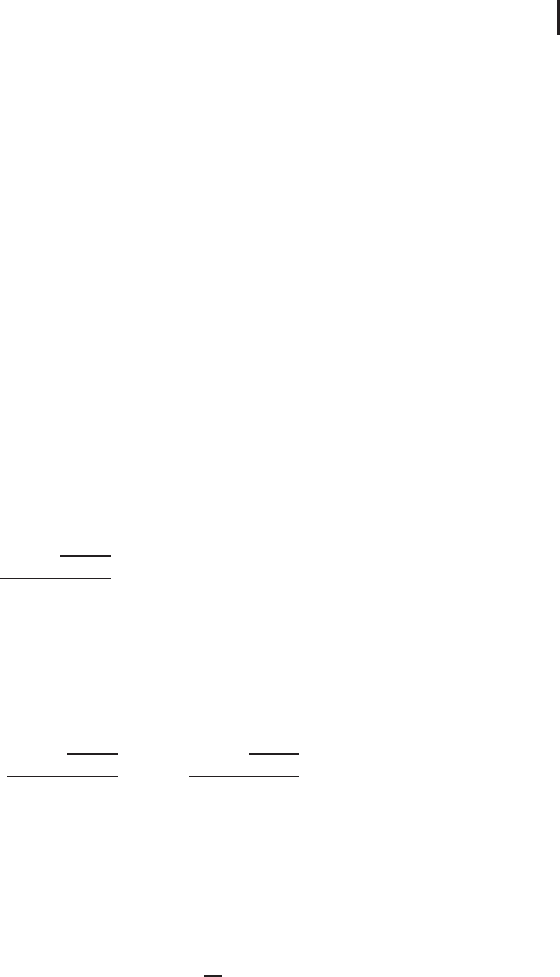
∞
x
dyφ(y), 0 ≤ x < ∞. (4.5.1)
4.5 Solvable Example 135
Solution. This is a Fredholm integral equation of the second kind with the kernel
K(x, y) =
e
−(x−y)
for 0 ≤ y < x < ∞,
1for0≤ x ≤ y < ∞.
(4.5.2)
Note that this kernel (4.5.2) is not square-integrable. Differentiating both sides of
Eq. (4.5.1) once, we find after a little algebra
e
x
φ
(x) =−λ
x
0
dye
y
φ(y). (4.5.3)
Differentiate both sides of Eq. (4.5.3) once more to obtain the second-order ordinary
differential equation of the form
φ
(
x
)
+φ
(
x
)
+ λφ
(
x
)
= 0. (4.5.4)
We try a solution of the form
φ(x) = Ce
αx
. (4.5.5)
Substituting Eq. (4.5.5) into Eq. (4.5.4), we obtain α
2
+ α + λ = 0, or
α =
−1 ±
√
1 −4λ
2
.
In general, we obtain
φ(x) = C
1
e
α
1
x
+ C
2
e
α
2
x
, (4.5.6)
with
α
1
=
−1 +
√
1 −4λ
2
, α
2
=
−1 −
√
1 −4λ
2
. (4.5.7)
Now, the expression for φ
(x) given above, Eq. (4.5.3), indicates that
φ
(0) = 0. (4.5.8)
This requires
α
1
C
1
+α
2
C
2
= 0orC
2
=−
α
1
α
2
C
1
.
Hence the solution is
φ(x) = C
(e
α
1
x
α
1
) −(e
α
2
x
α
2
)
.