
Molina-Par?s C., Lythe G. (editors) Mathematical Models and Immune Cell Biology
Подождите немного. Документ загружается.

8 Diversity Maintenance of Na¨ıve T Cells 173
Continuous-Time Markov Chains
A stochastic process fX
t
W t 2 T g is a collection of random variables indexed by a
set T , the elements of which usually correspond to time values. The state-space S
of the process is the range of all possible values that the random variables X
t
can
take. In this chapter, the values of the random variables will represent the number
of T cells belonging to a particular clonotype and so the state-space will be discrete.
Production of a new cell or death of an existing cell may occur at any time and so
the set T will be continuous.
A stochastic process fX
t
W t t
0
g on the state-space S Df0; 1; : : :g is called a
continuous-time Markov chain if it satisfies the following condition. For any 0
t
0
<t
1
< :::< t
j
<t
j C1
,
P.X
t
j C1
D n
j C1
jX
t
0
D n
0
;:::;X
t
j
D n
j
/ D P.X
t
j C1
D n
j C1
jX
t
j
D n
j
/:
This is the Markov property. It says that, given the current state of the process, the
probability of future behaviour is not influenced by any additional knowledge of the
past history of the process.
The transition probabilities are denoted by
p
nm
.t
1
;t
2
/ D P.X
t
2
D mjX
t
1
D n/
for t
1
<t
2
and n, m 2 S.Thatis,p
nm
.t
1
;t
2
/ is the probability that the process
is in state m at time t
2
given that it was in state n at time t
1
. We will say that the
transition probabilities are stationary (homogeneous) if the transition probabilities
depend, not on both t
1
and t
2
, but only on t
2
t
1
. Then the notation becomes
p
nm
.t
2
t
1
/ D P.X
t
2
D mjX
t
1
D n/:
The transition probabilities have the property
C1
X
mD0
p
nm
.t/ D 1 for t t
0
;n2 S;
and satisfy the equations
p
nm
.t C s/ D
C1
X
kD0
p
nk
.t/p
km
.s/; (8.1)
for all s, t 2 Œt
0
; C1/ and all n, m 2 S, which are known as the Chapman–
Kolmogorov equations.
174 C. Molina-Par´ıs et al.
Birth and Death Processes
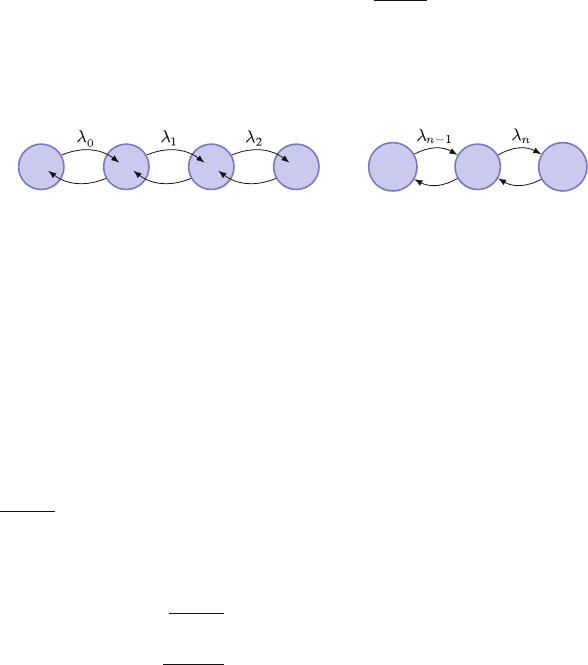
A birth and death process is a continuous-time Markov chain where transitions are
only allowed to adjacent states. The state-space of the process may be finite i.e.,
S Df0;1;:::;Ng or infinite i.e., S Df0; 1; : : :g. A birth and death process has the
following transition probabilities as t ! 0
C
:
p
nm
.t/ D P.X
tCt
D mjX
t
D n/
D
8
ˆ
ˆ
<
ˆ
ˆ
:
n
t C o.t/ m D n C 1
n
t C o.t/ m D n 1
1 .
n
C
n
/t C o.t/ m D n
o.t/ otherwise,
(8.2)
where f.t/ D o.t/ as t ! 0
C
if lim
t!0
C
f.t/
t
D 0. The birth rate,
n
,is
the rate of transition from state n to n C 1 while the death rate,
n
, is the rate of
transition from state n to n 1. The birth and death rates satisfy
n
0,
n
0
for n D 0; 1; 2; : : :,but
0
D 0 so that transitions outside of the state-space cannot
occur. The process can be represented as
0 1 2 3
m
1
m
2
m
n
m
n+1
m
3
···
n
···
n−1
n+1
Let
p
n
.t/ D P.X
t
D njX
t
0
D n
0
/; n 2 S; (8.3)
which is the probability that the birth and death process is in state n at time t,given
that the initial state of the process is n
0
. If the state-space of the process is finite and
N
D 0 so that transitions outside of the state-space cannot occur, the equation for
the endpoint, n D N ,is
p
N
.t C t/ D
N 1
tp
N 1
.t/ C.1
N
t/p
N
.t/ Co.t/: (8.4)
Taking the limit t ! 0
C
, results in
dp
n
.t/
dt
D
n1
p
n1
.t/ C
nC1
p
nC1
.t/ .
n
C
n
/p
n
.t/; 1 n N 1:
(8.5)
Similarly,
dp
0
.t/
dt
D
1
p
1
.t/
0
p
0
.t/; (8.6)
dp
N
.t/
dt
D
N 1
p
N 1
.t/
N
p
N
.t/: (8.7)
The differential equations (8.5)–(8.7) are known as the forward Kolmogorov
equations.
8 Diversity Maintenance of Na¨ıve T Cells 175
Stationary Probability Distribution
A stationary probability distribution D .
0
;
1
;:::/,where
n
0 for n 2 S,
n
D 0 for n … S and
P
1
nD0
n
D 1, satisfies the equations
0 D
1
1
0
0
;
0 D
n1
n1
C
nC1
nC1
.
n
C
n
/
n
;1 n N 1;
0 D
N 1
N 1
N
N
;
which are the forward Kolmogorov equations with the time derivatives set to zero.
If the state-space of the birth and death process fX
t
W t t
0
g is infinite i.e., S D
f0; 1; : : :g, a unique positive stationary probability distribution, , exists if and only
if [12]
n1
>0 and
n
>0 for n D 1;2;::: (8.8)
and
C1
X
nD1
0
1
:::
n1
1
2
:::
n
< C1: (8.9)
If these conditions are satisfied, the stationary probability distribution is given by
0
D
1
1 C
P
C1
nD1
0
1
:::
n1
1
2
:::
n
; (8.10)
n
D
0
1
:::
n1
1
2
:::
n
0
for n D 1;2;:::: (8.11)
If the state space of the birth and death process is finite i.e., S Df0; 1; 2; : : : ; N g,
then a unique positive stationary probability distribution exists if and only if
n1
>0 and
n
>0 for n D 1;2;:::;N:
Then the stationary probability distribution is given by (8.10)–(8.11), where the
index n and the summation on n extend from 1 to N .
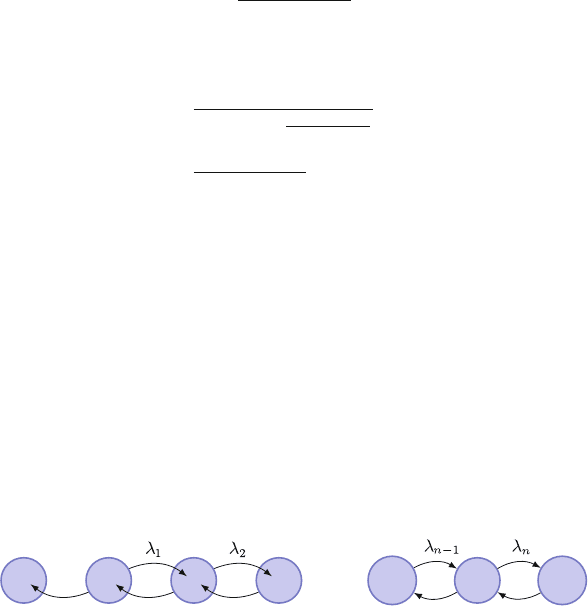
Continuous-Time Birth and Death Process with Absorbing States
If
0
D
0
D 0 then n D 0 is an absorbing state, meaning that once the process
reaches this state, it remains there forever. The process can be represented as
0 1 2 3
··· ···
m
1
m
2
m
n
m
n+1
m
3
n
n−1
n+1

176 C. Molina-Par´ıs et al.
The stationary probability distribution of the process has all its mass at the absorbing
state, i.e., D .1;0;0;:::/
T
. The probability of the process reaching the absorbing
state is given by lim
t!C1
p
0
.t/. If the state-space of the process is infinite i.e., S D
f0; 1; : : : g and
C1
X
nD1
1
2
:::
n
1
2
:::
n
DC1; (8.12)
then lim
t!C1
p
0
.t/ D 1;which means that eventual absorption at n D 0 is guaran-
teed [13]. On the other hand, if (8.12) does not hold, then
lim
t!C1
p
0
.t/ D
P
C1
nDm
1
2
:::
n
1
2
:::
n
1 C
P
C1
nD1
1
2
:::
n
1
2
:::
n
; (8.13)
where m is the initial state of the process.
The Limiting Conditional Probability Distribution
Prior to extinction at n D 0 occurring, the probability distribution of a birth and
death process may adopt a stationary shape for a long period of time, especially
if the expected time until absorption is relatively large. In order to study the be-
haviour of the process before extinction occurs, we define the following conditional
probabilities:
q
n
.t/ D P.X
t
D n j X
t
¤ 0/ D
p
n
.t/
1 p
0
.t/
for n D 1;2;:::; (8.14)
which is the probability that the process is in state n at time t, given that absorption
has not yet occurred. These conditional probabilities satisfy:
dq
n
.t/
dt
D
1
1 p
0
.t/
dp
n
.t/
dt
C
p
n
.t/
1 p
0
.t/
1
1 p
0
.t/
dp
0
.t/
dt
D
n1
q
n1
.t/ .
n
C
n
/q
n
.t/
C
nC1
q
nC1
.t/ C
1
q
1
.t/q
n
.t/; (8.15)
for n 2 and
dq
1
.t/
dt
D
1
1 p
0
.t/
dp
1
.t/
dt
C
p
1
.t/
1 p
0
.t/
1
1 p
0
.t/
dp
0
.t/
dt
D
2
q
2
.t/ .
1
C
1
/q
1
.t/ C
1
q
1
.t/q
1
.t/: (8.16)
8 Diversity Maintenance of Na¨ıve T Cells 177
If the state space is finite, we have
dq
N
.t/
dt
D
1
1 p
0
.t/
dp
N
.t/
dt
C
p
N
.t/
1 p
0
.t/
1
1 p
0
.t/
dp
0
.t/
dt
D
N 1
q
N 1
.t/
N
q
N
.t/ C
1
q
1
.t/q
N
.t/: (8.17)
A distribution Nq is called a quasi-stationary probability distribution (QSD) if it is
a solution of (8.15)–(8.17) where the time derivatives are set to zero. The limiting
conditional probability distribution (LCD) of the process is defined as
lim
t!C1
q
n
.t/; n 1: (8.18)
Since the LCD is independent of time, it is also a QSD. If the state-space of the
process is finite, there is a unique QSD, which is also the LCD of the process.
However, if the process has an infinite state-space, there may be no QSD and, if a
QSD does exist, it is not necessarily unique [14]. In most cases, it is not possible
to find an explicit solution for the QSD or the LCD, but numerical methods can be
used (see [15] for an iterative procedure).
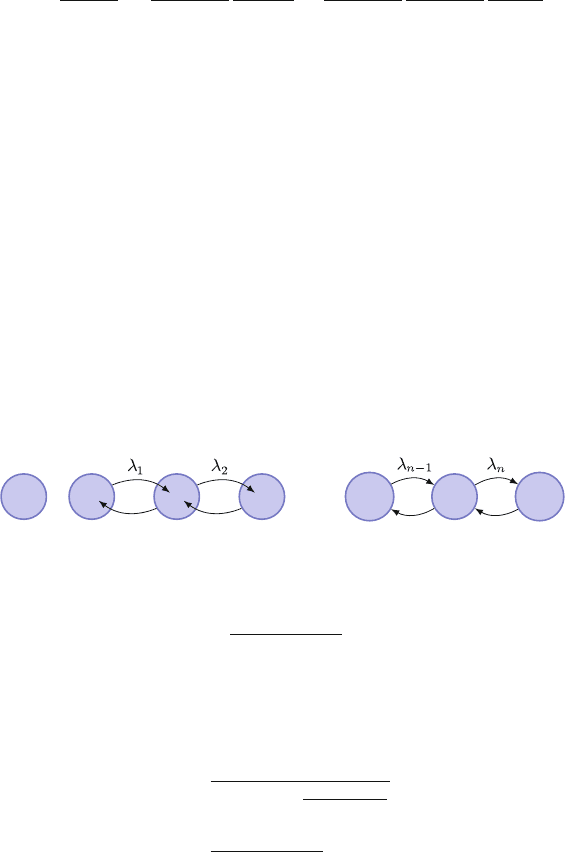
The LCD can be approximated analytically by setting
1
D 0 [15]. This results
in a new birth and death process which has no absorbing state and can be repre-
sented as
··· ···
01 2 3
m
2
m
n
m
n+1
m
3
n
n−1
n+1
If
n1
>0 and
n
>0 for n D 2;3;:::;and
C1
X
nD2
1
2
:::
n1
2
3
:::
n
< C1 (8.19)
the new process has a unique positive stationary probability distribution which is
given by
.1/
1
D
1
1 C
P
C1
nD2
1
2
:::
n1
2
3
:::
n
;
.1/
n
D
1
2
:::
n1
2
3
:::
n
.1/
1
for n 2: (8.20)
This distribution is an approximation to the true LCD of the process.
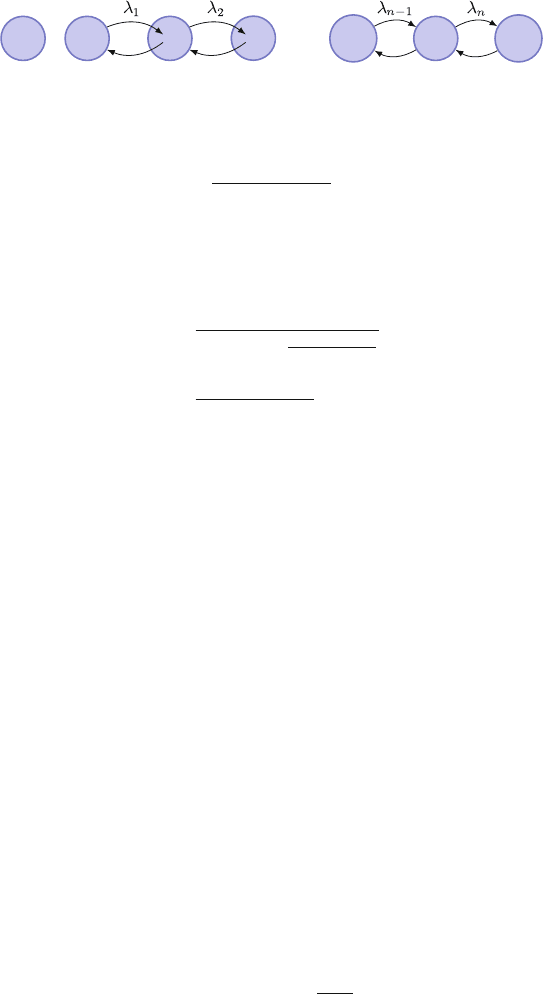
The LCD may also be approximated by the stationary distribution of a birth and
death process which has the same birth rates as the original process, but where the
death rates
n
are replaced by
n1
to allow for one immortal individual [15]. This
can be represented as
178 C. Molina-Par´ıs et al.
··· ···
01
2
3
m
1
m
n−1
m
2
m
n
n
n−1 n+1
If
n
>0 and
n
>0 for n D 1;2;:::;and
C1
X
nD2
1
2
:::
n1
1
2
:::
n1
< C1 (8.21)
this process has a unique positive stationary probability distribution which is
given by
.2/
1
D
1
1 C
P
C1
nD2
1
2
:::
n1
1
2
:::
n1
;
.2/
n
D
1
2
:::
n1
1
2
:::
n1
.2/
1
for n 2: (8.22)
In general,
.1/
is a better approximation to the LCD when the mean time until
extinction is long, whereas
.2/
provides a better approximation when the mean
extinction time is short [15].
Mathematical Model of Peripheral Maintenance
We will use the index i to label T cell clonotypes and the index q to label APPs. Let
C be the set of all T cells in the na¨ıve repertoire. Whether or not a T cell of clonotype
i can receive a survival signal from a given APP q depends on the particular TCR
it expresses on its surface. The subset C
q
is defined to be the set of all T cells that
are capable of receiving a survival signal from APP q.Also,Q is the set of all APPs
which may occur in the periphery and Q
i
is the subset of APPs from which T cells
of clonotype i can receive a survival signal. We define n
q
DjC
q
j, which is the
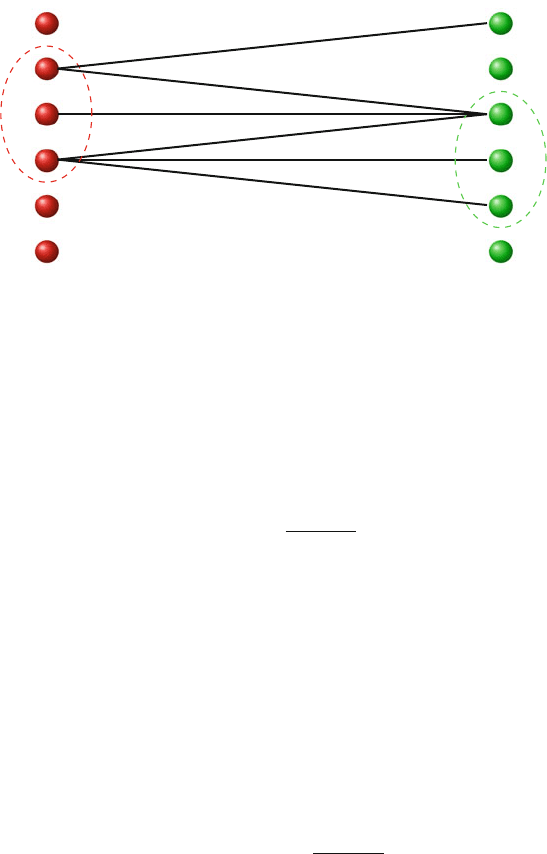
total number of T cells that can receive a survival signal from APP q. These sets are
illustrated in Fig. 8.2.
Let
q
be the rate of survival signals from all the APCs presenting APP q,which
we assume remains constant in time. We will also assume that the survival signals
from any APP q are shared equally among all the T cells capable of receiving them.
Now define
.i/
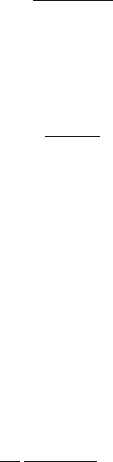
to be the per cell birth rate for T cells of clonotype i .Then
.i/
D
X
q2Q
i
q
jC
q
j
: (8.23)
8 Diversity Maintenance of Na¨ıve T Cells 179
q
i
Q
i
C
q
APPs T cell clonotypes
Fig. 8.2 The sets of APPs and T cell clonotypes. Each circle on the left represents an APP, while
each circle on the right represents a T cell clonotype (containing all the T cells with an identical
TCR). A line between the two circles indicates that T cells of this clonotype receive a survival
signal from the APP
Let n
i
be the number of T cells belonging to clonotype i and n
iq
be the number of
T cells not of clonotype i that receive a survival signal from an APP q 2 Q
i
.Then
n
q
D n
i
C n
iq
so that
.i/
D
X
q2Q
i
n
i
C n
iq
; (8.24)
wherewehaveassumedthat
q
D for simplicity. Next, we partition the set Q
i
into disjoint subsets as follows:
Q
i
D
C1
[
rD0
Q
ir
; (8.25)
where Q
ir
is the set of APPs which provide survival signals to T cells of clonotype i
and to r other distinct clonotypes in the repertoire. Then Q
ir
\Q
ir
0
D;for r ¤ r
0
,
and hence,
.i/
D
C1
X
rD0
X
q2Q
ir
1
n
i
C n
iq
: (8.26)
The previous equation implies that the birth rate per T cell of clonotype i depends
not only on the number of T cells of clonotype i, but also on the number of T cells
of any other clonotype that receives a survival signal from an APP q 2 Q
i
through
the term n
iq
.
We proceed to develop a mean field approximation to decouple the birth rates so
that the expression for
.i/
depends only on the number of T cells of clonotype i.
180 C. Molina-Par´ıs et al.
Treating the mean number of T cells per clonotype as a parameter, hni, the approx-
imation is [9]
.i/
D
C1
X
rD0
jQ
ir
j
rhniCn
i
: (8.27)
Let
i
be the number of clonotypes that compete with T cells of clonotype i for
survival signals from an APP, with the average taken over all the APPs belonging to
the set Q
i
. Assuming that
jQ
ir
jDjQ
i
j
r
i
e
i
rŠ
(8.28)
completes the model.
Summary of the Model
Using the mean field approximation, we have modelled the number of T cells
belonging to a given clonotype, i, as a continuous-time birth and death process
fX
t
W t t
0
g on the state-space S Df0; 1; 2; : : :g with the birth and death rates
0
D 0; (8.29)
n
D 'ne
C1
X
rD0
r
rŠ
1
rhniCn
;n 1; (8.30)
n
D n ; n 0; (8.31)
where the clonotype label i has been dropped for notational convenience. The model
has four parameters:
(1) ' is a parameter proportional to the number of APPs which can provide survival
stimuli to T cells of the fixed clonotype i.Then'
1
is proportional to the mean
time until a T cell of this clonotype receives a survival signal from an APP in
the absence of competition with T cells of other clonotypes.
(2) is the “mean niche overlap” and encodes competition for survival stimuli be-
tween T cells of the fixed clonotype, i, and T cells of other clonotypes.
(3) hni is the average clonotype size over the na¨ıve T cell repertoire.
(4) is the death rate per T cell of clonotype i.
Special Cases
We introduce two special cases of the model which are defined by the value of the
mean niche overlap parameter , which encodes competition. If 1 we say that
the clone occupies a “hard niche”, while if 1 we say that it occupies a “soft
niche”. Biologically, a clonotype with 1 possesses a TCR that is very different
8 Diversity Maintenance of Na¨ıve T Cells 181
from the other clonotypes in the repertoire, while a clonotype with 1 has a
TCR that is similar to the TCRs of many other clonotypes in terms of the APPs
from which it is able to receive survival signals. We now derive expressions for the
forms of the birth rates in these special cases.
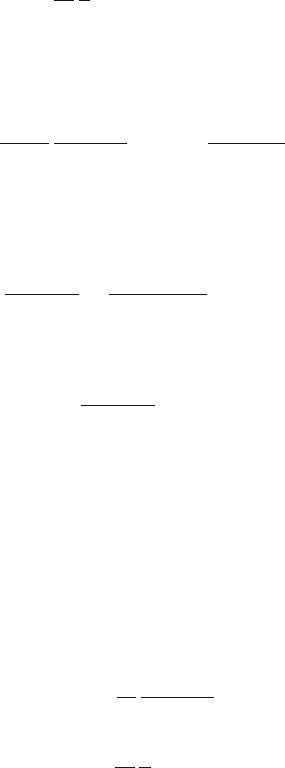
For 1, the first term in the sum in (8.30) dominates so that
n
'ne
0
0Š
1
n
'; for n 1;
which means that the birth rate is approximately constant in this case. On the other
hand, for 1 we have
n
D 'n
C1
X
rD0
e
r
rŠ
1
rhniCn
D 'nE
1
YhniCn
; (8.32)
where Y is Poisson distributed with mean . Carrying out a Taylor expansion about
the mean gives
n
D 'n
1
hniCn
C
hni
2
.hniCn/
3
C :::
: (8.33)
Since 1, the second and subsequent terms in the above expansion may be
neglected, which results in
n
D
'n
hniCn
: (8.34)
Clonal Extinction and Mean Extinction Times
Since
0
D
0
D 0, the birth and death process has an absorbing state at n D 0.
Clonal extinction occurs if the process reaches this state. We now calculate the prob-
ability of extinction using condition (8.12).
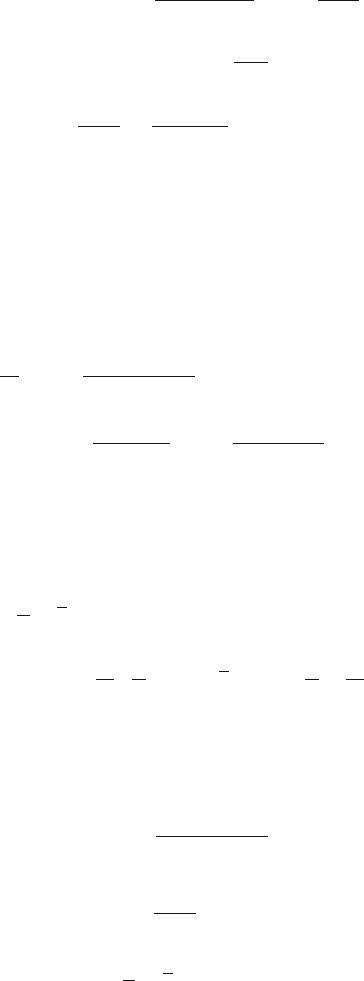
Firstly, note that the birth rate is bounded from above as follows:
n
D 'ne
C1
X
rD0
r
rŠ
1
rhniCn
'ne
C1
X
rD0
r
rŠ
1
n
D 'e
e
D ': (8.35)
182 C. Molina-Par´ıs et al.
Therefore
C1
X
nD1
1
2
:::
n
1
2
:::
n
C1
X
nD1
n
nŠ
'
n
; (8.36)
using the upper bound (8.35). Let a
n
D
n
nŠ
'
n
.Then
a
nC1
a
n
D
.n C 1/
'
!C1as n !C1;
and so
P
C1
nD1
a
n
diverges by the ratio test. Hence, condition (8.12) holds by the
comparison test and we conclude that absorption at n D 0 is certain for all values
of the parameters. This means that the eventual fate of any clone is extinction and
disappearance from the repertoire.
We now compute the mean times to extinction. The mean time to extinction from
initial state m isgivenby[12]
m
D
8
ˆ
ˆ
ˆ
ˆ
ˆ
<
ˆ
ˆ
ˆ
ˆ
ˆ
:
1
1
C
C1
X
nD2
1
2
:::
n1
1
2
:::
n
;mD 1;
1
C
m1
X
kD1
2
4
1
:::
k
1
:::
k
C1
X
nDkC1
1
:::
n1
1
:::
n
3
5
;mD 2;3;::::
(8.37)
We first calculate the mean time to extinction for the hard niche case ( 1). Sub-
stituting the birth and death rates
n
D ' and
n
D n into the above expressions
results in
1
D
1
'
e
'
1
; (8.38)
m
D
1
C
m1
X
kD1
kŠ
'
kC1
"
e
'
k
X
nD0
'
n
1
nŠ
#
for m 2: (8.39)
We now consider the most general form of the birth and death rates given by (8.30)–
(8.31). Then
1
D
C1
X
nD1
1
2
:::
n1
1
2
:::
n
C1
X
nD1
'
n1
n
nŠ
using the bound
n
'
D
1
'
e
'
1
; (8.40)