
Molina-Par?s C., Lythe G. (editors) Mathematical Models and Immune Cell Biology
Подождите немного. Документ загружается.


14 Dynamics of Peripheral Regulatory and Effector T Cells 283
Table 14.1 Parameters and variables of the T cell dynamics model. The values adopted here
for some parameters were taken from Carneiro et al. [16]. The remaining parameters were de-
termined in order to satisfy specific conditions on the crossreactivity distribution, as explained in
the main text
Parameter/variable Values Description
Basic T cell dynamics
D
t
— Number of T cell clones at time t (T cell diversity)
t
i
— Time of entrance of the i -th T cell clone in the periphery
E
i;t
i
, R
i;t
i
—T
R
-andT
E
-cell densities from T cell clone i when entering
the periphery
E
i;tt
i
, R
i;tt
i
—T
E
and T
R
cell densities from T cell clone i at time t given
that the clone entered in the periphery at time t
i
E
i;t
, R
i;t
— Activated T
E
-andT
R
-cell densities from i-th clone at time t
e
1.00 T
E
-cell proliferation rate upon stimulation by APCs
r
1.10 T
R
-cell proliferation rate upon stimulation by APCs
ı 0.02 T cell death rate
s
c
— Number of T cell clones entering the periphery per unit of time
Characterization of APC population
A — Number of distinct APC subpopulations in the periphery (APC
diversity)
A
j
— APC density of subpopulation j
s 2 Number of conjugation sites per APC
a
— Mean of the exponential deviate of APC subpopulation density
Interaction between T cells and APCs
C
ij;t
— Density of APC-T cell conjugates formed by i -th T cell clone
and j -th APC population
c
1.00 Rate at which T cells conjugate with cognate APCs
d
1.00 Rate at which T cells deconjugate from cognate APCs
k
i
— Number of APC subpopulations recognized by the i-th T cell
clone (crossreactivity of the i -th T cell clone)
0.90 Initial probability of connecting an APC population with
a new clone
c
— Exponential decay in the probability of increasing
crossreactivity of a clone given that it recognizes a certain
number of APC subpopulations
A
T;i
— Total APC density recognized by the i-th T cell clone
order to specify the proportion of clones falling in the bistable regime at the time
of their entrance in the periphery (Fig. 14.3d). For simplicity in the simulations, we
generate all T cell clones with similar initial conditions, E
i;t
i
D E and R
i;t
i
D R,
8i. Clonal extinction is assumed when the overall density of a clone drops below a
certain threshold (e.g., 10
3
). The corresponding equations are then removed from
the system, as previously done [19,25].
284 N. Sep´ulveda and J. Carneiro
Results
Dynamics and Structure of the Peripheral T Cell Repertoire
in the Absence of Thymic Export
We first study the simplest situation where the whole T cell repertoire is generated at
the beginningof the simulations. This situation is conceptually related to an adoptive
transfer experiment, in which a pool of T cells is transferred into an animal lacking
T cells, such as nude or rag
=
mouse [11,26].
Less Crossreactive T Cell Clones are Outcompeted from the Repertoire
It has been suggested that T cell competition is one of the major forces shaping the
T cell repertoire [27]. T cell competition was studied before but not accounting for
the presence of T
R
cells in the repertoire [28,29] and the heterogeneity of the APC
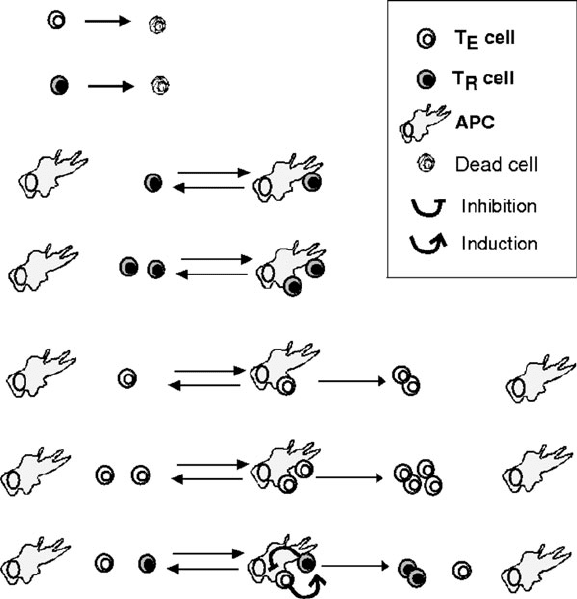
pool [19]. In the present model, T cells should form multicellular conjugates with
their cognate APCs in order to survive and proliferate (Fig. 14.1). Thus, the model
features competition among T cells within the same clone and also between different
clones partaking the same APC. Since we assume that the pairwise conjugation rate
has the same value for all clones and APC subpopulations, the competitiveness of
a clone depends on its cognate APC density relatively to those of the remaining
clones. In general, it is expected that T cell clones that can conjugate with more
APCs will outcompete the ones with lower cognate APCs. Yet, this expectation
may not hold true owing to the fact that T cell clones share different sets of APC
subpopulations, forming a complex network of interactions between these two cell
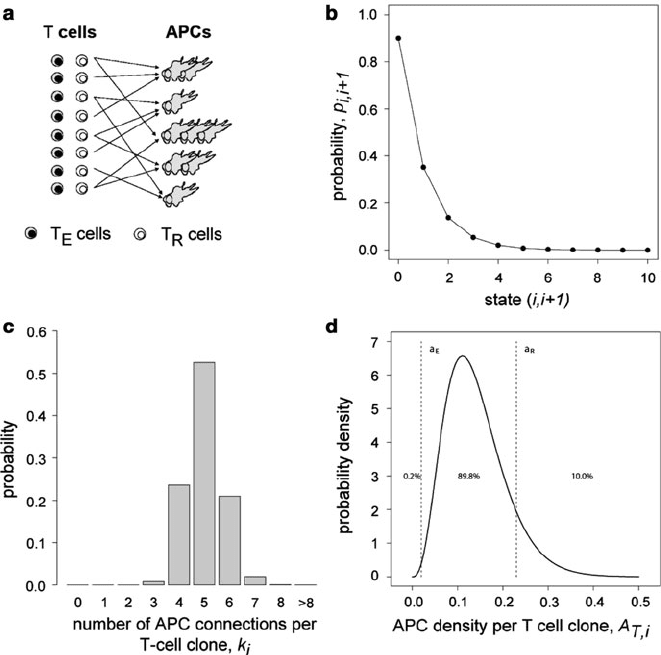
types (Fig.14.3a). In this scenario, the persistence of a given T cell clone in the
periphery is dependent not only on the APC density but also on the different APC
subsets shared with the remaining clones. It is then reasonable to conceive a situation
where a T cell clone recognizing a large density of APCs can be outcompeted if it
has to partake these APCs with many different T cell clones.
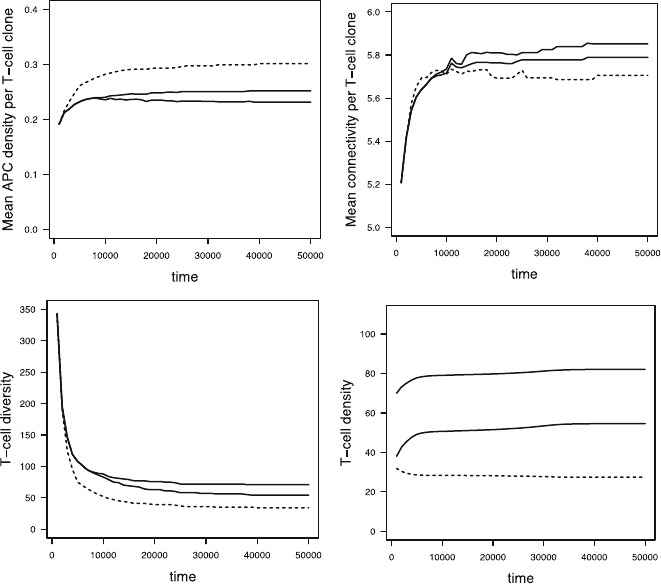
It is clear from the simulations that the mean APC density per T cell clone in-
creases in time until reaching a plateau (Fig. 14.4a). This result suggests that clones
that can form more multicellular conjugates tend to persist longer in the simula-
tions. A similar result can be extracted from the temporal evolution of the mean
crossreactivity of T cell clones (Fig. 14.4b). Since less crossreactive T cell clones
are purged from the repertoire, T cell diversity decreases in time (Fig. 14.4c). This
decrease is more pronounced in the beginning of the simulation, where the differ-
ence between T cell clones with low and high level of crossreactivity is larger, and
less pronounced in the end of the simulation, where this difference is smaller. In
terms of total T cell density, the respective steady-state is reached very early in the
simulation (Fig. 14.4d), maintaining it even when T cell diversity is still decreasing
and far from its final value (Fig. 14.4c).
14 Dynamics of Peripheral Regulatory and Effector T Cells 285
Fig. 14.1 The Crossregulation Model. The reaction diagram indicates the events and interactions
underlying the dynamics of APCs, T
E
cells and T
R
cells as assumed in the model. In this simple
scenario the APC can only form conjugates with a maximum of two T cells, which can belong to
any of the clones that recognize this specific APC subpopulation
Partition of the T Cell Repertoire
We previously studied the T cell repertoire assuming that T cells recognize indepen-
dent mutually exclusive APC subsets [16]. In this particular case, if all clones are
generated with similar initial composition, the structure of the repertoire is straight-
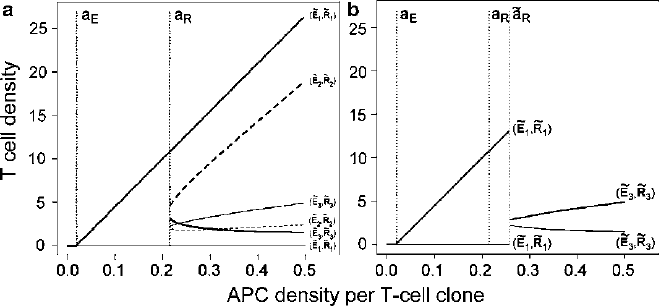
forwardly predicted from the bifurcation diagram shown in Fig. 14.2b. This shaping
of the repertoire leads to a partition of the peripheral compartment in three distinct
T cell clone subsets. The first subset contains T cell clones that eventually go ex-
tinct in the periphery, because they can conjugate with just a few APCs (at densities
lower than a
E
). The second subset is made of T cell clones that can conjugate with
APCs at densities between a
E
and Qa
R
. At equilibrium, these clones are composed
of T
E
cells only, because T
R
-cell populations cannot be sustained. Therefore, this
286 N. Sep´ulveda and J. Carneiro
Fig. 14.2 Steady state analysis of the Crossregulation model as a function of APC density per
T cell clone. (a) Bifurcation diagram where stable (solid lines) and unstable (dashed lines) steady
states for T
E
(thick lines)andT
R
(thin lines) cells are represented. The system qualitatively changes
its dynamic behaviour in the critical points a
E
and a
R
, defining three distinct parameter regimes.
First, for APC density less than a
E
, the stable steady state is .
Q
E
0
;
Q
R
0
/ D .0; 0/ (not labelled).
Second, for APC density between a
E
and a
R
, the stable steady state is given by .
Q
E
1
;
Q
R
1
/ with
Q
R
1
D 0. Third, for APC density higher than a
R
, the system enters in a bistable regime that,
depending on the initial conditions for T
R
and T
E
cells, the system either goes to .
Q
E
1
;
Q
R
1
/ or
.
Q
E
3
;
Q
R
3
/. These two separated by the saddle point .
Q
E
2
;
Q
R
2
/.(b) Stable steady states of T
E
and T
R
cells for a given initial condition: E.0/ D R.0/ D 0:50. Parameters values are given in Table 14.1
subset represents an exclusive T
E
-cell repertoire. The third subset includes clones
that recognize cognate APCs in densities higher than Qa
R
. Because of the specified
initial condition, the T
R
-cell populations can be sustained in this parameter regime,
coexisting with their T
E
counterparts. Therefore, this subset comprises the overlap
repertoire between T
E
and T
R
cells, characterized by a higher average T
R
-cell den-
sity than that of T
E
cells and a negative correlation between the respective T
R
and
T
E
-cell densities (Fig. 14.2b). Since there is no parameter regime in which T
R
cells
can be sustained alone, the previously-studied model provides no means of forming
an exclusive T
R
-cell repertoire.
With these previous results, we ask whether they are robust under interclonal
competition for APCs. Can a similar partition of the repertoire be obtained in
these conditions? Can T cell competition generate an exclusive T
R
-cell repertoire?
Representative results of the simulation of peripheral repertoire dynamics contem-
plating interclonal competition in the absence of thymic export are illustrated in
Fig. 14.5.
It is clear that, at equilibrium, a partition of the peripheral repertoire is also ob-
tained in the presence of interclonal competition (Fig. 14.5a). Clones whose cognate
APCs are in densities less than a
E
vanish. Moreover, since highly crossreactive T
cell clones can outcompete less crossreactive ones (Fig. 14.4a and b), the effective
14 Dynamics of Peripheral Regulatory and Effector T Cells 287
Fig. 14.3 Network between T cell clones and APC subpopulations. (a) T cell clones recognize a
different subset of APC subpopulations; (b) Probability of generating a new connection (i C 1)
given a clone has already i connections (14.8); (c) Probability distribution of the number of
connections per T cell clone; (d) Probability distribution of APC density recognized per T cell
clone. Parameters were specified in order to generate 0.2% T cell clones in an extinction regime
(A
t
<a
E
), 89.8% T cell clones in immunity regime (a
E
A
t
a
R
) and 10% T cell clones in
the bistable regime (A
t
>a
R
). Parameter values of plots B, C and D: A D 100,
a
D 2:8 10
3
,
D 0:90,and
c
D 1:07
limit for T cell survival is higher than a
E
, as shown by the respective APC density
associated to the clone that recognizes the smallest APC density. The exact value for
this threshold cannot be computed because it is dependent on the actual connectivity
structure between APC subpopulations and T cell clones, which is randomly gener-
ated in each simulation. A similar result is obtained for the threshold that allows T
R
cells to be sustained within a clone. In this case, clones recognizing APCs at den-
sities higher than Qa
R
will help to maintain T
R
cells in less crossreactive clones. As
a consequence, the threshold for T
R
-cell persistence decreases, being closer to a
R
,
288 N. Sep´ulveda and J. Carneiro
ab
cd
Fig. 14.4 Peripheral T cell repertoire dynamics without thymic export. The panel shows the time
course of several quantities during a representative simulation in which 500 distinct clones were
generated at time t D 0, with similar initial conditions, competing for
A D 100 APC subpopu-
lations (thick line - T cells; solid line -T
E
cells; dashed line -T
R
cells; Initial condition for each
clone: t
i
D 0, E
i;0
D R
i;0
D 0:50; 8i D 1; : : : ; 500). The parameters
a
and
c
were specified
in order to generate T cell clones with a mean crossreactivity of five cognate APCs and 10% prob-
ability of recognizing APC densities necessary for a bistable dynamics, as illustrated in Fig. 14.3
(
a
D 2:8 10
3
and
c
D 1:07). The remaining parameters are given in Table 14.1
the lower APC density limit that defines the bistable regime for the homogeneous
population case (Fig. 14.2a). It is worth noting that, in this scenario, the equilibrium
T cell density of each clone driven by a given APC density is lower than in the
scenario without interclonal competition for APCs.
Since a similar partition of the peripheral repertoire is observed in the context of
interclonal competition, previous suggestions for the diversity and related proper-
ties of T
R
and T
E
cells also hold [16]. Therefore, T
R
cells seem to be less diverse
than their T
E
counterparts (Fig. 14.5b). As a corollary, the diversity of the T
E
-cell
exclusive repertoire has the largest contribution to the total diversity (Fig. 14.5c).
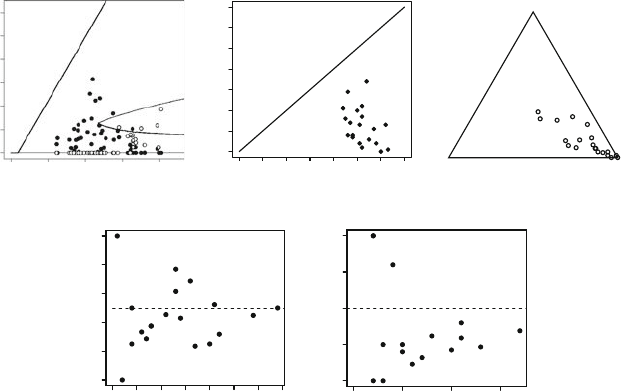
14 Dynamics of Peripheral Regulatory and Effector T Cells 289
1.0
1.0
0 5 10 15
0.5
0.0
_
0.5
_
1.0
0.8
0.6
0.4
0.2
0.0
0 5 10 15 20 25 30 35
fraction of T
R
–cell diversity due to overlap
T
R
exclusive repertoire
T
E
exclusive repertoire
overlap repertoire
0.0 0.1 0.2 0.3 0.4
APC density recognized per T-cell clone
T-cell density
12
10
8
6
4
2
0
Spearman’s correlation coefficient
a
b
c
0 10203040506070
0
10
20
30
40
50
60
70
T
E
diversity
T
R
–cell diversity
diversity of overlap repertoire
T
R
diversity
X=Y
de
Fig. 14.5 Partition of the peripheral T cell repertoire in simulations without thymic export.
(a) A representative snapshot of a T cell repertoire at equilibrium (t D 50000), where solid and
empty circles represent T
E
and T
R
clones, respectively. (b) Diversity of T
R
and T
E
cells, where
the diagonal line corresponds to equal diversity of both cell types. (c) Ternary diagram represent-
ing the contribution of the diversities of T
R
-exclusive, T
E
-exclusive, and overlap repertoires to the
total T cell repertoire diversity. (d) Diversity of the T
R
/T
E
overlap repertoire plotted as a fraction
of total T
R
-cell diversity, where the horizontal line corresponds to the case in which T
R
-cell exclu-
sive and overlap repertoires are equally diverse. (e) Spearman’s correlation coefficient calculated
between T
R
and T
E
-cell densities in clones of the overlap repertoire. Each dot in plots B, C, D and
E represents a distinct simulation of the T cell repertoire (20 simulations in total). The parameters
of these simulations are given in Fig. 14.4 and Table 14.1
Interestingly, the T
R
-cell repertoire can now be divided into an exclusive subset
and a subset overlapping with the repertoire of T
E
-cells (Fig. 14.5c). Therefore,
in contrast to the previous model [16], competition between T cell clones with
different specificities can give rise to an exclusive T
R
-cell repertoire. The contri-
bution of this repertoire to the overall T
R
-cell diversity varies across simulations.
The diversity of the exclusive T
R
-cell repertoire can be lower, equal or higher
than the diversity of overlap between T
E
and T
R
repertoire (Fig. 14.5d). Finally,
as predicted by Fig. 14.2b, T
R
and T
E
-cell densities of clones belonging to the
intersection repertoire tend to be negatively correlated according to Spearman’s co-
efficient (Fig. 14.5e).
290 N. Sep´ulveda and J. Carneiro
Dynamics and Structure of the T Cell Repertoire in the Presence
of a Constant Thymic Export
We now present the results of simulations with a continuous thymic export. These
simulations are more complex than the previous ones and, as we will see below, it is
important to distinguish two pools within the total peripheral T cell repertoire: the
pool of recent thymic emigrants and the pool of resident T-clones. The repertoire of
resident clones can exhibit a structure similar to that obtained without thymic export,
while the repertoire of recent thymic emigrant clones will exhibit a structure related
to the initial conditions imposed for the generation of each clone.
Three Distinct Classes of T Cell Repertoire Patterns Arise in the Presence
of a Continuous Thymic Export
The peripheral T cell repertoires emerging in simulations with interclonal competi-
tion and constant thymic export can be classified into three classes according to their
overall structure and the partitioning of clones made exclusively of T
R
or T
E
cells,
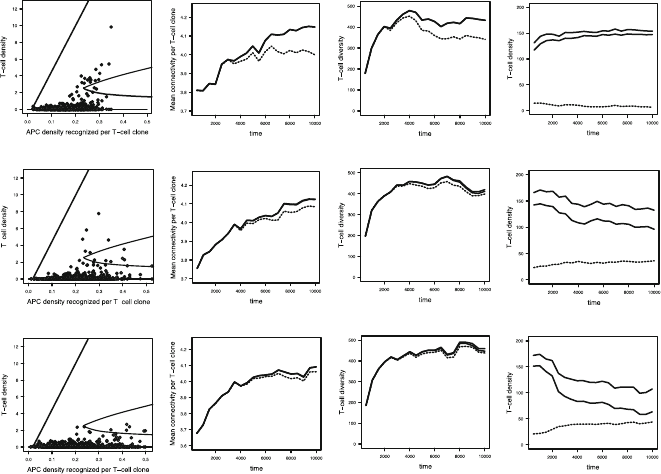
or containing both cell types (Fig. 14.6a, e and i). These three classes for repertoire
structures can be obtained even for the same parameter values.
The first class of repertoire structure is characterised by clones containing only
T
E
cells, even if these clones recognize cognate APCs at densities within the bista-
bility regime (Fig. 14.6a). Newly generated T
R
-cell clones persist transiently in the
periphery until their extinction, and the T
R
-cell repertoire is maintained only by
thymic influx. All T
R
-cell clones are in the subset regarding the newly-generated
T cells clones (i.e., recent thymic emigrant population). Nonetheless, T
R
-cell mean
connectivity, density, and diversity increase in the initial phase of the simulations
until a plateau is reached (Fig. 14.6b, c and d). This is explained by the fact that,
even if all T
R
cells eventually become extinct, T
R
-cell clones that recognize few
APCs vanish faster than the ones recognizing more APCs, resulting in an apparent
increase of the above properties.
The second class of repertoire structure is associated with a partition similar to
that shown in Fig. 14.5a. The total repertoire is partitioned into three subsets, even
though recent thymic emigrants are present in all of them (Fig. 14.6e). The first
subset comprises a set of transient T cell clones that recognize cognate APCs at
low densities and, thus, eventually go extinct after entering periphery. This subset is
maintained by thymic influx. The second subset refers to T cell clones that recognize
intermediate densities of APCs and form the T
E
-cell exclusive repertoire. The third
subset encompasses T cell clones that recognize APCs at sufficiently high amounts.
In most cases, these clones are regulated by T
R
cells. Occasionally, this third subset
might include some expanded clones containing exclusively T
E
cells. As for the
previous repertoire class, the mean connectivity increases in time (Fig. 14.6f), but
now due to a highly crossreactive T
R
and T
E
-cell resident population. Therefore,
the mean connectivity of both cell types increases not only due to the initial purging
14 Dynamics of Peripheral Regulatory and Effector T Cells 291
a
b
c
d
•
•
e
f
g
h
i
j
k
l
Fig. 14.6 Three distinct classes of T cell repertoire patterns arise in the simulations with thymic
export (thick line - T cells; solid line -T
E
cells; dashed line -T
R
cells; s
c
D 0:3, initial condition
for each clone: E
i;t
i
D 0:75; R
i;t
i
D 0:25; 8i). Plots in first row represent total repertoire
structures where T
E
-cell clones predominate within repertoire (repertoire structure of class I). In
this scenario, T
R
cells are mostly maintained by continuous thymic export. Plots in second row
represent total repertoires showing a partition similar to the one shown in Fig. 14.5a (repertoire
structure of class II). Plots in third row represent total repertoire structures in which T
R
cell clones
predominate (repertoire structure of class III). In this case, T
E
cells are mostly maintained by the
constant thymic export. Parameters
a
and
c
were setup in order to generate T cell clones with
a average connectivity of 3.75 APC species and a 10% probability of recognizing APC densities
in the bistable regime (
a
D 3:6 10
3
and
c
D 0:72). The remaining parameters are given in
Table 14.1
of more specific clones from the repertoire, but also to the formation and maturation
of a T
R
and T
E
resident pool with increasingly high crossreactivity. Crossreactivity
increases slowly in this resident pool, as old resident clones are replaced by newly
arrived clones, which happen to be more crossreactive. As in Fig. 14.4c, T
E
-cell
diversity is higher than that of T
R
cells (Fig. 14.6g). Interestingly, the total T cell
density reaches its peak very early in the simulation but after that, with the matura-
tion of the resident T
R
-cell pool, decreases slowly in time (Fig. 14.6h), eventually
reaching a steady state determined by an overall regulation of all resident clones
by T
R
cells. Thus, while the total T cell density decreases the total T
R
-cell density
increases.
The third class of repertoire structure refers to a predominance of T
R
cells within
the clones early on in simulations (Fig. 14.6i and l). The repertoire is composed of a
292 N. Sep´ulveda and J. Carneiro
recent thymic emigrant population and a resident population made almost exclusive
of clones with T
R
cells and without T
E
cells (Fig. 14.6i). Few T
E
-cell clones are
maintained in the intermediate APC density region. However, the populations of T
R
cells, which require T
E
cells for growth, can only persist in the periphery due to the
source of T
E
cells coming from the thymus. Since T cell clones are exported to the
periphery with both cell types, T
R
-cell diversity tends to be close to that of T
E
cells
(Fig. 14.6k). In some cases, T
R
-cell diversity can be even higher (simulations not
shown). Finally, as in the previous class, the evolution of total T cell density has a
biphasic behaviour: it reaches a peak early in the simulations, followed by an abrupt
drop. This drop correlates with the overtaking of the repertoire by T
R
-cell clones
(Fig. 14.6l). Therefore, these repertoires can be interpreted as a situation where all
the immune responses are globally regulated by T
R
cells.
At this point, it is worth noting that the first and third classes of repertoire pat-
terns have deleterious functional consequences for the organism. The organism’s
phenotype corresponding to the first class of repertoire structures, in which T
E
-cell
predominate in all the clones and T
R
-cells cannot expand and persist in the periph-
ery, is that of a massive systemic autoimmune pathology, akin to what is observed
in animals or humans deficient in the foxp3 gene. [30]. Conversely, in the third class
of repertoire structures, in which T
E
-cells are under strong control of highly cross-
reactive T
R
-cell clones, the phenotype of the organism would be effectively that
of an immunocompromised individual unable to mount immune responses. There-
fore, the repertoire structure of class II seems to be the most adequate to describe
the structure and function of the peripheral T cell repertoire in a healthy individual,
as suggested in a previous work [16]. Yet, there is a price to pay in this class. In these
simulations, some occasional clonal expansions containing exclusively T
E
cells are
observed, which might be interpreted as organ-specific autoimmune diseases.
The Three Repertoire Classes are Better Distinguished by the Structure
of Their Resident Populations
As mentioned above, any peripheral T cell repertoire is composed of a recent thymic
emigrant population and a resident one. The latter population is represented by a
small number of clones that expand and persist at T
R
and/or T
E
densities above
those initially set (as can be observed in Fig. 14.6a, e and i). Nevertheless, it is
difficult to define exactly which clones effectively form the resident population.
For the sake of simplicity, the 25 oldest clones in the simulations are considered
representative of the resident population. In contrast, recent thymic emigrant clones
represent the majority of the repertoire by the large number of clones with densities
equal or lower than the initial ones (as also observed in Fig. 14.6a, e and i). It is
worth noting that most of these recent thymic emigrant clones will eventually go
extinct.
Due to the predominance of recent thymic emigrant clones, all three reper-
toire classes show similar structures when the whole T cell repertoire is analyzed
(Fig. 14.7a, b and c). That is, T
E
-cell diversity tends to be higher than that of T
R