
Molina-Par?s C., Lythe G. (editors) Mathematical Models and Immune Cell Biology
Подождите немного. Документ загружается.

14 Dynamics of Peripheral Regulatory and Effector T Cells 293
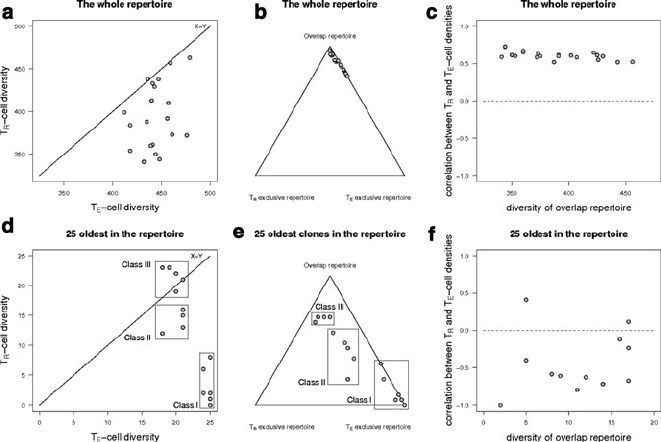
Fig. 14.7 The three T cell repertoire classes are better distinguished within the structure resident
cell populations. Plots A, B, and C refer to the analysis of the whole T cell repertoire, while plots
D, E, and F correspond to the analysis of the resident T cell population, represented by the 25 oldest
clones in the simulations. Each dot in the plot represents a distinct simulation (20 simulations in
total). See Fig. 14.6 for further details
cells but with no clear distinction between these three classes of repertoire structures
(Fig. 14.7a). The same happens when analyzing the contribution of the exclusive
repertoires of T
R
and T
E
cells, and their overlapping repertoire, to the total T cell
diversity (Fig. 14.7b). As expected, the overlap between the repertoires of T
R
and
T
E
recent thymic emigrants represents the larger fraction of the total repertoire. This
implies in turn a positive correlation between T
R
and T
E
-cell clones belonging to
the overlapping repertoire (Fig. 14.7c).
The main differences between the three repertoire classes are found within the
minor pool of resident T cell clones. In fact, the first class of repertoires has a
resident population with a large difference between T
R
and T
E
-cell diversities
(Fig. 14.7d). In this class, the resident repertoire is mainly composed of T
E
-cell
exclusive repertoire. The second class of repertoires has an intermediate difference
between T
R
and T
E
-cell diversities. Using a ternary diagram representation we plot
simultaneously the diversities of the T
R
and T
E
exclusive repertoires as well as
that of the overlap. The points representing the resident population in the second
class of repertoires lay almost in the central region of the triangle, which means
that exclusive T
R
-cell and T
E
-cell diversities and the shared diversity contribute
almost equally to the overall T cell diversity (Fig. 14.7e). Since the third class of
repertoires is characterized by a strong predominance of T
R
cells, the diversity of
these cells within the resident population is equal or higher than that of the T
E
cells
294 N. Sep´ulveda and J. Carneiro
(Fig. 14.7d). The repertoire of the resident population is then mostly composed of T
cell clones in the overlapping repertoire and few clones from the exclusive T
R
-cell
repertoire (Fig. 14.7e). Notwithstanding the differences between the three classes
of repertoire, they all tend to show a negative correlation between T
R
and T
E
-cell
densities within the clones that represent the overlap. A positive correlation can also
be obtained when some of the clones in the resident population are replaced by
newly arising T cell clones.
Parameter Dependence of the Peripheral T Cell
Repertoire Structure
We now ask how the structure of the peripheral T cell repertoire changes with some
of the parameters in the simulations, such as the average clonal connectivity coming
from the thymus, number of APC subpopulations (APC diversity), and the num-
ber of clones exported from the thymus (Fig. 14.8). We pay special attention to the
probability of obtaining each of the three classes of T cell repertoire structures and
the decomposition of T cell diversity into their three components. To calculate the
proportion of each repertoire structure for a given parameter set, we visually clas-
sified the repertoires according to the diversity composition exhibited by their 25
oldest clones at the end of the simulation (t D 10;000), as illustrated in Fig. 14.7e.
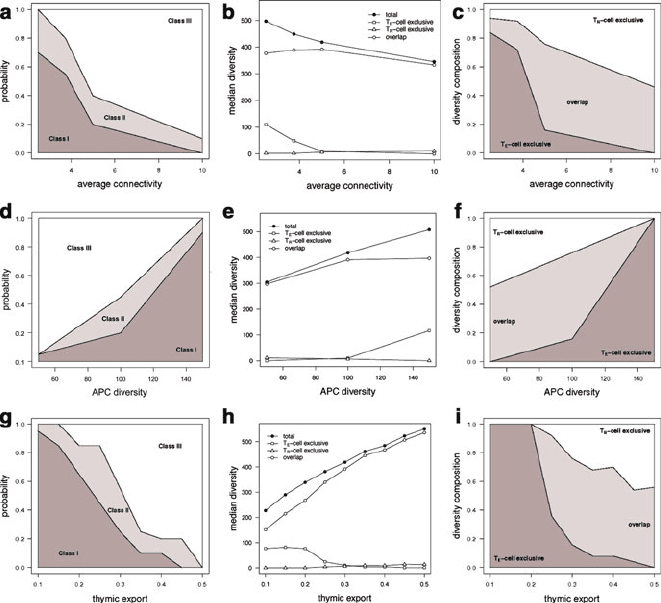
In the simulations, for fixed values of APC diversity and thymic export, increas-
ing the average connectivity per clone increases the chance of obtaining repertoire
structures of class III (Fig. 14.8a). Because repertoires in this class are character-
ized by a predominance of T
R
cells, the overall T cell diversity tends to decrease
as connectivity increases (Fig. 14.8b), and the repertoire of the resident population
becomes increasingly dominated by the T
R
-cell exclusive repertoire (Fig. 14.8c). In
fact, with a higher average connectivity for clones coming from the thymus, the ratio
of T
R
cells per APC increases, promoting in this way peripheral tolerance.
Fixing the parameters controlling connectivity and thymic export, a higher APC
diversity increases the overall T cell diversity (Fig. 14.8e). This is just a consequence
of a higher number of combinations of different APCs that can be recognized by the
T cell clones. In theory, this parameter when increased should transiently decrease
interclonal competition, unless compensated by an increase of the thymic export. T
E
cells would then benefit of this diminished interclonal competition in the beginning
of the simulation to proliferate and competitively exclude T
R
-cell within the same
clone. Therefore, individuals with a higher APC diversity but with similar thymic
output tend to exhibit repertoires of class I (Fig. 14.8d). For this reason, the diversity
of the T
E
-cell exclusive repertoire (Fig. 14.8e) and its relative contribution to the
diversity of the resident population (Fig. 14.8f) tend to increase as a function of the
APC diversity.
The overall T cell diversity is also positively correlated with the thymic export
(Fig. 14.8h), as expected from the fact that there is more clones from the thymus.
Since clones enter the periphery with both T
R
and T
E
cells, diversity of the overlap
14 Dynamics of Peripheral Regulatory and Effector T Cells 295
Fig. 14.8 Effect of some parameters on the structure of the repertoire. First, second and third rows
refer to the effect of mean connectivity coming from the thymus, APC diversity, and thymic export,
respectively. First, second, and third columns refer to the probability of generating each repertoire
structure (classes I, II, and III), the diversity of each T cell repertoire, and diversity composition
for the 25 oldest clones at the end of the simulations (t D 10;000). Parameters: s
c
D 0:30 and
A D 100 (plots a, b,andc); s
c
D 0:30,
a
D 2:0810
3
and
c
D 1:07 (plots d, e,andf; thymic
average connectivity of five APC populations);
A D 100,
a
D 2:0810
3
and
c
D 1:07 (plots
g, h,andi; thymic average connectivity of five APC populations). The parameter
a
was calculated
in order to generate 10% of clones in the bistable regime. For each parameter set, we performed 20
simulations
repertoire also increases with this parameter (Fig. 14.8h). A priori, a higher thymic
export is expected to exhibit two major effects. On the one hand, it increases the
chance of generating highly crossreactive clones. On the other hand, as it was the
case for increased connectivity, it promotes the control by T
R
cells by favoring
the ratio of T
R
cells per APC and, at the same time, increasing interclonal com-
petition, which slows down the taking over of APC by T
E
cells. Because of these
effects, high values of thymic export favor the emergence of repertoires of class
III (Fig. 14.8g), leading to a high contribution of T
R
-cell diversity in the resident
population (Fig.14.8i).
296 N. Sep´ulveda and J. Carneiro
Discussion
Recently, there is a growing interest in the structure of the T cell repertoire, in
particular in its decomposition in subsets that are exclusive of either T
R
-orT
E
-cell
populations, and the subset corresponding to the overlap between the two popula-
tions. Here, we tried to understand how this decomposition comes about based on
the simulations of the Crossregulation model [16], describing the peripheral dynam-
ics of T
R
-orT
E
-cell populations.
We previously studied a scenario in which the peripheral T cell repertoire was,
by construction, composed of independent clones that recognize mutually exclusive
sets of cognate APCs [16]. This model precluded the possibility of generating a T
R
-
cell exclusive repertoire, because the persistence of T
R
-cell populations requires
their T
E
counterparts in the same clone. To overcome this limitation of the model,
each T cell clone in the repertoire was interpreted as an independent functional
class of T cells exhibiting similar TCR specificity but that may contain distinct T
E
and T
R
-cells with different specificities. According to this possibility, a T
R
-cell
exclusive repertoire was implicitly included, but the model could not be used to
make predictions about the fractions of exclusive or overlapping repertoires.
We now show that shared specificity between different clones is enough to orig-
inate a T
R
-cell exclusive repertoire. Shared specificity is then a sufficient but not a
necessary condition for the generation of a T
R
-cell exclusive repertoire, since the
mechanism of differentiation in the thymus of T
E
and T
R
cells might produce in
the first place exclusive repertoires of each cell type. Studies on the fate of individ-
ual thymocytes bearing a specific transgenic TCR demonstrated the differentiation
of cells with the same specificity to both T
R
and T
E
phenotypes [31]. However,
a small overlap was observed between thymic T
R
and T
E
TCR samples in recent
studies on animal models with limited TCR diversity [7, 8]. At first glance, this
observation suggests that the thymus is actually able to seed the periphery with
aT
R
-cell exclusive repertoire. Yet, a small overlap in these small samples might
not imply a similar interpretation for the whole repertoire of an individual, as dis-
cussedindepthinSep´ulveda [32]. Small or no overlap between pairs of samples can
arise by chance due to small or different sample sizes. Venturi [33] alluded to this
problem when studying the evolution of TCR repertoire of an individual during an
influenza infection, and provided a method to standardize the calculations. A small
overlap was observed in small peripheral T
R
and T
E
TCR samples, which was also
interpreted as evidence for the existence of peripheral T
R
-cell exclusive repertoire
[6, 8]. Yet, the cautionary note on the interpretation of these observations based on
small samples also hold here. We then conclude that current statistical analysis of
available data is not sufficiently accurate to determine whether or not an exclusive
T
R
-cell repertoire exists in the thymus or periphery.
Notwithstanding this conclusion, our simulations of peripheral T cell clone
dynamics with continuous thymic export suggest that a small T
R
-cell exclusive
repertoire may arise in the periphery, irrespective of how the repertoire is struc-
tured (Fig. 14.7e). This result can be further extended to the more general situation
in which the thymus exports T
R
-cell exclusive specificities. In fact, we demonstrate
14 Dynamics of Peripheral Regulatory and Effector T Cells 297
that peripheral repertoire selection would purge those specificities that are less cross-
reactive, maintaining only the highly crossreactive ones. At this point, it is worth to
recall that current models and observations of thymic T
R
-cell development suggest
that these cells are educated or selected on high affinity/avidity interactions with
thymic APC [13]. Therefore, it is tempting to speculate that thymic T
R
-cell differ-
entiation process has been ‘optimized’ in order to generate T
R
-cell clones that, in
theory, would have a higher chance to survive peripheral selection.
Three distinct structures of the peripheral T cell repertoire emerged in our sim-
ulations. On the one extreme, repertoire structures of class I are characterized by a
dominance of T
E
cell and exclusion of T
R
cells in most of the resident clones. This
scenario can be interpreted as the devastating systemic autoimmune pathology ob-
served in foxp3-deficient individuals. On the other extreme, there are repertoires
patterned in such a way (class III repertoires) that, in the vast majority of resi-
dent clones, T
R
cells predominate over their T
E
counterparts, which often vanish.
A repertoire patterned in this way is expected to avoid autoimmunity but will be
mostly likely inappropriate to fight infections. From previous studies of the Cross-
regulation model in the presence of growing antigen [20, 21], one expects this
repertoire pattern would benefit mild and moderate growing infections that should
become chronic due the inhibition of specific immune responses by (specific) T
R
cells [20]. In contrast, strong acute infections that elicit an overwhelming increase
in specific APC subpopulations, might break the global regulation state of the reper-
toire, as demonstrated in Leon et al. [20]. The last repertoire structure arising in
simulations lies in the middle of the above two extremes, showing a similar struc-
ture to that discussed in Carneiro et al. [16] and obtained here in simulations without
thymic export (class II repertoire). The repertoire is partitioned in three subsets of
clones: (1) a small resident subset avoiding autoimmune responses against recurrent
body antigens by the presence of T
R
cells; (2) a relatively large subset lacking T
R
cells that allows T
E
cells to respond to non-recurrent foreign antigens; (3) a third
subset solely maintained by the thymus that would otherwise go extinct.
As argued above, repertoire structures of class II seem the most adequate to
describe a healthy immune system. Assuming that the parameters used in the sim-
ulations are more or less realistic, this pattern for peripheral T cell repertoire has
a small chance of being generated in the context of a continuous thymic export, as
showninFig.14.8. In fact, this repertoire structure should be better understood as
quasi-stationary transient rather than a true steady state. Since T
R
cells are present
in the resident population of this repertoire structure, a continuous thymic export
would help the system to reach asymptotically the above-mentioned global regu-
lation repertoire structure. This is evident by the sustained increase in time of the
fraction of T
R
cells during the simulations in which the repertoire were character-
ized as class II. As a consequence, we expect that aged animals would be in general
more susceptible to infections due to a higher fraction of T
R
-dominated clones in the
peripheral repertoire. Interestingly, T
R
cells seem to be at a higher fraction in older
individuals than in young ones both in humans and mice (refs. [34, 35]; R. Paiva
and colleagues, unpublished results). For example, Nishioka et al. [35] reported that
aged C57BL/6 mice show a fraction of T
R
cells in the CD4
C
pool around 30%,
298 N. Sep´ulveda and J. Carneiro
which is statistically higher than the 14% observed in young mice. Moreover, these
T
R
cells in older mice seem to maintain their suppressive function. In agreement
with our above interpretation, it was suggested that the increased fraction of T
R
cells in the peripheral repertoire might be an explanation for the increased incidence
of infectious diseases in the elderly [34,35].
One of the simplifications introduced in our simulations was to assume that
thymic export is constant. However, thymic output could be controlled in order to
maintain the repertoire as much time as possible in its healthy structure. Since it was
more easy to obtain such repertoire structures in simulations without thymic export
(data not shown), one can raise the hypothesis that in healthy organisms the thymic
export should be divided into two distinct phases. First, during early ontogeny of
the organism, the thymic export should be strong (perhaps enriched with multire-
active clones) to fill up the periphery and seed it with sustainable T
R
-cell clones.
Then, thymic export should decrease to avoid the filling of the periphery with fur-
ther T
R
-cell clones that, “helped” by early resident T
R
-cell clones, ultimately push
the system to a global regulation repertoire structure. This biphasic thymic export
is a well established fact both in humans and mice, the so-called thymic involu-
tion. Yet, this phenomenon is generally viewed as being deleterious, as remarked by
Dowling and Hodgkin [36], since it is usually associated with a decline in immune
function in the elderly. In the vein of the above discussion, we suggest that thymic
involution might be crucial to seed and maintain the repertoire in a healthy structure.
Dowling and Hodgkin [36] also argue that thymic involution is an important pro-
cess shaping the T cell repertoire in young individuals. In their view, T cell clones
exhibiting TCR specificities close to positive and negative thresholds have a shorter
lifespan. In this scenario, the thymus involutes to allow to peripherally select T cell
clones exhibiting TCR with affinities lying between positive and negative thresholds
and, thus, have longer lifespans and are more useful for immunity.
Interestingly, a biphasic thymus export has been previously proposed but using
a different argument [13]. It was suggested that T
R
cells against ubiquitious pep-
tides are produced in the thymus during perinatal period in order to cover every
available tissue-specific antigen. Then, it was assumed that the thymus stops produc-
ing T
R
cells, exporting only naive T
E
cells, which undergo a process of education
upon encountering antigen that converts them to the T
R
pool in the periphery. In
this line of thought, this process of peripheral education assumes a key role in the
maintenance of the T
R
pool in adulthood. Although peripheral education is now
known to occur in the periphery [26, 37–39], its exact contribution to the structure
of the peripheral repertoire is still unclear, since current estimates for the fraction of
peripherally-converted T
R
cells are disparate across different experimental settings,
and furthermore, T
R
cells are known to be continuously produced in the thymus
(reviewed in [40]).
The long-term outcome of our simulations was somehow dependent on the early
history of repertoire formation. In this regard, if T
E
-cell clones take over the reper-
toire in the first place, it would be difficult to maintain later-generated T
R
-cell clones
in the periphery. This would lead to a repertoire structure of class I with its delete-
rious consequences to the host. In contrast, if early-generated T
R
-cell clones could
14 Dynamics of Peripheral Regulatory and Effector T Cells 299
be sustained in the periphery, they would help later-generated ones to survive in the
repertoire, giving rise to repertoire structures of class III. This dependence on the
early history of repertoire formation seems in agreement with previous studies on
neonatally thymectomized animals [41], where thymus ablation between 2 and 4
days of life but not later can generate an autoimmune condition in adults. This short
time window for the consequences of thymectomy suggests that very early events
of repertoire formation are crucial to determine the respective long-term outcome.
This is in line with the functional significance of thymic involution alluded above,
since a large thymic output in early life would favor the emergence of a repertoire
with a healthy pattern.
It is well known that autoimmune diseases are affected by multiple genetic and
environmental factors, which lead to a complex inheritance pattern [42]. Complex-
ity in these diseases arises due to the incomplete penetrance phenomenon, that is,
only a proportion of individuals with risk-associated genotypes will manifest dis-
ease. Traditionally, one invokes environmental factors to explain this observation,
such as the occurrence of specific infections. Interestingly, twins maintained in
the same environment do not show a 100% concordance rate for disease status.
Moreover, different autoimmune-disease animal models also show incomplete pen-
etrance, even under strict environmental conditions. This is particularly evident in
the NOD mouse strain that spontaneously develops type I diabetes with incomplete
penetrance in both males and females [43]. To explain this phenomenon, we and
others have previously argued that a fraction of incomplete penetrance could be
attributed to an internal stochastic component governing the expression of the phe-
notype, such as a stochastic allelic expression [44–47]. In the case of autoimmune
diseases, we invoked the stochasticity in T cell repertoire generation as a putative
explanation for this internal component of penetrance [45], following the observa-
tions in monozygotic twins when studying different autoimmune diseases [48, 49].
In this line of reasoning, the simulations reported here showed that the three above-
mentioned repertoire patterns can arise in simulations with the same parameter set
(Fig. 14.8). If one interprets these simulations as different individuals with the same
genetics, they indicate that the stochasticity in the T cell repertoire formation can
indeed be an important factor in the understanding of incomplete penetrance in the
context of complex autoimmune diseases. Recently, a lower T
R
-cell TCR diversity
in NOD mice than in non-diabetic C57BL6 mice was reported, suggesting impor-
tant differences between the T cell repertoires of these mouse models [50]. However,
the comparison of TCR diversity between unaffected and affected NOD mice was
not performed, which would allow to assess the putative role of stochastic T cell
repertoire formation in incomplete penetrance. In this scenario, one would expect
to observe clear differences in the T cell repertoire between unaffected and affected
NOD mice.
Our simulations provide simple predictions for some structural properties of
the peripheral repertoire. These predictions are distinct for each repertoire class,
namely, in what concerns to the resident T cell population. For instance, reper-
toire structures of class I exhibit a higher diversity of resident T
E
cells than that
of T
R
cells, and a small overlap between the respective resident repertoires. Class II
300 N. Sep´ulveda and J. Carneiro
repertoires also predict a higher diversity of resident T
E
cells but the difference
between T
E
and T
R
-cell diversity should be smaller than in class I. Repertoire
structures of class III would in turn show comparable diversities of T
R
and T
E
cells.
Besides these predictions, our simulations suggest that, when there is an overlap be-
tween resident T
R
and T
E
-cell specificities, the respective clonal size distributions
tend to be negatively correlated.
Since the three classes repertoire patterns are fairly distinguished by their resi-
dent population, a way to discriminate them experimentally is to study the evolution
of the T cell repertoire in time. In theory, one can detect the resident population
by following the TCR specificities that consistently appear in different time points.
However, current peripheral T
R
-cell repertoire studies just take a snapshot of the
repertoire at a given time point [6, 8–10, 51], which might obscure the underly-
ing complexities [52]. These studies show that TCR samples of T
R
cells are more
diverse than those from their T
E
counterparts, which prompted the authors to ex-
tend this conclusion to the whole repertoire of an individual [6, 8–10]. However,
we demonstrate that this conclusion might not be true [32, 53]. In fact, when re-
analyzing data from Hsieh et al. [6, 7], we could not reject the hypothesis of equal
diversity between peripheral T
R
and T
E
cells at the level of the whole peripheral
repertoire. Since there is no information available on the resident T cell popula-
tion, the comparable diversity of peripheral T
R
and T
E
cells might be due to a
situation where the thymus preferentially exports clones with both cell types, as
in simulations performed here. If this holds true, little can be said about the un-
derlying repertoire structure, as illustrated in Fig. 14.7a and b. In fact, stochastic
simulations demonstrate that the available data of Hsieh et al. [6, 7] could not rule
out a complete overlap between thymic T
R
and T
E
-cell repertoires and, thus, little
information about the underlying structure can be extracted by a snapshot of the
repertoire [32]. In line with these results, we conclude that current T
R
-cell studies
need to be redesigned in order to gain more insight on peripheral T
R
-cell repertoire
structure.
Acknowledgements This work was supported by Fundac¸˜aoparaaCiˆenciaeaTecnologia(grants
PTDC/SAU-MII/71402/2006) and a fellowship to NS (SFRH/BD/19810/2004). The authors would
like to thank Prof. Ramit Mehr (Bar-Ilan University) for many comments on an early version of
this paper.
References
1. Hori S, Nomura T, Sakaguchi S (2003) Control of regulatory T cell development by the tran-
scription factor Foxp3. Science 299:1057–1061
2. Fontenot JD, Gavin MA, Rudensky AY (2003) Foxp3 programs the development and function
of CD4
C
CD25
C
regulatory T cells. Nat Immunol 4:330–336
3. Sakaguchi S, Sakaguchi N, Shimizu J, Yamazaki S, Sakihama T, Itoh M, Kuniyasu Y,
Nomura T, Toda M, Takahashi T (2001) Immunologic tolerance maintained by CD25
C
CD4
C
regulatory T cells: their common role in controlling autoimmunity, tumor immunity, and trans-
plantation tolerance. Immunol Rev 182:18–32
14 Dynamics of Peripheral Regulatory and Effector T Cells 301
4. Mills KHG (2004) Regulatory T cells: friend or foe in immunity to infection? Nat Rev Im-
munol 4:841–855
5. Belkaid Y (2007) Regulatory T cells and infection: a dangerous necessity. Nat Rev Immunol
7:875–888
6. Hsieh CS, Liang Y, Tyznik AJ, Self SG, Liggitt D, Rudensky AY (2004) Recognition of the
peripheral self by naturally arising CD25
C
CD4
C
T cell receptors. Immunity 21:267–277
7. Hsieh CS, Zheng Y, Liang Y, Fontenot JD, Rudensky AY (2006) An intersection between the
self-reactive regulatory and nonregulatory T cell receptor repertoires. Nat Immunol 7:401–410
8. Pacholczyk R, Ignatowicz H, Kraj P, Ignatowicz L (2006) Origin and T cell receptor diversity
of Foxp3
C
CD4
C
CD25
C
T cells. Immunity 25:249–259
9. Pacholczyk R, Kern J, Singh N, Iwashima M, Kraj P, Ignatowicz L (2007) Nonself-antigens
are the cognate specificities of Foxp3
C
regulatory T cells. Immunity 27:493–504
10. Wong J, Obst R, Correia-Neves M, Losyev G, Mathis D, Benoist C (2007) Adaptation of
TCR repertoires to self-peptides in regulatory and nonregulatory CD4
C
T cells. J Immunol
178:7032–7041
11. Sakaguchi S, Sakaguchi N, Asano M, Itoh M, Toda M (1995) Immunologic self-tolerance
maintained by activated T cells expressing IL-2 receptor alpha-chains (CD25). Breakdown of
a single mechanism of self-tolerance causes various autoimmune diseases. J Immunol 155:
1151–1164
12. Sakaguchi S, Wing K, Miyara M (2007) Regulatory T cells - a brief history and perspective.
Eur J Immunol 37:S116–S123
13. Modigliani Y, Bandeira A, Coutinho A (1996) A model for developmentally acquired thymus-
dependent tolerance to central and peripheral antigens. Immunol Rev 149:155–200
14. van Santen HM, Benoist C, Mathis D (2004) Number of Treg cells that differentiate does not
increase upon encounter of agonist ligand on thymic epithelial cells. J Exp Med 200:1221–
1230
15. Mason D (1998) A very high level of crossreactivity is an essential feature of the T-cell
receptor. Immunol Today 19:395–404
16. Carneiro J, Le´on K, Caramalho I, van den Dool C, Gardner R, Oliveira V, Bergman ML,
Sep´ulveda N, Paixao T, Faro J, Demengeot J (2007) When three is not a crowd: a Crossregu-
lation model of the dynamics and repertoire selection of regulatory CD4
C
T cells. Immunol
Rev 216:48–68
17. Le´on K, Per´ez R, Lage A, Carneiro J (2000) Modelling T-cell-mediated suppression dependent
on interactions in multicellular conjugates. J Theor Biol 207:231–254
18. Le´on K, Per´ez R, Lage A, Carneiro J (2001) Three-cell interactions in T cell-mediated sup-
pression? A mathematical analysis of its quantitative implications. J Immunol 166:5356–5365
19. Le´on K, Lage A, Carneiro J (2003) Tolerance and immunity in a mathematical model of T-cell
mediated suppression. J Theor Biol 225:107–126
20. Le´on K, Faro J, Lage A, Carneiro J (2004) Inverse correlation between the incidences of
autoimmune disease and infection predicted by a model of T cell mediated tolerance. J Au-
toimmun 22:31–42
21. Le´on K, Garcia K, Carneiro J, Lage A (2007) How regulatory CD25
C
CD4
C
T cells im-
pinge on tumor immunobiology: the differential response of tumors to therapies. J Immunol
179:5659–5668
22. Fouchet D, Regoes R (2008) A population dynamics analysis of the interaction between adap-
tive regulatory T cells and antigen presenting cells. PLoS ONE 3:e2306
23. Stirk ER, Molina-Par´ıs C, van den Berg HA (2008) Stochastic niche structure and diversity
maintenance in the T cell repertoire. J Theor Biol 255:237–249
24. Carneiro J, Paixao T, Milutinovic D, Sousa J, Le´on K, Gardner R, Faro J (2005) Immunological
self-tolerance: lessons from mathematical modeling. J Comput Appl Math 184:77–100
25. Carneiro J, Coutinho A, Faro J, Stewart J (1996) A model of the immune network with B-T
cell cooperation I - prototypical structures and dynamics. J Theor Biol 182:513–529
26. Zelenay S, Lopes-Carvalho T, Caramalho I, Moraes-Fontes MF, Rebelo M, Demengeot J
(2005) Foxp3
C
CD25- CD4 T cells constitute a reservoir of committed regulatory cells that re-
gain CD25 expression upon homeostatic expansion. Proc Natl Acad Sci USA 102:4091–4096
302 N. Sep´ulveda and J. Carneiro
27. Freitas AA, Rocha B (2000) Population biology of lymphocytes: the flight for survival. Annu
Rev Immunol 18:83–111
28. de Boer RJ, Perelson AS (1994) T cell repertoires and competitive exclusion. J Theor Biol
169:375–390
29. de Boer RJ, Perelson AS (1997) Competitive control of the self-renewing T cell repertoire. Int
Immunol 9:779–790
30. Brunkow ME, Jeffery EW, Hjerrild KA, Paeper B, Clark LB, Yasayko SA, Wilkinson JE, Galas
D, Ziegler SF, Ramsdell F (2001) Disruption of a new forkhead/winged-helix protein, scurfin,
results in the fatal lymphoproliferative disorder of the scurfy mouse. Nat Genet 27:68–73
31. Bensinger SJ, Bandeira A, Jordan MS, Caton AJ, Laufer TM (2001) Major histocompatibility
complex class ii-positive cortical eptihelium mediates the selection of CD4
C
25
C
immunoreg-
ulatory T cells. J Exp Med 194:427–438
32. Sep´ulveda N (2009) How is the T-cell repertoire shaped? PhD thesis, University of Porto
33. Venturi V, Kedzierska K, Tanaka MM, Turner SJ, Doherty PC, Davenport MP (2008) Method
for assessing the similarity between subsets of the T cell receptor repertoire. J Immunol Meth-
ods 329:67–80
34. Dejaco C, Duftner C, Schirmer M (2006) Are regulatory T cells linked with aging? Exp
Gerontol 41:339–345
35. Nishioka T, Shimizu J, Yamazaki S, Sakaguchi S (2006) CD4
C
CD25
C
Foxp3
C
T cells and
CD4
C
CD25
Foxp3
C
T cells in aged mice. J Immunol 176:6586–6593
36. Dowling MR, Hodgkin PD (2009) Why does the thymus involute? A selection-based hypoth-
esis. Trends Immunol 30:295–300
37. Thorstenson KM, Khoruts A (2001) Generation of anergic and potentially immunoregulatory
CD25
C
CD4 T cells in vivo after induction of peripheral tolerance with intravenous or oral
antigen. J Immunol 167:188–195
38. Apostolou I, von Boehmer H (2004) In vivo instruction of suppressor commitment in naive T
cells. J Exp Med 199:1401–1408
39. de Lafaille MAC, Lino AC, Kutchukhidze N, Lafaille JJ (2004) CD25- T cells generate
CD25
C
Foxp3
C
regulatory T cells by peripheral expansion. J Immunol 173:7259–7268
40. Annacker O, Pimenta-Araujo R, Burlen-Defranoux O, Bandeira A (2001) On the ontogeny
and physiology of regulatory T cells. Immunol Rev 182:5–17
41. Asano M, Toda M, Sakaguchi N, Sakaguchi S (1996) Autoimmune disease as a consequence
of developmental abnormality of a T cell subpopulation. J Exp Med 184:387–396
42. Gregersen PK, Behrens T (2006) Genetics of autoimmune diseases – disorders of immune
homeostasis. Nat Rev Genet 7:917–928
43. Anderson M, Bluestone J (2005) The nod mouse: a model of immune dysregulation. Annu
Rev Immunol 23:447–485
44. Sep´ulveda N, Paulino CD, Carneiro J, Penha-Gonc¸alves C (2007) Allelic penetrance approach
as a tool to model two-locus interaction in complex binary traits. Heredity 99:173–184
45. Sep´ulveda N, Paulino C, Penha-Gonc¸alves C (2009) Bayesian analysis of allelic penetrance
models for complex binary traits. Comput Stat Data Anal 53:1271–1283
46. Alper CA, Awdeh Z (2000) Incomplete penetrance of MHC susceptibility genes. Tissue
Antigens 56:199–206
47. Alper CA, Husain Z, Larsen CE, Dubey DP, Stein R, Day C, Baker A, Beyan H, Hawa M,
Ola TO, Leslie RD (2006) Incomplete penetrance of susceptibility genes for MHC-determined
immunoglobulin deficiencies in monozygotic twins discordant for type diabetes. J Autoimmun
27:89–95
48. Hohler T, Hug R, Schneider PM, Krummenauer F, Gripenberg-Lerche C, Granfors K, Merker-
Hermann E (1999) Ankylosing spondylitis in monozygotic twins: studies on immunological
parameters. Ann Rheum Dis 58:435–440
49. Haegert DG, Galutira D, Murray TJ, O’Connor P, Gadag V (2003) Identical twins discor-
dant for multiple sclerosis have a shift in their T-cell receptor repertoire. Clin Exp Immunol
134:532–537