
Molina-Par?s C., Lythe G. (editors) Mathematical Models and Immune Cell Biology
Подождите немного. Документ загружается.

2 T Cell Receptor Triggering and Antigen Discrimination 43
20. McKeithan K (1995) Kinetic proofreading in T-cell receptor signal transduction. Proc Natl
Acad Sci USA 92:5042–5046
21. Hopfield JJ (1974) Kinetic proofreading: A new mechanism for reducing errors in biosynthetic
processes requiring high specificity. Proc Natl Acad Sci USA 71:4135–4139
22. Ninio J (1975) Kinetic amplification of enzyme discrimination. Biochimie 57:587–595
23. van den Berg HA, Burroughs NJ, Rand DA (2002) Quantifying the strength of ligand antago-
nism in TCR triggering. Bull Math Biol 64:781–808
24. Coombs D, Kalergis AM, Nathenson SG, Wofsy C, Goldstein B (2002) Activated TCRs remain
marked for internalization after dissociation from pMHC. Nat Immunol 3:926–931
25. Chan C, George AJT, Stark J (2003) T cell sensitivity and specificity - kinetic proofreading
revisited. Discrete Continuous Dyn Syst - Series B 3:343–360
26. Gonzalez PA, Carreno LJ, Coombs D, Mora JE, Palmieri E, Goldstein B, Nathenson SG,
Kalergis AM (2005) T cell receptor binding kinetics required for T cell activation depend
on the density of cognate ligand on the antigen-presenting cell. Proc Natl Acad Sci USA 102:
4824–4829
27. Wedagedera JR, Burroughs NJ (2006) T-cell activation: A queuing theory analysis at low ago-
nist density. Biophys J 91:1604–1618
28. George AJT, Stark J, Chan C (2005) Understanding specificity and sensitivity of T-cell recog-
nition. Trends Immunol 26:653–659
29. Campi G, Varma R, Dustin ML (2005) Actin and agonist MHC-peptide complex-dependent
T cell receptor microclusters as scaffolds for signaling. J Exp Med 202:1031–1036
30. Varma R, Campi G, Yokosuka T, Saito T, Dustin ML (2006) T cell receptor-proximal signals
are sustained in peripheral microclusters and terminated in the central supramolecular activa-
tion cluster. Immunity 25:117–127
31. Valitutti S, Muller S, Cella M, Padovan E, Lanzavecchia A (1995) Serial triggering of many
T-cell receptors by a few peptide-MHC complexes. Nature 375:148–151
32. Dushek O, Coombs D (2008) Analysis of serial engagement and peptide-MHC transport in
T cell receptor microclusters. Biophys J 94:3447–3460
33. Torigoe C, Inman JK, Metzger H (1998) An unusual mechanism for ligand antagonism.
Science 281:568–572
34. Faeder JR, Hlavacek WS, Reischl I, Blinov ML, Metzger H, Redondo A, Wofsy C, Goldstein B
(2003) Investigation of early events in FceRI-mediated signaling using a detailed mathematical
model. J Immunol 170:3769–3781
35. Goldstein B, Coombs D, Faeder JR, Hlavacek WS (2008) Kinetic proofreading model. Adv
Exp Med Biol 640:82–94
36. Stefanov´a I, Hemmer B, Vergelli M, Martin R, Biddison WE, Germain RN (2003) TCR ligand
discrimination is enforced by competing ERK positive and SHP-1 negative feedback pathways.
Nat Immunol 4:248–254
37. Altan-Bonnet G, Germain RN (2005) Modeling T cell antigen discrimination based on feed-
back control of digital ERK responses. PLoS Biol 3:e356
38. Lipniacki T, Hat B, Faeder JR, Hlavacek WS (2008) Stochastic effects and bistability in T cell
receptor signaling. J Theor Biol 254:110–122
39. Lauffenburger D, Linderman J (1993) Receptors: Models for binding, trafficking, and signal-
ing. Oxford University Press, Oxford
40. Rabinowitz JD, Beeson C, Lyons DS, Davis MM, McConnell HM (1996) Kinetic discrimina-
tion in T-cell activation. Proc Natl Acad Sci USA 93:1401
41. Chan C, George AJT, Stark J (2001) Cooperative enhancement of specificity in a lattice of
T cell receptors. Proc Natl Acad Sci USA 98:5758–5763
42. Chan C, Stark J, George AJT (2004) Feedback control of T-cell receptor activation. Proc R Soc
B: Biol Sci 271:931–939
43. Wylie DC, Das J, Chakraborty AK (2007) Sensitivity of T cells to antigen and antagonism
emerges from differential regulation of the same molecular signaling module. Proc Natl Acad
Sci USA 104:5533–5538
44 D. Coombs et al.
44. Feinerman O, Veiga J, Dorfman JR, Germain RN, Altan-Bonnet G (2008) Variability and
robustness in T cell activation from regulated heterogeneity in protein levels. Science
321:1081–1084
45. Casal A, Sumen C, Reddy TE, Alber MS, Lee PP (2005) Agent-based modeling of the context
dependency in T cell recognition. J Theor Biol 236:376–391
46. Wylie DC, Hori Y, Dinner AR, Chakraborty AK (2006) A hybrid deterministic-stochastic al-
gorithm for modeling cell signaling dynamics in spatially inhomogeneous environments and
under the influence of external fields. J Phys Chem B 110:12749–12765
47. Dushek O (2008) Mathematical modeling in cellular immunology: T cell activation and pa-
rameter estimation. PhD thesis, University of British Columbia
48. Choudhuri K, Kearney A, Bakker TR, van der Merwe PA (2005) Immunology: How do T cells
recognize antigen? Curr Opin Biol 15:R382–R385
49. Choudhuri K, van der Merwe PA (2007) Molecular mechanisms involved in T cell receptor
triggering. Semin Immunol 19:255–261
50. Ma Z, Janmey PA, Finkel TH (2008) The receptor deformation model of TCR triggering.
FASEB J 22:1002–1008
51. Aivazian D, Stern LJ (2000) Phosphorylation of T cell receptor zeta is regulated by a lipid
dependent folding transition. Nature 7:1023–1026
52. Gil D, Schamel WWA, Montoya M, S´anchez-Madrid F, Alarc´on B (2002) Recruitment of Nck
by CD3 reveals a ligand-induced conformational change essential for T cell receptor signaling
and synapse formation. Cell 109:901–912
53. Xu C, Gagnon E, Call ME, Schnell JR, Schwieters CD, Carman CV, Chou JJ, Wucherpfennig
KW (2008) Regulation of T cell receptor activation by dynamic membrane binding of the
CD3epsilon cytoplasmic tyrosine-based motif. Cell 135:702–713
54. Gil D, Schrum AG, Alarcon B, Palmer E (2005) T cell receptor engagement by peptide-MHC
ligands induces a conformational change in the CD3 complex of thymocytes. J Exp Med
201:517–522
55. Mingueneau M, Sansoni A, Gr´egoire C, Roncagalli R, Aguado E, Weiss A, Malissen M,
Malissen B (2008) The proline-rich sequence of CD3epsilon controls T cell antigen receptor
expression on and signaling potency in preselection CD4
C
CD8
C
thymocytes. Nat Immunol
9:522–532
56. Heldin CH (1995) Dimerization of cell surface receptors in signal transduction. Cell 80:
213–223
57. Cochran JR, Cameron TO, Stern LJ (2000) The relationship of MHC-peptide binding and T cell
activation probed using chemically defined MHC class II oligomers. Immunity 12:241–250
58. Krogsgaard M, Li QJ, Sumen C, Huppa JB, Huse M, Davis MM (2005) Agonist/endogenous
peptide-MHC heterodimers drive T cell activation and sensitivity. Nature 434:238–243
59. Bachmann MF, Salzmann M, Oxenius A, Ohashi PS (1998) Formation of TCR dimers/trimers
as a crucial step for T cell activation. Eur J Immunol 28:2571–2579
60. Utzny C, Coombs D, M¨uller S, Valitutti S (2006) Analysis of peptide/MHC-induced TCR
downregulation: Deciphering the triggering kinetics. Cell Biochem Biophys 46:101–111
61. Salzmann M, Bachmann MF (1998) The role of T cell receptor dimerization for T cell antago-
nism and T cell specificity. Mol Immunol 35:271–277
62. Bachmann MF, Ohashi PS (1999) The role of T-cell receptor dimerization in T-cell activation.
Immunol Today 20:568–576
63. Wyer J, Willcox B, Gao G, Gerth U, Davis S, Bell J, van der Merwe P, Jakobsen B (1999)
T cell receptor and coreceptor CD8 alphaalpha bind peptide-MHC independently and with
distinct kinetics. Immunity 10:219–225
64. Yokosuka T, Sakata-Sogawa K, Kobayashi W, Hiroshima M, Hashimoto-Tane A, Tokunaga M,
Dustin ML, Saito T (2005) Newly generated T cell receptor microclusters initiate and sustain
T cell activation by recruitment of Zap70 and SLP-76. Nat Immunol 6:1253–1262
65. Davis SJ, van der Merwe PA (1996) The structure and ligand interactions of CD2: Implications
for T-cell function. Immunol Today 17:177–187
66. van der Merwe PA, Davis SJ, Shaw AS, Dustin ML (2000) Cytoskeletal polarization and redis-
tribution of cell-surface molecules during T cell antigen recognition. Semin Immunol 12:5–21
2 T Cell Receptor Triggering and Antigen Discrimination 45
67. Davis SJ, van der Merwe PA (2006) The kinetic-segregation model: TCR triggering and be-
yond. Nat Immunol 7:803–809
68. Springer TA (1990) Adhesion receptors of the immune system. Nature 346:425–434
69. Burroughs NJ, Lazic Z, van der Merwe PA (2006) Ligand detection and discrimination by
spatial relocalization: A kinase-phosphatase segregation model of TCR activation. Biophys J
91:1619–1629

Chapter 3
Dynamic Tuning of T Cell Receptor Specificity
by Co-Receptors and Costimulation
Hugo A. van den Berg and Andrew K. Sewell
Abstract Mounting evidence that each clonotype of T cell antigen receptor can
productively interact with hundreds or even thousands of peptide antigens would
appear to conflict,
prima facie
, with the immune system’s primary task of guarding
against auto-immunity and singling out harmful “non-self” epitopes against a back-
ground of “self” epitopes. This paradox dissolves somewhat once it is appreciated
that, at any one time, a TCR will only have high functional sensitivity to a small
subset of all its potential agonists, that is, when presented at low copy numbers,
only this small subset will be able to activate the T cell. In this light, the self-nonself
problem becomes a matter of keeping the TCR trained on the appropriate subset of
salient epitopes. We review evidence and models that show how the co-receptors
CD4 and CD8, as well as the “signal 2” costimulatory system, act to keep the TCR
focussed on the appropriate agonist subset. On the theory of dynamic tuning of
TCR specificity, both immune tolerance and specific reactivity against salient epi-
topes rely on continual regulation by other components of the immune system. We
present a model of “avidity maturation” during the early phase of a T cell response.
The TCR repertoire, while vast, is thought to be too small by at least one order
of magnitude to encompass a specific TCR against any pathogen-derived peptide
the host may ever encounter [1, 2]. Several lines of evidence suggest that a given
TCR may recognise a wide variety of peptides, a phenomenon known as
TCR de-
generacy
[3, 4]. This raises the questions of how the immune system ensures that
such degeneracy does not engender autoimmunity, and if any of these mechanisms
may also play a role in TCR maturation. This chapter reviews models of T cell ac-
tivation that propose that the degeneracy of a TCR is not merely a static property
determined by the molecular identity of its CDRs, but instead a highly malleable
property of the TCR/pMHC/co-receptor complex, subject to dynamic modulation
that can restrict or expand the set of ligands for which the TCR has high functional
H.A. van den Berg (
)
Warwick Systems Biology Centre, University of Warwick, Coventry CV47AL, UK
e-mail: hugo@maths.warwick.ac.uk
C. Molina-Par´ıs and G. Lythe (eds.), Mathematical Models and Immune Cell Biology,
DOI 10.1007/978-1-4419-7725-0
3,
c
Springer Science+Business Media, LLC 2011
47

48 H.A. van den Berg and A.K. Sewell
sensitivity, and which, moreover, can act to focus the TCR on one particular ligand,
suggestive of an avidity maturation mechanism analogous to affinity maturation in
humoral immunity.
A key variable in the analysis is
functional sensitivity
, a term coined by Wool-
dridge et al. [5]. This quantity corresponds to what has been termed
TCR avidity
by some immunologists (e.g. [6]), although use of this latter term may invite confu-
sion, since avidity already has an established biochemical meaning. Quantification
of TCR signalling strength has been controversial, which is perhaps not surpris-
ing since a read-out at the cellular/population level must somehow be related to
biomolecular parameters. The importance of both the TCR/pMHC off-rate (equiv-
alently, the mean TCR/pMHC interaction time) and the affinity (off-rate divided
by on-rate) has been emphasised, as well as that of TCR and pMHC densities
on the surfaces of, respectively, the T cell and the APC. The TCR triggering rate
model of functional sensitivity due to Rand and co-workers [7–9] is perhaps the
simplest mathematical model that combines all these parameters, and is briefly
reviewed below.
When one considers TCR degeneracy in statistical terms, each TCR is viewed
as functionally sensitive to every possible peptide ligand, and characterised by its
distribution over these ligands. Almost all of the probability mass is concentrated
about zero sensitivity; these
null peptides
trivially include those that cannot bind
to the appropriate MHC isoform. On the order of 10
5
of the probability mass is
concentrated over the non-null range of functional sensitivities, with 10
6
–10
7
found at the maximum functional sensitivity end of the spectrum.
Looking at TCR degeneracy in statistical terms is necessary because a T cell can
actively alter its functional sensitivity distribution, and hence its TCR degeneracy.
That is to say that a T cell can tune itself to become more broad-spectrum promis-
cuous, or sensitive only to a very small set of peptide ligands.
1
Moreover, it seems
possible that the T cell can select this ligand from among a set of potential strong
agonists. These abilities can be understood, in mechanistic terms, on the basis of the
TCR triggering rate model, as will be explained below.
Dynamic degeneracy would vastly amplify the flexibility of the T cell response
and allow it to mount a specific response to virtually every antigen even with a lim-
ited repertoire. However, dynamic degeneracymight equally well allow a substantial
portion of T cells to become autoreactive – even those who have been exposed to
negative selection. This underlines the importance of costimulation in regulating the
T cell’s functional sensitivity, in both health and disease. The role of costimulation
and threshold adaptation in the maintenance of the na¨ıve T cell repertoire has been
analysed elsewhere [10, 11]; we consider the role of costimulation in adjusting the
functional sensitivity spectrum associated with an immune response.
1
A residual level of promiscuity is inherent in the physico-chemical properties of the TCR/pMHC
contact; one might say that a TCR tuned to minimal degeneracy is sensitive to a single molecular
fingerprint.

3 Tuning of TCR Specificity by Co-Receptors 49
The Triggering Rate Model for Functional Sensitivity
The T cell integrates, at the whole-cell level, intracellular signals emanating from in-
dividual TCR/CD3 complexes that have been triggered by a peptide/MHC molecule
(the triggered TCR corresponds to a signalosome, a complex involving several ki-
nases and adapter linkers). The philosophy of the triggering model, due to Rand and
co-workers, is that any pMHC can trigger a given TCR, but will do so with widely
varying likelihood. In particular, the rate at which TCRs are triggered on the surface
of a given T cell is given by a simple formula:
X
j
˝
ij
P
trig
.i; j /
where the sum ranges over all pMHC species j ; ˝
ij
denotes the rate at which cou-
plings occur between the TCR of clonotype i and a ligand of species j , whereas
P
trig
.i; j / denotes the probability that a given interaction between a TCR of type i
and a pMHC of type j results in the TCR being triggered.
The kinetic pre-factor ˝
ij
generally depends on several factors: the density of
free (unbound) TCR molecules on the T cell surface; the density of free pMHC
molecules on the APC surface; and the affinity constant of the TCR/pMHC interac-
tion. A detailed derivation of these dependencies is given by van den Berg et al. [8].
The kinetic pre-factor depends only on the free TCR density when the latter is suf-
ficiently low relative to the affinity constant; in this
TCR-limited triggering regime
the expression levels of ligand are immaterial. This regime may prevail during pos-
itive selection in the thymus, and is perhaps also important in CTLs. On the other
hand, interactions between T cells and APCs in secondary lymphoid tissues may be
expected to take place in the
MHC-limited triggering regime
, where the rate factor
depends only on the pMHC levels:
˝
ij
D
Z
j
T
ij
(3.1)
where Z
j
is the copy number of pMHC species j engaged by the T cell and T
ij
denotes the mean interaction time of the TCR/pMHC interaction (that is, 1=T
ij
is
the off-rate). Although the affinity constant does not appear explicitly in this ex-
pression, it plays an important role in governing the change-over between TCR- and
MHC-limited triggering; a theoretical prediction that was borne out by experimental
observations [12]. The theory postulates that the T cell response is a functional of
the triggering rate
P
j
˝
ij
P
trig
.i; j / (cf. [13–15]); e.g. the T cell is activated if the
integrated rate
P
j
˝
ij
P
trig
.i; j / exceeds a certain value, called the
cellular activa-
tion threshold
, during the T cell:APC conjugation [16].
Equation (3.1) forms a link between theory and experiment. Write the TCR trig-
gering rate due to pMHC species j as W
ij
and assume MHC-limited triggering. Then
W
ij
D Z
j
P
trig
.i; j /
T
ij
: (3.2)

50 H.A. van den Berg and A.K. Sewell
Also assume that the T cell responds when W
ij
>W
act
where W
act
>0denotes the
cellular activation threshold. The functional sensitivity is determined experimentally
by exposing T cells to APCs with various ligand levels and determining the midpoint
of the dose-response curve.
2
Let Z
crit
j
denote this midpoint level. Then the reciprocal
is taken as a measure of functional sensitivity: the higher the pMHC copy number
required, the lower the functional sensitivity of the TCR for that ligand. In formula:
1
Z
crit
j
D
1
W
act
P
trig
.i; j /
T
ij
(3.3)
which shows that functional sensitivity is proportional to the MHC-specific TCR
triggering rate
3
P
trig
.i; j /=T
ij
. Moreover, (3.3) shows how functional sensitivity
might be modulated: through changes of P
trig
.i; j / and T
ij
at the receptor level and
through changes of W
act
at the cellular level. We discuss modulation of P
trig
.i; j /
and T
ij
via the co-receptor and then modulation of W
act
via the costimulatory ligands.
Co-Receptor Tuning of Functional Sensitivity
T cells vary considerably with respect to the amount of stimulation that is re-
quired to elicit a response: na¨ıve, nearly quiescent T cells require an interaction
with a professional APC that may last for hours, whereas fully differentiated CTLs
may be triggered by very few ligand molecules [17, 18]. These differences re-
flect differences in the expression of the TCR, various kinases, phosphorylases,
including CD45 which occurs in isoforms that correlate with the cellular activa-
tion threshold of the T cell, as well as different forms of costimulation which
modulate the strength of the cognate TCR/pMHC interaction. The T cell sur-
face glycoproteins CD4 and CD8 interact with invariable regions of the MHC
molecule, independently of the cognate contact [19], and hence termed
co-receptors
(see Fig. 3.1). This section focuses on the effects exerted by these co-receptors on
TCR triggering.
2
The width of the dose-response curve is attributable to natural variability in Z
j
among the APCs
and W
act
among the T cells; this variation comes into play because a population-level response is
measured.
3
In fact, an additional step intervenes between experiment and theory: the immunologist does
not control the presentation level Z directly, but rather the concentration at which the APC is
incubated with peptide ligand. The latter may be assumed to increase with Z and will often be
simply proportional.
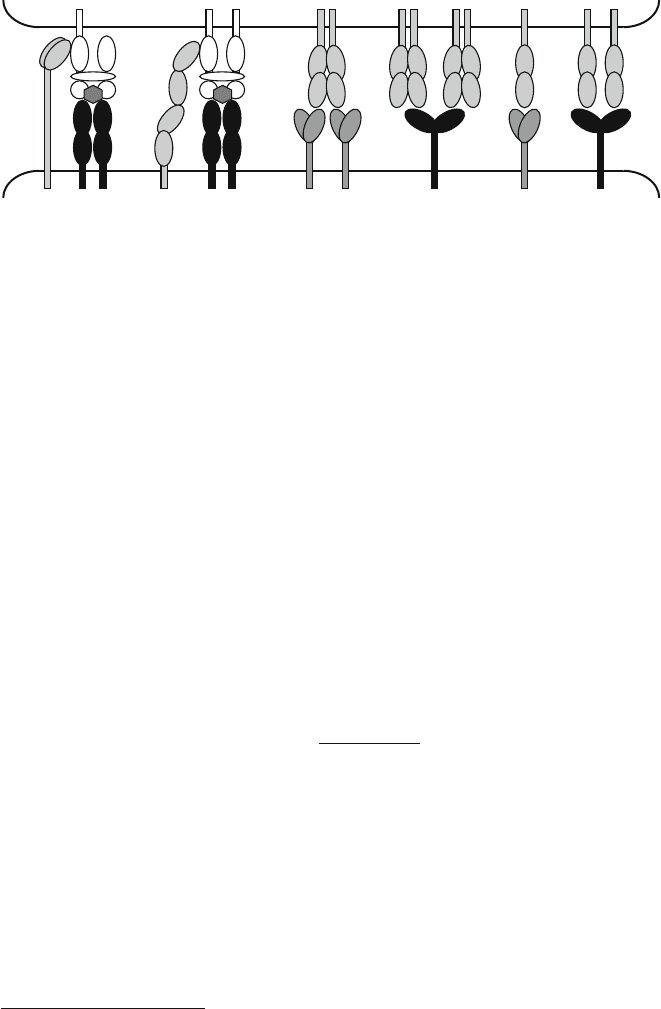
3 Tuning of TCR Specificity by Co-Receptors 51
pMHCI pMHCII CD80 CD86
TCRCD8 CD4 CD28 CD152
antigen-presenting cell
T cell
Fig. 3.1 Receptors and co-receptors at the T cell:APC interface
The TCR Triggering Probability
The probability that the TCR/CD3 complex achieves signalosome status (i.e. starts
to contribute to the activation signal that is conveyed through intracellular signalling
pathways) following an interaction with a pMHC molecule is given by the following
formula
4
:
P
trig
D
Z
1
0
P
n
.t/f
T
.t/dt (3.4)
where f
T
.t/ is the probability density function of the TCR/pMHC residence time,
that is, the probability that the TCR remains bound to the pMHC molecule for at
least an amount of time t equals
R
1
t
f
T
.u/du,andP
n
.t/ is the probability that the
TCR/CD3 complex is phosphorylated at all n sites at time t. If the dissociation rate
is not influenced by the age of the ternary complex, the TCR/pMHC interaction
time follows the exponential distribution:
f
T
.t/ D
exp
t=T
ij
T
ij
(3.5)
where T
ij
denotes the average docking time of a TCR/pMHC complex constituting
a TCR molecule of clonotype i and a pMHC molecule of species j ; the half-life of
the interaction is log.2/T
ij
.
If there are a large number of individual reaction steps that all have to occur in
order for the TCR to be triggered, the waiting time for completion of all steps may
be expected to be well-approximated by a narrow Gaussian, in view of the Central
Limit Theorem. Such steps include phosphorylations of ITAMs, binding of kinases
4
For the sake of simplicity, the dependence on i and j will be suppressed if it is less important in
the immediate context.

52 H.A. van den Berg and A.K. Sewell
and linker proteins, which themselves may need to undergo phosphorylations for
further steps to happen [20, 21]. The narrow Gaussian may be expected to be
obtained if the steps are strictly ordered in a linear succession. For more complex
transition graphs, the narrow Gaussian remains a good approximation if all steps
are forward and all completion paths through the graph contain many steps; in this
case the shortest path dominates. The T cell can modulate which path is shortest by
diverting certain routes through the transition graph by means of ITIM phosphory-
lation. If backward steps, such as dephosphorylations, are allowed, the waiting time
distribution widens.
In the limit for large n, the narrow Gaussian becomes degenerate. The func-
tion P
n
.t/ is then well-approximated by the Heaviside step function:
P
n
.t/ D
0 for t T
R
1 for t>T
R
(3.6)
where T
R
denotes the receptor threshold duration: whenever the TCR remains lig-
ated with a pMHC molecule for longer than this threshold time T
R
, the TCR/CD3
complex is triggered. Equations (3.4)–(3.6) together give:
P
trig
D
Z
1
T
R
exp.t=T
ij
/
T
ij
dt D exp.T
R
=T
ij
/: (3.7)
Recall from (3.2) that the MHC-limited kinetic co-factor is inversely propor-
tional to T
ij
. The TCR triggering rate is then proportional to exp.T
R
=T
ij
/=T
ij
,
which implies that the TCR triggering rate depends non-monotonically on T
ij
, with
a maximum at T
R
. This is the
serial triggering
effect first proposed by Valitutti &
Lanzacecchia [22] and experimentally confirmed by Kalergis et al. [23]. Clearly, the
serial triggering effect will only be found under MHC-limited conditions.
The Classic Proof-Reading Model
One may question how robust approximation (3.7) is, given the simplifying assump-
tions. Some support is lent by the classic kinetic proof-reading model [24], which
approaches the narrow Gaussian very neatly via a sequence of Gamma distributions.
On this model, the TCR/CD3 complex has to undergo n ITAM phosphorylations
before it acquires the ability to mediate intracellular signal transduction, leading to
various cellular responses (notably gene activation in the na¨ıve T cell) [25, 26]. It is
assumed that the ith phosphorylation can take place only after phosphorylations 1
through i 1 have taken place. Let the ITAM phosphorylation rate be nil if the
TCR is not bound to a peptide/MHC (pMHC) complex, and take >0during
TCR/pMHC ligation. The probability P
i
.t/ that there are i phosphorylated ITAMs
at time t then obeys the following differential equations during ligation: