
Molina-Par?s C., Lythe G. (editors) Mathematical Models and Immune Cell Biology
Подождите немного. Документ загружается.

2 T Cell Receptor Triggering and Antigen Discrimination 33
is recruited to TCR during pMHC binding, and that this leads to the inactivation of
Lck kinase, but that as binding continues, this process is inhibited by recruitment of
the MAP kinase ERK-1 [36] (discussed further below).
Theoretical modelling of ligand antagonism was also performed by van den
Berg, Burroughs and Rand [23]. This work proposed a method whereby careful
experimentation and data analysis could be used to distinguish between passive an-
tagonism (where antagonist pMHC successfully compete with agonists in terms of
binding TCR) and active antagonism (where the signalling ability of individual TCR
is reduced after antagonist binding). The strength and mode of ligand antagonism
was shown to depend on the density of presented pMHC, also suggesting that T cells
may control their signalling capacity by modulating surface presentation of TCR.
Spatially Extended Models of TCR Activation
The basic ideas described by Rabinowitz et al. [40] were extended in a mathematical
modelling paper by Cliburn Chan et al. [41]. In this model, a spatial Monte Carlo
simulation of pMHC-induced TCR activation was used to examine spatial spread of
activation and inhibition from a ligated TCR to its neighbours. Individual TCR in the
model were supposed to exist in different states – empty, bound, partially activated,
and fully activated. Furthermore, signals were supposed to spread to neighbouring
TCR. These signals could be inhibitory (prohibiting further activation) or protec-
tive (protecting the TCR against inhibition). Biologically, these effects could occur
via recruitment of SHP-1 phosphatase to the signalling region (inhibiting Lck acti-
vation) and ERK-1 activation (which protects Lck from SHP-1). Inhibitory signal
spreading (“receptor crosstalk”) improves the specificity of signalling based on k
off
of the TCR–pMHC bond, although it decreases sensitivity to low numbers of pre-
sented pMHC. The loss of sensitivity in the model is restored in the full model
by protective signal spreading. Importantly, this model addresses a crucial short-
coming of the basic kinetic proofreading model in that it shows how a low-density,
long-lived (small k
off
) ligand can be discriminated from a very high density, but
short-lived (large k
off
) ligand.
Detailed Biochemical Models and Feedback Control
of the Signalling Cascade
A development of the kinetic proofreading model based on signalling feedbacks has
been advanced by Germain and coworkers [15, 36, 37]. This model contains four
TCR states – unbound, bound, partially activated and completely activated. Two
feedback loops are proposed: a negative feedback from the partially activated state,
reducing further activation steps, and a positive feedback from the fully activated
state, enhancing further signalling. The model identifies the mediator of negative
feedback as SHP-1, while the positive feedback is mediated by ERK-1. The model
34 D. Coombs et al.
is described using ordinary differential equations, and broadly represents a spatially
homogenized version of earlier models of Chan et al. [41, 42]. However, the focus
here is on short-time (1–3 min) responses to ligand, rather than over 60 min as in
Chan et al. The combination of positive and negative feedback responses in the
model leads to a bistability in the T cell response. The power of this work is in
the integration of modelling and detailed experimental work within a single labora-
tory. The model is shown to make a number of predictions, which are then tested
experimentally, verifying the model. For example, the feedback model shows the
response time decreases sharply as the number of pMHC is reduced. By measuring
the ERK-1 response at different ligand densities, Altan-Bonnet and Germain were
able to verify this behaviour [37]. Wylie et al. (2007) incorporated the same feed-
back mechanisms in another model for the role of CD4 coreceptors (constitutively
associated with Lck) and nonagonist ligands in T cell activation [43]. This latter
paper also emphasizes the importance of considering stochastic fluctuations when
analyzing receptor signalling models.
The basic idea of combining kinetic proofreading with positive and negative
feedbacks received further attention in a modelling paper by Lipniacki et al. [38]. In
this model, TCR can exist in six states: (1) unbound; (2) bound; (3) associated with
unphosphorylated Lck; (4) associated with phosphorylated Lck; (5) with phospho-
rylated Lck and TCR- chain singly phosphorylated; (6) with phosphorylated Lck
and TCR- chain doubly phosphorylated, leading to cellular activation. The model
also incorporates negative feedback via phosphorylated SHP from state (4) onto it-
self, and positive feedback from state (6) via a pathway from the receptor to ZAP-70,
MEK and ultimately doubly phosphorylated ERK onto the negative feedback. The
model, which explicitly contains SHP and ERK, is expressed as a set of ordinary
differential equations which are solved deterministically and also in a stochastic
framework. The results indicate that the T cell will respond, most of the time, to
5–10 agonist pMHC, but that the sensitivity is substantially reduced in the presence
of antagonist pMHC. The modelling indicates a bistability in response (activation or
nonactivation with no intermediate) but that the barrier between the basins of attrac-
tion is low enough that small fluctuations can change the response. It is shown that
the deterministic solution of the system is therefore a poor descriptor of the actual
behaviour in the presence of noise.
To summarize, models based on known biochemical events, and particularly the
SHP-1 / ERK-1 feedback loops, allow experimentally testable predictions to be
made (and tested), and surely represent the future of TCR signalling models. How-
ever, substantial challenges remain:
– The accurate parameterization of the models remains a thorny issue, especially
given the multitude of interacting chemical species. This means that sensitivity
analysis becomes extremely important (discussed in [43]). However, the fact that
we can speak of measuring identifiable parameters at all is a major step forward.
– The models must handle the presence of two kinds of stochastic effects. First,
the obviously stochastic nature of any biochemical reaction network with small
numbers of players. Second, there is substantial variation in expression levels of
signalling components between cells. This second point was examined in detail
in a theoretical-computational study of Feinerman et al. [44].
2 T Cell Receptor Triggering and Antigen Discrimination 35
– The role of spatial effects such as TCR clustering and segregation of signalling
molecules must be carefully addressed. This requires the intelligent use of mod-
els defined by partial differential equations or (more likely) spatial Monte Carlo
simulations. The development of efficient algorithms is an important ongoing
concern [45–47].
The authors of competing feedback models are sometimes at pains to distinguish
their work from kinetic proofreading. We find this, to some extent, to be a false
dichotomy since in every model we have described, a core pathway can be dis-
tinguished, which is essentially determining a kinetic proofreading process. This
scheme is modified by the presence of feedback loops, of course. As stated above,
the paradigm of kinetic proofreading remains useful in describing the basic features
of these models.
Models of TCR Triggering
The mathematical models described above have assumed that TCR proximal sig-
nalling is initiated upon pMHC binding to the TCR. For example, kinetic proof-
reading models assume that proofreading initiates when pMHC binds TCR and
is terminated when pMHC unbinds. However, the exact mechanism by which the
pMHC signal is communicated across the plasma membrane and initiates signalling
is presently unknown. We now review three broad classes of TCR triggering models
and discuss how kinetic proofreading is modified in these systems.
Models Relying on a Conformational Change
Conformational change models postulate that TCR binding to pMHC somehow
results in a conformational change in the CD3 cytoplasmic portions. Early confor-
mational change models postulated that a conformational change was transmitted
allosterically through the TCR˛ˇ subunits. However this is implausible given the
huge semi-random structural diversity of TCR/pMHC interfaces, and structural
studies of the TCR/pMHC complexes have failed to identify any such long-range
conformational change which is common to many TCR upon pMHC binding. More
recent models have postulated that the TCR binding leads to a conformational
change of two TCR/CD3 complexes with respect to each other, the TCR˛ˇ module
with respect to the CD3 chains or a ‘piston-like’ change in the TCR/CD3 com-
plex with respect to the plasma membrane. How could pMHC binding lead to such
changes? We have noted that pMHC binding will automatically subject the TCR to a
mechanical pulling force [7] and proposed that this pulling could be responsible for
such conformational changes [48,49]. A very similar ‘receptor-deformation’ model
has been proposed more recently by others [50].
36 D. Coombs et al.
Support for conformational change models has come from the demonstration
that the cytoplasmic portions of the CD3 chains undergo conformational change
[51–53]. In one case the conformational change in a proline-rich motif of the CD3
was shown to be induced by TCR binding to pMHC [54], although subsequent func-
tional studies indicated that this motif is not required for TCR signalling but is
instead involved in regulation of TCR/CD3 surface density in thymocytes [55]. The
recent evidence that the CD3 chain binds to the membrane, with the two ITAM
tyrosine residues sequestered deep therein, suggests how conformational change
might regulate tyrosine phosphorylation [53]. It is possible, however that phos-
phorylation of CD3 regulates membrane association rather than vice versa, and
it remains to be shown that TCR binding to pMHC can influence this CD3 binding
to the membrane.
In this model of TCR triggering, the basic kinetic proofreading scheme does not
need any modification. The binding of pMHC to TCR transduces a conformational
change at the TCR which initiates kinetic proofreading (signalling) while pMHC
unbinding reverses the TCR conformational change which terminates kinetic proof-
reading (signalling). In this way, TCR triggering by a conformational change is the
simplest kinetic proofreading mechanism.
Molecular Aggregation Models
A common mechanism of signal transduction across the plasma membrane is
the dimerization (or oligomerization) of cell surface proteins [56]. For example,
receptor tyrosine kinases (RTKs) are transmembrane receptors composed of an
extracellular ligand binding site and an intracellular tyrosine residue which can
become phosphorylated by a specific kinase domain also located on the RTK. Typi-
cally, a single RTK cannot phosphorylate itself because these intracellular domains
are physically separated. Ligand binding induces RTK dimerization which brings
these domains into close proximity and allows each receptor to phosphorylate the
other, a process known as trans-autophosphorylation. Unlike RTKs, the TCR does
not have intrinsic kinase domains that allow for autophosphorylation. However, ty-
rosine kinases of the Src family (SFKs) (e.g. Lck, Fyn) may associate with the
TCR/CD3 complex even in the basal state such that subsequent dimerization of
TCRs bring SFKs into close proximity of tyrosine residues on the other TCR. There-
fore it is possible that signal transduction is initiated by TCR aggregation.
Several experimental studies have demonstrated that TCR aggregation is suf-
ficient for TCR triggering. Stern and colleagues [57]haveusedsoluble pMHC
oligomers to demonstrate that homo-dimers, -trimers, and -tetramers are able to
induce T cell activation (by crosslinking TCR) but monomeric pMHC cannot. How-
ever, in a physiological setting agonist pMHC are present at low concentrations
making it improbable to find agonist pMHC homodimers. To address this, a subse-
quent study revealed that even agonist-endogenous pMHC heterodimers can drive

2 T Cell Receptor Triggering and Antigen Discrimination 37
T cell activation [58]. These studies have convincingly demonstrated that TCR
aggregation via pMHC oligomers can drive TCR triggering.
A key drawback to a model where pMHC oligomers drive TCR triggering by
aggregation is that, to date, there is little evidence that pMHC form oligomers when
presented to T cells on the APC membrane [49]. However, quantitative analysis of
the dependence of TCR internalization rates on TCR surface density suggests that
TCR internalization following exposure to pMHC pulsed APCs is preceded by TCR
dimerization [59,60]. Since only triggered TCR are marked for internalization, these
result imply that TCR triggering is accompanied by TCR dimerization. Although
suggestive, it does not follow that TCR triggering is the result of and follows dimer-
ization/aggregation. Moreover, it is possible that TCR dimerization/aggregation
follows and is the result of TCR triggering.
Assuming that TCR aggregation via pMHC binding is required for TCR trig-
gering, it is natural to ask what are the effects of TCR aggregation on pMHC
discrimination. This question was investigated using a mathematical model by Salz-
mann and Bachmann [61] (reviewed by Bachmann and Ohashi [62]). The model
assumes that two pMHC species, denoted with superscript plus and minus, undergo
reversible reactions with TCR,
C
C
D K
C
P
C
T
C
D K
P
T
where T , P ,andC represent the free TCR, free pMHC, and bound TCR–pMHC
concentrations. Assuming that all TCR–pMHC complexes rapidly partition into
dimers they approximate the dimer concentrations as
D
C=C
D ˇ.C
C
/
2
=C
tot
D
C=
D 2ˇC
C
C
=C
tot
D
=
D ˇ.C
/
2
=C
tot
:
where C
tot
D C
C
C C
, ˇ is a dimensionless proportionality constant, and the
subscripts indicate the dimer composition. The model next assumes that both TCR
in the newly formed dimer undergo basic kinetic proofreading and that a productive
signal is transduced only if both TCR remain bound to pMHC. They do not model
kinetic proofreading explicitly, but instead assume a simple lag time () between
TCR/pMHC binding and full TCR activation. The probability that both TCR in
an agonist homodimer remain bound after time t is simply e
k
C
off
t
e
k
C
off
t
. Signals
generated by each pMHC can be computed as
A
C=C
D ˇ
.C
C
/
2
C
tot
exp
2k
C
off
t
A
=
D ˇ
.C
/
2
C
tot
exp
2k
off
t
:

38 D. Coombs et al.
Extending the analysis for an oligomer consisting of n TCR–pMHC complexes the
relative signal obtained from the two pMHC species is then
A
nC
A
n
D
C
C
C
n
exp
n.k
C
off
k
off
/
(2.1)
where is the lag phase required for signalling. The equation is further simplified by
assuming 1) both pMHC are present at concentrations that exceed the TCR concen-
tration and 2) both pMHC are present at equal concentrations. The ratio of signals
generated becomes
A
nC
A
n
D
"
k
C
on
=k
C
off
k
on
=k
off
#
n
exp
n.k
C
off
k
off
/
:
Note that molecular concentrations do not appear in the equation. Based on the
form of this equation the authors argue that the discriminatory capacity of T cells
increases more rapidly with the oligomer size n (appearing in both exponents) than
the proofreading lag . This result is important because increasing will, in general,
reduce the total signals obtained by the T cells (equivalent to reducing sensitivity by
additional proofreading steps). By requiring both TCR in a dimer to be bound to
pMHC, they propose that a further increase in specificity can be achieved.
There are several shortcomings to the model. The most critical shortcoming is
the omission of kinetic processes, mainly serial binding. We expect that pMHC with
large off-rates will be less likely to transduce productive signals (as predicted by the
model) but in addition, these pMHC will be able to rapidly form and reform many
dimers effectively increasing the probability of transducing productive signals. We
suspect that including this effect will remove the n dependence in the first fraction
above, reducing specificity obtained by oligomers. Additionally, it is unclear how
these results will be altered if the two pMHC species are present in unequal num-
bers (e.g. ŒP
C
ŒP
). In the future, it will be important to extend the model to
the physiological scenario where the agonist pMHC is expressed at low numbers,
possibly revealing the importance of agonist-endogenous pMHC heterodimers. In
addition, any future model should account for the process of aggregation as a kinetic
process that allows for the formation and also disassembly of TCR oligomers.
We briefly mention that models have been proposed based on the aggregation of
T cell coreceptors (CD4/CD8) and TCR [49]. T cell coreceptors are able to bind
pMHC directly at a site that is independent of the TCR binding site and therefore
complexes composed of TCR–pMHC–coreceptor are expected to form. This core-
ceptor heterodimerization model posits that only once this complex forms can a
productive signal be transduced. This mechanism is possible because Lck, an im-
portant kinase that can phosphorylate the TCR signalling modules, is constitutively
associated with T cell coreceptors. However, many studies have shown that TCR
triggering is possible in the complete absence of the T cell coreceptors, suggest-
ing that coreceptors may enhance triggering by recruiting additional Lck to the
2 T Cell Receptor Triggering and Antigen Discrimination 39
TCR–pMHC complex [16] or stabilizing the TCR/pMHC interaction [63]. A model
incorporating the effects of agonist-endogenous pMHC heterodimers and corecep-
tors has also been proposed [58]. This pseudodimer model, although plausible in
principle, cannot account for TCR triggering in the complete absence of coreceptors.
In summary, studies have shown that TCR aggregation,by TCR crosslinking with
soluble pMHC oligomers, can activate T cells and therefore trigger TCR. However,
the mechanism of TCR crosslinking at the T cell–APC interface remains elusive
because pMHC do not form oligomers. Under the assumption that TCR–pMHC
complexes aggregate, mathematical modelling has attempted to determine the ef-
fects of oligomerization on T cell specificity. Future experiments and modelling is
required to determine the physiological mechanism of TCR aggregation and the
effects that aggregation may have on pMHC detection and discrimination.
In recent years, experiments have demonstrated that TCR rapidly aggregate into
sub-micron scale clusters when stimulated by pMHC on a supported planar bilayer
[29,30,64]. These studies demonstrated the importance of TCR clusters by showing
that signalling molecules localize to them. However, it is unclear if TCR cluster
formation is required for TCR triggering (via aggregation) or if TCR clusters form
once triggering has already taken place, possibly allowing for signal amplification.
In addition to the aggregation of TCR (and signalling molecules) in clusters, studies
have also revealed that certain molecules (e.g. the membrane phosphatase CD45)
are excluded from clusters [30]. This raises the possibility that TCR clusters may
be important for molecular segregation. The role of molecular segregation in TCR
triggering and pMHC discrimination is the topic of the next section.
Segregation
Given the inability of the conformational change and aggregation mechanisms to
fully account for TCR triggering, a third type of mechanism has been proposed,
namely that triggering is the result of segregation of the engaged TCR/CD3 com-
plex from inhibitory molecules [65–67]. This kinetic-segregation model of TCR
triggering was inspired by two observation. Firstly, exposure of T cells to tyrosine
phosphatase inhibitors stimulates a dramatic increase in tyrosine phosphorylation
on the TCR/CD3 complex and results in full T cell activation. This observation in-
dicates that there is constitutive tyrosine phosphorylation of the TCR/CD3 complex
which is normally balanced by tyrosine phosphatases (reviewed in [66]). Sec-
ondly, the most abundant receptor tyrosine phosphatase, CD45, has a much larger
ectodomain than the TCR and would therefore be expected to segregate from the
engaged TCR at the T cell/APC contact interface [68]. As a result of this local
segregation, the kinase/phosphatase balance is shifted decisively towards phospho-
rylation which triggers a signal cascade.
This model of TCR triggering was explored using stochastic simulations by
Burroughs et al. [69]. The simulation domain was taken to be a square of area
of 1 m
2
with periodic boundary condition. In the absence of agonist pMHC,
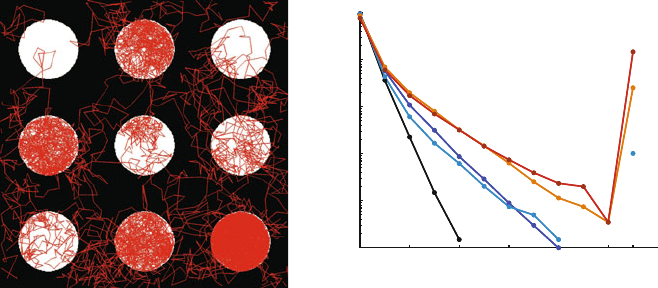
40 D. Coombs et al.
TCR randomly diffuse on a lattice and are continually phosphorylated (kinases) and
dephosphorylated (phosphatases). Since there are multiple phosphorylation sites on
the TCR they use kinetic proofreading to represent each phosphorylated state of the
TCR but unlike previous schemes, they account for the ability of phosphatases to
reverse individual kinetic proofreading steps. In the basal state, an individual TCR
cannot reach the final step in the kinetic proofreading scheme because phosphatases
rapidly reverse each step. Therefore this study accounts for phosphatase activity by
implementing a dual-track (reversible) kinetic proofreading mechanism.
In the presence of agonist pMHC, TCR/pMHC complexes will form which will
segregate membrane proteins with large ectodomains, such as the membrane phos-
phatase CD45. For simplicity the model does not account for the formation of areas
depleted of CD45, herein referred to as kinase rich domains (KRD), and instead
models nine identical and static KRDs within the simulation domain, Fig. 2.3a.
KRDs have two major effects that collectively allow for TCR triggering. First, the
rate to traverse forward steps in the reversible kinetic proofreading scheme is in-
creased while the backward rate decreases, due to the depletion and enrichment
of phosphatases and kinases, respectively. Secondly, TCR that bind pMHC within
KRDs are expected to become trapped for longer periods of time due to mem-
brane deformation. This effect is modelled by assuming that the TCR/pMHC bond
is spring-like, favoring an optimal intermembrane separation. Departing a close-
contact zone will stress the bond and therefore effectively confines complexes to
KRDs. Longer durations in KRDs will increase the probability of TCR triggering.
0 2 4 6 8 10 S
10
0
10
−1
10
−2
10
−3
10
−4
10
−5
Activation state
ab
Occupancy probability
Fig. 2.3 T cell receptor triggering via kinetic segregation. (a) Stochastic spatial simulations of
diffusing TCRs (red traces) are performed on a periodic boundary consisting of nine kinase rich
domains (KRDs). (b) The probability of the TCR being in the ith proofreading step is shown with-
out any pMHC (black line), low activity self pMHC with k
off
D 5s
1
and [pMHC]D300 m
2
(dark blue), self pMHC with k
off
D 3s
1
and [pMHC] D50 m
2
(light blue), high density self
pMHC with k
off
D 3s
1
and [pMHC]D300 m
2
(orange), and high density self pMHC with
agonist pMHC having k
off
D 0:1s
1
and [pMHC]D1 m
2
(red). The physiologically relevant
comparisons are the light blue curve (little productive signalling) and red curve, showing substan-
tial productive signalling only when agonist pMHC are present. For further details see Burroughs
et al. [69]
2 T Cell Receptor Triggering and Antigen Discrimination 41
The critical results from the model are shown in Fig. 2.3b, where the kinetic
proofreading steps are plotted against the occupancy probability. First, we see that
TCR are able to reach the final activation state (S) and hence become triggered by
remaining in KRDs for sufficiently long. Second, TCR triggering by self pMHC
is minimal and therefore kinetic-segregation is also able to minimize noise from a
high density of such pMHC. Lastly, small changes in the off-rate of agonist pMHC
alters the number of triggered TCR and therefore allow for pMHC discrimination
(not shown).
The model itself has several shortcomings. For simplicity, forward and re-
verse kinetic proofreading steps are assumed to be first order. However, these
kinase/phosphatase enzymatic interactions are bimolecular two-step reactions. In
the future it will be important to investigate the role of these nonlinearities in pMHC
detection. The model is also sensitive to the size of KRDs, whereby KRDs with a
radius of over 300nm lead to TCR triggering from self pMHC. It will be important
to determine which factors determine the size of KRDs and whether they reach this
critical size on the T cell surface.
In addition to kinetic-segregation, another class of TCR triggering model based
on segregation invokes lipid rafts, which are lipid microdomains thought to be en-
riched tyrosine kinases such as Lck and deficient in tyrosine phosphatases such as
CD45. These models postulate that TCR engagement of pMHC results in associ-
ation of the TCR/CD3 complex with lipid rafts, resulting in enhances phospho-
rylation because of the altered kinase/phosphatase balance within rafts. The main
drawback of lipid raft models is that they do not provide a plausible molecular
mechanism by which TCR engagement of pMHC drives association with rafts.
Concluding Remarks
Experiments have shown that T cells respond to very few and very specific pMHC
presented on antigen presenting cells. In order to understand these observations var-
ious mathematical models have been formulated based on the known biophysics
and biochemistry of TCR/pMHC interactions and the signalling events that are
triggered within the T cell upon pMHC binding to TCR. The backbone of all math-
ematical models to date is the kinetic proofreading model which is able to explain
pMHC discrimination based on the TCR/pMHC bond off-rate.Over the past decade,
this simple model has been extended and modified to explain various experimental
observations. In parallel to this research aimed at understanding antigen discrimi-
nation, molecular immunologists have been investigating the mechanism by which
pMHC binding to TCR transduces a signal across the plasma membrane that initi-
ates the very first steps intracellular signalling. This process of TCR triggering is
intricately linked to antigen discrimination and we believe that additional insights
can be made by future mathematical modelling that couples the two processes.
42 D. Coombs et al.
Acknowledgments DC and OD acknowledge financial support from the National Science and
Engineering Research Council of Canada and the Mathematics of Information Technology and
Complex Systems National Centre of Excellence. PAV is supported by the UK Medical Research
Council. We also thank Salvatore Valitutti and Raibatak Das for valuable discussions.
References
1. Sykulev Y, Joo M, Vturina I, Tsomides TJ, Eisen HN (1996) Evidence that a single peptide-
MHC complex on a target cell can elicit a cytolytic T cell response. Immunity 4:565–571
2. Irvine DJ, Purbhoo MA, Krogsgaard M, Davis MM (2002) Direct observation of ligand recog-
nition by T cells. Nature 419:845–849
3. Sloan-Lancaster J, Shaw AS, Rothbard JB, Allen PM (1994) Partial T cell signaling: Altered
phospho- and lack of ZAP-70 recruitment in APL-induced T cell anergy. Cell 79:913–922
4. Kersh GJ, Miley MJ, Nelson CA, Grakoui A, Horvath S, Donermeyer DL, Kappler J, Allen
PM, Fremont DH (2001) Structural and functional consequences of altering a peptide MHC
anchor residue. J Immunol 166:3345–3354
5. J¨onsson U, F¨agerstam L, Ivarsson B, Johnsson B, Karlsson R, Lundh K, L¨of´as S, Persson B,
Roos H, R¨onnberg I (1991) Real-time biospecific interaction analysis using surface plasmon
resonance and a sensor chip technology. BioTechniques 11:620–627
6. Malmqvist M (1993) Biospecific interaction analysis using biosensor technology. Nature
361:186–187
7. van der Merwe PA (2001) The TCR triggering puzzle. Immunity 14:665–668
8. Tolentino TP, Wu J, Zarnitsyana VI, Fang Y, Dustin ML, Zhu C (2008) Measuring diffusion
and binding kinetics by contact area FRAP. Biophys J 95:920–930
9. Dushek O, Das R, Coombs D (2009) A role for rebinding in rapid and reliable T cell responses
to antigen. PLoS Comput Biol 5:e1000578
10. Aleksic M, Dushek O, Zhang H, Shenderov E, Chen JL, Cerundolo V, Coombs D, van der
Merwe PA (2010) Dependence of T cell antigen recognition on T cell receptor-peptide MHC
confinement time. Immunity 32:1–12
11. Wofsy C, Coombs D, Goldstein B (2001) Calculations show substantial serial engagement of
T cell receptors. Biophys J 80:606–612
12. Qi S, Krogsgaard M, Davis MM, Chakraborty AK (2006) Molecular flexibility can influence
the stimulatory ability of receptor-ligand interactions at cell-cell junctions. Proc Natl Acad Sci
USA 103:4416–4421
13. Krogsgaard M, Prado N, Adams EJ, He XL, Chow DC, Wilson DB, Garcia KC, Davis MM
(2003) Evidence that structural rearrangements and/or flexibility during TCR binding can con-
tribute to T cell activation. Mol Cells 12:1367–1378
14. van der Merwe PA, Davis SJ (2003) Molecular interactions mediating T cell antigen recogni-
tion. Annu Rev Immunol 21:659–684
15. Feinerman O, Germain RN, Altan-Bonnet G (2008) Quantitative challenges in understanding
ligand discrimination by alphabeta T cells. Mol Immunol 45:619–631
16. Holler PD, Kranz DM (2003) Quantitative analysis of the contribution of TCR/pepMHC affin-
ity and CD8 to T cell activation. Immunity 18:255–264
17. Tian S, Maile R, Collins EJ, Frelinger JA (2007) CD8+ T cell activation is governed by TCR-
peptide/MHC affinity, not dissociation rate. J Immunol 179:2952–2960
18. Wooldridge L, van den Berg HA, Glick M, Gostick E, Laugel B, Hutchinson SL, Milicic A,
Brenchley JM, Douek DC, Price DA, Sewell AK (2005) Interaction between the CD8 corecep-
tor and major histocompatibility complex class I stabilizes T cell receptor-antigen complexes
at the cell surface. J Biol Chem 280:27491–27501
19. van den Berg HA, Rand DA, Burroughs NJ (2001) A reliable and safe T cell repertoire based
on low-affinity T cell receptors. J Theor Biol 209:465–486