
Morris T., Goldsworthy S. PR - A Persuasive Industry? Spin, Public Relations, and the Shaping of the Modern Media
Подождите немного. Документ загружается.


76
PR – A Persuasive Industry?
media, including magazines, newspaper sections, or programs on
national and regional media (often funded by related advertising),
and dedicated journalists. Third, these sectors are often character-
ized by strong personalities – fashion designers, chefs, artists, and
cultural and social figures of many kinds. This is distinct from the
blander corporate personae of most big companies, and lends itself
to smaller scale, more personal PR, often by PR’s own personalities.
Fashion and travel, for example, apart from being perceived as
glamorous, generate high levels of dedicated media and
media coverage. This in turn justifies specialist consultancies
and practitioners. Indeed the relationship between the PRs and
the journalists in these sorts of sectors means that there is a high
level of movement, usually from journalism to PR, due to higher
PR salaries.
Personal financial services PR (as opposed to financial PR related
to mergers and acquisitions and share prices), though it operates in a
highly regulated market, has not spawned many specialist firms.
As with high tech PR this is partly because financial services have
become more mainstream. The other factor here seems to be that
most financial service firms are large enough to employ in-house PR
people, only using consultancies for brand building or to cope with
peaks in workload. Similarly the automotive industry, despite its size
and importance, has generated few specialist PR shops. Indeed major
industries such as the utilities, transport, and communications, des-
pite their size and wealth, have little in the way of dedicated media
and consequently few specialist PR firms serving them.
So the factors underpinning sector specialization would seem to
be one or more of the following:
heavy regulation;1.
technical complexity;2.
dedicated sector media;3.
the dominance of individual personalities; and4.
medium to small-sized client businesses.5.
The reasons that PR is able to service this ever-changing range of
demands are twofold: the cost of setting up a PR firm is so low; and,
second, because, in a business sector which is based on personalities
rather than professional qualifications, clients can easily follow their
9780230_205840_06_cha05.indd 769780230_205840_06_cha05.indd 76 8/7/2008 4:10:08 PM8/7/2008 4:10:08 PM

77
Portrait of an industry
favorite PR person as they move around from mega consultancy to
start-up firm – or even offer them an in-house position.
Skill specialists
Skill specialist PR firms do not service industry sectors but seek to
meet generic industry needs. For example lobbyists specialize in
understanding and influencing the political and regulatory process
on behalf of their clients (see p. 145). Similarly financial or City PR
firms (in the United Kingdom) or Investor Relations firms (in the
United States) specialize in understanding the capital and equity
markets. And yet, while both operate in areas that are to some degree
regulated, the regulation is neither so complex nor so technical that
an intelligent generalist PR person could not grasp it. It is knowledge
and experience of another kind, of gossip and “politicking” rather
than simply reading the press on a daily basis, which is needed to
manage and play the political process or the equity markets. The
expertise of such specialists represents less a laboriously studied
body of knowledge than an interest, coupled with cumulatively
acquired experience of their area. It also takes a certain attitude.
It is no accident that a large percentage of lobbyists have political
ambitions. Lobbying also makes a nice home for politicians who
have been rejected by the voters.
The gossipy knowledge that investor relations specialists and
lobbyists have is important as their clients will often be new to, or at
least inexperienced, in the fields they cover. As Irwin Ross put it, the
art of name-dropping
is a serious business tactic, designed to impress present
and future clients with the PR man’s easy familiarity
with the potentates of industry and government. But
name-dropping alone is not enough; the accomplished
inside dopester must be in a position to pass along
scraps of information which are not yet in the public
domain.
14
It is difficult to hire high quality people to work in-house to play
these advisory roles. Flotations, mergers, acquisitions, and lobbying
for legislative change are not for most businesses everyday events
or continuous processes – unlike marketing – but they are of critical
9780230_205840_06_cha05.indd 779780230_205840_06_cha05.indd 77 8/7/2008 4:10:08 PM8/7/2008 4:10:08 PM

78
PR – A Persuasive Industry?
importance. So it is that financial PRs, closely followed by lobby-
ists, tend to be better paid than their generalist siblings. According
to UK-based Median Recruitment, in 2006 the average salary for an
account director in a financial PR consultancy was between £40,000
and £80,000+. In contrast the equivalent salary for an account director
in consumer PR was only £38,000 to £55,000.
15
There are also other similarities with sector specialists: the worlds
of high finance and politics have their own specialist media and jour-
nalists; the cost of entry for new specialist firms is low; and the impor-
tance of personalities is high – as is the case for fashion, food, and
travel.
Employee or internal communication specialists are another group
of skill – or audience – specialists, although a surprisingly small
group given the potential size of the employee audience. There are
several reasons for this specialism’s comparatively small size and
low visibility.
First, most employee communications work (see Chapter 10) is con-
ducted in-house. It therefore attracts less attention than areas of PR
that are well served by consultancies which have to spend a lot of
time promoting their wares and the benefits of what they do. Second,
employee communications – be it in-house or consultancy-sourced –
often comes under the control of the human resources or personnel
department. This means that it can fall outside the boundaries of
public relations and not be described as PR. It also has little involve-
ment with PR’s heartland of media relations and is thus seldom seen
or heard of, beyond its tightly defined target audiences. Finally
employee communications is less labor intensive than PR directed at
external audiences. Employers create and control their own media, be
they newsletters, web-casts or business TV. Internal communicators
have no need to spend time researching, cajoling, flattering, and help-
ing cynical or even antagonistic journalists. As we argue later on,
employee or internal communications is one of the purest forms of
propaganda.
In addition, there is the much talked about specialist area of
digital PR. Most senior PR practitioners and commentators say that
digital PR – by which they mean everything from interactive web-
sites, to blogging, social networks, and online news – should be
central to and integrated in every PR campaign. We broadly agree
with this, while noting that there are large groups in society and
9780230_205840_06_cha05.indd 789780230_205840_06_cha05.indd 78 8/7/2008 4:10:08 PM8/7/2008 4:10:08 PM

79
Portrait of an industry
large parts of the population of the world for whom the digital
world is a distant dream.
In response to the rise of the internet, most large PR agencies have
set up digital practices and many small specialist consultancies
have emerged – though presumably these will be dissolved or dis-
appear as digital integration into the mainstream becomes a reality.
Certainly the need to influence and persuade audiences through
third parties such as bloggers and online journalists fits our defin-
ition of public relations (see p. 102). Digital PR, like Corporate Social
Responsibility, also gives agencies something new and exciting to
sell to clients.
However, PR does not have the digital space all to itself. Many
other marketing disciplines – not least advertising – are also jump-
ing on the digital bandwagon and may be seen as more credible than
PR when it comes to data analysis and the number crunching aspects
of the digital world.
In-house PR and the eunuchs of
modern corporate life
Despite its high profile it is estimated by the CIPR
16
that in the
United Kingdom the consultancy sector only accounts for around
18% of all PR people. The remaining 82% work in-house, directly
employed by the organizations they serve. In-house PR depart-
ments – often lurking under the guise of “corporate communica-
tions” or “communications” or other titles – are now ubiquitous in
all but the smallest organizations, throughout the private, public,
and voluntary sectors. Even in the United States, birthplace of mod-
ern PR, senior figures in the consultancy sector can recall work-
ing with sizeable companies that lacked any PR capability of their
own, and relied on PR consultancies for all aspects of their public
relations. This is now rare. Organizations which once outsourced
their entire PR realize that routine work can be achieved more
cost-effectively in-house: a consultancy after all aims to recover
much more than its consultants’ salaries when it hires them out,
as it seeks to cover overheads and achieve a margin for its share-
holders. As in-house PR has grown it has also achieved the crit-
ical mass required to undertake more complex PR tasks on its
own, and organizations using in-house PR enjoy the advantage of
readier physical access.
9780230_205840_06_cha05.indd 799780230_205840_06_cha05.indd 79 8/7/2008 4:10:08 PM8/7/2008 4:10:08 PM

80
PR – A Persuasive Industry?
Just as the job-titles of in-house PR practitioners vary, so do the
size and role of their departments. It is harder to generalize about the
in-house sector than the world of PR consultancy because the former
is even more atomized – few organizations employ as many com-
munications or PR professionals directly as the big PR consultancies.
Thus, despite more PR people working in-house than in the consul-
tancy sector, they are in even less of a position to have an overview
of in-house PR, let alone public relations in general.
In-house PR is afflicted by a paradox. While most business leaders
concede that PR is important, no-one has been able to quantify its
importance convincingly – and certainly not to demonstrate its
financial value (although attempts have been, and continue to be,
made – see pp. 161–171). As a result there is no real business rationale
for determining the size of in-house PR departments or their budg-
ets. Instead these tend to be the product of informal processes that
are heavily dependent on the ambition and personal influence of
senior PR people. Past experience may be taken into account, along-
side the size of rival organizations’ PR departments – or the PR
budget may be based on a percentage of the organization’s overall
spending on marketing communications.
The inability of in-house PR departments to justify their existence
with robust financial figures does not necessarily mean that they, or
the people who run them, lack power. Typically a large in-house PR
team will include a communications or corporate affairs director.
They play the role of courtiers: seldom on the main board of the
company, they enjoy extensive access to their chief executives – to
whom they typically report – as well as exclusive control of media
relations. Their real influence hinges on their relationship with the
CEO – and other key figures in the organization – and the extent to
which their advice is respected.
17
Other senior figures in the company
may run large departments, control massive budgets, and have their
own power bases, but senior in-house PR people are essentially
creatures of the CEO, with whom they often stand or fall. Unlike
other members of the senior management team they are most unlikely
ever to become CEOs themselves, and so do not pose a direct threat
to the status quo. They can be compared to palace eunuchs: well-
placed, well-informed confidants who play a vital role behind the
scenes without challenging the organization’s succession strategy.
It is arguable that as CEOs confront an ever more complex business
environment – particularly the real or potential challenges of
9780230_205840_06_cha05.indd 809780230_205840_06_cha05.indd 80 8/7/2008 4:10:08 PM8/7/2008 4:10:08 PM

81
Portrait of an industry
regulation – adept in-house PR chiefs will grow in importance.
Overall the balance of power has shifted in favor of in-house PR: both
the numbers and the quality of the personnel have improved. Indeed
many in-house practitioners have consultancy backgrounds. A move
in-house can be seen as a good career move for senior consultancy
staff that are put off by the managerialism of big consultancies and are
not in the fortunate position of having their own businesses to sell.
Nonetheless turf wars between corporate affairs directors and mar-
keting directors are common. Their relative power will depend on the
nature of the business, their personalities, and their degree of access to
the rest of the senior management team. In the past much of a market-
ing director’s power derived from the fact that they “owned” the
advertising budget (a sum that did – and still does for some organiza-
tions – run into many millions of dollars/pounds). In budgetary terms
the corporate affairs director was the poor relation. However the frag-
mentation of media spend and the rise in the importance of public
relations has led to a gradual shift in the center of gravity toward PR,
though tensions between the two persist. Some – though not many –
businesses have overcome this problem by combining the two roles.
Anne Groves, Global Head of Public Relations at the leading
international law firm Clifford Chance
Anne Groves coordinates a global PR network for Clifford
Chance which is made up as follows:
London – 4 people (including herself)
Frankfurt – 3
USA – 2
Milan – 2
Paris – 2
Amsterdam – 2
Brussels – 1
Budapest – 1
Moscow – 1
Madrid – 1
Hong Kong – 2
The total PR team comprises 17 women and four men. Most
are in their thirties, although six are in their forties or older.
Of the four in the UK, all are women. The team has degrees
9780230_205840_06_cha05.indd 819780230_205840_06_cha05.indd 81 8/7/2008 4:10:08 PM8/7/2008 4:10:08 PM

82
PR – A Persuasive Industry?
in Politics and English from Kingston University, English and
History from Auckland University, NZ, and Marketing from
the University of Central England. Anne has a degree in English
from London University.
A day in her life
7.00 a.m. Check email; read faxes of Clifford Chance
national newspaper coverage at home.
8.00 a.m. On way in pick up emails, mostly from New York
office (and anyone else who has emailed over-
night) on my beloved “blackberry”; read work
papers (position papers on current issues, drafts
of documents).
9.00 a.m. Arrive in office. Scan online news service of all
coverage of CC and our main competitors, scan
newspapers to check who’s writing what in our
sector, and current topical issues. PR team passes
on coverage to spokespeople concerned and
to internal communications team for possible
inclusion in daily electronic internal newsletter.
Note anything significant to add to our weekly
“media news” update internally.
9.30 a.m. Call Hong Kong office for regular catch-up on
plans and issues with our head of communica-
tions there
10.15 a.m. Start drafting a briefing note for our managing
partner for a forthcoming journalist meeting
(background on the journalist, recent examples
of stories they’ve written, notes on what we want
to talk about, and what may come up)
Take/return calls from an FT journalist writing a
piece about opportunities for young professionals
in countries which have just joined the EU; from
the London correspondent of the New York Times
on an M&A story; and from our media coverage
evaluation agency on the next quarterly report
on our media coverage compared to our main
9780230_205840_06_cha05.indd 829780230_205840_06_cha05.indd 82 8/7/2008 4:10:09 PM8/7/2008 4:10:09 PM

83
Portrait of an industry
competitors. Ring a newswire journalist contact
to suggest that we set up a meeting for them with
some spokespeople at CC who have some views on
their specialist area
11.00 a.m. Meeting with one of our competition lawyers on
forthcoming competition issues in the EU. These
include a Competition Commission enquiry on
store cards, a planned joint client seminar with the
Office of Fair Trading, and further opportunities
for comment on the EU Commission’s enquiry into
Microsoft.
12.00 p.m. Write up notes from the meeting – add to the
PR’s team’s “quarterly plan” which identifies
opportunities we should follow up
1.00 p.m. Lunch with the business features editor of The
Times – one of my favorite contacts.
3.00 p.m. Regular monthly meeting with the in-house PR
team and our PR agency to plan the next initiatives,
discuss issues etc.
4.30 p.m. Return calls from a business magazine doing a
piece on trends in private equity deals; from a
legal trade paper researching a piece on global
expansion in law firms – and pass on request,
with advice, to relevant partners on how we can
best respond.
5.00 p.m. Catch up with plans for a forthcoming hospitality
event aimed at the firm’s main senior contacts
5.45 p.m. Fix time for regular global PR group conference
call and distribute draft agenda. Continue
briefing note for the managing partner
6.00 p.m. Call our head of communications in the Americas
to discuss progress on projects and forthcoming
issues. These include opportunities for promoting
the New York practice in the Wall Street Journal
(we have close relations with the Wall Street Journal
London too, and keep each other updated on PR
9780230_205840_06_cha05.indd 839780230_205840_06_cha05.indd 83 8/7/2008 4:10:09 PM8/7/2008 4:10:09 PM

84
PR – A Persuasive Industry?
In the past the corporate PR practitioner – be it in-house or
consultancy – would nearly always answer to the head of corporate
communications while their consumer counterpart would answer
to the vice president or director of marketing. Although this practice
still persists there has been a recent trend to take a more holistic or
“joined-up” view of communications, reflecting the need to integrate
lobbying and corporate social responsibility into mainstream
marketing programs.
One problem with this is that the pursuit of profit does not always
sit comfortably with the quest for an excellent reputation. The
marketing department may want to increase sales of an alcoholic
beverage popular with young people, while the PR people want to
convince regulators and lobbyists that their organization has a social
conscience and fosters responsible drinking. It can be difficult to
satisfy the media’s – and consumers’ – contradictory demands for
easy availability, low prices and saintly social behavior. Not
surprisingly PR people sometimes tie themselves in knots and can
appear disingenuous as they try to do so.
Other areas of conflict include employee communications, which
human resources departments like to hold on to; and financial PR,
which some financial directors think they need to control. This is a
circular argument. Communication is so important you need a
specialist to do it, and financial relations and employee relations are
activity for all media outlets where we have active
relationships in different countries), the possibility
of a partner in Washington DC joining the legal
team at a client company, and the updating of the
briefing note document we provide for the senior
management spokespeople – plus general gossip. (I
have a similar regular conversation with our head
of communications in Hong Kong as well.)
6.45 p.m. Finish briefing document for managing partner
and talk through the forthcoming meeting with
him.
7.15 p.m. Finish off emails
7.30 p.m. Leave office; read minutes of meetings, relevant
newspaper and magazine articles on way home
9780230_205840_06_cha05.indd 849780230_205840_06_cha05.indd 84 8/7/2008 4:10:09 PM8/7/2008 4:10:09 PM
85
Portrait of an industry
so important that you need a specialist to do them too. Ultimately
where the specialist sits is an issue only of interest to those playing
corporate musical chairs!
W hy t h e n do PR c o n su l t a n c ie s c o nt i n ue t o e x i s t? W h at c a n t h e y de l iv e r
or achieve more cost-effectively than their in-house counterparts?
First, an external consultancy can bring a freshness of perspec-
tive which an in-house team cannot, caught up as it is in the web of
office politics and corporate culture which characterize any organ-
ization. Consultancies can be more objective and, it is claimed, are
better able to understand the world as the client’s intended target
audiences see it. It is no accident that PR consultancies are increas-
ingly brought in to create and run high-profile one-off campaigns,
leaving more run-of-the-mill reactive media relations work to in-
house teams. Freshness of approach does not mean absence of
knowledge: by definition an external consultancy can have a range
of up-to-the-minute experience derived from working for related
business areas, and even competitors, in a way that an in-house
team cannot.
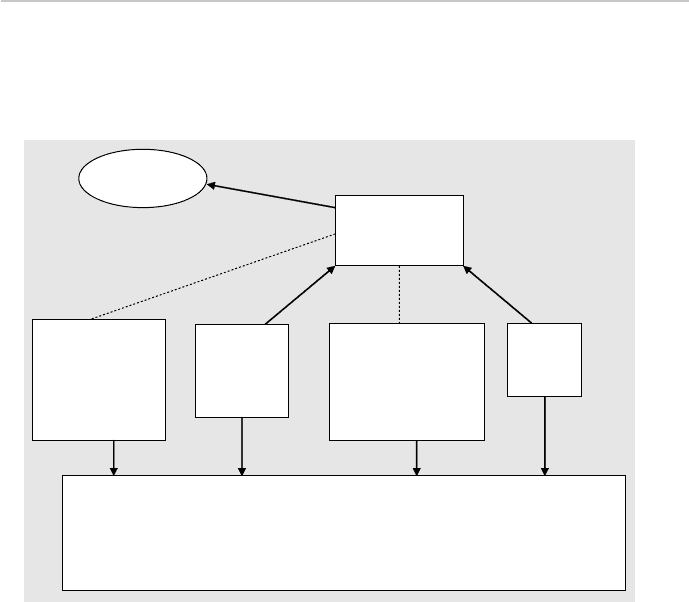
Corporate affairs
director
CEO and
main board
Employee
communication
(
sometimes
under the control
of HR or
personnel)
Lobbying/
public
affairs
CSR
Financial
(quoted companies
only and
sometimes
under the control
of the finance
director)
Press office/media relations team: Depending on the size of the department
some press officers will specialize in particular types of media: corporate,
consumer, trade, business, financial, local etc. and/or cover particular subject
areas. (The marketing director may have influence and even direct control
over press officers dealing with consumer media.)
Figure 5.1
A simplified diagram of a large in-house “public relations”
department
9780230_205840_06_cha05.indd 859780230_205840_06_cha05.indd 85 8/7/2008 4:10:09 PM8/7/2008 4:10:09 PM