
Muga G. Time in Quantum Mechanics - Vol. 2
Подождите немного. Документ загружается.


10 Time Scales and Correlations in Non-Markovian Quantum Open Systems 285
10.4.2 Two-Time Correlation Function of System Observables
in the Non-Markovian Case
Let us take a set of N system observables A
1
(t
1
), A
2
(t
2
),...,A
N
(t
N
) in Heisenberg
representation, such that t
1
> t
2
> ··· > t
N
.IfΨ
0
is the initial state of the total
system, C
A
(t) =Ψ
0
|A
1
(t
1
)A
2
(t
2
) ···A
N
(t
N
)|Ψ
0
is an N-time correlation function
of the system. This is the object of our interest.
To begin let us consider the Heisenberg evolution equation for a system observ-
able A(t) = U
−1
(t, 0)AU(t, 0), where U(t, 0) is the evolution operator with the total
Hamiltonian,
dA(t
1
)
dt
1
= iU
−1
(t
1
, 0)[H
T
, A]U(t
1
, 0) =−i[H
S
(t
1
), A(t
1
)]
+i
λ
g
λ
a
†
λ
(t
1
, 0)[L(t
1
), A(t
1
)] + [L
†
(t
1
), A(t
1
)]a
λ
(t
1
, 0)
!
. (10.15)
We can replace in (10.15) the formal solution of the evolution equation of the
environmental operators, da
λ
(t
1
, 0)/dt
1
= i[H
T
(t
1
), a
λ
(t
1
, 0)] =−iω
λ
a
λ
(t
1
, 0) −
ig
λ
L(t
1
),
a
λ
(t
1
, 0) = e
−iω
λ
t
1
a(0, 0) −ig
λ
t
1
0
dτ e
−iω
λ
(t
1
−τ )
L(τ ) . (10.16)
The single evolution equation (10.15) becomes
dA(t
1
)
dt
1
= i[H
S
(t
1
), A(t
1
)] − ν
†
(t
1
)[L(t
1
), A(t
1
)]
+
t
1
0
dτα
∗
(t
1
−τ )L
†
(τ )[A(t
1
), L(t
1
)] + [L
†
(t
1
), A(t
1
)]ν(t
1
)
+
t
1
0
dτα(t
1
−τ )[L
†
(t
1
), A(t
1
)]L(τ ) , (10.17)
with α(t) =
λ
|g
λ
|
2
e
−iω
λ
t
being the environment correlation function. Generally,
for an environment with a large number of degrees of freedoms this function decays
in a typical timescale τ
B
environment correlation time. We have also defined the
bath operators
ν
†
(t
1
) =−i
λ
g
λ
a
†
λ
(0, 0)e
iω
λ
t
1
,
ν(t
1
) = i
λ
g
λ
a
λ
(0, 0)e
−iω
λ
t
1
. (10.18)
From (10.17) the evolution equation of the quantum mean value of A for an initial
state of the form | Ψ
0
=|ψ
0
|0, with |0 the vacuum state for the environment,
is equal to

286 D. Alonso and I. de Vega
d
dt
1
Ψ
0
| A(t
1
) | Ψ
0
=iΨ
0
| [H
S
(t
1
), A(t
1
)] | Ψ
0
+
t
1
0
dτα(t
1
−τ )Ψ
0
| [L
†
(t
1
), A(t
1
)]L(τ ) | Ψ
0
+
t
1
0
dτα
∗
(t
1
−τ )Ψ
0
| L
†
(τ )[A(t
1
), L(t
1
)] | Ψ
0
.
(10.19)
It is important to note that in dynamical equation (10.17) the environment oper-
ators ν(t) and ν
†
(t) represent an external driving acting on the system due to its
interaction with the environment. These f orces are related to the correlation func-
tion α(t − t
), in fact it can be shown that 0|ν(t)ν
†
(t
)|0=α(t − t
), so that the
environment correlation function is the autocorrelation function of the environment
f orces acting on the system. Furthermore, 0|ν
†
(t)|0=0|ν(t)|0=0.
Let us now calculate the following evolution equation:
dA(t
1
)B(t
2
)
dt
1
= iU
−1
(t
1
)[H
T
, A]U(t
1
)B(t) = i[H
S
(t
1
), A(t
1
)]B(t
2
)
+i
λ
g
λ
a
†
λ
(t
1
, 0)[L(t
1
), A(t
1
)]B(t
2
)
+[L
†
(t
1
), A(t
1
)]a
λ
(t
1
, 0)B(t
2
)
!
.
(10.20)
The idea again is to eliminate the dependence on the environmental operators once
the average over the total system state is performed. First, we replace the analytical
solution of the creation operator a
†
λ
(t
1
, 0), so that the term a
†
λ
(0, 0) appears in the left
hand side of the expression and can be eliminated when applying the vacuum initial
state. Second, we move the annihilation operator to the right-hand side by doing the
following:
a
λ
(t
1
, 0)B(t
2
) = U
−1
(t
2
)a
λ
(t
1
, t
2
)BU(t
2
)
= U
−1
(t
2
)e
−iω
λ
(t
1
−t
2
)
a
λ
(0, 0)BU(t
2
) − ig
λ
t
1
t
2
dτ e
−iω
λ
(t
1
−τ )
L(τ )B(t
2
)
= B(t
2
)a
λ
(t
2
, 0) −ig
λ
t
1
t
2
dτ e
−iω
λ
(t
1
−τ )
L(τ )B(t
2
) , (10.21)
wherewehaveused
a
λ
(t
1
, t
2
) = e
−iω
λ
(t
1
−t
2
)
a
λ
(t
2
, t
2
) − ig
λ
t
1
t
2
dτ e
−iω
λ
(t
1
−τ )
L(τ,t
2
), (10.22)

10 Time Scales and Correlations in Non-Markovian Quantum Open Systems 287
with a
λ
(t
2
, t
2
) = a
λ
(0, 0) ≡ a
λ
and [B, a
λ
(0, 0)] = 0. We now insert in the former
expression the solution of a
λ
(t
2
, 0), which is of the form (10.16), and obtain
a
λ
(t
1
, 0)B(t
2
) = e
−iω
λ
t
1
B(t
2
)a
λ
(0, 0) −ig
λ
t
2
0
dτ e
−iω
λ
(t
1
−τ )
B(t
2
)L(τ )
−ig
λ
t
1
t
2
dτ e
−iω
λ
(t
1
−τ )
L(τ )B(t
2
) . (10.23)
Replacing (10.23) by (10.20) and considering the solution of a
†
λ
(t
1
, 0), we obtain
dA(t
1
)B(t
2
)
dt
1
= i[H
S
(t
1
), A(t
1
)]B(t
2
) − ν
†
(t
1
)[L(t
1
), A(t
1
)]B(t
2
)
−
t
1
0
dτα
∗
(t
1
−τ )L
†
(τ )[L(t
1
), A(t
1
)]B(t
2
) + [L
†
(t
1
), A(t
1
)]B(t
2
)ν(t
1
)
+
t
1
t
2
dτα(t
1
−τ )[L
†
(t
1
), A(t
1
)]L(τ )B(t
2
)
+
t
2
0
dτα(t
1
−τ )[L
†
(t
1
), A(t
1
)]B(t
2
)L(τ ) . (10.24)
The evolution of the quantum mean value A(t
1
)B(t
2
) is again obtained by
applying the total initial state on both sides of the former expression. When such
initial state is | ψ
0
|0, we obtain the following:
dΨ
0
| A(t
1
)B(t
2
) | Ψ
0
dt
1
= iΨ
0
| [H
S
(t
1
), A(t
1
)]B(t
2
) | Ψ
0
+
t
1
0
dτα
∗
(t
1
−τ )Ψ
0
| L
†
(τ )[A(t
1
), L(t
1
)]B(t
2
) | Ψ
0
+
t
1
t
2
dτα(t
1
−τ )Ψ
0
| [L
†
(t
1
), A(t
1
)]L(τ )B(t
2
) | Ψ
0
+
t
2
0
dτα(t
1
−τ )Ψ
0
| [L
†
(t
1
), A(t
1
)]B(t
2
)L(τ ) | Ψ
0
.
(10.25)
Equations (10.19) and (10.25) represent the evolution of quantum mean values
and two-time correlations, respectively, obtained without the use of any approxima-
tion. However, it is clear that these equations are open, in the sense that quantum
mean values depend on two-time correlations, while two-time correlations depend
on three-time correlations. In general, when no approximations are made, N -time
correlation depends on (N + 1)-time correlations, which gives rise to a hierarchy
structure of MTCF as described in [76].

288 D. Alonso and I. de Vega
At this stage we consider that the system and the environment are weakly cou-
pled. If we define V
t
AB = e
iH
S
t
Ae
−iH
S
t
B and A(t) = e
iH
T
t
Ae
−iH
T
t
, we can write
a weak coupling approximations of Eqs. (10.19) and (10.25) up to second order in
the coupling constant (see [34, 75] for details).
Then we obtain the following equation for quantum mean values:
d
dt
1
Ψ
0
| A(t
1
) | Ψ
0
=iΨ
0
|
{
[H
S
, A]
}
(t
1
) | Ψ
0
+
t
1
0
dτα
∗
(t
1
−τ )Ψ
0
|
V
τ −t
1
L
†
[A, L]
(t
1
) | Ψ
0
+
t
1
0
dτα(t
1
−τ )Ψ
0
|
[L
†
, A]V
τ −t
1
L
(t
1
) | ψ
0
(10.26)
and for two-time correlations
d
dt
1
Ψ
0
| A(t
1
)B(t
2
) | Ψ
0
=iΨ
0
|
{
[H
S
, A]
}
(t
1
)B(t
2
) | Ψ
0
+
t
1
0
dτα
∗
(t
1
−τ )Ψ
0
|
V
τ −t
1
L
†
[A, L]
(t
1
)B(t
2
) | Ψ
0
+
t
1
0
dτα(t
1
−τ )Ψ
0
|
[L
†
, A]V
τ −t
1
L
(t
1
)B(t
2
) | ψ
0
+
t
2
0
dτα(t
1
−τ )Ψ
0
|
[L
†
, A]
(t
1
)
[B, V
τ −t
2
L]
(t
2
) | Ψ
0
.
(10.27)
As noted in [34, 75], while the first two terms of (10.27) are analogous to those of
(10.26), the equation for two-time correlations contains an additional term that does
not appear in the evolution of quantum mean values. Note that this term vanishes
for Markovian interactions, since then the correlation α(t
1
− τ) = Γδ(t
1
− τ)is0
in the domain of integration from 0 to t
2
. This result is consistent with the quantum
regression theorem discussed in Sect. 10.4.1.
In conclusion, Eq. (10.27) shall be used in general to evaluate the evolution of
non-Markovian two-time correlations. Moreover, as it is shown in [76], Eqs. (10.26)
and (10.27) are just the first two equations of a full hierarchy of equations for multi-
ple time correlations. This hierarchy is closed in the sense that an N-time correlation
function depends at most on other N-time correlations.
Let us remark that it is possible to show that under certain conditions, multiple
time correlation functions evolve as expectation values in the stationary limit, even
in the non-Markovian case [77].

10 Time Scales and Correlations in Non-Markovian Quantum Open Systems 289
In the same vein that for the expectation values, it is possible to compute a par-
ticular multiple time correlation function with a stochastic scheme. We shall discuss
this issue in the next section.
10.4.3 Non-Markovian Stochastic Trajectory Methods for MTCF
It is possible to develop a stochastic scheme to compute multiple time correla-
tion functions. The advantage of this method is that it allows the evaluation of a
specific correlation function, in contrast to the equations discussed in the previ-
ous sections where the evolution of a certain correlation is coupled to some other
correlations.
If we take the partial interaction picture with respect to the environment, the N-
time correlation function is defined as C
A
(t|Ψ
0
)=Ψ
0
|
<
N
i=1
U
−1
I
(t
i
, 0)A
i
U
I
(t
i
, 0)|Ψ
0
,
where U
I
is the evolution operator of the system in the interaction picture. Within
the Bargmann representation [9, 66], we write
C
A
(t|Ψ
0
) =
dμ(z)ψ
0
|G
−1
(0, 1)
N
4
i=1
A
i
G(i, i +1)|ψ
0
, (10.28)
with t
0
= 0, t
N+1
= 0, and z
N+1
= z
0
. We have introduced the reduced propagators
G(i, i + 1) ≡ G(z
∗
i
z
i+1
|t
i
t
i+1
) =z
i
|U
I
(t
i
, t
i+1
)|z
i+1
, which act on the system
Hilbert space and give the evolution of system state vectors from t
i+1
to t
i
,given
that in the same time interval the environment coordinates go from z
i+1
to z
i
.It
is clear then that once their time evolution is solved, the time correlation function
(10.28) can be obtained. It can be shown that the reduced propagator satisfies the
evolution equation [34]
∂G(i, i + 1)
∂t
i
=
−iH
S
+ Lz
∗
i,t
i
− L
†
z
i+1,t
i
G(i, i +1)
−L
†
t
i
t
i+1
dτα(t
i
−τ )z
i
|U
I
(t
i
, t
i+1
)L(τ,t
i+1
)|z
i+1
,(10.29)
with L(t
, t) = e
iH
B
t
e
−iH(t−t
)
Le
iH(t−t
)
e
−iH
B
t
.Also,z
i,t
= i
λ
g
λ
z
i,n
e
iω
λ
t
is a
time-dependent function, α(t − τ ) =
λ
|g
λ
|
2
e
−iω
λ
(t−τ )
, and the initial condition
G(i, i +1) = exp (z
∗
i
z
i+1
). Thus the function z
i,t
is a sum of time-dependent coher-
ent states and α(t − τ ) is its time autocorrelation function, as it can be verified
by computing the average M[z
i,t
z
∗
i,τ
] regarding the measure dμ(z) as shown in the
previous section:
z
i
|U
I
(t
i
,τ)LU
I
(τ,t
i+1
) | z
i+1
=M
l
1
z
i
|U
I
(t
i
,τ) | z
l
Lz
l
| U
I
(τ,t
i+1
) | z
i+1
2
= M
l
1
G(z
∗
i
z
l
|t
i
τ )LG(z
∗
l
z
i+1
|τ t
i+1
)
2
, (10.30)
where in the second line we have inserted 1=
%
d
2
z
π
e
−|z|
2
|zz|, and we have defined

290 D. Alonso and I. de Vega
M
l
[···] =
dμ(z
l
) ··· . (10.31)
With this notation, Eq. (10.29) can be rewritten as
∂G(z
∗
i
z
i+1
|t
i
t
i+1
)
∂t
i
=
−iH
S
+ Lz
∗
i,t
i
− L
†
z
i+1,t
i
G(z
∗
i
z
i+1
|t
i
t
i+1
)
−L
†
t
i
t
i+1
dτα(t
i
−τ )M
l
1
G(z
∗
i
z
l
|t
i
τ )LG(z
∗
l
z
i+1
|τ t
i+1
)
2
.
(10.32)
In this equation, the last term expresses how the dissipation at time t depends
on previous trajectories of other system propagators [78]. For that reason, Eq.
(10.29) cannot in general be expressed in terms of the particular propagator evolved
G(i, i + 1), and hence it is not a closed equation for this propagator. Only in very
exceptional cases this can be done in an exact way, while in most of the systems it
is necessary to perform some approximations to close the equation.
One possible approximation is to assume that
z
i
|U
I
(t
i
, t
i+1
)L(τ,t
i+1
)|z
i+1
=O(z
i+1
z
i
, t
i+1
,τ)G(i, i + 1) , (10.33)
where the operator O has to be constructed [55], for instance, by treating L(τ,t
i+1
)
in the weak coupling limit. In terms of O(z
i+1
z
i
, t
i+1
,τ), Eq. (10.29) reads
∂G(i, i + 1)
∂t
i
=
−iH
S
+ Lz
∗
i,t
i
− L
†
z
i+1,t
i
−L
†
t
i
t
i+1
dτα(t
i
−τ )O(z
i+1
z
i
, t
i+1
,τ)
G(i, i +1) . (10.34)
Equations (10.29) or (10.34) depend on two time-dependent functions, z
∗
i,t
i
and
z
i+1,t
i
, which take into account the “history” of the environment and lead to a con-
ditioned dynamics of the system with respect to the environment dynamics. They
constitute the starting point to compute the non-Markovian MTCFs within a Monte
Carlo method by choosing the variables z
i
randomly according to the distribution
dμ(z). For a single realization, a value of the integrand appearing in (10.28) can
be obtained; first, evolving |ψ
0
from (t
N+1
= 0, z
N+1
= z
0
)to(t
N
, z
N
) so that
a vector |φ
N
=G(N, N + 1)|ψ
0
, second, applying A
N
to |φ
N
so that we get
|
˜
φ
N
=A
N
|φ
N
,third,evolving|
˜
φ
N
with G(N − 1, N), and so on. The process
continues until the vector |φ
1
=G(1, 2)|
˜
φ
2
is obtained and finally it is used to
compute ψ
1
|A
1
|φ
1
, with |ψ
1
=G(0, 1)|ψ
0
. In the end, the sum over many of
these “histories” with respect to the measure dμ(z) leads to the MTCFs defined in
(10.28).
Notice that since the equation for the reduced propagator (10.29) is made for an
initial state of the environment different from the vacuum, it can be used to compute

10 Time Scales and Correlations in Non-Markovian Quantum Open Systems 291
the expectation values and correlation functions of system observables with more
general initial conditions than the one usually taken, i.e., |Ψ
0
=|ψ
0
|0 [64].
The choice between using the stochastic method and the system of equations for
computing the MTCFs has to be made according to the particular problem. When
an N-time correlation function has to be computed with the first method, the system
of equations will contain all possible correlations of the matrices Y that form a basis
for the QOS. The correlation of other system observables can be computed by com-
bining correlations of this basic set of observables. In turn, the stochastic method
allows us to compute only the particular correlation function that is needed, and not
the whole set of Y
N
correlations that appears interrelated in the set of differential
equations. Hence, if the system has a large number of degrees of freedom, so that Y
is a large set, the stochastic method is in general more convenient.
10.5 Examples
To illustrate the theory let us discuss the particular examples of the spontaneous
emission of an atom and the fluorescence in a structured environment.
10.5.1 Atomic Emission Spectra
In this section, we derive the formula necessary to obtain the emission spectra of a
two-level atom in non-Markovian interaction with the surrounding radiation field.
We follow a well-known photodetection model of experiment, the gedanken spec-
trum analyzer, that provides an operational definition of the spectral profile [79].
The Hamiltonian of the emitting atom (with levels |1 and |2)isgivenby
H
S
=−
ω
12
2
(σ
22
−σ
11
) =
ω
12
2
σ
z
, (10.35)
where σ
i, j
=|ij|, with {i, j}=1, 2, are the atomic pseudospin operators in
the atomic basis, and the total Hamiltonian of emitting atom and radiation field
is described by a Hamiltonian H
R
, given by H
R
= H
S
+ H
B
+
λ
g
λ
(L
†
a
λ
+
a
†
λ
L). In order to detect the emitted radiation, suppose that we have a detecting atom
placed in r with Hamiltonian H
D
= ωσ
z
/2, where ω is its rotating frequency. The
Hamiltonian of the total system (detector atom, emitting atom, and radiation field) is
H = H
D
+ H
R
+ W . (10.36)
Here the coupling between the detecting atom H
D
with H
B
is dipolar and given by
a Hamiltonian W , which in the interaction picture with respect to the detector is
given by
˜
W(t) =
1
σ
21
d
D
·E
(+)
(r, t)e
iωt
+σ
12
d
D
·E
(−)
(r, t)e
−iωt
2
. (10.37)

292 D. Alonso and I. de Vega
Here, we have considered d
D
21
ˆ
d
D
= d
D
12
ˆ
d
D
=1 | D | 2=d
D
. The superindex
D reminds that these are the components of the detector’s dipole. It is important to
note here that the field operators E
(+)
and E
(−)
correspond to the field emitted by
the atoms and the background radiation field. The positive part of the field at the
position r is defined as
E
(+)
(r, r
a
, t) =
λ
ε
λ
A
λ
(r)a
λ
(r
a
, t)e
λ
(10.38)
and E
(−)
(r, r
a
, t) = [E
(+)
(r, r
a
, t)]
†
[80]. In the last expression (and from now on)
we have added explicitly the dependence on the position r
a
of the source dipole
(or emitting atom) that originates the field. The quantity ε
λ
=
ω
λ
2ε
0
, with υ the
quantization volume. In terms of the coupling strengths we find that g
λ
≡ g
λ
(r) =
ε
λ
A
λ
(r)d · e
λ
.
A shutter is placed between the radiating atom and the detector. In that way,
the radiation illuminates the detector only for the time T in which the shutter is
open. In order to excite the detector, the time of observation T needs to be much
larger than the inverse of the natural width γ of the detecting atom’s excited level.
In addition, T should be larger than the reciprocal of the spectral width 1/Γ of the
emitting atom. With this setup, the spectral distribution of the fluorescence light,
P(ω, T ), is defined as the probability of excitation of the detecting atom at the time
of observation T , i.e.,
P(ω, T ) = Tr
R,D
(
| 22 | ρ(T )
)
, (10.39)
where ρ(T ) is the density matrix of the total system at time T . Replacing the Taylor
expansion of the density matrix ρ(T )forρ(T ) ≈ ρ(0), and after some manipula-
tions, P(ω, T ) is obtained as
P(ω, T ) =
T
0
dt
T
0
dt
e
iω(t−t
)
g
(1)
(r, r
a
; t, t
) . (10.40)
Here, the average ···=Tr
R
(
ρ
R
···
)
, and we have defined
g
(1)
(r, r
a
; t, t
) =d
D
·E
(−)
(r, r
a
, t)d
D
·E
(+)
(r, r
a
, t
) (10.41)
as the first-order correlation of the projection of the emitted field in the direc-
tion of the dipole. In the last expression, the operators d
D
· E
(−)
(r, r
a
, t) and
d
D
· E
(+)
(r, r
a
, t
) should be replaced by their expression in terms of the system
operators L
†
and L, respectively. This is done by inserting in (10.38), and in its
complex conjugated, solution (10.16) for a
†
λ
(t, 0) and a
λ
(t
, 0), respectively. Taking
10 Time Scales and Correlations in Non-Markovian Quantum Open Systems 293
into account that the term proportional to a
†
λ
(0, 0) a
λ
(0, 0) does not contribute to
photodetection signals since the field is in the vacuum state |0, then
P(ω, T ) =
T
0
dt
T
0
dt
e
iω(t−t
)
×
t
0
dτ
t
0
dτ
α
∗
(t −τ )α(t
−τ
)L
†
(τ )L(τ
)
. (10.42)
This formula emphasizes the role of the system fluctuations L
†
(τ )L(τ
) in mea-
surable quantities like the power spectrum of emitted light.
Here it has been assumed that there is no spatial dependence of the environment
correlation function. More details of the derivation can be found in [81].
In the Markov case, the environmental correlation is a delta function, α(t −τ ) =
Γδ(t −τ ), and the last formula is just
P(ω, T ) = Γ
2
T
0
dt
T
0
dt
e
iω(t−t
)
L
†
(t)L(t
) , (10.43)
which in the stationary limit, i.e., with an observation time T →∞, leads to the
usual expression for the power spectra [9]. In addition, within the Markov approx-
imation the system correlations L
†
(0)L(τ ) can be computed with the quantum
regression theorem.
In the non-Markovian case, we cannot assume that the correlation function is a
delta, and it is necessary to use the original formula, (10.42) for the spectra, and the
system of equations (10.27) in order to compute the system correlations.
Let us now use formulas (10.42) and (10.43) to compute the non-Markovian
and Markovian spectra, respectively [82], see Fig. 10.1. The non-Markovian case
corresponds to choosing γ small enough so that the correlation function decays
within a nonzero correlation time. Since we are dealing with spontaneous emission
processes, in which the correlation functions L
†
(t)L(t
) relax to a zero value, we
choose the observing time of the detector T > T
CA
, where T
CA
is the relaxation
time of the two-time correlation. Notice that when a laser is tuned to the atomic
rotating frequency, then the two-time correlations do not decay to a zero value, so
that the condition T > T
CA
is not sufficient to obtain a stationary spectrum. In this
case it is necessary to define the spectra in a stationary limit T →∞.
In the derivation of Eq. (10.42) we have assumed that (10.41) does not depend
on the spatial coordinates and therefore no spatial dependence is considered in the
correlation function of the environment. However, there are systems in which it
is crucial to consider this spatial dependence, for instance, where the evanescent
components of the emitted field are relevant [83]. We shall see in the next section an
example in which such spatial dependence has to be taken into account explicitly.
The emission spectra (10.42) are then replaced by a more general expression which
includes the relative position of the detector with respect to the emitting atom:
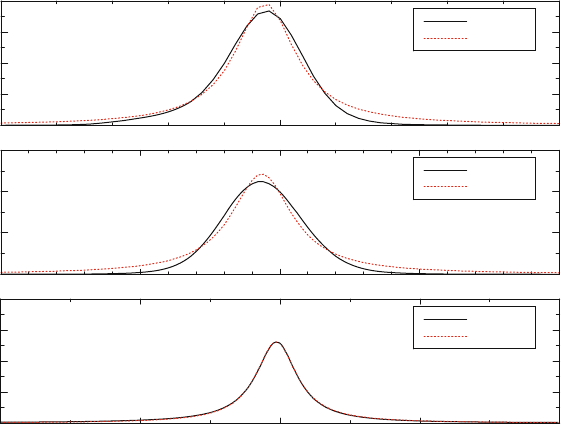
294 D. Alonso and I. de Vega
Emission Spectrum
−5 0
0
1
2
3
4
Γ = 0.4
fitting
−10 −5 0 10
0
1
2
3
Γ =1
fitting
−100 −50 0 50 100
0
0.1
0.2
0.3
0.4
Γ = 100
fitting
ω
5
5
Fig. 10.1 (Color online) The spontaneous emission spectra are computed with formula (10.42) for
several values of γ , and by choosing T > T
A
,whereT
A
is the atomic relaxation time. In order
to observe the departure from the Lorentzian profile typical of Markovian interactions, the result
is numerically fitted with a Lorentzian function. When γ is small, so that non-Markovian effects
are important in the atomic dynamics, the Lorentzian fitting is not appropriate, which means that
the use of formula (10.42) is necessary to compute the spectra. For γ = 100 the interaction is
practically Markovian, and the spectra correspond perfectly to a Lorentzian
P(ω, T ) =
T
0
dt
T
0
dt
e
iω(t−t
)
g
(1)
(r, r
a
, t, t
)
=
T
0
dt
T
0
dt
e
iω(t−t
)
t
0
dτ
t
0
dτ
S
∗
(r, r
a
, t,τ)S(r, r
a
, t
,τ
)
×L
†
(τ )L(τ
)
, (10.44)
where
S(r, r
a
, t,τ) =
λ
g
D
λ
g
λ
e
−iω
λ
(t−τ )
e
i(r−r
a
)k
(10.45)
is the spatially dependent correlation function. In order to compute the fluorescence
spectra, the limit of T →∞has to be taken, so that the signal is observed in the
stationary limit. In that case, the above formula corresponds to a double Laplace
transform of a convolution,
P(ω) = S
∗
(r, r
a
, −ω)S(r, r
a
,ω)L
†
(−ω)L(ω) . (10.46)