
Muga G. Time in Quantum Mechanics - Vol. 2
Подождите немного. Документ загружается.

306 G.G. Paulus and D. Bauer
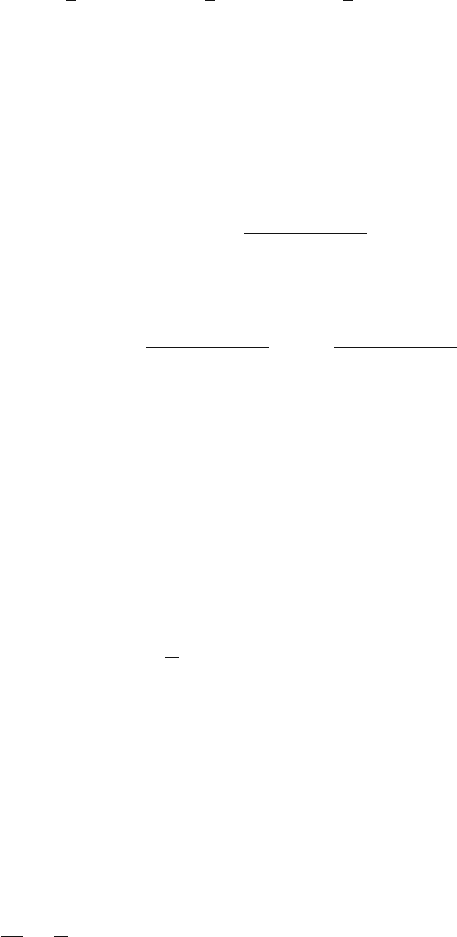
p|ψ
k
z
(t)=2Aa
3
exp
−
1
2
a
2
(k
z
− p
z
)
2
−
1
2
a
2
(p
2
x
+ p
2
y
) −
1
2
ip
2
t
cos p
x
d .
(11.6)
For the probability density in position space one obtains the lengthy and time-
dependent expression
|r|ψ
k
z
(t)|
2
=|A|
2
ρ
a
(y, t)ρ
a
(z −k
z
t, t)
{
ρ
a
(x −d, t) + ρ
a
(x +d, t) + I(x, t)
}
,
(11.7)
with
ρ
a
(ξ,t) =
1
1 + (t/a
2
)
2
2
−1/2
exp
−
ξ
2
a
2
[1 + (t/a
2
)
2
]
(11.8)
and the interference term
I(x, t) = 2
1
1 + (t/a
2
)
2
2
−1/2
exp
−
x
2
+d
2
a
2
[1 + (t/a
2
)
2
]
cos
2xdt/a
2
a
2
[1 + (t/a
2
)
2
]
.
(11.9)
In momentum space the probability density is stationary and simply given by
|p|ψ
k
z
|
2
= 4|A|
2
a
6
exp
1
−a
2
(k
z
− p
z
)
2
−a
2
(p
2
x
+ p
2
y
)
2
cos
2
p
x
d , (11.10)
from which the position of the interference maxima and minima can be immediately
inferred. The function cos
2
ϕ has maxima (zeros) at ϕ = nπ (ϕ = (2n + 1)π/2),
n = 0, 1, 2,.... Hence we have
p
x
d = nπ (maxima) , (11.11)
p
x
d = (2n + 1)
π
2
(minima) (11.12)
(note that the slit separation is 2d in our case). For t/a
2
1 the interference term
(11.9) is proportional to cos(2dx/t) so that interference maxima (minima) in (11.7)
are expected for 2dx/t = 2nπ (for 2dx/t = (2n + 1)π). Identifying x/t with the
lateral momentum p
x
this result agrees, of course, with (11.11) and (11.12). On
the other hand, with k
z
= z/t = 2π/λ one obtains the condition for constructive
interference as usually given in textbooks, i.e., in terms of the wavelength λ,the
distance between the slits and the screen L = z, and the fringe distance from the
central maximum x,
nλ
2d
=
x
L
(constructive interference) . (11.13)
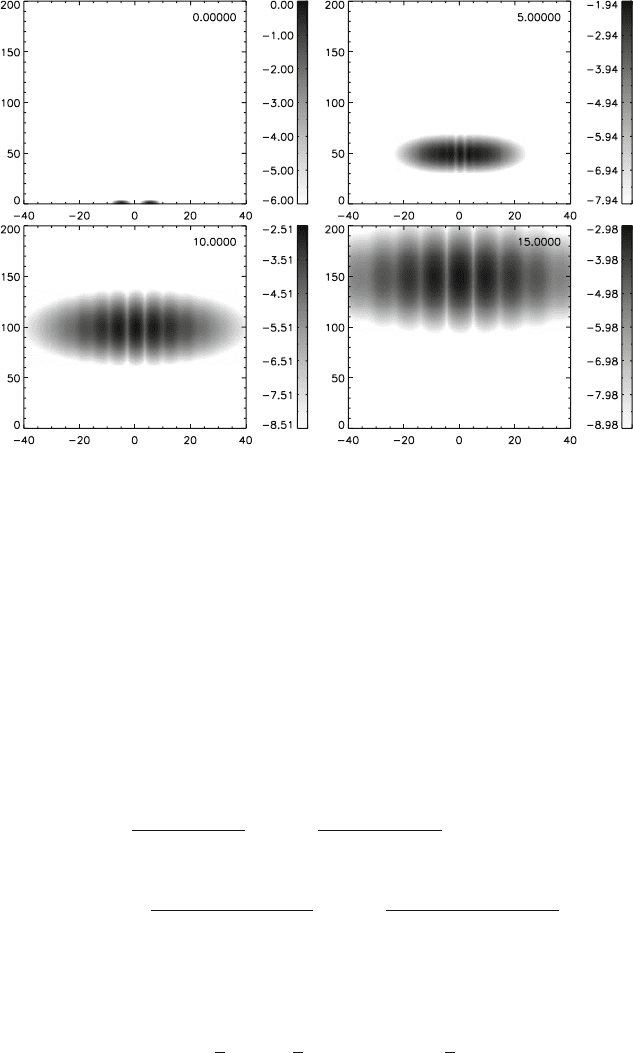
Figure 11.1 illustrates the interference of two Gaussian wave packets in position
space.
11 Double-Slit Experiments in the Time Domain 307
z (a.u.) z (a.u.)
x (a.u.) x (a.u.)
Fig. 11.1 Interference of two Gaussian wave packets in position space. The wave packets of width
a and amplitude A start at x =±d with equal momentum k
z
in z-direction. The actual param-
eters are A = a = 1, k
z
= 10, and d = 5. The contours of the probability density are scaled
logarithmically. The time t is given in the upper right of each panel
11.2.2 Double-Slit in Time
Let us now consider two Gaussian wave packets “born” at the same spatial position
r = 0 with vanishing group velocity k = 0 and the same amplitude A and initial
width a at times t = 0 and t = t
. The wave function in position space for times
t > t
is then given by
r|ψ(t)=
A
1 + it/a
2
3/2
exp
−
r
2
2a
2
1 + it/a
2
+
A
1
1 + i(t −t
)/a
2
2
3/2
exp
−
r
2
2a
2
1
1 + i(t −t
)/a
2
2
(11.14)
and in momentum space by
p|ψ(t)=Aa
3
exp
−
1
2
a
2
p
2
−
1
2
ip
2
t
1 + exp
1
2
ip
2
t
. (11.15)
308 G.G. Paulus and D. Bauer
The interference term in the position space probability density |r|ψ(t)|
2
appears
to be quite complicated, and in the more general case of nonvanishing momenta k
1
and k
2
even more so. However, it can be shown that far away from the origin and
for t/a
2
t
/a
2
the modulation is proportional to cos[r
2
t
(1 + t
/t)/(2t
2
)], i.e.,
chirped in time and space. Identifying r/t with p, the leading term in the cosine
argument is just p
2
t
/2. In fact, calculating the probability density in momentum
space from (11.15) we obtain
|p|ψ|
2
= 2|A|
2
a
6
exp
1
−a
2
p
2
2
1 + cos
1
2
p
2
t
. (11.16)
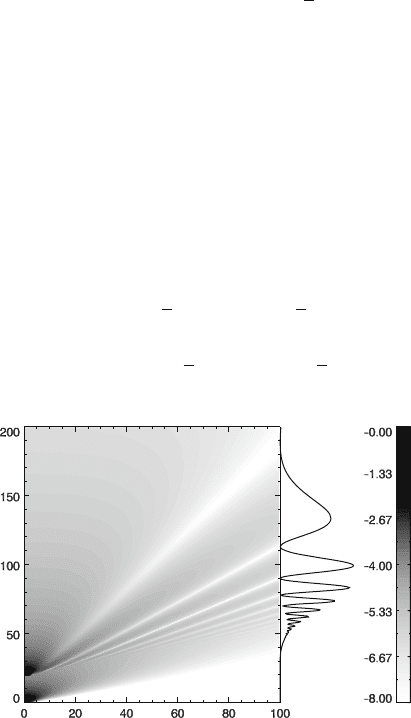
Figure 11.2 shows the probability density in space and time. In a gedankenexperi-
ment one may observe at a fixed position in space the probability density which
passes by. In Fig. 11.2 the result is shown for x, y = 0 and z = 100: first the fast
components of the first wave packet arrive. Then the fast components of the second
wave packets reach the observer, interfering with the first wave packet. At later
times the slower components pass by. As a result the modulation in the observed
probability density has a negative chirp.
Equations (11.15) and (11.16) can be easily generalized to the case of nonvan-
ishing center-of-mass momenta k
1
, k
2
and different amplitudes A
1
, A
2
where
p|ψ
k
1,2
,A
1,2
(t)=A
1
a
3
exp
−
1
2
a
2
(k
1
−p)
2
−
1
2
ip
2
t
+ A
2
a
3
exp
−
1
2
a
2
(k
2
−p)
2
−
1
2
ip
2
(t −t
)
(11.17)
z (a.u.)
t (a.u.)
Fig. 11.2 Interference of two Gaussian wave packets born with a time delay t
in the zt-plane.
The wave packets of width a and amplitude A start at r = 0 with k = 0. The actual parameters
are A = a = 1andt
= 20. The contours of the probability density are scaled logarithmically.
The probability density at the fixed spatial position z = 100, x = y = 0 as a function of time is
indicated at the right border of the contour plot

11 Double-Slit Experiments in the Time Domain 309
and
|p|ψ
k
1,2
,A
1,2
|
2
= a
6
|A
1
|
2
exp
1
−a
2
(k
1
−p)
2
2
+|A
2
|
2
exp
1
−a
2
(k
2
−p)
2
2
+exp
−
1
2
a
2
[(k
1
−p)
2
+(k
2
−p)
2
]
2Re A
1
A
∗
2
exp
−
1
2
ip
2
t
.
(11.18)
The interference is therefore governed by the term
∼ 2Re A
1
A
∗
2
exp
−
1
2
ip
2
t
, (11.19)
while the center-of-mass momenta k
1
, k
2
affect the envelope of the momentum
spectrum only. If A
1
and A
2
are both real, the condition for interference maxima
reads
E
kin
t
= 2nπ, n = 0, 1, 2,... , (11.20)
where E
kin
= p
2
/2. The interference term (11.19) is one of the examples for a
time–energy uncertainty relation promised in our introductory remarks in Sect. 11.1.
It is a relation between the time delay of preparation of the two wave packets and
the kinetic energy. The bigger the time delay t
the faster are the oscillations due
to interference in the energy or momentum spectra. Suppose we want to measure
the time delay by determining the interference minima or maxima. Then expression
(11.20) tells us that we need a spectrometer with an energy resolution better than
π/t
.
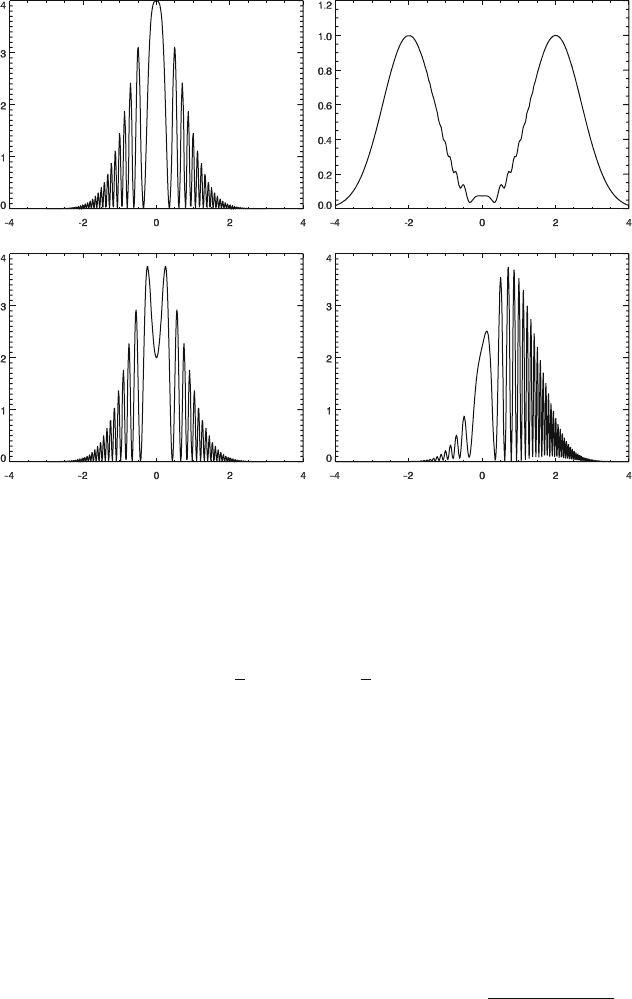
Figure 11.3 shows cuts (p
x
= p
y
= 0) through the probability density in momen-
tum space for various center-of-mass momenta and amplitudes. Panel (a) shows
basically 1 + cos(p
2
z
t
/2) multiplied by a Gaussian envelope. In case (b) the inter-
ference causes only minor modulations of the two momentum wave packets moving
with p
z
= k
z
=±2. In case (c) the complex amplitude A
2
changes the “phase of
the slit,” resulting in a sine-like modulation instead of a cosine-like. Finally, panel
(d) corresponds to two wave packets with k
2z
= 2k
1z
so that the later-emitted wave
packet overtakes the previously emitted one.
11.2.3 Grating in Time
Combinations of single- and double-slits in time and space were thoroughly studied
in [11]. We move directly on to the time analogue of a spatial grating. Let us assume
that the time delay between two subsequent emissions is constant and given by
t
= T = 2π/ω, and the total number of time slits is N. For times t > (N − 1)T ,
the wave function in momentum space then reads
310 G.G. Paulus and D. Bauer
Probability density (arb. units)
p
z
(a.u.) p
z
(a.u.)
(a)
(c) (d)
(b)
Fig. 11.3 Cuts (p
x
= p
y
= 0) through the probability density in momentum space for the case of
two Gaussian wave packets of width a = 1, “born” with a delay t
= 50, and (a) k
1
= k
2
= 0,
A
1
= A
2
= 1.0; (b) k
1
=−2.0e
z
=−k
2
, A
1
= A
2
= 1.0; (c) k
1
= k
2
= 0, A
1
= 1.0, A
2
=−i;
(d) k
1
= 0.5e
z
, k
2
= 1.0e
z
, A
1
= A
2
= 1.0
p|ψ
k
(t)=a
3
exp
−
1
2
a
2
(k − p)
2
−
1
2
ip
2
t
Σ
N,T
(p) , (11.21)
with
Σ
N,T
(p) =
N−1
n=0
A
n
exp
[
iE
kin
nT
]
. (11.22)
If the phase-slip between subsequent emissions is constant, i.e., A
n
= A exp[inϕ],
we obtain
Σ
N,T
(p) = A
N−1
n=0
exp
[
i(E
kin
T +ϕ)n
]
= A
N−1
n=0
exp
[
iEnT
]
= A
exp[iENT] −1
exp[iET ] −1
,
(11.23)
where E = E
kin
+ϕ/T . The probability density in momentum space thus is
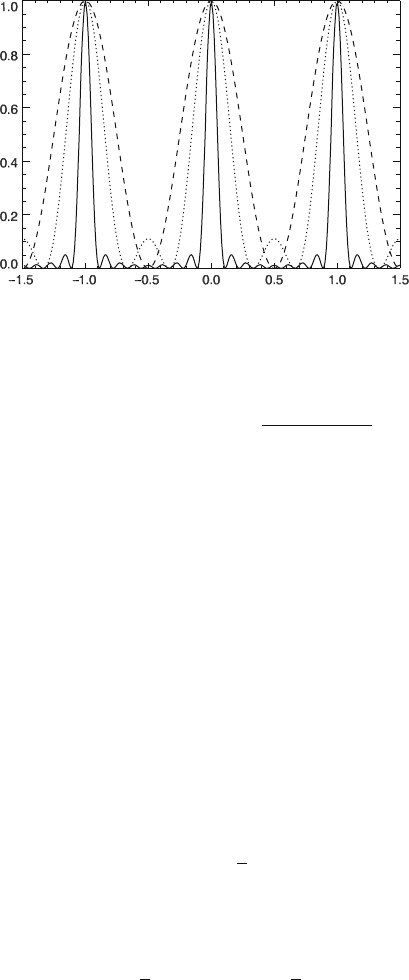
11 Double-Slit Experiments in the Time Domain 311
f
N
(x)
x
Fig. 11.4 The function f
N
(x) = sin
2
(Nxπ )/[N
2
sin
2
(xπ )] for N = 2(dashed), 3 (dotted), and 9
(solid). The factor 1/N
2
was introduced to normalize all the absolute maxima at integer x to 1
|p|ψ
k
|
2
=|A|
2
a
6
exp
1
−a
2
(k − p)
2
2
sin
2
[EN π/ω]
sin
2
[Eπ/ω]
. (11.24)
The grating function f
N
(x) = sin
2
(Nxπ )/[N
2
sin
2
(xπ)] is shown in Fig. 11.4 for
N = 2, 3, and 9. As for a spatial grating the maxima of f
N
(x) at integer x become
sharper and sharper with increasing number of slits N, while all other modulations
in between are more and more suppressed. N
2
f
N
(x) approaches a δ-comb in the
limit N →∞. Integer x corresponds to peaks at E = jω, j ∈ Z. Hence, if we
think of the wave packets being generated by a long laser pulse of frequency ω,
the photo electron peaks in the energy spectra are expected to be separated by the
photon energy ω (= ω in atomic units).
11.2.4 Continuous Slit in Time
If the electronic population in the continuum is generated continuously, e.g., by
ionization in strong fields, it is reasonable to replace (11.21) by
p|ψ
k
(t)=a
3
exp
−
1
2
ip
2
t
S(p) (11.25)
with
S(p) =
T
p
0
g(t
)exp
−
1
2
a
2
[k(t
) − p]
2
+
1
2
ip
2
t
dt
, (11.26)
where g(t
) is some complex function which weights the electronic source and
replaces the coefficients A
n
in (11.22). We assume that g(t
) is only nonvanishing
312 G.G. Paulus and D. Bauer
within the time interval [0, T
p
] and allow the center-of-mass momentum k to vary
with the emission time. Having in mind the ionization of atoms in strong laser fields
as the source of electronic wave packets in the continuum, we set
k(t) =−A(t) , (11.27)
with A(t) the vector potential of the laser pulse because a classical electron, which
is instantaneously “born” in a laser field at time t with vanishing initial velocity,
will have a drift momentum k(t) =−A(t) once the laser pulse is over. If the laser
pulse is short (meaning that the electron does not leave the focal region while the
laser pulse is on) k(t) =−A(t) will also be the drift momentum with which the
electron reaches the detector. Since the ionization probability of atoms strongly
increases with the absolute value of the applied electric field of the laser pulse
E(t) =−∂
t
A(t), the absolute value of the weight function |g(t)| should be chosen
accordingly. Figure 11.5 shows cuts (p
x
= p
y
= 0) through the probability density
in momentum space |p|ψ|
2
for a vector potential describing a linearly polarized
laser pulse in dipole approximation
Probability density (arb. units)
(a) (b)
p
z
(a.u.) p
z
(a.u.)
(c) (d)
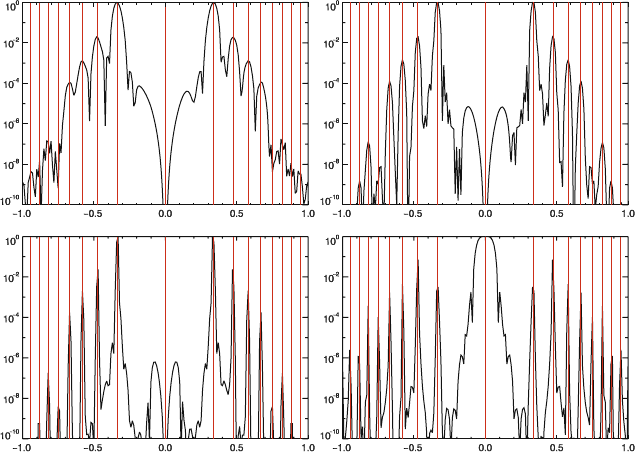
Fig. 11.5 (Color online) Cuts (p
x
= p
y
= 0) through the probability density in momentum space
for the continuous slit according to Eqs. (11.25), (11.26), (11.27), and (11.28) with g(t) = E(t)
and the laser pulse parameters ω = 0.056, ϕ
cep
= π/2,
ˆ
E = 0.05. Panel (a) shows the result for
an n
cyc
= 5-cycle pulse of the form (11.28), (b) for a 10-cycle, (c) for a 25-cycle, and (d)fora
25-cycle pulse but g(t) =|E(t)|.Thevertical lines indicate momenta p
z
fulfilling p
2
z
/2 = jω,
j ∈
Z

11 Double-Slit Experiments in the Time Domain 313
A(t) =
ˆ
Ae
z
sin
2
#
ωt
2n
cyc
$
sin(ωt + ϕ
cep
)fort ∈ [0, n
cyc
2π/ω]
0 otherwise
. (11.28)
Here,
ˆ
A =−
ˆ
E/ω is the vector potential amplitude corresponding to an electric
field amplitude
ˆ
E, n
cyc
is the number of laser cycles in the pulse, and ϕ
cep
is the
carrier-envelope phase. Figure 11.5 shows that with increasing pulse duration the
peaks in the momentum spectra narrow around the positions E
kin
= p
2
z
/2 = jω,
j ∈ Z – another example for a time–energy uncertainty relation.
11.3 Time-Domain Double-Slit Experiments
The first experiment specifically designed to investigate interference phenomena in
a dynamical double-slit setup was carried out by Sillitto and Wykes in 1972 [62].
The motivation for that experiment dates back to a paper by Mandel in 1959. Based
on classical coherence theory, Mandel predicted that interference may be observed
in a double-slit arrangement where the slits are opened and closed alternately, even
if both shutters are never open at the same time [43]. The condition is that the coher-
ence time is longer than the time lag between closing the one and opening the other
slit. Interestingly, Mandel’s work was inspired by a paper discussing a variant of
the Schr
¨
odinger-cat paradox [32], which, however, has little to do with the type
experiments discussed in the following. In fact, even the Sillitto and Wykes paper
differs from the experiments to be discussed, as it still considers a spatial double-slit
where certain transmission properties of each slit can be controlled in time. In fact,
without a spatial separation of the slits, no diffraction or interference effects are to
be expected for light [10]! Therefore we will focus on experiments with massive
particles where interference of de Broglie waves is observed. The observation of
diffraction when using massive particles belongs, of course, to the classics of mod-
ern physics. For the first time it was realized with electrons scattered at crystals by
Davisson and Germer [18]. In the 1960s, J
¨
onsson succeeded to realize the classic
double-slit arrangement and to observe the respective interference pattern [33, 34].
Interference of thermal neutrons in interferometers cut from a single crystal has been
the next step for this kind of experiments. They have opened unique possibilities for
investigating, e.g., the Aharonov–Bohm effect [21] and dynamical diffraction [58].
With the advent of laser-cooled atoms and the invention of optical elements like
mirrors and beam splitters for cold atoms, the number of possible applications of
atom interferometry has grown such that it is impossible to summarize them in a
few words.
11.3.1 Double-Slit in Time Using Cold Atoms
Virtually all of these experiments are analogues of static optical setups. Time-
dependent interferometers have rarely been realized with de Broglie waves. For the
Sillitto–Wykes experiment, e.g., a neutron interferometer has been proposed [9] but
314 G.G. Paulus and D. Bauer
not yet realized. One notable exception is the experiment by Szriftgiser et al. [63]
that uses laser-cooled cesium atoms. These are dropped onto an atom mirror and
bounce there three times like on a trampoline. Being based on a laser, this trampoline
can be switched on and off at any time ad libitum. Most of the time, the jumping
sheet is in fact missing. This allows to use the first bounce for selecting atoms with
well-defined velocity. When the atoms return to the mirror at the second bounce, the
mirror may in fact be switched on twice, i.e., two wave packets will be reflected.
In this way, the double-slit in time is realized. The third bounce together with sub-
sequent optical detection of the atoms that made it through this sequence then is
used to analyze the energy distribution (or, what is equivalent, the time of flight) of
the atoms upon their second return to the atom mirror. The various places of use
of lasers in this experiment should not lead to the misunderstanding that internal
states of the atoms being used were altered. This would in fact destroy the effects
to be discussed below, could however be used in the future for other which-way
experiments.
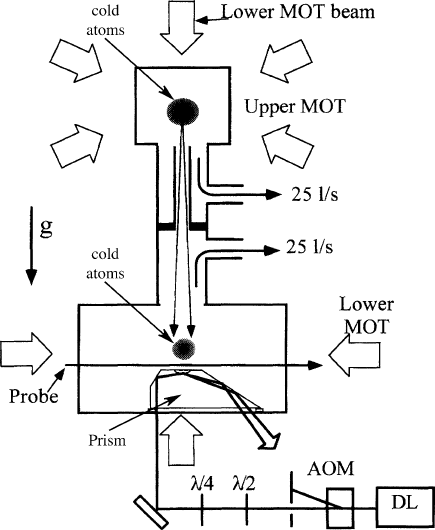
A schematic of the experimental setup is displayed in Fig. 11.6. It consists
in fact of two magneto-optical traps (MOTs), realized by shining diode lasers of
Fig. 11.6 The experimental setup consists of two magneto-optical traps (MOTs). The upper one
at relatively high pressure is used to cool a sufficiently large number of atoms. Subsequently, these
are dropped and recaptured by the lower MOT some 3 mm above the prism. The evanescent wave
created on the prism surface serves as atom mirror (from Szriftgiser et al. [63])
11 Double-Slit Experiments in the Time Domain 315
appropriate wavelength from all directions into two glass cubes aligned vertically
with 70 cm distance. They are each pumped by a 25- ion pump and connected
such that differential pumping is effective through a 140 mm long thin glass tube.
This allows high gas pressures and thus a large number of trapped atoms (≈ 10
8
)
in the upper cube while maintaining good vacuum in the lower cube where the
actual experiment is performed. The atoms are released from the upper trap by
switching off the respective laser and magnetic field. After falling some 375 ms
through the connecting tube they are caught with 20% efficiency in the second
MOT, just h = 3 mm above the atom mirror. Cooled to 5 μK, in the F = 4
hyperfine ground state, every 1.6 s some 10
7
atoms can be dropped onto the atom
mirror.
This mirror is formed by an evanescent light field created by total internal reflection
at a super-polished fused silica prism using a laser blue-detuned from the cesium
D line, see Fig. 11.6 [16]. Accordingly, the atoms are low-field seekers and may be
reflected in the light field that decays rapidly in vertical direction like exp(−2κz),
where κ
−1
= 190 nm. The spatial extend of the evanescent field in vertical direction
requires that it remains switched on for at least τ
min
= 2κ/v, where v =
√
2gh is
the mean velocity of the atoms at the surface of the atom mirror and g = 9.81 m/s
2
.
This leads to τ
min
= 1.5 μs.
The potential energy of the atoms, when released from the MOT, exceeds the
thermal energy by about a factor of 10. The temperature of 5 μK would translate
into a coherence time 1/Δν = 10 μs. However, a further reduction in energy spread
of the atoms is desirable. As already mentioned, this can be achieved by switching
the atom mirror active for a brief period τ , of course τ>τ
min
. Obviously, this
reduces the energy spread of the reflected atoms to E
0
τ/T when they return after
another 2T to the mirror surface for a second time. Here E
0
= mgz
0
and T = 25 ms
is the drop time of the atoms.
In order to observe quantum effects induced on the second reflection of the atoms
on the mirror, the (classical) energy spread ΔE
cl
= E
0
τ/T , given by cooling and
subsequent selection of atoms as described, has to be smaller than the energy uncer-
tainty ΔE
qu
due to quantum effects, i.e., due to diffraction of de Broglie waves. This
sets an upper limit for the duration τ during which the mirror is active at the second
bounce.
3
Otherwise the former would mask the latter. As for any square-shaped
mask, the diffraction pattern after the mirror made active by a single laser pulse
of duration τ has the familiar sinc-shape form with a width of ΔE
qu
= h/τ .An
equivalent statement would be to demand that the coherence time 1/Δν = h/Δ E
cl
has to be longer than τ . Both lead to τ<
√
hT/E
0
= 150 μs.
Quite elegantly, the energy distribution of the atoms after the second reflection
can be analyzed by another reflection taking place around 5T after the release of the
atoms from the MOT. In order to probe the energy distribution of the atoms, the third
pulse is shifted in a time interval corresponding to a few times ΔE
qu
. What remains
to be done is to determine the number of atoms reflected at the third bounce in
3
For simplicity, τ is chosen to be equal for all three reflections.