
Muga G. Time in Quantum Mechanics - Vol. 2
Подождите немного. Документ загружается.

316 G.G. Paulus and D. Bauer
dependence of the position in time of the third pulse. This can be done by exciting
the atoms after the third reflection with yet another laser pulse, but now tuned to
the 6s
1/2
–6p
3/2
transition. The fluorescence is detected by a photomultiplier. At
this point, the low-target gas pressure made possible by the twin-MOT becomes
essential. As one would expect, the transmission of the apparatus is very low. Out
of the 10
7
atoms captured in the lower MOT, just a few make it to the detection
interaction area. A few improvements in this respect are certainly possible and some
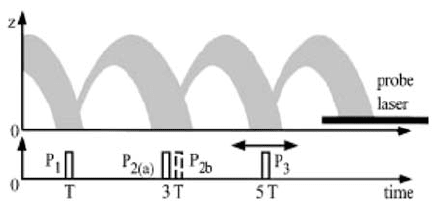
are in fact implemented in the work described in more detail in [63]. The sequence
of pulses is shown in Fig. 11.7.
Now it is straightforward to perform a double-slit experiment by switching on the
atom mirror twice at the second return of the atoms. This means that two interfering
de Broglie waves generated with a brief delay will emerge. Of course, the separation
of these two pulses should be shorter than the coherence time. Just like for diffrac-
tion with a single pulse as discussed above, the interference fringes can be recorded
by scanning the third pulse. Thus, the interference pattern is measured as a function
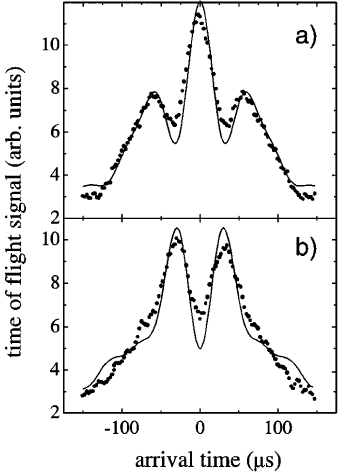
of the time of flight (see Fig. 11.8). It is even possible to shift the fringe pattern.
In case one of the two pulses that form the double-slit is weaker than the other, the
atoms are reflected a little bit closer to the surface of the atom mirror. Therefore,
those atoms experience an additional phase shift. With Δφ = 2π ·Δ/Λ
DB
, where
Λ
DB
= h/(mgT) is the de Broglie wavelength close to the mirror surface, it can
easily be calculated that a difference in path length of Δ = h/(2mgT) ≈ 12 nm
results in destructive interference (Δφ = π). This means that a fringe shift by half
a period is observed, if the atom for one of the slits approaches the surface by 6 nm
closer than the other. A reduction in intensity of 5% for one of the atom mirror
pulses is sufficient to realize this phase shift.
Fig. 11.7 Trajectories of the atoms following their release from the lower trap. The atoms bounce
like on a trampoline at the atom mirror which can be switched on and off by pulsing the laser that
creates the evanescent wave. The first reflection by applying a laser pulse P
1
is used to narrow
down the velocity distribution, thus increasing the coherence time. The second reflection induces
diffraction in time. A double-slit in time can be realized by switching the atom mirror on twice
with a pair of pulses P
2a
and P
2b
, separated by a brief time lag. The atom mirror is switched on for
a third time by a laser pulse P
3
in order to probe the diffraction pattern. P
3
is shifted around the
nominal return time and the number of atoms that have successfully completed the entire trajectory
are detected (from Szriftgiser et al. [63])
11 Double-Slit Experiments in the Time Domain 317
Fig. 11.8 Interference fringes of cold atoms after reflection at a temporal double-slit. For the upper
panel both atom trajectories have the same length. For the lower panel, pulse P
2b
was given a
slightly smaller intensity so that atoms reflected by this pulse would approach the prism surface a
few nanometers closer, thus giving rise to a fringe shift of half a period (from Szriftgiser et al. [63])
11.3.2 The Attosecond Double-Slit
Strong-field ionization provides mechanisms for realizing a double-slit in time under
quite different conditions. In this case, the temporal slits are brief windows in time
within the cycles of the optical field that induce ionization. The decisive fact is
that the phase (or time) within any optical cycle, at which ionization takes place,
determines the photoelectron momentum and thus its kinetic energy. This means
that the instant of ionization is mapped onto the momentum of the photoelectron.
Consequently, for more than one optical cycle, there is more than one possibility
to create photoelectrons of a given momentum and interference will be observed.
Few-cycle laser pulses consisting of two or even less optical cycles within their full
width at half maximum (FWHM) are particularly well suited to create double-slit
interferences [41].
In the present context, a laser field is considered strong if optical field ionization,
i.e., tunneling, is the leading process of ionization. As for regular field ionization,
the barrier through which bound electrons may tunnel is formed by the laser field
and the atomic potential. For linear ionization, this implies that the tunnel opens and
closes twice during one optical cycle. The transient nature of the potential barrier
suggests that a description of ionization based on tunneling can only be meaningful

318 G.G. Paulus and D. Bauer
if the frequency ω
t
of the electron that tunnels through the Coulomb barrier is high
as compared to the laser frequency ω = 2π/T [36, 37], i.e.,
γ :=
ω
ω
t
=
ω
√
2m|E
0
|
|e
ˆ
E|
=
|E
0
|
2U
P
< 1 . (11.29)
γ is the so-called Keldysh parameter, E
0
is the energy of the bound state from which
the electron starts, i.e., |E
0
| is the ionization potential, and
ˆ
E is the amplitude of the
laser field. The ponderomotive potential U
P
= e
2
ˆ
E
2
/(4mω
2
) is the quiver energy of
an unbound electron in an electric field oscillating with angular frequency ω and an
important scaling factor in strong-field laser physics. Keldysh parameters γ ≈ 1 can
fairly easily be realized by exposing rare gas atoms to intense femtosecond lasers at
intensities around 10
14
W/cm
2
. A review of tunneling and multiphoton ionization
can be found in [55].
The tunneling probability depends exponentially on the field strength. As a con-
sequence, ionization is confined to brief time intervals close to the maxima of the
oscillating electric field strength of a laser pulse. To a large extent, the trajectory of
an electron (or rather an electron wave packet) released from the atom by tunneling
will be dominated by the laser field because it is much stronger than the field of the
ion for the biggest part of the trajectory.
4
Therefore, it is reasonable to model in a
first approximation ionization by classical mechanics, i.e., by calculating classical
electron trajectories. Assuming, for the time being, a continuous, linearly polarized
laser field of the form
E(t) =
ˆ
E cos(ωt) (11.30)
and tunneling at a phase ωt
0
, one immediately obtains in atomic units (see also the
remark after Eq. (11.27) in Sect. 11.2.4)
v(t) =−
ˆ
E
ω
[
sin(ωt) −sin(ωt
0
)
]
(11.31)
for the velocity of the electron, if v = 0 is assumed for the electron at the instant of
tunneling. For the drift energy E
kin
of the photoelectron, i.e., the quantity measured
in an experiment, this results in
E
kin
= 2U
P
sin
2
(ωt
0
) . (11.32)
Equation (11.32) is quite an important result as it shows what has been announced at
the beginning: The kinetic energy is determined by the instant at which the electron
enters the continuum. In addition, we note that electrons tunneling at ωt
0
= 0 will
have zero drift energy, whereas those ejected into the field at ωt
0
= π/2 will obtain
4
This is in fact the essence of the strong-field approximation (SFA) to be introduced in Sect. 11.4.
11 Double-Slit Experiments in the Time Domain 319
the maximum kinetic energy of 2U
P
. Tunneling is, of course, much more likely at
the peak of the field at ωt = 0, which explains that photoelectron spectra show
way more electrons at low energies than at high energies. This simple theory of
strong-field ionization is known as the “simple man’s model” since the late 1980s
[65] and has been beautifully confirmed in microwave experiments using Rydberg
atoms [25, 26].
The same result can be obtained taking advantage of conservation of the canoni-
cal momentum
p
can
= p + eA = const., (11.33)
where A is the vector potential and p = mv (= v in atomic units) is the kinetic
momentum. Using the same approximations as above, i.e., p(t
0
) = 0, remembering
that p(t →∞) ≡ p
drift
, and taking into account A(t →∞) = 0 for a pulse with no
DC component [48], the identity p
can
(t
0
) = p
can
(∞) yields
p
drift
= eA(t
0
) . (11.34)
Thus, the electron momentum is given by the vector potential at the instant of ioniza-
tion. Or, reading this statement the other way round: Selecting electrons with a given
momentum is equivalent to selecting electrons leaving the atom at a well-defined
phase. This result holds for arbitrary pulse forms, in particular also for few-cycle
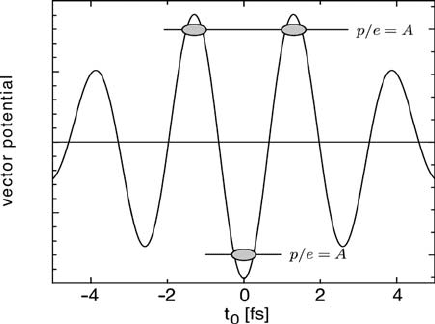
pulses. For an illustration, see Fig. 11.9. Choosing the electron momentum implies
choosing the instant of ionization with sub-cycle resolution, i.e., on the attosec-
ond scale. For a given electron energy and emission direction (parallel to the laser
Fig. 11.9 Temporal variation of the vector potential A(t) for a few-cycle laser pulses with a −sine-
like temporal variation of the field, i.e., E(t) =
ˆ
E(t)cos(ωt + π/2). The temporal slits are given
by the condition p −eA(t
0
) = 0. For a −sine-like pulse, this leads to a double-slit in the negative
(since e =−|e|) direction and a single slit in the opposite direction. Each slit can be resolved into
a pair of slits (from Lindner et al. [41])
320 G.G. Paulus and D. Bauer
polarization), the temporal evolution of the field of a few-cycle laser pulse can be
chosen such that for one emission direction, just a single optical (half-) cycle may
generate electrons of this energy, while for the opposite direction there are two such
(half-) cycles. This is in fact the essence of the attosecond double-slit.
The strength of the classical model is the intuitive insight it provides. Hardly
more than the number and position of the solutions of p − eA(t
0
) = 0 for given
p has been used in order to explain double-slit behavior for strong-field ioniza-
tion induced by few-cycle laser pulses. The respective solutions t
0
(p) in a quantum
model that will be discussed below in Sect. 11.4.3 are complex, thus allowing access
to classically forbidden electron energies. However, the symmetry of these solutions
stays the same and so do the results qualitatively.
Generation of few-cycle laser pulses is remarkably simple: Pulses of a conven-
tional femtosecond laser system are sent through a hollow fiber filled with a few
hundred millibar of Argon or Neon [51, 52]. Due to self-phase modulation the spec-
trum broadens and the pulses can be compressed to as few as 5 fs (FWHM). The
method works best for sufficiently powerful (1 mJ) and short (<25 fs) femtosecond
pulses to start with. The duration of the compressed pulse has to be compared with
the optical period of T = 2.5 fs for the typical wavelength of 800 nm of titanium-
sapphire femtosecond lasers. This means the temporal evolution of the field E(t)
depends on the phase of the carrier wave with respect to the maximum of the pulse
envelope. This can be seen by writing E(t) as a product of envelope
ˆ
E(t) and carrier
wave:
E(t) =
ˆ
E(t) cos(ωt +ϕ) . (11.35)
ϕ is the so-called absolute phase, also known as carrier-envelope phase. Special
cases are cosine-like, sine-like, −cosine-like, and −sine-like pulses for ϕ = 0,
−π/2, π, and π/2. This phase determines the evolution of the field and therefore its
measurement and stabilization is of pivotal importance for, e.g., attosecond laser
physics which takes advantage of processes evolving within fractions of optical
cycles. The absolute phase was first detected in photoionization experiments [53]
and later measured in the same way [54]. Stabilization of the absolute phase has
first been achieved in frequency metrology [59, 64, 35] and later also for amplified
laser pulses [5]. For the attosecond double-slit, the absolute phase determines the
number of slits for a given emission direction. More precisely, it determines the ion-
ization probability for each half-cycle by controlling their amplitude. The analogue
to a regular double-slit would be that the number and the width of the slits can be
controlled.
The phase-stabilized few-cycle laser pulses are focused onto a gas jet situated
in an electrically and magnetically shielded vacuum apparatus. Perpendicular to the
laser beam, two electron detectors are installed to the left and to the right of the laser
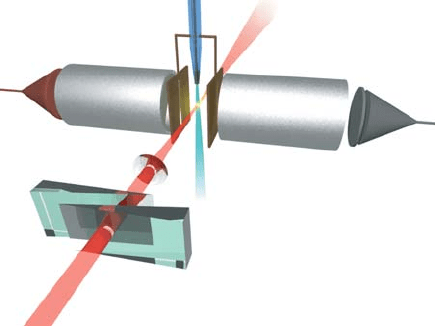
focus, thus forming a twin (or stereo) time-of-flight (TOF) spectrometer. The setup
is depicted in Fig. 11.10. The laser polarization is linear and parallel to the axis of
the TOF spectrometers.
11 Double-Slit Experiments in the Time Domain 321
Fig. 11.10 (Color online) Stereo-photoelectron spectrometer. Two opposing electrically and mag-
netically shielded time-of-flight spectrometers are mounted in an ultrahigh vacuum apparatus.
Argon atoms fed in through a nozzle from the top are ionized in the focus of a few-cycle laser beam.
The laser polarization is linear and parallel to the flight tubes. Note that the laser field changes
sign while propagating through the focus. Slits with a width of 250μm are used to discriminate
electrons created outside the laser focus region chosen. The slits can be moved from outside the
vacuum system. A photodiode and micro-channel plates (shown in gray (red online) and black)
detect the laser pulses and photoelectrons, respectively. A pair of glass wedges is used to optimize
dispersion and to change the absolute phase (from Paulus et al. [54])
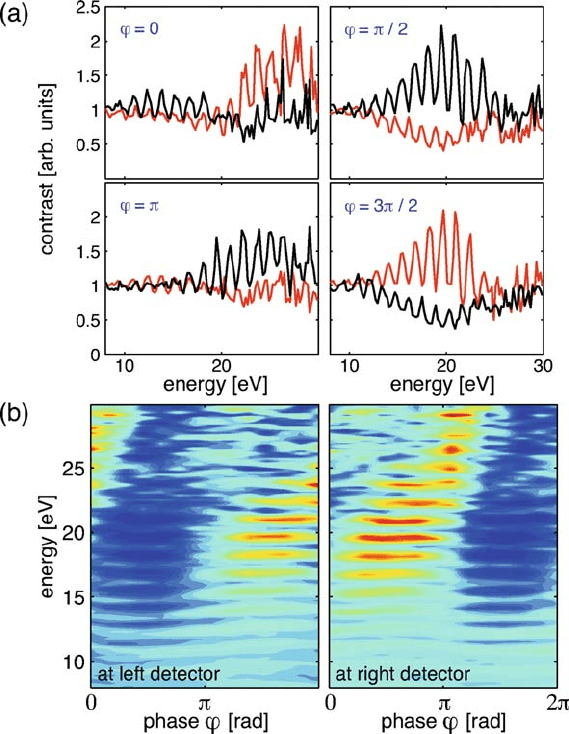
Figure 11.11 displays measured electron spectra. In Fig. 11.11(a) the spectra
recorded at the left and the right detectors are shown for ±cosine-like and ±sine-
like pulses. A problem in presenting such spectra is that they quickly roll off with
increasing electron energy. This roll-off was eliminated by dividing the spectra by
the average of all spectra over the pulse’s phase. Clear interference fringes with
varying visibility are observed as expected from the discussion above. The highest
visibility is observed for −sine-like pulses in the positive (“right”) direction. For
the same pulses, the visibility is very low in the opposite direction. Changing the
phase by π interchanges the role of left and right as expected. The most straight-
forward explanation is to assume that, for −sine-like pulses, there are two slits and
no which-way information for the positive direction and just one slit and (almost)
complete which-way information in the negative direction. The fact that the inter-
ference pattern does not entirely disappear is caused by the pulse duration, which is
still slightly too long to create a perfect single slit.
Under the conditions of this experiment, each argon atom emits at most one
electron, whose various options of how to reach a given final state lead to interfer-
ence. For sine-like pulses, these options correspond to a double-slit in time in one
direction and to a single-slit in the other and are created for each atom separately
by the few-cycle laser pulse. Therefore, even though there is more than one argon
atom in the laser focus, the experiment operates under single-electron conditions.
On the scale of the electron’s de Broglie wavelength, other atoms are far away and,
322 G.G. Paulus and D. Bauer
Fig. 11.11 (Color online) Photoelectron spectra of argon measured with 6-fs laser pulses at an
intensity of 1 ×10
14
W/cm
2
as a function of the absolute phase. Panel (a) displays the spectra for
±sine- and ±cosine-like laser fields. The gray (red online) curves are spectra recorded with the left
detector (negative direction), while the black curves relate to the positive direction. For ϕ = π/2
the fringes exhibit maximum visibility for electron emission to the right, while in the opposite
direction minimum fringe visibility is observed. In addition, the fringe positions are shifted. Panel
(b) displays the entire measurement where the fringe visibility is coded in false colors (online).
The fringe positions vary as the phase ϕ of the pulse is changed. This causes the wave-like bending
of the stripes in these figures. Both panels, in principle, show the same information because a
phase shift of π mirrors the pulse field in space and thus reverses the role of positive and negative
direction. However, the data shown were recorded simultaneously but independently where the
phase φ was varied between 0 and 2π (from Lindner et al. [41])
11 Double-Slit Experiments in the Time Domain 323
moreover, randomly distributed. This is in contrast to the double-slit in space where
the beam has to be sufficiently dilute to ensure a one-electron measurement.
The fringe pattern exhibits an envelope. From Fig. 11.11 a width of this envelope of
about four fringes is inferred. Just as for a double-slit experiment, the width of this
envelope can be associated with the width of the slits. However, Fig. 11.9 suggests
that what is seen here is not the width of the slit. Rather, each slit can be resolved
into a pair of slits whose separation is inversely proportional to the width of the
envelope.
It might be worth reflecting that this version of the double-slit experiment has
quite some remarkable features. Besides the fact that it is realized in the time–energy
domain, there are slits being windows in time of attosecond duration. These “slits”
can be opened or closed by changing the temporal evolution of the field of a few-
cycle laser pulse by controlling the absolute phase. At any given time there is only a
single electron in the double-slit arrangement. In addition, the presence and absence
of interference may be observed for the same electron at the same time by choosing
the direction of observation.
11.3.3 More Slits
Fringes in photoelectron spectra recorded under strong-field conditions are not new
at all. In fact, strong-field photoionization is also known as above-threshold ioniza-
tion (ATI), and the signature of ATI spectra is a series of peaks separated by the
photon energy. The effect has first been observed in 1979 [1]. The conventional
interpretation of the effect is an extension of multiphoton ionization. Accordingly,
the energy position E
s
of the sth ATI peaks is predicted to be given by a generalized
Einstein law E
s
= (n +s)ω −|E
0
|−U
P
. Here, n is the minimum number of photons
necessary to subdue the ionization threshold which is raised by U
P
due to light
shift [15]. However, it is hardly possible to generalize this picture to few-cycle laser
pulses. For these the notion of ponderomotive level shifts is questionable. Moreover,
the varying contrast of the fringes as well as the fringe shifts in dependence of the
absolute phase are difficult to explain.
It is much easier to extend diffraction in the time domain from few-cycle to longer
pulses. In place of the double-slit one would then speak of a grating in time, as dis-
cussed in Sect. 11.2.3. The respective temporal windows for photoelectron emission
in a given direction are separated by the optical period T . Therefore, the separation
of the ATI peaks by ω is an immediate consequence. With slightly more effort,
the ATI peak shift due to the ponderomotive shift of the ionization potential can be
explained. For this, the phases of the trajectories given by S/ have to be computed.
Hereby S =
%
Ldt is the classical action of the trajectory calculated by integrating
the Lagrange function L along the trajectory. For constructive interference, trajec-
tories launched during subsequent optical cycles must have a phase difference of
an integer multiple of 2π. This is the case when the generalized Einstein law is
fulfilled.

324 G.G. Paulus and D. Bauer
The times t
0
at which the temporal slits are open for a given photoelectron
momentum are determined by Eq. (11.34). However, t
0
determines not only the drift
momentum of the photoelectrons via Eq. (11.34) but also the probability with which
such an electron is ionized in the first place. For tunneling the ionization probability
depends exponentially on −1/|E(t
0
)|.
5
Ionization probability and drift momentum
can be disentangled by inducing ionization with attosecond XUV pulses. Attosec-
ond pulses are much shorter than an optical period in the visible (VIS) or near-
infrared (NIR) spectral range. If used for ionizing atoms exposed to an additional
optical field in the VIS or NIR, they can promote an electron at a defined phase
ωt
0
into the optical field. At that instant, the kinetic energy of that photoelectron is
E(t
0
) = ω
XUV
−|E
0
|. This is different from the situation discussed in Sect. 11.3.2
where we had E(t
0
) = 0. Nevertheless, also in this situation it is possible to calculate
the photoelectron’s drift momentum using Eq. (11.33):
p
drift
=±
/
2mE(t
0
) + eA(t
0
) . (11.36)
If this process is repeated in subsequent optical cycles, interference of the electron
wave packets created in each cycle can be expected. Due to the periodicity with T ,
the spacing of the fringes must be equal to the photon energy ω.
It might seem to be exceedingly difficult to implement the idea just described
experimentally because one needs to synchronize the XUV attosecond pulses with
the optical field with attosecond precision, which corresponds to sub-micron spa-
tial precision. Fortunately, the prevalent method for generation of attosecond pulses
offers an intrinsic solution to this problem. XUV attosecond pulses can be gen-
erated by high-harmonic generation (HHG) in gases. HHG was discovered in the
1980s [24]: An intense NIR femtosecond pulse is focused on rare gases at a density
of 10
16
–10
17
cm
−3
. Depending on intensity and other experimental parameters, all
odd harmonics up to a few hundred orders may be produced. The mechanism of
this process is not very relevant to the present topic. Briefly, it can be explained
by a simple extension of the classical model of strong-field ionization discussed in
Sect. 11.3.2. Electron wave packets leaving the atom near the peak of the NIR field
may be driven back to the ion core. Depending on the phase at which the wave
packet was launched, the kinetic energy of the electrons upon return may be as high
as 3.17U
P
. In case the electron recombines about 3/4 T later, short-wavelength radi-
ation with ω
XUV
< 3.17U
P
+|E
0
| is created [40, 17] and XUV attosecond pulses
are emitted collinear to the NIR femtosecond laser pulses in each half-cycle. For
reviews on HHG, see [61], and for one on re-colliding electrons in general [7]. The
5
The tacit assumption is that tunneling is an instantaneous process. This assumption may be
wrong. In that case, one would need to distinguish between the time t
01
when the electron enters
the tunnel and the time t
02
when the electron leaves the tunnel and the trajectory begins to evolve
in the laser field. The field strength relevant for calculating the ionization probability would be
E(t
01
), while the drift momentum would be given by eA(t
02
). Obviously, this complication would
not alter the mechanisms discussed so far. The only consequence would be a change of the shape
of the spectrum.
11 Double-Slit Experiments in the Time Domain 325
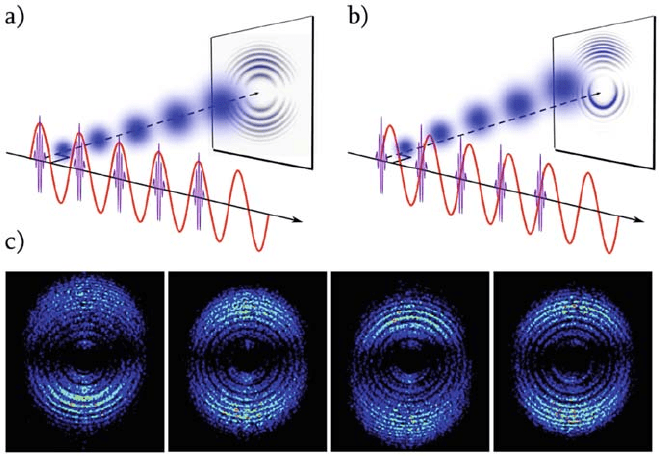
Fig. 11.12 (Color online) Attosecond pulse trains synchronized to an NIR laser field are used to
create electron wave packets by ionizing rare gas atoms. Successive electron wave packets have a
delay of one optical cycle. The ionization probability can be controlled by shifting the attosecond
pulses with respect to the NIR laser field. The electron wave packets interfere and create a diffrac-
tion pattern. Panel (c) displays experimental results obtained for XUV–NIR delays of 0, T/4, T/2,
and 3T/4 (from Mauritsson et al. [47])
re-collision process explains why the train of attosecond pulses are synchronized
with the optical field by which they are created.
In order to choose t
0
, one has to delay the attosecond pulses with respect to the
optical field. This is certainly technically demanding, but possible. The remaining
problem is that the attosecond pulses are created every half-cycle, i.e., for different
signs of the field which results in a π phase shift for consecutive attosecond pulses.
Also this problem can be solved by using a two-color femtosecond laser pulse [46].
The idea of realizing a multiple slit diffraction experiment in this way has been
realized recently [47], see Fig. 11.12. Admittedly, the purpose of that experiment
reaches beyond the present discussion by addressing potential applications outside
the scope of this chapter.
11.4 Strong-Field Approximation and Interfering
Quantum Trajectories
In our theoretical analysis of time slits in Sect. 11.2, we tacitly assumed that wave
packets somehow appear in the continuum and evolve freely afterward. Such a
dynamics does not correspond to a unitary time evolution. Instead, the wave function