
Nelson V. Wind Energy. Renewable Energy and the Environment
Подождите немного. Документ загружается.


xi
Series Preface
By 2050 the demand for energy could double or even triple as the global population grows and
developing countries expand their economies. All life on Earth depends on energy and the cycling
of carbon. Energy is essential for economic and social development and also poses an environmen-
tal challenge. We must explore all aspects of energy production and consumption, including energy
efciency, clean energy, the global carbon cycle, carbon sources, and sinks and biomass, as well as
their relationship to climate and natural resource issues. Knowledge of energy has allowed humans
to ourish in numbers unimaginable to our ancestors.
The world’s dependence on fossil fuels began approximately 200 years ago. Are we running
out of oil? No, but we are certainly running out of the affordable oil that has powered the world
economy since the 1950s. We know how to recover fossil fuels and harvest their energy for oper-
ating power plants, planes, trains, and automobiles; this leads to modifying the carbon cycle and
additional greenhouse gas emissions. The result has been the debate on availability of fossil energy
resources; peak oil era and timing for anticipated end of the fossil fuel era; price and environmental
impact versus various renewable resources and use; carbon footprint; and emissions and control,
including cap and trade and emergence of “green power.”
Our current consumption has largely relied on oil for mobile applications and coal, natural gas,
and nuclear or water power for stationary applications. In order to address the energy issues in a
comprehensive manner, it is vital to consider the complexity of energy. Any energy resource, includ-
ing oil, coal, wind, and biomass, is an element of a complex supply chain and must be considered
in its entirety as a system from production through consumption. All of the elements of the system
are interrelated and interdependent. Oil, for example, requires consideration for interlinking of all
of the elements, including exploration, drilling, production, water, transportation, rening, renery
products and byproducts, waste, environmental impact, distribution, consumption/application, and,
nally, emissions.
Inefciencies in any part of the system have an impact on the overall system, and disruption in
one of these elements causes major interruption in consumption. As we have experienced in the past,
interrupted exploration will result in disruption in production, restricted rening and distribution, and
consumption shortages. Therefore, any proposed energy solution requires careful evaluation and, as
such, may be one of the key barriers to implementing the proposed use of hydrogen as a mobile fuel.
Even though an admirable level of effort has gone into improving the efciency of fuel sources
for delivery of energy, we are faced with severe challenges on many fronts. These include population
growth, emerging economies, new and expanded usage, and limited natural resources. All energy
solutions include some level of risk, including technology snafus, changes in market demand, and
economic drivers. This is particularly true when proposing an energy solution involving implemen-
tation of untested alternative energy technologies.
There are concerns that emissions from fossil fuels will lead to changing climate with possibly
disastrous consequences. Over the past ve decades, the world’s collective greenhouse gas emis-
sions have increased signicantly—even as increasing efciency has resulted in extending energy
benets to more of the population. Many propose that we improve the efciency of energy use and
conserve resources to lessen greenhouse gas emissions and avoid a climate catastrophe. Using fossil
fuels more efciently has not reduced overall greenhouse gas emissions for various reasons, and it is
unlikely that such initiatives will have a perceptible effect on atmospheric greenhouse gas content.
Although the correlation between energy use and greenhouse gas emissions is debatable, there are
effective means to produce energy, even from fossil fuels, while controlling emissions. Emerging
technologies and engineered alternatives will also manage the makeup of the atmosphere, but will
require signicant understanding and careful use of energy.
© 2009 by Taylor & Francis Group, LLC
xii Series Preface
We need to step back and reconsider our role in and knowledge of energy use. The traditional
approach of micromanagement of greenhouse gas emissions is not feasible or functional over a
long period of time. More assertive methods to inuence the carbon cycle are needed and will be
emerging in the coming years. Modications to the cycle mean that we must look at all options in
managing atmospheric greenhouse gases, including various ways to produce, consume, and deal
with energy. We need to be willing to face reality and search in earnest for alternative energy solu-
tions. Some technologies appear to be able to assist; however, all may not be viable. The proposed
solutions must not be in terms of a “quick approach,” but rather as a more comprehensive, long-term
(10, 25, and 50+ years) approach based on science and utilizing aggressive research and develop-
ment. The proposed solutions must be capable of being retrotted into our existing energy chain.
In the meantime, we must continually seek to increase the efciency of converting energy into heat
and power.
One of the best ways to dene sustainable development is through long-term, affordable avail-
ability of resources, including energy. There are many potential constraints to sustainable develop-
ment. Foremost of these is the competition for water use in energy production, manufacturing, and
farming versus a shortage of fresh water for consumption and development. Sustainable develop-
ment is also dependent on the Earth’s limited amount of soil; in the not too distant future, we will
have to restore and build soil as a part of sustainable development. Hence, possible solutions must be
comprehensive and based on integrating our energy use with nature’s management of carbon, water,
and life on Earth as represented by the carbon and hydrogeological cycles.
Obviously, the challenges presented by the need to control atmospheric greenhouse gases are
enormous and require “out of the box” thinking, innovative approaches, imagination, and bold engi-
neering initiatives in order to achieve sustainable development. We will need to exploit energy even
more ingeniously and integrate its use with control of atmospheric greenhouse gases. The continued
development and application of energy is essential to the development of human society in a sustain-
able manner through the coming centuries.
All alternative energy technologies are not equal; they have various risks and drawbacks. When
evaluating our energy options, we must consider all aspects, including performance against known
criteria, basic economics and benets, efciency, processing and utilization requirements, infra-
structure requirements, subsidies and credits, and waste and the ecosystem, as well as unintended
consequences such as impacts on natural resources and the environment. Additionally, we must
include the overall changes and the emerging energy picture based on current and future efforts
to modify fossil fuels and evaluate the energy return for the investment of funds and other natural
resources such as water.
A signicant driver in creating this book series focused on alternative energy and the environ-
ment and was provoked as a consequence of lecturing around the country and in the classroom
on the subject of energy, environment, and natural resources such as water. Water is a precious
commodity in the West in general and the Southwest in particular and has a signicant impact on
energy production, including alternative sources, due to the nexus between energy and water and
the major correlation with the environment and sustainability-related issues. The correlation among
these elements, how they relate to each other, and the impact of one on the other are understood;
however, integration and utilization of alternative energy resources into the energy matrix has not
been signicantly debated.
Also, as renewable technology implementation grows by various states nationally and interna-
tionally, the need for informed and trained human resources continues to be a signicant driver in
future employment. This has resulted in universities, community colleges, and trade schools offer-
ing minors, certicate programs, and, in some cases, majors in renewable energy and sustainability.
As the eld grows, the demand increases for trained operators, engineers, designers, and architects
able to incorporate these technologies into their daily activity. Additionally, we receive daily del-
uges of yers, e-mails, and texts on various short courses available for parties interested in solar,
wind, geothermal, biomass, and other types of energy. These are under the umbrella of retooling
© 2009 by Taylor & Francis Group, LLC
Series Preface xiii
an individual’s career and providing the trained resources needed to interact with nancial, govern-
mental, and industrial organizations.
In all my interactions in this eld throughout the years, I have conducted signicant searches for
integrated textbooks that explain alternative energy resources in a suitable manner that would com-
plement a syllabus for a potential course to be taught at the university and provide good reference
material for parties getting involved in this eld. I have been able to locate a number of books on
the subject matter related to energy; energy systems; and resources such as fossil nuclear, renewable
energy, and energy conversion, as well as specic books on the subjects of natural resource avail-
ability, use, and impact as related to energy and environment. However, books that are correlated
and present the various subjects in detail are few and far between.
We have therefore started a series in which each text addresses specic technology elds in the
renewable energy arena. As a part of this series, there are textbooks on wind, solar, geothermal,
biomass, hydro, and other energy forms yet to be developed. Our texts are intended for upper level
undergraduate and graduate students and informed readers who have a solid fundamental under-
standing of science and mathematics. Individuals and organizations that are involved with design
development of the renewable energy eld entities and interested in having reference material avail-
able to their scientists and engineers, consulting organizations, and reference libraries will also
be interested in these texts. Each book presents fundamentals as well as a series of numerical and
conceptual problems designed to stimulate creative thinking and problem solving.
I wish to express my deep gratitude to my wife, Maryam, who has served as a motivator and
intellectual companion and too often has been the victim of this effort. Her support, encouragement,
patience, and involvement have been essential to the completion of this series.
Abbas Ghassemi, PhD
© 2009 by Taylor & Francis Group, LLC

xv
The Series Editor
Dr. Abbas Ghassemi is the director of Institute for Energy and Environment (IE&E) and profes-
sor of chemical engineering at New Mexico State University. In addition to teaching and research,
he oversees the operations of WERC: A Consortium for Environmental Education and Technology
Development, the Southwest Technology Development Institute (SWTDI), and the Carlsbad
Environmental Monitoring and Research Center (CEMRC) and has been involved in energy,
water, risk assessment, process control, pollution prevention, and waste minimization areas for a
number of industries throughout the United States for the past 20 years. He has also successfully
led and managed a number of peer-reviewed scientic evaluations of environmental, water, and
energy programs for the U.S. Department of Energy, the U.S. Environmental Protection Agency,
national laboratories, and industry. Dr. Ghassemi has over 30 years of industrial and academic
experience in risk assessment and decision theory; renewable energy; water quality and quantity;
pollution control technology and prevention; energy efciency; process control, management,
and modication; waste management; and environmental restoration. He has authored and edited
several textbooks and many publications and papers in the areas of energy, water, waste manage-
ment, process control, sensors, thermodynamics, transport phenomena, education management,
and innovative teaching methods. Dr. Ghassemi serves on a number of public and private boards,
editorial boards, and peer-review panels and holds an MS and PhD in chemical engineering, with
minors in statistics and mathematics, from New Mexico State University, and a BS in chemical
engineering, with a minor in mathematics, from the University of Oklahoma.
© 2009 by Taylor & Francis Group, LLC

xvii
Preface
The big question: How do we use science and technology such that Spaceship Earth will be a place
for all life to exist? We are citizens of the planet Earth, and within your lifetime there will be major
decisions over the following: energy (including food), water, minerals, space, and war (which I can
state will happen with 99.9% probability). The previous statements were written over 20 years ago
when I rst taught introductory courses on wind and solar energy. Since then the United States has
been involved in Grenada, Panama, Somalia, the Gulf War, the Balkans, Afghanistan, and now
Iraq, so the prediction on war was easily fullled. I refer to two of the wars as Oil War I (the Gulf
War) and Oil War II (Iraq War).
We are over 6 billion and heading toward 11 billion people. Renewable energy is part of the solu-
tion for the energy problem, and wind energy is one of the cost-effective options for the generation
of electricity. By the end of 2007, there were around 100,000 wind turbines installed in wind farms
(also called parks or plants), with an installed capacity of 94,000 megawatts, which generated
around 300 terawatt-hours in a year. Wind energy is now part of national policies for generation
of electricity.
I was very fortunate to work in a new eld, which allowed research, publication and travel, and
interaction with scientists, engineers, manufacturers, policy makers, and students that has enriched
my life. I enjoyed visiting the wind farms, installations, universities, and institutes in many parts of
the world. It is a pleasure to get paid for something you like to do.
I am deeply indebted to colleagues, present and past, at the Alternative Energy Institute (AEI);
West Texas A&M University (WTAMU); the Wind Energy Group at the Agricultural Research
Service; the U.S. Department of Agriculture (USDA), Bushland, Texas; and the students in my
classes and those who have worked at AEI who have provided insight and feedback. There are many
others who have worked with us at AEI and USDA, especially the numerous international research-
ers and interns. Thanks also to the Instruction Innovation and Technology Laboratory, WTAMU,
for the computer drawings. I want to express gratitude to my wife, Beth, who has put up with me all
these years. Even though if you have seen one wind turbine or wind farm, you have seen them all,
she does not complain when we make side trips to take more photos.
© 2009 by Taylor & Francis Group, LLC

xix
The Author
Dr. Vaughn Nelson has been involved with wind energy since the early 1970s, is the author of
ve books (four books on CD), has published over fty articles and reports, was the principal
investigator on numerous grants, and has given over sixty workshops and seminars on the local
to international level. His primary work has been on wind resource assessment, education and
training, applied R&D, and rural applications of wind energy. Presently, he is a research profes-
sor with the Alternative Energy Institute (AEI), West Texas A&M University (WTAMU). He
was director of AEI from its inception in 1977 through 2003 and retired as dean of the graduate
school of Research and Information Technology, WTAMU, in 2001. He has served on State of
Texas committees, most notably the Texas Energy Coordination Council during its 10 years. He
has received three awards from the American Wind Energy Association, one of which was the
Lifetime Achievement Award in 2003, and served on the board of directors for state and national
renewable energy organizations.
Dr. Nelson’s degrees are a PhD in physics, University of Kansas; an EdM, Harvard University; and
a BSE, Kansas State Teachers College, Emporia. He was at the Departamento de Física, Universidad
de Oriente, Cumana, Venezuela for 2 years and then at WTAMU from 1969 to the present.
© 2009 by Taylor & Francis Group, LLC

1
1
Introduction
Industrialized societies run on energy, and as third world countries industrialize, especially China and
India with their large populations, the demand for energy is increasing. Economists look at monetary
values (dollars) to explain the manufacture and exchange of goods and services. However, in the nal
analysis, the physical commodity is the transfer of energy units. While industrialized nations comprise
only one-fourth of the population of the world, they use four-fths of the world’s energy. Most of these
forms of energy are solar energy, which are subdivided into two classications;
Stored solar energy: Fossil fuels—coal, oil, and natural gas, which are nite and therefore
depletable.
Renewable energy: Radiation, wind, biomass, hydro, and ocean thermal and waves. Many
people discount renewable solar energy, some even calling it an exotic source of energy.
However, presently it is the source of all food, most ber, and in many parts of the world,
heating and cooking [1].
Other forms of energy are tidal (due to gravitation), geothermal (heat from the earth), and nuclear
(ssion and fusion). In reality, geothermal is a form of renewable energy, because as heat is removed
from the earth’s surface, it is replenished from heat from further down.
The main source of energy in industrialized nations is fossil fuels, and when that factor is com-
bined with the increasing demand and increasing population of the world, a switch to other energy
sources is imminent. Whether this change will be rational or catastrophic depends on the enlighten-
ment of the public and their leaders.
1.1 HISTORY
The use of wind as an energy source begins in antiquity. Vertical-axis windmills for grinding grain
were reported in Persia in the tenth century and in China in the thirteenth century [2]. At one time
wind was a major source of energy for transportation (sailboats), grinding grain, and pumping water.
Windmills, along with water mills, were the largest power sources before the invention of the steam
engine. Windmills, numbering in the thousands, for grinding grain and pumping drainage water were
common across Europe, and some windmills were even used for industrial purposes, such as sawing
wood. As the Europeans set off colonizing the world, windmills were built across the world [3].
Except for sailing, the main long-term use of wind has been for pumping water. Besides the
Dutch windmills, another famous example was the sail wing blades for pumping water for irrigation
on the island of Crete. One of the blades had a whistle on it to notify the operator to change the sail
area when the winds were too high.
1.1.1 DUTCH WINDMILL
At one time there were over 9,000 windmills in the Netherlands. Of course there were different designs,
from the earlier post mill to the taller mills where only the top rotated to keep the blades perpendicular
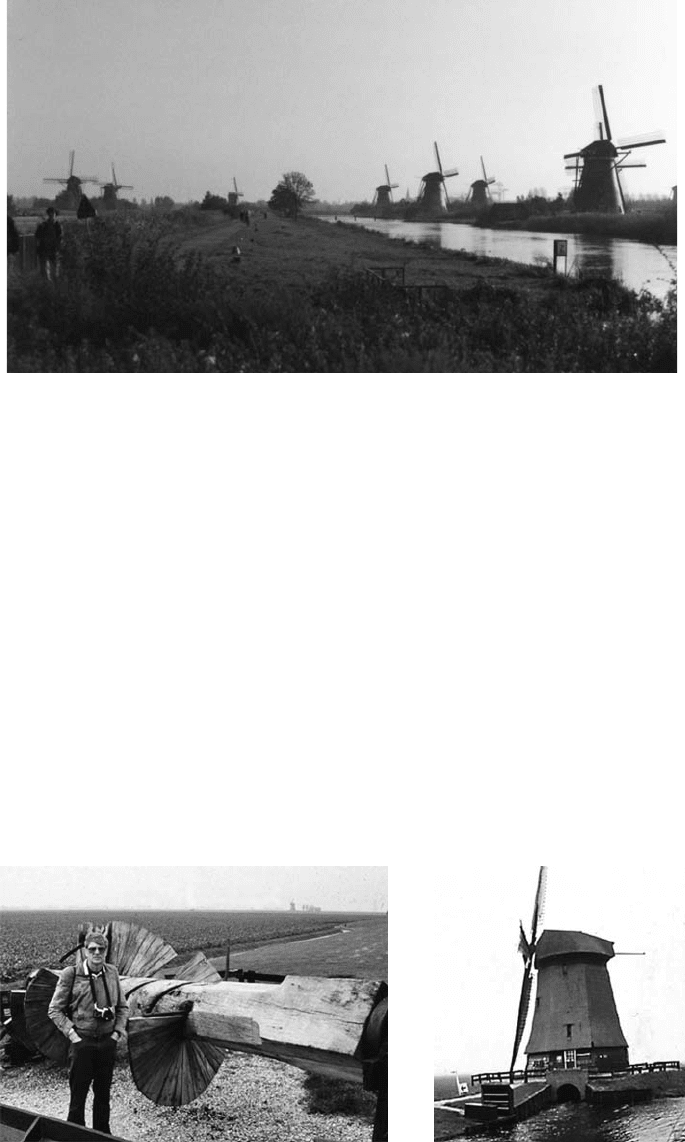
to the wind. Today, the Dutch windmills are a famous attraction in the Netherlands (Figure 1.1). The
machines for pumping large volumes of water from a low head were as large as 25 m in diameter and
were almost all wood. Even the helical pump, an Archimedean screw, was made of wood (Figure 1.2).
They were quite sophisticated in terms of the aerodynamics of the blades. The miller would rotate
(yaw) the top of the windmill from the ground with a rope attached to a wooden beam on the cap,
© 2009 by Taylor & Francis Group, LLC
2 Wind Energy: Renewable Energy and the Environment
so the rotor would be perpendicular to the wind. Others would have a small fan rotor to yaw the big
rotor. The rotational speed and power were regulated by the amount of sail that was on the blades. The
miller and his family lived in the bottom of the windmill, and the smoke from the replace was vented
to the upper oors to control insects. For the thatched windmill, re was a major hazard.
1.1.2 FARM WINDMILL
Farm windmills were one of the primary factors in the settlement of the Great Plains of the United
States [4]. From 1850 on water pumping windmills were manufactured in the tens of thousands.
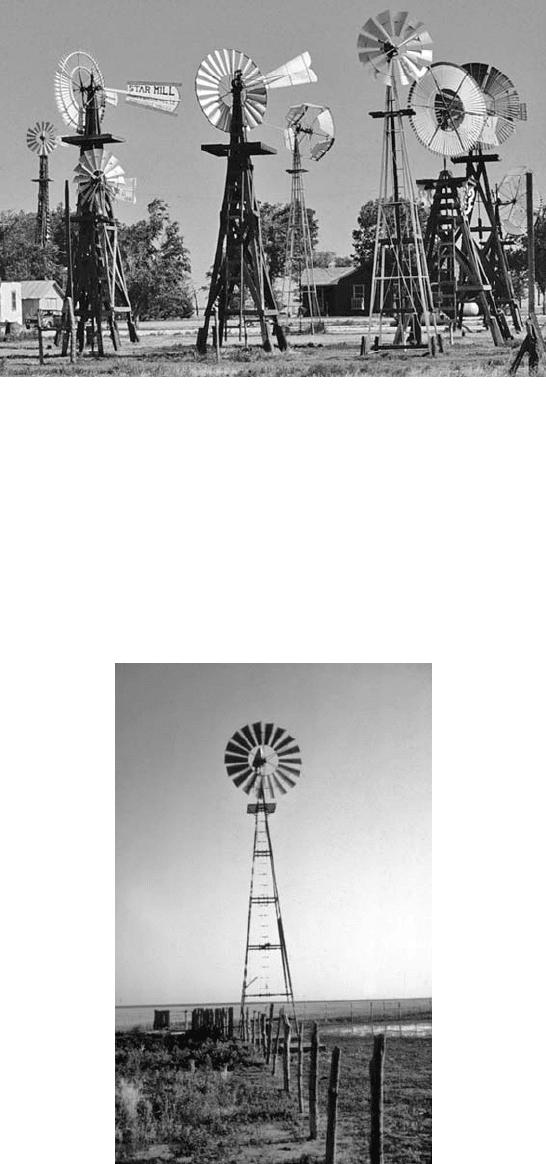
The early wood machines (Figure 1.3) have largely disappeared from the landscape, except for an
isolated farmhouse or in museums.
By 1900, almost all windmills were made of metal, still with multiblade vanes, and the fan
or blades were 3–5 m in diameter (Figure 1.4). Although the peak use of farm windmills was
in the 1930s and 1940s, when over 6 million were in operation, these windmills are still being
FIGURE 1.1 Dutch windmills, World Heritage Site, Kinderdijk, The Netherlands.
FIGURE 1.2 Thatched Dutch windmill. Notice water ow at bottom of windmill into the canal. Author in
much younger days next to helical pump.
© 2009 by Taylor & Francis Group, LLC
Introduction 3
manufactured and are being used to pump water for livestock and residences. The American Wind
Power Center in Lubbock, Texas, has an outstanding collection of farm windmills.
Most of the farm windmills are in Africa, Argentina, Australia, Canada, and the United States.
As the farm windmill is fairly expensive, there has been a resurgence of design changes to create a
less expensive system. Another major change is the development and commercialization of stand-
alone, electric-electric systems for pumping enough water for villages or irrigation, or both [5].
FIGURE 1.3 Historical farm windmills at J. B. Buchanan farm near Spearman, Texas. Windmills have been
moved to museum at Spearman.
FIGURE 1.4 Farm windmill in the Southern High Plains, United States.
© 2009 by Taylor & Francis Group, LLC
4 Wind Energy: Renewable Energy and the Environment
The farm windmill proves that wind energy is a valuable commodity, even though the size is small.
For example, there are an estimated 30,000 operating farm windmills in the Southern High Plains of
the United States. Even though the power output is low, 0.2–0.5 kilowatts (kW), they collectively pro-
vide an estimated output of 6 megawatts (MW). If these windmills for pumping water were converted
to electricity from the electric grid, it would require around 15 MW of thermal power at the generating
station and over $1,000 million for the transmission lines, electric pumps, etc. This does not count the
dollars saved in fossil fuel with an energy equivalent of 130 million kilowatt-hours (kWh) per year
(equivalent to 80,000 barrels of oil per year). Because many of these windmills are 30 years old or
older and maintenance costs are $250–400 per year, farmers and ranchers are looking at alternatives
such as solar water pumping rather than purchasing new farm windmills.
In 1888, Brush built a windmill to generate electricity, which was based on the rotor (large
number of slats) and tail vane of a large farm windmill. The wooden rotor (17 m diameter) was
connected to a direct current generator through a 50:1 step-up gearbox to produce around 12 kW in
good winds. The unit operated for 20 years; however, the low rotational speed was too inefcient
for the production of electricity. For example, a wind turbine with the same-diameter rotor would
produce around 100 kW.
1.1.3 WIND CHARGERS
As electricity became practical, isolated locations were too far from generating plants and transmis-
sion lines were too costly. Therefore, a number of manufacturers built stand-alone wind systems for
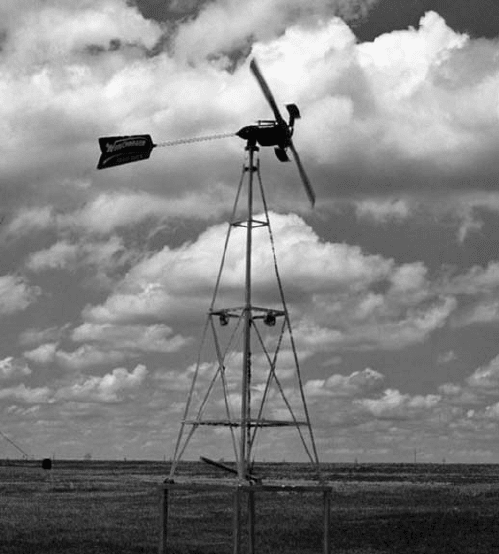
generating electricity (Figures 1.5 and 1.6), based on a propeller type rotor with two or three blades.
Most of the wind chargers had a direct current generator, 6 to 32 volts (V), and some of the later
FIGURE 1.5 Windcharger, 100 W, direct current, with ap air brakes. At USDA-ARS wind test station,
Bushland, Texas.
© 2009 by Taylor & Francis Group, LLC