
Nelson V. Wind Energy. Renewable Energy and the Environment
Подождите немного. Документ загружается.


Wind Solutions 291
V average 6
Enertech 44/25 Enertech 44/60
Class j Speed m/s Frequency No. Hours kW Power kWh Energy kW Power kWh Energy
1 1 0.04 374
2 2 0.08 700 0.0 0
3 3 0.11 942 0 0 0
4 4 0.12 1,078 0 0 0 0
5 5 0.13 1,107 4 4,430 3 3,322
6 6 0.12 1,046 5 5,228 6 6,273
7 7 0.10 919 10 9,187 11 10,106
8 8 0.09 757 14 10,598 19 14,383
9 9 0.07 588 18 10,581 26 15,284
10 10 0.05 432 20 8,632 34 14,675
11 11 0.03 300 23 6,908 46 13,816
12 12 0.02 198 26 5,159 53 10,517
13 13 0.01 125 28 3,490 55 6,854
14 14 0.01 74 30 2,235 60 4,469
15 15 0.00 42 31 1,315 65 2,756
16 16 0.00 23 32 736 68 1,565
17 17 0.00 12 33 393 70 833
18 18 0.00 6 33 194 72 423
19 19 0.00 3 33 91 74 205
20 20 0.00 1 34 42 76 95
Sum 0.99 8,705 68,498 104,021
19. For 2005, 3,974,759,861 kWh 3.97 TWh.
Vestas, installed capacity 563,985 kW.
Kenetech, number installed 3,598.
20. Power will be reduced from 30% to 50%.
21. Llano Estacado Wind, White Deer, Texas:
Installed capacity 80 MW.
From Figure 8.5, CF 0.34. AMWH 0.34808,760 239,000 MWh/year.
24. Vortex generators, small vanes to mix laminar ow with boundary layer.
Suction or blowing air through holes in the blade.
25. Active stall control, since blade pitch can be changed to still obtain power output. The
other solution is to use airfoils, which are less sensitive to surface roughness.
CHAPTER 9
1. Rule of thumb, 5–10 m above the building. So tower should be around 25 m tall, which is
80 ft. Place it 10 m away from the building.
2. Rule of thumb, tower height should be 5–10 m above the trees or move tower farther away
from trees. So tower should be 40 m tall. Need to look in a catalog for cost of towers;
guyed lattice tower would be the cheapest. Need to check manufacturer’s brochure for
recommended tower size (strength of structure) for that size wind turbine (example,
10 kW from Bergey Windpower). Stand-alone towers, Rohn SSV, cost more but do not
need space for guy wires. Bergey website has tower costs.
© 2009 by Taylor & Francis Group, LLC
292 Wind Energy: Renewable Energy and the Environment
3. Building is 15 m high, so the comparison is between additional 10 m of tower height at
the building and distance of ten building heights, which gives a power reduction of 17%.
Because you are farther away, will need larger size wire (see handbook on wiring or
Table 7.1). Need a detailed analysis, as the costs are around the same for taller tower or
farther away.
5. Class 3 wind is 150–200 W/m
2
at 10 m height. Lower value is 150 W/m
2
, mid-value is
175 W/m
2
. Terrain exposure, E is 80 m. For grassland, roughness length 0.01 m. If you
use 0.03 m, that is OK. H
h
50 m. Use Equation 9.1 and calculate for P
avg
for 150 and
175 W/m
2
.
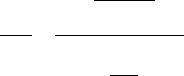
P
P
HE
z
H
z
h
h
avg
§
©
¨
¨
¶
¸
·
·
¤
¦
¥
³
µ
´
§
©
¨
¨
¶
¸
·
·
ln
ln
0
3
0
¤¤
¦
¥
³
µ
´
3
ln[130/0.01] ln 1,300 7.17, ln 800 6.68
P {7.17
3
/6.68
3
} 150 W/m
2
1.2150 W/m
2
184 W/m
2
P {7.17
3
/6.68
3
} 175 W/m
2
1.2175 W/m
2
210 W/m
2
If you used the bottom of the class, you would still be in the same class for an exposure
of 80 m. If you used the middle of the class, then you would increase the wind class from
3 to 4.
6. Selected 1 MW, 60 m diameter wind turbine, with 5D by 10D spacing. Fifty wind tur-
bines are arranged in a grid of three rows with 17, 17, 16 turbines in each row. Rotor
area 2,800 m
2
. Assume capacity factor of 35%. Estimate annual energy production for
one turbine.
AMWH CFareaWM0.00876 0.352,8005000.00876 4300 MWh/year.
Use availability of 0.95, 4,000 MWh/year per turbine.
Estimated annual energy production 504,000 200,000 MWh/year.
7. Estimate array losses for 3D by 6D spacing. Array loss for row 2 10%, array loss for
row 3 15%. Turbine in row 2, energy 0.94,000 3,600 MWh/year. Turbine in row
3 0.854,000 3,400 MWh/year.
Estimated annual energy production 174,000 173,600 163,400 183,000 MWh/year.
Total estimated annual energy production 504.410
6
kWh 22010
6
kWh.
8. Choose 1 MW wind plants, 60 m diameter, spacing 5D by 10D. Each turbine requires
a space of 300 by 600 m, or an area of 180,000 m
2
, which is 18 ha. Total area for fty
turbines is 900 ha.
This does not allow any space for a buffer zone around the wind farm. So you would need
over 1,000 ha, or 10 km
2
. That results in 5 MW/km
2
.
9. Turbine 3 MW, 4D by 8D spacing, D 90 m. Space per turbine 329090 26 ha.
1 km
2
100 ha, so could place four turbines per km
2
, which is 12 MW/km
2
. Notice this
is over double the result for problem 8.
10. Row of 3 MW turbines, 2D spacing, D 90 m. Space per turbine 180 m, so 1,000
m/180 m 5 turbines. That is, 15 MW/km.
11. With complex terrain, the spacing will generally be larger than for plains or rolling hills.
In general, the overall spacing could be larger than 10D by 10D. From previous problems,
answers will probably vary from 3 to 5 MW/km
2
.
© 2009 by Taylor & Francis Group, LLC
Wind Solutions 293
12. Raster based, takes more data space since every pixel has a value. Vector based, means
only need endpoints. In nal analysis it primarily depends on cost and ease of use.
14. Estimated spacing 4D by 8D, D 56 m. Area allocated to a turbine is 100,400 m
2
10 ha,
or 10 MW/km
2
. 1 sq. mile 2.6 km
2
. However, note in Figure 9.11, with proper arrange-
ment you could place eighteen turbines in a square mile (7 MW/km
2
), so the estimated
spacing is a little large.
15. There were two rows, so two roads around 1 mile long.
Road area 27 m1,600 m 22,400 m
2
2.2 ha. Base area of each turbine 1010
100 m
2
. So 16 turbines 16,000 1.7 ha.
Land area taken out of production 4 ha.
Because there were county roads in place, the land taken out of production is around
0.25 ha per turbine. However, they had to upgrade the county roads with grading and
caliche.
16. Area of wind farm is around 12 square miles. For 80, 1 MW wind turbines, which result
in 7 MW/sq. mile.
17. Hard to tell, but guess is around 2D in a row, and 3 to 5D from row to row.
18. This is a difcult problem because of the many parameters. Students will have to do quite
a bit of searching.
a. How much land does a 50 MW wind farm occupy? 10–20 km
2
b. Type of terrain: plains, hills, passes, ridges, and complex terrain?
c. Size turbines? Hub height?
Again, it is a question of cost and time. What kind of risk are the developer and invest-
ment bankers willing to accept? Answer depends on the terrain and the availability of
long-term database in similar nearby terrain.
My opinion: However, wind farm developers and meteorologists who consult for wind
farm developers make these decisions:
a. Period of data collection: Long-term reference database is available nearby in similar
terrain, 1 year. No reference database, 2–3 years.
b. Number of met towers:
Plains terrain: Tall towers, 50 m; hub height, 1–2. Short towers, 20–25 m height;
4–6.
Complex terrain: Tall towers, 50 m; hub height, 2–4. Short towers, 20
–25 m height,
6–10.
50 MW wind farm would be fty 1 MW wind turbines. Would you place a met tower
at every proposed location? Would you then move the shorter towers to try to nd a
better site? For plains, denitely not. For complex terrain, one met tower per ve tur-
bines? In California, in complex terrain, some project operators actually moved some
small wind turbines after installation to improve energy production. It would have been
cheaper to install more met towers and move them. Also, this is impractical for large
wind turbines.
Costs will have wide variationm from $1 to 4 million.
Wade Weichmann’s response (from actual wind farm in rolling hills area): I have encoun-
tered very different numbers from different sources on the number of met stations. I know
that at Lake Benton I, Minnesota, 22 met stations were erected for the 143-turbine site for
3 years (15 square miles). On the other hand, Spera stated in Wind Turbine Technology that
it could be cost justied to install one met tower per turbine site for large-scale turbines.
I believe the number of stations would depend on the topography of the site. A at topog-
raphy would need less met towers to get accurate data that could be correlated to long-
term regional data mentioned earlier. One-year duration was also mentioned in the Wind
Resource Assessment Handbook to predict power density to within 10%. I believe 2 years
© 2009 by Taylor & Francis Group, LLC

294 Wind Energy: Renewable Energy and the Environment
would strengthen the predictability of power density. Also, the tallest sensors on the met
towers should be placed at hub height.
19. Wind speed is around 5 m/s from the northeast.
20. Data should be collected:
a. 2 to 3 years
b. 1 year
c. 6 months to 1 year
21. Elevation of mesa is around 1,600 m. Trails.com purchased Topozone. Have a free 14-day
trial. Go to www.awstruewind.com or to www.newmexico.org/map and use terrain.
22. General rule; can install 5–9 MW/km
2
for plains and rolling hills, and 8–12 MW/km
for ridgeline.
23. Power per area 535,342/110,788 4.8 MW/km
2
.
24. Using general rule, use 8 MW/km
2
, then could install 8110,788 880,000
MW. Capturable power to be in the same ratio as in Table 9.3; capturable power
17/54880,000 280,000 MW.
25. Mesa Redonda, wind speed at 100 m height, 9.1 m/s.
CHAPTER 10
1. Wind-assist system is where wind turbine is combined with another power source to
produce power on demand.
2. Wind Power Monthly, www.windpower.com. Windicator is now under Wind Insight.
Previous answers given for comparison:
Date World Largest Cap, MW China, MW
Jan 08 93,881 Germany 22,247 5,906
Nov 03 31,243 Germany 12,001 468
Apr 02 24,471 Germany 8,752 399
3. End of year 2008, 94,200 MW. For 2013, my guess is 260 GW. Past growth, which has
been exponential, was 25% per year, doubling time 2.5 years. Five years in the future
would be two doubling times 376 GW, which is too much. Cannot have continued expo-
nential growth, even in the wind industry. However, my 2002 guess was 120,000 MW
by 2010, which will be low. For the United States, end of 2007 17,000 MW. Guess for
5 years in the future is 70,000 MW.
4. Offshore wind for 2007 is around 1000 MW.
5. Yes, both grid-connected and stand-alone, from 1 kW to 50 kW.
6. Yes, school districts have from two to ve 50 kW wind turbines.
7. Yes, should receive same incentives that wind farms receive.
8. Main difference is in control and operation of the diesels. Low penetration, the diesels
run all the time. High penetration requires more complicated controls, with dump loads,
storage, and being able to shut down the diesel generators.
9. National Wind Technology Center site: www.nrel.gov/wind.
Sometimes it is hard to distinguish between R&D and non-R&D programs.
R&D: Low-wind-speed technologies, advanced component technology.
10. NREL, non-R&D programs: information and outreach, utility grid integration, environ-
mental issues, wind resource assessment.
© 2009 by Taylor & Francis Group, LLC
Wind Solutions 295
11. Joanes, Brazil, 50 kW system; four 10 kW wind turbines, 10 kW PV, 228 kWh battery
bank, rotary converter (from Northern Power website).
12. Major advantage is people now have electrical power for schools, clinics, and homes.
Also, there is the possibility of productive use. Major disadvantages are higher cost, lim-
ited electricity, institutional issues of who pays and how much.
13. Wind electric can pump enough water for small irrigation and villages.
14. Annual efciencies; electric system is 12–15%, farm windmill is 5–6%.
15. Federal tax credits and avoided cost set by California Energy Commission.
16. Vestas.
17. Vestas, 90 m diameter, 3 MW, 105 m tower.
Siemens, 107 m diameter, 3.6 MW, 80 m or site-specic tower.
18. Yes, Wildorado, 70 turbines, rated power 2.3 MW.
19. Applications are electricity, pumping water, making ice.
20. Aerospace industry was used to cost plus contracts. U.S. federal R&D supported light-
weight two-bladed wind turbines, which had higher O&M and was not competitive with
European wind turbines.
21. Lots of examples: China, Alaska, Europe, Australia, etc.
CHAPTER 11
3. Ancillary costs are additional costs the utility incurs because there are wind turbines on
the grid.
4. Two main environmental issues are birds and possible impact on playa lakes.
5. Discussion question. Know the difference between the tax credits of the early 1980s
(based on units installed, $/kW) and the production tax credit of the 1990s ($/kWh).
6. R&D, demonstration projects, guaranteed loans, commercialization projects, subsidies
for village power are examples. Need to back up your statements with reasons.
7. Some examples are net energy billing, tax breaks, incentives from economic develop-
ment commissions.
10. Coal plant externalities: acid rain, greenhouse gas emissions, environmental aspects of
mining coal, ash disposal.
11. www.dsireusa.org; states with net metering of 100 kW or greater, as of 2008: AZ, CA,
CN, District of Columbia, HI, IA, MA, MD, MI, NE, NH, NJ, NY (12 kW for farm-based
wind), ND, OH, OK, OR, RI, VT, VA, WA.
15. Number of states with renewable portfolio standards as of 2008: 33.
16. Value is around $5–8/MWh.
18. Installed capacity for world, 94,000 MW (2007). Production estimated at
0.3594,0008,760 290,000,000 MWh/year. U.S. coal plants emit around 1 kg of
carbon dioxide per kWh, or 1 metric ton per MWh. Therefore, wind-generated electricity
avoided 290,000,000 metric tons of carbon dioxide per year.
19. Europe installed capacity 57,000 MW (2007). Energy production 0.3557,0008,760
174,000,000 MWh/year. Coal plants emit 1 ton/MWh, so wind avoided 174,000,000 tons
of carbon dioxide.
U.S. installed capacity 17,000 MW (2007). Energy production 0.3517,0008,760
52,000,000 MWh/year. Coal plants emit 1 ton/MWh, so wind avoided 52,000,000 tons
of carbon dioxide.
20. Around $1,000,000/km ($ 2008).
21. Birds, around one per year per turbine. Bats are the same, except for the East United
States, thirty per year per turbine.
22. Falls, blades.
© 2009 by Taylor & Francis Group, LLC

296 Wind Energy: Renewable Energy and the Environment
CHAPTER 12
1. From the sensitivity analysis, Figure 12.1, the most important factors are annual energy
production and initial installed costs.
2. Bergey 1 kW wind turbine produces 2,000 kWh/year. Value of electricity for remote site
is $0.50/kWh. From Bergey website, remote package, with batteries: $6,000. Installation
adds another $500, so total cost is $6,500.
Va lue/year 2,000 kWh/year$0.50/kWh $1,000/year.
Use Equation 12.1, payback IC/(AKWH$/kWh) 6,500/1,000 7 years.
Of course, this is very dependent on AKWH and the value of the electricity.
3. Air X, IC $1,200, AKWH 400, FCR 0.05, AOM 0.
COE (ICFCR AOM)/AKWH ($1,2000.05)/400 60/400 $0.15/kWh.
4. Go to Bergey site, www.bergey.com; value package for 10 kW, grid intertie $40,600.
With shipping and installation, IC $46,000; assume FCR 0.08, AOM $100/year.
Assume capacity factor 25%, AKWH CFGS8,760 0.25108,760 h
21,900 kWh/year.
COE (ICFCR AOM)/AKWH ($46,0000.08 $100)/21,900 kWh/year.
COE 3,780/21,900 $0.17/kWh.
5. IC $150,000, AKWH 120,000, FCR 0.10, AOM 150,0000.01
$900, LCR
$4,000/year.
COE (150,0000.10 1,500 4,000)/90,000 20,500/120,000 $0.17/kWh.
6. IC $150,000, r 0.08, AKWH 120,000 at $0.09/kWh, ] 0.06.
Value per year f
0
120,000$0.08/kWh $9,600 per year.
Calculate left-hand side of Equation 12.7, f
0
/c $9,600/$150,000 0.064.
Then for values of ] and r, guess at L and calculate right-hand side of Equation 12.7.
From rst answer, estimate new L and calculate again. I chose L 10 as a starting point.
Answer is 12 years to payback.
ar LHS
0.04 0.08 0.064
Calculate RHS of Equation 12.7
L (1 r)
L
(1 ])
L
Num. Dem. RHS
10 2.2 1.48 0.069 1.04 0.067
20 4.7 2.19 0.298 5.55 0.054
15 3.2 1.80 0.152 2.54 0.060
12 2.5 1.60 0.097 1.51 0.064
The price for oil in 2002 was around $20/bbl, and the fuel ination rate was close to
zero. This type of calculation shows the difculty of trying to predict future energy costs,
which are primarily driven by the price of oil. In 1980, a fuel ination rate of 7% was
considered low. With spreadsheets it is easy to vary the parameters.
7. Life cycle costs are total costs over the lifetime of the system, including disposal or
salvage costs at the end. When externalities are included in fossil fuel costs, then life
cycle costs for renewable energy systems are cheaper. However, these external costs are
estimated at widely different values, from zero to $0.10/kWh for coal plants. Also, we are
used to purchasing with cheap down payment and monthly payments. The big unknown
is the future O&M costs for small wind turbines.
8. See Figure 12.5.
© 2009 by Taylor & Francis Group, LLC

Wind Solutions 297
9. The last nuclear power plants generate electricity at $0.10–0.13/kWh. On the South Texas
Project, construction started in 1976 and generation began in 1988. That is why stranded
costs are included in electric restructuring. For new nuclear plants, COE will probably be
close to $16–20/MWh. One reason costs of nuclear plants are high is because of the long
construction period.
10. Previous times I taught the course.
1998 values: fuel ination 0; discount rate from the feds, 4.5%; interest rate to borrow
from bank, 7–?% (this depends on length of loan and type of loan, for large wind farm
project).
2002 values: fuel ination 0; discount rate from the feds, 1.75%; prime rate, 4.75%;
interest rate to borrow from bank, 7–?%.
2008 values: fuel ination 5%; discount rate from the feds, 2.25%; prime rate, 5%;
interest rate to borrow from bank, 7–?%.
11. Total production 1003000 MWh/year 300,000 MWh/year. Payment $40/MWh.
Income $40/MWh300,000 MWh/year $12,000,000/year.
Land owners, royalty 0.04$1210
6
/year $300,000/year.
12. Calculate COE for one wind turbine:
IC $1,600,000, FCR 0.09,
AKWH 310
6
, AOM $0.05/kWh310
6
kWh/year $15,000/year.
Estimated LCR $15,000/year.
COE (1,600,0000.08 15,000 15,000)/(310
6
).
COE 158,000/(310
6
) $0.053/kWh.
The wind farm receives a production tax credit of $0.02/kWh for 10 years plus acceler-
ated depreciation.
13. The wind farm boom in Texas was driven by the mandated Renewable Portfolio Standards
of 2,000 MW of new renewable by 2009, which was increased to 4,500 MW by 2015. The
production tax credit was scheduled to end as of December 31, 2008.
14. July 3, 2008, price of oil was $141/bbl.
Estimated price for future in today’s dollars.
Year 2010 2020 2030
08 estimate $160 $200 $250
Jun 08 EIA $90 $65 $70
15. Cost of Oil War II (Iraq War) is around $100,000,000,000 per year. Amount of oil pro-
duced by Middle East is around 22 million bbl/day, or 8,000,000,000 bbl/year. So the
cost of that oil is increased by $12/bbl. If it were just Iraq oil, 2 million bbl/day, then that
cost is increased by $130/bbl.
16. The reasons were federal tax credits and that the California Energy Commission set the
avoided costs for wind energy. Wind farm developers could make primarily one of two
assumptions: lower cost but guaranteed $/kWh over a long time period, or that fuel ina-
tion would be greater in the future. Those that selected the second were wrong.
17. My opinion for the federal energy program is the following with incentives in the same
rank. Fossil fuels are nite, and they are a mature industry, so money needs to go for
R&D, not tax incentives for drilling, etc. Nuclear is also a mature industry, so again,
money needs to go for R&D, not commercialization. Total incentives for nuclear are hard
to determine. Nuclear and fossil fuels receive more support than energy efciency and
renewable energy in the federal budget.
© 2009 by Taylor & Francis Group, LLC

298 Wind Energy: Renewable Energy and the Environment
Millions of dollars DOE FY 08
1 Conservation and energy efciency 1,500 1,236 (includes renewable)
2 Renewable energy 1,000
3 Nuclear (includes fusion) 300 875
Civilian radioactive waste management 495
Nuclear waste disposal 202
4 Natural gas 200 863 fossil
5 Coal (clean) 100
How do you pay for it? My opinion, we need a large tax on oil (gasoline and diesel), prices
comparable to Europe, so we will buy fuel-efcient vehicles. In 2008, gas prices reached
$4/gallon in the United States, and nally people were concerned about fuel efciency.
Also, we will need nuclear energy for generation of electricity; however, waste disposal
and nuclear proliferation are primarily political problems. There are risks, and there
will be accidents. For your perusal, try a little book on risks, John Ross’s The Polar
Bear Strategy. (1999, Basic Books, Reading, MA.)
19. Cost for Bergey 10.1 kW hybrid system, $75,100. Installed costs are around $100,000.
AKWH 20,000, FCR 0.08, AOM $500.
COE ($100,0000.08 $500)/20,000 $0.43/kWh.
20. Southwest Windpower does not list prices on its website.
IC $15,000, AKWH 2000, FCR 0.08, AOM $200.
COE ($15,0000.08 $200)/2,000 $0.70/kWh.
21. Northwind 100 prices are not available on its website.
In remote Alaska, installed costs are around double the cost of the unit at the plant.
IC $300,000, AKWH 300,000, FCR 0.08, AOM $800, LRC $12,000.
COE
(IC*FCR) LRC AOM
AEP
COE (300,0000.08 12,000 800)/300,000 $0.12/kWh.
22. IC $45,000, AKWH 50365 18,000, FCR 0.03, AOM $180.
COE (45,0000.03 180)/18,000 $0.085/kWh.
23. IC 304,300 $129,000, AKWH 65,000, FCR 0.03, AOM $650.
COE (129,0000.03 650)/65,000 $0.07/kWh.
For Llano Estacado Wind:
24. Power purchase agreement $0.02489/kWh (2007).
25. Q1 $1,473,008; Q2 $1,350,000; Q3 $1,229,000; Q4 1,776,000.
Total income $5,897,000.
Simple payback $80,000,000/$5,897,000 14 years.
26. For 2007, energy 236 MWh.
Income for 2007 from PTC $20/MWh236,000 MWh $4,720,000.
Assume it is the same for each year, so total income $10,000,000 per year.
Now simple payback 8 years.
28. Average power
236,000 MWh/8760 h 26.9 MW.
Capacity factor 26.9/80 34%.
28. FPL Energy Oklahoma Wind, 2008 Q1:
Peak $23.60/MWh, off-peak $12.00/MWh, avg. $18.04/MWh.
FPL Energy Hancock County Wind, 2008 Q1:
High $43.09/MWh, low $22.64/MWh, avg. $28.09/MWh.
© 2009 by Taylor & Francis Group, LLC