
Oren Michael B. Six Days of War. June 1967 and the Making of the Modern Middle East
Подождите немного. Документ загружается.

212 SIX DAYS OF WA R
The thrust to Egypt’s center enabled Tal and Sharon to complete the un-
finished business of the previous day—conquering the Jiradi Defile, Khan Yunis,
and the bastions at Umm Qatef. Each of these battles was savage. Having pressed
a frontal attack through Abu ‘Ageila, Sharon’s Centurions launched their main
thrust against Umm Qatef, the main Egyptian redoubt, only to find the ap-
proaches thickly mined and cratered. When IDF engineers finally cleared a
path, at 4:00
A.M., Israeli and Egyptian tanks engaged in intense combat, at
ranges as close as ten yards. Forty Egyptian and nineteen Israeli tanks were left
side by side, smoldering. Kuti Adam’s infantry, meanwhile, completed its clear-
ance of the triple-tier trenches. Israeli casualties were 14 dead and 41 wounded,
as opposed to the 300 Egyptians killed and 100 taken prisoner.
Sharon’s men passed the morning cleaning up around Umm Qatef and
preparing to seize al-Qusayma in the southeast. Meanwhile, to the north, Col.
Gonen’s tanks managed to smash through the Jiradi Pass—again—to link up
with forward elements stranded on its western side. These, however, had not
waited for relief, but had advanced to the outskirts of al-‘Arish. Gonen rushed
to reunite with them and, after receiving supplies via airdrop, proceeded to al-
‘Arish airport, which he captured at 7:50. Yet the battle was far from finished.
“We entered the city at 8:00
A.M., intending to cross it and reach the coast road.
Al-‘Arish was totally quiet, desolate,” recounted company commander Yossi
Peled. “Suddenly the city turned into a madhouse. Shots came at us from every
alley, every corner, every window and house.”
While detailing several units to clear out al-‘Arish, Gonen split his force
three ways. A column of tanks, engineers, and artillery under the command of
Col. Yisrael Granit continued down the Mediterranean coast toward the Ca-
nal, while a second force led by Gonen himself turned south to Bir Lahfan and
Jabal Libni. Col. Eytan and the paratroopers of the 35th brigade were detailed
for the conquest of Gaza. Much as Dayan had feared, the fighting in the area,
from Khan Yunis to ‘Ali Muntar ridge, was brutal, accounting for nearly half of
all Israel casualties on the southern front. But Dayan’s prediction that Gaza,
once severed from Sinai, would quickly fall proved correct. By mid-morning
the Israelis had already captured the Egyptian headquarters in the city, and had
begun mopping-up operations.
1
For the Egyptians on the front lines, the Israeli offensive was devastating.
The 2nd Division had been badly mauled and isolated, while the 7th and 20th
Divisions had essentially ceased to exist. Thousands of vehicles had been de-
stroyed—their flaming hulls lined the roads, illuminating them at night—and
hundreds immobilized by mechanical failures as Soviet-made engines proved
unsuitable to desert conditions. At least 1,500 soldiers had been killed. Recon-
naissance Officer ‘Adel Mahjub, having fled from Umm Qatef, reached Bir
Hasana before dawn, only to find it “burning and totally destroyed. Those
soldiers still alive were left without food. There was no petrol for the vehicles
and no ammunition for the weapons. It was like a journey to hell.” At Jabal
Day Two, June 6 213
Libni, Reconnaissance Officer Hasan Bahgat watched as Egyptian artillery
opened fire on thousands of soldiers advancing toward him from the west. “An
hour later, one of those soldiers reached us and we found out that he was Egyp-
tian. Our guns had destroyed Egyptian soldiers retreating from Abu ‘Ageila.”
Harassed by enemy artillery, the Egyptians were hounded throughout the
day by continuing air strikes. ‘Azzam Shirahi, a security officer at the Bir Gafgafa
airfield, recalled how, “on the second day, Field Marshal ‘Amer spoke with the
base commander and asked him to repair the runway quickly so that new planes
could be sent. We all went down to try and repair the runway but the bombings
continued. The anti-aircraft guns fired at the Israeli planes without respite,
fired until their barrels melted, but with no effect. Many of the pilots were
killed along with many aerial defense soldiers and officers. After that, no new
planes arrived and no one opposed the Israelis.” The few Egyptian jets that did
manage to get airborne, such as the two Sukhoi’s that strafed Gonen’s supply
trucks that morning, were swiftly set upon by Israeli squadrons.
2
Yet, for all this destruction, the Egyptian army in Sinai was far from van-
quished. Over half of Nasser’s forces were still intact, and important elements—
the 3rd and 6th Divisions, and the Shazli Force—had yet to fire a shot. Hundreds
of pilots were available to fly once new planes were secured. And forty-eight
Algerian MiG’s were already en route to Egypt, along with volunteer forces from
Morocco, Tunisia, and Sudan. Expressions of support also poured in from Egypt’s
sympathizers around the world. “We are highly indignant at the action of Israeli
reactionary agents of the United States and British imperialists,” wrote Vietnam-
ese Communist leader Ho Chi Minh in a personal wire to Nasser. “They are
doomed to ignominious defeat.” An official Soviet statement proclaimed “reso-
lute support” and “complete confidence” in the Arabs’ “just struggle against im-
perialism and Zionism.” The Egyptian people, listening to Cairo Radio, were
informed that their army had “wiped out” the enemy attacks on Kuntilla and
Khan Yunis, and was penetrating enemy territory.
3
These circumstances contrasted sharply with Israel’s. Unlike the majority of
Egyptian soldiers, the bulk of the Israeli invasion force and planes had been in
almost constant combat for over twenty-four hours; they were tired and low on
ammunition and fuel. Politically, both Britain and the United States had de-
clared their neutrality in the conflict, and France embargoed further arms ship-
ments to Israel. Though morale improved after Rabin, in a 1:00
A.M. radio
broadcast, finally informed the Israeli public of the IDF’s successes in the air and
on the ground, that admission increased the chances of an internationally im-
posed cease-fire. Preparing for that contingency, Rabin acknowledged that Israel
would have no choice but to honor the UN’s decision, albeit mostly in the breech
until minimal objectives could to be achieved, especially in Sharm al-Sheikh.
“We’ll find the war coming to an end before we get our hands on its cause!”
Dayan exclaimed to his generals. His orders to Rabin, issued at 7:45
A.M., were
214 SIX DAYS OF WA R
precise: “Complete the conquest of Gaza. Clear the al-‘Arish axis. Advance west
but remain four miles at least from the Canal. Prepare to attack southward toward
al-Qusayma.” He considered sending Mendler’s column in a race from Kuntilla
down the Red Sea coast, but in the end settled on a combined airborne and naval
assault. This would be launched no later than the following night, June 7. As for
the 6th, the southern front would continue to occupy Israel’s main attention, the
entire day dedicated to “the thorough treatment of Egyptian armor.”
4
Ironically, the Egyptians did not share the Israelis’ assessment of the situa-
tion—ironically, because both Nasser and ‘Amer saw it as far more desperate
than it really was. Rather than calling for an immediate halt to the fighting and
focusing international pressure on Israel, Cairo continued to claim victories for
its forces advancing through the Negev. Rather than rallying their still-exten-
sive forces, digging in during the day and counterattacking at night when the
IAF’s edge was blunted, Egypt’s leaders ordered a wholesale and wildly disor-
ganized retreat.
The question of who, exactly, issued that order would divide Egyptians for
many years to come. Apologists for Nasser, among them Hassanein Heikal and
Anwar Sadat, insist that the initiative was solely ‘Amer’s, that the president
learned of it only belatedly and then tried to rescind it. ‘Amer’s defenders ad-
mit that he gave the instructions, but assert that Nasser was fully informed of
them and concurred. Both sides agree, however, in tracing the order to 5:50 on
the morning of June 6, when Gen. Fawzi received a copy of a wireless message
from ‘Amer directing the garrison at Sharm al-Sheikh to prepare to withdraw
westward. Shortly before noon, the field marshal began calling for a fallback to
the second line of defense, but at 5:00
P.M., he summoned Chief of Staff Fawzi
and gave him twenty minutes to draw up plans for a general retreat. Fawzi was
convinced that ‘Amer had acted on his own, but ‘Amer and Badran later testi-
fied that Nasser personally approved the order.
5
Fawzi, in any event, was crushed. In spite of the deep psychological blow
dealt the army, he believed that the Conqueror plan was still operational. Is-
raeli forces, bloodied by the first line of Egypt’s defense, could still be drawn
into the second line at Jabal Libni and Bir al-Thamada and crushed. Fawzi was
not alone; virtually the whole general staff agreed. Earlier that morning, when
‘Amer had phoned Murtagi, inquiring in a quavering voice, “how fare our
forces?” the Sinai commander had replied optimistically. Only four brigades
had been lost out of fourteen, he assured ‘Amer, and three of them were still
holding out at Umm Qatef. Additional troops—the Soviet Union’s or, as in
1956, the UN’s—were sure to intervene soon. “Sir, if you reinforce the north-
ern axis, we can hold out until foreign forces come to secure the Canal.” He
never suspected that ‘Amer was thinking retreat.
Yet retreat was precisely his intention, as Fawzi presently found out. He
and Operations Chief al-Qadi drafted a plan for a gradual rollback to the Giddi
Day Two, June 6 215
and Mitla passes and a concentrated defense of the Canal. “The withdrawal
was supposed to have taken three days,” Murtagi remembered. “The 4th Divi-
sion was to have remained at the Straits. The next night, that division’s place
would be taken by the 6th Division, and on the third night, the 6th would pull
out and be replaced by a reserve brigade.” The strategy appeared workable,
given the circumstances, yet ‘Amer rejected it on the spot. “I gave you an order
to withdraw!” he shouted. “Period!”
No longer waiting for a written plan, the field marshal telephoned his cro-
nies in Sinai. “Make sure that all the planes you have left are ready and waiting
by 13:00,” he instructed Sidqi Mahmud, “You are to undertake no missions
other than providing aerial cover for the 4th Division, until it gets west of the
Canal.” Other protégés he merely advised to evacuate, by whatever means and
as quickly as they could. Maj. Gen. ‘Uthman Nassar, for example, commander
of the 3rd Infantry Division, told his officers that he had an urgent meeting in
headquarters, packed up, and left. He was later seen frequenting cafés in Cairo.
But most officers would learn of the order only by hearsay. The direct lines
between them and Fawzi’s headquarters had all been severed before the war,
on ‘Amer’s explicit instructions.
‘Amer would later justify his decision by citing the collapse of Egypt’s air
power and the fall of the first line of defense: “Withdrawal was the only way I
could prevent the army from total destruction and captivity.” But the results of
the order were precisely that, as a massive army assembled over twenty-four
days attempted in as many hours to retreat.
“The Battalion Commander summoned us and told us that we had to pull
back,” remembered Muhammad Ahmad Khamis, a communications officer with
the 4th Division. “It came as a total surprise. My soldiers’ morale was high, in
preparation for the attack—how was I to face them?” Telling them nothing,
Khamis had his men drive through the night. “Suddenly, as dawn rose, my
driver looked out and saw the Canal. ‘We have retreated! We have retreated!’
he started screaming, weeping with astonishment and fear.” Other units were
less fortunate. Jammed on roads with thousands of vehicles, tens of thousands
of men, many Egyptians became easy prey for marauding Israeli jets. The aerial
cover ordered by ‘Amer never materialized.
6
The arcane and convoluted relationship between Nasser and ‘Amer had
finally translated into anarchy in the field. Their honor irrevocably tarnished
by the loss of their air force, of Gaza and northern Sinai, neither man had the
will or the presence of mind to effect damage control. Neither had the skill to
execute an organized retreat, always the most difficult of military maneuvers.
Perhaps they believed that the face-saving myth of 1956 would repeat itself,
and that the retreat could be spun as a tactical maneuver necessitated by over-
whelming, imperialist odds. Maybe they hoped that so dramatic a setback to
Soviet arms would impel the Russians to intercede. Ultimately, though, the
question of why the order was given and who, Nasser or ‘Amer, issued it, be-
came moot. The Egyptian army was running.
216 SIX DAYS OF WA R
Watching that flight from Bir Lafhan, Col. Avraham Bren, Yoffe’s second-
in-command and a veteran of the two previous campaigns in Sinai, was stupefied.
“You ride past burnt-out vehicles and suddenly you see this immense army, too
numerous to count, spread out of a vast area as far as your eyes can see,” he told
IDF debriefers after the war. “It was not a pleasant feeling, seeing that gigantic
enemy and realizing that you’re only a single battalion of tanks.” Dayan, tracking
the course of the war from the Pit, was no less puzzled. “Though Israel had
gained command of the skies, Egypt’s cities were not bombed, and the Egyptian
armored units at the front could have fought even without air support.”
7
Intelligence Chief Yariv, reporting to the general staff that afternoon, re-
vealed the radical change that had transpired in Sinai. “Our pilots report that
the Egyptian army is in bad shape, retreating en masse on roads partially blocked
by our earlier airstrikes.” Haim Bar-Lev stressed the need to press on with the
destruction of Egypt’s army. But with the enemy fleeing faster than the IDF
could follow, how was this to be done?
“There was no planning before the war about what the army would do
beyond the al-‘Arish-Jabal Libni axis, not even a discussion,” Gen. Yoffe re-
called. “Nobody believed that we could have accomplished more or that the
[Egyptian] collapse would be so swift. Nobody believed we would have four
uninterrupted days of combat—we were thinking in terms of a surgical opera-
tion.” The questions of where to lead the army, how far, and with what objec-
tives, were all addressed by Shaike Gavish at dusk when he convened his three
Ugdah commanders—Sharon, Tal, and Yoffe—at Jabal Libni.
Gavish’s strategy was to prevent the Egyptians from stabilizing their sec-
ond defense line and mounting a possible counterattack on al-‘Arish. He wanted
to hit them hard and then beat them to the passes, destroying what remained of
their tanks. Accordingly, Tal’s forces were to overwhelm the Egyptian posi-
tions to the west of Jabal Libni, to attack Egypt’s 3rd Division east of Bir al-
Thamada and the 4th Division at Bir Gafgafa. Yoffe, striking south through
Bir Hasana and the remnants of the 3rd Division, would divide his force into
two columns, one each to the Giddi and Mitla passes. Farther south, Sharon
would block Shazli’s retreat at Nakhl before driving the rest of Egypt’s army
into Tal and Yoffe’s ambushes. Col. Granit’s column, meanwhile, would con-
tinue to advance along the Mediterranean coast, through Romani en route to
Qantara. But there would be no conquest of the Canal itself, at least not yet, for
political reasons. “Once Gavish gave us our orders,” Yoffe recounted, “the course
of the rest of the war became obvious. Though some unexpected turns might
occur—the 4th Division might be waiting for us, or worse—we were essen-
tially in a pursuing operation. The battle was already decided.”
8
Egyptian leaders appeared to agree, at least with regard to the military struggle.
In the wake of the retreat, Egypt’s emphasis swerved from tanks and guns to
political propaganda, specifically the charge of U.S. and British intervention
for Israel. Here, at least, the coordination between Nasser and ‘Amer was
Day Two, June 6 217
complete. Both held conversations with Soviet ambassador Pojidaev, evincing
the collusion claim as a means of securing direct Soviet support. ‘Amer, unable
to furnish proof of U.S. and British attacks, accused the USSR of supplying
faulty weapons to Egypt. “I’m no expert on weaponry,” Pojidaev replied, “but
I do know that the arms we’ve given the Vietnamese have certainly proved
superior to the Americans’.” But Nasser left little room for debate. He simply
dictated a direct letter to Kosygin informing him that the 6th Fleet, together
with U.S. bases in the region, was actively aiding the Israelis. The Jews now
stood to reap a great victory unless Moscow extended similar help to Egypt,
which was desperately in need of planes.
9
The myth snowballed rapidly as the day progressed, reaching all corners of
the Arab world. “British bombers, taking off in endless waves from Cyprus, are
aiding and supplying the Israelis,” Damascus Radio declared. “Canberra bombers
are striking our forward positions.” Radio Amman claimed that three Ameri-
can aircraft carriers were operating off Israel’s coast. American warships were
reportedly sighted off Port Said, in Haifa harbor, and blocking the entrance to
the Canal. Other sources spoke of Israelis piloting American planes with CIA-
supplied maps of Egypt and of American pilots flying incognito for Israel. Cap-
tured Israeli pilots purportedly “confessed” to collaborating with the U.S. Israel,
which had attacked Egypt with 1,200 jets, could not possibly have acted alone—
so the argument ran. In a widely distributed communiqué, Nasser called on
“the Arab masses to destroy all imperialist interests.”
Within hours of the broadcast, mobs attacked American embassies and
consulates throughout the Middle East. In Baghdad and Basra, Aleppo, Alex-
andria, and Algiers, even in congenial cities such as Tunis and Benghazi, Ameri-
can diplomats barricaded themselves in their compounds and prepared for the
worst. Oil facilities were shut in Iraq and Libya, while Saudi Arabia, Kuwait,
and Bahrein banned oil shipments to the United States and Britain. “America
is now the number 1 enemy of the Arabs,” proclaimed Algiers Radio, “the
American presence . . . must be exterminated from the Arab homeland.” Ameri-
cans in Egypt, many of them long-time residents, were given minutes to pack
and then, at gunpoint, searched and summarily deported. “This is how people
felt on their way to Auschwitz,” wrote Thomas Thompson, a Life correspon-
dent, who was among the hundreds banished. In Cairo, Richard Nolte watched
as an angry crowd gathered outside his office. “We are burning all—repeat
all—classified papers and preparing for demonstration and attempt to enter
building,” he wired. Yet, at the height of this tension, Nolte was summoned
and escorted to the Egyptian Foreign Ministry, there to be told the “facts” of
the Anglo-American conspiracy with Israel.
“You say you are against aggression, but when you have aggression of Is-
rael against Egypt you do nothing,” Mahmoud Riad excoriated Nolte. “You
say you don’t know who is the aggressor. It is perfectly clear who is the aggressor
and there are 90 or at least 80 ambassadors in Cairo who know this to be true.”

218 SIX DAYS OF WA R
The ambassador’s only reply was to stress the international sympathy Egypt
could reap by accepting a cease-fire resolution that would specifically label Is-
rael as the aggressor. Muhieddin could then come to Washington as planned,
and a diplomatic solution could then be found for the Straits. But his words
failed to impress the foreign minister, who continued in a similar vein: “If Egypt
had been the aggressor, the Sixth Fleet would now be on its shores!”
10
Convinced though he was of America’s complicity in Israel’s attack, Riad
opposed any rupture of relations with Washington, with which Egypt would
have to conduct the postwar negotiations. Nasser, however, dissented. He re-
called Egypt’s embassy staff from Washington and announced the severance of
all diplomatic ties with the United States. Six additional Arab states—Syria,
Sudan, Algeria, Iraq, Mauritania, and Yemen—quickly followed suit, and ten
Arab oil-producing states banned exports to the U.S. and Britain. In Dam-
ascus, Ambassador Smythe was given forty-eight hours to leave the country,
and until then, was confined to his residence. Nolte wrote, “Thus endeth my
meteoric mission to Cairo.”
Politically, at least, Nasser was succeeding where militarily he had capitu-
lated, rallying the Arab world around his leadership. And yet that victory re-
mained incomplete as long as one Arab state, Jordan, failed to follow Egypt’s
lead. Once reviled as an imperialist tool, Hussein had become for Nasser “our
heroic and nationalist brother” and “the brave little king.”
11
Enlisting the mon-
arch in the charge of Anglo-American collusion would have powerful reper-
cussions in the area, especially among Arab allies of the West. Nasser needed
Hussein’s cooperation, but Hussein had concerns of his own.
“That night was hell,” Hussein recounted in his memoirs. “It was clear as day.
The sky and the earth glowed with the light of the rockets and the constant
explosions of the bombs pouring from Israeli planes.” In the darkness, the king
shuttled between his headquarters in Amman and his still-secure positions at
the front. The latter were dwindling steadily.
In Jenin, where Col. Khalidi’s infantry and Maj. ‘Ajluni’s three surviving
tanks were holding off substantially superior Israeli forces advancing from both
the north and the south, relief arrived unexpectedly at 4:00
A.M. in the form of
two battalions from the 40th Armored Brigade. Having slipped through unde-
tected by the Israelis, the 4th Armored Battalion reinforced Khalidi in defend-
ing the city, while the 2nd Battalion blocked the Israelis at ‘Arabe, to the east.
At the cry of “Fight for Allah!,” Brig. al-Ghazi’s Pattons charged with every
gun blazing. A mechanized battalion—the Amir ‘Abdallah—equipped with M-
113 armored personnel carriers also joined the fray. One after another, Israeli
vehicles burst into flames, and the tide began to shift. “The enemy allowed our
Day Two, June 6 219
forces to get within close range and fought us bravely and stubbornly,” remem-
bered Moshe Bar Kokhva, the Israeli brigade commander. Al-Ghazi was already
thinking of moving from a defensive to an offensive strategy, consolidating the
remainder of the 40th’s Pattons and driving the Israelis back across the border.
Then the sun rose, and the Jordanians were again exposed to the sky. Is-
raeli jets and artillery dropped a two-hour barrage on al-Ghazi’s men, killing
10 and wounding 250, many of whom had to be left on the field. Only seven
tanks—two without gas—and sixteen APC’s remained to limp eastward to the
Tubas road and then south, toward Nablus. Bar-Kokhva’s armored forces, to-
gether with Avnon’s infantry, meanwhile blasted their way into Jenin. Resis-
tance proved obstinate, especially around the city’s police fort, where Bar Kokhva
himself was wounded. Not until noon could the Israelis claim functional con-
trol over the city, the key to the northern West Bank.
12
The Jordanians were losing ground in the Jerusalem theater as well, in the
hills west of the city. Though one of Harel’s column ran into strong opposition
outside Bidu—one Israeli and twenty Legionnaires were killed—and another
lost most of its tracked vehicles to boulders, five Shermans reached Nabi Samwil
at 2:55
A.M. Waiting for them there was a company of Jordanian Pattons which,
after a fifteen-minute battle, were driven off with their external fuel tanks aflame.
The road was now open to Beit Hanina, a suburb of East Jerusalem situated
only 500 meters from the Ramallah-Jerusalem highway.
13
Mount Scopus was
virtually secured.
Gen. Narkiss, however, could not afford to believe that. He was convinced
that the 60th Brigade still posed an imminent threat to Jewish Jerusalem—
soldiers on Mount Scopus reported hearing tanks approaching—and had begged
for additional air strikes. Bar-Lev at first declined the request, explaining that
Israel’s pilots were exhausted, having flown five missions in less than twenty-
four hours, but Narkiss could not be put off. Without air support, he argued,
Jerusalem would be lost—“tired or not, they have to knock out that armor.”
Yet, even after the IAF wrought havoc among Brig. bin Shaker’s tanks, the
Central Command chief remained skeptical. Unsure how many enemy vehicles
survived, he refused to take any chances with the fate of Mount Scopus. The
garrison would be relieved, as planned, by the paratroopers.
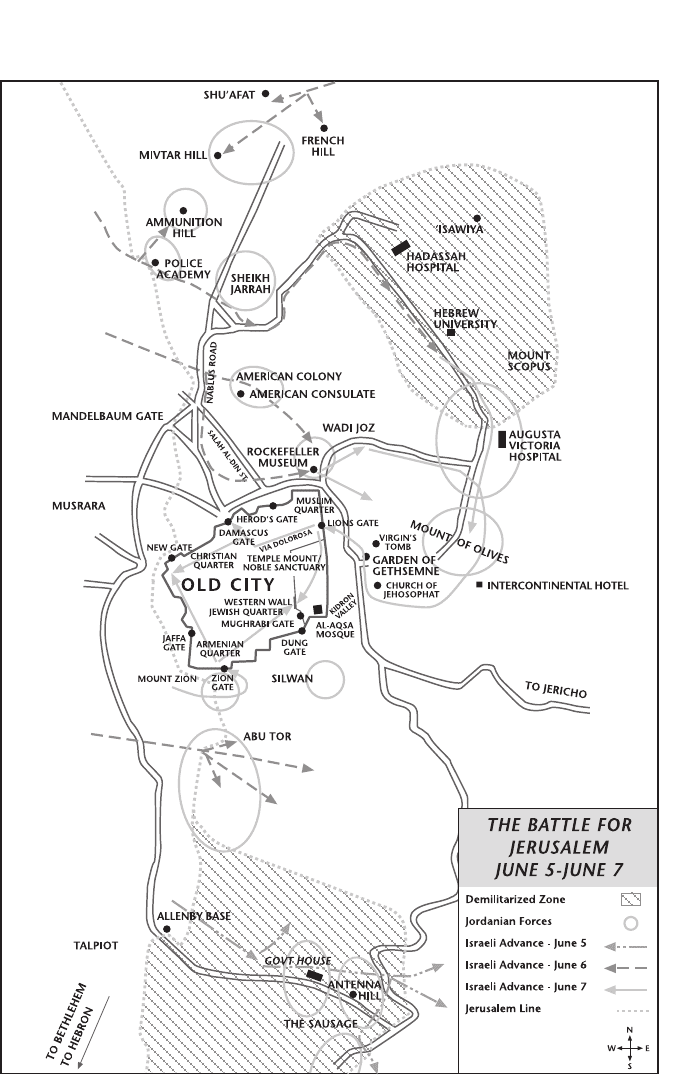
Blocking that effort were the strongest fortifications in Jerusalem, a gan-
glia of trenches, bunkers, minefields, and concrete obstacles known since World
War I, when Gen. Allenby stored his ordnance there, as Ammunition Hill.
The Israelis perceived the bastion as a direct threat to Mount Scopus and the
western half of the city, while for the Jordanians, it represented a first line
defense against any Israeli assault on the east. The soldiers on both sides of that
line, Israelis and Jordanians, had been under continuous shellfire for many hours.
Yet their morale remained commensurately high and their vital supplies undi-
minished. The scene was set for a grueling battle when, at 1:25
A.M., Motta
Gur’s paratroopers moved quietly into position.
220 SIX DAYS OF WA R
Gur’s men were to divide into three forces. The first would cross the no-
man’s land near the Mandelbaum Gate, the UN checkpoint between the two
sectors of the city, and assault the Police Academy that guarded the southern
approaches to Ammunition Hill. The second group would proceed east through
the neighborhoods of Sheikh Jarrah and the American Colony to reach the
Rockefeller Museum, while the third followed the ravine of Wadi Joz up to the
Augusta Victoria Hospital, on the ridge midway between Mount Scopus and
the Mount of Olives. At battle’s end, it was hoped, Israel would not only be free
of any Jordanian threat but also be poised to enter the Old City. “Jerusalem is
not al-‘Arish,” Narkiss told the paratroopers just prior to the attack. “Let’s
hope this time we’ll atone for the sin of ’48.”
14
At 2:10 in the morning the Jerusalem sky was again illuminated, this time by
intense Israeli artillery, tank, and mortar fire to soften up the enemy line. Giant
searchlights placed atop the Labor Federation building—West Jerusalem’s high-
est—further exposed the Jordanians and effectively blinded them. Thus heralded,
Battalion 66 under Maj. Yosef “Yossi” Yoffe, a farmer in civilian life and a vet-
eran of the 1950s retaliation raids, crept up to the first line of barbed wire and
blasted their way through. But beyond that row lay another, and four more after
that, none of which appeared on the IDF’s maps. The attackers were caught in
no-man’s land, in a blistering crossfire and under a rising moon. “We made our
way, Bangalore [torpedo] after Bangalore, fence by fence, squad by squad,” Arik
Akhmon, the paratroop intelligence officer, remembered. “And the most diffi-
cult battle had yet to begin. Before us lay Ammunition Hill.” Seven Israelis were
killed and over a dozen wounded before the last of the wires were cut. Only at
3:10 did Gur, anxious about the approaching dawn, receive the signal that Yoffe’s
men had broken through to the Police Academy. Gur replied, “I could kiss you.”
Built by the British during Mandate times and later passed to the UN, the
Police Academy was believed by the Israelis to house ‘Ata ‘Ali’s main head-
quarters and was therefore heavily defended. In fact, the area was manned by a
single company, 140 men, of the 2nd al-Husseini Battalion under Capt. Suliman
Salayta. With the covering fire from two Shermans borrowed from the Jerusa-
lem Brigade, Israeli engineers cleared a path for the assault units which, over
the next two hours, destroyed some thirty-four bunkers and machine-gun nests.
Still, the Jordanians fought, stalling the Israeli charge just fifteen meters from
Salayta’s position. The captain, with seventeen killed and forty-two wounded,
ordered an artillery barrage on his own position, and with those of his men still
able, fell back to nearby Ammunition Hill.
The battle for the Police Academy also proved costly for the Israelis, only
a squad of whom remained fit for further fighting. Reinforcements arrived,
however, and the paratroopers proceeded to Ammunition Hill, attacking it from
three directions: west, east, and center.
“Sir, the enemy has succeeded in penetrating the area to the left of the
Police Academy,” Pvt. Farhan Haman reported to Maj. Mansur Kranshur, in
Day Two, June 6 221