
Oren Michael B. Six Days of War. June 1967 and the Making of the Modern Middle East
Подождите немного. Документ загружается.

202 SIX DAYS OF WA R
bodies of soldiers after the Israeli tanks had run them over . . . I saw the
wounded lying on the ground and was utterly unable to help them.” By night-
fall, Mendler’s men had achieved a strategically valuable position, able to pre-
vent Shazli Force from aiding Umm Qatef and also to join Sharon’s next major
engagement, at Nakhl.
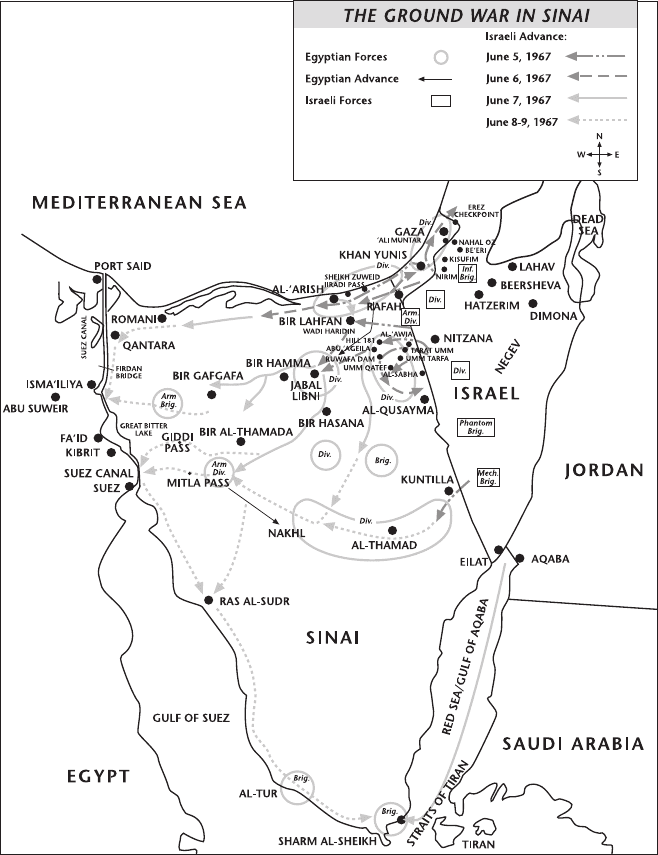
In the north, Tal’s division consolidated its hold on Rafah and Khan Yunis,
and reached the outskirts of al-‘Arish. “Clearing the city was hard fighting,”
according to the IDF record. “The Egyptians fired from the rooftops, from
balconies and windows. They dropped grenades into our half-tracks and blocked
the streets with trucks. Our men threw the grenades back and crushed the
trucks with their tanks.”
Between Tal and Sharon’s forces, close to midnight and with lights blaz-
ing, passed the third of Israel’s southern divisions—Gen. Yoffe’s—en route to
Bir Lahfan and Jabal Libni. Skirting Abu ‘Ageila to the north, threading through
Sharon’s battlefield and exchanging friendly fire with some of his tanks, the
lead Centurions of Col. Elhanan Sela advanced and turned southwest. Farther
to the north, in the sandy wastes of Wadi Haridin, inched the 200th Brigade of
Col. Yissachar “Yiska” Shadmi. Believed impassable by the Egyptians, the wadi
had been studied by IDF paratroopers in 1956 and found suitable for tanks.
Bedeviled by mines and artillery bombardments, Sela and Shadmi nevertheless
managed to cut off all the major road junctions—to Jabal Libni, Abu ‘Ageila,
and al-‘Arish—and to stop two Egyptian armored brigades attempting to en-
circle Sharon.
Less success attended the Israelis’ advance in a battle they had hoped to
avoid, in Gaza. Dayan had expressly forbade entry into the twenty-five-mile
Strip, explaining that Israel did not need to saddle itself with 250,000 Palestin-
ian refugees and complicated inner-city fighting. Yet, shortly after issuance of
the Red Sheet order, Palestinian positions in Gaza opened fire on nearby Is-
raeli settlements of Nirim and Kisufim. Rabin overruled Dayan’s orders and
instructed a reinforced mechanized brigade, the 11th, under Col. Yehuda Reshef,
to enter the Strip. The force promptly met withering artillery fire and spirited
opposition from Palestinian soldiers and remnants of the 7th Division from
Rafah. “The Egyptian soldier, by his nature, is better at static than mobile
defense,” Rafael Eitan, the paratrooper commander, observed. “The Palestin-
ian soldiers, by contrast, were more willing to make sacrifices.”
Seventy Israelis would be killed in some of the war’s heaviest fighting. Also
killed were Ben Oyserman of the CBC, Life magazine’s Paul Schutzer, whose
final photographs would appear in a special edition on the war, and twelve more
members of UNEF. By sunset, IDF forces had taken the strategically vital ‘Ali
Muntar ridge, overlooking Gaza city, but were beaten back from the city itself.
44
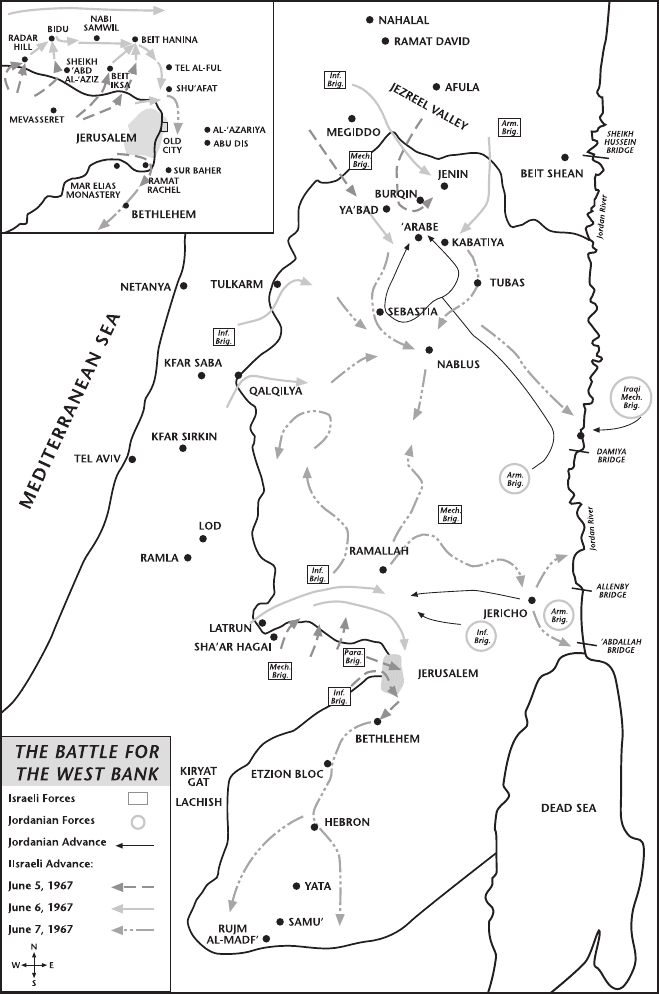
Other unanticipated battles continued to rage along the eastern front, where
the resistance offered the Israelis was no less dogged. Around Jenin, the Legion’s
Day One: June 5 203
12th Armored Battalion held off repeated attempts by Bar Kokhva’s column—a
far larger force—to break through Burqin woods, close by the Kabatiya cross-
roads. The deputy battalion commander, Maj. Muhammad Sa‘id al-‘Ajluni, or-
dered the woods held “to the last man and shell,” and claimed to have destroyed
eighteen Israeli tanks. “Confused and panicky, the Israelis were running around
their blazing vehicles like frightened ants,” ‘Ajluni’s commander, Maj. Salah
‘Alayyan, recorded. But relentless IAF air strikes began to take their toll on the
Jordanians. Their M-48 Pattons, equipped with external fuel tanks, proved vul-
nerable at short distances, even to Israel’s older Shermans. Twelve of ‘Ajluni’s
tanks were destroyed, and only six remained operative. Then, just after dusk,
‘Ajluni spotted lights approaching from the south that he believed belonged to
reinforcements from the 40th Armored Brigade. In fact, they were the lights of
yet more Israeli tanks which, once within range, immediately opened fire.
“The Jordanians fought bravely and effectively,” conceded an official Is-
raeli history of the battle, “Their tanks and antitank weapons had to be de-
stroyed before the [Peled’s] Ugdah could proceed to higher ground and the
enemy’s infantry positions.” Ephraim Reiner, commander of the IDF’s 37th
Armored Brigade, described how his forces were unable to advance without
first waiting for supporting artillery fire and air strikes against the enemy. “One
plane swung around and dove right onto the Jordanian commander’s tank,
wounding him and killing his radio operator and intelligence officer. Only then
did I inform the division that I was attacking . . . a classic night attack, very
nice.” Wounded, ‘Ajluni ordered his surviving tanks to fall back to Jenin where,
together with the remnants of Khalidi’s 25th Infantry Brigade, they found them-
selves effectively surrounded.
45
The IDF’s breakthrough in the northern West Bank was mirrored in the
Jerusalem area, where Ben-Ari’s 10th Brigade was approaching Bidu and the
crucial Beit Iksa-Beit Hanina junction. Another Brigade, the 4th, under Col.
Moshe Yotvat, had been thrown together from sundry infantry units and sent
to open the Latrun Corridor. The Jordanian police fort at the corridor’s west-
ern entrance—Bab al-Wad in Arabic, and in Hebrew, Sha‘ar HaGai—had with-
stood successive Israeli forays in 1948, but it fell with surprisingly little resistance
in the early evening of June 5. So, too, did the adjacent villages of Yalu, Imwas,
and Beit Nuba.
Billeted within those villages were commandos of Egypt’s 33rd and 53rd
“Thunderbolt” battalions, prepared to attack Israeli airfields. “The patrols, each
led by Jordanian intelligence scouts, moved out toward Ramla and Hatzor at
7:00
P.M.,” confirmed commando officer ‘Ali ‘Abd al-Mun‘im Marsi. “We started
infiltrating through Israeli settlements . . . We had no clear idea of our assign-
ment, only a palm-sized photograph of one of the bases.” Marsi’s men were
soon detected, however, and sought shelter in nearby fields, which the Israelis
then set on fire. Of the original force of 600 commandos, only 150 survived
and fled to Jordan.
206 SIX DAYS OF WA R
“They’ll be in the city within two hours,” Deputy Chief of Staff Haim Bar-
Lev, referring to the Harel Brigade’s tanks, blithely reported to the govern-
ment that evening. Within the city, too, the confrontation was coming to a
head. Starting at 7:45
P.M., salvos of Israeli mortar and artillery shells saturated
the Jordanian positions along the so-called northern line leading from the
Mandelbaum Gate up to Mount Scopus. Flares and search beams lit up the
night. Israeli infantrymen stationed along that line received their first relief
from the Jordanian shell and small-arms fire that had continued unabated
throughout the day. For Motta Gur’s paratroopers, though, the countermea-
sures were merely preparations for the pending effort to burst through the
Arab neighborhood of Sheikh Jarrah and link up with Mount Scopus. Resisting
that assault was a dense network of obstacles—bunkers, barbed wire, and mines.
Rabin tried to persuade Gur to delay his attack until dawn, when cover
could be provided by the IAF, but the offer was promptly declined. Jets were of
little use in the close, street-by-street fighting ahead, Gur explained, while the
paratroopers preferred to fight in darkness. Also, if fighting intensified in Sinai,
or broke out with Syria, the army might postpone the Jerusalem operation
indefinitely. Gur hoped to move out at midnight, but logistical difficulties de-
layed H-hour until 2:15
A.M., leaving only ninety minutes before daybreak. Yet
the colonel remained confident, later writing, “We knew that the Arab Legion
would defend Jerusalem from its fixed positions . . . [and] that they never con-
structed a second defense line. Once we broke through [the first line], our
progress would be easy.”
46
Jordan’s brigades in the Jerusalem area—King Talal, Hittin, and Imam
‘Ali—were indeed immobile, with little coordination or even communication
between them. By the late afternoon, however, as the Israeli attacks intensified,
command over the city was entrusted to King Talal’s general, ‘Ata ‘Ali Haza‘.
The 44-year-old ‘Ali, mild-mannered and slight, a soldier since the age of fif-
teen, had been decorated for gallantry in fighting near the Mandelbaum Gate
in 1948. A graduate of England’s Camberley College, he was a no-nonsense
officer, deeply patriotic, and averse to Arab radicals. “Before 1967, I had no
fear that Israel would start a war,” he attested, “but since 1956, I feared that
Nasser would.” While deploring Jordan’s entanglement in “Nasser’s war,” he
was determined to hold out in Jerusalem, at least until a cease-fire.
‘Ata ‘Ali ordered his forces consolidated in a line extending from Abu Tor
in the south and northward to the Old City, Sheikh Jarrah, and Tel al-Ful
astride Mount Scopus. At his disposal were 5,000 Legionnaires and 1,000 Pal-
estinian militiamen, armed with heavy mortars, machine-guns, and howitzers.
But he had no tanks, and believed that the Israeli forces outnumbered his own
by at least three-to-one. Though his own transmitter was seriously damaged,
‘Ata ‘Ali managed to get a message through to Maj. Gen. Muhammad Ahmad
Salim, commander of the Western Front, urging him to send tanks and troops
immediately.
Day One: June 5 207
Salim obliged and dispatched a Patton battalion from the 60th Armored
Brigade. Like the 40th, the 60th Brigade was a corps d’élite, commanded by King
Hussein’s cousin, Brig. Sharif Zayd bin Shaker, a graduate of the U.S. Army Staff
College. His original orders were to repel Israeli forces from the Latrun Corri-
dor, but in view of the worsening situation in Jerusalem itself, the brigade was
now to proceed to the city’s Arab suburbs and from there attack Mount Scopus.
Inching forward in the dark, the tanks climbed the twenty-mile, 2,700-foot as-
cent from Jericho. Parallel to them, struggling up a mountain track from Wadi
Qelt to ‘Isawiya, came infantrymen from Imam ‘Ali Brigade. Well before they
reached their destinations, though, both forces were spotted by Israeli planes
and, subjected to rocket and cannon fire, virtually decimated.
At 9:00 that night, just as the Israelis completed their capture of southern
Jerusalem and prepared to assault the northern line, ‘Ata ‘Ali saw the sky light
up over the Mount of Olives. Instinctively, he knew what had happened. Fur-
ther appeals to send troops from Ramallah and Hebron were rejected; both
cities were braced for attack. Jerusalem would receive no reinforcements.
47
The worsening plight of the Jordanians was closely monitored by Israeli lead-
ers. For them, the question now was not whether the IDF would win in Jerusa-
lem, but whether capture of the city’s eastern half was politically prudent. Several
members of the government, most notably Menachem Begin and Yigal Allon,
emphatically thought so, and throughout the day had pressed Eshkol to ap-
prove a Jerusalem offensive. “Sis Agedank,” Eshkol replied—in Yiddish, slap-
ping a hand to his forehead—“That’s an idea.” The prime minister was once
again torn between total confidence in Israel’s fighting ability and fear for its
future safety. Now, in addition to Soviet intervention, Israelis faced the danger
of censure and even embargo by the Christian world should they capture the
Old City and its Holy Places.
Eshkol was not alone; other ministers, most notably those from the Na-
tional Religious party, shared his fear of an international backlash. But
countervailing pressures were also at work, beginning with those from Jordan.
Despite repeated Israeli requests, conveyed through diplomatic channels, for a
cease-fire, the shelling of outer Tel Aviv and downtown Jerusalem had contin-
ued. Dayan, arriving at the Knesset for his own swearing-in ceremony as de-
fense minister, found the building deserted and returned to Tel Aviv. It was
not until the early evening that the other ministers managed to get through
and, at Begin’s request, convene in an underground shelter.
Begin’s purpose was to discuss the Old City—whether Israeli forces should
enter it and what Israel’s policy would be if they did. In addition to the military
requisites of forcing Hussein to stop the shelling and of defending Mount Scopus,
the ministers were seized by the millennial vision of a united Jewish capital. “Per-
haps the most important Cabinet meeting Jerusalem ever held,” Col. Lior wrote,
mindful of his own elated state: “As the son of an observant family exterminated
in the concentration camps, as the scion of the Jewish people and a citizen of the
State of Israel, I could not hold back my soaring emotions.”
48
208 SIX DAYS OF WA R
Emotions indeed flared as the ministers, speaking above the basso continuo
of incoming shells, spoke their minds. “This is the hour of our political test,”
Begin opened. “We must attack the Old City in response both to the unheeded
warnings we sent Hussein as well as to the Jordanian shelling.” Allon con-
curred: “We all want to see the Old City as an indivisible part of Israel—or that
Israelis at least have access to the Holy Places.” But Eshkol advised caution.
“We have to weigh the diplomatic ramifications of conquering the Old City,”
he said, “Even if we take the West Bank and the Old City, we will eventually be
forced to leave them.” The NRP’s Haim Moshe Shapira supported Eshkol,
declaring, “I assume that there will be pressure to internationalize the city, and
I, for one, won’t oppose the idea.” The debate broke down less on ideological
than on visceral lines, with Mapai’s Zalman Aran seconding Shapira and
Mordechai Bentov, of the left-wing Mapam, siding with Begin. Abba Eban
expressed concern for possible damage to the Holy Places.
In the end, the ministers agreed not to agree, accepting a compromise
formula proposed by Eshkol: “In view of the situation created in Jerusalem by
the Jordanian bombardment, and after warnings were sent to Hussein, an op-
portunity has perhaps been created to capture the Old City.” The immediate
task, however, was to silence the Jordanian guns.
Dayan was already wrestling with that question, deep in the Pit with his
generals—Rabin, Weizman, Bar-Lev. “I know what you want,” he told them.
“You want to take Jenin.” None of them raised an objection, nor did Dayan
demur. Thus, laconically, the first step was authorized for Israel’s entry into
the West Bank. As for Jerusalem, Dayan ordered another message sent to
Hussein, this one threatening to bomb Amman if his forces persisted in bom-
barding Israel. In the interim, the IDF could press its attacks to the north and
south of the Old City, surrounding it. “The Old City can be in our hands by
tomorrow,” Dayan responded when Eshkol informed him of the Cabinet’s dis-
cussion. But the defense minister was determined to delay that action even
longer, until the conquest of Sinai was complete.
49
The Egyptian and Jordanian fronts remained intrinsically related. Jordan’s
bombing of Israel came in reaction to Israel’s attack on Egypt, the early success
of which enabled Israel to strike back at Jordan. Another nexus existed in the
fact that neither Nasser nor Hussein was aware of the perilous state of their
armies. Nasser’s officers were afraid to enlighten him while Hussein’s, lacking
communications with the field, were clueless. Neither would easily believe that
Egypt’s air force, the linchpin of the Arab war effort, had been eliminated in a
matter of hours, or that Israeli tanks were advancing on two fronts while the
Syrians remained inert. Egypt’s propaganda organs, radio and press, continued
to boast of extraordinary victories, while according to Jordanian communiqués,
Israeli forces had been repulsed from Jerusalem and Jenin and thirty-one Is-
raeli planes shot down.
50
Such ignorance could not withstand the mounting
evidence of disaster, however, as the first day of fighting waned.
Day One: June 5 209
The truth became known to Nasser at 4:00 P.M. when, for the first time
that day, he entered Supreme Headquarters and encountered bedlam. ‘Amer,
either drunk or drugged or both, had gone from a state of extreme excitement
to one of profound depression. Screaming into the phone, he told Murtagi first
to move his forces at al-‘Arish to Umm Qatef, and then changed his mind and
ordered a retreat to Jabal Libni and the second line of defense. He spoke with
Sidqi Mahmud and declared that U.S., and not Israeli, planes had performed
the attack against Egypt, and that one of his pilots—Husni Mubarak—had seen
the American jets. ‘Amer refused to take other calls, whether from the Soviet
ambassador or from the Foreign Ministry, all of them anxious for information.
Nor could they get through to Shams Badran. The defense minister had a bed
moved into his office, then sequestered himself inside. “To think that’s our
highest security official,” scoffed ‘Abd al-Latif al-Baghdadi who, along with
Kamel Hassan and Hassan Ibrahim—all former Free Officers—had volunteered
their services at headquarters. “That’s our equivalent to Dayan.”
Nasser tried to talk with his field marshal but found him inconsolable and
practically incoherent. The exact substance of their conversation remains un-
known, but its outcome was indisputable. Orders went out to Gen. Salah Muhsin,
commander of the 14th Armored Brigade at al-‘Arish, to counterattack at dawn,
even without air cover. A decision was also made to inform Algeria of the air
force’s destruction and to request that it loan Egypt a large number of its MiG’s.
Lastly and most fatefully, Nasser and ‘Amer agreed to maintain the fiction of
direct Anglo-American involvement in the war, both to minimize Egypt’s dis-
honor and to prod the Soviets to intervene. Ambassador Ghaleb in Moscow
was instructed to request an immediate audience with Kosygin to inform him
of the collusion. Arab oil producers, beginning with Iraq and Kuwait, answered
Nasser’s call to suspend all shipments to the U.S. and Great Britain. At 6:05
P.M., listeners to Cairo’s Voice of the Arabs learned that “the United States is
the enemy. The United States is the hostile force behind Israel. The United
States, oh Arabs, is the enemy of all peoples, the killer of life, the shedder of
blood, that is preventing you from liquidating Israel.”
51
Rumors, traditionally a vehicle for disseminating information in the Middle
East, had begun to spread. Sixteen hours after the first Israeli jet dropped its
bombs on an Egyptian runway, the results of that operation were being whis-
pered in the streets of Lebanon and Syria, in Iraq and Saudi Arabia. Jordanian
Military Intelligence Chief Brig. Gen. Ibrahim Ayyub summoned his staff at
7:00
P.M. and told them that, “I have just received information that 90 percent
of the Egyptian air force has been destroyed on the ground.”
One of the few populations in the region to remain totally ignorant of the
course of the battle was, strangely enough, Israel’s. Air raid sirens had sounded
throughout the day, but no signal of “all clear” had followed. Egyptian tanks,
for all Israelis knew, were rumbling into the Negev, while other Arab armies
prepared to invade as well. Speaking on national radio, Eshkol described the
210 SIX DAYS OF WA R
“cruel and bloody campaign” his fellow citizens faced, warning them that “the
distinction between front and rear may become blunted . . . all of Israel is a
front line.” In spite of the grave insecurity these pronouncements instilled,
Dayan insisted on maintaining absolute press silence about the IDF’s achieve-
ments. His purpose was to delay as long as possible international pressure for a
cease-fire and the danger of Soviet meddling.
52
This did not prevent the Israelis from updating the Americans, however.
Meir Amit briefed McPherson and Barbour, stressing the existential threat Is-
rael had faced and its intention to “press all the buttons” now that the shooting
had started. The battle, he declared, was not only for Israel’s security but also
for the survival of all pro-Western forces in the Middle East. Subsequently, a
general depiction of the IDF’s successes in Sinai, Jerusalem, and the West Bank
was forwarded from Tel Aviv to Washington, along with a report on the 400
Arab aircraft destroyed and Israel’s 19 losses. The updates were reviewed by
Walt Rostow, who then passed them on to the president. “Herewith the ac-
count, with a map,” Rostow’s memo began, “of the first day’s turkey shoot.”
53

Day Two, June 6 211
THE WAR: DAY TWO, JUNE 6
Israeli advances and Arab retreats.
America on war and peace.
Big Lies and cease-fires.
T
HOUGH FIFTY-THREE YEARS OLD AND PAUNCHY, the director of Israel’s
Nature Protection Society, Avraham Yoffe, was a seasoned fighter in
Sinai. In 1956, he had led an infantry column down the peninsula’s
eastern coast to capture Sharm al-Sheikh. Later, as head of the Southern Com-
mand, he developed contingency plans for moving tanks over desert wastes
that were widely believed insurmountable. Summoned a few weeks before the
war by Gen. Gavish, Yoffe had arrived at camp in civilian clothes, thinking he
was making a courtesy call. He returned in a brigadier general’s uniform and
took charge of the 31st Ugdah with its two reserve brigades, each with 100
tanks. His assignment was to penetrate Sinai south of Tal’s forces and north of
Sharon’s, dividing the two fronts and preventing enemy reinforcements from
reaching either. Then, dashing eastward, he would attack Egypt’s second line
of defense while its first was still busy fighting.
Yoffe’s initial objective, taking the vital road junctions of Abu ‘Ageila, Bir Lahfan,
and al-‘Arish, had already been accomplished before midnight. “We received in-
formation that two Egyptian armored brigades were approaching,” Yissachar
Shadmi, commanding twenty-four Centurions, later related. “They had turned off
all their lights, and my forward observer reported, ‘I can’t see them!’ I told him,
‘shoot blindly,’ and our first barrage blew up seven vehicles. The Egyptians then
spread out in the dunes and a bitter battle ensued, lasting from 11
P.M. to 10 A.M.
the next morning.” Israeli planes completed the work begun by Shadmi, and by
midday, the desert was strewn with burning wrecks. The Egyptians fled westward,
toward Jabal Libni, which the Israelis regrouped to attack.