
Oren Michael B. Six Days of War. June 1967 and the Making of the Modern Middle East
Подождите немного. Документ загружается.

282 SIX DAYS OF WA R
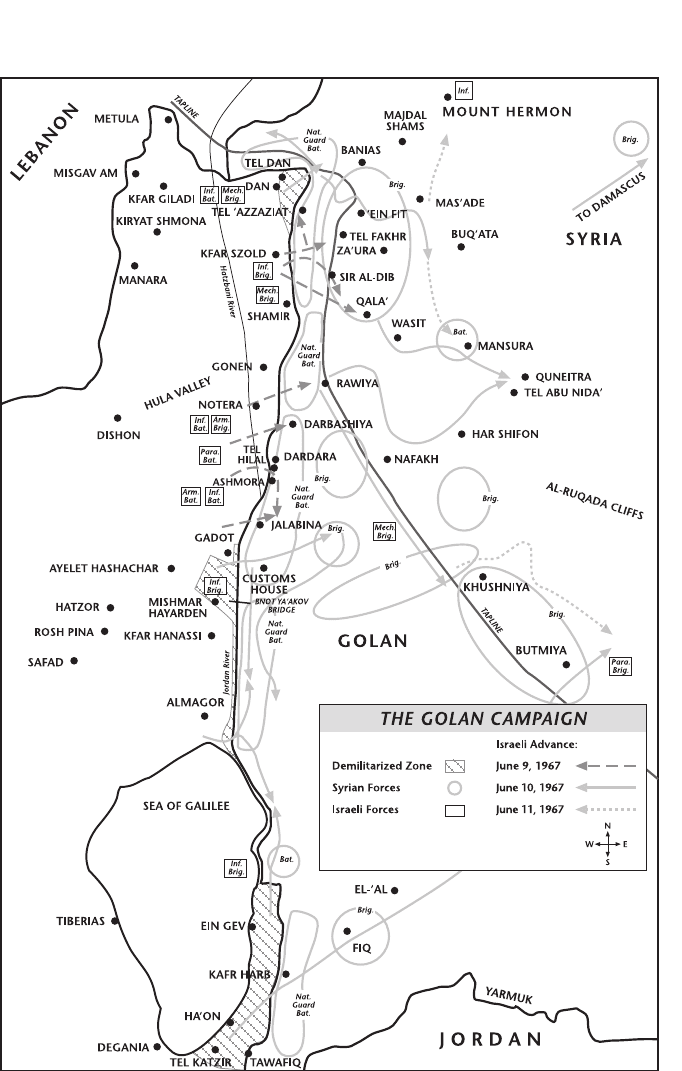
the tide of the battle.” Improvising, he ordered the attacks on Za‘ura and Qala‘
to proceed simultaneously.
The fighting was intense and confused as Israeli and Syrian tanks struggled
around obstacles, firing at extremely short range. Mendler recalled how “the
Syrians fought well and bloodied us. We beat them only by crushing them
under our treads and by blasting them with our cannons at very short range,
from 100 to 500 meters.” The first three Shermans to enter Qala‘ were halted by
a Syrian bazooka team. Behind it, a relief column of seven T-54s rushed to repel
the attackers. Mokady’s replacement, Capt. Nataniel Horowitz, remembered how,
“we took heavy fire from the houses but we couldn’t turn back because forces
behind us were pushing us forward. We were on a narrow path with mines on
either side.” Suffering from a head wound—blood shorted his helmet’s inter-
com—and with his maps destroyed, Horowitz signaled his remaining vehicles to
press forward, and called for an air strike on the enemy’s armor. Mendler turned
him down, saying there were simply no planes available. “Sir,” the captain re-
plied, “if we don’t receive air support at once, it’s good-bye, for I don’t think
we’ll see each other again.” A pair of jets materialized and disabled two of the
T-54’s; the remainder withdrew. The surviving defenders of Qala‘ also retreated,
after their commander, Maj. Muhammad Sa‘id, was killed.
By 6:00
P.M., both Qala‘ and Za‘ura had fallen, along with a third fort, ‘Ein
Fit. The most accessible road to Quneitra lay open to the Israelis, but their
victory had been largely pyrrhic. Dozens of Israelis had been killed and wounded,
and of their original twenty-six tanks, only two remained battle-worthy.
5
Similar carnage occurred throughout the central sector—in the battles for
the strongholds of Dardara and Tel Hilal, which left twenty-one members of
Israel’s 181st Battalion dead and thirty-six wounded. Desperate fighting also
broke out along Hammer’s northern axis, where the 12th Barak (“Lightning”)
Battalion of the Golani Infantry Brigade was assigned to clear some thirteen
positions, including Tel Fakhr—an imposing, horseshoe-shaped bastion three
miles inside Syrian territory. All had been subjected to prolonged air attack in
the hope of reducing their defenses or inducing their garrisons to flee.
But here, too, the Israelis underestimated the bunkers’ ability to withstand
massive bombing, while navigational errors again placed them directly under the
Syrians’ guns. One by one, the battalion’s nine tanks and nineteen half-tracks
were picked off, their passengers wounded or killed. Reuven Dangor, driver of
one of those tanks, found himself targeted by multiple artillery pieces. “No sooner
had we passed the southern part of the tel than I felt a violent jolt . . . The driver’s
compartment filled with smoke and then, when I finally recovered from the shock,
we caught another blast, harder and deadlier than the first, in the turret. I es-
caped through the emergency hatch and looked for the crewmembers who’d
been sitting in the turret. The turret, though, was empty.”
The Israelis had been stopped, but the forces who stopped them had also
taken a beating. The internal Syrian army report of the battle provided a stark
record of fear, chaos, and desertion:
Day Five, June 9 283
With the enemy just 700 meters away, under heavy shelling, the platoon in
the front trench prepared for battle. The platoon commander sent Private
Jalil ‘Issa to the company commander to request permission to take cover, but
‘Issa could not find him. The platoon commander sent another runner who
returned with Private Fajjar Hamdu Karnazi who reported on the company
commander’s disappearance. When the enemy reached 600 meters, Sgt.
Muhammad Yusuf Ibrahim fired a 10-inch anti-tank gun and knocked out
the lead tank. But then he and his squad commander were killed. The enemy
column advanced. First Sergeant Anwar Barbar, in charge of the second 10-
inch gun, could not be found. The platoon commander searched for him but
unsuccessfully . . . Private Hajj al-Din, who was killed just minutes later, took
the gun and fired it alone, knocking out two tanks and forcing the column to
retreat. But when the platoon commander tried to radio the information to
headquarters, nobody answered.
On the road, meanwhile, the Israeli battalion commander, Moshe “Musa”
Klein, ordered his twenty-five remaining men to dismount their vehicles, to
divide into two groups, and to charge the northern and southern flanks of Tel
Fakhr. The southern approach was densely braced with bunkers, trenches, and
a double row of wire. Behind them, a company of the 187th Infantry Battalion
under Capt. Ahmad Ibrahim Khalili waited with an arsenal of antitank guns,
machine-guns, and 82-mm mortars. “It was one of our most fortified posi-
tions,” he remembered. “It placed them [the Israelis] directly in our crosshairs.”
The fighting that ensued was reminiscent of that at Jerusalem’s Ammuni-
tion Hill, waged at extremely close quarters, often hand-to-hand. The first Israe-
lis to reach the perimeter laid bodily down on the barbed wire so that the rest of
their squads could vault over them. From there they dashed to the Syrian trenches.
Captain Diko Takum, the commander of Tel Fakhr’s northern flank, or-
dered his men not to fire until the Israelis had reached the wire. “We’ll catch
them in a sure-kill zone,” he said. Minutes later, Takum’s deputy, Lieutenant
Hatim Haliq, reported that “the Jews are already inside! I’ve taken heavy casu-
alties!” Takum called for reinforcements, but when no answer came, he issued
instructions to hold all positions indefinitely. “Nobody moves. Do not let them
advance. We will all stand here or we’ll all die here.”
The Israelis charged. Shlomo Ben Basat, a Golani enlisted man, testified:
I ran to the left with Kalman, my NCO. We ran through the trenches, clear-
ing out bunkers, until suddenly we saw an alcove with beds and boxes in it.
Kalman told me, “‘I’ll go in and you wait outside.” But no sooner had he
entered [the alcove] when he was hit by burst of fire from a wounded Syrian
inside. Kalman managed to stumble out—he fell and died. Then the Syrian
came out. He saw me and immediately started pleading to me for his life. He
stood there with his gun still smoking from the bullets that killed Kalman. I
avenged his blood.
Ten of the thirteen Israelis who assaulted the northern flank became casu-
alties, while only one of the twelve on the southern flank, Corp. Yitzhak Hamawi,

284 SIX DAYS OF WA R
remained standing. “We ran, Musa (Klein) and I, through the trenches,” he
remembered. “Whenever a helmet popped up, we couldn’t tell if it was one of
ours or not. Suddenly in front of us stood a soldier whom we couldn’t identify.
The battalion commander shouted the password and when the soldier didn’t
answer, he fired a burst at him but missed. We jumped out of the trench, ran
five meters, and then Musa fell on his face . . . killed by the Syrian soldier he’d
missed. Our radio man waited for him to leap up again, then shot him.”
The man who killed Klein was identified in Syrian records as ‘Ali ‘Issa
Hafez. Dying immediately after him was Sgt. Jamil Musa, commander of the
last trench to hold out in Tel Fakhr. Only eight of its defenders remained,
under Corp. Mustafa Suliman, and these retreated when a detachment of Golani
scouts breached the fort from an unmarked trail in the rear. A single Syrian
officer, 2nd Lt. Ahmad ‘Ali, and two privates, surrendered. In the seven-hour
struggle, the Israelis had thirty-one dead and eighty-two wounded. Sixty-two
Syrians were killed and twenty taken prisoner.
Tel Fakhr fell, as did Tel ‘Azzaziat, taken by the Golani Brigade’s 51st
Battalion, and Darbashiya. Though Israeli forces had achieved most of their
objectives and well ahead of schedule, they had penetrated no deeper than eight
miles into Syrian territory. A five-mile-wide bridgehead between Za‘ura and
Qala‘ had been established and armed probes effected at five other points on
the Syrian front. These were the minimal goals of Hammer, but Elazar and the
general staff aspired to much more than that—to Operation Pincers and the
conquest of the entire Golan. Accomplishing that, Rabin estimated, would take
two more days of fighting, at least.
6
Beyond its shattered first line, Syria’s defenses were largely intact. Mount
Hermon and the Banias in the north and the entire southern sector between
Tawafiq and the Customs House road remained in Syrian hands. Meeting early
that night, Syrian leaders decided to reinforce those dispositions as quickly as
possible, and to maintain a steady barrage on the Israeli settlements. The 17th
Mechanized Battalion, having advanced to northern Jordan at Gen. Riyad’s in-
sistence, was summarily moved back to defend Damascus. In a nationally broad-
cast speech, al-Assad swore to carry on the battle against “Zionist imperialist
aggression,” irrespective of the cost. “The enemy’s objective is to break the people’s
morale, thus forcing it to retreat from its heroic stand in the battle against the
enemies of the Arab nation.” Arab ambassadors to Damascus were summoned to
the Foreign Ministry and asked what their governments would do to assist Syria
militarily. A special appeal was made to Egypt, Syria’s ally by treaty.
7
The Egyptians could offer no help, of course, but were themselves in need of
assistance urgently. Whether out of bitterness toward Damascus for failing to
Day Five, June 9 285
286 SIX DAYS OF WA R
come to Egypt’s rescue earlier in the war, or a need to recoil from the death-
trap of inter-Arab politics, Cairo all but ignored the battle unfolding in the
north. Its sole concern was Sinai and Israel’s coup de grâce.
By noontime, June 9, the Israelis had completed the peninsula’s conquest.
Two columns from Yoffe’s Ugdah—one heading south from Suez and the other
west from Mitla—met up with paratroopers who landed by helicopter at Ras al-
Sudr. The entire eastern bank of the Gulf of Suez was now in their hands. In the
north, Gonen’s 7th Armored Brigade reached the shore of the Great Bitter Lake,
while the Granit Force, bypassing al-Qantara, took up position opposite Isma‘iliya
and Firdan. Though scattered skirmishes continued—the Egyptians lost fifty more
tanks—the fighting had effectively ceased. The Egyptians scuttled ships to block
the Suez Canal, but the Israelis, perhaps out of a sense of overconfidence or
simply fatigue, failed to occupy its northern terminus. That port—Fu’ad—would
soon serve as the main conduit for the massive Soviet rearmament of Egypt.
The first deliveries of Russian arms had in fact already landed near Cairo,
and would total nearly 50,000 tons by the end of the month. Yet, not even this
impressive effort could hide the scenes of thousands of Egyptian troops limp-
ing back to the capital. Humiliated, many of these men removed their uni-
forms, lest they be identified with defeat. “There were only four hundred soldiers
between Isma‘iliya and my house,” Nasser later told Sudanese leader Mohamed
Mahjoub. “Israeli troops could have entered Cairo if they wanted to.” British
intelligence sources reported that “defenses apparent along [the] approaches to
Cairo consist of several sand barricades and trenches that could scarcely pose
any serious problems for an advancing army except perhaps a dissident Egyp-
tian one.” Rumors spread of an impending revolt by disaffected officers or by
pro-Soviet agents led by ‘Ali Sabri. Intelligence Chief Salah Nasir went so far
as to risk a secret meeting with Nolte, warning him of a Communist coup
unless the United States embraced “pro-Arab” policies.
Gone were the mass demonstrations in praise of Arab victories, the reports
of Israel’s demise. The economy lay in shambles. “By the time the cease-fire
had been arranged the UAR was approximately $448.5 million per year poorer
than she had been before the war started,” one British diplomat, tallying the
loss of tourism, Sinai oil, and Canal revenues, calculated. Deeply depressed,
Anwar Sadat still refused to come out of his villa near the pyramids. “I . . . was
completely overwhelmed by our defeat. It sank into the very fabric of my con-
sciousness so that I relived it day and night . . . trying, with all the fortitude I
possessed, to weather the fierce campaign of denigration launched by both friend
and foe against our armed forces.” Le Monde’s Eric Rouleau recalled how “an
air of mourning seized Cairo,” and how secretly its citizens were calling Nasser
al-wahsh—“The Beast.” Nor was the disenchantment confined to Egypt. Riot-
ers in Algiers chanted “Nasser traitor!” and attacked the Egyptian embassy; in
Tunis they burned down the Egyptian cultural center. The Arab world had
been shamed and angered, and desperately needed a scapegoat.
8
Day Five, June 9 287
Nasser seemed willing to play that scapegoat. The once-unflappable leader was
suffering from severe depression, complaining of leg pains, and sleeping with a
gun under his pillow. Repeatedly he phoned Gen. Fawzi, questioning him on
the state of his troops. “I’m sitting here waiting for the army to come and take
me,” he told Madkur Abu al-‘Izz, the governor of Aswan, whom Nasser would
soon name to rebuild the air force. The president was sitting in the dark—a
blackout was still enforced—a single candle lighting his face. “My personal
guard is at the front, along the Canal. But I need nothing except for my pistol.
It is here, in my pocket, ready.” The implication was that Nasser would take his
own life rather than fall victim to a military coup. And yet, shortly after mid-
night, when reports reached him that ‘Amer had already attempted suicide,
Nasser rushed to Supreme Headquarters.
There he found the field marshal heavily intoxicated, ranting about con-
spiracies, and demanding large doses of sleeping pills. Nasser managed to calm
him down, and in doing so, to restore some clarity to his own thinking. “A
regime which is unable to defend the borders of its homeland loses its legiti-
macy,” the president told his best friend and fiercest political rival. “As sad as
we may be right now, we have to know that our rule has ended in tragedy.”
‘Amer offered no argument, but instead proposed passing the reins of govern-
ment to Shams Badran, his hand-picked defense minister. Nasser preferred his
vice president, Zakkariya Muhieddin.
At 7:00 that morning, Nasser received a visit from his protégé, Mohamed
Hassanein Heikal. The Al-Ahram editor was shocked: The president had aged
ten years in half as many days. Nasser said that he accepted complete responsi-
bility for the debacle and would face a firing squad, if the people so deter-
mined. He could not, however, continue in office, if for no other reason than
that Egypt’s leader would now have to work closely with the United States—a
task for which he was far too bitter. Rather, he would announce his resignation
that evening; senior military commanders would also forfeit their posts. With
that, Nasser rose to leave, but before he could, the phone rang. ‘Amer, crying
hysterically, had called to say that the Israelis had crossed the Canal and were
now racing toward Cairo. “He’s completely lost his nerve,” sighed Nasser, hang-
ing up. “And that’s how he lost his army.”
9
Nasser’s announcement was broadcast live at 6:30 that evening, shortly
after Cairo Radio informed its listeners that “calm now prevails on the front
and all operations have been halted in accordance with the cease-fire decision.”
The president’s tone was subdued, his voice uncharacteristically frail. Citing
Israel’s intention to invade Syria, he defended his decisions to remilitarize Sinai,
oust UNEF, and blockade the Tiran Straits, and stressed the pressure that
both the U.S. and the USSR had levied on Egypt not to fire first. He credited
Israel with a surprise attack—“We expected the enemy to come from the east
and the north, but instead he came from the west”—but assigned its success to
the open assistance afforded Israel by U.S. and British aircraft. To reverse the
288 SIX DAYS OF WA R
“setback” (al-naksa), as Nasser called it, the Arabs would have to unite against
Israel and maintain their faith in eventual victory. Then, as anticipated, Nasser
accepted full responsibility for his actions; he tendered his resignation and an-
nounced Muhieddin as his successor. His concluding words seemed to evoke
an earlier Nasser, the author of The Philosophy of the Revolution:
The forces of imperialism imagine that Abdel Nasser is their enemy. I want it
to be clear to them that it is the entire Arab nation and not Gamal Abdel
Nasser . . . for the hope of Arab unity began before Gamal Abdel Nasser and
it will remain after Gamal Abdel Nasser. It is the nation which survives. What-
ever Nasser’s contribution to the causes of his homeland, he is but an expres-
sion of a popular will and is not the creator of that will.
No sooner had Nasser uttered these words when planes were heard in the
Cairo sky; anti-aircraft batteries began firing. Suddenly, as if on cue, the streets
filled with people. Hundreds of thousands of people—children, women, uni-
versity students—flooded down Manshiet al-Bakri avenue. Tearing their hair,
their clothing, beating their heads, the demonstrators cried, “Nasser, don’t leave
us!” Eric Rouleau described hearing “a roaring, like the sea,” and witnessing “a
great black mass” proceeding toward the city center. “All of a sudden I found
myself wading through multitudes of people,” recounted Mahmoud Riad. “An-
gry people and highly incensed, clamoring that Nasser must stay . . . [and that]
honor and dignity be avenged.”
Similar outpourings of devotion for Nasser occurred in Alexandria and in
cities throughout the Middle East, from Rabat to Baghdad. “I urge you to re-
spond to the nation’s wishes and stay on,” King Hussein wrote Nasser in a
cable broadcast over Radio Amman. “The battle is only beginning.” Promi-
nent Egyptian intellectuals, National Assembly representatives, and union of-
ficials, rushed to declare their allegiance to the president. Muhieddin publicly
declined to assume his place. The TV anchorman covering the speech broke
into tears, sobbing, “Let bombs fall and let the Sixth Fleet come to our shore,
but we want you to stay!” Nasser’s photograph promptly filled the screen.
Many Westerners were incredulous about the spontaneity of these events,
dismissing them as “a deliberate ploy by Nasser to strengthen his sagging posi-
tion with renewed popular mandate.” R. M. Tesh, the Canadian ambassador,
called the speech “a superlative stroke with all the weird and wonderful quali-
ties of which Nasser is master . . . [that] quickly turned the tables of outrageous
defeat to victory.” Life magazine correspondent Thomas Thompson asked rhe-
torically, “Is Nasser putting on a show?” and then answered himself: “It would
seem so. The resignation, the ack-ack, the blackout, the momentary panic, the
hysterical mobs, all of it builds to the inescapable conclusion that only Nasser
could keep the country together.” Rouleau, virtually alone, rejected such skep-
ticism. “You don’t organize millions of people in a few hours,” he explained.
“People despised Nasser for leading them to disaster, but they also loved him

Day Five, June 9 289
as a father. They didn’t want him to desert them, and they had nobody else to
trust. After all, who was Muhieddin?”
Whether impromptu or not, the outpouring of support proved irresistible.
Nasser accepted the resignations of ‘Amer and Badran and of virtually all his
general staff—the army’s command went to Muhammad Fawzi—but quickly
rescinded his own. A statement pledged that the president would discuss his
position with the National Assembly, but en route to the session, his motor-
cade was allegedly blocked by celebrating citizens. The next communiqué re-
vealed that Nasser “could not ignore the voice of the people,” and would remain
in office until “the traces of Israel’s aggression were eradicated.”
10
Even as Nasser pledged to restore conquered Arab lands, the extent of Israel’s
conquests was expanding. Unsuccessful in their bid to recruit Arab assistance,
fearful of an Israeli drive on Damascus itself, the Syrians had little choice but to
appeal to the United Nations.
At 5:30
A.M. in New York, as the Israelis were pressing their attack beyond
the Golan escarpment, George Tomeh called Hans Tabor, the Security Coun-
cil president, and demanded an emergency session. “In spite of our observance
of the cease-fire,” Syria’s formal protest read, “we are now being subjected to
an Israeli attack on the whole length of the armistice demarcation line and
against our towns and villages.” Verbally, Tomeh went further, charging that
Israeli planes were bombing Damascus and Israeli paratroopers landing in
Quneitra.
Israel’s response was reserved and evasive. Official sources had yet to an-
nounce that an offensive was even taking place—Israel Radio made no mention
of it—only that the Syrian shelling of northern Galilee was continuing. Wally
Barbour, reporting on a conversation with Eban, assured the State Department
that the operation would soon be over and that “should make the cease fire
with Syria effective not only de jure but de facto.” At the UN, Gideon Rafael
claimed that sixteen settlements were being shelled, and dismissed Syria’s ac-
ceptance of the cease-fire as “nothing but camouflage for a premeditated . . .
attack against Israel.”
So began what the Israeli ambassador later described as a debate “unsur-
passed in vehemence.” Mohammad El Kony added to Tomeh’s charges by re-
porting that the Israelis were also bombing Cairo. Rafael, incensed, dismissed
the claim as “a malicious fabrication,” adding that, “the spreading of irrespon-
sible and false charges of this kind only aggravates the already tense situation in
the Middle East.” Federenko demanded that Israel be “severely punished” for
its actions, and warned that “non-compliance [with the cease-fire] will have the
gravest consequences for the Israeli State.”
290 SIX DAYS OF WA R
While the Soviets sparred, the Syrians were willing to settle for simple cease-
fire resolution—anything to stop the Israeli advance. Before it could be voted on,
however, Federenko suddenly insisted on appending articles condemning Israel
and ordering it back to the Armistice lines. Goldberg countered by accusing the
Russians of playing politics at the cost of human lives. Federenko asked in reply,
“why then is it that Washington, which has sufficient means to do something,
has not lifted one finger to stop the aggressive forces of Israel?”
Federenko’s grandstanding had cost the Syrians dearly. At 12:30, Tabor
called an end to the debate and read out a “lowest common denominator” state-
ment confirming the Council’s interest in a cease-fire and instructing the sec-
retary-general to confer with the warring parties. Thereafter, Undersecretary
General Aleksei Nesterenko, a beefy Russian, literally hauled both Tomeh and
Rafael into his office—“into two opposite corners like prize-fighters,” the Is-
raeli delegate wrote, “positioning himself like a referee in the middle of the
ring”—but made no progress. Rafael claimed that he was still awaiting instruc-
tions from Jerusalem. Reminding Nesterenko that “So far it has been the prac-
tice that governments instruct their ambassadors and not the Secretariat of the
United Nations, and we had better continue to abide by this principle.” He
nodded at his Syrian counterpart, and exited.
11
Through a combination of Soviet obduracy and their own stonewalling, the
Israelis had gained valuable time for their offensive. The Council was not set to
reconvene until 6:30 that night. But while demands to end the fighting waned
in the international forum, in Washington they mounted sharply.
The opening of a third Arab-Israeli front fully exposed the fundamental
contradiction in American policy toward the war. While welcoming Israeli gains
that could be traded in a future peace settlement, and eager to see Syria’s provo-
cations punished, the administration was also anxious to uphold the cease-fire
and avoid any clash with the Soviets. A confrontation with the USSR appeared
conceivable when, shortly after news of Israel’s offensive reached Moscow, the
Kremlin pledged to “render them [Egypt and Syria] assistance in order to repel
the aggression and defend their national independence.”
The Soviets’ statement strengthened the hands of Rusk and State Depart-
ment officials who had always resisted armed action by the Israelis, and weak-
ened those of Walt Rostow, Bundy, and Saunders, who had seen its possible
advantages. The scales were further tipped by what many in the White House
viewed as growing Israeli hubris. In an interview with UPI that day, Eshkol
intimated that the U.S. had not lived up to its obligations before the war, thus
forcing Israel to act alone. Though the prime minister had been egregiously
misquoted—he had actually praised America’s commitment to Israel—Johnson
was piqued. “I had a firm commitment from Eshkol [honoring the cease-fire]
and he blew it,” the president scribbled on his notepad during a National Secu-
rity Council meeting. “That old coot isn’t going to pay any attention to any
imperialist pressures”—pressures, that is, from both the U.S. and the USSR.
12
Day Five, June 9 291
Rusk wasted no time in calling the Israelis to task. “Deeply disturbed” by
UN reports of Israeli attacks, disinclined to believe that Syria’s guns posed a
serious threat to Galilee, he instructed Barbour to find Abba Eban at once. He
was to tell the foreign minister that the situation in the Security Council was
“deteriorating rapidly”; that the United States expected Israel to observe the
cease-fire “at all costs” and shoot only in clear-cut cases of self-defense. “We
consider it very important that Israel demonstrate by actions on the ground
that it. . . means what it says.”
The deteriorating situation in the Security Council, the burgeoning Soviet threat
and expressions of American displeasure, the alarmingly high casualty rate—all
weighed on the Ministerial Defense Committee when it met at 8:00 that evening.
The atmosphere was severely strained. Several members, most vocally the NRP’s
Haim Moshe Shapira and Yisrael Barzilai of Mapam, were opposed to continu-
ing the Golan offensive, and furious with Dayan for sanctioning it.
The defense minister had, in fact, just approved the opening of Operation
Hammer south. Israeli forces were to conquer Tawafiq, the Syrian fortress
overlooking the southern tip of the Sea of Galilee, provided the resistance there
proved light. Upon returning from the northern front, however, Dayan found
himself on the defensive, forced to explain why he had suddenly reversed his
previous opposition to attacking Syria. He cited the sudden move by Egypt and
Syria to accept the cease-fire, and Nasser’s telegram to Damascus. Just as the
decisions to attack the West Bank and enter the Old City of Jerusalem had
been taken on the spur of the moment, in reaction to altered circumstances, so,
too, had the approval for the Golan offensive come in response to a new situa-
tion. “These notices gave us the possibility of thinking that maybe we had the
ability to change the international border between us and Syria,” Dayan at-
tested, intimating—disingenuously—that Eshkol had fully approved the attack.
The prime minister came close to refuting this claim—“I cannot say that I
was asked [by Dayan]”—but however hefty, his reservations about the defense
minister could not outweigh his enmity toward Syria. He kept his response
oblique: “All day yesterday we were walking on coals . . . I was really in favor [of
the operation] and sorry that it was postponed, though it was truly decided that
. . . if there’s quiet [in the north]—that would oblige us to shut up as well. How
can we stop now that we’re in the middle of the operation—I cannot say.”
But Shapira was less ambiguous. “Why are we now violating the cease-fire
in front of the whole world?” he shouted. “I demand to know who’s respon-
sible for violating our [the Defense Committee’s] decision!”
“The defense minister has a right to change his mind, but the substantive
argument has changed from end to end,” seconded Barzilai; “this forum should
have reconvened in the middle of the night and made a proper decision.”
Shapira insisted that the offensive be canceled immediately, and was once
again opposed by Allon. “Even if Syria and Egypt had accepted the cease-fire
before this meeting, I will still have approved the operation.” Galili agreed: “I