
Oren Michael B. Six Days of War. June 1967 and the Making of the Modern Middle East
Подождите немного. Документ загружается.

302 SIX DAYS OF WA R
jeeps with bullhorns sped around urging the people to stand and fight, the
defense of Damascus was left to a single brigade—the 70th, known for its loy-
alty to the regime
11
Following full-tilt on the Syrians’ heels, the Israelis descended on Quneitra
from three directions—from Mas‘ade and Buq‘ata in the north, east from Qala‘,
and northeast from Tel Abu Nida’. Other units headed south to Khushniya
and north into the foothills abutting the Lebanese border. At the southern tip
of the Sea of Galilee, a concentrated artillery barrage on Tawafiq at 1:00
P.M.
preceded a paratrooper assault to take the fortress. Thereafter, gambling on the
possibility that few, if any, Syrian troops remained in the field, 800 paratroopers
were flown by helicopter first to Kafr Harb, then to el-‘Al, and finally to Butmiya.
So quick was this leapfrogging that commanders often had no idea where they
were, only that they had to keep advancing before the cease-fire took effect. The
Syrians retreated even more swiftly; most of their positions were deserted.
Yet progress remained relatively slow. The two o’clock deadline was ap-
proaching, and even the lead Israeli elements had yet to reach their objectives.
Many, believing a cease-fire was imminent, saw no reason to rush. Driving past
Nafakh, Yigal Allon halted his jeep and asked one loitering officer—Ron Sariq,
a reconnaissance company commander—what he and his men were doing.
“Waiting for orders,” came Sariq’s reply.
“Don’t just stand there, run! Now!” shouted Allon. “Quickly take
Quneitra!”
12
Quneitra was taken at 12:30 P.M. Mendler deferred to a request from Bar-
Lev and allowed the Golani Brigade, in honor of its nineteen-year defense of
the northern border, to enter the city first. What they found were entire neigh-
borhoods almost completely deserted, their stores and markets full, lunches
still hot on the tables. “We could have continued on to Damascus,” recalled
Col. Benny Inbar, commander of Golani’s 51st Battalion. “The road was to-
tally open before us. They [the Syrians] had fled.”
Meeting in the Syrian Officers’ Club, Elazar urged Rabin to authorize an
armored thrust deep into Syria. A 1964 IDF contingency plan, Hatchet (Garzen),
called for two divisions to conquer the enemy’s capital within eighty hours. But
Rabin rejected the idea, insisting that there be no more seizure of Syrian terri-
tory. The sole exception was Mount Hermon, described by Motti Hod, who
was also present at the meeting, as “the eyes of the nation.” Part of its summit
would be captured as soon as possible and transformed into Israel’s highest
observation post, with a view of downtown Damascus.
13
Absent from this crucial consultation was Moshe Dayan. The defense minister
was preparing for his rendezvous with Odd Bull. In a rather crude maneuver to
gain time, Dayan had arranged for the meeting to be held in Tiberias. But when
the chief UN observer arrived there, he found that the venue had been moved to
Tel Aviv. The two met, finally, at 3:00
P.M., an hour later than scheduled.
Day Six, June 10 303
Bull opened by stressing the need to break the cycle in which Israeli forces
advanced and the Syrians defended themselves, thus providing the Israelis with
a pretext for advancing further. The logic found no sympathy with Dayan,
however. The Syrians were still shelling Israeli settlements, he reported; if they
stopped, the IDF offensive would halt immediately. “We are not after mile-
age,” he said. Dayan described the cease-fire as absolute—“we are not negoti-
ating and we will agree to no conditions”—but then added major conditions of
his own. Israel would accept no excuses for violations, for example, that some
Syrian units had yet to receive the order. Moreover, the wording of the cease-
fire accord could in no way evoke the General Armistice Agreements of 1949.
No UN observers would be allowed near the cease-fire line; Bull would simply
have to accept Israel’s word that the fighting had indeed halted.
14
The cease-fire was to go into effect at 6:00 P.M. “Nobody’s to say their
radio’s not working,” Dayan instructed Elazar. He ordered Weizman and Ze’evi
to draw up a map of Israel’s new borders with Syria, scolding them, “and con-
trol yourselves!” The Northern Command nevertheless ignored Jerusalem’s
directives and stretched the deadline by another few hours in order to improve
Israel’s defensive position. Every unit, every soldier, was pressed into taking
strategically valuable hilltops and road junctions. Intelligence officer Ahuvia
Tabenkin stuck helmets on his cooks and supply clerks and sent them to sit
atop the al-Ruqada cliffs, north of Khushniya. Helicopters continued to ferry
troops into the hinterland northeast of Butmiya.
Not all these operations went unopposed, as scattered resistance occasion-
ally reappeared. At one point, the helicopter carrying Elazar was pursued by a
Syrian MiG, and was forced to dive sharply through a ravine. The helicopter
landed safely, however, at Kibbutz Ein Gev on the southern shore of the Sea of
Galilee. Dozens of kibbutz members ran out to greet the general. “That re-
union between Dado and the members of Ein Gev was absolutely unforget-
table,” recalled Yitzhak Hofi, chief of the operations staff, who, along with
Bar-Lev, had also been aboard. “Men, women, children, crying, laughing, fall-
ing all over him, hugging and kissing him. It must have been their exhilaration
over what had happened, relief that the nightmare was now over.”
15
News of Dayan’s meeting with Bull, followed by the advent of the cease-fire,
defused the volatile situation in the UN. “Israelis played for a time in political
maneuvers in the Security Council to a hair-raising proximity to the brink,” noted
Barbour, and that brinkmanship had clearly paid off. Though Federenko contin-
ued to rant against Anglo-American and Israeli imperialism, no resolution was
passed condemning Israel. Nor was there a reaction, Arab or Soviet, the follow-
ing day when Col. Pinchas Noi of the 13th Golani Battalion and his radio opera-
tor flew by helicopter to Mount Hermon and planted Israel’s flag on the peak.
The focus at the UN was no longer the military situation on the ground
but the postwar settlement. Goldberg went from delegation to delegation can-
vassing their attitudes toward Arab-Israeli negotiations. These, he assumed,
304 SIX DAYS OF WA R
would be face-to-face and direct with an option for UN mediation, and result
in initial agreements on forces separation and freedom of passage through the
Straits. With prophetic understatement, he wrote, “The issue of a simple with-
drawal as opposed to withdrawal as part of an overall settlement will be the
main and somewhat tricky problem as soon as [the] cease-fire firms up.”
World leaders, too, were already looking beyond the battlefield to the sub-
sequent, diplomatic phase. The contentiousness of that stage was evident in
Kosygin’s subsequent hot line message: “If today all military actions are con-
cluded, it will be necessary to proceed to the next step of evacuating the terri-
tory occupied by Israel and the return of troops behind the armistice line.” The
Soviet leader nevertheless ended on a positive note—“I consider that we should
maintain contact with you on this matter”—holding out the possibility for fu-
ture superpower cooperation. Johnson, for his part, was thinking not only of
troop disposition and withdrawal, but also the fundamental question of ending
the Arab-Israeli conflict—of changing its context. “It now appears that military
action in the Middle East is being concluded,” he replied to Kosygin. “I hope
our efforts in the days ahead can be devoted to the achievement of a lasting
peace throughout the world.”
16

Aftershocks 305
AFTERSHOCKS
Tallies, Postmortems, and the
Old/New Middle East
O
NE HUNDRED AND THIRTY-TWO HOURS: That was the duration of the
war, one of the shortest in recorded history. In that brief period, the
Egyptians lost between 10,000 and 15,000 men, among them 1,500
officers and forty pilots; thousands more were wounded. An additional 5,000
Egyptians were listed as missing. Seven hundred Jordanian soldiers had died,
and over 6,000 were wounded or missing. Syria’s losses were estimated at 450
dead and roughly four times that number wounded. Israel admitted to 679
dead and 2,563 wounded, though IDF fatality figures were later placed as high
as 800—the equivalent, in per capita terms, of 80,000 Americans.
1
The glaring disparity of the casualty rates—approximately 25 to 1 in Israel’s
favor—proved even more lopsided in the numbers of prisoners of war. Israel
held at least 5,000 Egyptians, including 21 generals, 365 Syrians (of whom only
30 were officers), and 550 Jordanians. Two Soviet advisers also fell prisoner,
the IDF claimed. Israeli POW’s totaled 15. Though accusations of beatings
and even executions were traded by both sides, prisoners were generally well
treated. Their exchange, however, dragged on for months. Israel held out for
the release of Egyptian Jews imprisoned on spying charges since 1954, and for
the remains of several executed agents, among them Eli Cohen. Egypt and
Syria were reluctant to repatriate their embittered prisoners, and refused to
negotiate directly with Israel.
2
The widest gap of all, however, was not in human but in material terms. All
but 15 percent of Egypt’s military hardware, $2 billion worth, was destroyed, and
vast stores—320 tanks, 480 guns, 2 SAM missile batteries, and 10,000 vehicles—
306 SIX DAYS OF WA R
became Israeli booty. The Jordanian list was also painfully long: 179 tanks, 53
APC’s, 1,062 guns, 3,166 vehicles, nearly 20,000 assorted arms. Of the Arab
forces, the Syrians emerged from the war the least impaired, losing 470 guns,
118 tanks, and 1,200 vehicles; another forty tanks were abandoned to the Israe-
lis. In all, the IAF destroyed 469 enemy planes, fifty of them in dogfights, in
3,279 sorties. The figures included 85 percent of Egypt’s combat aircraft and
all of its bombers. “Never in the history of military aviation has the exercise of
air power played so speedy and decisive a part in modern warfare,” observed R.
Goring-Morris, Britain’s air attaché in Tel Aviv, but that part came at a price.
Thirty-six planes and eighteen pilots, roughly 20 percent of Israel’s air power,
had been lost. And while the Soviet Union swiftly replenished Egypt’s and
Syria’s MiG’s, Israel’s orders for French Mirages and American Skyhawks re-
mained suspended.
Though military casualty rates were, even by contemporary standards, high,
those among civilians were remarkably low. Apart from the bombardment of
Jerusalem, Israeli border settlements, and Palestinian neighborhoods in Gaza
and the West Bank, much of the fighting took place far from major population
centers. Nevertheless, large numbers of noncombatants suffered and suffered
acutely. Between 175,000 (Israeli estimates) and 250,000 (Jordanian estimates)
Palestinians fled the West Bank for Jordan, many of them second-time refu-
gees who were once again billeted in wretched camps. While Israel did little to
precipitate this flight, neither did it do anything to stop it or, indeed, to en-
courage the refugees to return. Rather, initially, the IDF laid ambushes along
the banks of the Jordan River to prevent “infiltrators” from crossing back into
the West Bank. The ambushes were removed only after Dayan, observing them
a week after the war, deemed them inhumane.
Similarly, on the Golan, the exodus of the civilian population was neither
impelled nor inhibited by Israel. Though IDF war plans had made no provi-
sion for Syrian civilians, the general staff did issue a specific order (No. 121330)
stating: “There is to be no expulsion of villagers from the Syrian Heights or
from occupied territories in Syria.” Damascus later claimed that the villagers
had been expelled en masse, but in fact few Israelis even came into contact with
civilians, most of whom had fled with the Syrian command, well in advance of
the attackers.
After the cease-fire, Israel insisted that the 1967 refugee problem, like that
of 1948 before it, would have to be solved within the framework of a compre-
hensive peace treaty. The Arab states uniformly rejected this demand, and in-
sisted on unconditional repatriation and compensation for the refugees. When,
later that summer, Israel was pressed to permit at least some of the Palestinians
back into the West Bank, few in fact availed themselves of the offer.
3
The refugees’ plight, however tragic, was soon overshadowed by the per-
secution of Jews in Arab countries. With news of Israel’s victory, mobs at-
tacked Jewish neighborhoods in Egypt, Yemen, Lebanon, Tunisia, and
Aftershocks 307
Morocco, burning synagogues and assaulting residents. A pogrom in Tripoli,
Libya, left 18 Jews dead and 25 injured; the survivors were herded into deten-
tion centers. Of Egypt’s 4,000 Jews, 800 were arrested, including the chief
rabbis of both Cairo and Alexandria, and their property sequestered by the
government. The ancient communities of Damascus and Baghdad were placed
under house arrest, their leaders imprisoned and fined. A total of 7,000 Jews
were expelled, many with merely a satchel.
4
Apart from Tunisia’s Bourgiba
and King Hassan of Morocco, no Arab statesman condemned these outrages.
Attempts by both the UN and the Red Cross to intercede on the Jews’ behalf
were rebuffed.
By comparison, the 1.2 million Palestinians now under Israeli rule were
spared systematic persecution. While looting was widespread and acts of van-
dalism recorded—nearly half the houses in Qalqilya were reportedly damaged,
though later repaired by Israel—a military administration was rapidly estab-
lished for the West Bank and Gaza and a combination of Jordanian and martial
law imposed. Palestinian community and religious leaders were, for the most
part, retained in their prewar positions, including the Muslim waqf atop the
Temple Mount—a decision for which Moshe Dayan was criticized by Israeli
hawks. Israel nevertheless deviated from its tolerant policy in the Old City of
Jerusalem, where hovels of the Mughrabi neighborhood were cleared away to
create a prayer plaza in front of the Western Wall. The most controversial
decision, however, was the destruction of three villages—Yalu, Beit Nuba, and
Imwas—located at a strategic junction in the Latrun Corridor. The Israelis
accused the three of abetting the siege of Jerusalem in 1948 and billeting Egyp-
tian commandos in their recent attack on Lod, but even then several troops
refused to carry out the demolition order. Ultimately, it was executed, and the
Arab inhabitants, though offered compensation, were not allowed to return.
No further acts of retribution were taken against Arabs who, only days
before, had celebrated Israel’s demise. The revelation that Jordan had destroyed
the Old City synagogues and had paved roads and even latrines with Jewish
tombstones from the Mount of Olives did not dissuade Dayan from joining
4,000 Muslim worshipers for Friday prayers at the al-Aqsa Mosque.
5
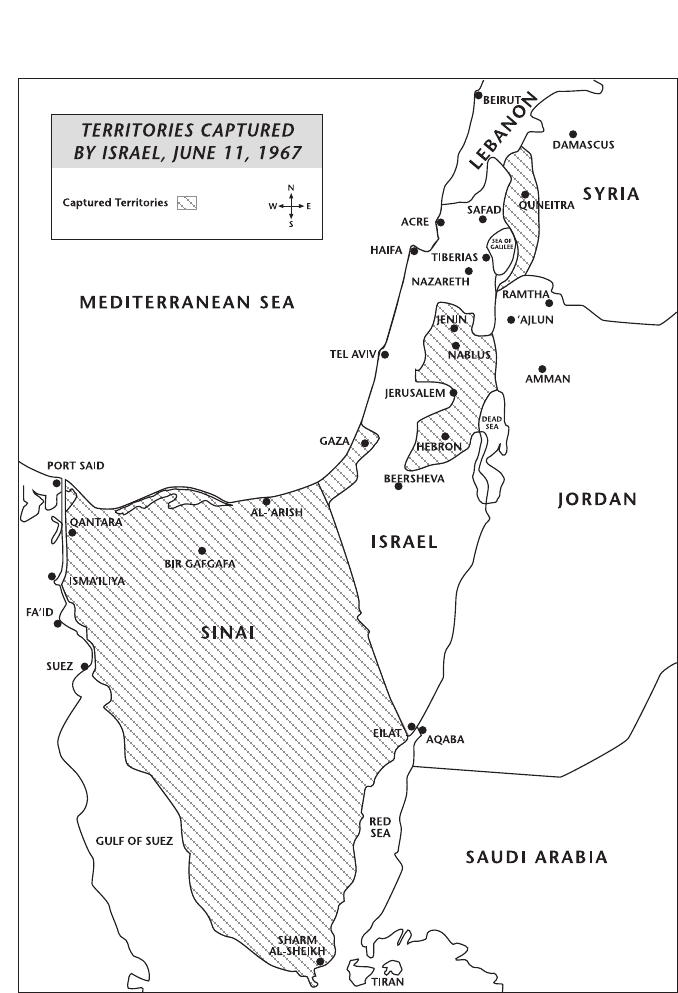
Casualties, prisoners, refugees—all were ultimately dwarfed by the war’s
most tectonic outcome. Israel had conquered 42,000 square miles and was now
three and a half times its original size. Exceedingly vulnerable before the war,
its major cities all within range of Arab guns, the Jewish state now threatened
Damascus, Cairo, and Amman. Its own capital, Jerusalem, was united. Though
ties had been severed with the Soviet Union and permanent strains left in its
relations with France—and in spite of the Liberty incident—Israel had earned
the solid respect of the United States. “The spirit of the army, indeed of all the
people, has to be experienced to be believed,” Harry McPherson reported to
his president, relating how he had seen a jeep with two Israeli women soldiers,
“one with a purple spangled bathing cap on her head, the other with an orange
308 SIX DAYS OF WA R
Aftershocks 309
turban,” riding in the Negev. “After the doubts, confusions, and ambiguities of
Vietnam, it was deeply moving to see people whose commitment is total and
unquestioning.”
Moribund before the war, Israel’s economy suddenly flourished as tourists
and donations flooded the country, and oil was extracted from Sinai wells. Emi-
gration all but ceased, and thousands of new immigrants hastened to partake of
the glory.
Israel indeed basked in that glory as its press for weeks afterward praised
the army’s audacity, its ingenuity and power. Ha’aretz informed its readers of
the minting of a new victory coin, and supplied a recipe for “victory cakes” to
be baked for homecoming soldiers. “From the podium of the UN, I proclaimed
the glorious triumph of the IDF and the redemption of Jerusalem,” Abba Eban
told a riveted audience in Lod. “Never before has Israel stood more honored
and revered by the nations of the world.” Less decorously, Haim Bar-Lev told
the Cabinet, “We have screwed every Arab country.” Always popular, Dayan
and Rabin were now elevated to icon-status, and not only among Israelis but
throughout the Diaspora where the war had enabled Jews “to walk with their
backs straight.” To the chief of staff was given the exceptional honor of actually
naming the war. Among the titles proposed—The War of Daring, the War of
Salvation, the War of the Sons of Light—Rabin chose the least ostentatious,
the Six-Day War, evoking the days of creation.
For a moment, the apocalyptic aspect of the Israeli self-view appeared to
have been eclipsed by that of the indomitable, the invincible Israeli—but only for
a moment. Michael Hadow, the British ambassador, noting the absence of mass
celebrations, found “something very inspiring and yet rather terrifying” about
the dispassionate way the Israelis went to war, won, and returned home to busi-
ness as usual. The discomfort many Israelis felt with their victory, the guilt and
pain of their losses, poured out in a postwar collection of interviews with kibbutz
members, entitled fittingly, The Seventh Day. “We weren’t especially excited or
happy about killing Arabs or knowing that we’d won,” recalled Shai, a twenty-
seven-year-old member of Kibbutz Afikim, who had led paratroopers at Umm
Qatef. “We just felt that we’d done what we had to do. But there’s a big differ-
ence between that and feeling happy.” Similarly, Gal, from Givat Haim, a tank
gunner, said, “What have I got against an Arab? Even if I can see that he’s got a
gun? You shoot at him, you know he’s a man, that he’s got a family . . . It all goes
fine right up to the moment you see someone dead. That’s when we began to
curse the war.” The diary of Rivka Niedt, of Kibbutz Usha, records her feelings
upon arriving at al-‘Arish: “There’s a heavy, thick blackness outside, and an aw-
ful noise . . . shots, screams, and short frightening booms . . . Your throat chokes,
your eyes cloud over and you run outside . . . but the wind . . . only brings in great
gusts of stench from the dead and the clouds of black flies.”
Following “Jerusalem of Gold,” the most popular Hebrew song to emerge in
the years after the war was “The Song of Peace,” a threnody of the recently dead:
310 SIX DAYS OF WA R
No one can bring us back
From the dark depths of our grave
Here the thrill of victory means nothing
Nor do songs of praise
Therefore, sing a song for peace
Do not merely whisper a prayer
Better to sing a song for peace
Shouting it loudly.
6
For Arabs, though, there could be no such ambivalence toward the war.
Even the “Six-Day” epithet, with its image of lightning conquests, proved odi-
ous to them, and they resorted to more reticent titles—The Setback, The Di-
saster, or the anodyne June War. No sooner had the shooting stopped than the
Arab world embarked on what one Middle East historian called “an audit dur-
ing a moment of great stress and clarity,” examining how “a small state had
displayed their historical inadequacy, had seized massive chunks of land, and
had devastated the armies whose weapons and machismo had been displayed
with great pride for the last decade or so.” Intellectuals would evince intense
disillusionment with Arab nationalism—as a mass movement, it would never
revive—and stress the need for modernization and democracy. Others would
advocate an even more militant radicalism on the Vietnamese or Cuban model,
or a return to the rigorous fundamentals of Islam. Painful examinations would
be made of Arab society, its inherent propensities and weaknesses, and of the
Arab personality and psyche.
Arab politicians, on the other hand, persisted in avoiding any responsibility
for the defeat, much less engage in introspection. Nasser continued to blame the
insubordinate Egyptian officers and the Anglo-American cabal for Egypt’s de-
feat in what he curiously called “Bunche’s war.” King Hussein waxed fatalistic,
telling his people that “I seem to belong to a family which . . . must suffer and
make sacrifices for its country without end . . . If you were not rewarded with
glory it was not because you lacked courage, but because it is Allah’s will.” The
deepest denial came from Syrian leaders, criticized throughout the Arab world
for having done so much to start the war and then so little to fight it. “The
Israelis’ objective was not to conquer a few miles from Syria but to topple its
progressive government,” explained Gen. Suweidani. “This they did not accom-
plish. Therefore we must view ourselves as the victors of this war.” The point
was refined by Foreign Minister Makhous: “Were Damascus or Aleppo to fall,
they could be rebuilt. But there could be no compensation for the loss of the
Ba’th, for it is the hope of the Arab nation.” Hafez al-Assad declared that “Syria,
alone, fought for six days, without letup, with all our might.” When one junior
officer demanded an investigation of the debacle, Assad reportedly had him shot.
7
Not until after the 1973 war, with their army’s honor restored, did Egyp-
tians begin to speak out about the causes of 1967. Thus, Salah al-Hadidi, chief
justice in the trials of officers held accountable for the defeat, wrote that, “I can
state that Egypt’s political leadership called Israel to war. It clearly provoked
Aftershocks 311
Israel and forced it into a confrontation.” Gen. Fawzi singled out “the individu-
alist bureaucratic leadership” and “‘Amer’s collapse,” while Muhammad Sadiq
spoke of “promotions on the basis of loyalty, not expertise, and the army’s fear of
telling Nasser the truth.” Murtagi credited the Israelis with having better weap-
ons, command, and organization; they seemed to have a stronger will to fight.
Sidqi Mahmud pointed his finger at the hasty decision to oust UNEF, to occupy
Sharm al-Sheikh, and to weather Israel’s first strike. “We were totally dependent
on Russian equipment,” he testified. “The field marshal was not committed to
the army’s affairs.” Lack of intelligence was the problem, according to Zakkariya
Muhieddin: “While the Israelis knew the name of every Egyptian on relief, and
his wife’s name too, we didn’t even know where Moshe Dayan’s house was.” ‘Ali
Sabri faulted the army’s refusal to investigate its failures in the Suez and Yemen
wars, and to oust the officers responsible. Shams Badran blamed Nasser: “He
took the decisions that placed the army in a trap. Without consulting with any-
one, he led us into the ambush that Israel had laid with American help.”
8
How had it happened? No shortage of pundits rushed to answer that question,
noting the Israelis’ superior training and motivation, the Arabs’ lack of opera-
tional unity and inability to understand their foe. Hadow stressed the personal
element, the stark disparity between the Israeli and the Arab soldier:
These were not elite professional troops lavishly equipped with the most mod-
ern equipment, but for the most part civilian reservists, with comparatively
limited training behind them, who were carried into battle in civilian trans-
port, and were supplied and supported by essentially civilian services. By com-
parison, the professional Arab armies showed a total lack of appreciation of
the essential elements of modern warfare, and an almost equal inability to use
the sophisticated weapons and equipment provided by their Russian quarter-
masters. Their leadership on almost all fronts was inept to a degree which
hardly seems possible after 10 years of preparation and training for a war
which was to bring about Israel’s annihilation.
Moshe Dayan proved less complimentary. His final report to the general
staff criticized Israel’s misreading of Nasser’s intentions, its overdependence on
the United States and hesitation to act the minute Egypt closed the Straits. Yet
Israel had “ended the Six-Day War with maximum lines on all fronts,” in spite of
these shortcomings, he wrote. The reason was that Egypt had failed to appreciate
the advantages of launching a first strike, had failed to gauge the enemy’s power
and his willingness to use it. Lulled into arrogance by these errors, the Israelis
would repeat them six years later, in their next major war with the Arabs.
9
Such analyses perhaps explained how Israel won the war; they could not
account for its outcome. Beyond the goals of eliminating the Egyptian threat and
destroying Nasser’s army, no other stage of the conflict was planned or even
contemplated, not the seizure of the entire Sinai Peninsula, not the conquest of
the West Bank, nor the scaling of the Golan Heights. Even the “liberation” of