
Oren Michael B. Six Days of War. June 1967 and the Making of the Modern Middle East
Подождите немного. Документ загружается.

322 SIX DAYS OF WA R
enabled our enemies to undermine our security and plot against our sover-
eignty and existence.”
22
Confusion continued to surround Khartoum, yet certain conclusions were
clear. The Arabs’ focus had shifted away from liberating Palestine to liberating
those areas recently conquered—from “erasing Israel,” as Shuqayri put it, to
“erasing the traces of the aggression.” And for Nasser, who successfully ended
the Yemen war and procured $200 million in aid, the summit was unquestion-
ably a triumph, his last.
23
The next three years would be rife with disappointments for Nasser—mili-
tary, economic, political. By 1970, the economy was in appalling shape, even
by Egyptian standards, and the country was virtually occupied by thousands of
Soviet advisers. The attrition war along the Canal had escalated disastrously—
the outskirts of Cairo were bombed—without loosening Israel’s hold on the
territories. In August, Nasser consented to a cease-fire, but a month later he
was again thrust into conflict as Palestinian forces in Jordan staged an open
revolt against the monarchy. Syrian tanks moved toward the Jordanian border,
and the Israelis pledged to help Hussein—the entire region verged on confla-
gration until Nasser stepped in and mediated a solution in which Arafat and his
guerrillas would evacuate Jordan and receive asylum in Lebanon. The Jorda-
nian civil war or, as the Palestinians called it, Black September, utterly drained
the already desiccated Nasser. He returned to Cairo on September 28 and went
to bed, never to rise again.
Egypt was seized by a paroxysm of anguish unprecedented in its modern
history. Kosgyin, notoriously unflappable, was moved to tears by the sight of
countless thousands of mourners choking the streets of Cairo. Flags flew at
half-mast throughout the Middle East, where the mood was best described by
Sadat, Nasser’s successor: “My grief for him will live as long as I live, inflaming
my heart.” Among Israelis, alone, the reaction was muted—not celebratory,
but wary of an Arab world without a leader strong enough to make peace as
well as war. Many could have subscribed to the words of King Hussein: “The
greatness of most world leaders lies in their ideas and actions, but Gamal’s
greatness empowered his actions and ideas.”
24
Hussein would outlive Nasser by nearly thirty years, navigating his coun-
try through social and economic crises and eruptions of Arab-Israeli violence.
Abrogating to the PLO his role as representative of the Palestinian people, and
surrendering his claim to the West Bank, Hussein tried to mediate between
Israeli and Palestinian leaders. Though passively pro-Iraqi in the 1991 Gulf
War, he joined Yitzhak Rabin in 1994 in signing the Jordan-Israel peace treaty,
and the following year delivered the main eulogy at Rabin’s funeral. He died of
cancer in February 1999, and was mourned by the entire world, with the ex-
ception of many Palestinians.
Hussein, in turn, was survived by one year by Hafez al-Assad, who con-
spicuously boycotted Khartoum. Ousting Jadid and “Doctors” Makhous and

Aftershocks 323
Atassi, al-Assad achieved supreme power in Syria. He joined Egypt in launch-
ing what the Arabs called the October or Ramadan War of 1973, which ended
with the IDF on the outskirts of Damascus. Three years later, in an effort to
aid Christian militias warring against the PLO, al-Assad sent his troops into
Lebanon, where they soon turned on the Christians as well and occupied much
of the country. Renowned for his ruthlessness, credited with massacring an
estimated 20,000 of his countrymen in an abortive 1982 revolt, he bitterly op-
posed the Egypt-Israel peace treaty, and continued to support Palestinian guer-
rillas. And yet al-Assad also negotiated, albeit indirectly, with Rabin and other
Israeli leaders. They offered to return most, if not all, of the Golan, but their
quid pro quo—peace—proved too steep for Assad.
Yasser Arafat, the longest-lived of all the Arab leaders of 1967, was not
even invited to Khartoum. Yet the conference, by negating the possibility of
conventional war for the near future, placed him and his guerrillas in the van-
guard of the armed struggle. Within two years, Arafat had gained the chair-
manship of the PLO—Shuqayri was swiftly forgotten—and mounted numerous
high-profile raids, typified by the 1972 massacre of Israeli Olympic athletes in
Munich. Two more years passed and the Arab states recognized the PLO as
“the sole, legitimate representative of the Palestinian people,” and Arafat was
invited to address the UN General Assembly. But then the PLO became em-
broiled in the Lebanese civil war, fighting first the Christians, then the Syrians,
and finally the Israelis. Arafat, who had already been banished from Jordan,
was now exiled to Tunis where, after declaring his support for Saddam Hussein
in the Gulf War and sidelined by a popular revolt in Gaza and the West Bank
(the Intifada), he seemed to be consigned to obscurity. Rabin revived him, how-
ever, and Arafat returned to the territories as president of the newly created
Palestinian Authority.
25
The militant who praised the assassins of Sadat in 1981
appeared to be following in his footsteps. Like the Egyptians and Jordanians
before him, Arafat would draw on an American peacemaking experience that
began, thirty years before, with Lyndon Johnson.
The last shot of the war had scarcely been fired, but Arthur Goldberg was
already canvassing UN delegations on the possibility of peaceful arrangements;
of mediation and direct talks between the parties. Yet very quickly, the diffi-
culty of transforming the latest Arab-Israeli war into a lasting Arab-Israeli peace
became apparent.
The Arabs were insisting on the total and unconditional return of their
territories, and the Israelis, though willing to cede Sinai and the Golan Heights,
324 SIX DAYS OF WA R
had dug in their heels on the West Bank and Jerusalem. America had scant
means of influencing the Arabs, and only limited leverage on Israel. “It wasn’t
Dayan that kept Kosygin out,” the president told his advisers shortly after the
cease-fire. “The USSR will soon get fed up with Israel’s braggadocio.” The
Soviets, meanwhile, were ready to “pull out all the stops”—Joe Sisco’s phrase—
to defend the Arabs’ rejection of any form of acceptance for the Jewish state.
“Israel’s keeping the West Bank would create revanchism for the rest of the
20th century,” Dean Rusk concluded, “but Israel must be accepted.”
Faced with such mountainous challenges, burdened with his own difficulties
in Vietnam, Johnson might well have ignored the Middle East. Instead, he em-
barked on a daring initiative. Addressing an educators’ conference on June 19
(again, that date), the president set out the ideas he and his staff had been devel-
oping since the very first day of the war. These were framed in five principles
that recognized the right of every state in the region to exist, assured the territo-
rial integrity and political independence of all states, and guaranteed freedom of
navigation while advocating Middle East arms control and a solution to the refu-
gee problem. Eshkol expressed “deep admiration” for the speech; Eban called it
“masterful,” and Rostow reported, “as of tonight the Arabs haven’t cut the pipe-
lines or our throats.”
26
There remained only the Soviets’ cooperation to solicit.
The appeal was made in an unlikely venue: a Victorian house in Glassboro,
New Jersey. There, on June 23, Johnson raised a number of issues with Pre-
mier Kosygin, among them Vietnam and nuclear proliferation, before dealing
with the Middle East. Johnson appealed for support for his five principles, and
for a “common language of peace.” But Kosygin was intractable. He accused
the U.S. of encouraging Israeli expansion, of dealing perfidiously with Nasser.
“The Arabs are an explosive people,” he warned, predicting that the Arabs would
“fight with hunting rifles, even their bare hands,” to regain their lands uncon-
ditionally. In return for Israeli withdrawal from all the territories, the Soviets
would at most agree to adjudication of the Straits blockade by the International
Court of Justice.
Ten years would pass before Kosygin’s ouster by Brezhnev—Podgorny’s
fall would follow—but in the summer of 1967 the premier’s powers were broad.
Having failed to fulfill his goals in the Security Council, he requested an emer-
gency General Assembly session to “to bring about the liquidation of the con-
sequences of aggression and the immediate evacuation of Israeli forces behind
the armistice lines.” U Thant, in what Western observers saw as an effort to
atone for his lack of judgment during the crisis, softened the Soviet blow. He
merely cited the Uniting for Peace mechanism used when the Security Council
was deadlocked, and quietly convened the Assembly.
The session lasted five weeks but failed to uphold the Arab claim that the
war had been an act of Israeli aggression. Rather, it produced a Latin American
resolution offering UN mediation and the return of all conquered land for
recognition of “the right of all states in the area to live in peace and security,”
Aftershocks 325
and a non-aligned motion demanding immediate and unconditional withdrawal.
The Arabs rejected both, however, and the Soviets, exasperated by what they
termed “extremist Arab circles,” tabled a resolution closely resembling the Latin
draft. But this, too, failed to pass. “The Russians seem to have made every
mistake that they could,” observed Lord Caradon. “Having led the Arabs into
battle and having them sustain a resounding defeat, they then showed that they
were ready to abandon them.” Ambassador Federenko, the demagogue who
had once sworn to “humiliate and wipe the floor with the United States,” was
saddled with the failure and permanently removed from his post.
27
“We are now in the process of mopping up after Mr. Kosygin’s onslaught in
the General Assembly,” Johnson wrote to Harold Wilson. “The most likely pros-
pect is that the Middle East will go back to the Security Council, where it be-
longs, and that results will have to be negotiated out behind the scenes.” Quiet
talks had indeed already begun between Rusk, seeking to wed the “hare” of evacu-
ation to the “horse” of the price the Arabs would pay, and Soviet ambassador
Dobrynin, eager to reach any compromise that avoided the word “non-
belligerency.” Finally, in early July, Gromyko and Goldberg reached an agree-
ment that stipulated prompt withdrawal “in keeping with the inadmissibility of
the conquest of territory by war,” and upheld each party’s right “to maintain an
independent national state of its own and to live in peace and security.” UN
intervention would be sought in solving the refugee and free passage problems.
28
The agreement appeared to please nobody. Nasser objected to the absence
of a clear reference to withdrawal to the June 4 lines, and to the suggestion of
even indirect mediations with Israel. “I cannot accept this,” he told the Soviets.
“If I did, I could not return home; I could not even face my daughters.” The
Israelis, for whom even the Latin draft had been insufficiently specific on terri-
tory-for-peace, described the agreement “not only as a physical retreat but a
diplomatic backtracking to the grave situation that has existed for the last 19
years.” Eban protested, “Nothing but a husk will remain of Johnson’s prin-
ciples.” By the end of the summer, even the U.S. and the USSR appeared to be
distancing themselves from the accord.
29
The violence in Sinai escalated, meanwhile, climaxing on October 20 in
the sinking of the Israeli destroyer Eilat—a quarter of its crew was killed—by
an Egyptian missile. Israel retaliated by shelling Egypt’s principal oil refineries
at Suez and setting them ablaze. Sporadic fighting also broke out at various
points along the Jordan River. War, much more than a negotiated settlement,
seemed near. But the very threat of renewed regional conflict provided a fillip
to diplomacy as the Security Council again took up the Middle East.
Success, Goldberg realized, lay in language that intimated both Israel’s
desire for total peace in return for less than all the territories and the Arabs’
demand for complete withdrawal in return for at most nonbelligerency. The
démarche, Goldberg’s last before resigning over differences with Johnson on
Vietnam, required weeks of intensive discussions. To sway the Israelis, Walt
326 SIX DAYS OF WA R
Rostow suggested “we lean against them just enough to keep their thinking
from becoming too quickly set in the concrete of their current extended terri-
torial possessions”—to which McPherson warned, “We would have to push
them back by military force to accomplish a repeat of 1956; the cut-off of aid
would not do it.” But having resisted Eisenhower’s pressure tactics during Suez,
Johnson refused to arm-twist the Israelis. At most he was willing to delay arms
shipments to Israel, while urging Eshkol to be “flexible, patient, discreet and
generous.” As for the Jordanians, “our main purpose must be to let him [Hussein]
down as gently as we can from his present conviction that you must pull his
chestnuts out of the fire for him,” Bundy advised the president. “A formula that
is good enough for Kosygin is good enough for Hussein.” America could scarcely
influence the other Arab delegations, all of which were looking to Egypt’s lead.
In peacemaking, as previously in war, Nasser held the key.
30
“This is merely an Israeli resolution camouflaged as an American one,”
Mahmoud Riad, arriving in New York, protested to Goldberg. “It does not
even give us the minimum of erasing the traces of the June aggression.” Goldberg
responded with several concessions to Egyptian sensibilities, including refer-
ence to the “inadmissibility of the acquisition of territory by war” and to a UN
“representative” who would “establish contacts” and “promote agreement,”
rather than a mediator who would facilitate talks. Peace was promised for the
Middle East, and territorial integrity and security for all states in the area, without
specifying peace with, or recognition of, Israel. Even a non-American sponsor
for the resolution, Britain, was found. Finally, only one great stumbling block
remained: the extent of Israel’s withdrawal—whether from “territories occu-
pied in the recent conflict” or “the territories occupied in the recent conflict.”
Ultimately, through untiring efforts by Goldberg and Caradon, the Egyp-
tians were persuaded that “territories” indeed meant all the territories—the
French and Arabic versions of the text both retained the definite article—while
the Israelis were contented by fact that the official English-language version
remained obscure. Thus, on November 22, the Security Council unanimously
adopted Resolution 242 “Concerning Principles for a Just and Lasting Peace in
the Middle East.”
31
Israel accepted the resolution, albeit begrudgingly, as did Jordan. Nasser’s
response was more equivocal. While endorsing the UN’s decision, he reiter-
ated the three no’s to his National Assembly, reminding it: “That which was
taken by force will be regained by force,” and told his generals, “You don’t
need to pay any attention to anything I may say in public about a peaceful
solution.” And yet, secretly, he signaled the Americans his openness to a
nonbelligerency accord with Israel “with all of its consequences.” Iraq and Syria
rejected the resolution entirely, denouncing it as “a deception of the people, a
recipe for failure,” as did the Palestinians, incensed by their exclusion from the
text. The PLO, which would approve 242 only twenty years later, declared in
1967: “unresolved, the Palestinian problem will continue to endanger peace
and security not only in the Middle East, but in the entire world.”
32
Aftershocks 327
President Johnson was eager to exploit the opportunity he believed 242
created, to cooperate with the UN representative, Swedish diplomat Gunnar
Jarring, and to move the Middle East toward peace. Events, however, over-
whelmed him. Two months after the Security Council’s decision, North Viet-
nam launched its Tet Offensive, and two months after that, with his foreign
policy in ruins and a generation of young Americans reviling him, Lyndon
Johnson declined to stand for reelection. The Johnson administration would
leave a mixed legacy of good intentions and tragically failed dreams, yet there
could be no gainsaying its contribution in laying the cornerstone for future
Arab-Israeli agreements. Through seven subsequent presidencies, the United
States has continued to champion 242 and the territory-for-peace principle it
implies, if never explicitly promises.
Even from the perspective of thirty-five years, the answer to the question, “Did
six days of war truly change the Middle East?” remains equivocal. Events in the
region that previously converged only toward conflict could also, post-1967,
surge in the direction of peace. Diplomatic breakthroughs once deemed incon-
ceivable became almost commonplace in the following years, facilitated by spe-
cial mediators and leaders of both courage and vision. Violence, nevertheless,
continued to plague the lives of millions throughout the Middle East, and to
threaten to pitch not only the region, but the entire world, into war.
Along with opportunities for peace, the Six-Day or June War opened the
door to even deadlier conflagrations. Basic truths persisted: for all its military
conquests, Israel was still incapable of imposing the peace it craved. Though
roundly defeated, the Arabs could still mount a formidable military campaign.
The status of territories could be negotiated but the essential issues—Israel’s
right to exist, the demand for Palestinian repatriation and statehood—remained.
If the war was indeed a storm that altered the region’s landscape, it also ex-
posed the underlying nature of the Arab-Israel conflict—its bedrock. The mod-
ern Middle East created in 1967 was therefore a hybrid: a region of incipient
promise but also of imminent dangers, a mixture of old contexts and new.
At the time of this writing, the Middle East is once more in the grip of
turmoil. The Palestinians have taken up arms, Israel has retaliated, and the
peace process has run aground. Familiar patterns of terror and counterstrike,
incursion and retribution, have resurfaced. Nor has the bloodshed been con-
fined to the Arab-Israeli arena, but has burst beyond in the form of massive
terrorist attacks against the United States and America’s reprisals against Is-
lamic extremists. Today, Arab demonstrators, many bearing posters of Nasser,
are demanding a showdown with the West and with Israel. The Israelis wait,
meanwhile, and weigh the risks of preemption. The war that never quite ended
for statesmen, soldiers, and historians, is liable to erupt again.
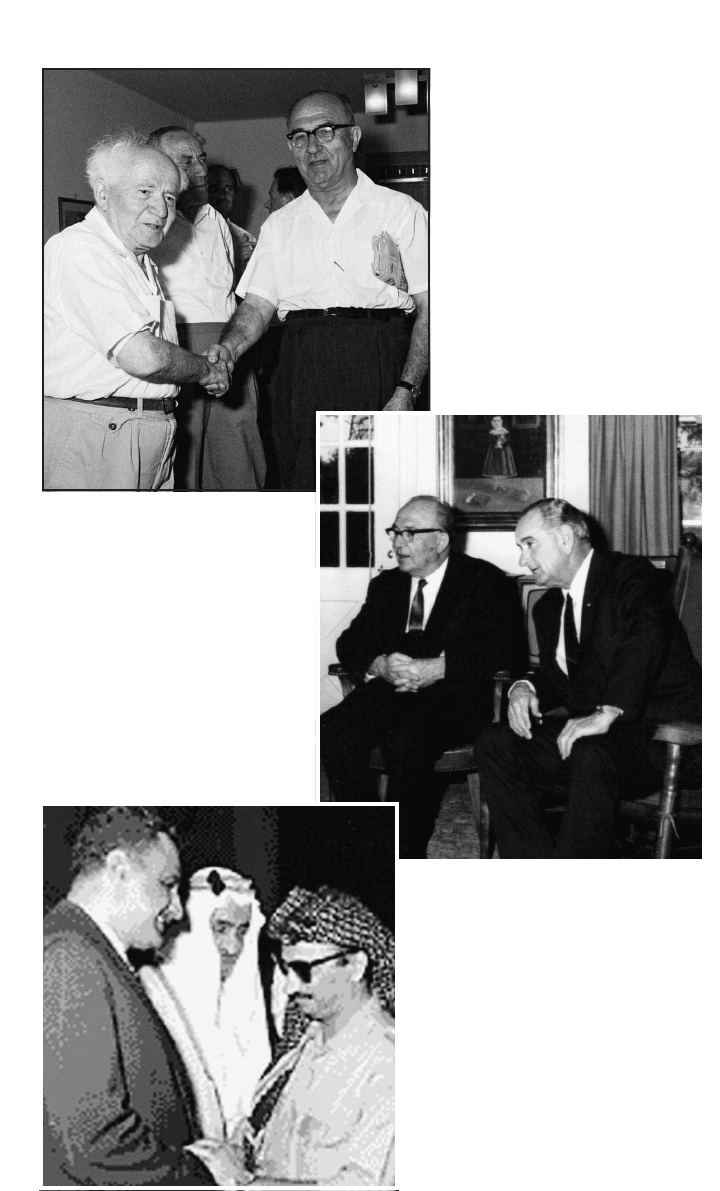
Eshkol (left) and Johnson, 1964.
“Israel’s friend in the true sense of
the word.” (Israel State Archives)
Ben-Gurion (left) and Eshkol:
“Like a father banishing him
from Eden.” (Fritz Cohen, Israel
Government Press Office)
Nasser and Arafat. (al-ahram)
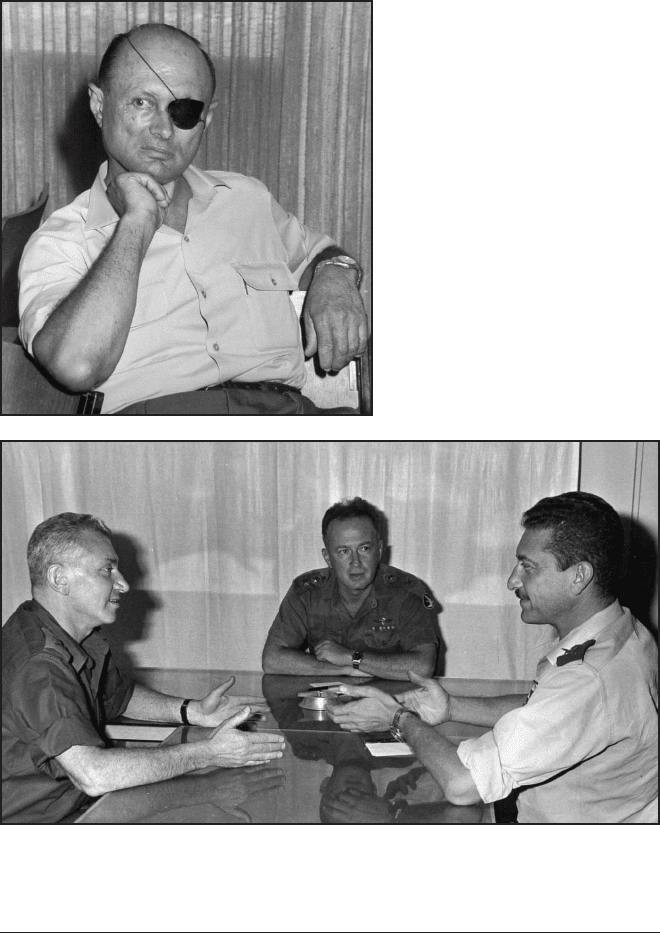
Moshe Dayan: “Liar, braggart,
schemer, prima donna—and object
of deep admiration.” (Fritz Cohen,
Israel Government Press Office)
From left to right: Bar-Lev, Rabin, Weizman. (Israel Government Press Office)
(Facing page, top)
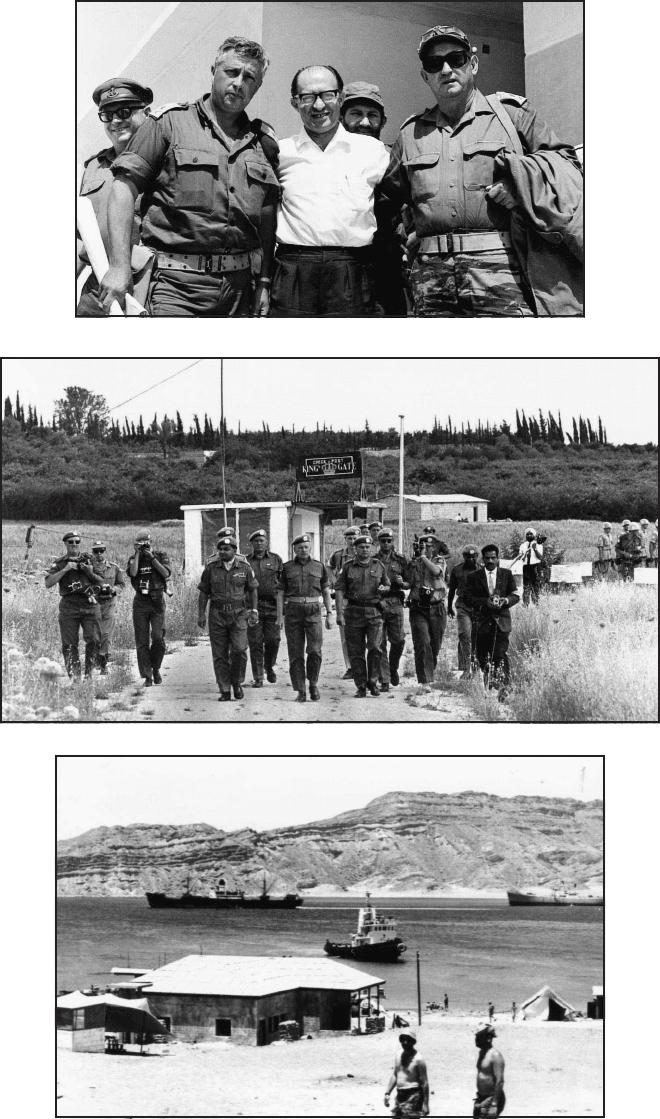
From left to right: Sharon, Begin, Yoffe. (Moshe Milner, Israel Government Press Office)
(Facing page, middle)
Exit UNEF. General Indar Jit Rikhye (first row, first on left). (Ilan Bruner, Israel Government
Press Office)
(Facing page, bottom)
The Straits of Tiran: “How can my forces simply watch Israel’s flag passing them?” asked
‘Amer. (Israel Government Press Office)
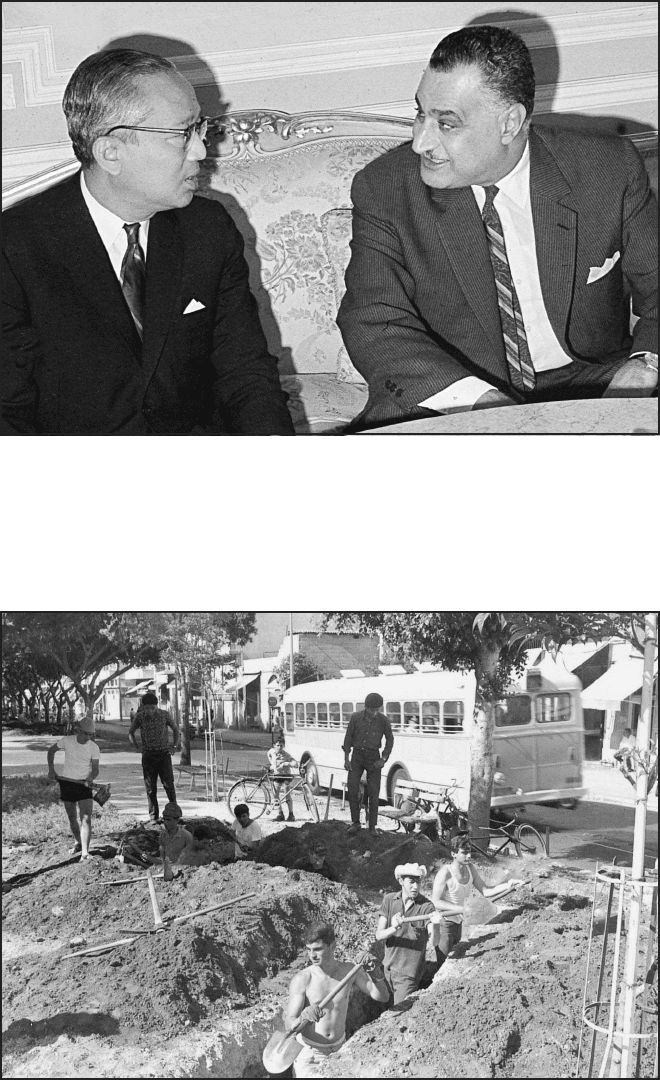
“My generals tell me we will win,” Nasser (right) informed U Thant. “What would you say to
them?” (Associated Press)
“The Waiting”: Israeli civilians digging trenches. (Ilan Bruner, Israel Government Press Office)