
Orzoff Andrea. Battle for the Castle: The Myth of Czechoslovakia in Europe, 1914-1948
Подождите немного. Документ загружается.

86 Battle for the Castle
was being attributed to the “Great Leader Masaryk” and the Legions. Sim-
ilarly, a 1924 debate in the pages of Pˇrítomnost raged over the Legionnaires’
level of education (implicitly, whether they were just a bunch of uneducated
belligerents who happened to be in the right place at the right time), and also
over the alleged holy or untouchable Legionnaire cult.
157
Former Legion-
naire and diplomat Lev Borský in his 1929 memoirs attacked Masaryk and
Beneš for betraying the Legionnaire ideal. Masaryk had committed treason
to the warlike, nationalist Legionnaire spirit, Borský wrote, by describing
Czechoslovak independence as a moral victory more than a military one,
by withdrawing the Legionnaires from Siberia to France where they were
just “another little troop,” and by bringing German political parties into the
governing coalition in 1926.
158
While the Legionnaires served as a powerful and contentious sym-
bol throughout the interwar period, concretely they also served the Cas-
tle. For most Legionnaires, Masaryk’s political and moral authority was
unshakable; Beneš’s position as Masaryk’s hand-picked successor granted
him a similar status. Masaryk and Beneš attended Battle of Zborov com-
memorations, approvingly observing extensive military formations and
displays.
159
Legionnaires played leading roles in public state ceremonies;
they helped create both the physical memorials and the public rituals
associated with them, such as the Memorial of the National Liberation
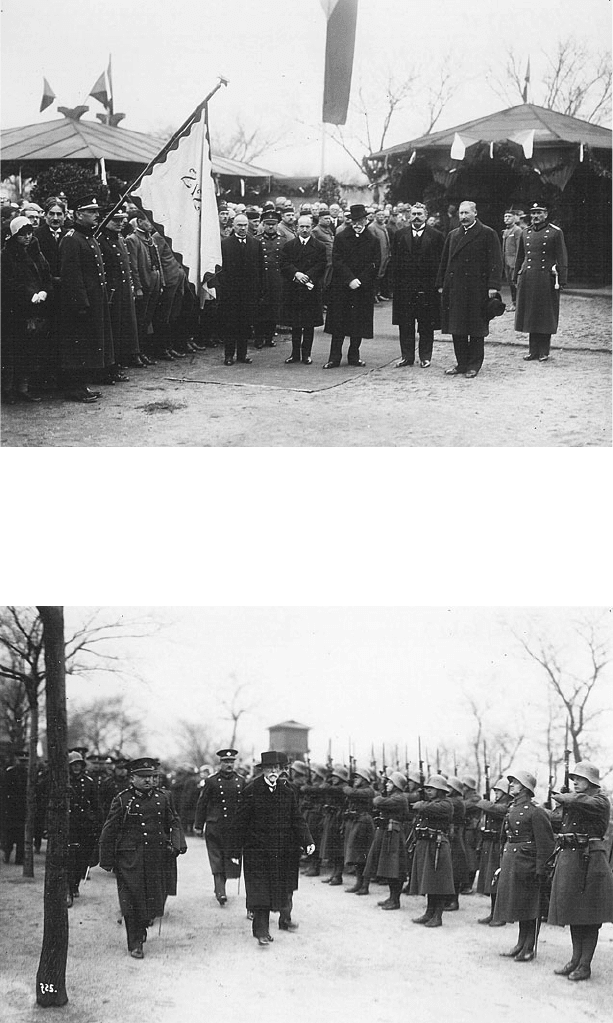
onŽižkovHillinPrague(seefigures2.1 and 2.2). They even wrote plays
and films romanticizing Legionnaire exploits.
160
When the Legionnaires’
noble deeds were lauded, so was the President-Liberator. Still, Masaryk
remained dubious of the Legionnaires’ commitment to the new democratic
republic.
The Castle leaders also cultivated prominent writers and intellectuals,
particularly those a generation younger. The two best-known Castle writers
and helpmeets, essential popularizers of the Castle’s mythology, were among
the most significant literati of the interwar era: playwright, journalist, and
novelist Karel
ˇ
Capek and master essayist and journalist Ferdinand Peroutka.
These two writers set the intellectual tone for the younger Castle intelli-
gentsia, frequently referred to as the lost generation, the generation of prag-
matists, or, most tellingly, the
ˇ
Capek generation, a term first used by Czech
literary critics in 1913 to describe the generation of artists born between 1880
and 1895.
161
In a 1931 set of essays, František Goetz described the
ˇ
Capek
generation as powerfully influenced by the Great War, the formation of
Czechoslovakia, and Tomáš Masaryk. Previous generations had engaged in
destructive revolt; the
ˇ
Capek generation had overcome its early nihilistic ten-
dencies to devote itself to the representation of Czech culture on the world
stage and the good of the state and nation. “[T]he most essential foundations
ofCzechnationallife...[are]simultaneously personified in the fundamental
The Castle 87
Figure 2.1. November 8, 1928: Celebration to mark the beginning of construction of the
Legionnaire “Pantheon” and mausoleum on Žižkov Hill in Prague. Masaryk is in the
center of the photograph, hatted, looking downward. He is flanked by an uncomfortable-
looking Edvard Beneš to his left and Karel Kramá
ˇ
r to the right. Source for this and figure
2.2: AÚTGM fotografické odd
ˇ
elení, VIII/47/2
∗
389/1–3, 3741, 3742, 3745.
Figure 2.2. Masaryk during the same event, reviewing soldiers (some of them former
Legionnaires) at arms.
88 Battle for the Castle
experiential, social, and artistic opinions of this generation, which has never
denied that [these opinions stem in large part] from Masaryk’s work.”
162
Peroutka agreed that his generation owed Masaryk a political and intel-
lectual debt. Unlike Masaryk, Peroutka wrote, the
ˇ
Capek generation lacked
a metaphysics, drawing instead on Henri Bergson’s “vitalism,” American
pragmatism, and Nietzsche’s “antimetaphysical radicalism.” The focus of
their gaze and their art had been the world: they sought inspiration and
joy in what they could see, and found the past irrelevant. Despite their
differences with him, Masaryk was a crucial exemplar of passionate praxis,
idealism translated to reality. Masaryk’s philosophies—political realism and
existential humanism—were close to the
ˇ
Capek generation’s vision of the
world, although they and the president had traveled utterly different paths
and continued to differ, Peroutka wrote. “[We] do not link humanity with
being Czech, or even with being a Slav, but rather with being a good
European.” For Peroutka, Masaryk was the last and greatest of the Czech
Awakeners: his vision of Czech history, linking the Hussite past to the
republican present, offered the Czechoslovak nation a new, enlightened,
powerful vision of itself.
163
Peroutka personally introduced Masaryk to the group of intellectuals and
literati at
ˇ
Capek’s Friday evening salons (Friday is pátek in Czech; the group
was dubbed the Páte
ˇ
cníci, or Friday Men). Just before the war,
ˇ
Capek began
holding weekly gatherings with a few friends at Prague cafés to drink black
coffee and expound on their art. In April 1925,when
ˇ
Capek, his father, and
his brother’s family moved into a double “villa” in the Prague suburb of
Královské Vinohrady, a room was reserved for the Friday meetings, which
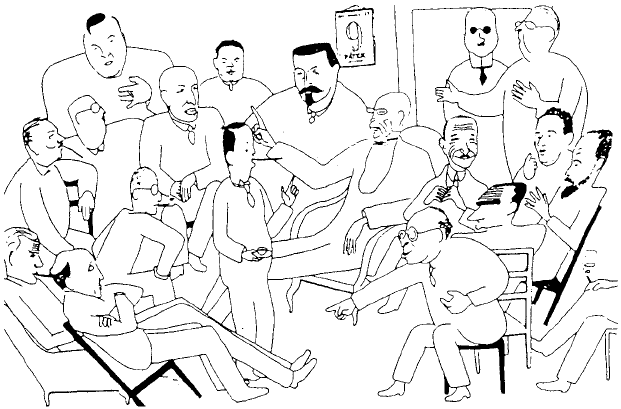
grew to include more participants (figure 2.3).
164
First-time guests to
ˇ
Capek’s
salon had to be escorted by a regular attendee. If the new guest seemed
congenial, he was welcomed back into the group on his own. “Karel
ˇ
Capek
sat at the door of the little room. ...He did not get up when a new guest
entered. He just extended his hand. ‘So, take a seat somewhere!’ ”
165
Regular
attendees tended to sit in the same easy chair, or next to the same people.
A table held drinks and refreshments, and
ˇ
Capek solicitously poured coffee
and offered food, libations, and cigarettes.
166
Friday Man Adolf Hoffmeister
described the room where the Friday Men met as the “kitchen of conver-
sations; they cook all afternoon.” Hoffmeister’s
ˇ
Capek was a “small, black-
haired, rosy-cheeked host, with a coffeepot in hand and half a cigarette in
his holder, attentive to ideas and to guests.”
167
Discussion topics ranged
widely, from issues in the public eye to wine, women, and song. Friday Men
would kid one another about female companions or attending séances, and
mock academic politics.
168
The group’s custom was to treat one another with
blasé courtliness. Not even those who had known each other since boyhood
addressed one another with the intimate ty; all Friday Men used the formal
The Castle 89
Figure 2.3. Adolf Hoffmeister’s cartoon of the Friday Men. First row, from left: Ferdi-
nand Peroutka, J. B. Kozák, Arne Laurin. Second row: Karel Kraus, František Langer,
Karel
ˇ
Capek, Josef Kodí
ˇ
cek, Josef Macek. Third row: Josef
ˇ
Capek, Vladimír Van
ˇ
cura,
Masaryk, Edvard Beneš, Karel Polá
ˇ
cek. Fourth row: František Kubka, Josef Kopta, Dr. L.
Procházka, Vilem Mathesius, Josef Šusta.
vy, and last names. No women, not even
ˇ
Capek’s housemaids, were allowed
save on rare occasions such as New Year’s Eve celebrations.
Tolerant
ˇ
Capek wanted to . .. bring opposing views closer to one
another. Only he could have managed to surround himself with such
heterogeneous talents and ideological opponents, and create for them
a reconciliatory atmosphere in which communist writers and Marxist
aesthetes sat companionably alongside Legionnaires, militant
Catholics next to liberals.
169
There were many overlapping groups and generations within the Friday
assemblées, which drew on some forty members, although no more than
twenty generally appeared any given Friday. Among the Communists,
many of whom also participated in the Left avant-garde group Dev
ˇ
etsil,
were journalist and artist Adolf Hoffmeister, novelist Vladimír Van
ˇ
cura,
and more occasional visitors such as poet Vit
ˇ
ezslav Nezval and journalist
Ivan Olbracht, writer for Rudé právo and editor in chief of Rudý veˇcerník.
There was a Lidové noviny contingent, including publisher Jaroslav Strán-
ský, reporters Karel Polá
ˇ
cek, Eduard Bass, and Jan Herben, and Prague
editor in chief Karel Zden
ˇ
ek Klíma. (Ferdinand Peroutka, one of the
90 Battle for the Castle
earliest members, stopped coming to the Fridays by the 1930s.) František
Langer and Josef Kopta, Legionnaire novelists and writers for Národní
osvobození, came, as did publisher Bohumil P
ˇ
rikryl of the centrist Legion-
naire publishing house,
ˇ
Cin. Other journalistic members included Prager
Presse chief editor Arne Laurin and reporter František Kubka; Josef Kodí
ˇ
cek,
Tribuna drama critic and theater director; and friendly reporters from hostile
papers, such as Národní listy’s Karel Scheinpflug.
170
The older generation
of Friday Men generally came from the professoriate or the civil service,
and sometimes both. Among them were Germanist Otakar Fischer, his-
torian Josef Šusta, philosopher J. B. Kozák, and Anglicist Vilém Mathe-
sius. Fischer, also a poet, would eventually head Prague’s National The-
ater; Šusta and Mathesius engaged in various kinds of government service,
Šusta serving briefly as minister of education. Mathesius was the group’s
link to the well-known Prague Linguistic Circle of the 1930s; articles by
ˇ
Capek and other Friday Men appear in the early issues of the Linguis-
tic Circle’s journals.
171
Otokar Vo
ˇ
cadlo, who taught Czech language and
literature at the London School of Slavonic Studies, attended when in
Prague.
172
But the most famous Friday Man was President Masaryk. Beginning in
1926, Masaryk, Beneš, and other KPR and Zamini leaders—Vasil Škrach,
Josef Schieszl, Václav Bou
ˇ
cek, and Masaryk’s son Jan—occasionally visited
the Fridays.
173
When Masaryk was to attend,
ˇ
Capek placed a vase of flowers
on the table near the president’s chair, otherwise kept ceremoniously empty,
and served only black coffee. Masaryk rarely spoke much, according to Fri-
day Man memoirs, and heightened the group’s formal air by addressing each
member according to his profession: “Mr. Reporter [pane redaktore],” and so
on. Peroutka recalled that when he attended, “Unfortunately a few people
spoke ‘presidentially,’ always positively and in defense of the state: ‘And,
Mr. President, just as the sun shines above us, etc etc.’ This was hideously
irritating.” But the Communist members of the group openly baited the
president and were met with good-natured humor. “Once [poet Vit
ˇ
ezslav
Nezval] with his customary enthusiasm declared to Masaryk, ‘The petit-
er the bourgeois, the worse! [ˇcím menší buržoa, tím horší]’ Masaryk smiled
widely; this was more pleasant for him than hearing serious opinions.”
174
But
the president recalled things differently. During a 1934 visit from Friday Man
Josef Macek, Masaryk commented that he had stopped attending the Friday
meetings because they were a waste of time. Macek explained that the Friday
Men wanted to enjoy tranquil conversation, not exhaust themselves with
problems. “Entirely wrong,” Masaryk responded acidly. “Nothing’s more
tiring than talking about nothing.”
175
The president’s presence intimidated most attendees into careful conver-
sation or awkward silence. František Kubka wrote, “We did not speak about
The Castle 91
women in front of the president, nor did we tell each other anecdotes, curse
about politics, or use words which were inappropriate for conversation.”
176
If
Masaryk dampened the Friday discussions, Beneš enlivened them. Peroutka
wrote that “Beneš was a debater. He led argument, would discuss absolutely
anything, and argued openly, as was his habit.”
177
Masaryk considered the Fridays to represent a political grouping, and
once told some of the Friday Men, “Your ‘Friday’ is already a [political]
program in and of itself.” František Kubka disputed this: “The Friday Men
in fact had no political program, and were unwilling to organize themselves
as a political unit. Especially when even the host, Karel
ˇ
Capek, was unen-
thusiastic about the matter.”
178
Although the Friday Men did not in fact take
up the president’s call as an organized group, many responded individually,
especially
ˇ
Capek, Peroutka, Stránský, and the many Friday Men working for
Zamini. Masaryk’s impression was strongest on the younger members, as
ˇ
Capek explained in a grateful letter after the president’s first visit:
I can say for almost everyone you saw at my house on Friday that we
had been prepared for you in our youth; you had ceased teaching
when we were at university, and thus we missed [contact with] the
single philosophical figure who affected us directly and vividly. How
we came to find you despite this, not just from books but from our
lives, is another story; but, along with our sincere thanks, I wanted to
say to you, that last Friday you gave our generation back what we had
missed then.
179
After 1926, the Friday meetings became a locus for Castle intellectuals
and the center of a constellation of Castle-loyal cultural institutions, from
newspapers to political parties to publishing houses. The Friday Men’s close
personal relationships with Masaryk and Beneš, their centrality to interwar
Czechoslovak culture, and their willingness to take up political activity made
them uniquely placed observers and actors in interwar Prague political life.
And although the group welcomed diverse members, its members shared the
same basic political assumption: “loyalty from one human being to another,
and...to Czechoslovak democracy, and to the so-called humanistic ideals
on which it relied.”
180
Not a single German speaker or Slovak, much less a Hungarian, attended
ˇ
Capek’s Fridays: their absence was not coincidental. The Castle’s rela-
tionships to Czechoslovakia’s subject nationalities were among the trick-
iest to negotiate. Masaryk and Beneš wanted the country’s nationalities,
especially the Germans, involved in parliamentary coalitions; the Castle
helped bring German “activist” (pro-Czechoslovak) parties into the “gen-
tlemen’s” or “all-bourgeois” governing coalition of October 1926 through
92 Battle for the Castle
October 1929. The National Democrats publicly accused them of betraying
the new republic’s ideals, calling out “Germans into the government—
we into revolution!”
181
The Castle had reliable German and Slovak allies,
among them Samuel Saenger, chargé d’affaires in the German embassy
in Prague; professor and Christian Socialist leader Robert Mayr-Harting;
German Social Democrat Ludwig Czech; German Agrarian leaders Franz
K
ˇ
repek and Franz Spina (also a Slavic studies professor at the German
University in Prague); Slovak Agrarians Vavro Šrobar and Milan Hodža
(although Hodža’s relationship to the Castle alternated from opposition to
close collaboration and back); and Slovak Social Democrat Ivan Dérer.
182
Non-Czech intellectual figures also associated with the Castle or accepted
support from Zamini to act as cultural ambassadors for the new state:
among these were German writers Max Brod, Otto Pick, and Pavel Eis-
ner, and the Slovak and Hungarian members of Czechoslovakia’s P.E.N.
Club.
183
Still, the Castle frequently played both ends against the middle when
it came to the minorities. Robert Mayr-Harting can stand as an example:
even as the Castle relied on him, they also reported on him, monitoring
his activities through 1936.
184
Masaryk and Beneš considered Czechoslo-
vakia’s creation a “national”—that is, Czech—revolution. They defended
Czech interests, assuming that the minorities had little real justification for
complaint, and that their caviling would ebb in a generation or so. Histo-
rians have discussed Masaryk’s relative popularity in Slovakia; the Castle-
sponsored National Labor Party polled surprisingly well in Bratislava in
1925.
185
But Slovaks voted consistently throughout the interwar period for
the autonomist Slovak L’udak (Populist) Party (SPP) led by outspoken Castle
critic Father Andrej Hlinka; the SPP criticized Masaryk for supposedly
promising Slovaks autonomy in the Pittsburgh Agreement of May 1918 and
then reneging upon his return to Czechoslovakia. They also disagreed with
Beneš’s reliance on the West and his hostility to right-wing, but Catholic,
states like Poland and Austria.
186
The SPP occasionally sparred directly with
the Castle throughout the interwar period, for example in 1925, when Hlinka
was sentenced to eight days in jail for insulting the president.
187
Nor did the
Castle possess widespread popular support among the country’s Germans
or Hungarians. The Czech-led land reform, described as an instrument
of social justice but administered as a tool of nationalist retribution for
mythologized losses—specifically White Mountain, in 1620—angered these
groups throughout the interwar period.
188
Although Zamini argued before
the League of Nations committee for minority complaints that Czechoslovak
land reform had been fair, Beneš later admitted to the British minister to
Prague that “Before the war, the Germans were here [pointing to the ceiling]
and we were there [pointing to the floor]; now, [reversing the gesture] we are
The Castle 93
thereandtheyarethere....Thelessonhadbeen necessary, and land reform
had been necessary if only as part of it.”
189
German-Castle disputes on this
and other matters continued throughout the interwar years, within domestic
and international politics.
190
Conclusion
Ferdinand Peroutka once recalled longtime Prime Minister Antonín Švehla
as “a politician of small rooms.” The much-vaunted democracy of the First
Republic was clearly a democracy of small rooms, since most important
decisions were made there, among a small circle of leaders, rather than in
the voting booth.
191
Neither parliamentarians nor the electorate had any real
say over policy in the interwar period. Since the judiciary had little power
or independence, “the fate of Czech democracy was solely in the hands
of the executive, i.e. the government (and the parties backing it) and the
President.”
192
The P
ˇ
etka, particularly the Agrarian Party, also wielded power,
frequently in opposition to the Castle. But historians have been far less kind
to the P
ˇ
etka than to the Castle, despite their commonalities.
While claiming to represent transcendent European ideals, Castle polit-
ical methods were decidedly earthbound: they included the questionable
and the unsavory. Certainly Castle political infighting was no less forceful
than the P
ˇ
etka’s. Masaryk and Beneš created the KPR and Zamini as their
de facto political organization, staffed by their closest supporters and with
control of “dispositionary funds.” It was within these institutions that Castle
priorities were established, Castle contacts and attempts at persuasion made,
information and policy assembled. The press was also central, not just for the
Castle but for interwar Czechoslovak politics overall. The Castle tried to buy
out oppositional newspapers, and was not above bribery of individuals or
of entire parties. Castle personnel cultivated literati, but rewards for loyalty
were infrequent.
The Castle’s political philosophy was probably closest to the Social
Democrats: reformist moderate socialism. Yet the Castle leaders were able to
look farther afield than most other Czechoslovak political groupings, never
losing sight of Czechoslovakia’s place in the new European order and how
incidents at home might appear from abroad. The Castle’s legitimacy rested
on several different foundations: their standing and success abroad, their
links to groups at home capable of supporting them symbolically (especially
the Legionnaires and the press), and their ability to exercise real power
through institutions and financial or personal relationships. The Castle’s for-
eign policy depended on its strength at home; its strength at home depended
at least in part on the success of its foreign policy. In this sense it was far
94 Battle for the Castle
more than a Czechoslovak political institution: we might view the Castle as
a European political and propaganda organization with a Czechoslovak arm.
For these reasons, the Castle remained preoccupied with control of and
representation in the Czechoslovak and European press. For Czechoslovakia
to remain the heart of the postwar European order and Europe’s new
Switzerland, with Masaryk and Beneš as ideal democrats, Czechoslovakia’s
reputation in the West had to be spotless. The entire country had to be
viewed as solidly behind the Castle; its flaws had to be made to disappear, or
at least to be overshadowed by those of Czechoslovakia’s enemies. Domestic
Czech political squabbles—especially what seemed to be the rising power
of the Czech far right—might echo across the continent. The Castle would
have to find a way to contain them and to gain symbolic legitimacy as well
as actual political power. The next chapter details various efforts at gaining
actual and mythic power at home by the Castle.
3
Battles of the Legend Makers
Taking over the stage requires keeping other people off it.
—Milan Kundera
T
he American diplomat George Kennan once famously com-
pared interwar Czech politicians to “small boys dividing a
stolen melon,” obsessed only with the size of their share.
1
In fact, Prague
could never turn its back entirely on the rest of Europe, or the world. After
all, the First Republic owed its existence to international political upheaval;
its continued security depended on the West’s commitment to Central
Europe. For that reason, Czech newspapers avidly, if solipsistically, followed
any mention of Czechoslovakia in the international press. The shadows of
the Great Powers and the Soviet Union, of Italy and Japan, played across the
surface of Czechoslovak politics throughout the interwar decades.
The Castle leaders understood this perhaps more clearly than any other
Czech political faction. International approval had always been Masaryk and
Beneš’s greatest trump card, although they had to play it carefully. Neither
at home nor abroad could they afford to appear a Great Power pawn. In the
eyes of the world, no other Czech politician could compete with Masaryk
or Beneš for authority. Their political legitimacy depended on their Great
War legacy, on the success of their foreign policy, and on Masaryk’s popular
status as a kingly president and beloved father figure. These factors meant
95