
Orzoff Andrea. Battle for the Castle: The Myth of Czechoslovakia in Europe, 1914-1948
Подождите немного. Документ загружается.

176 Battle for the Castle
Czechoslovakia’s Great Power allies were increasingly uninterested in the
country they claimed credit for creating. Sir Joseph Addison, the pessimistic
British minister to Prague from 1930 to 1936, expressed to London doubt
about the Czechoslovak state’s viability. In January 1932, he called it an
“artificial country”; in late 1933 he described it as a hastily sewn patch-
work quilt, needing only a tug to collapse into pieces. Addison blamed the
Czechs for “needlessly provoking” the Germans, even refusing to ameliorate
the Depression’s effects in the German-settled areas, thereby forcing the
Czechoslovak Germans into a hostile posture and forcing Hitler to defend
his fellow nationals. In Addison’s eyes, the Czechoslovak government was
guilty of “acts of petty tyranny.”
9
The Czechs themselves had contributed to their growing distance from
the West. The Little Entente effectively dissolved, as Yugoslavia and
Romania turned to Germany to buy their agricultural goods and exports.
Beneš believed that Hitler’s seizure of power meant that the Versailles order,
predicated on a weak Germany, had been overturned. Czechoslovakia was
therefore fundamentally endangered unless a new European balance of
power could be achieved. The Soviet Union, Czechoslovakia’s only poten-
tial savior, represented potential danger as well, since the British remained
preoccupied with Bolshevism.
10
Beneš and French Foreign Minister Louis
Barthou both wanted to bring the Soviets fully into European international
relations: the USSR joined the League of Nations in 1934. But that same
year, Barthou was killed, leaving Beneš isolated.
11
In 1935, the Soviet Union
signed a mutual assistance pact with Czechoslovakia similar to that which it
had signed with the French; the Soviets were only obliged to help Czechoslo-
vakia once the French fulfilled their own commitment to do so. After the
pact was concluded, Edvard Beneš gave an interview to Pravda in which
he effusively praised both the treaty and Stalin’s USSR. Propagandists in
Germany, Hungary, and Poland promptly and gleefully painted Beneš and
Czechoslovakia as a Soviet fellow traveler or lackey. Worse still, later that year,
Beneš—always surprisingly loquacious for a diplomat—lectured Addison
for almost two hours about Stalin’s reliability and the trustworthiness of
the Soviet Union.
12
Previous British reserve toward the Czechs now became
open impatience, combined with growing interest in Konrad Henlein. The
Foreign Office found him moderate and reasonable, and saw him as a
potential counterweight to Hitler; they also believed that without the Sude-
ten Germans, Czechoslovakia was doomed to disintegrate. Czechoslovakia
therefore had to be “realistic” about its relationship to its Germans and to
Nazi Germany. Vansittart repeatedly discussed the possibility of recreating
Czechoslovakia as a “state of nationalities” with substantial autonomy for
German speakers; Ambassador to Britain Jan Masaryk agreed that such a
step would be necessary.
13
ATimeofIronandFire 177
Within Czechoslovakia, now Europe’s lone democracy east of the Rhine,
even Castle stalwarts expressed considerable doubt about the virtue and
security of Czechoslovakia’s democratic system. Prominent National Social-
ist Emil Franke noted, “our democracy is suitable for normal conditions,
quiet times, and relative wealth. If conditions are extraordinary, one cannot
exclude equally extraordinary measures.”
14
Similarly, Václav Klofá
ˇ
c, Beneš’s
coleader of the Czechoslovak National Socialist Party, argued on September
30, 1933 that the “parliamentary system, and everything connected with it,
needs a thorough revision, because ...itisarelicoftheoldcapitalist/liberal
trends.” Josef Schieszl, political chief of Masaryk’s chancellery, wrote in a per-
sonal letter dated from mid-1933 that “liberalism can work only in a liberal
society...andliberalism is on its last legs.”
15
At one of Karel
ˇ
Capek’s Friday
meetings in 1934, the attendees argued about Czechoslovakia’s problematic
relationship with Poland. Josef Šusta blamed Beneš for it, and for his blind
confidence that Mussolini and fascism would disappear. “We are completely
isolated,” he despaired.
16
Beyond the Castle, readiness to move rightward
was even more widespread.
By the 1930s, the Czechoslovak parliamentary system had remade itself as
a “disciplined democracy,” willing to suspend the constitution in the name
of the state.
17
In 1933, Parliament passed a zmocˇnování zákon or Enabling
Law, allowing the government to make economic policy by decree during
the crisis years of the Great Depression. Crafted by the Agrarians, who
used it to harass the Social Democrats, the scope of the law gradually grew
beyond economic policy and was used to rule by decree, even to replace
existing legislation; many experts believed this violated the constitution.
18
Other means of bypassing full parliamentary sessions had been in place
since the republic’s birth, such as the stálý výbor (Permanent Committee)
of sixteen representatives and eight senators, granted power to deal with
parliamentary matters when Parliament was not in session and used fre-
quently, especially in the 1930s.
19
In 1935, Masaryk’s designated successor
Beneš won the presidency with difficulty. In the initial voting, the Czechoslo-
vak and German Agrarians, the National Union (the National Democrats,
Ji
ˇ
rí St
ˇ
ríbrný’s National League, and the semifascist National Front led by
Prof. Frantíšek Mareš), and the Fascists united against Beneš, denying him
a majority. Beneš refused to turn to the SdP for the necessary votes. Milan
Hodža, prime minister and a former foe of the Castle, placed the Slovak
Agrarians in Beneš’s camp; thanks to Hodža’s suasion, the Slovak Populists
joined them, tipping Parliament toward the Castle. In the final vote, Beneš
won by a substantial majority. But the negotiation process—the open split
within the Agrarian Party, the Agrarian right wing opposing the Castle, the
Slovak autonomists’ increasing importance—was unnerving.
20
The Castle
had claimed for seventeen years to represent democracy itself, and Beneš
178 Battle for the Castle
was Masaryk’s chosen disciple. Dissension and challenge within Parliament,
against an increasingly hostile international context, augured badly for the
Castle and perhaps the republic.
The Castle propaganda apparatus remained extremely active during these
arduous years. Increasingly, the Third Section supported Castle-loyal papers
all over the republic, in particular non-Czech papers, in an effort to build
the bridges not constructed a decade earlier. The Third Section sent funding
to the German Christian Social publications Bund der Landwirte, Deutsche
Presse,andLandpost, as well as the German-language magazines Zeit im
Bild and Die Brücke. After 1933, Jan Hájek and the Third Section became
an important source of support for German Jews and leftists fleeing Nazi
Germany, working in coordination with the presidential chancellery. Zamini
sponsored publications by émigré Germans, such as Der Montag, published
by Walter Tschuppik in Prague, and Wahrheit, published by G. Mannheim
and Bela Rév, respectively German and Hungarian journalists living in
Prague. The relatively liberal Bratislava Hungarian daily Magyar Újsag also
received Third Section funds in the late 1930s.
21
The Castle’s increasing sense
of threat was reflected in Orbis titles. By the mid-1930s, Orbis materials
loudly iterated the Czechs’ contributions to European culture and post-
war politics, and the importance of a stable, democratic Czechoslovakia at
Europe’s heart. Historian Kamil Krofta, Beneš’s successor as foreign minister
after 1935, published with Orbis his Europa im Scheideweg/Europe at the Cross-
Roads/L’Europe au Carrefour and Czechoslovakia and the Crisis of Collective
Security. Beneš contributed The Problems of Czechoslovakia. Orbis published
many other texts, in French, English, and German, on Czechoslovakia’s
German “problem,” its strategic importance, and its relationship to the
Third Reich and the Soviet Union.
22
At home, Czech expressions of steadfast devotion to the state and its
leaders continued, at least as quantified by a steady stream of books, maga-
zines, brochures, gadgets, photographic portraits, and other items allowing
Czech consumers to support the Castle. Not just Masaryk but also Beneš
now received his share of propagandistic popularization. The Castle myth-
making apparatus responded to the country’s increasing political insecurity
by emphasizing the old nineteenth-century oppositions, reinvigorated by a
dangerous new era. The Czechoslovaks were once again noble martyrs as
their Hussite predecessors had been, threatened by the Germanic onslaught.
But at no point did the Castle extend a symbolic hand to the country’s
minorities.
Masaryk died in 1937; Karel
ˇ
Capek and the First Republic expired in
1938. As the republic was forced to its end, an onslaught of text about and
by its foremost symbol and popularizer bolstered the Castle myth.
ˇ
Capek’s
ATimeofIronandFire 179
Conversations with Masaryk was published in installments from 1927 to 1935;
a companion volume, Silences with Masaryk, about the circumstances of
creating the Conversations,cameoutin1935.
ˇ
Capek also helped Legionnaire
novelist Josef Kopta and Masaryk’s secretary, Vasil Škrach, compile Days
of Sorrow, a collection of photographs and writings about Masaryk’s death
from within and outside Czechoslovakia. And Ferdinand Peroutka’s four-
volume history of the republic’s early years, Building the State: Czechoslovak
Politics in the Postrevolutionary Years, was published between 1932 and 1937.
The Conversations and Building the State focused on the immediate post-
war aftermath, when the nation had emerged victorious from the chaos of
the war and, with the blessing of the civilized West, moved forward to take
its place among the nations of Europe. The books emphasized the role
of Masaryk and Beneš in this jubilant process, and in steering the state
through the waters of the relatively calm and prosperous 1920s(
ˇ
Capek’s
book mentions the 1930s only glancingly).
ˇ
Capek and Peroutka created
a narrative of Czechoslovakia through their work, a Czechoslovakia that
had Masaryk and Beneš to thank for its very existence, which rested on
tolerant and inclusive multiethnicity, democracy, and the support of the
West.
Beneš’s capitulation to Hitler’s 1938 Munich Diktat, and the Czech expe-
rience of Nazi occupation during the Second World War, changed both
the presentation of the myth (now coming from the exile government
in London) and public reception of the Castle myth at home. At home,
especially after the Nazi invasion of March 1939, most Czechs continued
to believe in Beneš as Masaryk’s heir, an important symbol of continuity
with the prewar era. At the same time, few wanted to return to the First
Republic. The interwar democracy was now seen as a luxury ill afforded
in difficult times, weak, corrupt, perhaps mistaken to have relied on the
West, and certainly wrong to have tried to accommodate the country’s
minorities, now viewed as uniformly belligerent. The party system, not the
Castle, received much of the blame for the First Republic’s inadequacies. In
exile, Beneš reiterated most of the Castle myth, but its themes changed in
response to wartime developments. The new Castle myth slowly eliminated
any potential coexistence with Czechoslovak Germans, and began to empha-
size Czechoslovakia’s ties to the Slavic world, particularly the Soviet Union.
While the myth still hailed democracy as the Czechoslovak ideal, now
invoking “economic democracy” and social egalitarianism, Beneš’s wartime
writings never clarified what exactly democracy entailed. Like Masaryk,
Beneš tended to discuss democracy in terms of personal morality rather than
just institutions. By war’s end, the Castle myth had shifted considerably,
although its terminology had not. While still discussing “democracy,” Beneš’s
180 Battle for the Castle
postwar variant on the Castle myth defended a socialist approach to the
country’s economy and social problems, and invoked the “Slavic” Soviet
Union as protector and model.
This chapter analyzes text—books, journalism, and correspondence—as
well as cultural diplomacy and political activity to sketch out the shifting
parameters of the Castle myth at the end of the republic, during wartime,
and between 1945 and 1948. Response to and participation in the myth
shifted notably, in three disparate phases: heightened intensity through 1938,
complex adherence between 1939 and 1945, and critical analysis between 1945
and 1948.
Conversations with Masaryk: Myth as History
Books by and about Masaryk had always stood at the center of Orbis
publishing efforts. The 1933 Zamini analyst describing the French press’s
venality and cooptation by Nazi and Japanese propaganda concluded his
report with a set of suggestions, among them that the Czechoslovaks send
more texts by Masaryk, as if his shining moral example could magically com-
pensate for Czechoslovakia’s financial limitations and strategic concerns.
23
A
central Orbis text, granted great importance by the Castle, was Karel
ˇ
Capek’s
Conversations with Masaryk.
The Conversations were conceived as propaganda, to secure Masaryk’s
place as founder and symbol of the state.
ˇ
Capek and Masaryk discussed
the idea of a cowritten autobiography during a 1927 visit with Masaryk
at Topol’
ˇ
cianky, the president’s home in Slovakia.
ˇ
Capek wrote his com-
panion Olga Scheinpflugová that the book would be “a politically good
thing,...tremendously valuable: I’d like to have it finished as a gift for the
republic’s tenth anniversary.”
24
Only the first third of the book was finished
by then; the entire work did not come out until 1935.
The Conversations were a collective Castle effort. The writing process
began with the eponymous conversations: Masaryk and
ˇ
Capek would typ-
ically talk together for hours, Masaryk answering a series of questions
ˇ
Capek put to him,
ˇ
Capek taking notes (figure 5.1).
ˇ
Capek would then
write up an initial draft and send manuscript pages to the president, leav-
ing a wide left margin in which Masaryk made comments or suggested
changes.
25
Once
ˇ
Capek wrote up a manuscript incorporating Masaryk’s
recommendations, Masaryk’s intimates and family became involved.
ˇ
Capek’s
work did not always please Masaryk; the president had noted, after read-
ing the draft of the second volume, Life and Work,“Oftenitishimin
there and not me.”
26
Alice Masaryková, with the help of family archivist
Anna Gašpariková and Masaryk’s personal assistant Antonín Schenk, edited
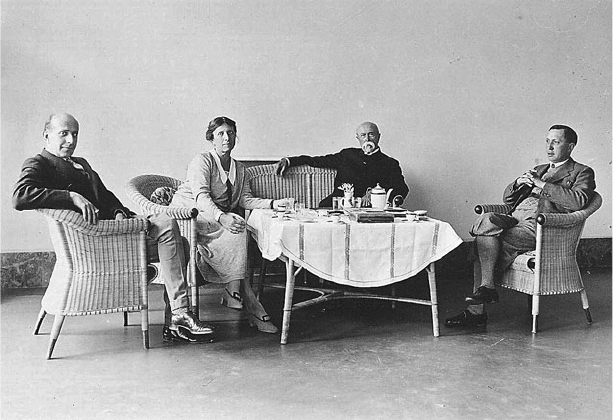
ATimeofIronandFire 181
Figure 5.1. Masaryk chatting with Karel
ˇ
Capek at Bystri
ˇ
cka in Slovakia. From left: Jan
Masaryk, Alice Masaryková, Masaryk,
ˇ
Capek. Source: AÚTGM fotografické odd
ˇ
elení,
VIII/47/2*107/16, 826.
the manuscript to “preserve the ‘pure Masaryk’...[and] tried to erase
the traces of the, according to them, rather unimaginatively materialistic
author....[T]heyalsocensored alleged vulgarisms.”
27
ˇ
Capek complained to
his friend Julius Firt that Alice Masaryková was “puritanical” and wanted
to keep her father on a pedestal, rather than show the world the living
man.
28
Masaryk’s correspondent Olga Sedlmajerová sent him suggestions for
improving the Conversations.
29
Beneš, too, requested to see the manuscript,
which frustrated
ˇ
Capek.
30
Most of the Conversations’ three sections presented Masaryk’s life, told in a
charming, gently self-deprecating tone purporting to be Masaryk’s own. The
Era of Youth (1928) contained Masaryk’s remembrances of his childhood. Life
and Work (1931) took Masaryk’s story up through his 1919 election to the pres-
idency. The final section of the book, Thought and Life (1935) was a philo-
sophical interview, in which Masaryk expounded on abstract issues from
suicide to cognition, metaphysics, ethics, religion, and culture. This material
would be largely familiar to Czechoslovak patriots, thanks to the welter of
previous Masaryk biographies. The main difference here was the singular
narrative voice, since Masaryk’s old-fashioned constructions and occasional
use of Moravian dialect were left intact. Like other biographers,
ˇ
Capek
made much of Masaryk’s peasant childhood in a Slovak village, his moves
to Brno, Vienna, and Prague to pursue schooling, his career as an outspoken
182 Battle for the Castle
university professor and public gadfly, his bravery during the First World
War, his incessant efforts on behalf of his nation, and his fatherly concern
for the young Czechoslovak democracy.
ˇ
Capek admiringly noted Masaryk’s
personal virtues: his teetotaling, his adoration for his American wife. In the
Conversations as in the other presidential biographies, Masaryk frequently
departs from the story of his life to issue virtuous declarations about
social issues, particularly feminism and education.
31
Czechoslovak politi-
cal life appeared infrequently in the Conversations and generally presented
the standard Castle narrative. For example: “Our politics are ...essentially
rationalistic, enlightened. In this, we are like France—hence those national
sympathies with her.” Or, underscoring the link between Czechoslovakia
and democracy: “In virtue of our history and nature, we are destined for
democracy. ...[W]eareanationdemocratic in body and soul.”
32
The heart of the Conversations is, of course, the president. The Conver-
sations’ Masaryk is nothing like the canny, frequently aggressive politician
contemporaries knew.
ˇ
Capek’s Masaryk represents an ideal of gentlemanly
masculinity, willing to move boldly when the situation demands it but
preferring an unassuming, contemplative life. The Conversations’ Masaryk
practically has to be begged to describe his glorious deeds to the public, let
alone to explain their significance or extol his own bravery. For example,
ˇ
Capek complained in the foreword to the fourth edition of Life and Work
of his subject’s modesty. “Press questions on him, how it was then, what he
did, how it was for him in this or that difficult moment. He barely waves a
hand and says: ‘Yes, well, that’s long past.’ ...Itwould be difficult for you to
find another man who is so reluctant to speak about himself.”
33
The sheer
number of Masaryk biographies written during the interwar period, many
of them based on interviews with Masaryk himself, belies this comment.
Nevertheless,
ˇ
Capek’s characterization is compelling.
Masaryk’s recollection of revolutionary Moscow exemplifies the Con-
versations’ presentation of heroism and courteous reserve. The Legionar-
ies had told Masaryk to go to Moscow, believing it would be safer than
St. Petersburg. But within moments of his arrival, Masaryk heard gunshots.
He left his Legionnaire-assigned bodyguard at the train station to collect
the baggage and went off alone to the Hotel National on foot, then found
his way blocked by a row of soldiers. Masaryk asked to pass, and was told
(and saw) that the Bolsheviks and Kerensky’s forces were exchanging gunfire
in the streets. He went instead to the Hotel Metropol, where the gate was
shut in his face. “I banged on it and called out, ‘What are you doing? Open
up!’ ‘Are you a guest?’ the porter called back. ‘We can’t let you [in] if you’re
not; we’re full up.’ I didn’t want to lie, so I yelled out to him, ‘Don’t be
an idiot and let me in!’ ” Gunshots were being fired at the hotel as well.
The guests and Masaryk fled to the cellar, and were confined to the hotel
ATimeofIronandFire 183
for a week. But Masaryk recalled that he seldom felt fear. “I wasn’t afraid,
and if I was, I didn’t let myself know it, because of our boys. How on
earth could I have commanded them if they’d seen that I was afraid?”
34
This
anecdote neatly conveys the mythic Masaryk’s greatest qualities: his refusal
to lie, even to protect his own life; calm in the face of imminent danger;
and a constant attention to the collective good, effectively commanding
his men, extricating them from Bolshevik clutches, and returning them
to the Czechoslovak state they were working together to create. Masaryk’s
depiction as the personification of honesty itself, along with the comment,
“I didn’t want to lie,” appears in his other biographies and memoirs; in
Svˇetová revoluce, for example, he noted that even propaganda must be hon-
orable: “exaggeration and outright lies never succeed.”
35
One might assume a president’s biography would discuss politics, but
ˇ
Capek’s Masaryk discussed domestic and international politics almost
entirely in the realm of theory, as if his own considerable political praxis
did not exist. When Masaryk mentioned his difficulty in adjusting to the
role of president and notes that he made mistakes, the example he offered is
in the end somewhat flippant: in early 1919 he agreed to meet some friends at
a café, only to find himself surrounded by crowds.
36
The book’s final section
did refer obliquely to current events, specifically Czechoslovakia’s minorities.
For example, Masaryk stated:
[N]ational and racial minorities have been part of human
development since the beginning. ...EveryEuropean state
contains linguistic minorities; little states and nations are
minorities among the larger states, and even the largest states
and nations are in the end minorities when compared with the
human world. Thus the just resolution of minority politics is a
precondition for better and more cosmopolitan organization of
the world.
37
In this way Masaryk tried to defuse the calls from Czechoslovakia’s minorities
for better treatment with an implicit request that Czechoslovakia’s larger
neighbors extend her the same courtesy.
Similarly, the final section contained an uncharacteristically topical state-
ment about Czechoslovakia’s German minority. “The state is ours, it is ours
by historical right, by the majority principle and by the [fact] that we created
it,” Masaryk stated, “but we have significant minorities. .. . [I]t is our task to
[win over] for the idea of our democratic republic the minorities with whom
we live...Their numbers and their cultural advancement charge us, and
them, [to create] a democratic compromise.” Masaryk then called on the
184 Battle for the Castle
(presumably Czech) reader to be inspired both by the noble Czech past and
its ignominy under Austria:
Our procedure with the minorities is practically given to us by our
own experience under Austria-Hungary. What we did not like to be
done to us we shall not do unto others. The program of Palacký, the
father of our nation, applies for us and for the future. Our history, the
politics of the P
ˇ
remyslid dynasty, of saint Václav, of [Kings] Charles
and George [of Pod
ˇ
ebrady] must be a model for our politics regarding
our Germans. The fact that we are encircled by our large German
neighbor forces the thoughtful Czech to a wise and circumspect
politics.
38
This passage indicates that at least discursively, even in the mid-1930sthe
Czechs were still essentially separate from “their” Germans, still suspi-
cious of German allegiance to the state even after almost twenty years of
largely peaceful coexistence. Wisdom and circumspection were forced on
the Czechs by admiration for German culture or (more likely) the powerful
German Reich, not by any sense of shared rights or responsibilities within
a common state. Masaryk focused his attention on the Czech past, using
ideas and phrases quite similar to his depiction in Svˇetová revoluce, published
almost ten years earlier. As a statement of Castle myth, this speaks volumes.
ˇ
Capek wrote of his text, “It in itself is more than a document or a
biography; rather, it is—what else could we call it?—an example.”
39
This
comment’s religious overtones suggest religion’s central role in the Conversa-
tions, similar to the generalized Christian spirituality featured in Masaryk’s
prewar writings. More than half of Thought and Life (1935) addresses topics
like “Sub specie aeterni,” “Spirit and World,” “The Religion of Jesus,” “The
Religion of Love,” “Religious Development in the Czech Lands (unás),”
and “Faith and Science.” Masaryk repeatedly emphasized his own reverence
for and intimate, loving relationship with God, from which he derived
his relationship to humanity. “[Y]ou would like to hear my creed: its last
word is reverentia; a conscious honoring of God and man; implicit in this
honoring of those close to me is love; I mean by that a love that is also
conscious.”
40
This love for God naturally implied a love for one’s fellow
citizen, in Masaryk’s understanding: “love, sympathy, synergy—such is the
law of life whether it be for the couple, the family, the nation, the state,
or humanity.”
41
This late presentation of Masaryk’s ideas implies that the
individual’s relationship to God provides the basis for his political sensibility
and participation; the individual, rather than institutions, constitutions,
parties, or administration, is charged with transforming civic culture into
a culture of reverentia and love. These statements seem startlingly similar
ATimeofIronandFire 185
to those he expressed in his major works of the 1890s, and like them evade
analysis of democratic discourse and interaction by emphasizing individual
civic religiosity.
Since 1926,
ˇ
Capek and Masaryk had worked closely together:
ˇ
Capek had
become Masaryk’s admiring confidant and one of the Castle’s most impor-
tant popularizers. The Conversations was far from his only contribution
to the Castle’s work or to Masaryk’s personality cult. As he was writing
the Conversations,
ˇ
Capek also produced a great number of Castle-friendly
articles and interviews with the president in Lidové noviny, some of which
he allowed Masaryk to edit.
42
ˇ
Capek was the main force responsible for the
popular mass-audience picture book, Masaryk in Photographs; he suggested
it to the president, took some of the photographs, shepherded the book
through production, and wrote its foreword. Some of the best-known images
of Masaryk, such as the president holding his happy, naked toddler grandson
on his shoulder, come from this book.
43
ˇ
Capek’s newspaper articles from the 1930s reveal other, related concerns
for the state, as in the 1932 piece “Your Masaryk.”
ˇ
Capek explained to his
readers that “any educated foreigner,” even those who knew little about
Czechoslovakia, knew about Masaryk: “your Masaryk,” they allegedly said,
“you’re lucky!” This was true,
ˇ
Capek avowed, even though the world press
wrote little about Masaryk or, by extension, Czechoslovakia. This worri-
some development—that Czech propaganda efforts to attract the world’s
attention were unsuccessful—was in fact a sign of good fortune and lasting
fame,
ˇ
Capek explained: “[O]ur public and state life ...never appears...in
a sensational light....Masaryk’s world popularity is not current, because
it is permanent. ...That same foreigner who says to us ‘your Masaryk’
knows factually little about him, just as he knows little about George
Washington.”
44
Masaryk was more than a human being,
ˇ
Capek wrote after
Masaryk’s final, unanimous reelection to the presidency in 1934:“Masaryk
is a principle. Masaryk is for us and for the entire educated world the
embodiment of certain moral and political ideals, which can be called
democracy.” The Czechs, Slovaks, and the country’s national minorities had
chosen Masaryk, and democracy, at a moment when Europe was abandoning
it,
ˇ
Capek wrote: “In Germany, in Austria, in Bulgaria. Everywhere around
us....[We are] a little island in the center of Europe. Or perhaps God’s
soldiers, strengthened by their faith rather than by power. ...as Antonín
Švehla said just before he died, ‘We are clearly the bastion of Western
democracy; that means that we must hold on....’Callitour fate,...orthe
meaning of history.”
45
ˇ
Capek’s journalistic output increased in the weeks
after Masaryk’s death in mid-September 1937, when he wrote long articles
every few days about Masaryk’s funeral arrangements, the country’s respect-
ful participation, and Masaryk’s meaning for the country. “T.G. MASARYK