
Samarskii A.A., Vabishchevich P.N. Numerical Methods for Solving Inverse Problems of Mathematical Physics
Подождите немного. Документ загружается.


256 Chapter 7 Evolutionary inverse problems
Theorem 7.7 Let self-adjoint, time-independent and positively defined operators S
and A be mutually permutable. Then, the solution of the difference optimal control
problem (7.60)–(7.63) satisfies the equation
y
n+1
− y
n
τ
− Ay
n
= 0, n = 0, 1,...,2N
0
− 1, (7.76)
supplemented with the non-local condition (7.75).
Thus, for the difference optimal control problem we have established their relation
with problems with time-non-local conditions over the double time interval. Above,
the relation between non-local problems and optimal control problems was established
under the assumption that the initial operator A is a self-adjoint, time-independent
operator positively defined in H. These restrictions are not related with the essence of
the problems, and for more general optimal control problems, in a similar manner, an
Euler equation in the form of a non-local problem can be constructed.
7.1.7 Program realization
For methods with non-locally perturbed initial conditions, there exists a problem with
computational realization of such regularizing algorithms. It should be noted that,
presently, simple and convenient computational schemes for numerical solution of
general non-local boundary value problems for mathematical physics equations are
lacking. In order to avoid computational difficulties that obscure the essence of
the problem, below we consider a simple inverse problem for the one-dimensional
parabolic equation with constant coefficients. The solution of the difference problem
will be constructed using the variable separation method in the fast Fourier transform
technique.
Within the framework of a quasi-real experiment, we first solve the direct, initially
boundary value problem:
∂u
∂t
−
∂
2
u
∂x
2
= 0, 0 < x < l, 0 < t ≤ T,
u(0, t) = 0, u(l, t) = 0, 0 < t ≤ T,
u(x, 0) = u
0
(x), 0 ≤ x ≤ l.
The solution of the problem at the end time (u(x, T )) is perturbed to subsequently use
this solution as input data for the inverse problem of reconstructing the initial solution
at t = 0.
The realization is based in the fast Fourier transform (subroutines SINT and
SINTI). A more detailed description was given above (program PROBLEM9).
The value of the regularization parameter is chosen considering the discrepancy.
The computational realization is based on using the sequence
α
k
= α
0
q
k
, q > 0

Section 7.1 Non-local perturbation of initial conditions 257
with given α
0
and q.
Program PROBLEM10
C
C PROBLEM10 - PROBLEM WITH INVERTED TIME
C ONE-DIMENSIONAL PROBLEM
C NON-LOCALLY DISTURBED INITIAL CONDITION
C
PARAMETER ( DELTA = 0.005,N=65,M=65)
DIMENSION U0(N), UT(N), UTD(N), UT1(N), U(N), U1(N)
+ ,X(N), ALAM(N-2), W(N-2), W1(N-2), WSAVE(4
*
N)
C
C PARAMETERS:
C
C XL, XR - LEFT AND RIGHT END POINTS OF THE SEGMENT;
C N - NUMBER OF GRID NODES OVER SPACE;
C TMAX - MAXIMAL TIME;
C M - NUMBER OF GRID NODES OVER TIME;
C DELTA - INPUT-DATA INACCURACY LEVEL;
C Q - MULTIPLIER IN THE REGULARIZATION PARAMETER;
C U0(N) - INITIAL CONDITION TO BE RECONSTRUCTED;
C UT(N) - END-TIME SOLUTION OF THE DIRECT PROBLEM;
C UTD(N) - DISTURBED SOLUTION OF THE DIRECT PROBLEM;
C U(N) - APPROXIMATE SOLUTION OF THE INVERSE PROBLEM;
C
XL = 0.
XR = 1.
TMAX = 0.1
PI = 3.1415926
C
OPEN (01, FILE = ’RESULT.DAT’) !FILE TO STORE THE CALCULATED DATA
C
C GRID
C
H=(XR-XL)/(N-1)
TAU = TMAX / (M-1)
DOI=1,N
X(I) = XL + (I-1)
*
H
END DO
C
C DIRECT PROBLEM
C
C INITIAL CONDITION
C
DOI=1,N
U0(I) = AU(X(I))
END DO
C
C EIGENVALUES OF THE DIFFERENCE OPERATOR
C
DOI=1,N-2
ALAM(I) = 4./H
**
2
*
(SIN(PI
*
I/(2.
*
(N-1))))
**
2
END DO
C
C FORWARD FOURIER TRANSFORM
C
CALL SINTI(N-2,WSAVE)
DOI=2,N-1

258 Chapter 7 Evolutionary inverse problems
W(I-1) = U0(I)
END DO
CALL SINT(N-2,W,WSAVE)
C
C FOURIER INVERSION
C
DOI=1,N-2
QQ=1./(1.+TAU
*
ALAM(I))
W1(I) = QQ
**
(M-1)
*
W(I)
END DO
CALL SINT(N-2,W1,WSAVE)
DOI=2,N-1
UT(I) = 1./(2.
*
(N-1))
*
W1(I-1)
END DO
UT(1) = 0.
UT(N) = 0.
DOI=1,N-2
QQ=1./(1.+TAU
*
ALAM(I))
W1(I) = QQ
**
((M-1)/2)
*
W(I)
END DO
CALL SINT(N-2,W1,WSAVE)
DOI=2,N-1
UT1(I) = 1./(2.
*
(N-1))
*
W1(I-1)
END DO
UT1(1) = 0.
UT1(N) = 0.
C
C DISTURBING OF MEASURED QUANTITIES
C
DOI=2,N-1
UTD(I) = UT(I) + 2.
*
DELTA
*
(RAND(0)-0.5)
END DO
UTD(1) = 0.
UTD(N) = 0.
C
C INVERSE PROBLEM
C
C INPUT-DATA FOURIER TRANSFORM
C
DOI=2,N-1
W(I-1) = UTD(I)
END DO
CALL SINT(N-2,W,WSAVE)
C
C ITERATIVE PROCESS TO ADJUST THE REGULARIZATION PARAMETER
C
IT=0
ITMAX = 1000
ALPHA = 0.001
Q = 0.75
100IT=IT+1
C
C FOURIER INVERSION
C
DOI=1,N-2
QQ=1.+TAU
*
ALAM(I)
W1(I) = W(I) / (1. + ALPHA
*
QQ
**
(M-1))
END DO
CALL SINT(N-2,W1,WSAVE)

Section 7.1 Non-local perturbation of initial conditions 259
DOI=2,N-1
U(I) = 1./(2.
*
(N-1))
*
W1(I-1)
END DO
C
C DISCREPANCY
C
SUM = 0.D0
DO I = 2,N-1
SUM = SUM + (U(I)-UTD(I))
**
2
*
H
END DO
SL2 = SQRT(SUM)
C
IF ( IT.EQ.1 ) THEN
IND=0
IF ( SL2.LT.DELTA ) THEN
IND=1
Q = 1.D0/Q
END IF
ALPHA = ALPHA
*
Q
GO TO 100
ELSE
ALPHA = ALPHA
*
Q
IF ( IND.EQ.0 .AND. SL2.GT.DELTA ) GO TO 100
IF ( IND.EQ.1 .AND. SL2.LT.DELTA ) GO TO 100
END IF
C
C SOLUTION
C
DOI=1,N-2
QQ=1.+TAU
*
ALAM(I)
W1(I) = QQ
**
((M-1)/2)
*
W(I) / (1. + ALPHA
*
QQ
**
(M-1))
+
*
QQ
**
((M-1)/2)
END DO
CALL SINT(N-2,W1,WSAVE)
DOI=2,N-1
U(I) = 1./(2.
*
(N-1))
*
W1(I-1)
END DO
U(1) = 0.
U(N) = 0.
DOI=1,N-2
QQ=1.+TAU
*
ALAM(I)
W1(I) = QQ
**
((M-1)/2)
*
W(I) / (1. + ALPHA
*
QQ
**
(M-1))
END DO
CALL SINT(N-2,W1,WSAVE)
DOI=2,N-1
U1(I) = 1./(2.
*
(N-1))
*
W1(I-1)
END DO
U1(1) = 0.
U1(N) = 0.
C
WRITE ( 01,
*
) (U0(I),I=1,N)
WRITE ( 01,
*
) (UT(I),I=1,N)
WRITE ( 01,
*
) (UT1(I),I=1,N)
WRITE ( 01,
*
) (UTD(I),I=1,N)
WRITE ( 01,
*
) (U(I),I=1,N)
WRITE ( 01,
*
) (U1(I),I=1,N)

260 Chapter 7 Evolutionary inverse problems
WRITE ( 01,
*
) (X(I),I=1,N)
WRITE ( 01,
*
) IT, ALPHA
CLOSE (01)
STOP
END
FUNCTION AU(X)
C
C INITIAL CONDITION
C
AU=X/0.3
IF (X.GT.0.3) AU = (1. - X) / 0.7
C
RETURN
END
The initial condition is set in the subroutine AU. With regard to the previous considera-
tion of the convergence, the approximate solution is calculated at the end time (t = T )
and at the time t = T /2.
7.1.8 Computational experiments
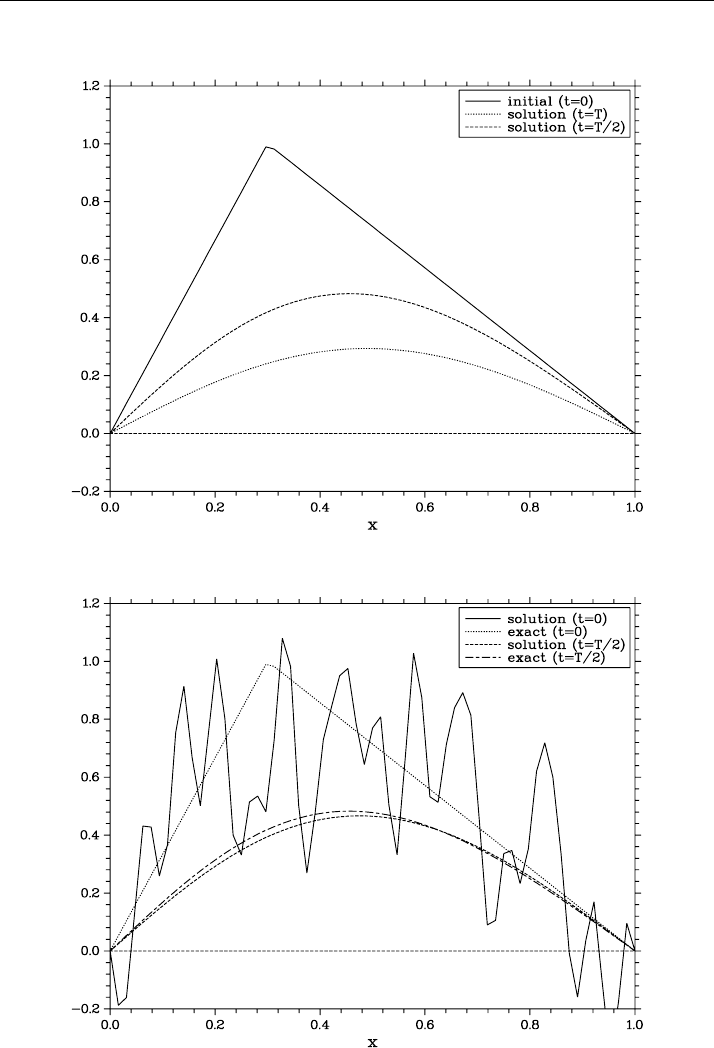
We solved a model problem whose input data were taken equal to the difference solu-
tion of the direct problem (l = 1, t = 0.1) with the initial condition
u
0
(x) =
x/0.3, 0 < x < 0.3,
(1 − x)/0.7, 0.3 < x < 1.
The computations were performed on a uniform grid with h = 1/64, τ = 1/640. The
results obtained by solving the direct problem are shown in Figure 7.1.
The effect due to inaccuracies was modeled by perturbing the input data (solution
of the direct problem at the time t = T ):
˜u(x, T ) = u(x, T ) + 2δ
σ(x) −
1
2
, x ∈ ω.
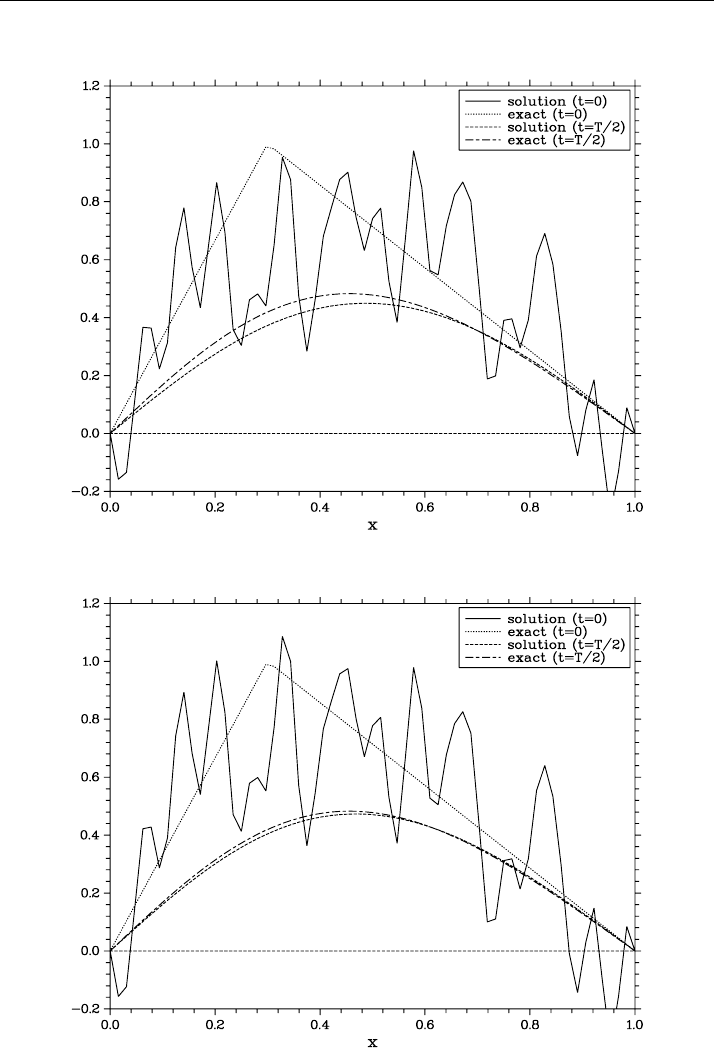
Here, σ(x) is a random function normally distributed over the interval [0, 1]. Fig-
ure 7.2 shows the exact and approximate solutions of the inverse problem at two char-
acteristic times, t = T and t = T/2, for δ = 0.005. Similar data obtained with a
greater (δ = 0.015) and lower (δ = 0.0025) inaccuracy are shown respectively in
Figures 7.3 and 7.4.
The data presented show that the solution reconstruction accuracy essentially de-
pends on the time. The end-time solution is reconstructed inaccurately, and the con-
vergence related with decreased input-data inaccuracy is indistinctly observed. A more
favorable situation is observed at t = T /2. It is by this time, as it was shown previ-
ously in the theoretical consideration of the problem, that the rate of convergence of
the approximations to the exact solution attains its highest.
Section 7.1 Non-local perturbation of initial conditions 261
Figure 7.1 Mesh solution of the direct problem
Figure 7.2 Solution of the inverse problem obtained with δ = 0.005
262 Chapter 7 Evolutionary inverse problems
Figure 7.3 Solution of the inverse problem obtained with δ = 0.01
Figure 7.4 Solution of the inverse problem obtained with δ = 0.0025

Section 7.2 Regularized difference schemes 263
7.2 Regularized difference schemes
An important class of solution methods for ill-posed evolutionary problems is related
with some perturbation applied to the initial equation. In the generalized inverse
method, such a perturbation can be applied immediately to the initial differential prob-
lem.
In a more natural approach, no auxiliary differential problem is considered; instead,
this approach uses a perturbation applied to the difference problem. In this way, regu-
larized difference schemes can be constructed.
7.2.1 Regularization principle for difference schemes
The regularization principle for difference schemes is presently recognized as a guid-
ing principle in improvement of difference schemes. For general two- and three-layer
schemes, recipes aimed at improving the quality of the difference schemes (their sta-
bility, accuracy and efficiency) can be formulated. Using this principle, one can ex-
amine stability and convergence of a broad class of difference schemes for boundary
value mathematical physics problems and develop solution algorithms for difference
problems.
Traditionally, the regularization principle is widely used to develop stable difference
schemes for well-posed problems involving partial differential equations. The same
uniform methodological base is used to construct difference schemes for conditionally
well-posed non-stationary mathematical physics problems. Weakly perturbing prob-
lem operators, one can exert control over the growth of the solution norm on passage
from one to the next time layer.
Absolutely stable difference schemes can be constructed, with the help of the regu-
larization principle, in the following manner:
1. For a given initial problem we construct some simplest difference scheme
(generating difference scheme) that does not possesses the required properties;
i. e., a scheme conditionally stable or even absolutely unstable.
2. We write the difference scheme in the standard (canonical) form for which
stability conditions are known.
3. The properties of the difference scheme (its stability) can be improved by per-
turbing the operators in the difference scheme.
Thus, the regularization principle for a difference scheme is based on using already
known results concerning conditional stability. Such criteria are given by the general
stability theory for difference schemes. From the latter standpoint, we can consider the
regularization principle as a means enabling an efficient use of general results yielded
by the stability theory for difference schemes. The latter can be achieved by writing
difference schemes in rather a general canonical form and by formulation of easy-to-
check stability criteria.

264 Chapter 7 Evolutionary inverse problems
To illustrate the considerable potential the regularization principle offers in the real-
ization of difference schemes, we will use this general approach to construct absolutely
stable schemes for direct mathematical physics problems. As a model problem, below
we consider the first boundary value problem for the parabolic equation. As a generat-
ing function, consider a conditionally stable explicit scheme. For an absolutely stable
scheme to be obtained, we perturb the operators in the explicit difference scheme. We
separately consider the variants with additively (standardly) and multiplicative (non-
standardly) perturbed operators of the generating difference scheme.
Consider a two-dimensional problem in the rectangle
={x | x = (x
1
, x
2
), 0 < x
α
< l
α
,α= 1, 2}.
In , we seek the solution of the parabolic equation
∂u
∂t
−
2
α=1
∂
∂x
α
k(x)
∂u
∂x
α
= 0, x ∈ , 0 < t < T , (7.77)
supplemented with the simplest homogeneous boundary conditions of the first kind:
u(x, t) = 0, x ∈ ∂, 0 < t < T . (7.78)
Also, an initial condition is given:
u(x, 0) = u
0
(x), x ∈ . (7.79)
We assume that the coefficient in (7.77) is sufficiently smooth and k(x) ≥ κ, κ>0,
x ∈ .
We put into correspondence to the differential problem (7.77)–(7.79) a differential-
difference problem by performing discretization over space. We assume for simplicity
that a grid with step sizes h
α
, α = 1, 2, uniform along each of the directions, is
introduced in the domain . As usually, ω is the set of internal nodes.
On the set of mesh functions y(x) such that y(x) = 0, x = ω, we define, by the
relation
y =−
2
α=1
(a
α
y
¯x
α
)
x
α
, (7.80)
a difference operator , putting, for instance,
a
1
(x) = k(x
1
− 0.5h
1
, x
2
), a
2
(x) = k(x
1
, x
2
− 0.5h
2
).
In the Hilbert space H = L
2
(ω), we introduce the scalar product and the norm by the
relations
(y,w) =
x∈ω
y(x)w(x)h
1
h
2
, y=
(y, y).

Section 7.2 Regularized difference schemes 265
In H ,wehave =
∗
≥ mE, m > 0. We pass from (7.77)–(7.79) to the differential-
operator equation
dy
dt
+ y = 0, 0 < t < T (7.81)
atagiven
y(0) = u
0
, x ∈ ω. (7.82)
Now, we are going to construct absolutely stable two-layer difference schemes for
problem (7.81), (7.82) around the regularization principle.
In compliance with the regularization principle, we first choose some difference
scheme to start from. As such generating a scheme, we can consider the simplest
explicit scheme
y
n+1
− y
n
τ
+ y
n
= 0, n = 0, 1,...,N
0
− 1, (7.83)
y
0
= u
0
, x ∈ ω, (7.84)
where N
0
τ = T .
We write the difference scheme (7.83), (7.84) in the canonical form for two-layer
operator-difference schemes
B
y
n+1
− y
n
τ
+ Ay
n
= 0, t
n
∈ ω
τ
(7.85)
with the operators
B = E, A = .
By Theorem 4.2, the condition
B ≥
τ
2
A, t ∈ ω
τ
(7.86)
is a condition necessary and sufficient for the scheme (7.84), (7.85) to be stable in H
A
or, in other words, for the estimate
y
n+1
A
≤u
0
A
, t ∈ ω
τ
to hold.
With the inequality ≤E taken into account, we would like to obtain, from
the necessary and sufficient stability conditions (7.86), the following constraints on the
time step size in the explicit scheme (7.83), (7.84):
τ ≤
2
.
In the case under consideration, =O(|h|
2
), where |h|
2
= h
2
1
+ h
2
2
, and for the
maximum admissible step size we have τ
0
= O(|h|
2
).