
Samarskii A.A., Vabishchevich P.N. Numerical Methods for Solving Inverse Problems of Mathematical Physics
Подождите немного. Документ загружается.


286 Chapter 7 Evolutionary inverse problems
C(N2-1) = 5.D0
*
ALPHA / (H2
**
4) + 0.5D0 / TAU
D(N2-1) = 0.D0
A(N2) = 0.D0
B(N2) = 0.D0
C(N2) = 1.D0
F(N2) = 0.D0
C
C SOLUTION OF THE DIFFERENCE PROBLEM
C
ITASK2 = 1
CALL PROG5 ( N2, A, B, C, D, E, F, YY, ITASK2 )
DOJ=1,N2
Y2(I,J) = YY(J)
END DO
END DO
C
C ADDITIVE AVERAGING
C
DOI=1,N1
DOJ=1,N2
Y(I,J) = 0.5D0
*
(Y1(I,J) + Y2(I,J))
END DO
END DO
END DO
DOI=1,N1
DOJ=1,N2
U(I,J) = Y(I,J)
END DO
END DO
C
C DIRECT PROBLEM
C
DOK=2,M
C
C SWEEP OVER X1
C
DOJ=2,N2-1
C
C COEFFICIENTS IN THE DIFFERENCE SCHEME FOR THE DIRECT PROBLEM
C
B(1) = 0.D0
C(1) = 1.D0
F(1) = 0.D0
A(N1) = 0.D0
C(N1) = 1.D0
F(N1) = 0.D0
DOI=2,N1-1
A(I) = 1.D0 / (H1
*
H1)
B(I) = 1.D0 / (H1
*
H1)
C(I) = A(I) + B(I) + 0.5D0 / TAU
F(I) = 0.5D0
*
Y(I,J) / TAU
END DO
C
C SOLUTION OF THE DIFFERENCE PROBLEM
C
ITASK1 = 1
CALL PROG3 ( N1, A, C, B, F, YY, ITASK1 )

Section 7.2 Regularized difference schemes 287
DOI=1,N1
Y1(I,J) = YY(I)
END DO
END DO
C
C SWEEP OVER X2
C
DOI=2,N1-1
C
C COEFFICIENTS IN THE DIFFERENCE SCHEME FOR THE DIRECT PROBLEM
C
B(1) = 0.D0
C(1) = 1.D0
F(1) = 0.D0
A(N2) = 0.D0
C(N2) = 1.D0
F(N2) = 0.D0
DOJ=2,N2-1
A(J) = 1.D0 / (H2
*
H2)
B(J) = 1.D0 / (H2
*
H2)
C(J) = A(J) + B(J) + 0.5D0 / TAU
F(J) = 0.5D0
*
Y(I,J) / TAU
END DO
C
C SOLUTION OF THE DIFFERENCE PROBLEM
C
ITASK1 = 1
CALL PROG3 ( N2, A, C, B, F, YY, ITASK1 )
DOJ=1,N2
Y2(I,J) = YY(J)
END DO
END DO
C
C ADDITIVE AVERAGING
C
DOI=1,N1
DOJ=1,N2
Y(I,J) = 0.5D0
*
(Y1(I,J) + Y2(I,J))
END DO
END DO
END DO
C
C CRITERION FOR THE EXIT FROM THE ITERATIVE PROCESS
C
SUM = 0.D0
DOI=2,N1-1
DOJ=2,N2-1
SUM = SUM + (Y(I,J) - UTD(I,J))
**
2
*
H1
*
H2
END DO
END DO
SL2 = DSQRT(SUM)
C
IF ( IT.EQ.1 ) THEN
IND=0
IF ( SL2.LT.DELTA ) THEN
IND=1

288 Chapter 7 Evolutionary inverse problems
Q = 1.D0/Q
END IF
ALPHA = ALPHA
*
Q
GO TO 100
ELSE
ALPHA = ALPHA
*
Q
IF ( IND.EQ.0 .AND. SL2.GT.DELTA ) GO TO 100
IF ( IND.EQ.1 .AND. SL2.LT.DELTA ) GO TO 100
END IF
C
C SOLUTION
C
WRITE ( 01,
*
) ((UTD(I,J),I=1,N1), J=1,N2)
WRITE ( 01,
*
) ((U(I,J),I=1,N1), J=1,N2)
CLOSE (01)
STOP
END
DOUBLE PRECISION FUNCTION AU ( X1, X2 )
IMPLICIT REAL
*
8 ( A-H, O-Z )
C
C INITIAL CONDITION
C
AU = 0.D0
IF ((X1-0.6D0)
**
2 + (X2-0.6D0)
**
2.LE.0.04D0) AU = 1.D0
C
RETURN
END
7.2.6 Computational experiments
The data presented below were obtained on a uniform grid with h
1
= 0.01, h
2
= 0.01
for the problem in the unit square. As input data, the solution of the direct problem
at the time T = 0.025 was taken, the time step size being τ = 0.00025. In the
direct problem, the initial condition, taken as the exact end-time solution of the inverse
problem, is given in the form
u
0
(x, 0) =
1,(x
1
− 0.6)
2
+ (x
2
− 0.6)
2
≤ 0.04,
0,(x
1
− 0.6)
2
+ (x
2
− 0.6)
2
> 0.04.
The end-time solution of the direct problem (the exact initial condition for the di-
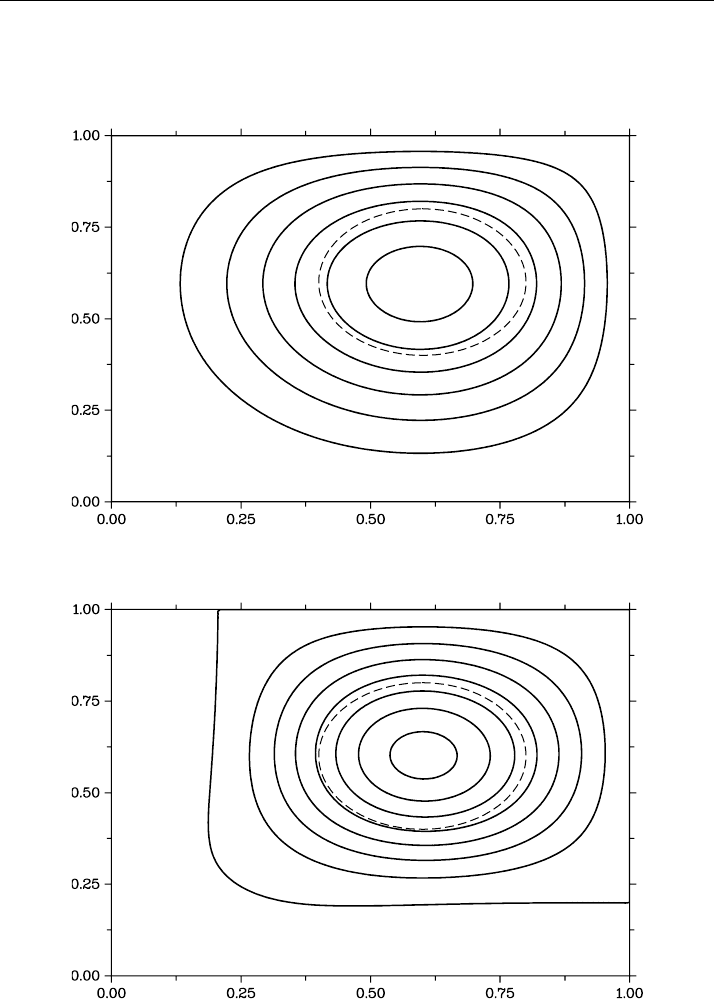
rect problem) is shown in Figure 7.5. Here, contour lines obtained with u = 0.05 are
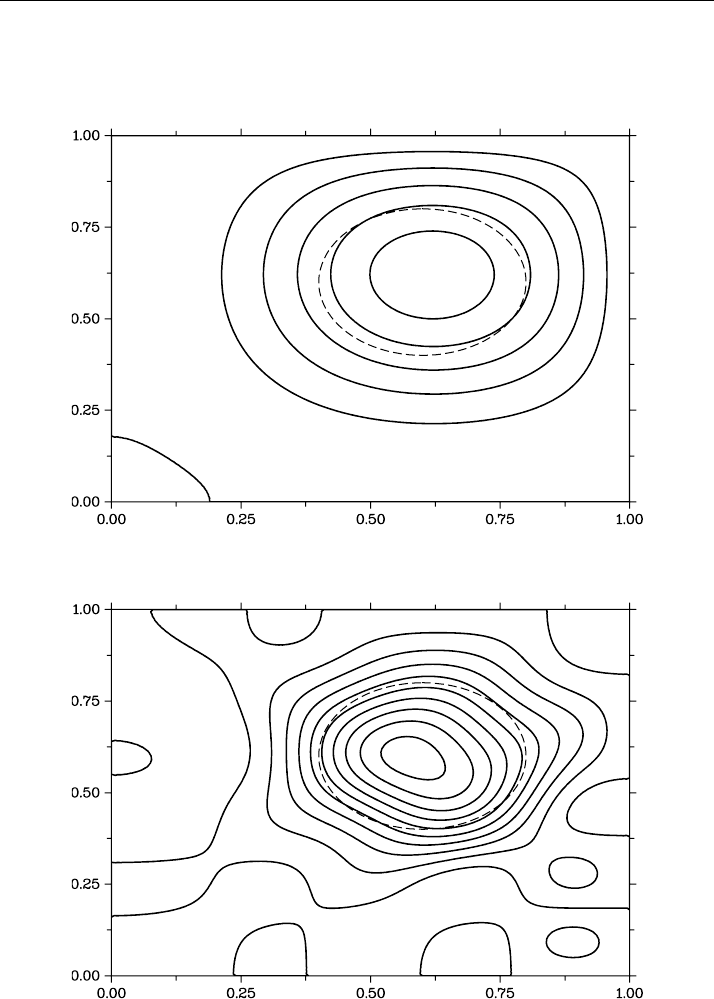
shown. Figure 7.6 shows the solution of the inverse problem obtained with δ = 0.01
(here, u = 0.1). Since, in the present example, a discontinuous function is recon-
structed, one cannot expect that a very good accuracy can be achieved. The effect due
to the inaccuracy level can be traced considering Figures 7.7 and 7.8.
Section 7.2 Regularized difference schemes 289
Figure 7.5 Solution of the direct problem at t = T
Figure 7.6 Solution of the inverse problem obtained with δ = 0.01
290 Chapter 7 Evolutionary inverse problems
Figure 7.7 Solution of the inverse problem obtained with δ = 0.02
Figure 7.8 Solution of the inverse problem obtained with δ = 0.005

Section 7.3 Iterative solution of retrospective problems 291
7.3 Iterative solution of retrospective problems
Key features of algorithms intended for the approximate solution of inverted-time
problems by iteration methods with refinement of initial conditions are outlined. A
model problem for the two-dimensional non-stationary parabolic equation is consid-
ered.
7.3.1 Statement of the problem
In solving inverse problems for mathematical physics equations, gradient iteration
methods are applied to the variational formulation of the problem. Below, we consider
a simplest iteration method for the approximate solution of the retrospective inverse
problem for the second-order parabolic equation. For this inverse problem, the ini-
tial condition is refined iteratively, which requires solving, at each iteration step, an
ordinary boundary value problem for the parabolic equation.
Based on the general theory of iteration solution methods for operator equations,
sufficient conditions for convergence of the iterative process can be established, and
the iteration parameters are chosen. In such problems, the operator of transition to the
next approximation makes it possible to identify the approximate solution in a desired
class of smoothness.
As a model problem, consider a two-dimensional problem in the rectangle
={x | x = (x
1
, x
2
), 0 < x
β
< l
β
,β= 1, 2}.
In the domain , we seek the solution of the parabolic equation
∂u
∂t
−
2
β=1
∂
∂x
β
k(x)
∂u
∂x
β
= 0, x ∈ , 0 < t < T , (7.159)
supplemented with the simplest first-kind homogeneous boundary conditions:
u(x, t) = 0, x ∈ ∂, 0 < t < T . (7.160)
In the inverse problem, instead of setting the zero-time solution (the solution at t = 0),
the end-time solution is specified:
u(x, T ) = ϕ(x), x ∈ . (7.161)
Such an inverse problem is a well-posed one, for instance, in the classes of bounded
solutions.

292 Chapter 7 Evolutionary inverse problems
7.3.2 Difference problem
Performing discretization over space, we put into correspondence to the differential
problem (7.159)–(7.161) some differential-difference problem. For simplicity, we as-
sume that a grid uniform along either direction with steps h
β
, β = 1, 2 is introduced
in the domain , and let ω be the set of internal nodes.
On the set of mesh functions y(x) such that y(x) = 0, x ∈ ω, we define the
difference operator :
y =−
2
β=1
(a
β
y
¯x
β
)
x
β
(7.162)
where, for instance,
a
1
(x) = k(x
1
− 0.5h
1
, x
2
), a
2
(x) = k(x
1
, x
2
− 0.5h
2
).
In the mesh Hilbert space H , we introduce the scalar product and the norm:
(y,w) =
x∈ω
y(x)w(x)h
1
h
2
, y=(y, y)
1/2
.
In H ,wehave =
∗
> 0. We pass from (7.159)–(7.161) to the differential-operator
equation
dy
dt
+ y = 0, x ∈ ω, 0 < t < T (7.163)
with some given
y(T ) = ϕ, x ∈ ω. (7.164)
Previously, possible ways in constructing regularizing algorithms for the approxi-
mate solution of problem (7.163), (7.164) based on using perturbed equations or per-
turbed initial conditions were discussed. In this chapter, the inverse problem (7.163),
(7.164) will be solved by iteration methods.
7.3.3 Iterative refinement of the initial condition
Here, we are going to employ methods in which, at each iteration step, the emerging
well-posed problems are solved using standard two-layer difference schemes.
Suppose that, instead of the inverse problem (7.163), (7.164), we treat the direct
problem for equation (7.163), in which, instead of (7.164), we use the initial condition
y(0) = v, x ∈ ω. (7.165)
We denote by y
n
the difference solution at the time t
n
= nτ , where τ>0 is the time
step size, so that N
0
τ = T . In the ordinary two-layer weighted scheme the passage to

Section 7.3 Iterative solution of retrospective problems 293
the next time layer in problem (7.163), (7.165) is to be made in accordance with
y
n+1
− y
n
τ
+ (σ y
n+1
+ (1 − σ)y
n
) = 0,
n = 0, 1,...,N
0
− 1,
(7.166)
y
0
= v, x ∈ ω. (7.167)
As it is well known, the weighted scheme (7.166), (7.167) is absolutely stable if
σ ≥ 1/2, and there holds the following estimate of stability:
y
n+1
≤y
n
≤···≤y
0
=v,
n = 0, 1,...,N
0
− 1.
(7.168)
Thereby, the solution norm decreases with time.
To approximately solve the inverse problem (7.163), (7.164), we use a simplest
iterative process based on successive refinement of the initial condition and on solving
at each iteration step the direct problem. Let us formulate the problem in the operator
form.
From (7.166) and (7.167), for the given y
0
at the end time we obtain
y
N
0
= S
N
v, (7.169)
where S is the operator of transition from one time layer to the next time layer:
S = (E + στ)
−1
(E + (σ − 1)τ ). (7.170)
In view of (7.163), (7.164), and (7.169), the approximate solution of the inverse
problem can be put into correspondence to the solution of the following difference
operator equation:
Av = ϕ, x ∈ ω, A = S
N
. (7.171)
Since the operator is a self-adjoint operator, the transition operator S and the
operator A in (7.171) are also self-adjoint operators. The difference equation (7.171)
can be solved uniquely if, for instance, the operator A is a positive operator. In turn,
the latter condition is satisfied if the transition operator S is a positive operator. Taking
into account the representation (7.170), we obtain that S > 0 in the case of
σ ≥ 1. (7.172)
Condition (7.172) imposed on the weight of scheme (7.166), (7.167) is a more strin-
gent condition than the ordinary stability condition. In the case of interest, under the
constraints (7.172) for the operator A defined by (7.171) we have:
0 < A = A
∗
< E. (7.173)

294 Chapter 7 Evolutionary inverse problems
Equation (7.171), (7.173) can be solved using the explicit two-layer iteration
method; this method can be written as
v
k+1
− v
k
s
k+1
+ Av
k
= ϕ. (7.174)
Here, s
k+1
are iteration parameters. We denote the difference solution obtained with
the initial condition v
k
as y
(k)
.
The iteration method under consideration implies the following organization of cal-
culations in the approximate solution of the retrospective inverse problem (7.159),
(7.160).
First, with the given v
k
, we solve the direct problem, using, for determining y
(k)
N
0
, the
difference scheme
y
(k)
n+1
− y
(k)
n
τ
+ (σ y
(k)
n+1
+ (1 − σ)y
(k)
n
) = 0,
n = 0, 1,...,N
0
− 1,
(7.175)
y
(k)
0
= v
k
, x ∈ ω. (7.176)
Then, with the found end-time solution of the direct problem, we use formula
(7.174) to refine the initial condition:
v
k+1
= v
k
− s
k+1
(y
(k)
N
0
− ϕ). (7.177)
As it follows from the general theory of iterative solution methods, the rate of con-
vergence in method (7.174), used to solve equation (7.171), is defined by the energy
equivalence constants γ
β
,β= 1, 2:
γ
1
E ≤ A ≤ γ
2
E,γ
1
> 0. (7.178)
Regarding (7.173), we can put γ
2
= 1. The positive constant γ
1
, close to zero, depends
on the grid.
In the notation used, in the stationary iteration method (s
k
= s
0
= const) the condi-
tions for convergence in (7.174) have the form s
0
≤ 2. For the optimal constant value
of the iteration parameter we have: s
0
≈ 1. For the convergence to be improved, it
makes sense to use variation-type iteration methods. In the iteration method of mini-
mal discrepancies, for the iteration parameters we have:
s
k+1
=
(Ar
k
, r
k
)
(Ar
k
, Ar
k
)
, r
k
= Av
k
− ϕ.
Here, at each iteration step we minimize the discrepancy norm which implies the fol-
lowing estimate:
r
k+1
< r
k
< ···< r
0
.

Section 7.3 Iterative solution of retrospective problems 295
In the more general implicit iteration method, instead of (7.174) we have:
B
v
k+1
− v
k
s
k+1
+ Av
k
= ϕ, (7.179)
where B = B
∗
> 0. In the method of minimal corrections, iteration parameters can
be calculated by the formulas
s
k+1
=
(Aw
k
,w
k
)
(B
−1
Aw
k
, Aw
k
)
,w
k
= B
−1
r
k
.
Here, to be minimized at each iteration step is the correction w
k+1
which implies the
estimate
w
k+1
< w
k
< ···< w
0
.
In a similar manner, more rapidly converging three-layer variational iteration methods
can be considered.
Note the following specific features in the choice of B in solving ill-posed problems.
In ordinary iteration methods the operator B is to be chosen so that just to raise the
rate of convergence in the method. In solving ill-posed problem, the iterative process
is to be terminated on attainment of a discrepancy value defined by the input-data
inaccuracy. Of importance for us is not only the rate with which the iterative process
converges on the descending portion of the characteristic curve but also the class of
smoothness in which this iterative process converges and the norm with which the
required discrepancy level can be achieved. A key specific feature of the approximate
solution of ill-posed problems by iteration methods consists in that the approximate
solution can be identified in the desired class of smoothness using a proper choice
of B.
7.3.4 Program
The iteration method under consideration is based on refinement of the initial condition
for the solution of a well-examined direct problem. For the implicit difference schemes
(7.175), (7.176) to be realized, we have to solve at each time step two-dimensional
difference elliptic problems. To this end, we use iteration methods (embedded iterative
process).
Program PROBLEM12
C PROBLEM12 - PROBLEM WITH INVERTED TIME
C TWO-DIMENSIONAL PROBLEM
C ITERATIVE REFINEMENT OF THE INITIAL CONDITION
C
IMPLICIT REAL
*
8 ( A-H, O-Z )
PARAMETER ( DELTA = 0.01D0, N1 = 51, N2 = 51, M = 101 )
DIMENSION A(17
*
N1
*
N2), X1(N1), X2(N2)
COMMON / SB5 / IDEFAULT(4)